Numbers 13:33

Hebrew (Westminster Leningrad Codex) Numbers 13:33 appears in the Hebrew Old Testament. The text above is from the Westminster Leningrad Codex. Each word links to its Strong’s number, a concise gloss, and parsing drawn from the Open Scriptures Hebrew Bible morphology. Click any word for its full Brown-Driver-Briggs (BDB) entry.
Download image
Cite this verse

Numbers 13:33 (World English Bible). Public Domain. Lemma interlinear Bible study tool, https://lemma.gebible.app/v/numbers/13/33.

Show BibTeX & RIS
BibTeX
RIS
English Translation
There we saw the Nephilim, the sons of Anak, who come of the Nephilim: and we were in our own sight as grasshoppers, and so we were in their sight.
World English Bible · Public Domain
Download a study sheet

One document with this verse’s original text, its word-by-word gloss line, the meaning frame, cross-references with their text, attributed commentary, and full source and license credits — printable, and it pastes into notes with its structure intact.

This verse Autodidact and up

Study sheet (.html) Plain text (.txt)

A passage Seminary Student

Up to 50 verses in one chapter. A passage sheet keeps up to 6 commentary sources and 12 cross-references per verse, in the order this page ranks them, and says so on the sheet whenever that leaves anything out. Ask for a single verse and you get the Autodidact verse sheet above.

Everything on this page stays free to read, with no account — the sheet is a download of what is already on screen, not access to it.

Want to remove ads? Support Godless Engineer
Compare translations 3

The same verse in 3 English versions, stacked beneath the original-language interlinear above. Click any original word for its lexicon entry.

Each is an independent rendering of the whole verse — the interlinear is not word-aligned to these translations.

Highlighted words mark where these versions differ — a whole-verse word diff, not a word-by-word alignment.

  • World English Bible Public Domain
    There we saw the Nephilim, the sons of Anak, who come of the Nephilim: and we were in our own sight as grasshoppers, and so we were in their sight.
  • King James Version Public Domain
    And there we saw the giants, the sons of Anak, which come of the giants: and we were in our own sight as grasshoppers, and so we were in their sight.
  • unfoldingWord Literal Text CC BY-SA 4.0
    and there we saw the Nephils (the sons of Anak from the Nephils), and we were in our eyes like the grasshoppers, and thus we were in their eyes.”

unfoldingWord Literal Text — © unfoldingWord, licensed CC BY-SA 4.0. Word-aligned USFM3 via Door43 (git.door43.org/unfoldingWord/en_ult).

Versions to compare (up to 4)

3 of 4 selected

Show all 18 translations

Every available English version of this verse, each an independent rendering of the whole verse.

  • World English Bible Public Domain
    There we saw the Nephilim, the sons of Anak, who come of the Nephilim: and we were in our own sight as grasshoppers, and so we were in their sight.
  • Berean Standard Bible Public Domain
    We even saw the Nephilim there—the descendants of Anak that come from the Nephilim! We seemed like grasshoppers in our own sight, and we must have seemed the same to them!”
  • Majority Standard Bible Public Domain
    We even saw the Nephilim there—the descendants of Anak that come from the Nephilim! We seemed like grasshoppers in our own sight, and we must have seemed the same to them!”
  • King James Version Public Domain
    And there we saw the giants, the sons of Anak, which come of the giants: and we were in our own sight as grasshoppers, and so we were in their sight.
  • American Standard Version (1901) Public Domain
    And there we saw the Nephilim, the sons of Anak, who come of the Nephilim: and we were in our own sight as grasshoppers, and so we were in their sight.
  • Revised Version (1885) Public Domain
    And there we saw the Nephilim, the sons of Anak, which come of the Nephilim: and we were in our own sight as grasshoppers, and so we were in their sight.
  • Geneva Bible (1599) Public Domain
    So they brought vp an euill report of the land which they had searched for the children of Israel, saying, The lande which we haue gone through to search it out, is a land that eateth vp the inhabitants thereof: for all the people that we sawe in it, are men of great stature.
  • Douay-Rheims (1899) Public Domain
    And they spoke ill of the land, which they had viewed, before the children of Israel, saying: The land which we have viewed, devoureth its inhabitants: the people, that we beheld, are of a tall stature.
  • Young's Literal Translation Public Domain
    and there we saw the Nephilim, sons of Anak, of the Nephilim; and we are in our own eyes as grasshoppers; and so we were in their eyes.'
  • Literal Standard Version CC BY-SA 4.0
    and there we saw the giants, sons of Anak, of the giants; and we are as grasshoppers in our own eyes—and so we were in their eyes.”
  • Unlocked Literal Bible CC BY-SA 4.0
    There we saw giants, descendants of Anak, people who came from giants. In our own sight we were like grasshoppers in comparison with them, and this is what we were in their sight, too.”
  • unfoldingWord Literal Text CC BY-SA 4.0
    and there we saw the Nephils (the sons of Anak from the Nephils), and we were in our eyes like the grasshoppers, and thus we were in their eyes.”
  • Darby Bible Public Domain
    and there have we seen giants -- the sons of Anak are of the giants -- and we were in our sight as grasshoppers, and so we were also in their sight.
  • World Messianic Bible Public Domain
    There we saw the Nephilim, the sons of Anak, who come from the Nephilim. We were in our own sight as grasshoppers, and so we were in their sight.”
  • Webster's Bible Public Domain
    And there we saw the giants, the sons of Anak, who come of the giants: and we were in our own sight as grasshoppers, and so we were in their sight.
  • Free Bible Version CC BY-SA 4.0
    We even saw giants there—people descended from Anak the giant! Compared to them we looked like grasshoppers, and we must have looked like that to them too!”
  • Bible in Basic English Public Domain
    There we saw those great men, the sons of Anak, offspring of the Nephilim: and we seemed to ourselves no more than insects, and so we seemed to them.
  • JPS Tanakh (1917) Public Domain
    And there we saw the Nephilim, the sons of Anak, who come of the Nephilim; and we were in our own sight as grasshoppers, and so we were in their sight.'

Literal Standard Version (2020), Covenant Press — licensed CC BY-SA 4.0. Text via the HelloAO Bible API (eBible.org). Unlocked Literal Bible (unfoldingWord) — licensed CC BY-SA 4.0. Text via the HelloAO Bible API (eBible.org). unfoldingWord Literal Text — © unfoldingWord, licensed CC BY-SA 4.0. Word-aligned USFM3 via Door43 (git.door43.org/unfoldingWord/en_ult). Free Bible Version, Dr. Jonathan Gallagher — licensed CC BY-SA 4.0. Text via the HelloAO Bible API (eBible.org).

Word by word

More ways to search: Search by grammar → Find every occurrence → Compare this word →

Practice this passage: Drill this verse → Learn its vocabulary →

הַנְּפִילִ֛ים
nᵉphîyl
H5303
“the · giants”
Particle, Definite Article + Noun, Common, Masculine, Plural, Absolute
Part of Speech
Particle + Noun
Type
Common
Gender
Masculine
Number
Plural
State
Absolute
Full BDB Definition

Origin: from H5307

TWOT: 1393a

giants, the Nephilim
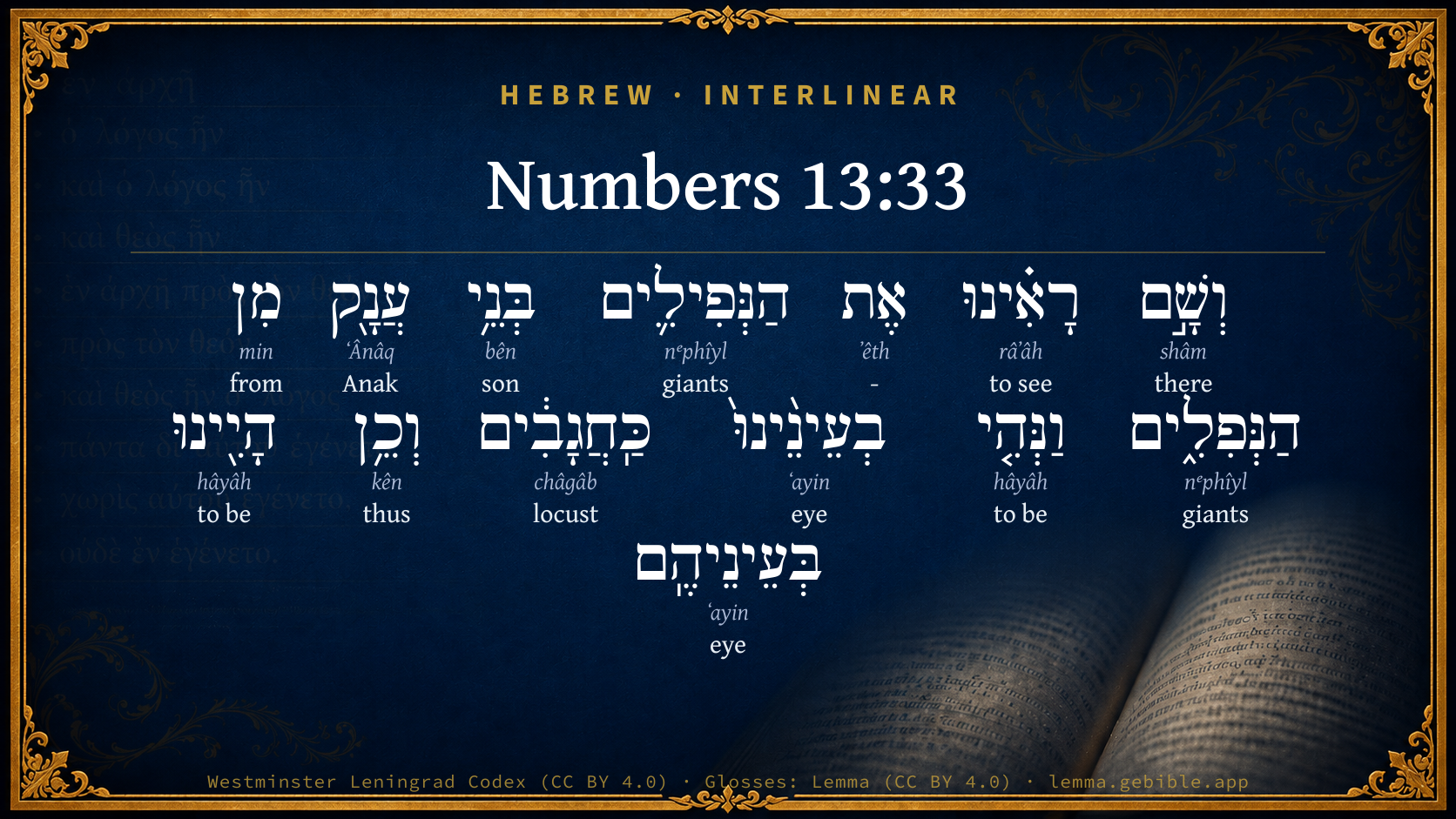
  1. וְשָׁ֣ם shâm H8033 “and · there” Conjunction + Adverb
  2. רָאִ֗ינוּ râʼâh H7200 “to see” Verb, Qal, Perfect, 1st Person, Common, Plural
  3. אֶת ʼêth H853 “-” Particle, Direct Object
  4. בְּנֵ֥י bên H1121 “sons of” Noun, Common, Masculine, Plural, Construct
  5. עֲנָ֖ק ʻÂnâq H6061 “Anak” Noun, Proper
  6. מִן min H4480 “from” Preposition
  7. הַנְּפִלִ֑ים nᵉphîyl H5303 “the · giants” Particle, Definite Article + Noun, Common, Masculine, Plural, Absolute
  8. וַנְּהִ֤י hâyâh H1961 “and · to be” Conjunction + Verb, Qal, Sequential Imperfect, 1st Person, Common, Plural
  9. בְעֵינֵ֨ינוּ֙ ʻayin H5869 “in/at · eyes · our” Preposition + Noun, Common, Both, Dual, Construct + Suffix, Personal, 1st Person, Common, Plural
  10. כַּֽחֲגָבִ֔ים châgâb H2284 “like/as · locusts” Preposition + Noun, Common, Masculine, Plural, Absolute
  11. וְכֵ֥ן kên H3651 “and · thus” Conjunction + Particle, Demonstrative
  12. הָיִ֖ינוּ hâyâh H1961 “to be” Verb, Qal, Perfect, 1st Person, Common, Plural
  13. בְּעֵינֵיהֶֽם ʻayin H5869 “in/at · eyes · their” Preposition + Noun, Common, Both, Dual, Construct + Suffix, Personal, 3rd Person, Masculine, Plural

About this verse

These counts appear in no published source. They are computed here, from the morphology-tagged text and Lemma’s own curated glosses. What Lemma adds →

14
words
11
distinct lemmas
Pentateuch
section

Notable vocabulary

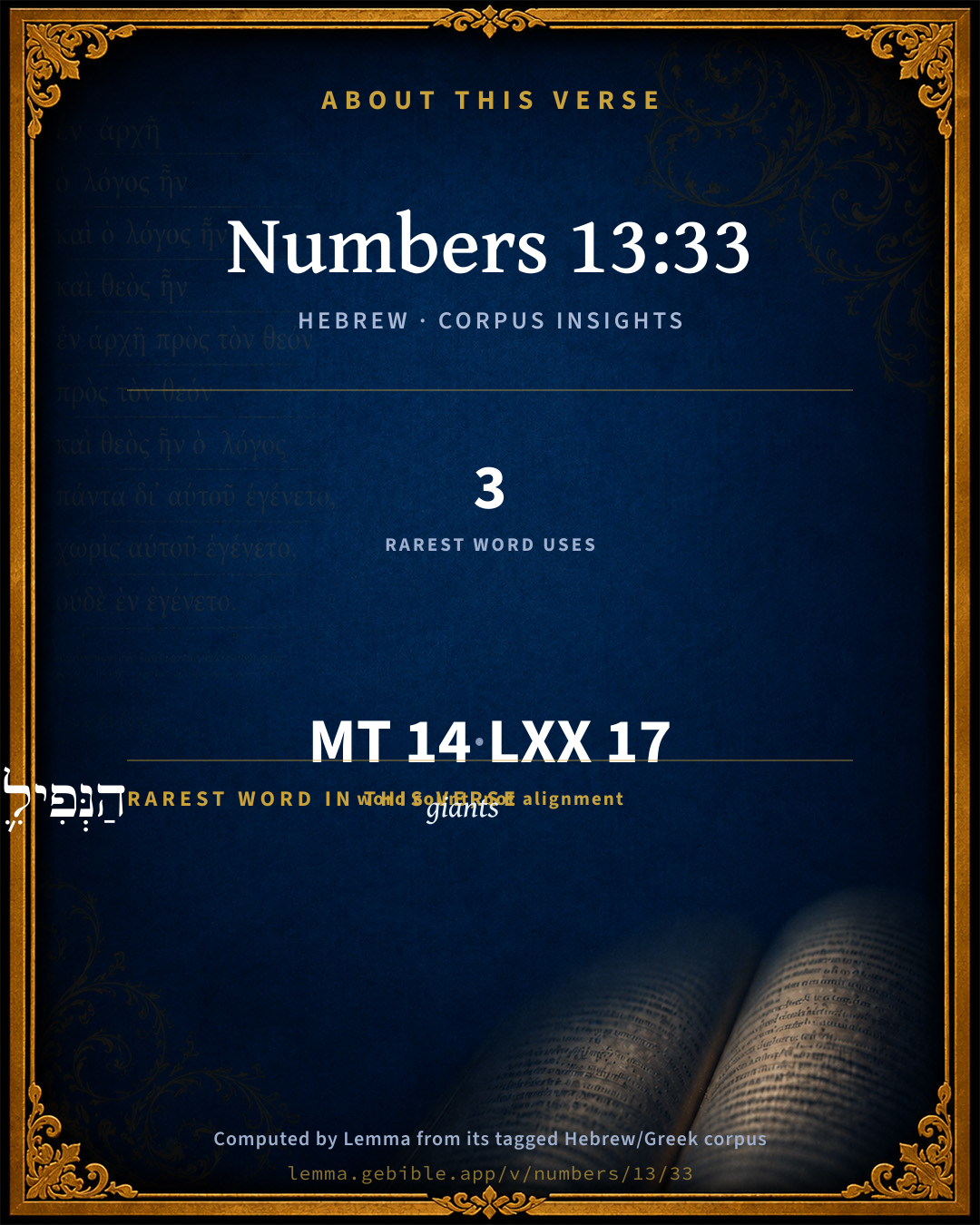
The rarest word here is הַנְּפִילִ֛ים giants H5303 — appearing just 3 times in the whole Hebrew Bible.

Shared distinctive vocabulary

הַנְּפִילִ֛ים giants H5303 occurs in 2 verses of the Hebrew Bible. Also found in:

Grammatical profile

  • 3 verbs
  • 7 nouns
  • 1 preposition
  • 1 adverb
  • 2 particles

Verb forms

  • רָאִ֗ינוּ Qal · Perfect
  • וַנְּהִ֤י Qal · Sequential Imperfect
  • הָיִ֖ינוּ Qal · Perfect

Repetition

Words recur within this verse — often emphatic in Hebrew:

  • הַנְּפִילִ֛ים giants H5303 ×2
  • וַנְּהִ֤י to be H1961 ×2
  • בְעֵינֵ֨ינוּ֙ eye H5869 ×2

Hebrew & Septuagint length

In English translation the verse runs 30 words from the Hebrew and 48 from the Septuagint (LXX English) — the Septuagint runs noticeably longer here. See the side-by-side →

A rough comparison of the two English renderings, which tokenize alike — not a word-level alignment.

Word counts can differ between the Hebrew and the Greek without any difference in meaning — e.g. the Hebrew direct-object marker אֵת has no separate Greek word, and Greek often adds the article ὁ.

In the original languages it is 14 Hebrew tokens and 17 Greek tokens — but the two are counted differently (Hebrew bundles its prefixes and suffixes into one token; the Greek is in lemma form), so that isn’t a like-for-like length.

Cross-references

11

Topical passages linked to Numbers 13:33 in the Treasury of Scripture Knowledge — connected by theme and wording, ordered by reader-vote popularity; previews shown in the World English Bible.

  • Deuteronomy 1:28 Where are we going up? our brothers have made our heart to melt, saying, The people are greater and taller than we; the cities are great and fortified up to the sky; and moreover we have seen the sons of the Anakim there.
  • Genesis 6:4 The Nephilim were in the earth in those days, and also after that, when God's sons came to men's daughters. They bore children to them: the same were the mighty men who were of old, men of renown.
  • Isaiah 40:22 [It is] he who sits above the circle of the earth, and the inhabitants of it are as grasshoppers; who stretches out the heavens as a curtain, and spreads them out as a tent to dwell in;
  • Deuteronomy 9:2 a people great and tall, the sons of the Anakim, whom you know, and of whom you have heard say, Who can stand before the sons of Anak?
  • 1 Samuel 17:42 When the Philistine looked about, and saw David, he disdained him; for he was but a youth, and ruddy, and withal of a fair face.
  • Deuteronomy 3:11 (For only Og king of Bashan remained of the remnant of the Rephaim; behold, his bedstead was a bedstead of iron; isn't it in Rabbah of the children of Ammon? nine cubits was the length of it, and four cubits the breadth of it, after the cubit of a man.)
  • Numbers 13:22 They went up by the South, and came to Hebron; and Ahiman, Sheshai, and Talmai, the children of Anak, were there. (Now Hebron was built seven years before Zoan in Egypt.)
  • Deuteronomy 2:10 (The Emim lived therein before, a people great, and many, and tall, as the Anakim:
  • 1 Samuel 17:4–7 There went out a champion out of the camp of the Philistines, named Goliath, of Gath, whose height was six cubits and a span.
  • 1 Chronicles 11:23 He killed an Egyptian, a man of great stature, five cubits high; and in the Egyptian's hand was a spear like a weaver's beam; and he went down to him with a staff, and plucked the spear out of the Egyptian's hand, and killed him with his own spear.
  • 2 Samuel 21:20–22 There was again war at Gath, where was a man of great stature, who had on every hand six fingers, and on every foot six toes, four and twenty in number; and he also was born to the giant.

Cross-references courtesy of OpenBible.info (CC BY 4.0).

Hebrew and Greek witnesses Masoretic Hebrew ↔ Greek Septuagint

The same verse in the two great witnesses to the Old Testament, shown verse-for-verse.

Here the Septuagint runs noticeably longer than the Hebrew — LXX2012 (modern English Septuagint) 48 words vs World English Bible 30. A rough length comparison of the two English translations, not a word-level alignment — read both below.

These are two independent witnesses, not word-aligned to each other, and the Septuagint is shown in lemma (dictionary) form.

Hebrew Numbers 13:33 Masoretic · Westminster Leningrad Codex

וְשָׁ֣ם רָאִ֗ינוּ אֶת הַנְּפִילִ֛ים בְּנֵ֥י עֲנָ֖ק מִן הַנְּפִלִ֑ים וַנְּהִ֤י בְעֵינֵ֨ינוּ֙ כַּֽחֲגָבִ֔ים וְכֵ֥ן הָיִ֖ינוּ בְּעֵינֵיהֶֽם

There we saw the Nephilim, the sons of Anak, who come of the Nephilim: and we were in our own sight as grasshoppers, and so we were in their sight.

World English Bible · Public Domain

Greek LXX Numbers 13:33 Septuagint · lemma form

καί ἐκεῖ ὁράω ὁ γίγας καί εἰμί ἐνώπιον αὐτός ὡσεί ἀκρίς ἀλλά καί οὕτως εἰμί ἐνώπιον αὐτός

And they brought a horror of that land which they surveyed upon the children of Israel, saying, The land which we passed by to survey it, is a land that eats up its inhabitants; and all the people whom we saw in it are men of extraordinary stature.

LXX2012 (modern English Septuagint) · Public Domain

On this verse, The Cambridge Bible for Schools and Colleges discusses the Septuagint’s reading. Read the note in Commentary ↓

Hebrew: Westminster Leningrad Codex (CC BY 4.0). Greek: Septuagint (public domain); English from LXX2012 (modern English Septuagint) (Public Domain). How the Septuagint differs from the Hebrew →

Targum (Aramaic paraphrase)

2

The Targum is the ancient Jewish Aramaic paraphrase of the Hebrew Scriptures — an interpretive translation, not the Hebrew text itself. Onkelos (literal) and Pseudo-Jonathan (expansive) render the Torah, and Jonathan the Prophets. Coverage is partial: where no permissively-licensed English translation exists for a verse, only the Aramaic is shown. This is verse-level text, not a word-by-word alignment to the Hebrew.

  1. Targum Onkelos Torah (Genesis–Deuteronomy)
    וְתַמָן חֲזֵינָא יָת גִבָּרַיָא בְּנֵי עֲנָק מִן גִבָּרַיָא וַהֲוֵינָא בְעֵינֵי נַפְשָׁנָא כְּקַמְצִין וְכֵן הֲוֵינָא בְּעֵינֵיהוֹן

    (no public-domain English translation for this verse)

    Targum Onkelos — Aramaic: “Onkelos Genesis” (public domain); “Onkelos Exodus” (public domain); “Onkelos Leviticus” (public domain); “Onkelos Numbers” (public domain); “Onkelos Deuteronomy” (public domain). English: “Sefaria Community Translation” (CC0 1.0 (public-domain dedication)); “J.W. Etheridge. The Targums of Onkelos and Jonathan Ben Uzziel on the Pentateuch. London: Longmans, Green, 1862” (public domain). Text via Sefaria.

  2. Targum Pseudo-Jonathan Torah (Genesis–Deuteronomy)
    וְתַמָן חָמֵינָא יַת גַבְרַיָא בְנֵי עֲנָק מִגְנִיסַת גוּבְרַיָא וַהֲוֵינָא דַמְיַין בְּאַנְפֵּי נַפְשָׁתָנָא הֵי כְקַמְצָן וְהֵיכְדֵין הֲוֵינָא דַמְיַין בְּאַנְפֵּי נַפְשֵׁיהוֹן

    And there we saw the giants, the sons of Anak, of the race of the giants; and we appeared to ourselves to be as locusts; and so we appeared to them.

    Targum Pseudo-Jonathan — Aramaic: “Targum Jonathan on Genesis” (public domain); “Targum Jonathan on Exodus” (public domain); “Targum Jonathan on Leviticus” (public domain); “Targum Jonathan on Numbers” (public domain); “Targum Jonathan on Deuteronomy” (public domain). English: “The Targum of Jonathan ben Uzziel, trans. J. W. Etheridge, London, 1862” (public domain). Text via Sefaria.

Commentary

Notes on Numbers 13:33 from classic Christian and Jewish commentators (each source and its license shown beneath its notes). The classic Christian expositions comment on the surrounding passage and are grouped to its opening verse, so a note may address several verses; the Jewish commentaries on the Tanakh (Rashi and others) are per-verse, so they appear only where the commentator wrote on this verse.

Lemma curates 59 commentaries, every one of them public domain or Creative Commons licensed, each selected and text-cleaned for this edition rather than reprinted as found. About our sources →

Joseph Benson's Commentary

Num 13:33. We were in our own sight as grasshoppers — Thus their fear magnified these sons of Anak above measure, so that in comparison of them they thought themselves as weak and contemptible as insignificant insects. And so we were in their sight — An hyperbole, signifying that the Anakims looked down upon them with the utmost contempt.

Joseph Benson's Commentary on the Old and New Testaments (1811–1818) — public domain. Text from a community e-Sword module.

Tyndale Open Study Notes

Tyndale Open Resources

13:33 giants: See study note on Gen 6:4.

Tyndale Open Study Notes — © Tyndale Open Resources, licensed CC BY-SA 4.0. Text via the HelloAO Bible API.

Geneva Bible (1599)

Geneva Bible translators

The giants were so cruel, that they spoiled and killed one another and those that came to them.

Geneva Bible (1599) marginal notes — public domain. Text via Bolls.life.

Jamieson, Fausset & Brown

Robert Jamieson, A. R. Fausset & David Brown

there we saw the giants, the sons of Anak--The name is derived from the son of Arba, a great man among the Arabians (Jos 15:14), who probably obtained his appellation from wearing a splendid collar or chain round his neck, as the word imports. The epithet "giant" evidently refers here to stature. (See on Gen 6:4). And it is probable the Anakims were a distinguished family, or perhaps a select body of warriors, chosen for their extraordinary size.

we were in our own sight as grasshoppers--a strong Orientalism, by which the treacherous spies gave an exaggerated report of the physical strength of the people of Canaan.

Next: Numbers Chapter 14

Jamieson, Fausset & Brown — Commentary Critical and Explanatory on the Whole Bible (1871) — public domain (CC PDM 1.0). Text via the HelloAO Bible API.

Adam Clarke's Commentary

Verse 33. There we saw the giants] נפלים nephilim. It is evident that they had seen a robust, sturdy, warlike race of men, and of great stature; for the asserted fact is not denied by Joshua or Caleb.

Tales of gigantic men are frequent in all countries, but they are generally of such as have lived in times very remote from those in which such tales are told. That there have been giants at different times, in various parts of the earth, there can be no doubt; but that there ever was a nation of men twelve and fourteen feet high, we cannot, should not believe. Goliath appears to have been at least nine feet high: this was very extraordinary. I knew three young men in my own neighbourhood, two of them brothers, each of whom was upwards of seven feet, the third was eight feet six inches, and these men were very well proportioned. Others I have seen of extraordinary stature, but they were generally disproportioned, especially in their limbs. These instances serve to prove the possibility of cases of this nature. The Anakim might appear to the Israelites as a very tall, robust nation; and in comparison of the latter it is very probable that they were so, as it is very likely that the growth of the Israelites had been greatly cramped with their long and severe servitude in Egypt. And this may in some measure account for their alarm. On this subject the reader is desired to turn back to the note on See Clarke on Ge 6:4.

CANAAN was a type of the kingdom of God; the wilderness through which the Israelites passed, of the difficulties and trials to be met with in the present world. The promise of the kingdom of God is given to every believer; but how many are discouraged by the difficulties in the way! A slothful heart sees dangers, lions, and giants, every where; and therefore refuses to proceed in the heavenly path. Many of the spies contribute to this by the bad reports they bring of the heavenly country. Certain preachers allow "that the land is good, that it flows with milk and honey," and go so far as to show some of its fruits; but they discourage the people by stating the impossibility of overcoming their enemies. "Sin," say they, "cannot be destroyed in this life - it will always dwell in you - the Anakim cannot be conquered - we are but as grasshoppers against the Anakim," c., &c. Here and there a Joshua and a Caleb, trusting alone in the power of God, armed with faith in the infinite efficacy of that blood which cleanses from all unrighteousness, boldly stand forth and say: "Their defence is departed from them, and the Lord is with us let us go up at once and possess the land, for we are well able to overcome." We can do all things through Christ strengthening us: he will purify us unto himself, and give us that rest from sin here which his death has procured and his word has promised. Reader, canst thou not take God at his word? He has never yet failed thee. Surely then thou hast no reason to doubt. Thou hast never yet tried him to the uttermost. Thou knowest not how far and how fully he can save. Do not be dispirited: the sons of Anak shall fall before thee, if thou meet them in the name of the LORD of HOSTS.

Adam Clarke's Commentary on the Bible (1810–1826) — public domain. Text from a community e-Sword/MySword module.

Ellicott's Commentary for English Readers

(33) And there we saw the giants.—The same word, nephilim. is here used which is found in Gen_6:4. See Note in loc.

A Bible Commentary for English Readers, edited by Charles John Ellicott (1878–1897) — public domain. Text from a community e-Sword module.

The Cambridge Bible for Schools and Colleges

gen. ed. J. J. S. Perowne

33. the Nephilim] Mentioned in Gen_6:4 in connexion with the ‘sons of Elohim,’ but not elsewhere in the O.T. The derivation and meaning of the name are obscure. Aq. [Note: q. The Greek translation by Aquila.] ἐπιπίπτοντες (‘falling upon’) connects it with nâphal (נפל) ‘to fall,’ as though the name described the violence with which the Nephilim fell upon their enemies. But LXX. γίγαντες (‘giants’) and Sym. βιαῖοι (‘violent’) are only paraphrases. The name appears to be a relic of primitive mythology, but little more can be said of it. If the Nephilim were thought of as superhuman or semi-divine beings, the spies may have used the name to heighten the effect of their description of the ‘sons of Anak’ (Num_13:28).

the sons of Anak, which come of the Nephilim] the sons of Anak are of the Nephilim. A separate sentence, which is absent from the LXX. , and was probably added to the Heb. text by a late scribe. He may have meant that the sons of Anak were either descended from, or of the number of, the Nephilim.

as grasshoppers] Very small and helpless. Oriental speech abounds in similes from nature. Insignificance and weakness are also expressed by ‘flocks of kids’ (1Ki_20:27), ‘a dead dog’ and ‘a flea’ (1Sa_24:14), ‘a partridge’ (1Sa_26:20).

The Cambridge Bible for Schools and Colleges (gen. ed. J. J. S. Perowne; Cambridge University Press, 1878–1918) — public domain. Text from a community e-Sword module.

Haydock's Catholic Bible Commentary

Spoke ill, &c. These men, who, by their misrepresentations of the land of promise, discouraged the Israelites from attempting the conquest of it, were a figure of worldlings, who, by decrying or misrepresenting true devotion, discourage Christians from seeking in earnest and acquiring so great a good, and thereby securing to themselves a happy eternity. (Challoner) --- Devoureth, by being exposed to continual wars from the Arabs, Idumeans, and from its own inhabitants, the monsters of the race of Enac. With this God had threatened the Hebrews, if they proved rebellious, Leviticus xxvi. 38. See Ezechiel xxxvi. 13. (Calmet)

George Leo Haydock (1774–1849), Haydock's Catholic Family Bible and Commentary, 1859 edition — public domain. Excludes Psalms (Douay-Rheims chapter numbering differs from Protestant) and Deuterocanonical books (Catholic canon only).

Matthew Poole's English Annotations

i.e. Small and contemptible.

Matthew Poole's English Annotations on the Holy Bible (1683–1685) — public domain. Text from a community e-Sword/MySword module.

Whedon's Commentary on the Bible

Daniel D. Whedon

33. The giants — Hebrew and R.V. Nephilim, like the antediluvian tyrants who corrupted the earth. Gen_6:4, note. The application of the term Nephilim to a race of antediluvians does not prove that the giants found by the spies were the lineal descendants of these, nor does it justify the extraordinary hypothesis of the “higher criticism,” that the writer of Gen_6:4, knew nothing of a flood in which all mankind except one family were destroyed. A resemblance in stature is all that is requisite.

Sons of Anak — See Num_13:22, note.

As grasshoppers — An Oriental exaggeration of the disparity of stature between the Hebrews and some of the Canaanites. The fears of the unbelieving spies magnified their foes. Probably the average stature of the Israelites did not fall much below that of the Canaanites.

In our own sight… in their sight — The contempt of their enemies is consequent upon their own cowardly self-depreciation. They who do not respect themselves will fail to gain the respect of others. “The man who counts himself as a grasshopper when he is set to represent a great cause is apt to be counted as a grasshopper by those who oppose him. Peculiarly is this the truth with one of God’s representatives. He who realizes that he stands for One into whose hands all power in heaven and earth is given need have no fear of giants or of the sons of giants. His sufficiency is of God; and in this sufficiency he can move forward unflinching-ly, until the giants who oppose him find themselves as grasshoppers in the path of his progress.” — H. Clay Trumbull.

Daniel D. Whedon (gen. ed.), Commentary on the Old and New Testaments (1874–1909) — public domain. Text from a community e-Sword module.

The Pulpit Commentary

The giants, the sons of Anak, which come of the giants, qn yniB The Nephilim, Beni-Anak, of the Nephilim. The Septuagint has only tougantav . The Nephilim are, without doubt, the primaeval tyrants mentioned under that name in Gen_6:4. The renown of these sons of violence had come down from those dim ages, and the exaggerated fears of the spies saw them revived in the gigantic forms of the Beni-Anak. There is no certainty that the Nephilim had been giants, and no likelihood whatever that the Beni-Anak had any real connection with them. As grasshoppers. We have no means of judging of the actual size of these men, unless the height assigned to Goliath (six cubits and a span) be allowed to them. Probably men of this stature were quite exceptional even among the Anakim. The report of the spies was thoroughly false in effect, although founded on isolated facts.

The Pulpit Commentary (1880–1919), ed. H.D.M. Spence-Jones & Joseph S. Exell — public domain. Text from a community e-Sword module.

Rashi

Rabbi Shlomo Yitzchaki (Rashi)

הנפילים (lit., the fallen ones) — Anakim who were descendants of Shemchazai and Azael who fell from heaven in the generation of Enosh (cf. Targum Jonathan on Genesis 6:4 and Rashi on Niddah 61a s. v. בני אחיה).

וכן היינו בעיניהם AND SO WE MUST HAVE BEEN IN THEIR EYES — We heard them say one to another; “There are ants in the vineyards that look like human beings (Sotah 35a).

ענק — They were thus called because it seemed as if the sun was draped around their necks (מַעֲנִיקִים) because of their height (Sotah 34b).

Rashi on the Tanakh — English translations: “The Judaica Press complete Tanach with Rashi, translated by A. J. Rosenberg” (CC BY 4.0); “Pentateuch with Rashi's commentary by M. Rosenbaum and A.M. Silbermann, 1929-1934” (public domain); “The Metsudah Tanach series, Lakewood, N.J” (CC BY 4.0); and “The Book of Joshua, Metsudah Publications, 1997” (CC BY 4.0). Text via Sefaria.

Lesson kit

Teaching starters — assembled from the data on this page, not authored interpretation. Every prompt links to the verse data it draws on. Edit before teaching.

Numbers, in the Pentateuch, opens this verse with 14 words (11 distinct Hebrew lemmas). Its most distinctive word is nᵉphîyl (“giants”). The Greek Septuagint runs longer here. A historical commentator’s framing appears above. Read the whole chapter for the surrounding context.

Discussion questions

  1. What does “giants” (nᵉphîyl) contribute to the verse as a whole?
  2. Genesis 6:4 shares the word «giants» with this verse. How do the two illuminate each other?
  3. “giants” occurs 2× in this one verse. What is the effect of the repetition?
  4. Compared with the Hebrew, the Septuagint runs longer here. What questions does that raise?
  5. These translations render this verse differently. What is at stake in choosing one wording over another?
  6. The verb «רָאִ֗ינוּ» is Qal Perfect. How does its form color the action?
  7. Reading how Joseph Benson's Commentary and Tyndale Open Study Notes read this verse, where do the two commentators agree and where do they part?

Things to notice

Reading settings

Reading text

Shown beneath each verse's original-language words.

Old Testament
Old Testament edition

Read the OT as the Masoretic Hebrew (MT) or the Greek Septuagint (LXX).

English shown for the Greek Septuagint (in the Hebrew ↔ Greek comparison).

Comparing translations? Open the Compare panel on any verse page to stack up to four side by side.