

2 Corinthians 7:11
Greek (Tischendorf 8th ed.) 2 Corinthians 7:11 appears in the Greek New Testament. The text above is from the Tischendorf 8th edition. Each word links to its Strong’s number and a concise gloss. Click any word for its full Thayer’s Greek Lexicon entry.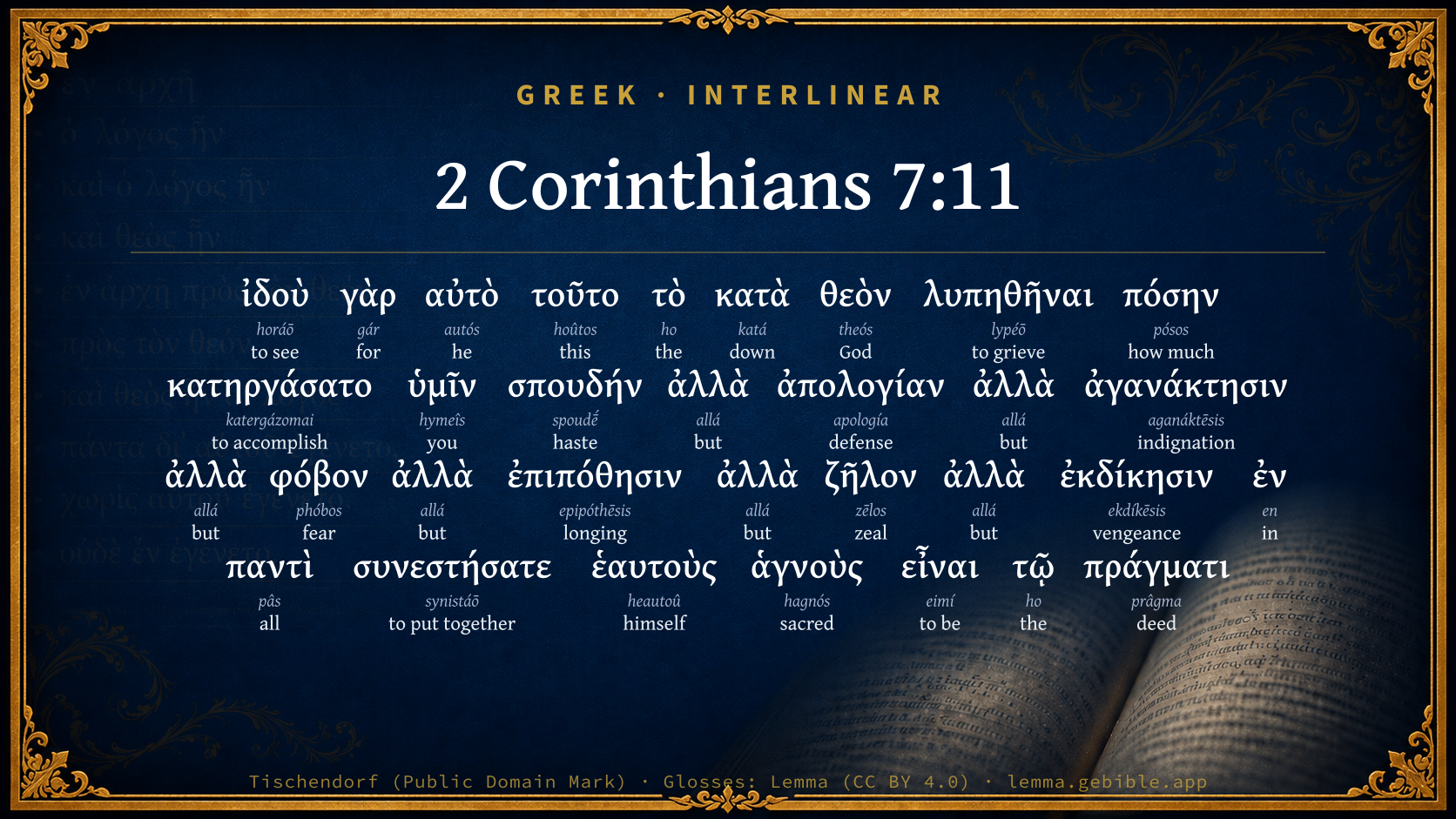
For behold, this same thing, that you were made sorry in a godly way, what earnest care it worked in you. Yes, what defense, indignation, fear, longing, zeal, and vengeance! In everything you demonstrated yourselves to be pure in the matter.
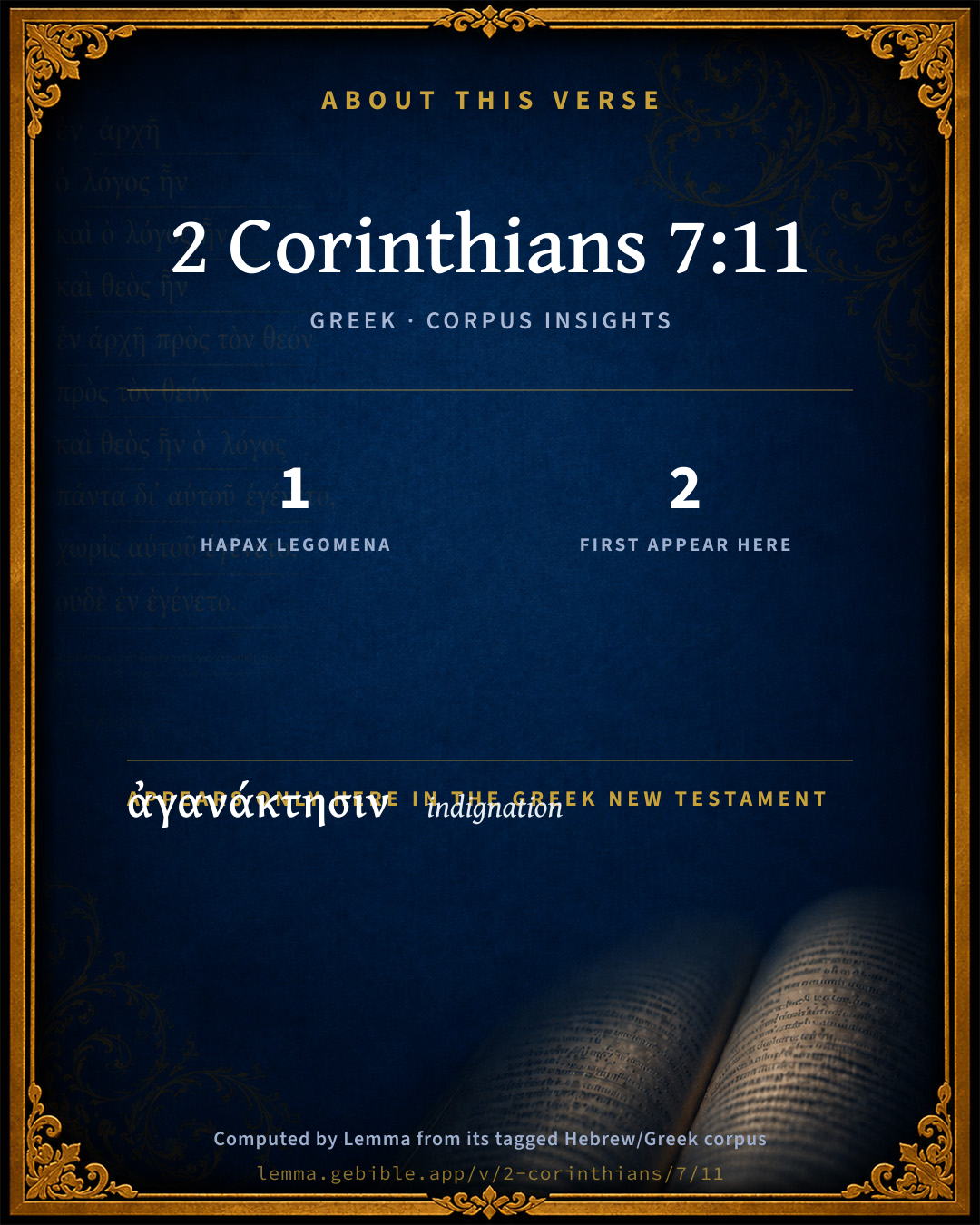
- 1 hapax legomenon — only here in the Greek New Testament
- 2 first appearances in the Greek New Testament
Download a study sheet
One document with this verse’s original text, its word-by-word gloss line, the meaning frame, cross-references with their text, attributed commentary, and full source and license credits — printable, and it pastes into notes with its structure intact.
This verse Autodidact and up
A passage Seminary Student
Up to 50 verses in one chapter. A passage sheet keeps up to 6 commentary sources and 12 cross-references per verse, in the order this page ranks them, and says so on the sheet whenever that leaves anything out. Ask for a single verse and you get the Autodidact verse sheet above.
Everything on this page stays free to read, with no account — the sheet is a download of what is already on screen, not access to it.
Compare translations 3
The same verse in 3 English versions, stacked beneath the original-language interlinear above. Click any original word for its lexicon entry.
Each is an independent rendering of the whole verse — the interlinear is not word-aligned to these translations.
Highlighted words mark where these versions differ — a whole-verse word diff, not a word-by-word alignment.
-
World English Bible Public Domain
For behold, this same thing, that you were made sorry in a godly way, what earnest care it worked in you. Yes, what defense, indignation, fear, longing, zeal, and vengeance! In everything you demonstrated yourselves to be pure in the matter.
-
King James Version Public Domain
For behold this selfsame thing, that ye sorrowed after a godly sort, what carefulness it wrought in you, yea, what clearing of yourselves, yea, what indignation, yea, what fear, yea, what vehement desire, yea, what zeal, yea, what revenge! In all things ye have approved yourselves to be clear in this matter.
-
unfoldingWord Literal Text CC BY-SA 4.0
For behold how much earnestness this same thing produced in you, to be made sorrowful with respect to God: what defense, what indignation, what fear, what longing, what zeal, what vindication! In everything you proved yourselves to be pure in this matter.
unfoldingWord Literal Text — © unfoldingWord, licensed CC BY-SA 4.0. Word-aligned USFM3 via Door43 (git.door43.org/unfoldingWord/en_ult).
Show all 19 translations
Every available English version of this verse, each an independent rendering of the whole verse.
-
World English Bible Public Domain
For behold, this same thing, that you were made sorry in a godly way, what earnest care it worked in you. Yes, what defense, indignation, fear, longing, zeal, and vengeance! In everything you demonstrated yourselves to be pure in the matter.
-
Berean Standard Bible Public Domain
Consider what this godly sorrow has produced in you: what earnestness, what eagerness to clear yourselves, what indignation, what alarm, what longing, what zeal, what vindication! In every way you have proved yourselves to be innocent in this matter.
-
Majority Standard Bible Public Domain
Consider what this godly sorrow of yours has produced in you: what earnestness, what eagerness to clear yourselves, what indignation, what alarm, what longing, what zeal, what vindication! In every way you have proved yourselves to be innocent in this matter.
-
King James Version Public Domain
For behold this selfsame thing, that ye sorrowed after a godly sort, what carefulness it wrought in you, yea, what clearing of yourselves, yea, what indignation, yea, what fear, yea, what vehement desire, yea, what zeal, yea, what revenge! In all things ye have approved yourselves to be clear in this matter.
-
American Standard Version (1901) Public Domain
For behold, this selfsame thing, that ye were made sorry after a godly sort, what earnest care it wrought in you, yea what clearing of yourselves, yea what indignation, yea what fear, yea what longing, yea what zeal, yea what avenging! In everything ye approved yourselves to be pure in the matter.
-
Revised Version (1885) Public Domain
For behold, this selfsame thing, that ye were made sorry after a godly sort, what earnest care it wrought in you, yea, what clearing of yourselves, yea, what indignation, yea, what fear, yea, what longing, yea, what zeal, yea, what avenging! In everything ye approved yourselves to be pure in the matter.
-
Geneva Bible (1599) Public Domain
For beholde, this thing that ye haue bene godly sory, what great care it hath wrought in you: yea, what clearing of yourselues: yea, what indignation: yea, what feare: yea, howe great desire: yea, what a zeale: yea, what reuenge: in all things ye haue shewed your selues, that ye are pure in this matter.
-
Douay-Rheims (1899) Public Domain
For behold this selfsame thing, that you were made sorrowful according to God, how great carefulness it worketh in you; yea defence, yea indignation, yea fear, yea desire, yea zeal, yea revenge: in all things you have shewed yourselves to be undefiled in the matter.
-
Young's Literal Translation Public Domain
for, lo, this same thing -- your being made sorry toward God -- how much diligence it doth work in you! but defence, but displeasure, but fear, but longing desire, but zeal, but revenge; in every thing ye did approve yourselves to be pure in the matter.
-
Literal Standard Version CC BY-SA 4.0
for behold, this same thing—your being made sorry toward God—how much diligence it works in you! But defense, but displeasure, but fear, but longing desire, but zeal, but revenge; in everything you approved yourselves to be pure in the matter.
-
Unlocked Literal Bible CC BY-SA 4.0
See what great determination this godly sorrow produced in you. How great was the determination in you to prove you were innocent. How great was your indignation, your fear, your longing, your zeal, and your desire to see that justice should be done! In everything you have proved yourselves to be innocent in this matter.
-
unfoldingWord Literal Text CC BY-SA 4.0
For behold how much earnestness this same thing produced in you, to be made sorrowful with respect to God: what defense, what indignation, what fear, what longing, what zeal, what vindication! In everything you proved yourselves to be pure in this matter.
-
Darby Bible Public Domain
For, behold, this same thing, your being grieved according to God, how much diligence it wrought in *you*, but [what] excusing [of yourselves], but [what] indignation, but [what] fear, but [what] ardent desire, but [what] zeal, but [what] vengeance: in every way ye have proved yourselves to be pure in the matter.
-
World Messianic Bible Public Domain
For behold, this same thing, that you were grieved in a godly way, what earnest care it worked in you. Yes, what defense, indignation, fear, longing, zeal, and vindication! In everything you demonstrated yourselves to be pure in the matter.
-
Webster's Bible Public Domain
For behold this very thing, that ye sorrowed after a godly sort, what carefulness it wrought in you, yea, what clearing of yourselves, yea, what indignation, yea, what fear, yea, what vehement desire, yea, what zeal, yea, what avenging! In all things ye have approved yourselves to be clear in this matter.
-
Free Bible Version CC BY-SA 4.0
See what happened to you when you had this very same experience of sorrow that God wants. Remember how enthusiastic you became, how keen you were to defend yourselves, how angry you were at what had happened, how seriously you took it, how you longed to do right, how concerned you were, how you wanted justice to be done. In all of this you showed that you were sincere in wanting to make things right.
-
Bible in Basic English Public Domain
For you see what care was produced in you by this very sorrow of yours before God, what clearing of yourselves, what wrath against sin, what fear, what desire, what serious purpose, what punishment. In everything you have made it clear that you are free from sin in this business.
-
Text-Critical English NT CC BY 4.0
Consider what earnestness this godly sorrow of yours has produced in you, what eagerness to clear yourselves, what indignation, what alarm, what longing, what zeal, what righting of wrong! In everything you have shown yourselves to be clear in the matter.
-
Tyndale New Testament (1534) Public Domain
Beholde what diligence this godly sorowe that ye toke hath wrought in you: yee it caused you to cleare youre selves. It caused indignacion it caused feare that caused desyre it caused a fervent mynde it caused punysshment. For in all thynges ye have shewed youreselues that ye were cleare in that matter.
Literal Standard Version (2020), Covenant Press — licensed CC BY-SA 4.0. Text via the HelloAO Bible API (eBible.org). Unlocked Literal Bible (unfoldingWord) — licensed CC BY-SA 4.0. Text via the HelloAO Bible API (eBible.org). unfoldingWord Literal Text — © unfoldingWord, licensed CC BY-SA 4.0. Word-aligned USFM3 via Door43 (git.door43.org/unfoldingWord/en_ult). Free Bible Version, Dr. Jonathan Gallagher — licensed CC BY-SA 4.0. Text via the HelloAO Bible API (eBible.org).
Word by word
More ways to search: Search by grammar → Find every occurrence → Compare this word →
Practice this passage: Drill this verse → Learn its vocabulary →
- Appears 1× in the Greek New Testament
- First appears here
- Part of Speech
- Noun
- Case
- Accusative
- Number
- Singular
- Gender
- Feminine
Full Thayer's Definition
- ἰδοὺ horáō G3708 “to see” Verb, Aorist, Middle, Imperative, 2nd person, Singular
- γὰρ gár G1063 “for” Conjunction
- αὐτὸ autós G846 “he” Personal pronoun, Nominative, Singular, Neuter
- τοῦτο hoûtos G3778 “this” Demonstrative pronoun, Nominative, Singular, Neuter
- τὸ ho G3588 “the” Article, Nominative, Singular, Neuter
- κατὰ katá G2596 “down” Preposition
- θεὸν theós G2316 “God” Noun, Accusative, Singular, Masculine
- λυπηθῆναι lypéō G3076 “to grieve” Verb, Aorist, Passive, Infinitive
- πόσην pósos G4214 “how much” Correlative/interrogative pronoun, Accusative, Singular, Feminine
- κατηργάσατο katergázomai G2716 “to accomplish” Verb, Aorist, Middle deponent, Indicative, 3rd person, Singular
- ὑμῖν hymeîs G5210 “you” Personal pronoun, 2nd person, Dative, Plural
- σπουδήν spoudḗ G4710 “haste” Noun, Accusative, Singular, Feminine
- ἀλλὰ allá G235 “but” Conjunction
- ἀπολογίαν apología G627 “defense” Noun, Accusative, Singular, Feminine
- ἀλλὰ allá G235 “but” Conjunction
- ἀγανάκτησιν aganáktēsis G24 “indignation” Noun, Accusative, Singular, Feminine
- ἀλλὰ allá G235 “but” Conjunction
- φόβον phóbos G5401 “fear” Noun, Accusative, Singular, Masculine
- ἀλλὰ allá G235 “but” Conjunction
- ἐπιπόθησιν epipóthēsis G1972 “longing” Noun, Accusative, Singular, Feminine
- ἀλλὰ allá G235 “but” Conjunction
- ζῆλον zēlos G2205 “zeal” Noun, Accusative, Singular, Masculine
- ἀλλὰ allá G235 “but” Conjunction
- ἐκδίκησιν ekdíkēsis G1557 “vengeance” Noun, Accusative, Singular, Feminine
- ἐν en G1722 “in” Preposition
- παντὶ pâs G3956 “all” Adjective, Dative, Singular, Neuter
- συνεστήσατε synistáō G4921 “to put together” Verb, Aorist, Active, Indicative, 2nd person, Plural
- ἑαυτοὺς heautoû G1438 “himself” Reflexive pronoun, 2nd person, Accusative, Plural, Masculine
- ἁγνοὺς hagnós G53 “sacred” Adjective, Accusative, Plural, Masculine
- εἶναι eimí G1510 “to be” Verb, Present, Active, Infinitive
- τῷ ho G3588 “the” Article, Dative, Singular, Neuter
- πράγματι prâgma G4229 “deed” Noun, Dative, Singular, Neuter
About this verse
These counts appear in no published source. They are computed here, from the morphology-tagged text and Lemma’s own curated glosses. What Lemma adds →
- 32
- words
- 26
- distinct lemmas
- Pauline Epistles
- section
Notable vocabulary
1 hapax legomenon — a word that appears only here in the entire Greek New Testament:
- ἀγανάκτησιν indignation G24
First appearance in Scripture
These words make their first canonical appearance in the Greek New Testament here:
Shared distinctive vocabulary
ἐπιπόθησιν longing G1972 occurs in 2 verses of the Greek New Testament. Also found in:
Cross-references
50Topical passages linked to 2 Corinthians 7:11 in the Treasury of Scripture Knowledge — connected by theme and wording, ordered by reader-vote popularity; previews shown in the World English Bible.
- Romans 14:18 For he who serves Christ in these things is acceptable to God and approved by men.
- 1 Timothy 5:21–22 I charge you in the sight of God, and Christ Jesus, and the chosen angels, that you observe these things without prejudice, doing nothing by partiality.
- 2 Timothy 2:15 Give diligence to present yourself approved by God, a workman who doesn't need to be ashamed, properly handling the Word of Truth.
- Psalms 2:11 Serve Yahweh with fear, And rejoice with trembling.
- Ephesians 5:11 Have no fellowship with the unfruitful works of darkness, but rather even reprove them.
- 1 Corinthians 5:13 But those who are outside, God judges. "Put away the wicked man from among yourselves."
- 2 Corinthians 7:7 and not by his coming only, but also by the comfort with which he was comforted in you, while he told us of your longing, your mourning, and your zeal for me; so that I rejoiced still more.
- Ephesians 4:26 "Be angry, and don't sin." Don't let the sun go down on your wrath,
- Hebrews 12:15–16 looking carefully lest there be any man who falls short of the grace of God; lest any root of bitterness springing up trouble you, and thereby the many be defiled;
- 1 Peter 2:2 as newborn babes, long for the pure milk of the Word, that you may grow thereby,
- Jude 1:23 and some save, snatching them out of the fire with fear, hating even the clothing stained by the flesh.
- Revelation 3:19 As many as I love, I reprove and chasten. Be zealous therefore, and repent.
- Psalms 35:13 But as for me, when they were sick, my clothing was sackcloth. I afflicted my soul with fasting. My prayer returned into my own bosom.
- Psalms 38:9 Lord, all my desire is before you. My groaning is not hidden from you.
- Psalms 42:1 As the deer pants for the water brooks, So my soul pants after you, God.
- Acts 17:16 Now while Paul waited for them at Athens, his spirit was provoked within him as he saw the city full of idols.
- Romans 11:20 True; by their unbelief they were broken off, and you stand by your faith. Don't be conceited, but fear;
- 1 Corinthians 5:2 You are puffed up, and didn't rather mourn, that he who had done this deed might be removed from among you.
- 1 Corinthians 12:25 that there should be no division in the body, but that the members should have the same care for one another.
- 2 Corinthians 2:6 Sufficient to such a one is this punishment which was inflicted by the many;
- 2 Corinthians 6:4 but in everything commending ourselves, as servants of God, in great endurance, in afflictions, in hardships, in distresses,
- 2 Corinthians 7:1 Having therefore these promises, beloved, let us cleanse ourselves from all defilement of flesh and spirit, perfecting holiness in the fear of God.
- 2 Corinthians 9:2 for I know your readiness, of which I boast on your behalf to them of Macedonia, that Achaia has been prepared for a year past. Your zeal has stirred up very many of them.
- 2 Corinthians 13:7 Now I pray to God that you do no evil; not that we may appear approved, but that you may do that which is honorable, though we are as reprobate.
- Philippians 2:12 So then, my beloved, even as you have always obeyed, not only in my presence, but now much more in my absence, work out your own salvation with fear and trembling.
- Titus 3:8 This saying is faithful, and concerning these things I desire that you affirm confidently, so that those who have believed God may be careful to maintain good works. These things are good and profitable to men;
- Hebrews 4:1 Let us fear therefore, lest perhaps a promise being left of entering into his rest, anyone of you should seem to have come short of it.
- 1 Peter 1:17 If you call on him as Father, who without respect of persons judges according to each man's work, pass the time of your living as strangers here in reverent fear:
- Genesis 44:6–7 He overtook them, and he spoke to them these words.
- 2 Samuel 12:5–7 David's anger was greatly kindled against the man, and he said to Nathan, "As Yahweh lives, the man who has done this is worthy to die!
- Nehemiah 5:6–13 I was very angry when I heard their cry and these words.
- Nehemiah 13:25 I contended with them, and cursed them, and struck certain of them, and plucked off their hair, and made them swear by God, [saying], You shall not give your daughters to their sons, nor take their daughters for your sons, or for yourselves.
- Psalms 69:9 For the zeal of your house consumes me. The reproaches of those who reproach you have fallen on me.
- Psalms 119:139 My zeal wears me out, Because my enemies ignore your words.
- Psalms 130:6 My soul longs for the Lord more than watchmen long for the morning; More than watchmen for the morning.
- Psalms 145:19 He will fulfill the desire of those who fear him. He also will hear their cry, and will save them.
- Proverbs 14:16 A wise man fears, and shuns evil, But the fool is hotheaded and reckless.
- Proverbs 28:14 Blessed is the man who always fears; But one who hardens his heart falls into trouble.
- Song of Solomon 8:6 Set me as a seal on your heart, As a seal on your arm; For love is strong as death. Jealousy is as cruel as Sheol; Its flashes are flashes of fire, A very flame of Yahweh.
- Isaiah 26:8 Yes, in the way of your judgments, Yahweh, have we waited for you; to your name, even to your memorial [name], is the desire of our soul.
- Isaiah 66:2 For all these things has my hand made, and [so] all these things came to be, says Yahweh: but to this man will I look, even to him who is poor and of a contrite spirit, and who trembles at my word.
- Jeremiah 31:18–20 I have surely heard Ephraim bemoaning himself [thus], You have chastised me, and I was chastised, as a calf unaccustomed [to the yoke]: turn you me, and I shall be turned; for you are Yahweh my God.
- Daniel 6:14 Then the king, when he heard these words, was sore displeased, and set his heart on Daniel to deliver him; and he labored until the going down of the sun to rescue him.
- Zechariah 12:10–14 I will pour on the house of David, and on the inhabitants of Jerusalem, the spirit of grace and of supplication; and they will look to me whom they have pierced; and they shall mourn for him, as one mourns for his only son, and will grieve bitterly for him, as one grieves for his firstborn.
- Matthew 5:29–30 If your right eye causes you to stumble, pluck it out and throw it away from you. For it is more profitable for you that one of your members should perish, than for your whole body to be cast into Gehenna.
- Mark 3:5 When he had looked around at them with anger, being grieved at the hardening of their hearts, he said to the man, "Stretch out your hand." He stretched it out, and his hand was restored as healthy as the other.
- Mark 9:43–48 If your hand causes you to stumble, cut it off. It is better for you to enter into life maimed, rather than having your two hands to go into Gehenna, into the unquenchable fire,
- John 2:17 His disciples remembered that it was written, "Zeal for your house will eat me up."
- Job 42:6 Therefore I abhor myself, And repent in dust and ashes."
- 2 Corinthians 7:9 I now rejoice, not that you were made sorry, but that you were made sorry to repentance. For you were made sorry in a godly way, that you might suffer loss by us in nothing.
Cross-references courtesy of OpenBible.info (CC BY 4.0).
Where the printed editions differ
1 variantPlaces in this verse where the major printed Greek editions disagree on the wording in a way that affects the translation — a comparison of editions, not a manuscript-by-manuscript collation. The editions are the modern critical texts (Nestlé-Aland 28/27, SBL, Westcott-Hort, Tregelles, Tyndale House) and the traditional texts behind the KJV (the Textus Receptus and the Byzantine/Majority text). It is not a claim about which reading is original.
-
Extra text
ὑμᾶς,
“by you”
In TRByz Not in NA28NA27TynSBLWHTregὑμᾶς, (humas) 'by you' is only in traditional manuscripts (TR+Byz)
Textual data: Translators Amalgamated Greek New Testament (STEPBible TAGNT) · CC BY 4.0.
Lesson kit
Teaching starters — assembled from the data on this page, not authored interpretation. Every prompt links to the verse data it draws on. Edit before teaching.
2 Corinthians, in the Pauline Epistles, opens this verse with 32 words (26 distinct Greek lemmas). Its most distinctive word is aganáktēsis (“indignation”). A historical commentator’s framing appears above. Read the whole chapter for the surrounding context.
Discussion questions
- How does “indignation” (aganáktēsis) shape what this verse is saying?
- 1 word here appears nowhere else in the Greek New Testament. Why might the author reach for such rare wording?
- 2 words make their first appearance in Scripture here. What does this debut establish?
- How does 2 Corinthians 7:7, which shares the word «longing», read alongside this verse?
- What does the repetition of “but” (6× in this one verse) do in this verse?
- These translations render this verse differently. What is at stake in choosing one wording over another?
- Compare how The Biblical Illustrator and Bengel's Gnomon read this verse. Where do they agree or differ?
Things to notice
- 1 word in this verse appears nowhere else in the Greek New Testament.
- 2 words make their first canonical appearance in Scripture here.
- These translations choose different wording for 40 words in this verse.
- “but” occurs 6× in this single verse.
- 26 distinct Greek lemmas span 32 words in this verse.
Commentary
Notes on 2 Corinthians 7:11 from classic Christian and Jewish commentators (each source and its license shown beneath its notes). The classic Christian expositions comment on the surrounding passage and are grouped to its opening verse, so a note may address several verses; the Jewish commentaries on the Tanakh (Rashi and others) are per-verse, so they appear only where the commentator wrote on this verse.
Lemma curates 59 commentaries, every one of them public domain or Creative Commons licensed, each selected and text-cleaned for this edition rather than reprinted as found. About our sources →
The Biblical Illustrator
Joseph S. Exell
The Biblical Illustrator, edited by Joseph S. Exell (c. 1880s–1900s) — public domain. Text from a community e-Sword module.
Bengel's Gnomon
Johann Albrecht Bengel
Bengel's Gnomon of the New Testament — English translation (T&T Clark, Edinburgh, 1860) — public domain. Text from a community e-Sword module.
Meyer's Critical & Exegetical Commentary
Heinrich August Wilhelm Meyer
Meyer — Critical and Exegetical Commentary on the New Testament — English translation by Peter Christie, edited by Frederick Crombie (T&T Clark, 1880) — public domain. Text from a community e-Sword module.
Expositor's Greek Testament
ed. W. Robertson Nicoll
The Expositor's Greek Testament, edited by W. Robertson Nicoll (1897–1910) — public domain. Text from a community e-Sword module.
Jamieson, Fausset & Brown
Robert Jamieson, A. R. Fausset & David Brown
Jamieson, Fausset & Brown — Commentary Critical and Explanatory on the Whole Bible (1871) — public domain (CC PDM 1.0). Text via the HelloAO Bible API.
Adam Clarke's Commentary
Adam Clarke's Commentary on the Bible (1810–1826) — public domain. Text from a community e-Sword/MySword module.
John Calvin's Commentaries
John Calvin's Commentaries (1540-1563) — public domain. Text from the Calvin Translation Society English edition (1840s-50s) via the Christian Classics Ethereal Library (ccel.org). Calvin's coverage is partial (roughly two-thirds of the Bible); uncommented books and verses are honest gaps, never fabricated. The 19th-century editor's footnotes and remarks are omitted so the notes are faithfully Calvin's own voice.
Ellicott's Commentary for English Readers
A Bible Commentary for English Readers, edited by Charles John Ellicott (1878–1897) — public domain. Text from a community e-Sword module.
The Cambridge Bible for Schools and Colleges
gen. ed. J. J. S. Perowne
The Cambridge Bible for Schools and Colleges (gen. ed. J. J. S. Perowne; Cambridge University Press, 1878–1918) — public domain. Text from a community e-Sword module.
John Gill's Exposition
John Gill's Exposition of the Whole Bible (1746–1763) — public domain (CC PDM 1.0). Text via the HelloAO Bible API.
Trapp's Complete Commentary
John Trapp
John Trapp, A Commentary or Exposition upon All the Books of the Old and New Testament (1647–1656) — public domain. Text from a community e-Sword module.
Albert Barnes' Notes on the Bible
Albert Barnes' Notes on the Bible (1834–1885) — public domain. Text from a community e-Sword/MySword module.
Matthew Poole's English Annotations
Matthew Poole's English Annotations on the Holy Bible (1683–1685) — public domain. Text from a community e-Sword/MySword module.
Whedon's Commentary on the Bible
Daniel D. Whedon
Daniel D. Whedon (gen. ed.), Commentary on the Old and New Testaments (1874–1909) — public domain. Text from a community e-Sword module.
The Pulpit Commentary
The Pulpit Commentary (1880–1919), ed. H.D.M. Spence-Jones & Joseph S. Exell — public domain. Text from a community e-Sword module.
John Wesley's Explanatory Notes
John Wesley, Explanatory Notes Upon the Whole Bible (1754–1765) — public domain. Text via the GEBible commentary corpus.
Burkitt's Expository Notes on the New Testament
William Burkitt
William Burkitt's Expository Notes on the New Testament (1700–1703) — public domain. Text from a community e-Sword module.
McGarvey & Pendleton's Commentaries
J. W. McGarvey
J. W. McGarvey (with Philip Y. Pendleton), Commentaries on the New Testament (The Fourfold Gospel, 1914; Acts; and the epistles) — public domain. Text from a community e-Sword/MySword module.
The People's New Testament
B. W. Johnson
B. W. Johnson's The People's New Testament with Notes (1889–1891) — public domain. Electronic text from the Christian Classics Ethereal Library (CCEL) ThML edition.
unfoldingWord translationNotes
Door43 World Missions Community
unfoldingWord translationNotes — © Distant Shores Media and the Door43 World Missions Community, licensed CC BY-SA 4.0. Source: git.door43.org/Door43/en_tn.
Cambridge Greek Testament for Schools and Colleges
Cambridge Greek Testament for Schools and Colleges (Cambridge University Press, 1896; 21 vols, various authors incl. Carr, Maclear, Plummer, Farrar, Lumby, Moule, M. R. James, Simcox) — public domain. Text from a community e-Sword module.
Alford’s Greek Testament
Henry Alford
Henry Alford, The Greek Testament (1849–1861) — public domain. Text from a community e-Sword module.
International Critical Commentary
International Critical Commentary — older volumes (1896–1929), various authors — public domain. Text from a community e-Sword module.
Vincent's Word Studies in the New Testament
Marvin R. Vincent
Marvin R. Vincent, Word Studies in the New Testament (1887–1900) — public domain. Text from a community e-Sword/MySword module.