
2 Corinthians 4:9

Greek (Tischendorf 8th ed.) 2 Corinthians 4:9 appears in the Greek New Testament. The text above is from the Tischendorf 8th edition. Each word links to its Strong’s number and a concise gloss. Click any word for its full Thayer’s Greek Lexicon entry.
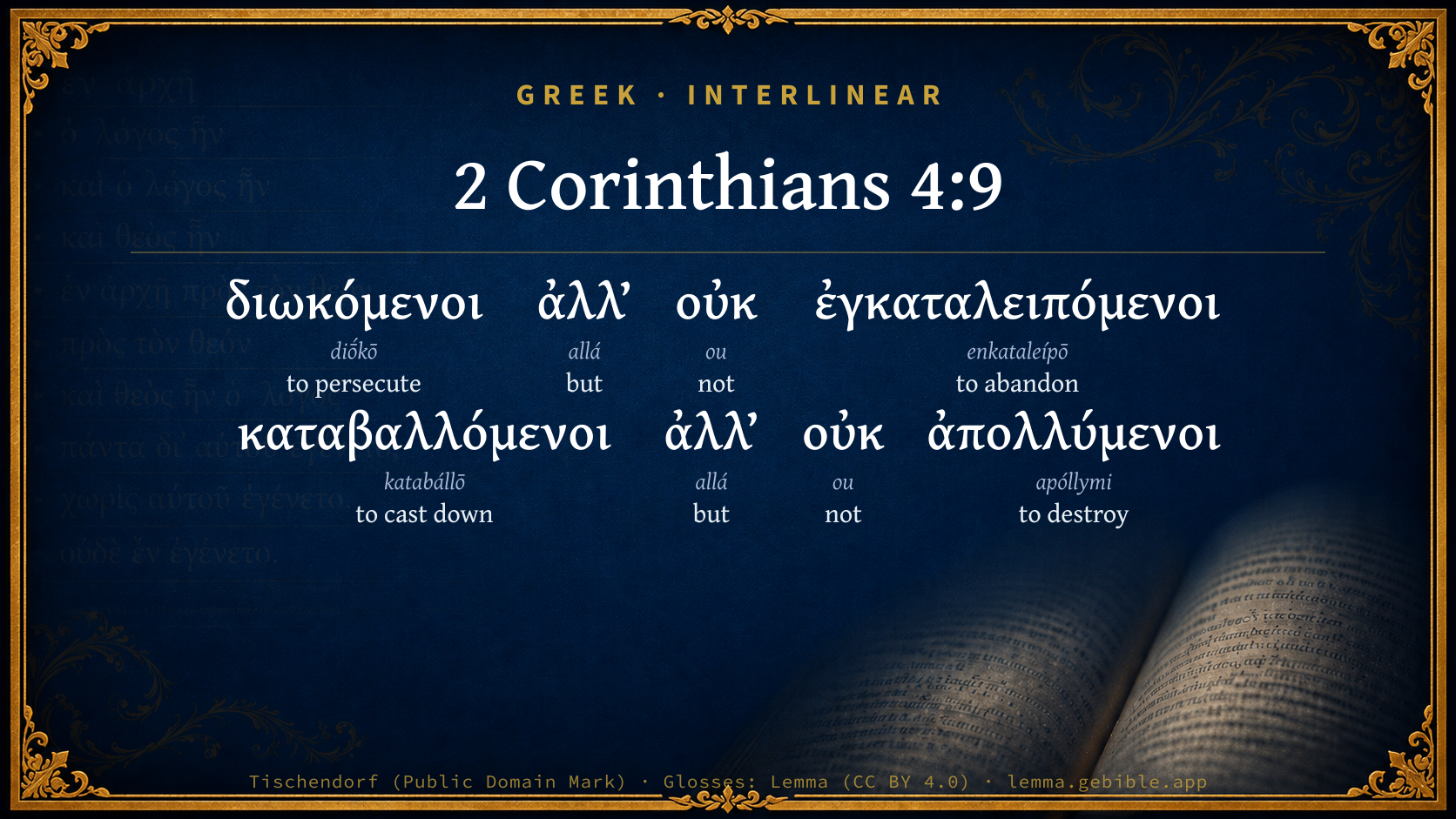
Download image
Cite this verse

2 Corinthians 4:9 (World English Bible). Public Domain. Lemma interlinear Bible study tool, https://lemma.gebible.app/v/2-corinthians/4/9.

Show BibTeX & RIS
BibTeX
RIS
English Translation
pursued, yet not forsaken; struck down, yet not destroyed;
World English Bible · Public Domain
Highlights
  • 1 first appearance in the Greek New Testament
Full analysis ↓
Download a study sheet

One document with this verse’s original text, its word-by-word gloss line, the meaning frame, cross-references with their text, attributed commentary, and full source and license credits — printable, and it pastes into notes with its structure intact.

This verse Autodidact and up

Study sheet (.html) Plain text (.txt)

A passage Seminary Student

Up to 50 verses in one chapter. A passage sheet keeps up to 6 commentary sources and 12 cross-references per verse, in the order this page ranks them, and says so on the sheet whenever that leaves anything out. Ask for a single verse and you get the Autodidact verse sheet above.

Everything on this page stays free to read, with no account — the sheet is a download of what is already on screen, not access to it.

Want to remove ads? Support Godless Engineer
Compare translations 3

The same verse in 3 English versions, stacked beneath the original-language interlinear above. Click any original word for its lexicon entry.

Each is an independent rendering of the whole verse — the interlinear is not word-aligned to these translations.

Highlighted words mark where these versions differ — a whole-verse word diff, not a word-by-word alignment.

  • World English Bible Public Domain
    pursued, yet not forsaken; struck down, yet not destroyed;
  • King James Version Public Domain
    Persecuted, but not forsaken; cast down, but not destroyed;
  • unfoldingWord Literal Text CC BY-SA 4.0
    being persecuted, but not being forsaken; being thrown down, but not perishing;

unfoldingWord Literal Text — © unfoldingWord, licensed CC BY-SA 4.0. Word-aligned USFM3 via Door43 (git.door43.org/unfoldingWord/en_ult).

Versions to compare (up to 4)

3 of 4 selected

Show all 19 translations

Every available English version of this verse, each an independent rendering of the whole verse.

  • World English Bible Public Domain
    pursued, yet not forsaken; struck down, yet not destroyed;
  • Berean Standard Bible Public Domain
    persecuted, but not forsaken; struck down, but not destroyed.
  • Majority Standard Bible Public Domain
    persecuted, but not forsaken; struck down, but not destroyed.
  • King James Version Public Domain
    Persecuted, but not forsaken; cast down, but not destroyed;
  • American Standard Version (1901) Public Domain
    pursued, yet not forsaken; smitten down, yet not destroyed;
  • Revised Version (1885) Public Domain
    pursued, yet not forsaken; smitten down, yet not destroyed;
  • Geneva Bible (1599) Public Domain
    We are persecuted, but not forsaken: cast downe, but we perish not.
  • Douay-Rheims (1899) Public Domain
    We suffer persecution, but are not forsaken; we are cast down, but we perish not:
  • Young's Literal Translation Public Domain
    persecuted, but not forsaken; cast down, but not destroyed;
  • Literal Standard Version CC BY-SA 4.0
    persecuted, but not forsaken; cast down, but not destroyed;
  • Unlocked Literal Bible CC BY-SA 4.0
    We are persecuted but not forsaken. We are struck down but not destroyed.
  • unfoldingWord Literal Text CC BY-SA 4.0
    being persecuted, but not being forsaken; being thrown down, but not perishing;
  • Darby Bible Public Domain
    persecuted, but not abandoned; cast down, but not destroyed;
  • World Messianic Bible Public Domain
    pursued, yet not forsaken; struck down, yet not destroyed;
  • Webster's Bible Public Domain
    Persecuted, but not forsaken; cast down, but not destroyed;
  • Free Bible Version CC BY-SA 4.0
    We are persecuted, but never abandoned by God. We are knocked down, but not dead yet!
  • Bible in Basic English Public Domain
    We are cruelly attacked, but not without hope; we are made low, but we are not without help;
  • Text-Critical English NT CC BY 4.0
    persecuted, but not forsaken; struck down, but not destroyed;
  • Tyndale New Testament (1534) Public Domain
    We are persecuted: but are not forsake. We are cast doune: neverthelesse we perisshe not.

Literal Standard Version (2020), Covenant Press — licensed CC BY-SA 4.0. Text via the HelloAO Bible API (eBible.org). Unlocked Literal Bible (unfoldingWord) — licensed CC BY-SA 4.0. Text via the HelloAO Bible API (eBible.org). unfoldingWord Literal Text — © unfoldingWord, licensed CC BY-SA 4.0. Word-aligned USFM3 via Door43 (git.door43.org/unfoldingWord/en_ult). Free Bible Version, Dr. Jonathan Gallagher — licensed CC BY-SA 4.0. Text via the HelloAO Bible API (eBible.org).

Word by word

More ways to search: Search by grammar → Find every occurrence → Compare this word →

Practice this passage: Drill this verse → Learn its vocabulary →

About this verse

These counts appear in no published source. They are computed here, from the morphology-tagged text and Lemma’s own curated glosses. What Lemma adds →

8
words
6
distinct lemmas
Pauline Epistles
section

Notable vocabulary

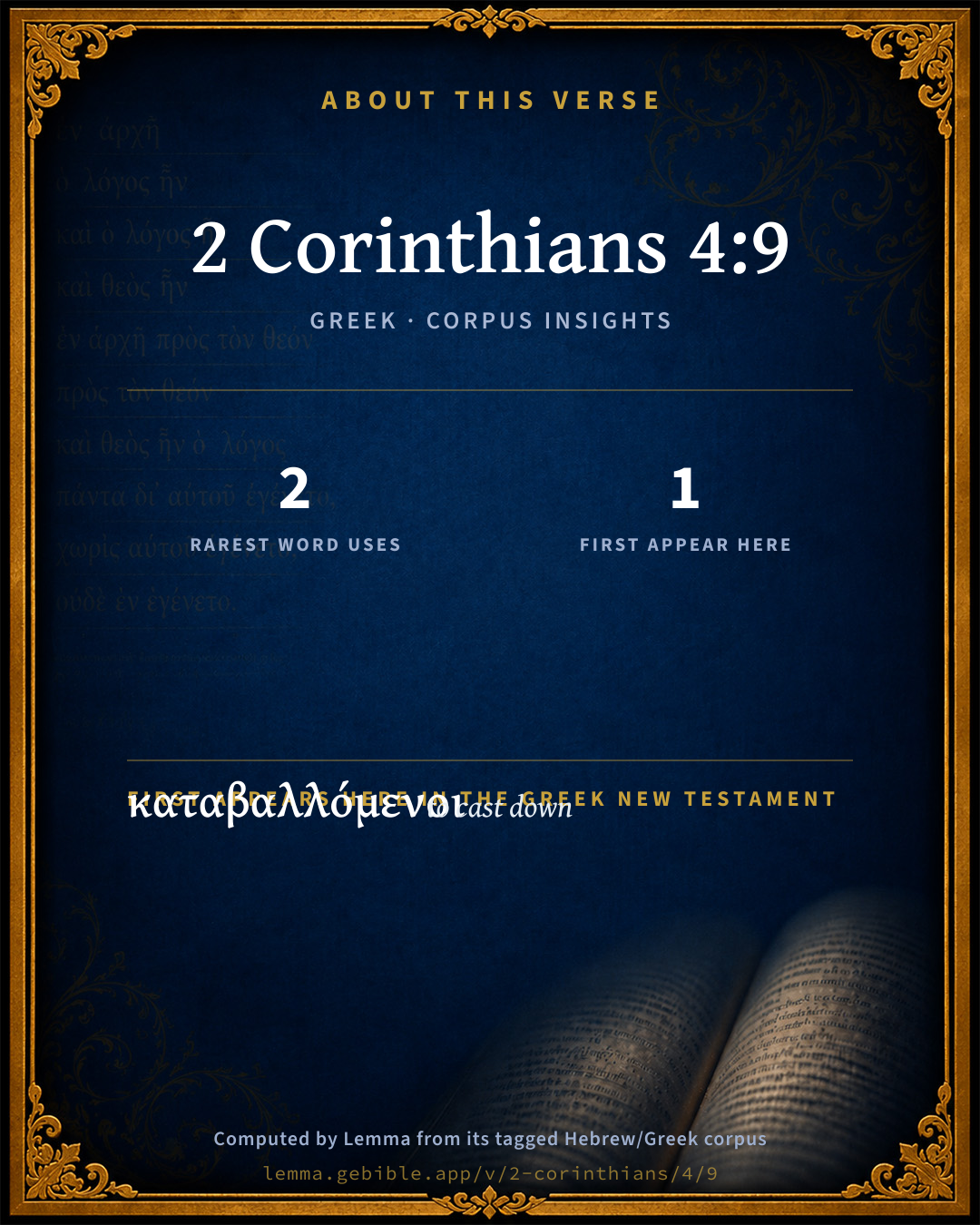
The rarest word here is καταβαλλόμενοι to cast down G2598 — appearing just 2 times in the whole Greek New Testament.

First appearance in Scripture

This word makes its first canonical appearance in the Greek New Testament here:

  • καταβαλλόμενοι to cast down G2598

Shared distinctive vocabulary

καταβαλλόμενοι to cast down G2598 occurs in 2 verses of the Greek New Testament. Also found in:
Repetition

Words recur within this verse:

  • ἀλλ’ but G235 ×2
  • οὐκ not G3756 ×2

Cross-references

15

Topical passages linked to 2 Corinthians 4:9 in the Treasury of Scripture Knowledge — connected by theme and wording, ordered by reader-vote popularity; previews shown in the World English Bible.

  • Isaiah 43:2 When you pass through the waters, I will be with you; and through the rivers, they shall not overflow you: when you walk through the fire, you shall not be burned, neither shall the flame kindle on you.
  • Micah 7:8 Don't rejoice against me, my enemy. When I fall, I will arise. When I sit in darkness, Yahweh will be a light to me.
  • Psalms 37:24–25 Though he stumble, he shall not fall, For Yahweh holds him up with his hand.
  • Proverbs 24:16 For a righteous man falls seven times, and rises up again; But the wicked are overthrown by calamity.
  • Psalms 42:11 Why are you in despair, my soul? Why are you disturbed within me? Hope in God! For I shall still praise him, The saving help of my countenance, and my God.
  • Isaiah 62:4 You shall no more be termed Forsaken; neither shall your land any more be termed Desolate: but you shall be called Hephzibah, and your land Beulah; for Yahweh delights in you, and your land shall be married.
  • 2 Corinthians 7:6 Nevertheless, he who comforts the lowly, God, comforted us by the coming of Titus;
  • Hebrews 13:5 Be free from the love of money, content with such things as you have, for he has said, "I will in no way leave you, neither will I in any way forsake you."
  • Psalms 9:10 Those who know your name will put their trust in you, For you, Yahweh, have not forsaken those who seek you.
  • Psalms 37:28 For Yahweh loves justice, And doesn't forsake his saints. They are preserved forever, But the children of the wicked shall be cut off.
  • Job 5:17–19 "Behold, happy is the man whom God corrects: Therefore do not despise the chastening of the Almighty.
  • Psalms 22:1 My God, my God, why have you forsaken me? Why are you so far from helping me, and from the words of my groaning?
  • Psalms 42:5 Why are you in despair, my soul? Why are you disturbed within me? Hope in God! For I shall still praise him for the saving help of his presence.
  • John 15:20 Remember the word that I said to you: 'A servant is not greater than his lord.' If they persecuted me, they will also persecute you. If they kept my word, they will keep yours also.
  • Job 22:29 When they cast down, you shall say, 'be lifted up.' He will save the humble person.

Cross-references courtesy of OpenBible.info (CC BY 4.0).

Commentary

Notes on 2 Corinthians 4:9 from classic Christian and Jewish commentators (each source and its license shown beneath its notes). The classic Christian expositions comment on the surrounding passage and are grouped to its opening verse, so a note may address several verses; the Jewish commentaries on the Tanakh (Rashi and others) are per-verse, so they appear only where the commentator wrote on this verse.

Lemma curates 59 commentaries, every one of them public domain or Creative Commons licensed, each selected and text-cleaned for this edition rather than reprinted as found. About our sources →

Bengel's Gnomon

Johann Albrecht Bengel

2Co 4:9. Διωκόμενοι, persecuted) καταβαλλόμενοι, cast down, is something more [worse] than persecution, viz., where flight is not open to one.

Bengel's Gnomon of the New Testament — English translation (T&T Clark, Edinburgh, 1860) — public domain. Text from a community e-Sword module.

Meyer's Critical & Exegetical Commentary

Heinrich August Wilhelm Meyer

2Co_4:9. Being persecuted, but not left (by God) in the lurch (Plato, Conv. p. 179 A: ἐγκαταλιπεῖν καὶ μὴ βοηθῆσαι). Comp. 2Ti_4:16; Heb_13:5. Paul here varies the mode of presentation, since the contrast does not again negative an action of enemies. Lydius (Agonistic. sacr. 24, p. 84 ff.), Hammond, and Olshausen think that we have here the figure of a foot-race, in which the runner overtaken ἐγκαταλείπεται (see the passages in Lydius); but the figure would be unsuitable, since the runners have a common goal (1Co_9:24). Hostile persecution in general is meant. Comp. διωγμός, 2Co_12:10; Rom_8:35; 2Th_1:4, al.

καταβαλλόμ. κ.τ.λ.] Figure of those seized in the act of flight, who are thrown to the ground (Hom. Odyss. iv. 344, viii. 508; Herod. ix. 63), but not deprived of life. This part thus appears in a most suitable relation of climax to what precedes; hence we should not think, as many do, of wrestlers in the games (comp. Plato, Hipp. min. p. 374 A).

Meyer — Critical and Exegetical Commentary on the New Testament — English translation by Peter Christie, edited by Frederick Crombie (T&T Clark, 1880) — public domain. Text from a community e-Sword module.

Jamieson, Fausset & Brown

Robert Jamieson, A. R. Fausset & David Brown

not forsaken--by God and man. Jesus was forsaken by both; so much do His sufferings exceed those of His people (Mat 27:46).

cast down--or "struck down"; not only "persecuted," that is, chased as a deer or bird (Sa1 26:20), but actually struck down as with a dart in the chase (Heb 11:35-38). The Greek "always" in this verse means, "throughout the whole time"; in Co2 4:11 the Greek is different, and means, "at every time," "in every case when the occasion occurs."

Jamieson, Fausset & Brown — Commentary Critical and Explanatory on the Whole Bible (1871) — public domain (CC PDM 1.0). Text via the HelloAO Bible API.

Adam Clarke's Commentary

Verse 9. Persecuted, but not forsaken] Διωκομενοι, αλλ' ουκ εγκαταλειπομενοι. The διωκομενοι, pursued, is peculiar to the δρομος, or race, when one being foremost others pursue, and get up close after him, endeavouring to outstrip him, but cannot succeed: this is the meaning of ουκ εγκαταλειπομενοι, not outstripped, or outgone, as the word implies. So in PLUTARCH: τους απολειφθεντας ου στεφανουσι, they do not crown them that are distanced or left behind. So says the apostle, 1Co 9:24: All run, but only ONE receiveth the PRIZE.

Cast down, but not destroyed.] Καταβαλλομενοι αλλ' ουκ απολλυμενοι. This also belongs to wrestlers, where he that throws the other first is conqueror. And so Hesychius: καταβαλει, νικησει, ῥιψει, to cast down is to overcome, to throw. And then, the being not destroyed signifies that, although they were thrown down-cast into troubles and difficulties, yet they rose again, and surmounted them all.

Adam Clarke's Commentary on the Bible (1810–1826) — public domain. Text from a community e-Sword/MySword module.

Ellicott's Commentary for English Readers

(9) Persecuted, but not forsaken.—Better, perhaps, as expressing in both terms of the clause the condition of a soldier on the field of battle, pursued, yet not abandoned. The next clause is again distinctly military, or, perhaps, agonistic: stricken down (as the soldier by some dart or javelin), yet not perishing. In the “faint, yet pursuing,” of Jdg_8:4, we have an antithesis of the same kind in a narrative of actual warfare.

A Bible Commentary for English Readers, edited by Charles John Ellicott (1878–1897) — public domain. Text from a community e-Sword module.

The Cambridge Bible for Schools and Colleges

gen. ed. J. J. S. Perowne

9. cast down, but not destroyed] i.e. struck or thrown down, as in warfare or wrestling, but not yet deprived of life, and therefore not unable to renew the conflict.

The Cambridge Bible for Schools and Colleges (gen. ed. J. J. S. Perowne; Cambridge University Press, 1878–1918) — public domain. Text from a community e-Sword module.

John Gill's Exposition

Persecuted, but not forsaken,.... Pursued from place to place, and followed with menaces, curses, and reproaches; laid hold on, proscribed, imprisoned, and threatened with the severest tortures, and death itself; but our God never leaves us nor forsakes us; though we are followed close by evil men, and left by our friends, we are not forsaken of God:

cast down we sometimes are, as an earthen vessel; Co2 4:7, which may be cast out of a man's hands, in order to be dashed to pieces; or as a man in wrestling, see Eph 6:12 may be thrown to the ground by his antagonist, so we are sometimes foiled by sin, Satan, and the world:

but not destroyed; we are still safe in the hands of Christ, and are kept by the power of God; and, indeed, to what else can all this be ascribed? it is surprising that earthen vessels should bear and suffer so much, and not fall, or be dashed to pieces.

John Gill's Exposition of the Whole Bible (1746–1763) — public domain (CC PDM 1.0). Text via the HelloAO Bible API.

Trapp's Complete Commentary

John Trapp

9 Persecuted, but not forsaken; cast down, but not destroyed;

Ver. 9. Persecuted, but not forsaken] The Church may be shaken, not shivered; persecuted, not conquered. ( Concuti, non excuti.) Roma cladibus animosior, said one; it is more true of the Church. She gets by her losses, and, as the oak, she taketh heart to grace from the maims and wounds given her. Duris ut ilex tonsa bipennibus.

" Niteris incassum Christi submergere navem:

Fluctuat, at nunquam mergitur illa ratis:"

as the pope wrote once to the Great Turk.

Cast down, but not destroyed] Impellere possunt, said Luther of his enemies, sed totum prosternere non possunt: crudeliter me tractare possunt, sed non extirpare: dentes nudare, sed non devorare: occidere me possunt, sed in totum me perdere non possunt. They may thrust me, but not throw me; show their teeth, but not devour me; kill me, but not hurt me.

John Trapp, A Commentary or Exposition upon All the Books of the Old and New Testament (1647–1656) — public domain. Text from a community e-Sword module.

Albert Barnes' Notes on the Bible

Persecuted - Often persecuted, persecuted in all places. The Book of Acts shows how true this was.

But not forsaken - Not deserted; nor left by God Though persecuted by people, yet they experi enced the fulfillment of the divine promise that he would never leave nor forsake them. God always interposed to aid them; always saved them from the power of their enemies; always sustained them in the time of persecution. It is still true. His people have been often persecuted. Yet God has often interposed to save them from the hands of their enemies; and where he has not saved them from their hands, and preserved their lives, yet he has never left them, but has sustained, upheld, and comforted them even in the dreadful agonies of death.

Cast down - Thrown down by our enemies, perhaps in allusion to the contests of wrestlers, or of gladiators.

But not destroyed - Not killed. They rose again; they recovered their strength; they were prepared for new conflicts. They surmounted every difficulty, and were ready to engage in new strifes, and to meet new trials and persecutions.

Albert Barnes' Notes on the Bible (1834–1885) — public domain. Text from a community e-Sword/MySword module.

Matthew Poole's English Annotations

Persecuted; violently pursued and prosecuted by such as are the adversaries of the gospel, and enemies to our Lord Jesus, because of our profession of him, and preaching his gospel;

but yet not forsaken of God, nor wholly of men; God, by the inward influences of his Holy Spirit, supporting, upholding, and comforting us; and also, by his providence, raising us up some friends that stick by us.

Cast down, either in our own thoughts, (as it is the nature of worldly troubles and afflictions to sink men’s thoughts), or cast down by the violence of men, thrown to the earth;

but not destroyed; but yet we live, and are by the mighty power of God preserved, that we are not utterly destroyed.

Matthew Poole's English Annotations on the Holy Bible (1683–1685) — public domain. Text from a community e-Sword/MySword module.

The Pulpit Commentary

Not forsaken. St. Paul, like the author of the Epistle to the Hebrews, knew by blessed experience the truth of the promise, "I will never leave thee nor forsake thee". (Heb_13:5, Heb_13:6) Cast down. Flung to the ground, as in some lost battle; yet not doomed, not "perishing." "Though he fall, he shall not be utterly cast down, for the Lord upholdeth him with his hand". (Psa_37:24)

Cast down, but not destroyed.

In ministering the Word, we need to play, if we may so speak, on various instruments of music. We take the silver trumpet when we would utter "the joyful sound." We take the harp when we show forth God"s praise. What shall we take for encouragement and comfort to the weary? As a great poetess has it

Experience, like a pale musician, holds A dulcimer of patience in his hand.

Let us play on the dulcimer. A good man struggling with adversity has been the subject of many moral reflections. We want to go further than the moralist, and show how the man of God is preserved in time of trouble. What heroism in the immortal Jew of Tarsus! All the sharp ordeal through which he passed his personal disadvantages, the disparagement by false apostles jealous of his influence, the coldness of former friends when he was in bonds at Rome, the hardship and misconstruction under which his great work had been done, all served only to bring out more fully the singleness of his aim and fortitude of his spirit

And give the world assurance of a man.

down, but not destroyed." Trouble threw him down, as one wrestler might throw another in the arena; but the cast was not mortal. He revived, for Christ lived in him. Nay; his sufferings increased his usefulness, No follower of Christ ever made such an impression on mankind, or did so much for the gospel, as this troubled, persecuted, perplexed, cast down Paul of Tarsus. Times have changed. Religious liberty prevails. Gross forms of persecution for confessing Christ are prevented by law and condemned by public sentiment. But it does not follow that the course of a faithful Christian is made easy. It is often beset with difficulty, broken, and uneven. Good men are "cast down;" and it is painful to have the skin grazed, even when the bones are not broken. Under such disappointing experiences feeble souls are apt to become more timid and more querulous, while bolder natures grow selfish and cynical. These last, if they have been struck down when grappling with something to them impracticable or forbidden, resolve to knock others down, and, if need be for their own interest, trample on them. But natures that are sweet and sound learn wisdom, consideration for others, and knowledge of themselves through hard experience. And hearts that trust in God have this joy in the worst defeat, that they are not, they cannot be, destroyed. Life is not wrecked by every trouble or by a score of troubles. A mistake may be the very making of a man, if he knows how to correct it. If the way is blocked in one direction, other paths are open. And if helpers fail and friends forsake, God still lives. We do not, indeed, conceal from ourselves that some overthrows cannot be quite remedied in this world; some losses are irreparable on earth, just as some diseases are incurable. But no Christian needs to be inconsolable. If he be stripped of ever so much that he valued, his best treasure remains, and is above the reach of worldly vicissitude. There is a good part which shall not be taken away. Thus life is always worth living. For a brave man it cannot be utterly wrecked by misfortune. For a devout man it cannot be shattered, though once and again struck down to the ground. The good Shepherd restores the soul. But many are the uses of adversity. Remember your faults and correct them; your mistakes, and avoid them; but do not waste time in vain regrets or temper in weak complaints. What purpose does it serve to brood over disappointment and "feed with sighs the passing wind? How much better to gird up your purpose and make the best of what is left to you of time, strength, and opportunity! You may yet stand all the more firmly because of that casting down. The ill you have suffered may lead to higher good. "Though the outward man perish, the inward man is renewed day by day." God knows how to give

Secret refreshings that repair your strength, And fainting spirits uphold.

F.

The Pulpit Commentary (1880–1919), ed. H.D.M. Spence-Jones & Joseph S. Exell — public domain. Text from a community e-Sword module.

McGarvey & Pendleton's Commentaries

J. W. McGarvey

pursued, yet not forsaken; smitten down, yet not destroyed [The apostle again changes his figure, and describes the Christian minister as a warrior defending a divine treasure. His enemies press upon him very closely, yet still leave him room to wield his weapons. He is greatly disturbed in mind because of his imperiled position, yet does not lose hope; as the conflict grows more strenuous he seeks refuge in flight, but feels that Providence has not forsaken him; finally the overtaking enemy strikes him down, and would overcome him, did not God deliver him for the sake of the treasure committed to his defense];

J. W. McGarvey (with Philip Y. Pendleton), Commentaries on the New Testament (The Fourfold Gospel, 1914; Acts; and the epistles) — public domain. Text from a community e-Sword/MySword module.

Cambridge Greek Testament for Schools and Colleges

9. διωκόμενοι. Comp. 1Co 4:12; Gal 6:12; Mat 5:10.

οὐκ ἐγκαταλειπόμενοι. We might have expected ‘but not captured’ rather than ‘but not forsaken’; ‘left behind’ (R.V. margin) ‘by his friends in the hands of his foes’ may be the meaning: ἐγκαταλιπεῖν … ἢ μὴ βοηθῆσαι κινδυνεύοντι (Plat. Symp. 179 A). ‘Forsaken of God’ is also possible. Comp. Mat 27:46; Mar 15:34; Act 2:27; Act 2:31; 2Ti 4:10; and the promise to Joshua, οὐκ ἐνκαταλείψω σε (Jos 1:5).

καταβαλλόμενοι ἀλλʼ οὐκ ἀπολλύμενοι. This refers to being struck down in battle rather than thrown in wrestling. Comp. καταβαλῶ αὐτὸν ἐν ῥομφαίᾳ (2Ki 19:7), κατ. αὐτοὺς ἐν μαχαίρᾳ (Jer 19:7).

Cambridge Greek Testament for Schools and Colleges (Cambridge University Press, 1896; 21 vols, various authors incl. Carr, Maclear, Plummer, Farrar, Lumby, Moule, M. R. James, Simcox) — public domain. Text from a community e-Sword module.

International Critical Commentary

9. διωκόμενοι, ἀλλʼ οὐκ ἐλκαραλειπόμενοι. ‘Pursued by men (1Co 4:12), yet not forsaken by God.’ ‘Pursued by foes, yet not left in the lurch by friends’ (Plat. Symp. 179 A), might be the meaning, but it has less point. The ruling idea throughout is that God manifests His power in His servants’ weakness. Whatever hostile agents, whether human or diabolical, may do, the earthen vessels are able to bear the shock and continue to render service. In LXX, the verb is used of the Divine promise; οὐ μή σε ἐγκαταλείπω (Gen 28:15; Jos 1:5; cf. Deu 31:6, Deu 31:8).

καταβαλλόμενοι, ἀλλʼ οὐκ ἀπολλύμενοι. ‘Struck down, yet not destroyed’; struck down, either ἐν ῥομφαίᾳ (2Ki 19:7), or ἐν μαχαίρᾳ (Jer 19:7), or any other weapon (Hdt. iv. 64).

It is probable that the last two illustrations, and possible that all four, are taken from combatants in battle or in the arena; ‘hard pressed, yet not hemmed in; in difficulties, yet not in despair; pursued, yet not abandoned; smitten down, yet not killed.’ But ἐγκαταλειπόμενοι must not be understood of being left behind in a race, nor καταβαλλόμενοι of being thrown in wrestling. The four form a climax.

International Critical Commentary — older volumes (1896–1929), various authors — public domain. Text from a community e-Sword module.

Vincent's Word Studies in the New Testament

Marvin R. Vincent

Persecuted - forsaken [διωκομενοι - εγκαταλειπομενοι] . Rev., for persecuted, pursued, the primary meaning of the verb, thus giving vividness to the figure. Forsaken, lit., left behind in (some evil plight). The figure is, pursued by enemies, but not left to their power : left in the lurch. Cast down - destroyed [καταβαλλομενοι - απολλυμενοι] . This carries on the previous figure. Though the pursuers overtake and smite down, yet are we not killed. Rev., smitten down. In all these paradoxes the A. V. fails to bring out the metaphors.

Marvin R. Vincent, Word Studies in the New Testament (1887–1900) — public domain. Text from a community e-Sword/MySword module.

Lesson kit

Teaching starters — assembled from the data on this page, not authored interpretation. Every prompt links to the verse data it draws on. Edit before teaching.

2 Corinthians, in the Pauline Epistles, opens this verse with 8 words (6 distinct Greek lemmas). Its most distinctive word is katabállō (“to cast down”). A historical commentator’s framing appears above. Read the whole chapter for the surrounding context.

Discussion questions

  1. How does “to cast down” (katabállō) shape what this verse is saying?
  2. This is the first place “to cast down” appears in Scripture (first appears here). What does its debut here establish?
  3. How does Hebrews 6:1, which shares the word «to cast down», read alongside this verse?
  4. What does the repetition of “but” (2× in this one verse) do in this verse?
  5. The translations on this page render this verse differently — a whole-verse word diff, not a word-by-word alignment. What might account for the different wordings?
  6. Compare how Bengel's Gnomon and Meyer's Critical & Exegetical Commentary read this verse. Where do they agree or differ?

Things to notice

  • 1 word makes its first canonical appearance in Scripture here.
  • These translations choose different wording for 8 words in this verse.
  • “but” occurs 2× in this single verse.
  • 6 distinct Greek lemmas span 8 words in this verse.

Reading settings

Reading text

Shown beneath each verse's original-language words.

Old Testament
Old Testament edition

Read the OT as the Masoretic Hebrew (MT) or the Greek Septuagint (LXX).

English shown for the Greek Septuagint (in the Hebrew ↔ Greek comparison).

Comparing translations? Open the Compare panel on any verse page to stack up to four side by side.