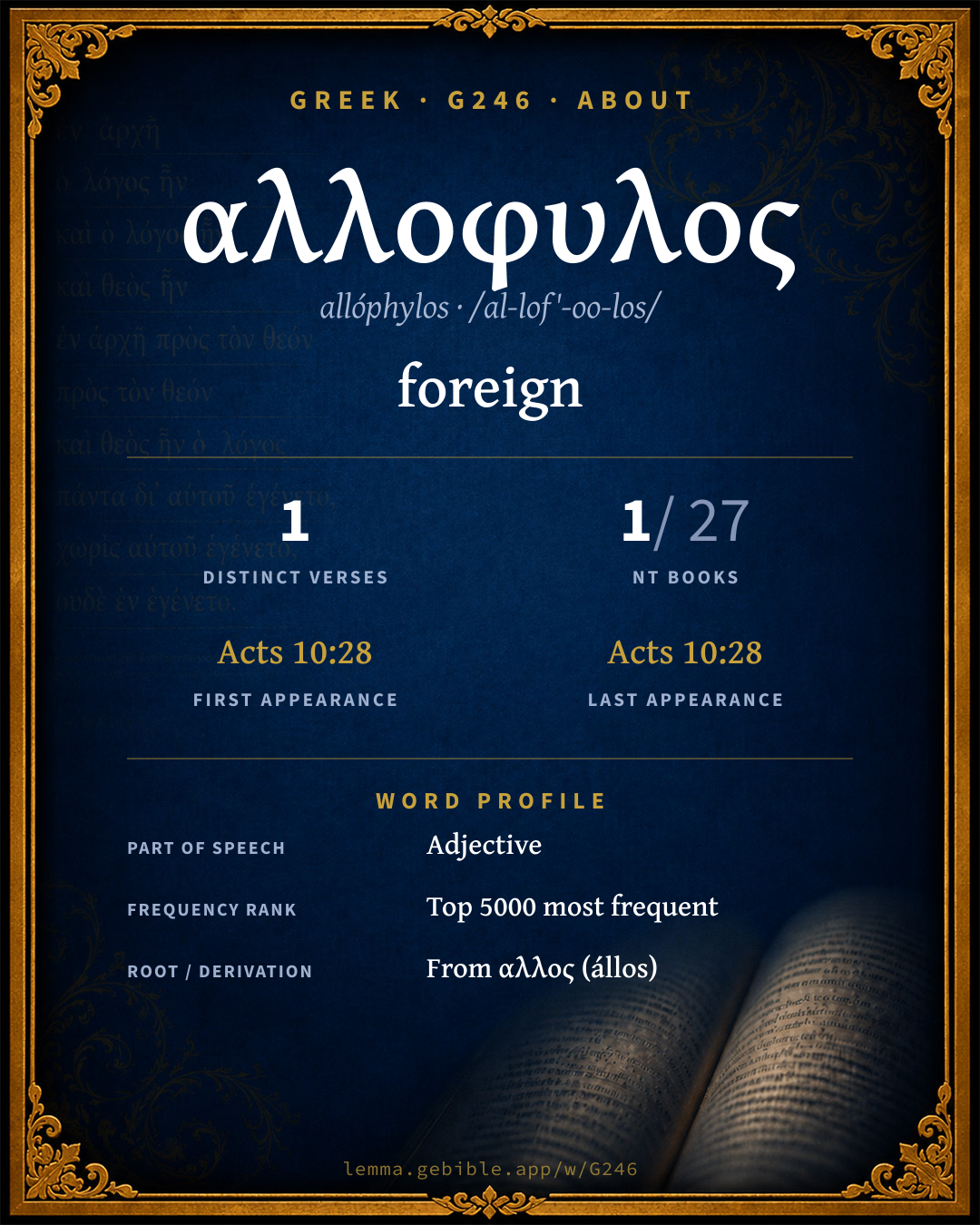
ἀλλόφυλος
foreign
Full lexicon entry — Thayer's Greek Lexicon
From Thayer's Greek Lexicon
Where this word appears
Grammar key — what these labels mean
Part of speech
- Adjective
- A word that describes or qualifies a noun.
Case
- Dative
- The case of the indirect object, means, or location — “to / for / with / in.”
Gender
- Masculine
- Grammatically masculine.
Number
- Singular
- One.
Every verse where G246 appears — 1 distinct verse across 1 book. Click any verse to open its interlinear word-by-word view. Verse text shown in the World English Bible for context — . Each verse’s Greek form is shown with its reference; the English is not keyword-highlighted, since the data carries no word-level English alignment. Use “Compare translations” on any verse to read it across multiple English versions. This concordance covers the Greek New Testament; Septuagint (Greek Old Testament) occurrences of this word are not indexed here.
Acts 1 verse
About this entry
At a glance — auto-summarized from this page’s data, not written by a person. Every figure links to its source below. This summary describes the numbers; it doesn’t interpret them.
αλλοφυλος (allóphylos) is a Greek adjective most often rendered “foreign.” It occurs a mere 1 verse across Scripture. Acts dominates its distribution — 1 of 1 verses. Scripture uses it exactly once, at Acts 10:28. Sharing its root, it stands alongside αλλος, αλλα and αλλασσω. The sections below give every sense, occurrence, and version rendering.
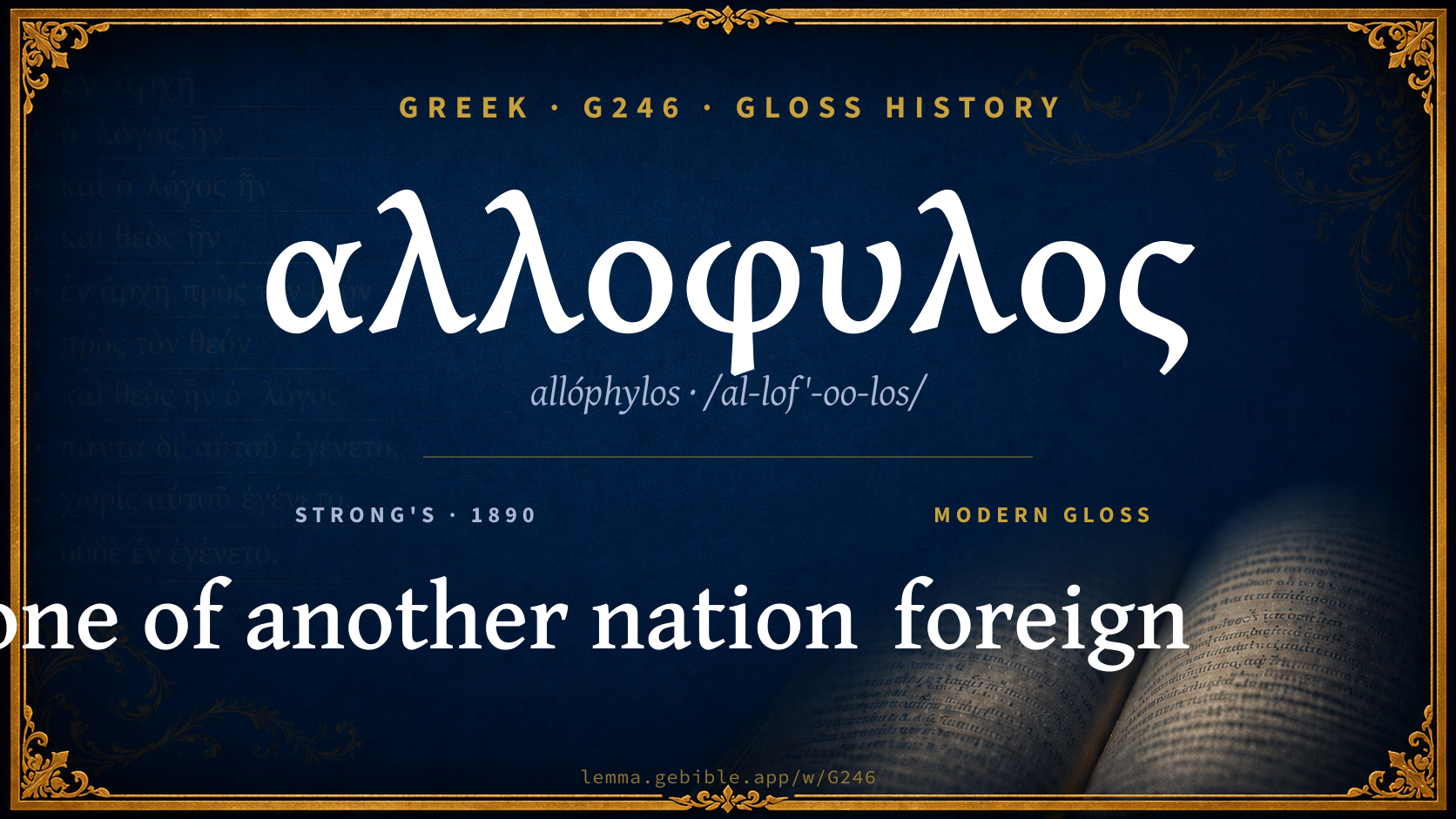
Gloss history
Strong's 1890 vs modern scholarship
About this word
Strong's G246 catalogs a Greek word from the Greek New Testament.
These counts are not copied from any lexicon or concordance. They are computed here, from the morphology-tagged Greek New Testament. What Lemma adds →
- 1
- distinct verses
- The word appears in 1 distinct verse.
- 1 / 27
- NT books
- The word appears in 1 of 27 New Testament books.
- #3,503
- by frequency
- Top 5000 most frequent Greek words (rank 3,503 of 5,347 Greek words by occurrence).
View all 1 occurrence in the concordance →
Most concentrated in
- Acts 1 verse 100%
By section of the New Testament
By traditional corpus
Conventional, traditional groupings — biblical authorship is debated, so this is a traditional corpus grouping, not an authorship claim. Some books belong to more than one corpus (Luke is in both the Gospels and the Lukan corpus, and so on), so these shares overlap and need not total 100%. Each figure is a share of the word’s 1 distinct verse.
- Lukan (Luke–Acts) 1 verse · 100%
How translations render this word
Counts come from each version’s own published word-to-Strong’s tagging or interlinear alignment — an approximate guide to how each version renders this word, not a word-level alignment the data otherwise carries. Because each total is that version’s own tagged count, the per-version totals vary from one another and need not match the appearance or distinct-verse counts above. These counts may also differ from a printed concordance because Lemma counts each distinctly tagged rendering and does not collapse phrase taggings into a single head-word total. This is a fixed set of word-tagged versions (KJV, ASV, BSB, ULT) and does not change with the reading translation you choose elsewhere. Each version’s license is shown beside its name below (and on Sources).
- King James Version: One of another nation 1×
- American Standard Version: One of another nation 1×
- Berean Standard Bible: Foreigner 1×
- unfoldingWord Literal Text: Foreigner 1×
King James Version Public Domain
Renders G246 across 1 tagged occurrence — most commonly:
American Standard Version Public Domain
Renders G246 across 1 tagged occurrence — most commonly:
Berean Standard Bible Public Domain
Renders G246 across 1 tagged occurrence — most commonly:
unfoldingWord Literal Text CC BY-SA 4.0
Renders G246 across 1 tagged occurrence — most commonly:
Senses in Thayer's
The 1 sense Thayer's distinguishes for this word, in lexicon order (not ranked by frequency or importance). The full entry — with sub-senses — is in the Lexicon Entry tab.
- foreign
Word origin
Derived from αλλος (állos) (G243) — another.
Same root — word family
Other Thayer's entries built from the same root as G246, grouped by Strong’s listed origin. These share a root / origin per the lexicon — not necessarily a shared meaning. Each links to that word’s own entry.
Derives from
Shares the same root
- αλλα allá G235 but
- αλλασσω allássō G236 to change
- αλλαχοθεν allachóthen G237 from another place
- αλληγορεω allēgoréō G238 to speak allegorically
- αλληλων allḗlōn G240 one another
- αλλογενης allogenḗs G241 foreigner
- αλλοτριος allótrios G245 foreign
- αλλως állōs G247 otherwise
Compare all same-root words → Showing 4 of 10 — not the complete family. They share a root, not necessarily a meaning.
Septuagint usage
The same Greek word αλλοφυλος appears 266 times in the Greek Old Testament (Septuagint), across 227 verses in 17 books.
- 266
- LXX occurrences
- Tagged occurrences of this Greek word in the Septuagint.
- 227
- verses
- Distinct Septuagint verses containing this word.
- 17 / 39
- OT books
- The word appears in 17 of the 39 Old Testament books.
Sample Septuagint occurrences
- Exodus 34:15 ἀλλόφυλος
- Judges 3:3 ἀλλόφυλος
- 1 Samuel 4:1 ἀλλόφυλος
- 2 Samuel 1:20 ἀλλόφυλος
- 1 Kings 2:46 ἀλλόφυλος
- 2 Kings 8:2 ἀλλόφυλος
- 1 Chronicles 10:1 ἀλλόφυλος
- 2 Chronicles 9:26 ἀλλόφυλος
- Psalms 55:1 ἀλλόφυλος
- Isaiah 2:6 ἀλλόφυλος
- Jeremiah 29:1 ἀλλόφυλος
- Ezekiel 16:27 ἀλλόφυλος
Septuagint occurrences (same lexeme)
Every verse where the same Strong’s number (G246) appears in the Greek Septuagint — showing the first 50 of 227. Verse text shown in the World English Bible for context; the Greek form is the matched word — the English is not keyword-highlighted.
- Exodus 34:15 ἀλλόφυλος Don't make a covenant with the inhabitants of the land, lest they play the prostitute after their gods, and sacrifice to their gods, and one call you and you eat of his sacrifice;
- Judges 3:3 ἀλλόφυλος [namely], the five lords of the Philistines, and all the Canaanites, and the Sidonians, and the Hivites who lived on Mount Lebanon, from Mount Baal Hermon to the entrance of Hamath.
- Judges 3:31 ἀλλόφυλος After him was Shamgar the son of Anath, who struck of the Philistines six hundred men with an ox-goad: and he also saved Israel.
- Judges 8:10 ἀλλόφυλος Now Zebah and Zalmunna were in Karkor, and their hosts with them, about fifteen thousand men, all who were left of all the host of the children of the east; for there fell one hundred twenty thousand men who drew sword.
- Judges 14:1 ἀλλόφυλος Samson went down to Timnah, and saw a woman in Timnah of the daughters of the Philistines.
- Judges 14:3 ἀλλόφυλος Then his father and his mother said to him, Is there never a woman among the daughters of your brothers, or among all my people, that you go to take a wife of the uncircumcised Philistines? Samson said to his father, Get her for me; for she pleases me well.
- Judges 14:4 ἀλλόφυλος But his father and his mother didn't know that it was of Yahweh; for he sought an occasion against the Philistines. Now at that time the Philistines had rule over Israel.
- Judges 15:3 ἀλλόφυλος Samson said to them, This time shall I be blameless in regard of the Philistines, when I do them a mischief.
- Judges 15:5 ἀλλόφυλος When he had set the brands on fire, he let them go into the standing grain of the Philistines, and burnt up both the shocks and the standing grain, and also the olive groves.
- Judges 15:6 ἀλλόφυλος Then the Philistines said, Who has done this? They said, Samson, the son-in-law of the Timnite, because he has taken his wife, and given her to his companion. The Philistines came up, and burnt her and her father with fire.
- Judges 15:9 ἀλλόφυλος Then the Philistines went up, and encamped in Judah, and spread themselves in Lehi.
- Judges 15:10 ἀλλόφυλος The men of Judah said, Why are you come up against us? They said, To bind Samson are we come up, to do to him as he has done to us.
- Judges 15:11 ἀλλόφυλος Then three thousand men of Judah went down to the cleft of the rock of Etam, and said to Samson, "Don't you know that the Philistines are rulers over us? What then is this that you have done to us?" He said to them, As they did to me, so have I done to them.
- Judges 15:12 ἀλλόφυλος They said to him, We have come down to bind you, that we may deliver you into the hand of the Philistines. Samson said to them, Swear to me that you will not fall on me yourselves.
- Judges 15:14 ἀλλόφυλος When he came to Lehi, the Philistines shouted as they met him: and the Spirit of Yahweh came mightily on him, and the ropes that were on his arms became as flax that was burnt with fire, and his bands dropped from off his hands.
- Judges 15:20 ἀλλόφυλος He judged Israel in the days of the Philistines twenty years.
- Judges 16:5 ἀλλόφυλος The lords of the Philistines came up to her, and said to her, Entice him, and see in which his great strength lies, and by what means we may prevail against him, that we may bind him to afflict him: and we will each give you of us eleven hundred [pieces] of silver.
- Judges 16:8 ἀλλόφυλος Then the lords of the Philistines brought up to her seven green cords which had not been dried, and she bound him with them.
- Judges 16:9 ἀλλόφυλος Now she had liers-in-wait abiding in the inner chamber. She said to him, The Philistines are on you, Samson. He broke the cords, as a string of tow is broken when it touches the fire. So his strength was not known.
- Judges 16:12 ἀλλόφυλος So Delilah took new ropes, and bound him therewith, and said to him, The Philistines are on you, Samson. The liers-in-wait were abiding in the inner chamber. He broke them off his arms like a thread.
- Judges 16:14 ἀλλόφυλος She fastened it with the pin, and said to him, The Philistines are on you, Samson. He awakened out of his sleep, and plucked away the pin of the beam, and the web.
- Judges 16:18 ἀλλόφυλος When Delilah saw that he had told her all his heart, she sent and called for the lords of the Philistines, saying, Come up this once, for he has told me all his heart. Then the lords of the Philistines came up to her, and brought the money in their hand.
- Judges 16:20 ἀλλόφυλος She said, The Philistines are on you, Samson. He awoke out of his sleep, and said, I will go out as at other times, and shake myself free. But he didn't know that Yahweh had departed from him.
- Judges 16:21 ἀλλόφυλος The Philistines laid hold on him, and put out his eyes; and they brought him down to Gaza, and bound him with fetters of brass; and he did grind in the prison-house.
- Judges 16:23 ἀλλόφυλος The lords of the Philistines gathered them together to offer a great sacrifice to Dagon their god, and to rejoice; for they said, Our god has delivered Samson our enemy into our hand.
- Judges 16:27 ἀλλόφυλος Now the house was full of men and women; and all the lords of the Philistines were there; and there were on the roof about three thousand men and women, who saw while Samson made sport.
- Judges 16:28 ἀλλόφυλος Samson called to Yahweh, and said, Lord Yahweh, remember me, Please, and strengthen me, Please, only this once, God, that I may be at once avenged of the Philistines for my two eyes.
- Judges 16:30 ἀλλόφυλος Samson said, Let me die with the Philistines. He bowed himself with all his might; and the house fell on the lords, and on all the people who were therein. So the dead that he killed at his death were more than those who he killed in his life.
- 1 Samuel 4:1 ἀλλόφυλος The word of Samuel came to all Israel. Now Israel went out against the Philistines to battle, and encamped beside Ebenezer: and the Philistines encamped in Aphek.
- 1 Samuel 4:2 ἀλλόφυλος The Philistines put themselves in array against Israel: and when they joined battle, Israel was struck before the Philistines; and they killed of the army in the field about four thousand men.
- 1 Samuel 4:3 ἀλλόφυλος When the people were come into the camp, the elders of Israel said, Why has Yahweh struck us today before the Philistines? Let us get the ark of the covenant of Yahweh out of Shiloh to us, that it may come among us, and save us out of the hand of our enemies.
- 1 Samuel 4:6 ἀλλόφυλος When the Philistines heard the noise of the shout, they said, What means the noise of this great shout in the camp of the Hebrews? They understood that the ark of Yahweh was come into the camp.
- 1 Samuel 4:7 ἀλλόφυλος The Philistines were afraid, for they said, God is come into the camp. They said, Woe to us! for there has not been such a thing heretofore.
- 1 Samuel 4:9 ἀλλόφυλος Be strong, and behave yourselves like men, O you Philistines, that you not be servants to the Hebrews, as they have been to you: quit yourselves like men, and fight.
- 1 Samuel 4:17 ἀλλόφυλος He who brought the news answered, Israel is fled before the Philistines, and there has been also a great slaughter among the people, and your two sons also, Hophni and Phinehas, are dead, and the ark of God is taken.
- 1 Samuel 5:1 ἀλλόφυλος Now the Philistines had taken the ark of God, and they brought it from Ebenezer to Ashdod.
- 1 Samuel 5:2 ἀλλόφυλος The Philistines took the ark of God, and brought it into the house of Dagon, and set it by Dagon.
- 1 Samuel 5:8 ἀλλόφυλος They sent therefore and gathered all the lords of the Philistines to them, and said, What shall we do with the ark of the God of Israel? They answered, Let the ark of the God of Israel be carried about to Gath. They carried the ark of the God of Israel [there].
- 1 Samuel 5:11 ἀλλόφυλος They sent therefore and gathered together all the lords of the Philistines, and they said, Send away the ark of the God of Israel, and let it go again to its own place, that it not kill us and our people. For there was a deadly confusion throughout all the city; the hand of God was very heavy there.
- 1 Samuel 6:1 ἀλλόφυλος The ark of Yahweh was in the country of the Philistines seven months.
- 1 Samuel 6:2 ἀλλόφυλος The Philistines called for the priests and the diviners, saying, "What shall we do with the ark of Yahweh? Show us with which we shall send it to its place."
- 1 Samuel 6:4 ἀλλόφυλος Then they said, "What shall be the trespass-offering which we shall return to him?" They said, "Five golden tumors, and five golden mice, [according to] the number of the lords of the Philistines; for one plague was on you all, and on your lords.
- 1 Samuel 6:10 ἀλλόφυλος The men did so, and took two milk cattle, and tied them to the cart, and shut up their calves at home;
- 1 Samuel 6:12 ἀλλόφυλος The cattle took the straight way by the way to Beth-shemesh; they went along the highway, lowing as they went, and didn't turn aside to the right hand or to the left; and the lords of the Philistines went after them to the border of Beth-shemesh.
- 1 Samuel 6:16 ἀλλόφυλος When the five lords of the Philistines had seen it, they returned to Ekron the same day.
- 1 Samuel 6:17 ἀλλόφυλος These are the golden tumors which the Philistines returned for a trespass-offering to Yahweh: for Ashdod one, for Gaza one, for Ashkelon one, for Gath one, for Ekron one;
- 1 Samuel 6:18 ἀλλόφυλος and the golden mice, according to the number of all the cities of the Philistines belonging to the five lords, both of fortified cities and of country villages, even to the great stone, whereon they set down the ark of Yahweh, [which stone remains] to this day in the field of Joshua the Beth-shemite.
- 1 Samuel 6:21 ἀλλόφυλος They sent messengers to the inhabitants of Kiriath Jearim, saying, The Philistines have brought back the ark of Yahweh; come you down, and bring it up to you.
- 1 Samuel 7:3 ἀλλόφυλος Samuel spoke to all the house of Israel, saying, If you do return to Yahweh with all your heart, then put away the foreign gods and the Ashtaroth from among you, and direct your hearts to Yahweh, and serve him only; and he will deliver you out of the hand of the Philistines.
- 1 Samuel 7:7 ἀλλόφυλος When the Philistines heard that the children of Israel were gathered together at Mizpah, the lords of the Philistines went up against Israel. When the children of Israel heard it, they were afraid of the Philistines.
These are occurrences of the same Greek lexeme (G246) in the Septuagint — not a translation of any one Hebrew word. The store carries no word-level Hebrew↔Greek alignment, so no Hebrew original is asserted here. Counts come from the recovered LXX Strong's tagging — high-frequency vocabulary is well covered, while rare or late forms may be untagged — so they reflect tagged occurrences and may slightly undercount.