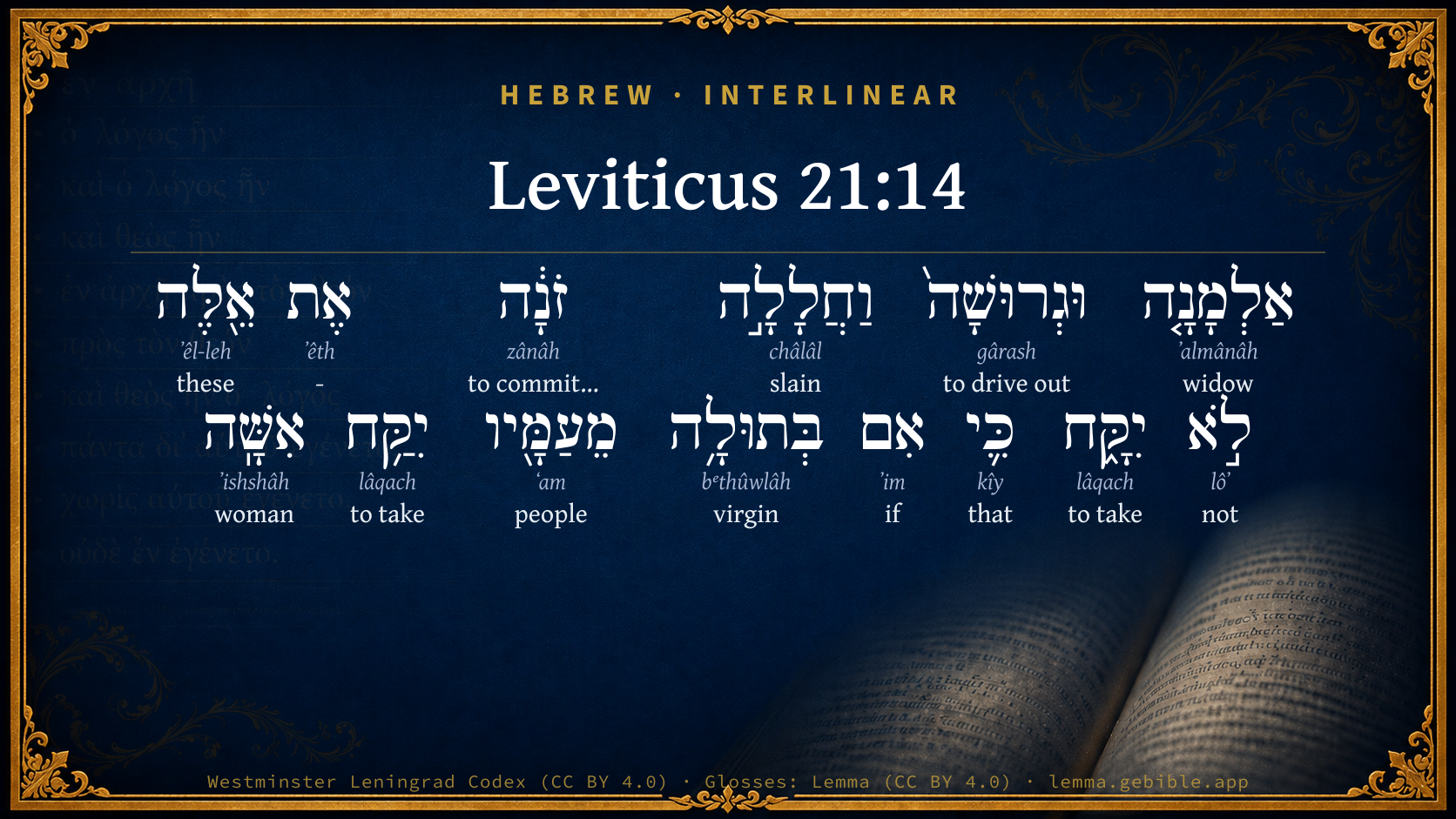
Leviticus 21:14

Hebrew (Westminster Leningrad Codex) Leviticus 21:14 appears in the Hebrew Old Testament. The text above is from the Westminster Leningrad Codex. Each word links to its Strong’s number, a concise gloss, and parsing drawn from the Open Scriptures Hebrew Bible morphology. Click any word for its full Brown-Driver-Briggs (BDB) entry.
Download image
Cite this verse

Leviticus 21:14 (World English Bible). Public Domain. Lemma interlinear Bible study tool, https://lemma.gebible.app/v/leviticus/21/14.

Show BibTeX & RIS
BibTeX
RIS
English Translation
A widow, or one divorced, or a woman who has been defiled, or a prostitute, these he shall not marry: but a virgin of his own people shall he take as a wife.
World English Bible · Public Domain
Download a study sheet

One document with this verse’s original text, its word-by-word gloss line, the meaning frame, cross-references with their text, attributed commentary, and full source and license credits — printable, and it pastes into notes with its structure intact.

This verse Autodidact and up

Study sheet (.html) Plain text (.txt)

A passage Seminary Student

Up to 50 verses in one chapter. A passage sheet keeps up to 6 commentary sources and 12 cross-references per verse, in the order this page ranks them, and says so on the sheet whenever that leaves anything out. Ask for a single verse and you get the Autodidact verse sheet above.

Everything on this page stays free to read, with no account — the sheet is a download of what is already on screen, not access to it.

Want to remove ads? Support Godless Engineer
Compare translations 3

The same verse in 3 English versions, stacked beneath the original-language interlinear above. Click any original word for its lexicon entry.

Each is an independent rendering of the whole verse — the interlinear is not word-aligned to these translations.

Highlighted words mark where these versions differ — a whole-verse word diff, not a word-by-word alignment.

  • World English Bible Public Domain
    A widow, or one divorced, or a woman who has been defiled, or a prostitute, these he shall not marry: but a virgin of his own people shall he take as a wife.
  • King James Version Public Domain
    A widow, or a divorced woman, or profane, or an harlot, these shall he not take: but he shall take a virgin of his own people to wife.
  • unfoldingWord Literal Text CC BY-SA 4.0
    A widow or a divorced or a profaned prostituting, these he shall not take. But rather, a virgin from his people he shall take a wife.

unfoldingWord Literal Text — © unfoldingWord, licensed CC BY-SA 4.0. Word-aligned USFM3 via Door43 (git.door43.org/unfoldingWord/en_ult).

Versions to compare (up to 4)

3 of 4 selected

Show all 18 translations

Every available English version of this verse, each an independent rendering of the whole verse.

  • World English Bible Public Domain
    A widow, or one divorced, or a woman who has been defiled, or a prostitute, these he shall not marry: but a virgin of his own people shall he take as a wife.
  • Berean Standard Bible Public Domain
    He is not to marry a widow, a divorced woman, or one defiled by prostitution. He is to marry a virgin from his own people,
  • Majority Standard Bible Public Domain
    He is not to marry a widow, a divorced woman, or one defiled by prostitution. He is to marry a virgin from his own people,
  • King James Version Public Domain
    A widow, or a divorced woman, or profane, or an harlot, these shall he not take: but he shall take a virgin of his own people to wife.
  • American Standard Version (1901) Public Domain
    A widow, or one divorced, or a profane woman, a harlot, these shall he not take: but a virgin of his own people shall he take to wife.
  • Revised Version (1885) Public Domain
    A widow, or one divorced, or a profane woman, an harlot, these shall he not take: but a virgin of his own people shall he take to wife.
  • Geneva Bible (1599) Public Domain
    But a widowe, or a diuorced woman, or a polluted, or an harlot, these shall he not marrie, but shall take a maide of his owne people to wife:
  • Douay-Rheims (1899) Public Domain
    But a widow or one that is divorced, or defiled, or a harlot, he shall not take, but a maid of his own people:
  • Young's Literal Translation Public Domain
    widow, or cast out, or polluted one -- a harlot -- these he doth not take, but a virgin of his own people he doth take `for' a wife,
  • Literal Standard Version CC BY-SA 4.0
    a widow, or cast out, or defiled, [or] a harlot—these he does not take, but he takes a virgin of his own people [for] a wife,
  • Unlocked Literal Bible CC BY-SA 4.0
    He must not marry a widow, a divorced woman, or a woman who is a prostitute. He will not marry these kinds of women. He may only marry a virgin from his own people,
  • unfoldingWord Literal Text CC BY-SA 4.0
    A widow or a divorced or a profaned prostituting, these he shall not take. But rather, a virgin from his people he shall take a wife.
  • Darby Bible Public Domain
    A widow, or a divorced woman, or a dishonoured one, a harlot, these shall he not take; but he shall take as wife a virgin from among his peoples.
  • World Messianic Bible Public Domain
    He shall not marry a widow, or one divorced, or a woman who has been defiled, or a prostitute. He shall take a virgin of his own people as a wife.
  • Webster's Bible Public Domain
    A widow, or a divorced woman, or profane, or a harlot, these shall he not take: but he shall take a virgin of his own people for a wife.
  • Free Bible Version CC BY-SA 4.0
    He must not marry a widow, a divorced woman, or one made unclean through prostitution. He has to marry a virgin from his own people,
  • Bible in Basic English Public Domain
    A widow, or one whose husband has put her away, or a common woman of loose behaviour, may not be the wife of a priest; but let him take a virgin from among his people.
  • JPS Tanakh (1917) Public Domain
    A widow, or one divorced, or a profaned woman, or a harlot, these shall he not take; but a virgin of his own people shall he take to wife.

Literal Standard Version (2020), Covenant Press — licensed CC BY-SA 4.0. Text via the HelloAO Bible API (eBible.org). Unlocked Literal Bible (unfoldingWord) — licensed CC BY-SA 4.0. Text via the HelloAO Bible API (eBible.org). unfoldingWord Literal Text — © unfoldingWord, licensed CC BY-SA 4.0. Word-aligned USFM3 via Door43 (git.door43.org/unfoldingWord/en_ult). Free Bible Version, Dr. Jonathan Gallagher — licensed CC BY-SA 4.0. Text via the HelloAO Bible API (eBible.org).

Word by word

More ways to search: Search by grammar → Find every occurrence → Compare this word →

Practice this passage: Drill this verse → Learn its vocabulary →

וּגְרוּשָׁה֙
gârash
H1644
“and · driven out”
Conjunction + Verb, Qal, Participle Passive, Feminine, Singular, Absolute
Part of Speech
Conjunction + Verb
Stem
Qal
Form
Participle Passive
Gender
Feminine
Number
Singular
State
Absolute
Full BDB Definition

Origin: a primitive root

TWOT: 388

to drive out, expel, cast out, drive away, divorce, put away, thrust away, trouble, cast up - (Qal) to thrust out, cast out - (Niphal) to be driven away, be tossed - (Piel) to drive out, drive away - (Pual) to be thrust out
  1. אַלְמָנָ֤ה ʼalmânâh H490 “widow” Noun, Common, Feminine, Singular, Absolute
  2. וַחֲלָלָ֣ה châlâl H2491 “and · slain” Conjunction + Adjective, Adjective, Feminine, Singular, Absolute
  3. זֹנָ֔ה zânâh H2181 “prostitute” Noun, Common, Feminine, Singular, Absolute
  4. אֶת ʼêth H853 “-” Particle, Direct Object
  5. אֵ֖לֶּה ʼêl-leh H428 “these” Pronoun, Demonstrative, Common, Plural
  6. לֹ֣א lôʼ H3808 “not” Particle, Negative
  7. יִקָּ֑ח lâqach H3947 “to take” Verb, Qal, Imperfect, 3rd Person, Masculine, Singular
  8. כִּ֛י kîy H3588 “that” Conjunction
  9. אִם ʼim H518 “if” Conjunction
  10. בְּתוּלָ֥ה bᵉthûwlâh H1330 “virgin” Noun, Common, Feminine, Singular, Absolute
  11. מֵעַמָּ֖יו ʻam H5971 “from · peoples · his” Preposition + Noun, Common, Masculine, Plural, Construct + Suffix, Personal, 3rd Person, Masculine, Singular
  12. יִקַּ֥ח lâqach H3947 “to take” Verb, Qal, Imperfect, 3rd Person, Masculine, Singular
  13. אִשָּֽׁה ʼishshâh H802 “woman” Noun, Common, Feminine, Singular, Absolute

About this verse

These counts appear in no published source. They are computed here, from the morphology-tagged text and Lemma’s own curated glosses. What Lemma adds →

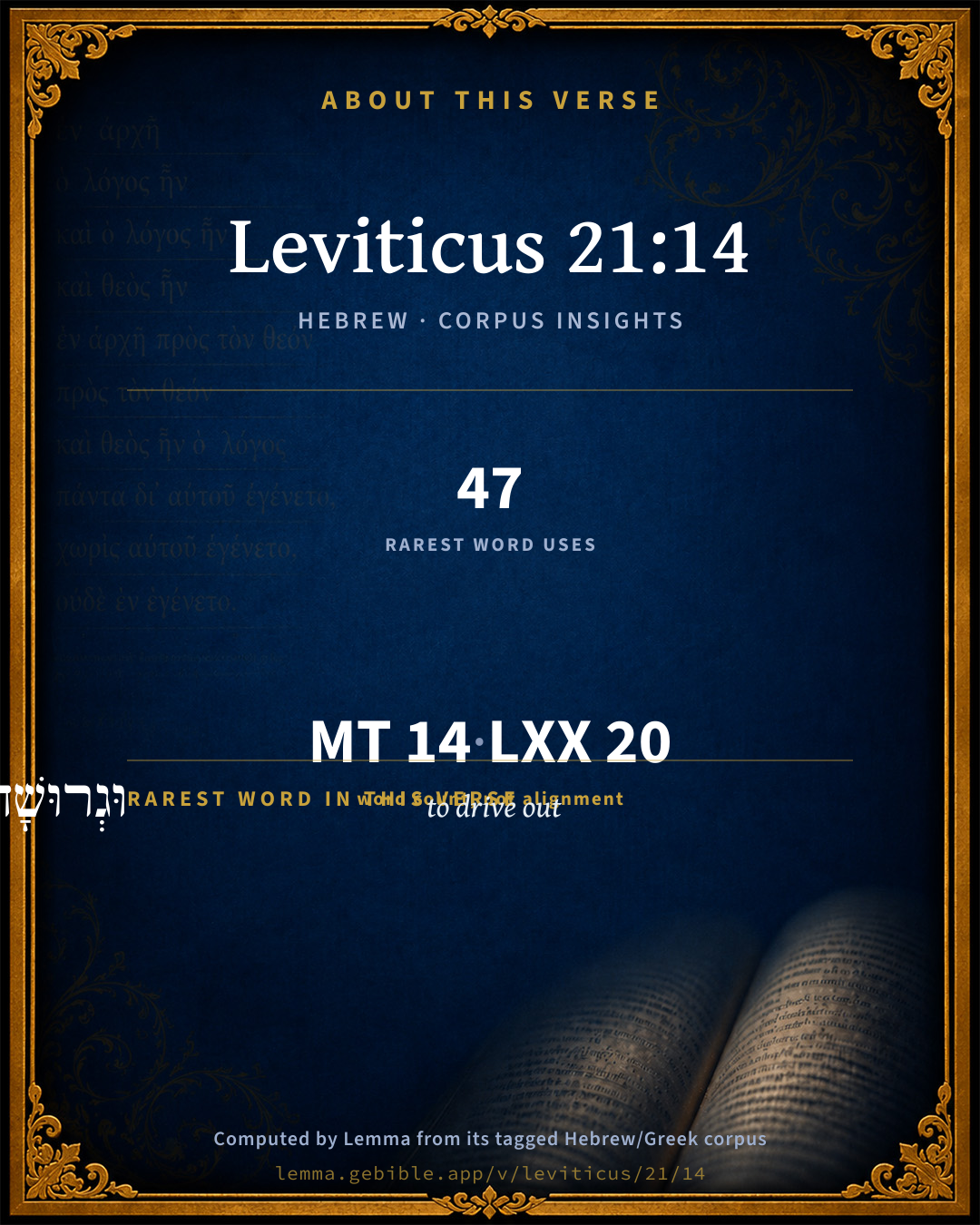
14
words
13
distinct lemmas
Pentateuch
section

Shared distinctive vocabulary

וּגְרוּשָׁה֙ to drive out H1644 occurs in 45 verses of the Hebrew Bible. Also found in:

Grammatical profile

  • 3 verbs
  • 5 nouns
  • 1 adjective
  • 1 pronoun
  • 2 conjunctions
  • 2 particles

Verb forms

  • וּגְרוּשָׁה֙ Qal · Participle Passive
  • יִקָּ֑ח Qal · Imperfect
  • יִקַּ֥ח Qal · Imperfect

Repetition

A word recurs within this verse — often emphatic in Hebrew:

  • יִקָּ֑ח to take H3947 ×2

Hebrew & Septuagint length

In English translation the verse runs 33 words from the Hebrew and 32 from the Septuagint (LXX English) — closely comparable.

A rough comparison of the two English renderings, which tokenize alike — not a word-level alignment.

Word counts can differ between the Hebrew and the Greek without any difference in meaning — e.g. the Hebrew direct-object marker אֵת has no separate Greek word, and Greek often adds the article ὁ.

In the original languages it is 14 Hebrew tokens and 20 Greek tokens — but the two are counted differently (Hebrew bundles its prefixes and suffixes into one token; the Greek is in lemma form), so that isn’t a like-for-like length.

Cross-references

2

Topical passages linked to Leviticus 21:14 in the Treasury of Scripture Knowledge — connected by theme and wording, ordered by reader-vote popularity; previews shown in the World English Bible.

  • Leviticus 21:7 "'They shall not marry a woman who is a prostitute, or profane; neither shall they marry a woman divorced from her husband: for he is holy to his God.
  • Ezekiel 44:22 Neither shall they take for their wives a widow, nor her who is put away; but they shall take virgins of the seed of the house of Israel, or a widow who is the widow of a priest.

Cross-references courtesy of OpenBible.info (CC BY 4.0).

Hebrew and Greek witnesses Masoretic Hebrew ↔ Greek Septuagint

The same verse in the two great witnesses to the Old Testament, shown verse-for-verse.

These are two independent witnesses, not word-aligned to each other, and the Septuagint is shown in lemma (dictionary) form.

Hebrew Leviticus 21:14 Masoretic · Westminster Leningrad Codex

אַלְמָנָ֤ה וּגְרוּשָׁה֙ וַחֲלָלָ֣ה זֹנָ֔ה אֶת אֵ֖לֶּה לֹ֣א יִקָּ֑ח כִּ֛י אִם בְּתוּלָ֥ה מֵעַמָּ֖יו יִקַּ֥ח אִשָּֽׁה

A widow, or one divorced, or a woman who has been defiled, or a prostitute, these he shall not marry: but a virgin of his own people shall he take as a wife.

World English Bible · Public Domain

Greek LXX Leviticus 21:14 Septuagint · lemma form

χήρα δέ καί ἐκβάλλω καί βεβηλόω καί πόρνη οὗτος οὐ λαμβάνω ἀλλά ἤ παρθένος ἐκ ὁ γένος αὐτός λαμβάνω γυνή

But a widow, or one that is put away, or profaned, or a harlot, these he shall not take; but he shall take for a wife a virgin of his own people.

LXX2012 (modern English Septuagint) · Public Domain

Hebrew: Westminster Leningrad Codex (CC BY 4.0). Greek: Septuagint (public domain); English from LXX2012 (modern English Septuagint) (Public Domain). How the Septuagint differs from the Hebrew →

Targum (Aramaic paraphrase)

2

The Targum is the ancient Jewish Aramaic paraphrase of the Hebrew Scriptures — an interpretive translation, not the Hebrew text itself. Onkelos (literal) and Pseudo-Jonathan (expansive) render the Torah, and Jonathan the Prophets. Coverage is partial: where no permissively-licensed English translation exists for a verse, only the Aramaic is shown. This is verse-level text, not a word-by-word alignment to the Hebrew.

  1. Targum Onkelos Torah (Genesis–Deuteronomy)
    אַרְמְלָא וּמְתָרְכָא וְחַלִילָא מַטְעֲיָא יָת אִלֵין לָא יִסָב אֱלָהֵין בְּתֻלְתָּא מֵעַמֵהּ יִסַב אִתְּתָא

    (no public-domain English translation for this verse)

    Targum Onkelos — Aramaic: “Onkelos Genesis” (public domain); “Onkelos Exodus” (public domain); “Onkelos Leviticus” (public domain); “Onkelos Numbers” (public domain); “Onkelos Deuteronomy” (public domain). English: “Sefaria Community Translation” (CC0 1.0 (public-domain dedication)); “J.W. Etheridge. The Targums of Onkelos and Jonathan Ben Uzziel on the Pentateuch. London: Longmans, Green, 1862” (public domain). Text via Sefaria.

  2. Targum Pseudo-Jonathan Torah (Genesis–Deuteronomy)
    אַרְמְלָא וּמִפְטְרָא וּדְאִיתְיְלִידָא מִן פִּיסוּלַיָא וּמַטְעַיָא בִּזְנוּ יַת אִילֵין לָא יִסַב אֱלָהֵן בְּתוּלְתָּא מִיכַשְׁרָא מִבְּנַת עַמֵיהּ יִסַב אִתְּתָא

    but a widow, or a divorced person, or one who was born of depraved parents, or who hath gone astray by fornication, such as these be shall not take; but a virgin proper shall he take to wife from the daughters of his people.

    Targum Pseudo-Jonathan — Aramaic: “Targum Jonathan on Genesis” (public domain); “Targum Jonathan on Exodus” (public domain); “Targum Jonathan on Leviticus” (public domain); “Targum Jonathan on Numbers” (public domain); “Targum Jonathan on Deuteronomy” (public domain). English: “The Targum of Jonathan ben Uzziel, trans. J. W. Etheridge, London, 1862” (public domain). Text via Sefaria.

Commentary

Notes on Leviticus 21:14 from classic Christian and Jewish commentators (each source and its license shown beneath its notes). The classic Christian expositions comment on the surrounding passage and are grouped to its opening verse, so a note may address several verses; the Jewish commentaries on the Tanakh (Rashi and others) are per-verse, so they appear only where the commentator wrote on this verse.

Lemma curates 59 commentaries, every one of them public domain or Creative Commons licensed, each selected and text-cleaned for this edition rather than reprinted as found. About our sources →

The Cambridge Bible for Schools and Colleges

gen. ed. J. J. S. Perowne

14. A widow] The rule for the high priest was thus stricter than that for an ordinary priest. The Jewish writer Rashi, in his commentary on the Talmudic treatise Chagigah (13a, Tal. Bab.), mentions this as one of the instances of apparent discrepancies between Ezekiel (Eze_44:22) and the Law (see Ryle, Canon, 203). Ezekiel (loc. cit.) allowed a priest, to marry a widow, provided she was the widow of a priest, whereas, according to the Law here, a high priest might not marry a widow. Ezekiel’s rule is, however, for priests. He does not say anything about the high priest. According to the law here, he must marry a virgin. As regards the rule for the ordinary priest, while Lev_21:7 does not say that he may marry a priest’s widow, Lev_21:14 may perhaps be taken to imply this.

of his own people] of the people of Israel, according to Ezekiel (loc. cit.), but the traditional practice was to marry a priest’s daughter, cp. Luk_1:5.

The Cambridge Bible for Schools and Colleges (gen. ed. J. J. S. Perowne; Cambridge University Press, 1878–1918) — public domain. Text from a community e-Sword module.

Trapp's Complete Commentary

John Trapp

Lev 21:14 A widow, or a divorced woman, or profane, [or] an harlot, these shall he not take: but he shall take a virgin of his own people to wife.

Ver. 14. Of his own people.] A Jewess of any tribe. {Eze 44:22 2Ch 22:11}

John Trapp, A Commentary or Exposition upon All the Books of the Old and New Testament (1647–1656) — public domain. Text from a community e-Sword module.

Geneva Bible (1599)

Geneva Bible translators

Not only of his tribe, but of all Israel.

Geneva Bible (1599) marginal notes — public domain. Text via Bolls.life.

Ellicott's Commentary for English Readers

(14) A widow.—By this the high priest was not only forbidden to marry the widow of an ordinary Israelite, or even the widow of a priest, but, according to the Jewish canons, a virgin who had been betrothed to another man, and whom she lost by death before they were married. If he, however, became engaged to a widow before he was elected to the pontificate, he could marry her after his consecration. He was, however, exempt from the obligation to marry the widow of his brother who died without issue. (See Lev_18:16.)

Or a divorced woman.—The classes of women which follow are also forbidden to the ordinary priests. (See Lev_21:7.)

A Bible Commentary for English Readers, edited by Charles John Ellicott (1878–1897) — public domain. Text from a community e-Sword module.

John Gill's Exposition

A widow,.... The high priest might not marry, whether the widow of a priest or of an Israelite, as Aben Ezra, that is, of any Israelite that was not of the priesthood; and this, whether a widow after espousals, or after marriage, as runs the Jewish canon (u); the meaning is, that if she was betrothed to a man, and that man died before he married her, and so was a virgin; yet being betrothed to him was reckoned as his widow; and such an one the high priest might not marry, any more than one that had been left a widow, having being married: though, according to the same constitutions, if he had betrothed a widow, and after that was appointed an high priest, he might marry her, and an instance of it is given in Joshua the son of Gamla: and in the same it is observed, that an high priest, when his brother dies, must suffer his shoe to be plucked off, and not marry his brother's widow; which, in other cases, when there was no issue, was required:

or a divorced woman; whether by a priest, or a common Israelite; and indeed, if a common priest might not marry such a person, much less an high priest: or profane anyone born of those that were not fit for priests to marry, as the Targum of Jonathan and Jarchi; See Gill on Lev 21:7,

or an harlot; a common prostitute:

those shall he not take any or either of them, to be his wife; which are forbid in order to maintain the dignity of his office, and a reverence of it: there seems to be a gradation in these instances, he might not marry a widow, which was forbidden no other man; and if not such an one, much less a divorced woman, still less a profane person, and least of all an harlot:

but he shall take a virgin of his own people to wife; which phrase, "of his own people", did not limit him to his own tribe, and to the fraternity of priests in it, as if he was to marry only in it, or the daughter of a priest; for the priests and Levites being scattered in the several tribes, and having no inheritances in them, were not restrained from marrying into other tribes, as the rest of the tribes were; and so an high priest sometimes married into another tribe, though he took care not to debase himself, by marrying into a mean family: so Jehoiada, the high priest, married Jehoshabeath, the daughter of King Jehoram, Ch2 22:11; but by this law he was forbid to marry a virgin of another nation, even though a proselytess and one that was made free, as Gersom observes; a captive virgin, and one that was become a Jewess, as Aben Ezra says, he was not allowed to marry.

(u) Misn. Yebamot, c. 6. sect. 4.

John Gill's Exposition of the Whole Bible (1746–1763) — public domain (CC PDM 1.0). Text via the HelloAO Bible API.

Haydock's Catholic Bible Commentary

Widow. Other priests might marry the widows of their fellow priests, Ezechiel xliv. 22.

George Leo Haydock (1774–1849), Haydock's Catholic Family Bible and Commentary, 1859 edition — public domain. Excludes Psalms (Douay-Rheims chapter numbering differs from Protestant) and Deuterocanonical books (Catholic canon only).

Matthew Poole's English Annotations

A widow; except she were the widow of his predecessor, which some gather from Eze 44:22. But that place speaks only of the common priest, not of the high priest.

Of his own people, i.e. either,

1. Of his own tribe, which is confuted by the examples of holy men; see 2Ch 22:11; or,

2. Of the seed of Israel, as it is explained Eze 44:22.

Matthew Poole's English Annotations on the Holy Bible (1683–1685) — public domain. Text from a community e-Sword/MySword module.

Rashi

Rabbi Shlomo Yitzchaki (Rashi)

וחללה OR A PROFANE [SHALL HE NOT TAKE] — i. e. a woman born from marriages forbidden to the priesthood alone (cf. v.7) (Sifra, Emor, Chapter 2 3).

Rashi on the Tanakh — English translations: “The Judaica Press complete Tanach with Rashi, translated by A. J. Rosenberg” (CC BY 4.0); “Pentateuch with Rashi's commentary by M. Rosenbaum and A.M. Silbermann, 1929-1934” (public domain); “The Metsudah Tanach series, Lakewood, N.J” (CC BY 4.0); and “The Book of Joshua, Metsudah Publications, 1997” (CC BY 4.0). Text via Sefaria.

Lesson kit

Teaching starters — assembled from the data on this page, not authored interpretation. Every prompt links to the verse data it draws on. Edit before teaching.

Leviticus, in the Pentateuch, opens this verse with 14 words (13 distinct Hebrew lemmas). Its most distinctive word is gârash (“to drive out”). A historical commentator’s framing appears above. Read the whole chapter for the surrounding context.

Discussion questions

  1. What does “to drive out” (gârash) contribute to the verse as a whole?
  2. Genesis 3:24 shares the word «to drive out» with this verse. How do the two illuminate each other?
  3. “to take” occurs 2× in this one verse. What is the effect of the repetition?
  4. The translations on this page render this verse differently — a whole-verse word diff, not a word-by-word alignment. What might account for the different wordings?
  5. The verb «וּגְרוּשָׁה֙» is Qal Participle Passive. How does its form color the action?
  6. Reading how The Cambridge Bible for Schools and Colleges and Trapp's Complete Commentary read this verse, where do the two commentators agree and where do they part?

Things to notice

Reading settings

Reading text

Shown beneath each verse's original-language words.

Old Testament
Old Testament edition

Read the OT as the Masoretic Hebrew (MT) or the Greek Septuagint (LXX).

English shown for the Greek Septuagint (in the Hebrew ↔ Greek comparison).

Comparing translations? Open the Compare panel on any verse page to stack up to four side by side.