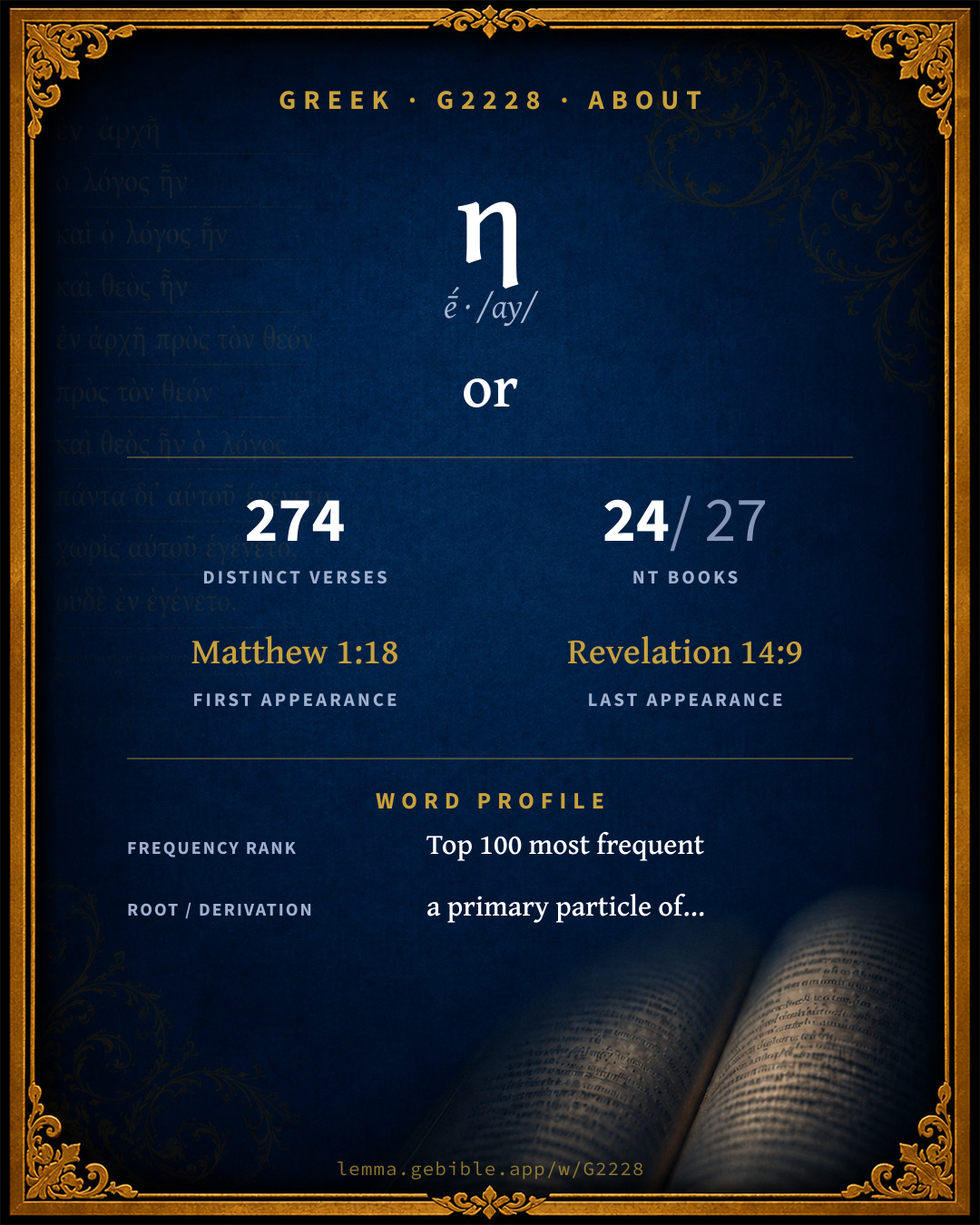
ἤ
or
Full lexicon entry — Thayer's Greek Lexicon
From Thayer's Greek Lexicon
Where this word appears
Grammar key — what these labels mean
Part of speech
- Particle
- A short, often untranslatable function word adding nuance or connection.
Every verse where G2228 appears in the Book of Matthew — 48 distinct verses. Click any verse to open its interlinear word-by-word view. Verse text shown in the World English Bible for context — . Each verse’s Greek form is shown with its reference; the English is not keyword-highlighted, since the data carries no word-level English alignment. Use “Compare translations” on any verse to read it across multiple English versions. This concordance covers the Greek New Testament; Septuagint (Greek Old Testament) occurrences of this word are not indexed here.
Matthew
- Matthew 1:18 ἢ ptcl Now the birth of Jesus Christ was like this; for after his mother, Mary, was engaged to Joseph, before they came together, she was found pregnant by the Holy Spirit.
- Matthew 5:17 ἢ ptcl "Don't think that I came to destroy the law or the prophets. I didn't come to destroy, but to fulfill.
- Matthew 5:18 ἢ ptcl For most assuredly, I tell you, until heaven and earth pass away, not even one smallest letter or one tiny pen stroke shall in any way pass away from the law, until all things are accomplished.
- Matthew 5:36 ἢ ptcl Neither shall you swear by your head, for you can't make one hair white or black.
- Matthew 6:24 ἢ ἢ ptcl ptcl "No one can serve two masters, for either he will hate the one and love the other; or else he will be devoted to one and despise the other. You can't serve both God and Mammon.
- Matthew 6:31 ἤ ἤ ptcl ptcl "Therefore don't be anxious, saying, 'What will we eat?', 'What will we drink?' or, 'With what will we be clothed?'
- Matthew 7:4 ἢ ptcl Or how will you tell your brother, 'Let me remove the speck from your eye;' and behold, the beam is in your own eye?
- Matthew 7:9 ἢ ptcl Or who is there among you, who, if his son asks him for bread, will give him a stone?
- Matthew 7:10 ἢ ptcl Or if he asks for a fish, who will give him a serpent?
- Matthew 7:16 ἢ ptcl By their fruits you will know them. Do you gather grapes from thorns, or figs from thistles?
- Matthew 9:5 ἢ ptcl For which is easier, to say, 'Your sins are forgiven;' or to say, 'Get up, and walk?'
- Matthew 10:11 ἢ ptcl Into whatever city or village you enter, find out who in it is worthy; and stay there until you go on.
- Matthew 10:14 ἢ ptcl Whoever doesn't receive you, nor hear your words, as you go out of that house or that city, shake off the dust from your feet.
- Matthew 10:15 ἢ ptcl Most assuredly I tell you, it will be more tolerable for the land of Sodom and Gomorrah in the day of judgment than for that city.
- Matthew 10:19 ἢ ptcl But when they deliver you up, don't be anxious how or what you will say, for it will be given you in that hour what you will say.
- Matthew 10:37 ἢ ἢ ptcl ptcl He who loves father or mother more than me is not worthy of me; and he who loves son or daughter more than me isn't worthy of me.
- Matthew 11:3 ἢ ptcl and said to him, "Are you he who comes, or should we look for another?"
- Matthew 11:22 ἢ ptcl But I tell you, it will be more tolerable for Tyre and Sidon on the day of judgment than for you.
- Matthew 11:24 ἢ ptcl But I tell you that it will be more tolerable for the land of Sodom, on the day of judgment, than for you."
- Matthew 12:5 ἢ ptcl Or have you not read in the law, that on the Sabbath day, the priests in the temple profane the Sabbath, and are guiltless?
- Matthew 12:25 ἢ ptcl Knowing their thoughts, Jesus said to them, "Every kingdom divided against itself is brought to desolation, and every city or house divided against itself will not stand.
- Matthew 12:29 ἢ ptcl Or how can one enter into the house of the strong man, and plunder his goods, unless he first bind the strong man? Then he will plunder his house.
- Matthew 12:33 Ἢ ἢ ptcl ptcl "Either make the tree good, and its fruit good, or make the tree corrupt, and its fruit corrupt; for the tree is known by its fruit.
- Matthew 13:21 ἢ ptcl yet he has no root in himself, but endures for a while. When oppression or persecution arises because of the word, immediately he stumbles.
- Matthew 15:4 ἢ ptcl For God commanded, 'Honor your father and your mother,' and, 'He who speaks evil of father or mother, let him be put to death.'
- Matthew 15:5 ἢ ἢ ptcl ptcl But you say, 'Whoever may tell his father or his mother, "Whatever help you might otherwise have gotten from me is a gift devoted to God,"
- Matthew 16:14 ἢ ptcl They said, "Some say John the Baptizer, some, Elijah, and others, Jeremiah, or one of the prophets."
- Matthew 16:26 ἢ ptcl For what will it profit a man, if he gains the whole world, and forfeits his life? Or what will a man give in exchange for his life?
- Matthew 17:25 ἢ ἢ ptcl ptcl He said, "Yes." When he came into the house, Jesus anticipated him, saying, "What do you think, Simon? From whom do the kings of the earth receive toll or tribute? From their children, or from strangers?"
- Matthew 18:8 ἢ ἢ ἢ ἢ ptcl ptcl ptcl ptcl If your hand or your foot causes you to stumble, cut it off, and cast it from you. It is better for you to enter into life maimed or crippled, rather than having two hands or two feet to be cast into the eternal fire.
- Matthew 18:9 ἢ ptcl If your eye causes you to stumble, pluck it out, and cast it from you. It is better for you to enter into life with one eye, rather than having two eyes to be cast into the Gehenna of fire.
- Matthew 18:13 ἢ ptcl If he finds it, most assuredly I tell you, he rejoices over it more than over the ninety-nine which have not gone astray.
- Matthew 18:16 ἢ ἢ ptcl ptcl But if he doesn't listen, take one or two more with you, that at the mouth of two or three witnesses every word may be established.
- Matthew 18:20 ἢ ptcl For where two or three are gathered together in my name, there I am in the midst of them."
- Matthew 19:24 ἢ ptcl Again I tell you, it is easier for a camel to go through a needle's eye, than for a rich man to enter into the Kingdom of God."
- Matthew 19:29 ἢ ἢ ἢ ἢ ἢ ἢ ptcl ptcl ptcl ptcl ptcl ptcl Everyone who has left houses, or brothers, or sisters, or father, or mother, or wife, or children, or lands, for my name's sake, will receive one hundred times, and will inherit eternal life.
- Matthew 20:15 ἢ ἢ ptcl ptcl Isn't it lawful for me to do what I want to with what I own? Or is your eye evil, because I am good?'
- Matthew 21:25 ἢ ptcl The baptism of John, where was it from? From heaven or from men?" They reasoned with themselves, saying, "If we say, 'From heaven,' he will ask us, 'Why then did you not believe him?'
- Matthew 22:17 ἢ ptcl Tell us therefore, what do you think? Is it lawful to pay taxes to Caesar, or not?"
- Matthew 23:17 ἢ ptcl You blind fools! For which is greater, the gold, or the temple that sanctifies the gold?
- Matthew 23:19 ἢ ptcl You blind fools! For which is greater, the gift, or the altar that sanctifies the gift?
- Matthew 24:23 ἤ ptcl "Then if any man tells you, 'Behold, here is the Christ,' or, 'There,' don't believe it.
- Matthew 25:37 ἢ ptcl "Then the righteous will answer him, saying, 'Lord, when did we see you hungry, and feed you; or thirsty, and give you a drink?
- Matthew 25:38 ἢ ptcl When did we see you as a stranger, and take you in; or naked, and clothe you?
- Matthew 25:39 ἢ ptcl When did we see you sick, or in prison, and come to you?'
- Matthew 25:44 ἢ ἢ ἢ ἢ ἢ ptcl ptcl ptcl ptcl ptcl "Then they will also answer, saying, 'Lord, when did we see you hungry, or thirsty, or a stranger, or naked, or sick, or in prison, and didn't help you?'
- Matthew 26:53 ἢ ptcl Or do you think that I couldn't ask my Father, and he would even now send me more than twelve legions of angels?
- Matthew 27:17 ἢ ptcl When therefore they were gathered together, Pilate said to them, "Whom do you want me to release to you? Barabbas, or Jesus, who is called Christ?"
About this entry
At a glance — auto-summarized from this page’s data, not written by a person. Every figure links to its source below. This summary describes the numbers; it doesn’t interpret them.
At its core, η (ḗ) means “or.” Scripture first uses it in Matthew 1:18. It appears 274 verses across 24 books of the Greek New Testament, among its common vocabulary. It clusters with η, ηδη and ηπερ under a shared root. Each statement above links to its evidence; the full detail follows below.
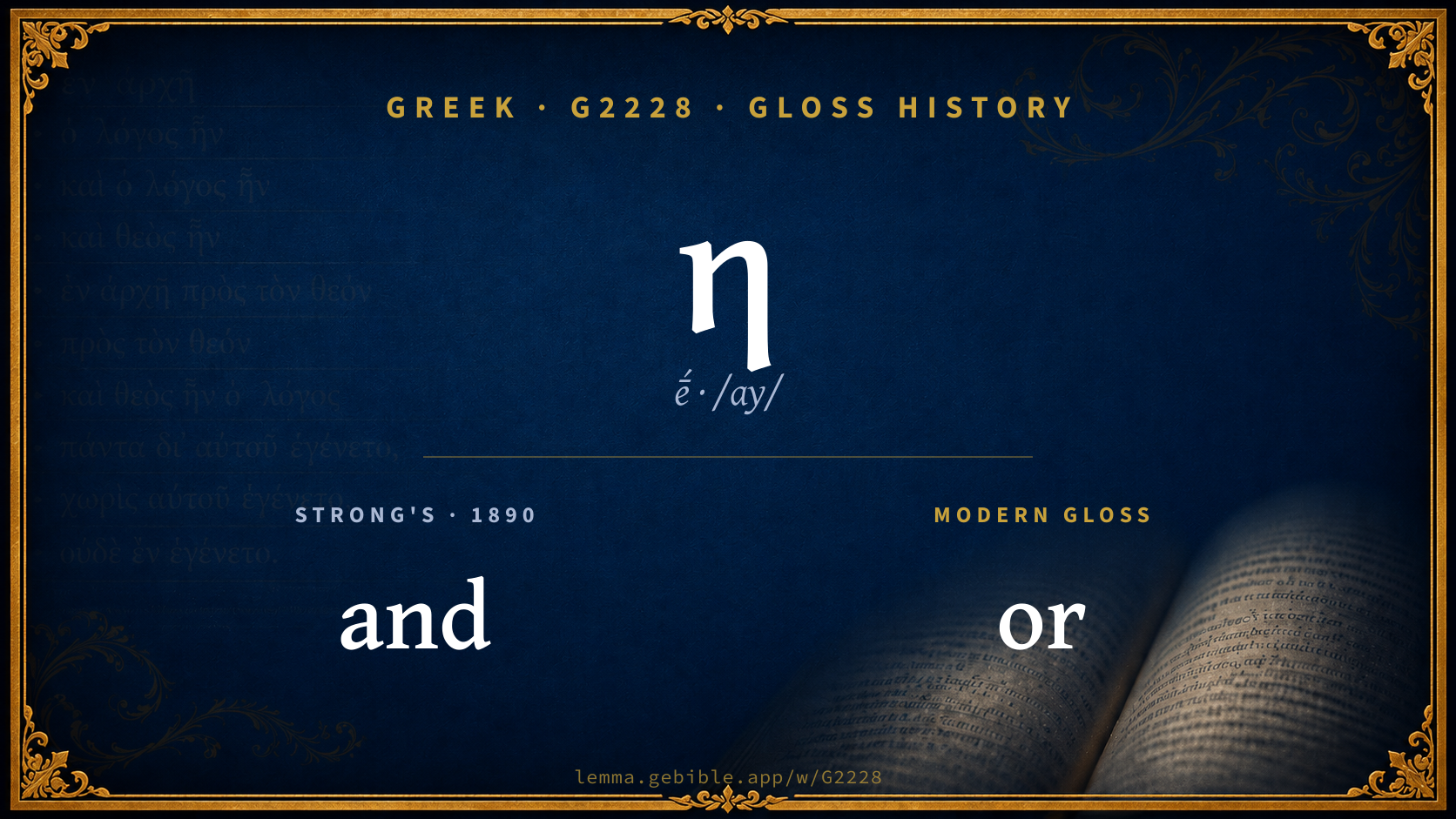
Gloss history
Strong's 1890 vs modern scholarship
About this word
Strong's G2228 catalogs a Greek word from the Greek New Testament.
These counts are not copied from any lexicon or concordance. They are computed here, from the morphology-tagged Greek New Testament. What Lemma adds →
- 274
- distinct verses
- The word appears in 274 distinct verses.
- 24 / 27
- NT books
- The word appears in 24 of 27 New Testament books.
- #51
- by frequency
- Top 100 most frequent Greek words (rank 51 of 5,347 Greek words by occurrence).
View all 274 occurrences in the concordance →
Most concentrated in
- Matthew 48 verses 18%
- Luke 40 verses 15%
- 1 Corinthians 40 verses 15%
By section of the New Testament
By traditional corpus
Conventional, traditional groupings — biblical authorship is debated, so this is a traditional corpus grouping, not an authorship claim. Some books belong to more than one corpus (Luke is in both the Gospels and the Lukan corpus, and so on), so these shares overlap and need not total 100%. Each figure is a share of the word’s 274 distinct verses.
- Gospels 122 verses · 45%
- Pauline corpus 98 verses · 36%
- Lukan (Luke–Acts) 70 verses · 26%
- Johannine 17 verses · 6%
- General (Catholic) Epistles 16 verses · 6%
- Hebrews 4 verses · 1%
- Revelation 4 verses · 1%
How translations render this word
Counts come from each version’s own published word-to-Strong’s tagging or interlinear alignment — an approximate guide to how each version renders this word, not a word-level alignment the data otherwise carries. Because each total is that version’s own tagged count, the per-version totals vary from one another and need not match the appearance or distinct-verse counts above. These counts may also differ from a printed concordance because Lemma counts each distinctly tagged rendering and does not collapse phrase taggings into a single head-word total. This is a fixed set of word-tagged versions (KJV, ASV, BSB, ULT) and does not change with the reading translation you choose elsewhere. Each version’s license is shown beside its name below (and on Sources).
- King James Version: Or 258×, Than 32×, Either 9×
- American Standard Version: Or 242×, Than 27×, Rather than 7×
- Berean Standard Bible: Or 238×, Than 32×, Than for 3×
- unfoldingWord Literal Text: Or 291×, Than 34×, Either 5×
King James Version Public Domain
Renders G2228 across 338 tagged occurrences — most commonly:
Plus 16 renderings that appear only once — usually multi-word phrases or single function words the recovered tagging swept in, not distinct renderings. Not rendered by a distinct English word in 19 further occurrences.
American Standard Version Public Domain
Renders G2228 across 323 tagged occurrences — most commonly:
Plus 27 renderings that appear only once — usually multi-word phrases or single function words the recovered tagging swept in, not distinct renderings. Not rendered by a distinct English word in 1 further occurrence.
Berean Standard Bible Public Domain
Renders G2228 across 290 tagged occurrences — most commonly:
Plus 13 renderings that appear only once — usually multi-word phrases or single function words the recovered tagging swept in, not distinct renderings. Not rendered by a distinct English word in 52 further occurrences.
unfoldingWord Literal Text CC BY-SA 4.0
Renders G2228 across 347 tagged occurrences — most commonly:
Plus 10 renderings that appear only once — usually multi-word phrases or single function words the recovered tagging swept in, not distinct renderings.
Senses in Thayer's
The 1 sense Thayer's distinguishes for this word, in lexicon order (not ranked by frequency or importance). The full entry — with sub-senses — is in the Lexicon Entry tab.
- either, or, than
Word origin
Origin: a primary particle of distinction between two connected terms
A primary particle of distinction between two connected terms; disjunctive or ; comparative than : - and but (either) (n-) either except it be (n-) or (else) rather save than that what yea. Often used in connection with other particles. Compare especially G2235 G2260 G2273 .
— Strong’s Exhaustive Concordance (1890), public domain.
Forms in the corpus
The 3 distinct written forms G2228 takes in the Greek New Testament, most frequent first — each parse links to that case’s occurrences in the concordance.
| Form | Parsing | Example | Uses |
|---|---|---|---|
| ἢ ḕ | Particle | Matthew 1:18 | 333 |
| ἤ ḗ | Particle | Matthew 6:31 | 9 |
| Ἢ Ḕ | Particle | Matthew 12:33 | 4 |
Same root — word family
Other Thayer's entries built from the same root as G2228, grouped by Strong’s listed origin. These share a root / origin per the lexicon — not necessarily a shared meaning. Each links to that word’s own entry.
Derived from this word
Compare all same-root words → Showing 4 of 5 — not the complete family. They share a root, not necessarily a meaning.
Septuagint usage
The same Greek word η appears 810 times in the Greek Old Testament (Septuagint), across 639 verses in 36 books.
- 810
- LXX occurrences
- Tagged occurrences of this Greek word in the Septuagint.
- 639
- verses
- Distinct Septuagint verses containing this word.
- 36 / 39
- OT books
- The word appears in 36 of the 39 Old Testament books.
Sample Septuagint occurrences
- Genesis 19:9 ἤ
- Exodus 1:19 ἤ
- Leviticus 1:14 ἤ
- Numbers 5:6 ἤ
- Deuteronomy 1:39 ἤ
- Joshua 2:8 ἤ
- Judges 2:22 ἤ
- Ruth 1:13 ἤ
- 1 Samuel 2:10 ἤ
- 2 Samuel 2:21 ἤ
- 1 Kings 2:42 ἤ
- 2 Kings 2:9 ἤ
Septuagint occurrences (same lexeme)
Every verse where the same Strong’s number (G2228) appears in the Greek Septuagint — showing the first 50 of 639. Verse text shown in the World English Bible for context; the Greek form is the matched word — the English is not keyword-highlighted.
- Genesis 19:9 ἤ They said, "Stand back!" They said, "This one fellow came in to live as a foreigner, and he appoints himself a judge. Now will we deal worse with you, than with them!" They pressed hard on the man, even Lot, and drew near to break the door.
- Genesis 19:12 ἤ The men said to Lot, "Do you have anybody else here? Sons-in-law, your sons, your daughters, and whoever you have in the city, bring them out of the place:
- Genesis 21:26 ἤ Abimelech said, "I don't know who has done this thing. Neither did you tell me, neither did I hear of it, until today."
- Genesis 22:17 ἦ that in blessing I will bless you, and in multiplying I will multiply your seed as the stars of the heavens, and as the sand which is on the seashore. Your seed will possess the gate of his enemies.
- Genesis 24:21 ἤ The man looked steadfastly at her, holding his peace, to know whether Yahweh had made his journey prosperous or not.
- Genesis 24:38 ἤ but you shall go to my father's house, and to my relatives, and take a wife for my son.'
- Genesis 24:49 ἤ Now if you will deal kindly and truly with my master, tell me. If not, tell me. That I may turn to the right hand, or to the left."
- Genesis 26:11 ἤ Abimelech charged all the people, saying, "He who touches this man or his wife will surely be put to death."
- Genesis 27:21 ἤ Isaac said to Jacob, "Please come near, that I may feel you, my son, whether you are really my son Esau or not."
- Genesis 28:17 ἤ He was afraid, and said, "How dreadful is this place! This is none other than God's house, and this is the gate of heaven."
- Genesis 29:19 ἤ Laban said, "It is better that I give her to you, than that I should give her to another man. Stay with me."
- Genesis 29:26 ἤ Laban said, "It is not done so in our place, to give the younger before the first born.
- Genesis 29:30 ἤ He went in also to Rachel, and he loved also Rachel more than Leah, and served with him yet seven other years.
- Genesis 31:14 ἤ Rachel and Leah answered him, "Is there yet any portion or inheritance for us in our father's house?
- Genesis 31:43 ἤ Laban answered Jacob, "The daughters are my daughters, the children are my children, the flocks are my flocks, and all that you see is mine: and what can I do this day to these my daughters, or to their children whom they have borne?
- Genesis 37:8 ἤ His brothers said to him, "Will you indeed reign over us? Or will you indeed have dominion over us?" They hated him all the more for his dreams and for his words.
- Genesis 37:32 ἤ They took the coat of many colors, and they brought it to their father, and said, "We have found this. Examine it, now, whether it is your son's coat or not."
- Genesis 38:26 ἤ Judah acknowledged them, and said, "She is more righteous than I, because I didn't give her to Shelah, my son." He knew her again no more.
- Genesis 42:16 ἤἦ Send one of you, and let him get your brother, and you shall be bound, that your words may be tested, whether there is truth in you, or else by the life of Pharaoh surely you are spies."
- Genesis 44:8 ἤ Behold, the money, which we found in our sacks' mouths, we brought again to you out of the land of Canaan. How then should we steal silver or gold out of your lord's house?
- Genesis 44:16 ἤ Judah said, "What will we tell my lord? What will we speak? Or how will we clear ourselves? God has found out the iniquity of your servants. Behold, we are my lord's bondservants, both we, and he also in whose hand the cup is found."
- Genesis 44:19 ἤ My lord asked his servants, saying, 'Have you a father, or a brother?'
- Genesis 45:8 ἤ So now it wasn't you who sent me here, but God, and he has made me a father to Pharaoh, lord of all his house, and ruler over all the land of Egypt.
- Genesis 47:18 ἤ When that year was ended, they came to him the second year, and said to him, "We will not hide from my lord how our money is all spent, and the herds of cattle are my lord's. There is nothing left in the sight of my lord, but our bodies, and our lands.
- Genesis 49:12 ἤ His eyes will be red with wine, His teeth white with milk.
- Exodus 1:19 ἤ The midwives said to Pharaoh, "Because the Hebrew women aren't like the Egyptian women; for they are vigorous, and give birth before the midwife comes to them."
- Exodus 5:3 ἤ They said, "The God of the Hebrews has met with us. Please let us go three days' journey into the wilderness, and sacrifice to Yahweh, our God, lest he fall on us with pestilence, or with the sword."
- Exodus 7:9 ἤ "When Pharaoh speaks to you, saying, 'Perform a miracle!' then you shall tell Aaron, 'Take your rod, and cast it down before Pharaoh, that it become a serpent.'"
- Exodus 10:7 ἤ Pharaoh's servants said to him, "How long will this man be a snare to us? Let the men go, that they may serve Yahweh, their God. Don't you yet know that Egypt is destroyed?"
- Exodus 12:9 ἤ Don't eat it raw, nor boiled at all with water, but roasted with fire; with its head, its legs and its inner parts.
- Exodus 12:44 ἤ but every man's servant who is bought for money, when you have circumcised him, then shall he eat of it.
- Exodus 12:45 ἤ A foreigner and a hired servant shall not eat of it.
- Exodus 13:12 ἤ that you shall set apart to Yahweh all that opens the womb, and every firstborn which you have that comes from an animal. The males shall be Yahweh's.
- Exodus 14:12 ἤ Isn't this the word that we spoke to you in Egypt, saying, 'Leave us alone, that we may serve the Egyptians?' For it were better for us to serve the Egyptians, than that we should die in the wilderness."
- Exodus 16:4 ἤ Then said Yahweh to Moses, "Behold, I will rain bread from the sky for you, and the people shall go out and gather a day's portion every day, that I may test them, whether they will walk in my law, or not.
- Exodus 16:8 ἤ Moses said, "Now Yahweh shall give you meat to eat in the evening, and in the morning bread to satisfy you; because Yahweh hears your murmurings which you murmur against him. And who are we? Your murmurings are not against us, but against Yahweh."
- Exodus 17:7 ἤ He called the name of the place Massah, and Meribah, because the children of Israel quarreled, and because they tested Yahweh, saying, "Is Yahweh among us, or not?"
- Exodus 19:13 ἤ No hand shall touch him, but he shall surely be stoned or shot through; whether it is animal or man, he shall not live.' When the trumpet sounds long, they shall come up to the mountain."
- Exodus 21:4 ἤ If his master gives him a wife and she bears him sons or daughters, the wife and her children shall be her master's, and he shall go out by himself.
- Exodus 21:15 ἤ "Anyone who attacks his father or his mother shall be surely put to death.
- Exodus 21:16 ἤ "Anyone who kidnaps someone and sells him, or if he is found in his hand, he shall surely be put to death.
- Exodus 21:18 ἤ "If men quarrel and one strikes the other with a stone, or with his fist, and he doesn't die, but is confined to bed;
- Exodus 21:20 ἤ "If a man strikes his servant or his maid with a rod, and he dies under his hand, he shall surely be punished.
- Exodus 21:21 ἤ Notwithstanding, if he gets up after a day or two, he shall not be punished, for he is his property.
- Exodus 21:26 ἤ "If a man strikes his servant's eye, or his maid's eye, and destroys it, he shall let him go free for his eye's sake.
- Exodus 21:27 ἤ If he strikes out his man-servant's tooth, or his maid-servant's tooth, he shall let him go free for his tooth's sake.
- Exodus 21:28 ἤ "If a bull gores a man or a woman to death, the bull shall surely be stoned, and its flesh shall not be eaten; but the owner of the bull shall not be held responsible.
- Exodus 21:29 ἤ But if the bull had a habit of goring in the past, and it has been testified to its owner, and he has not kept it in, but it has killed a man or a woman, the bull shall be stoned, and its owner shall also be put to death.
- Exodus 21:31 ἤ Whether it has gored a son or has gored a daughter, according to this judgment it shall be done to him.
- Exodus 21:32 ἤ If the bull gores a man-servant or a maid-servant, thirty shekels of silver shall be given to their master, and the ox shall be stoned.
These are occurrences of the same Greek lexeme (G2228) in the Septuagint — not a translation of any one Hebrew word. The store carries no word-level Hebrew↔Greek alignment, so no Hebrew original is asserted here. Counts come from the recovered LXX Strong's tagging — high-frequency vocabulary is well covered, while rare or late forms may be untagged — so they reflect tagged occurrences and may slightly undercount.