
Exodus 12:45

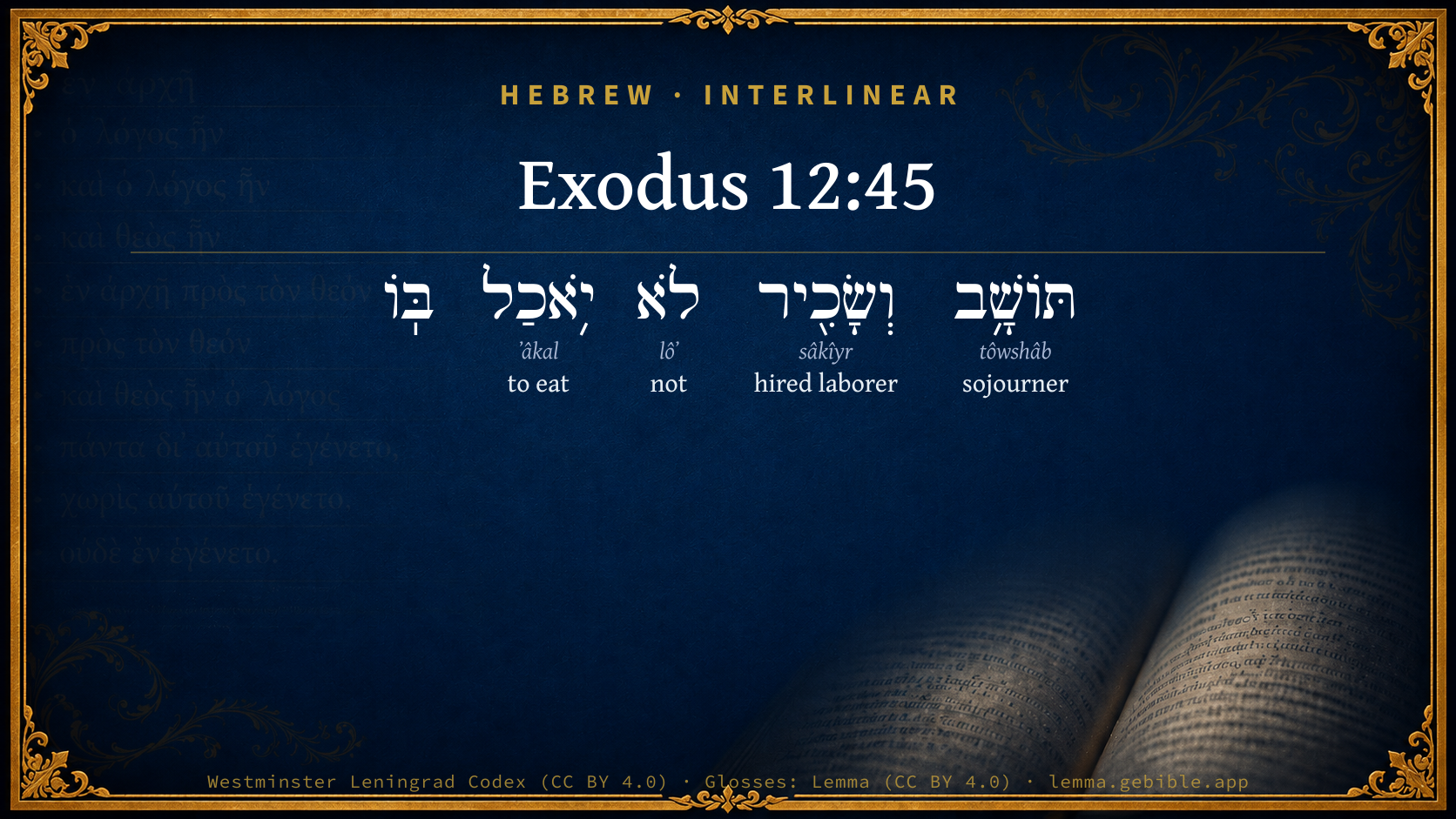
Hebrew (Westminster Leningrad Codex) Exodus 12:45 appears in the Hebrew Old Testament. The text above is from the Westminster Leningrad Codex. Each word links to its Strong’s number, a concise gloss, and parsing drawn from the Open Scriptures Hebrew Bible morphology. Click any word for its full Brown-Driver-Briggs (BDB) entry.
Download image
Cite this verse

Exodus 12:45 (World English Bible). Public Domain. Lemma interlinear Bible study tool, https://lemma.gebible.app/v/exodus/12/45.

Show BibTeX & RIS
BibTeX
RIS
English Translation
A foreigner and a hired servant shall not eat of it.
World English Bible · Public Domain
Highlights
  • 1 first appearance in the Hebrew Bible
Full analysis ↓
Download a study sheet

One document with this verse’s original text, its word-by-word gloss line, the meaning frame, cross-references with their text, attributed commentary, and full source and license credits — printable, and it pastes into notes with its structure intact.

This verse Autodidact and up

Study sheet (.html) Plain text (.txt)

A passage Seminary Student

Up to 50 verses in one chapter. A passage sheet keeps up to 6 commentary sources and 12 cross-references per verse, in the order this page ranks them, and says so on the sheet whenever that leaves anything out. Ask for a single verse and you get the Autodidact verse sheet above.

Everything on this page stays free to read, with no account — the sheet is a download of what is already on screen, not access to it.

Want to remove ads? Support Godless Engineer
Compare translations 3

The same verse in 3 English versions, stacked beneath the original-language interlinear above. Click any original word for its lexicon entry.

Each is an independent rendering of the whole verse — the interlinear is not word-aligned to these translations.

Highlighted words mark where these versions differ — a whole-verse word diff, not a word-by-word alignment.

  • World English Bible Public Domain
    A foreigner and a hired servant shall not eat of it.
  • King James Version Public Domain
    A foreigner and an hired servant shall not eat thereof.
  • unfoldingWord Literal Text CC BY-SA 4.0
    An outsider or a hireling shall not eat it.

unfoldingWord Literal Text — © unfoldingWord, licensed CC BY-SA 4.0. Word-aligned USFM3 via Door43 (git.door43.org/unfoldingWord/en_ult).

Versions to compare (up to 4)

3 of 4 selected

Show all 18 translations

Every available English version of this verse, each an independent rendering of the whole verse.

  • World English Bible Public Domain
    A foreigner and a hired servant shall not eat of it.
  • Berean Standard Bible Public Domain
    A temporary resident or hired hand shall not eat the Passover.
  • Majority Standard Bible Public Domain
    A temporary resident or hired hand shall not eat the Passover.
  • King James Version Public Domain
    A foreigner and an hired servant shall not eat thereof.
  • American Standard Version (1901) Public Domain
    A sojourner and a hired servant shall not eat thereof.
  • Revised Version (1885) Public Domain
    A sojourner and an hired servant shall not eat thereof.
  • Geneva Bible (1599) Public Domain
    A stranger or an hyred seruant shall not eat thereof.
  • Douay-Rheims (1899) Public Domain
    The stranger and the hireling shall not eat thereof.
  • Young's Literal Translation Public Domain
    a settler or hired servant doth not eat of it;
  • Literal Standard Version CC BY-SA 4.0
    a settler or hired servant does not eat of it;
  • Unlocked Literal Bible CC BY-SA 4.0
    Foreigners and hired servants must not eat any of the food.
  • unfoldingWord Literal Text CC BY-SA 4.0
    An outsider or a hireling shall not eat it.
  • Darby Bible Public Domain
    A settler and a hired servant shall not eat it.
  • World Messianic Bible Public Domain
    A foreigner and a hired servant shall not eat of it.
  • Webster's Bible Public Domain
    A foreigner, and a hired servant shall not eat of it.
  • Free Bible Version CC BY-SA 4.0
    Foreign visitors or those hired from other nations shall not eat the Passover.
  • Bible in Basic English Public Domain
    A man from a strange country living among you, and a servant working for payment, may not take part in it.
  • JPS Tanakh (1917) Public Domain
    A sojourner and a hired servant shall not eat thereof.

Literal Standard Version (2020), Covenant Press — licensed CC BY-SA 4.0. Text via the HelloAO Bible API (eBible.org). Unlocked Literal Bible (unfoldingWord) — licensed CC BY-SA 4.0. Text via the HelloAO Bible API (eBible.org). unfoldingWord Literal Text — © unfoldingWord, licensed CC BY-SA 4.0. Word-aligned USFM3 via Door43 (git.door43.org/unfoldingWord/en_ult). Free Bible Version, Dr. Jonathan Gallagher — licensed CC BY-SA 4.0. Text via the HelloAO Bible API (eBible.org).

Word by word

More ways to search: Search by grammar → Find every occurrence → Compare this word →

Practice this passage: Drill this verse → Learn its vocabulary →

About this verse

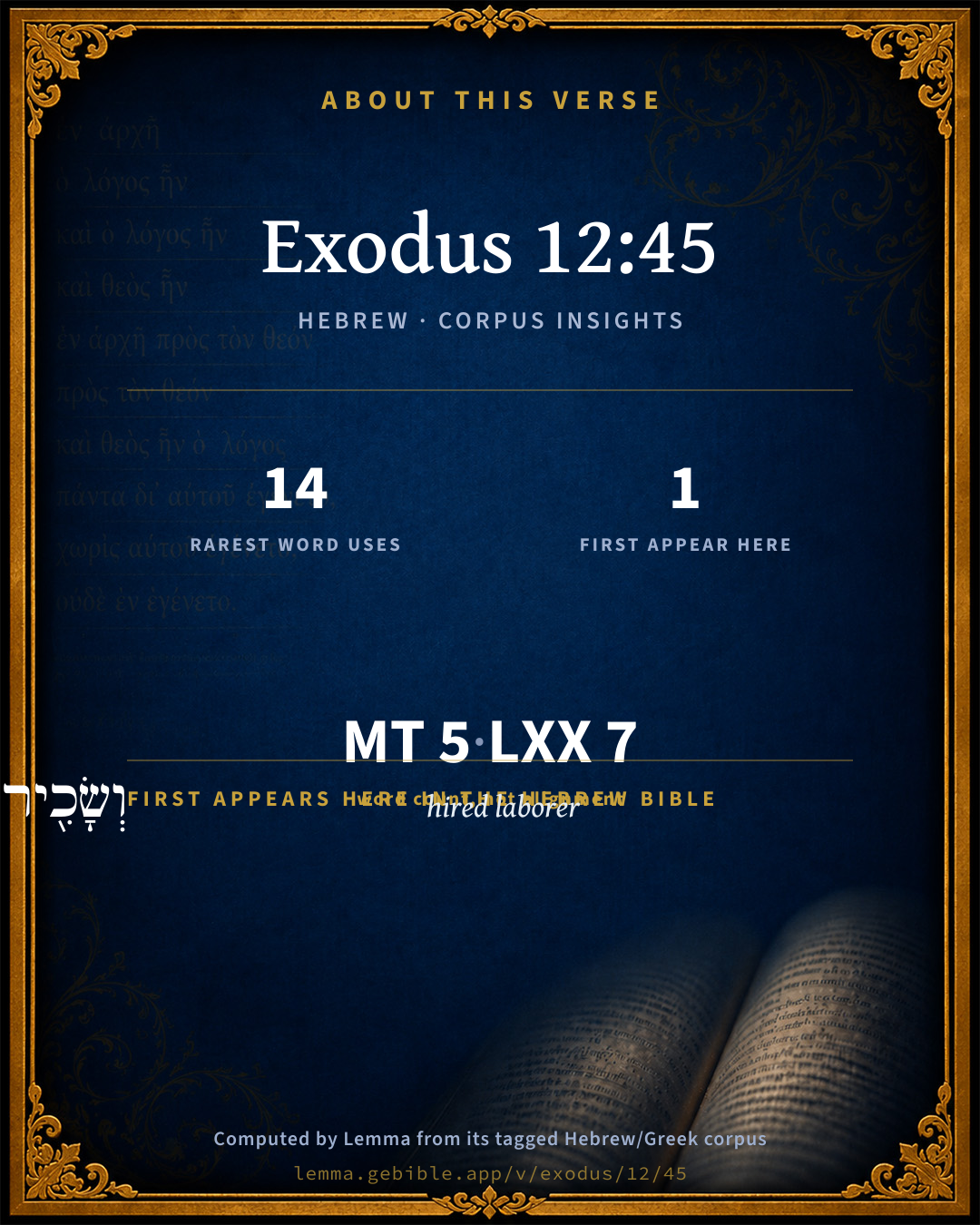
These counts appear in no published source. They are computed here, from the morphology-tagged text and Lemma’s own curated glosses. What Lemma adds →

5
words
4
distinct lemmas
Pentateuch
section

Notable vocabulary

The rarest word here is תּוֹשָׁ֥ב sojourner H8453 — appearing just 14 times in the whole Hebrew Bible.

First appearance in Scripture

This word makes its first canonical appearance in the Hebrew Bible here:

  • וְשָׂכִ֖יר hired laborer H7916

Shared distinctive vocabulary

תּוֹשָׁ֥ב sojourner H8453 occurs in 13 verses of the Hebrew Bible. Also found in:

Grammatical profile

  • 1 verb
  • 1 noun
  • 1 adjective
  • 1 preposition
  • 1 particle

Verb forms

  • יֹ֥אכַל Qal · Imperfect

Hebrew & Septuagint length

In English translation the verse runs 11 words from the Hebrew and 9 from the Septuagint (LXX English) — closely comparable.

A rough comparison of the two English renderings, which tokenize alike — not a word-level alignment.

Word counts can differ between the Hebrew and the Greek without any difference in meaning — e.g. the Hebrew direct-object marker אֵת has no separate Greek word, and Greek often adds the article ὁ.

In the original languages it is 5 Hebrew tokens and 7 Greek tokens — but the two are counted differently (Hebrew bundles its prefixes and suffixes into one token; the Greek is in lemma form), so that isn’t a like-for-like length.

Cross-references

2

Topical passages linked to Exodus 12:45 in the Treasury of Scripture Knowledge — connected by theme and wording, ordered by reader-vote popularity; previews shown in the World English Bible.

  • Leviticus 22:10 "'No stranger shall eat of the holy thing: a foreigner living with the priests, or a hired servant, shall not eat of the holy thing.
  • Ephesians 2:12 that you were at that time separate from Christ, alienated from the commonwealth of Israel, and strangers from the covenants of the promise, having no hope and without God in the world.

Cross-references courtesy of OpenBible.info (CC BY 4.0).

Hebrew and Greek witnesses Masoretic Hebrew ↔ Greek Septuagint

The same verse in the two great witnesses to the Old Testament, shown verse-for-verse.

These are two independent witnesses, not word-aligned to each other, and the Septuagint is shown in lemma (dictionary) form.

Hebrew Exodus 12:45 Masoretic · Westminster Leningrad Codex

תּוֹשָׁ֥ב וְשָׂכִ֖יר לֹא יֹ֥אכַל בּֽוֹ

A foreigner and a hired servant shall not eat of it.

World English Bible · Public Domain

Greek LXX Exodus 12:45 Septuagint · lemma form

πάροικος ἤ μισθωτός οὐ ἐσθίω ἀπό αὐτός

A sojourner or hireling shall not eat of it.

LXX2012 (modern English Septuagint) · Public Domain

On this verse, The Cambridge Bible for Schools and Colleges discusses the Septuagint’s reading. Read the note in Commentary ↓

Hebrew: Westminster Leningrad Codex (CC BY 4.0). Greek: Septuagint (public domain); English from LXX2012 (modern English Septuagint) (Public Domain). How the Septuagint differs from the Hebrew →

Targum (Aramaic paraphrase)

2

The Targum is the ancient Jewish Aramaic paraphrase of the Hebrew Scriptures — an interpretive translation, not the Hebrew text itself. Onkelos (literal) and Pseudo-Jonathan (expansive) render the Torah, and Jonathan the Prophets. Coverage is partial: where no permissively-licensed English translation exists for a verse, only the Aramaic is shown. This is verse-level text, not a word-by-word alignment to the Hebrew.

  1. Targum Onkelos Torah (Genesis–Deuteronomy)
    תּוֹתָבָא וַאֲגִירָא לָא יֵכוּל בֵּהּ:

    (no public-domain English translation for this verse)

    Targum Onkelos — Aramaic: “Onkelos Genesis” (public domain); “Onkelos Exodus” (public domain); “Onkelos Leviticus” (public domain); “Onkelos Numbers” (public domain); “Onkelos Deuteronomy” (public domain). English: “Sefaria Community Translation” (CC0 1.0 (public-domain dedication)); “J.W. Etheridge. The Targums of Onkelos and Jonathan Ben Uzziel on the Pentateuch. London: Longmans, Green, 1862” (public domain). Text via Sefaria.

  2. Targum Pseudo-Jonathan Torah (Genesis–Deuteronomy)
    דַּיוֹר תּוֹתַב וַאֲגִירָא נוּכְרָאָה לָא יֵיכוֹל בֵּיהּ

    A sojourner or a hired stranger shall not eat thereof.

    Targum Pseudo-Jonathan — Aramaic: “Targum Jonathan on Genesis” (public domain); “Targum Jonathan on Exodus” (public domain); “Targum Jonathan on Leviticus” (public domain); “Targum Jonathan on Numbers” (public domain); “Targum Jonathan on Deuteronomy” (public domain). English: “The Targum of Jonathan ben Uzziel, trans. J. W. Etheridge, London, 1862” (public domain). Text via Sefaria.

Commentary

Notes on Exodus 12:45 from classic Christian and Jewish commentators (each source and its license shown beneath its notes). The classic Christian expositions comment on the surrounding passage and are grouped to its opening verse, so a note may address several verses; the Jewish commentaries on the Tanakh (Rashi and others) are per-verse, so they appear only where the commentator wrote on this verse.

Lemma curates 59 commentaries, every one of them public domain or Creative Commons licensed, each selected and text-cleaned for this edition rather than reprinted as found. About our sources →

Trapp's Complete Commentary

John Trapp

Exo 12:45 A foreigner and an hired servant shall not eat thereof.

Ver. 45. A foreigner.] Unless a proselyte.

John Trapp, A Commentary or Exposition upon All the Books of the Old and New Testament (1647–1656) — public domain. Text from a community e-Sword module.

Joseph Benson's Commentary

Exo 12:45; Exo 12:48. A hired servant — Unless he submit to be circumcised. All the congregation of Israel must keep it — Though it was observed in families apart, yet it is looked upon as the act of the whole congregation. And so the New Testament passover, the Lord’s supper, ought not to be neglected by any that are capable of celebrating it. No stranger that was uncircumcised might eat of it. Neither may any now approach the Lord’s supper who have not first submitted to baptism; nor shall any partake of the benefit of Christ’s sacrifice, who are not first circumcised in heart. Any stranger that was circumcised might eat of the passover, even servants. Here is an indication of favour to the poor Gentiles, that the stranger, if circumcised, stands upon the same level with the home-born Israelite; one law for both. This was a mortification to the Jews, and taught them that it was their dedication to God, not their descent from Abraham, that entitled them to their privileges.

Joseph Benson's Commentary on the Old and New Testaments (1811–1818) — public domain. Text from a community e-Sword module.

Adam Clarke's Commentary

Verse 45. A foreigner] תושב toshab, from ישב yashab, to sit down or dwell; one who is a mere sojourner, for the purpose of traffic, merchandise, c., but who is neither a proselyte of the gate nor of the covenant.

And a hired servant] Who, though he be bought with money, or has indented himself for a certain term to serve a Jew, yet has not become either a proselyte of the gate or of the covenant. None of these shall eat of it, because not circumcised - not brought under the bond of the covenant and not being under obligation to observe the Mosaic law, had no right to its privileges and blessings. Even under the Gospel of our Lord Jesus Christ, he is the author of eternal salvation only to them who OBEY him, Heb 5:9; and those who become Christians are chosen to salvation through SANCTIFICATION of the Spirit, and belief of the truth, 2Th 2:13; for the grace of God, that bringeth salvation to all men, hath appeared, teaching us that, DENYING UNGODLINESS and WORLDLY LUSTS we should live SOBERLY, RIGHTEOUSLY, and GODLY, in this present world; Tit 2:11-12. Such persons only walk worthy of the vocation wherewith they are called.

Adam Clarke's Commentary on the Bible (1810–1826) — public domain. Text from a community e-Sword/MySword module.

Ellicott's Commentary for English Readers

(45) An hired servant.—It is assumed that the hired servant will be a foreigner; otherwise, of course, he would participate.

A Bible Commentary for English Readers, edited by Charles John Ellicott (1878–1897) — public domain. Text from a community e-Sword module.

The Cambridge Bible for Schools and Colleges

gen. ed. J. J. S. Perowne

45. The settler (tôshâb) and hired servant are not to eat of it. The technical distinction between the tôshâb and the gêr (v. 48) is not altogether clear. To judge from the etymology, the tôshâb was a foreigner, more permanently ‘settled’ in Israel than an ordinary gêr, and also perhaps (Lev_22:10; Lev_25:6) more definitely attached to a particular family (LXX. usually πάροικος), but, like the gêr, without civil rights, and dependent for his position on the good-will of his patronus (cf. Gen_23:4, Lev_25:23, Psa_39:12, 1Ch_29:15): the word also occurs Lev_25:35; Lev_25:40; Lev_25:45; Lev_25:47 (twice), Num_35:15. RV. ‘sojourner,’ except Lev_25:6; Lev_25:45 ‘stranger.’ See further Bertholet, Die Stellung der Isr. zu den Fremden (1896), p. 157 ff. (cf. 172 f.), Bä. p. 107, EB. iv. 4818. The ‘hired servant’ is associated, as here, in Lev_22:10; Lev_25:6; Lev_25:40, with the tôshâb, and in Lev_22:10 with the gêr as well, as having both similar disqualifications, and (Exo_25:39 f.) similar rights; evidently he is to be thought of as a foreigner (cf. Lev_25:6 ‘that sojourn with thee’), whose rights are limited, and who is hired by his master, for fixed wages, for a longer or a shorter time. Why the same permission is not given to the ‘settler’ as to the ‘sojourner’ (v. 48) to partake of the Passover, if he is circumcised, is not apparent; perhaps (cf. Bertholet, 159) he is included in v. 48 in the more general term gêr (cf. Lev_Exo_25:6 end).

The Cambridge Bible for Schools and Colleges (gen. ed. J. J. S. Perowne; Cambridge University Press, 1878–1918) — public domain. Text from a community e-Sword module.

John Gill's Exposition

One law shall be to him that is homeborn,.... A proper Israelite, one that is so by descent:

and unto the stranger that sojourneth among you; that becomes a proselyte to the true religion; these were both bound by the same law, and obliged to observe the same rites and ceremonies, and partook of the same ordinances, benefits, and privileges; this was a dawn of grace to the poor Gentiles, and presignified what would be in Gospel times, when they should be fellow citizens with the saints, and of the household of God, be fellow heirs of the same body, and partakers of the promises of Christ by the Gospel, Eph 2:19.

John Gill's Exposition of the Whole Bible (1746–1763) — public domain (CC PDM 1.0). Text via the HelloAO Bible API.

Albert Barnes' Notes on the Bible

A foreigner - or sojourner: one who resides in a country, not having a permanent home, nor being attached to an Israelitish household.

Albert Barnes' Notes on the Bible (1834–1885) — public domain. Text from a community e-Sword/MySword module.

Matthew Poole's English Annotations

Except he submit to circumcision, as Exo 12:43. See Num 9:14.

Matthew Poole's English Annotations on the Holy Bible (1683–1685) — public domain. Text from a community e-Sword/MySword module.

The Pulpit Commentary

A foreigner. Literally "a so-journeri.e., a foreigner who is merely passing through the land, or staying for a time, without intending to become a permanent resident. The Septuagint paroikov well expresses the meaning. A hired servant. It is assumed that the "hired servant" will be a foreigner; and intended to guard against any compulsion being put upon him.

The Pulpit Commentary (1880–1919), ed. H.D.M. Spence-Jones & Joseph S. Exell — public domain. Text from a community e-Sword module.

John Wesley's Explanatory Notes

An hired servant - Unless he submit to be circumcised.

John Wesley, Explanatory Notes Upon the Whole Bible (1754–1765) — public domain. Text via the GEBible commentary corpus.

unfoldingWord translationNotes

Door43 World Missions Community

The food must be eaten in one house

This can be stated in active form. AT: "Each Israelite family must eat the food in one house" (See: Active or Passive)

you must not break any bone of it

"you must not break any of its bones." Here the word "it" refers to the lamb which the Israelite family will eat.

translationWords

alien

servant

unfoldingWord translationNotes — © Distant Shores Media and the Door43 World Missions Community, licensed CC BY-SA 4.0. Source: git.door43.org/Door43/en_tn.

Rashi

Rabbi Shlomo Yitzchaki (Rashi)

תושב A TOLERATED SOJOURNER — this means a stranger who has settled in Palestine (having undertaken to observe the seven precepts of the “Sons of Noah”).

ושכיר AND A HIRED SERVANT — a heathen. But why need Scripture state at all that these (the תושב and the שכיר) may not eat of the Passover lamb? These are uncircumcised and it is said (v. 48) “And no uncircumcised person shall eat thereof”? But it refers to such a one as a circumcised Arabian or a circumcised Gibeonite who is a settler or a hired servant (Mekhilta; Yevamot 71a).

Rashi on the Tanakh — English translations: “The Judaica Press complete Tanach with Rashi, translated by A. J. Rosenberg” (CC BY 4.0); “Pentateuch with Rashi's commentary by M. Rosenbaum and A.M. Silbermann, 1929-1934” (public domain); “The Metsudah Tanach series, Lakewood, N.J” (CC BY 4.0); and “The Book of Joshua, Metsudah Publications, 1997” (CC BY 4.0). Text via Sefaria.

Ramban (Nachmanides)

Rabbi Moshe ben Nachman (Ramban / Nachmanides)

TOSHAV’ (A SOJOURNER) ‘V’SACHIR’ (AND A HIRED SERVANT) SHALL NOT EAT THEREOF. “Toshav is a resident non-Israelite [who has foresworn idolatry, but has not as yet been fully converted to Judaism]. A ‘sachir’ is a non-Israelite. But why should Scripture mention all these? They are uncircumcised, [and an uncircumcised person may not eat of the Passover-offering]! However, it refers to a circumcised Arabian or a circumcised Gibeonite.” ” (Mechilta here). Thus the language of Rashi.I do not know why the Rabbi [Rashi] wrote down matters which are rejected in the Gemara. The Rabbis have objected to this explanation [that the verse refers to a circumcised Arabian or a circumcised Gibeonite], asking: “Are these considered circumcised?! Have we not been taught that he who vows not to have benefit from the uncircumcised is permitted to have benefit from the uncircumcised of Israel, but not from the circumcised of other nations, as it is written, For all the nations are uncircumcised, but all the house of Israel are uncircumcised in the heart?” Instead, the Rabbis [there in the Gemara] explained the verse as referring to a proselyte who was circumcised but who has not yet undergone immersion.

Ramban (Nachmanides) on the Tanakh — English translation: “Commentary on the Torah by Ramban (Nachmanides). Translated and annotated by Charles B. Chavel. New York, Shilo Pub. House, 1971-1976” (CC BY 4.0). Text via Sefaria.

Lesson kit

Teaching starters — assembled from the data on this page, not authored interpretation. Every prompt links to the verse data it draws on. Edit before teaching.

Exodus, in the Pentateuch, opens this verse with 5 words (4 distinct Hebrew lemmas). Its most distinctive word is tôwshâb (“sojourner”). A historical commentator’s framing appears above. Read the whole chapter for the surrounding context.

Discussion questions

  1. The word tôwshâb carries the sense “sojourner.” How does it shape the verse?
  2. The word “hired laborer” first appears here in Scripture. What is being introduced at this debut?
  3. Genesis 23:4 shares the word «sojourner» with this verse. How do the two illuminate each other?
  4. These translations render this verse differently. What is at stake in choosing one wording over another?
  5. The verb «יֹ֥אכַל» is Qal Imperfect. How does its form color the action?
  6. Reading how Trapp's Complete Commentary and Joseph Benson's Commentary read this verse, where do the two commentators agree and where do they part?

Things to notice

Reading settings

Reading text

Shown beneath each verse's original-language words.

Old Testament
Old Testament edition

Read the OT as the Masoretic Hebrew (MT) or the Greek Septuagint (LXX).

English shown for the Greek Septuagint (in the Hebrew ↔ Greek comparison).

Comparing translations? Open the Compare panel on any verse page to stack up to four side by side.