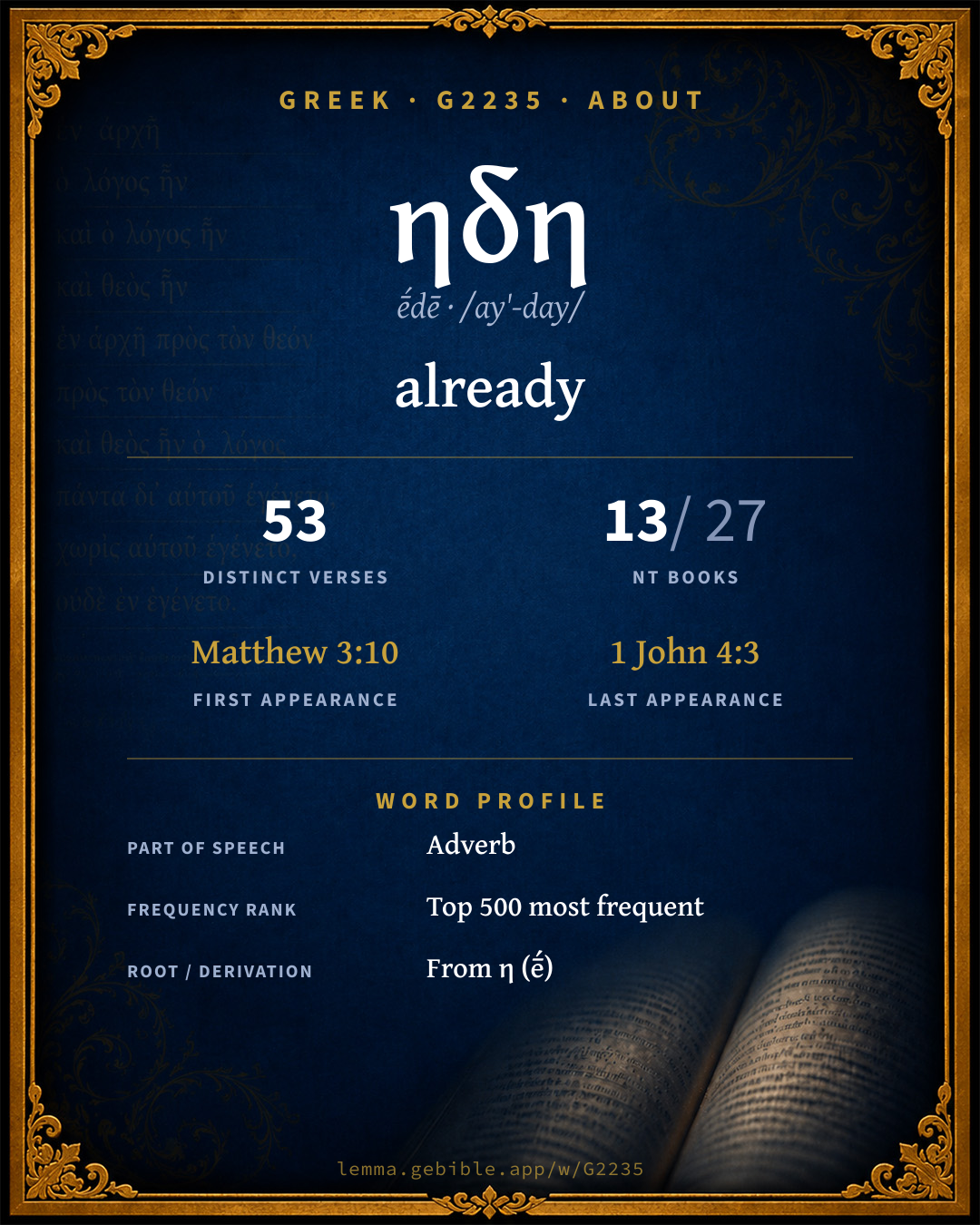
ἤδη
already
Full lexicon entry — Thayer's Greek Lexicon
From Thayer's Greek Lexicon
Where this word appears
Grammar key — what these labels mean
Part of speech
- Adverb
- A word that modifies a verb, adjective, or other adverb.
Every verse where G2235 appears — 53 distinct verses across 13 books. Click any verse to open its interlinear word-by-word view. Verse text shown in the World English Bible for context — . Each verse’s Greek form is shown with its reference; the English is not keyword-highlighted, since the data carries no word-level English alignment. Use “Compare translations” on any verse to read it across multiple English versions. This concordance covers the Greek New Testament; Septuagint (Greek Old Testament) occurrences of this word are not indexed here.
Matthew 7 verses
- Matthew 3:10 ἤδη adv "Even now the axe lies at the root of the trees. Therefore, every tree that doesn't bring forth good fruit is cut down, and cast into the fire.
- Matthew 5:28 ἤδη adv but I tell you that everyone who gazes at a woman to lust after her has committed adultery with her already in his heart.
- Matthew 14:15 ἤδη adv When evening had come, his disciples came to him, saying, "This place is deserted, and the hour is already late. Send the multitudes away, that they may go into the villages, and buy themselves food."
- Matthew 14:24 ἤδη adv But the boat was now in the middle of the sea, distressed by the waves, for the wind was contrary.
- Matthew 15:32 ἤδη adv Jesus summoned his disciples and said, "I have compassion on the multitude, because they continue with me now three days and have nothing to eat. I don't want to send them away fasting, or they might faint on the way."
- Matthew 17:12 ἤδη adv but I tell you that Elijah has come already, and they didn't recognize him, but did to him whatever they wanted to. Even so the Son of Man will also suffer by them."
- Matthew 24:32 ἤδη adv "Now from the fig tree learn this parable. When its branch has now become tender, and puts forth its leaves, you know that the summer is near.
Mark 7 verses
- Mark 4:37 ἤδη adv There arose a great wind storm, and the waves beat into the boat, so much that the boat was already filled.
- Mark 6:35 ἤδη ἤδη adv adv When it was late in the day, his disciples came to him, and said, "This place is deserted, and it is late in the day.
- Mark 8:2 ἤδη adv "I have compassion on the multitude, because they have stayed with me now three days, and have nothing to eat.
- Mark 11:11 ἤδη adv Jesus entered into the temple in Jerusalem. When he had looked around at everything, it being now evening, he went out to Bethany with the twelve.
- Mark 13:28 ἤδη adv "Now from the fig tree, learn this parable. When the branch has now become tender, and puts forth its leaves, you know that the summer is near;
- Mark 15:42 ἤδη adv When evening had now come, because it was the Preparation Day, that is, the day before the Sabbath,
- Mark 15:44 ἤδη adv Pilate marveled if he were already dead; and summoning the centurion, he asked him whether he had been dead long.
Luke 9 verses
- Luke 3:9 ἤδη adv Even now the axe also lies at the root of the trees. Every tree therefore that doesn't bring forth good fruit is cut down, and thrown into the fire."
- Luke 7:6 ἤδη adv Jesus went with them. When he was now not far from the house, the centurion sent friends to him, saying to him, "Lord, don't trouble yourself, for I am not worthy for you to come under my roof.
- Luke 11:7 ἤδη adv and he from within will answer and say, 'Don't bother me. The door is now shut, and my children are with me in bed. I can't get up and give it to you'?
- Luke 12:49 ἤδη adv "I came to throw fire on the earth. I wish it were already kindled.
- Luke 14:17 ἤδη adv He sent out his servant at supper time to tell those who were invited, 'Come, for everything is ready now.'
- Luke 19:37 ἤδη adv As he was now getting near, at the descent of the Mount of Olives, the whole multitude of the disciples began to rejoice and praise God with a loud voice for all the mighty works which they had seen,
- Luke 21:30 ἤδη ἤδη adv adv When they are already budding, you see it and know by your own selves that the summer is already near.
- Luke 23:44 ἤδη adv It was now about the sixth hour, and darkness came over the whole land until the ninth hour.
- Luke 24:29 ἤδη adv They urged him, saying, "Stay with us, for it is almost evening, and the day is almost over." He went in to stay with them.
John 14 verses
- John 3:18 ἤδη adv He who believes in him is not judged. He who doesn't believe has been judged already, because he has not believed in the name of the one and only Son of God.
- John 4:36 ἤδη adv He who reaps receives wages, and gathers fruit to eternal life; that both he who sows and he who reaps may rejoice together.
- John 4:51 ἤδη adv As he was now going down, his servants met him and reported, saying "Your child lives!"
- John 5:6 ἤδη adv When Jesus saw him lying there, and knew that he had been sick for a long time, he asked him, "Do you want to be made well?"
- John 7:14 Ἤδη adv But when it was now the midst of the feast, Jesus went up into the temple and taught.
- John 9:22 ἤδη adv His parents said these things because they feared the Jews; for the Jews had already agreed that if any man would confess him as Christ, he would be put out of the synagogue.
- John 9:27 ἤδη adv He answered them, "I told you already, and you didn't listen. Why do you want to hear it again? You don't also want to become his disciples, do you?"
- John 11:39 ἤδη adv Jesus said, "Take away the stone." Martha, the sister of him who was dead, said to him, "Lord, by this time there is a stench, for he has been dead four days."
- John 13:2 ἤδη adv After supper, the devil having already put into the heart of Judas Iscariot, Simon's son, to betray him,
- John 15:3 ἤδη adv You are already pruned clean because of the word which I have spoken to you.
- John 19:28 ἤδη adv After this, Jesus, seeing that all things were now finished, that the Scripture might be fulfilled, said, "I am thirsty."
- John 19:33 ἤδη adv but when they came to Jesus, and saw that he was already dead, they didn't break his legs.
- John 21:4 ἤδη adv But when day had already come, Jesus stood on the beach, yet the disciples didn't know that it was Jesus.
- John 21:14 ἤδη adv This is now the third time that Jesus was revealed to his disciples, after he had risen from the dead.
Acts 2 verses
Romans 2 verses
1 Corinthians 3 verses
- 1 Corinthians 4:8 ἤδη ἤδη adv adv You are already filled. You have already become rich. You have come to reign without us. Yes, and I wish that you did reign, that we also might reign with you.
- 1 Corinthians 5:3 ἤδη adv For I most assuredly, as being absent in body but present in spirit, have already, as though I were present, judged him who has done this thing.
- 1 Corinthians 6:7 ἤδη adv Therefore it is already altogether a defect in you, that you have lawsuits one with another. Why not rather be wronged? Why not rather be defrauded?
Philippians 2 verses
- Philippians 3:12 ἤδη ἤδη adv adv Not that I have already obtained, or am already made perfect; but I press on, if it is so that I may take hold of that for which also I was taken hold of by Christ Jesus.
- Philippians 4:10 ἤδη adv But I rejoice in the Lord greatly, that now at length you have revived your thought for me; in which you did indeed take thought, but you lacked opportunity.
2 Thessalonians 1 verse
1 Timothy 1 verse
2 Timothy 2 verses
2 Peter 1 verse
1 John 2 verses
- 1 John 2:8 ἤδη adv Again, I write a new commandment to you, which is true in him and in you; because the darkness is passing away, and the true light already shines.
- 1 John 4:3 ἤδη adv and every spirit who doesn't confess that Jesus Christ has come in the flesh is not of God, and this is the spirit of the antichrist, of whom you have heard that it comes. Now it is in the world already.
About this entry
At a glance — auto-summarized from this page’s data, not written by a person. Every figure links to its source below. This summary describes the numbers; it doesn’t interpret them.
ηδη (ḗdē) is a Greek verb most often rendered “already.” Scripture first uses it in Matthew 3:10. Spanning 53 verses in 13 books, it ranks among the moderately common words of the Greek New Testament. John dominates its distribution — 14 of 53 verses. Sharing its root, it stands alongside η, η and ηπερ. The sections below give every sense, occurrence, and version rendering.
Gloss history
Strong's 1890 vs modern scholarship
About this word
Strong's G2235 catalogs a Greek word from the Greek New Testament.
These counts are not copied from any lexicon or concordance. They are computed here, from the morphology-tagged Greek New Testament. What Lemma adds →
- 53
- distinct verses
- The word appears in 53 distinct verses.
- 13 / 27
- NT books
- The word appears in 13 of 27 New Testament books.
- #283
- by frequency
- Top 500 most frequent Greek words (rank 283 of 5,347 Greek words by occurrence).
View all 53 occurrences in the concordance →
By section of the New Testament
By traditional corpus
Conventional, traditional groupings — biblical authorship is debated, so this is a traditional corpus grouping, not an authorship claim. Some books belong to more than one corpus (Luke is in both the Gospels and the Lukan corpus, and so on), so these shares overlap and need not total 100%. Each figure is a share of the word’s 53 distinct verses.
- Gospels 37 verses · 70%
- Johannine 16 verses · 30%
- Lukan (Luke–Acts) 11 verses · 21%
- Pauline corpus 11 verses · 21%
- General (Catholic) Epistles 3 verses · 6%
How translations render this word
Counts come from each version’s own published word-to-Strong’s tagging or interlinear alignment — an approximate guide to how each version renders this word, not a word-level alignment the data otherwise carries. Because each total is that version’s own tagged count, the per-version totals vary from one another and need not match the appearance or distinct-verse counts above. These counts may also differ from a printed concordance because Lemma counts each distinctly tagged rendering and does not collapse phrase taggings into a single head-word total. This is a fixed set of word-tagged versions (KJV, ASV, BSB, ULT) and does not change with the reading translation you choose elsewhere. Each version’s license is shown beside its name below (and on Sources).
- King James Version: Now 34×, Already 16×, Yet 2×
- American Standard Version: Already 24×, Now 23×, Was now 4×
- Berean Standard Bible: Already 12×, Now 5×, Is already 3×
- unfoldingWord Literal Text: Already 54×, Now 4×, Is already 2×
King James Version Public Domain
Renders G2235 across 59 tagged occurrences — most commonly:
Plus 7 renderings that appear only once — usually multi-word phrases or single function words the recovered tagging swept in, not distinct renderings.
American Standard Version Public Domain
Renders G2235 across 60 tagged occurrences — most commonly:
Plus 7 renderings that appear only once — usually multi-word phrases or single function words the recovered tagging swept in, not distinct renderings.
Berean Standard Bible Public Domain
Renders G2235 across 28 tagged occurrences — most commonly:
Plus 6 renderings that appear only once — usually multi-word phrases or single function words the recovered tagging swept in, not distinct renderings. Not rendered by a distinct English word in 13 further occurrences.
unfoldingWord Literal Text CC BY-SA 4.0
Renders G2235 across 61 tagged occurrences — most commonly:
Plus 1 rendering that appears only once — usually multi-word phrases or single function words the recovered tagging swept in, not distinct renderings.
Senses in Thayer's
The 1 sense Thayer's distinguishes for this word, in lexicon order (not ranked by frequency or importance). The full entry — with sub-senses — is in the Lexicon Entry tab.
- now, already
Word origin
Derived from η (ḗ) (G2228).
Forms in the corpus
The 2 distinct written forms G2235 takes in the Greek New Testament, most frequent first — each parse links to that case’s occurrences in the concordance.
| Form | Parsing | Example | Uses |
|---|---|---|---|
| ἤδη ḗdē | Adverb | Matthew 3:10 | 57 |
| Ἤδη Ḗdē | Adverb | John 7:14 | 1 |
Same root — word family
Other Thayer's entries built from the same root as G2235, grouped by Strong’s listed origin. These share a root / origin per the lexicon — not necessarily a shared meaning. Each links to that word’s own entry.
Derives from
Shares the same root
Compare all same-root words → Showing 4 of 5 — not the complete family. They share a root, not necessarily a meaning.
Septuagint usage
The same Greek word ηδη appears 21 times in the Greek Old Testament (Septuagint), across 20 verses in 7 books.
- 21
- LXX occurrences
- Tagged occurrences of this Greek word in the Septuagint.
- 20
- verses
- Distinct Septuagint verses containing this word.
- 7 / 39
- OT books
- The word appears in 7 of the 39 Old Testament books.
Sample Septuagint occurrences
- Genesis 27:36 ἤδη
- Exodus 6:1 ἤδη
- Numbers 11:23 ἤδη
- Ruth 2:14 ἤδη
- Job 15:21 ἤδη
- Ecclesiastes 1:10 ἤδη
- Zechariah 7:3 ἤδη
Septuagint occurrences (same lexeme)
Every verse where the same Strong’s number (G2235) appears in the Greek Septuagint. Verse text shown in the World English Bible for context; the Greek form is the matched word — the English is not keyword-highlighted.
- Genesis 27:36 ἤδη He said, "Isn't he rightly named Jacob? For he has supplanted me these two times. He took away my birthright. See, now he has taken away my blessing." He said, "Haven't you reserved a blessing for me?"
- Genesis 43:10 ἤδη for unless we had lingered, surely we would have returned a second time by now."
- Exodus 6:1 ἤδη Yahweh said to Moses, "Now you shall see what I will do to Pharaoh, for by a strong hand he shall let them go, and by a strong hand he shall drive them out of his land."
- Numbers 11:23 ἤδη Yahweh said to Moses, Has Yahweh's hand grown short? now shall you see whether my word shall happen to you or not.
- Numbers 17:12 ἤδη The children of Israel spoke to Moses, saying, Behold, we perish, we are undone, we are all undone.
- Numbers 22:29 ἤδη Balaam said to the donkey, Because you have mocked me, I would there were a sword in my hand, for now I had killed you.
- Ruth 2:14 ἤδη At meal-time Boaz said to her, Come here, and eat of the bread, and dip your morsel in the vinegar. She sat beside the reapers, and they reached her parched grain, and she ate, and was sufficed, and left of it.
- Job 15:21 ἤδη A sound of terrors is in his ears; In prosperity the destroyer shall come on him.
- Job 15:22 ἤδη He doesn't believe that he shall return out of darkness, He is waited for by the sword.
- Job 20:7 ἤδη Yet he shall perish forever like his own dung, Those who have seen him shall say, 'Where is he?'
- Job 20:22 ἤδη In the fullness of his sufficiency, distress shall overtake him: The hand of everyone who is in misery shall come on him.
- Job 23:10 ἤδη But he knows the way that I take. When he has tried me, I shall come forth like gold.
- Ecclesiastes 1:10 ἤδη Is there a thing of which it may be said, "Behold, this is new?" It has been long ago, in the ages which were before us.
- Ecclesiastes 2:16 ἤδη For of the wise man, even as of the fool, there is no memory for ever, seeing that in the days to come all will have been long forgotten. Indeed, the wise man must die just like the fool!
- Ecclesiastes 3:15 ἤδη That which is has been long ago, and that which is to be has been long ago: and God seeks again that which is passed away.
- Ecclesiastes 4:2 ἤδη Therefore I praised the dead who have been long dead more than the living who are yet alive.
- Ecclesiastes 6:10 ἤδη Whatever has been, its name was given long ago; and it is known what man is; neither can he contend with him who is mightier than he.
- Ecclesiastes 9:6 ἤδη Also their love, their hatred, and their envy has perished long ago; neither have they any more a portion forever in anything that is done under the sun.
- Ecclesiastes 9:7 ἤδη Go your way--eat your bread with joy, and drink your wine with a merry heart; for God has already accepted your works.
- Zechariah 7:3 ἤδη and to speak to the priests of the house of Yahweh of Hosts, and to the prophets, saying, "Should I weep in the fifth month, separating myself, as I have done these so many years?"
These are occurrences of the same Greek lexeme (G2235) in the Septuagint — not a translation of any one Hebrew word. The store carries no word-level Hebrew↔Greek alignment, so no Hebrew original is asserted here. Counts come from the recovered LXX Strong's tagging — high-frequency vocabulary is well covered, while rare or late forms may be untagged — so they reflect tagged occurrences and may slightly undercount.