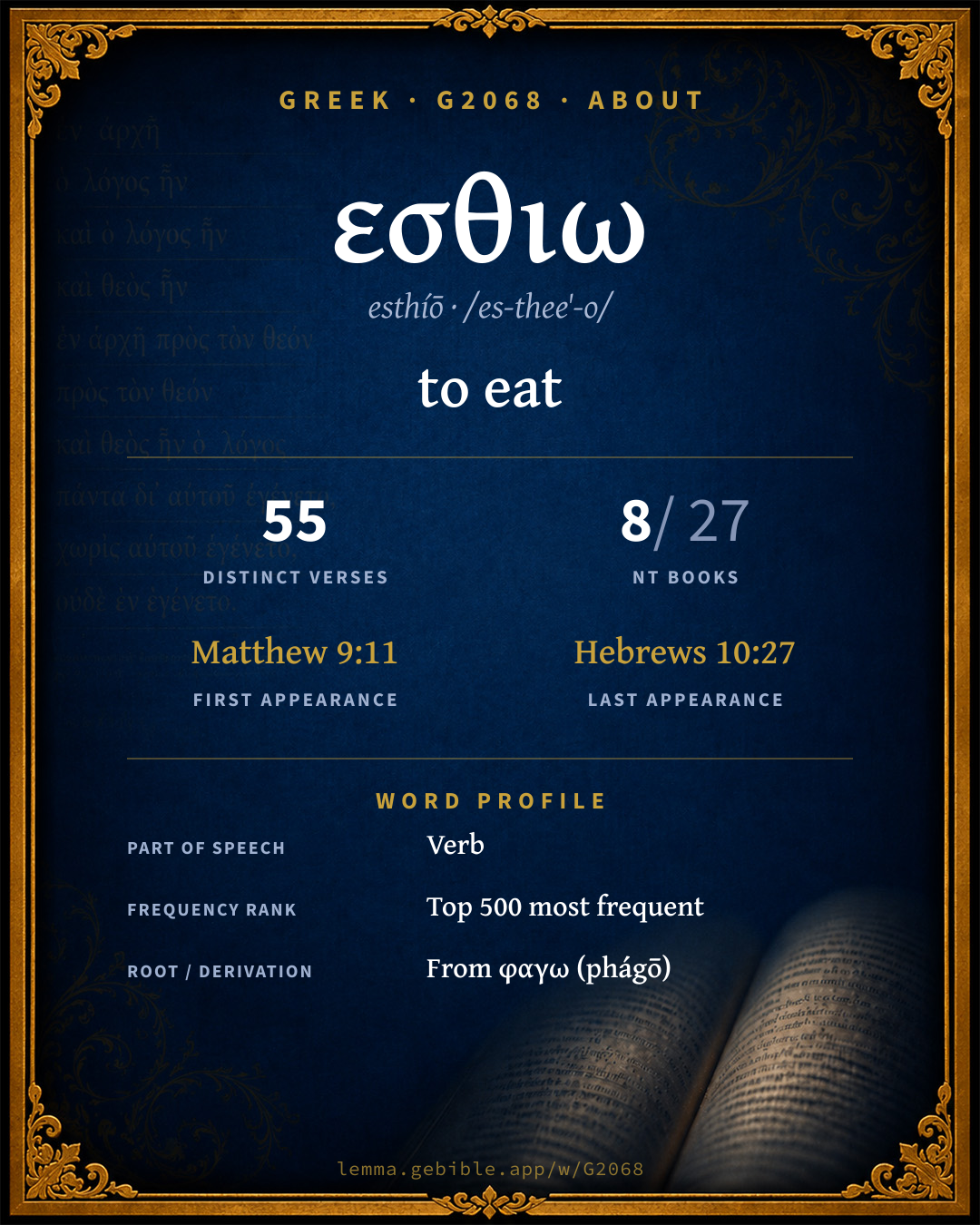
ἐσθίω
to eat
‘to eat’ is one of 3 main senses fuller range ↓
Full lexicon entry — Thayer's Greek Lexicon
From Thayer's Greek Lexicon
Where this word appears
See every Present-tense verb in the Greek New Testament →
Grammar key — what these labels mean
Part of speech
- Verb
- An action or state-of-being word.
Tense
- Present
- Ongoing or general action in present time (imperfective aspect).
- Imperfect
- Continuous or repeated action in past time (“was writing”).
Voice
- Active
- The subject performs the action.
Mood
- Participle
- A verbal adjective (“writing,” “having written”).
- Indicative
- States a fact or asks a factual question (the mood of reality).
- Infinitive
- A verbal noun (“to write”), unmarked for person or number.
- Imperative
- Expresses a command or request.
- Subjunctive
- Expresses probability, purpose, or possibility (the mood of contingency).
Case
- Nominative
- The case of the subject (and the predicate nominative).
- Genitive
- The case of source, possession, or “of” — answers “whose / from what.”
- Accusative
- The case of the direct object and of extent.
- Dative
- The case of the indirect object, means, or location — “to / for / with / in.”
Person
- 3rd person
- The one spoken about (“he / she / it / they”).
- 2nd person
- The one addressed (“you”).
Gender
- Masculine
- Grammatically masculine.
Number
- Singular
- One.
- Plural
- More than one.
Grammatical forms 16 distinct
- Verb, Present, Active, Participle, Nominative, Singular, Masculine 11 times (17%)
- Verb, Present, Active, Indicative, 3rd person, Singular 9 times (14%)
- Verb, Present, Active, Indicative, 3rd person, Plural 8 times (12%)
- Verb, Present, Active, Infinitive 6 times (9%)
- Verb, Imperfect, Active, Indicative, 3rd person, Plural 4 times (6%)
- Verb, Present, Active, Imperative, 2nd person, Plural 4 times (6%)
- Verb, Present, Active, Participle, Genitive, Plural, Masculine 4 times (6%)
- Verb, Present, Active, Participle, Nominative, Plural, Masculine 4 times (6%)
+8 more forms (15 occurrences)
Parsed forms decoded from the imported morphology (Robinson–Tischendorf, public domain), counted across 65 parsed occurrences — not distinct verses.
Every verse where G2068 appears — 55 distinct verses across 8 books. Click any verse to open its interlinear word-by-word view. Verse text shown in the World English Bible for context — . Each verse’s Greek form is shown with its reference; the English is not keyword-highlighted, since the data carries no word-level English alignment. Use “Compare translations” on any verse to read it across multiple English versions. This concordance covers the Greek New Testament; Septuagint (Greek Old Testament) occurrences of this word are not indexed here.
Matthew 11 verses
- Matthew 9:11 ἐσθίει pres act ind 3sg When the Pharisees saw it, they said to his disciples, "Why does your teacher eat with tax collectors and sinners?"
- Matthew 11:18 ἐσθίων pres act ptcp nom sg masc For John came neither eating nor drinking, and they say, 'He has a demon.'
- Matthew 11:19 ἐσθίων pres act ptcp nom sg masc The Son of Man came eating and drinking, and they say, 'Behold, a gluttonous man and a drunkard, a friend of tax collectors and sinners!' But wisdom is justified by her children."
- Matthew 12:1 ἐσθίειν pres act inf At that time, Jesus went on the Sabbath day through the grain fields. His disciples were hungry and began to pluck heads of grain and to eat.
- Matthew 14:21 ἐσθίοντες pres act ptcp nom pl masc Those who ate were about five thousand men, besides women and children.
- Matthew 15:2 ἐσθίωσιν pres act subj 3pl "Why do your disciples disobey the tradition of the elders? For they don't wash their hands when they eat bread."
- Matthew 15:27 ἐσθίει pres act ind 3sg But she said, "Yes, Lord, but even the dogs eat the crumbs which fall from their masters' table."
- Matthew 15:38 ἐσθίοντες pres act ptcp nom pl masc Those who ate were four thousand men, besides women and children.
- Matthew 24:49 ἐσθίῃ pres act subj 3sg and begins to beat his fellow-servants, and eat and drink with the drunken,
- Matthew 26:21 ἐσθιόντων pres act ptcp gen pl masc As they were eating, he said, "Most assuredly I tell you that one of you will betray me."
- Matthew 26:26 Ἐσθιόντων pres act ptcp gen pl masc As they were eating, Jesus took bread, gave thanks for it, and broke it. He gave to the disciples, and said, "Take, eat; this is my body."
Mark 9 verses
- Mark 1:6 ἐσθίων pres act ptcp nom sg masc John was clothed with camel's hair and a leather belt around his loins. He ate locusts and wild honey.
- Mark 2:16 ἤσθιεν ἐσθίει impf act ind 3sg pres act ind 3sg The scribes and the Pharisees, when they saw that he was eating with the sinners and tax collectors, said to his disciples, "Why is it that he eats and drinks with tax collectors and sinners?"
- Mark 7:2 ἐσθίουσιν pres act ind 3pl Now when they saw some of his disciples eating bread with defiled, that is, unwashed, hands, they found fault.
- Mark 7:3 ἐσθίουσιν pres act ind 3pl (For the Pharisees, and all the Jews, don't eat unless they wash their hands and forearms, holding to the tradition of the elders.
- Mark 7:4 ἐσθίουσιν pres act ind 3pl They don't eat when they come from the marketplace, unless they bathe themselves, and there are many other things, which they have received to hold to: washings of cups, pitchers, bronze vessels, and couches.)
- Mark 7:5 ἐσθίουσιν pres act ind 3pl The Pharisees and the scribes asked him, "Why don't your disciples walk according to the tradition of the elders, but eat their bread with unwashed hands?"
- Mark 7:28 ἐσθίουσιν pres act ind 3pl But she answered him, "Yes, Lord. Yet even the dogs under the table eat the children's crumbs."
- Mark 14:18 ἐσθιόντων ἐσθίων pres act ptcp gen pl masc pres act ptcp nom sg masc As they sat and were eating, Jesus said, "Most assuredly I tell you, one of you will betray me -- he who eats with me."
- Mark 14:22 ἐσθιόντων pres act ptcp gen pl masc As they were eating, Jesus took bread, and when he had blessed, he broke it, and gave to them, and said, "Take, eat. This is my body."
Luke 12 verses
- Luke 5:30 ἐσθίετε pres act ind 2pl Their scribes and the Pharisees murmured against his disciples, saying, "Why do you eat and drink with the tax collectors and sinners?"
- Luke 5:33 ἐσθίουσιν pres act ind 3pl They said to him, "Why do John's disciples often fast and pray, likewise also the disciples of the Pharisees, but yours eat and drink?"
- Luke 6:1 ἤσθιον impf act ind 3pl Now it happened on the second Sabbath after the first, that he was going through the grain fields. His disciples plucked the heads of grain, and ate, rubbing them in their hands.
- Luke 7:33 ἐσθίων pres act ptcp nom sg masc For John the Baptizer came neither eating bread nor drinking wine, and you say, 'He has a demon.'
- Luke 7:34 ἐσθίων pres act ptcp nom sg masc The Son of Man has come eating and drinking, and you say, 'Behold, a gluttonous man, and a drunkard; a friend of tax collectors and sinners!'
- Luke 10:7 ἔσθοντες pres act ptcp nom pl masc Remain in that same house, eating and drinking the things they give, for the laborer is worthy of his wages. Don't go from house to house.
- Luke 10:8 ἐσθίετε pres act impv 2pl Into whatever city you enter, and they receive you, eat the things that are set before you.
- Luke 12:45 ἐσθίειν pres act inf But if that servant says in his heart, 'My lord delays his coming,' and begins to beat the menservants and the maidservants, and to eat and drink, and to be drunken,
- Luke 15:16 ἤσθιον impf act ind 3pl He wanted to fill his belly with the husks that the pigs ate, but no one gave him any.
- Luke 17:27 ἤσθιον impf act ind 3pl They ate, they drank, they married, they were given in marriage, until the day that Noah entered into the ark, and the flood came, and destroyed them all.
- Luke 17:28 ἤσθιον impf act ind 3pl Likewise, even as it happened in the days of Lot: they ate, they drank, they bought, they sold, they planted, they built;
- Luke 22:30 ἔσθητε pres act subj 2pl that you may eat and drink at my table in my Kingdom. You will sit on thrones, judging the twelve tribes of Israel."
Acts 1 verse
Romans 4 verses
- Romans 14:2 ἐσθίει pres act ind 3sg One man has faith to eat all things, but he who is weak eats only vegetables.
- Romans 14:3 ἐσθίων ἐσθίοντα ἐσθίων ἐσθίοντα pres act ptcp nom sg masc pres act ptcp acc sg masc pres act ptcp nom sg masc pres act ptcp acc sg masc Don't let him who eats despise him who doesn't eat. Don't let him who doesn't eat judge him who eats, for God has received him.
- Romans 14:6 ἐσθίων ἐσθίει ἐσθίων ἐσθίει pres act ptcp nom sg masc pres act ind 3sg pres act ptcp nom sg masc pres act ind 3sg He who observes the day, observes it to the Lord; and he who does not observe the day, to the Lord he does not observe it. He who eats, eats to the Lord, for he gives God thanks. He who doesn't eat, to the Lord he doesn't eat, and gives God thanks.
- Romans 14:20 ἐσθίοντι pres act ptcp dat sg masc Don't overthrow God's work for food's sake. All things indeed are clean, however it is evil for that man who creates a stumbling block by eating.
1 Corinthians 15 verses
- 1 Corinthians 8:7 ἐσθίουσιν pres act ind 3pl However, that knowledge isn't in all men. But some, with consciousness of the idol until now, eat as of a thing sacrificed to an idol, and their conscience, being weak, is defiled.
- 1 Corinthians 8:10 ἐσθίειν pres act inf For if a man sees you who have knowledge sitting in an idol's temple, won't his conscience, if he is weak, be emboldened to eat things sacrificed to idols?
- 1 Corinthians 9:7 ἐσθίει ἐσθίει pres act ind 3sg pres act ind 3sg What soldier ever serves at his own expense? Who plants a vineyard, and doesn't eat of its fruit? Or who feeds a flock, and doesn't drink from the flock's milk?
- 1 Corinthians 9:13 ἐσθίουσιν pres act ind 3pl Don't you know that those who serve around sacred things eat from the things of the temple, and those who wait on the altar have their portion with the altar?
- 1 Corinthians 10:18 ἐσθίοντες pres act ptcp nom pl masc Consider Israel after the flesh. Don't those who eat the sacrifices have communion with the altar?
- 1 Corinthians 10:25 ἐσθίετε pres act impv 2pl Whatever is sold in the butcher shop, eat, asking no question for the sake of conscience,
- 1 Corinthians 10:27 ἐσθίετε pres act impv 2pl But if one of those who don't believe invites you to a meal, and you are inclined to go, eat whatever is set before you, asking no questions for the sake of conscience.
- 1 Corinthians 10:28 ἐσθίετε pres act impv 2pl But if anyone says to you, "This was offered to idols," don't eat it for the sake of the one who told you, and for the sake of conscience. For "the earth is the Lord's, and all its fullness."
- 1 Corinthians 10:31 ἐσθίετε pres act ind 2pl Whether therefore you eat, or drink, or whatever you do, do all to the glory of God.
- 1 Corinthians 11:22 ἐσθίειν pres act inf What, don't you have houses to eat and to drink in? Or do you despise God's assembly, and put them to shame who don't have? What shall I tell you? Shall I praise you? In this I don't praise you.
- 1 Corinthians 11:26 ἐσθίητε pres act subj 2pl For as often as you eat this bread and drink this cup, you proclaim the Lord's death until he comes.
- 1 Corinthians 11:27 ἐσθίῃ pres act subj 3sg Therefore whoever eats this bread or drinks the Lord's cup in a manner unworthy of the Lord will be guilty of the body and the blood of the Lord.
- 1 Corinthians 11:28 ἐσθιέτω pres act impv 3sg But let a man examine himself, and so let him eat of the bread, and drink of the cup.
- 1 Corinthians 11:29 ἐσθίων ἐσθίει pres act ptcp nom sg masc pres act ind 3sg For he who eats and drinks in an unworthy manner eats and drinks judgment to himself, if he doesn't discern the Lord's body.
- 1 Corinthians 11:34 ἐσθιέτω pres act impv 3sg But if anyone is hungry, let him eat at home, lest your coming together be for judgment. The rest I will set in order whenever I come.
2 Thessalonians 2 verses
- 2 Thessalonians 3:10 ἐσθιέτω pres act impv 3sg For even when we were with you, we commanded you this: "If anyone will not work, neither let him eat."
- 2 Thessalonians 3:12 ἐσθίωσιν pres act subj 3pl Now those who are that way, we command and exhort in the Lord Jesus Christ, that with quietness they work, and eat their own bread.
Hebrews 1 verse
About this entry
At a glance — auto-summarized from this page’s data, not written by a person. Every figure links to its source below. This summary describes the numbers; it doesn’t interpret them.
εσθιω (esthíō) is a Greek verb most often rendered “to eat.” One archaism survives in the King James Version — “eateth” — where modern Bibles read “eat”; see the renderings breakdown. Spanning 55 verses in 8 books, it ranks among the moderately common words of the Greek New Testament. 1 Corinthians dominates its distribution — 15 of 55 verses. Ranging over 3 senses, it is not a single-sense word. The sections below give every sense, occurrence, and version rendering.
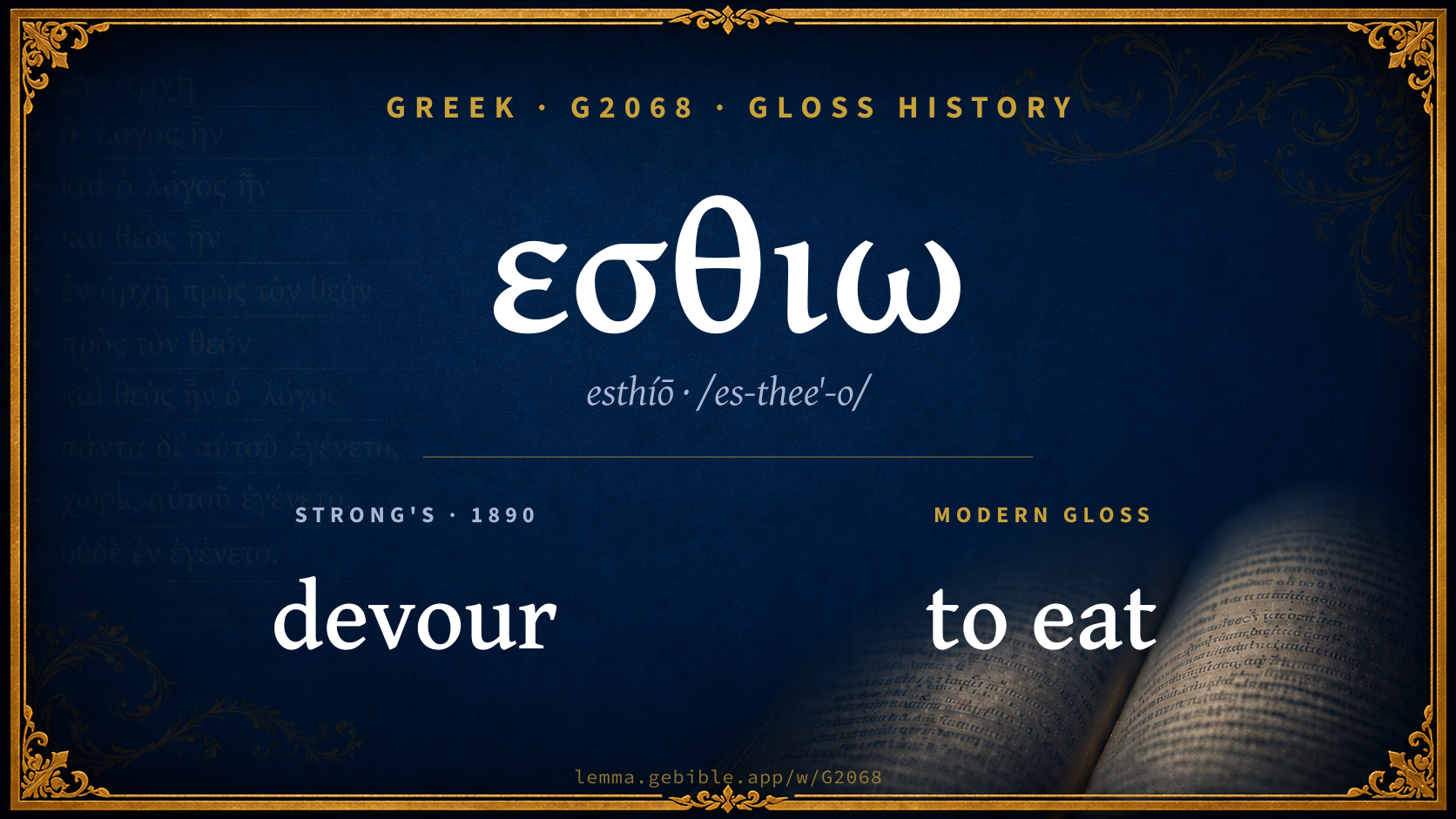
Gloss history
Strong's 1890 vs modern scholarship
About this word
Strong's G2068 catalogs a Greek word from the Greek New Testament.
These counts are not copied from any lexicon or concordance. They are computed here, from the morphology-tagged Greek New Testament. What Lemma adds →
- 55
- distinct verses
- The word appears in 55 distinct verses.
- 8 / 27
- NT books
- The word appears in 8 of 27 New Testament books.
- #256
- by frequency
- Top 500 most frequent Greek words (rank 256 of 5,347 Greek words by occurrence).
View all 55 occurrences in the concordance →
Most concentrated in
- 1 Corinthians 15 verses 27%
- Luke 12 verses 22%
- Matthew 11 verses 20%
By section of the New Testament
By traditional corpus
Conventional, traditional groupings — biblical authorship is debated, so this is a traditional corpus grouping, not an authorship claim. Some books belong to more than one corpus (Luke is in both the Gospels and the Lukan corpus, and so on), so these shares overlap and need not total 100%. Each figure is a share of the word’s 55 distinct verses.
- Gospels 32 verses · 58%
- Pauline corpus 21 verses · 38%
- Lukan (Luke–Acts) 13 verses · 24%
- Hebrews 1 verse · 2%
How translations render this word
Counts come from each version’s own published word-to-Strong’s tagging or interlinear alignment — an approximate guide to how each version renders this word, not a word-level alignment the data otherwise carries. Because each total is that version’s own tagged count, the per-version totals vary from one another and need not match the appearance or distinct-verse counts above. These counts may also differ from a printed concordance because Lemma counts each distinctly tagged rendering and does not collapse phrase taggings into a single head-word total. This is a fixed set of word-tagged versions (KJV, ASV, BSB, ULT) and does not change with the reading translation you choose elsewhere. Each version’s license is shown beside its name below (and on Sources).
- King James Version: Eat 19×, Eateth 12×, Did eat 5×
- American Standard Version: Eat 16×, Eateth 13×, Eating 5×
- Berean Standard Bible: Eat 16×, Eating 8×, Eats 6×
- unfoldingWord Literal Text: Eat 62×, Eating 22×, Ate 11×
King James Version Public Domain
Renders G2068 across 66 tagged occurrences — most commonly:
Plus 12 renderings that appear only once — usually multi-word phrases or single function words the recovered tagging swept in, not distinct renderings.
American Standard Version Public Domain
Renders G2068 across 66 tagged occurrences — most commonly:
Plus 12 renderings that appear only once — usually multi-word phrases or single function words the recovered tagging swept in, not distinct renderings.
Berean Standard Bible Public Domain
Renders G2068 across 61 tagged occurrences — most commonly:
Plus 18 renderings that appear only once — usually multi-word phrases or single function words the recovered tagging swept in, not distinct renderings. Not rendered by a distinct English word in 4 further occurrences.
unfoldingWord Literal Text CC BY-SA 4.0
Renders G2068 across 183 tagged occurrences — most commonly:
Plus other, less common renderings. Plus 31 renderings that appear only once — usually multi-word phrases or single function words the recovered tagging swept in, not distinct renderings.
Senses in Thayer's
The 3 senses Thayer's distinguishes for this word, in lexicon order (not ranked by frequency or importance). The full entry — with sub-senses — is in the Lexicon Entry tab.
- to eat
- to take food, eat a meal
- metaph. to devour, consume
Word origin
Derived from φαγω (phágō) (G5315) — to eat.
strengthened for a primary word ἔδω edō (to eat ); used only in certain tenses the rest being supplied by G5315 ; to eat (usually literally): - devour eat live.
— Strong’s Exhaustive Concordance (1890), public domain.
Forms in the corpus
The 18 distinct written forms G2068 takes in the Greek New Testament, most frequent first — each parse links to that tense’s occurrences in the concordance.
Same root — word family
Other Thayer's entries built from the same root as G2068, grouped by Strong’s listed origin. These share a root / origin per the lexicon — not necessarily a shared meaning. Each links to that word’s own entry.
Derives from
Shares the same root
Derived from this word
Compare all same-root words → Showing 4 of 5 — not the complete family. They share a root, not necessarily a meaning.
Septuagint usage
The same Greek word εσθιω appears 591 times in the Greek Old Testament (Septuagint), across 512 verses in 34 books.
- 591
- LXX occurrences
- Tagged occurrences of this Greek word in the Septuagint.
- 512
- verses
- Distinct Septuagint verses containing this word.
- 34 / 39
- OT books
- The word appears in 34 of the 39 Old Testament books.
Sample Septuagint occurrences
- Genesis 2:16 ἐσθίω
- Exodus 2:20 ἐσθίω
- Leviticus 3:17 ἐσθίω
- Numbers 6:3 ἐσθίω
- Deuteronomy 2:6 ἐσθίω
- Joshua 5:11 ἐσθίω
- Judges 9:20 ἐσθίω
- Ruth 2:14 ἐσθίω
- 1 Samuel 1:7 ἐσθίω
- 2 Samuel 9:7 ἐσθίω
- 1 Kings 1:25 ἐσθίω
- 2 Kings 4:8 ἐσθίω
Septuagint occurrences (same lexeme)
Every verse where the same Strong’s number (G2068) appears in the Greek Septuagint — showing the first 50 of 512. Verse text shown in the World English Bible for context; the Greek form is the matched word — the English is not keyword-highlighted.
- Genesis 2:16 ἐσθίω Yahweh God commanded the man, saying, "Of every tree of the garden you may freely eat:
- Genesis 2:17 ἐσθίω but of the tree of the knowledge of good and evil, you shall not eat of it: for in the day that you eat of it you will surely die."
- Genesis 3:1 ἐσθίω Now the serpent was more subtle than any animal of the field which Yahweh God had made. He said to the woman, "Yes, has God said, 'You shall not eat of any tree of the garden?'"
- Genesis 3:2 ἐσθίω The woman said to the serpent, "Of the fruit of the trees of the garden we may eat,
- Genesis 3:3 ἐσθίω but of the fruit of the tree which is in the midst of the garden, God has said, 'You shall not eat of it, neither shall you touch it, lest you die.'"
- Genesis 3:5 ἐσθίω for God knows that in the day you eat it, your eyes will be opened, and you will be like God, knowing good and evil."
- Genesis 3:6 ἐσθίω When the woman saw that the tree was good for food, and that it was a delight to the eyes, and that the tree was to be desired to make one wise, she took of the fruit of it, and ate; and she gave some to her husband with her, and he ate.
- Genesis 3:11 ἐσθίω God said, "Who told you that you were naked? Have you eaten from the tree that I commanded you not to eat from?"
- Genesis 3:12 ἐσθίω The man said, "The woman whom you gave to be with me, she gave me of the tree, and I ate."
- Genesis 3:13 ἐσθίω Yahweh God said to the woman, "What is this you have done?" The woman said, "The serpent deceived me, and I ate."
- Genesis 3:14 ἐσθίω Yahweh God said to the serpent, "Because you have done this, cursed are you above all cattle, and above every animal of the field. On your belly shall you go, and you shall eat dust all the days of your life.
- Genesis 3:17 ἐσθίω To Adam he said, "Because you have listened to your wife's voice, and have eaten of the tree, of which I commanded you, saying, 'You shall not eat of it,' cursed is the ground for your sake. In toil you will eat of it all the days of your life.
- Genesis 3:18 ἐσθίω Thorns also and thistles will it bring forth to you; and you will eat the herb of the field.
- Genesis 3:19 ἐσθίω By the sweat of your face will you eat bread until you return to the ground, for out of it you were taken. For you are dust, and to dust you shall return."
- Genesis 3:22 ἐσθίω Yahweh God said, "Behold, the man has become like one of us, knowing good and evil. Now, lest he put forth his hand, and also take of the tree of life, and eat, and live forever..."
- Genesis 6:21 ἐσθίω Take with you of all food that is eaten, and gather it to you; and it will be for food for you, and for them."
- Genesis 9:4 ἐσθίω But flesh with the life of it, the blood of it, you shall not eat.
- Genesis 14:24 ἐσθίω Except only that which the young men have eaten, and the portion of the men who went with me, Aner, Eshcol, and Mamre: let them take their portion."
- Genesis 18:5 ἐσθίω I will get a morsel of bread so you can refresh your heart. After that you may go your way, now that you have come to your servant." They said, "Very well, do as you have said."
- Genesis 18:8 ἐσθίω He took butter, milk, and the calf which he had dressed, and set it before them. He stood by them under the tree, and they ate.
- Genesis 19:3 ἐσθίω He urged them greatly, and they came in with him, and entered into his house. He made them a feast, and baked unleavened bread, and they ate.
- Genesis 24:33 ἐσθίω Food was set before him to eat. But he said, "I will not eat until I have told my message." He said, "Speak on."
- Genesis 24:54 ἐσθίω They ate and drank, he and the men who were with him, and stayed all night. They rose up in the morning, and he said, "Send me away to my master."
- Genesis 25:34 ἐσθίω Jacob gave Esau bread and stew of lentils. He ate and drank, rose up, and went his way. So Esau despised his birthright.
- Genesis 26:30 ἐσθίω He made them a feast, and they ate and drink.
- Genesis 27:4 ἐσθίω Make me savory food, such as I love, and bring it to me, that I may eat, and that my soul may bless you before I die."
- Genesis 27:7 ἐσθίω 'Bring me venison, and make me savory food, that I may eat, and bless you before Yahweh before my death.'
- Genesis 27:10 ἐσθίω You shall bring it to your father, that he may eat, so that he may bless you before his death."
- Genesis 27:19 ἐσθίω Jacob said to his father, "I am Esau your firstborn. I have done what you asked me to do. Please arise, sit and eat of my venison, that your soul may bless me."
- Genesis 27:25 ἐσθίω He said, "Bring it near to me, and I will eat of my son's venison, that my soul may bless you." He brought it near to him, and he ate. He brought him wine, and he drank.
- Genesis 27:31 ἐσθίω He also made savory food, and brought it to his father. He said to his father, "Let my father arise, and eat of his son's venison, that your soul may bless me."
- Genesis 27:33 ἐσθίω Isaac trembled violently, and said, "Who, then, is he who has taken venison, and brought it me, and I have eaten of all before you came, and have blessed him? Yes, he will be blessed."
- Genesis 28:20 ἐσθίω Jacob vowed a vow, saying, "If God will be with me, and will keep me in this way that I go, and will give me bread to eat, and clothing to put on,
- Genesis 31:46 ἐσθίω Jacob said to his relatives, "Gather stones." They took stones, and made a heap. They ate there by the heap.
- Genesis 31:54 ἐσθίω Jacob offered a sacrifice in the mountain, and called his relatives to eat bread. They ate bread, and stayed all night in the mountain.
- Genesis 32:33 ἐσθίω
- Genesis 37:25 ἐσθίω They sat down to eat bread, and they lifted up their eyes and looked, and saw a caravan of Ishmaelites was coming from Gilead, with their camels bearing spices and balm and myrrh, going to carry it down to Egypt.
- Genesis 39:6 ἐσθίω He left all that he had in Joseph's hand. He didn't concern himself with anything, except for the food which he ate. Joseph was well-built and handsome.
- Genesis 40:17 ἐσθίω In the uppermost basket there was all kinds of baked food for Pharaoh, and the birds ate them out of the basket on my head."
- Genesis 40:19 ἐσθίω Within three more days, Pharaoh will lift up your head from off you, and will hang you on a tree; and the birds will eat your flesh from off you."
- Genesis 43:16 ἐσθίω When Joseph saw Benjamin with them, he said to the steward of his house, "Bring the men into the house, and butcher an animal, and make ready; for the men will dine with me at noon."
- Genesis 45:18 ἐσθίω Take your father and your households, and come to me, and I will give you the good of the land of Egypt, and you will eat the fat of the land.'
- Genesis 47:22 ἐσθίω Only he didn't buy the land of the priests, for the priests had a portion from Pharaoh, and ate their portion which Pharaoh gave them. That is why they didn't sell their land.
- Genesis 49:27 ἐσθίω "Benjamin is a ravenous wolf. In the morning he will devour the prey. At evening he will divide the spoil."
- Exodus 2:20 ἐσθίω He said to his daughters, "Where is he? Why is it that you have left the man? Call him, that he may eat bread."
- Exodus 12:7 ἐσθίω They shall take some of the blood, and put it on the two side-posts and on the lintel, on the houses in which they shall eat it.
- Exodus 12:8 ἐσθίω They shall eat the flesh in that night, roasted with fire, and unleavened bread. They shall eat it with bitter herbs.
- Exodus 12:9 ἐσθίω Don't eat it raw, nor boiled at all with water, but roasted with fire; with its head, its legs and its inner parts.
- Exodus 12:11 ἐσθίω This is how you shall eat it: with your loins girded, your shoes on your feet, and your staff in your hand; and you shall eat it in haste: it is Yahweh's Passover.
- Exodus 12:15 ἐσθίω Seven days shall you eat unleavened bread; even the first day you shall put away yeast out of your houses, for whoever eats leavened bread from the first day until the seventh day, that soul shall be cut off from Israel.
These are occurrences of the same Greek lexeme (G2068) in the Septuagint — not a translation of any one Hebrew word. The store carries no word-level Hebrew↔Greek alignment, so no Hebrew original is asserted here. Counts come from the recovered LXX Strong's tagging — high-frequency vocabulary is well covered, while rare or late forms may be untagged — so they reflect tagged occurrences and may slightly undercount.