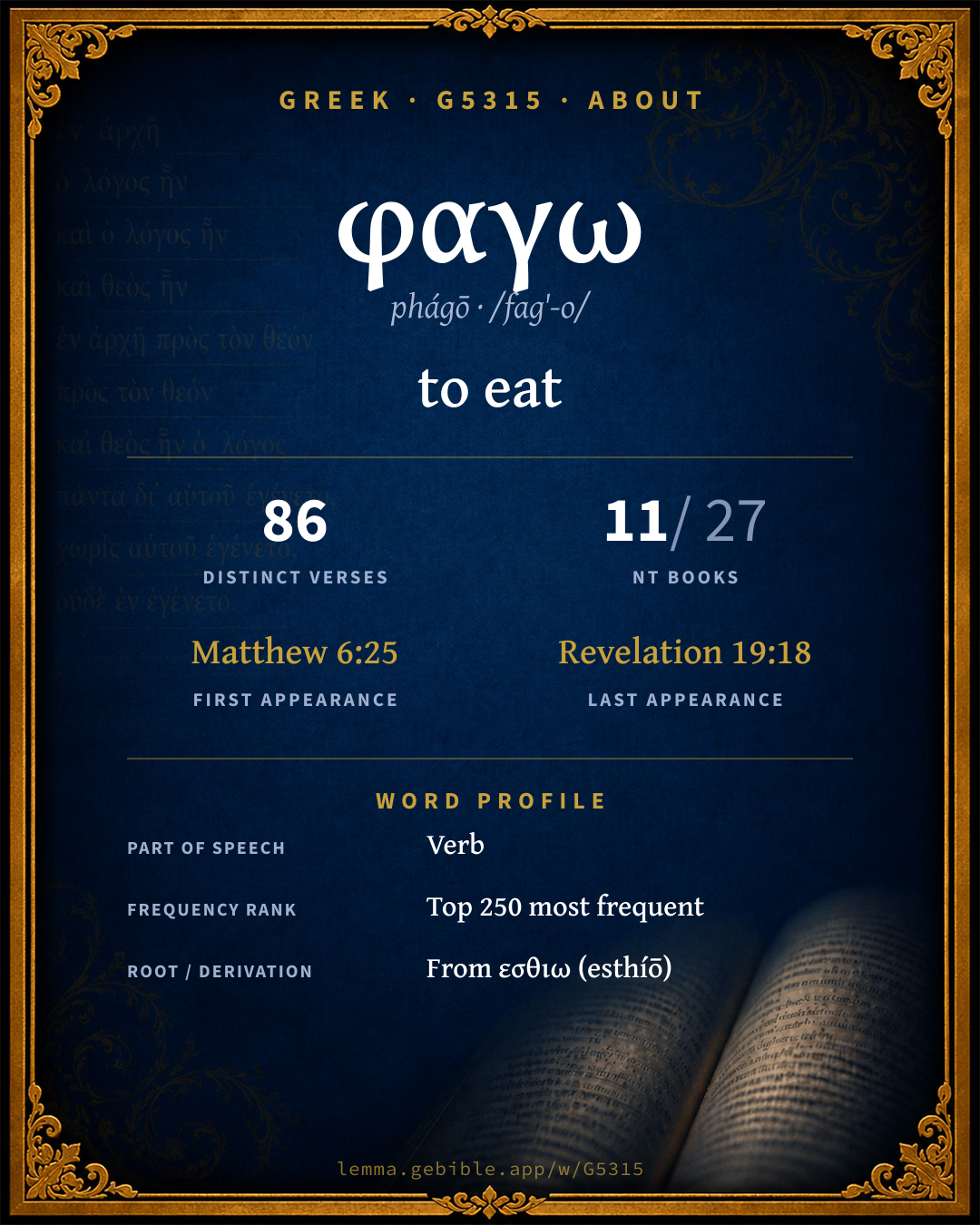
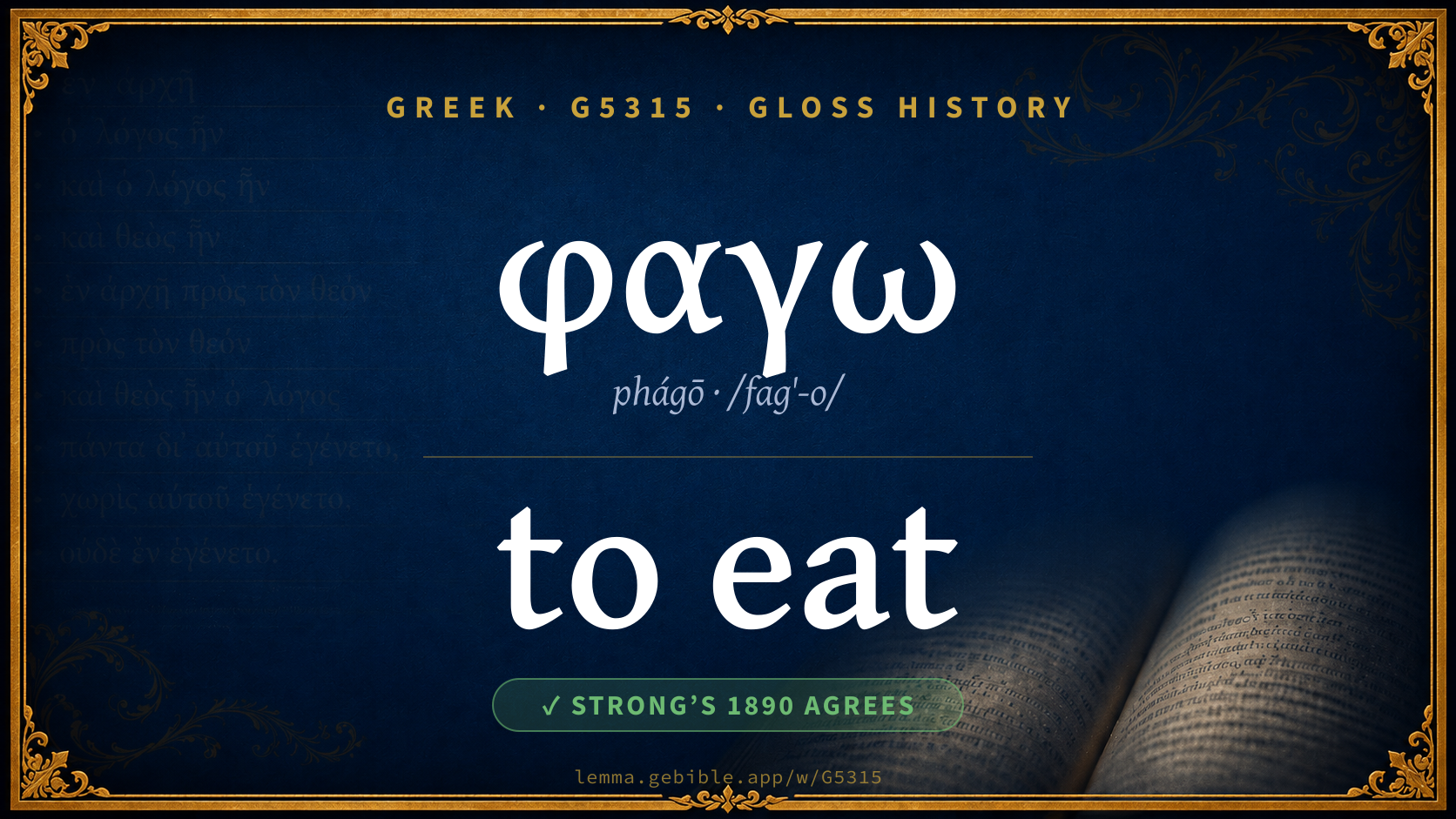
φάγω
to eat
‘to eat’ is one of 3 main senses fuller range ↓
Full lexicon entry — Thayer's Greek Lexicon
From Thayer's Greek Lexicon
Where this word appears
See every Aorist-tense verb in the Greek New Testament →
Grammar key — what these labels mean
Part of speech
- Verb
- An action or state-of-being word.
Tense
- Aorist
- Action viewed as a simple whole, without regard to duration — often past (perfective aspect).
- Future
- Action expected in future time.
Voice
- Active
- The subject performs the action.
- Middle deponent
- Middle in form but active in meaning.
Mood
- Infinitive
- A verbal noun (“to write”), unmarked for person or number.
- Indicative
- States a fact or asks a factual question (the mood of reality).
- Subjunctive
- Expresses probability, purpose, or possibility (the mood of contingency).
- Imperative
- Expresses a command or request.
- Participle
- A verbal adjective (“writing,” “having written”).
- Optative
- Expresses a wish or a remote possibility.
Case
- Nominative
- The case of the subject (and the predicate nominative).
Person
- 3rd person
- The one spoken about (“he / she / it / they”).
- 1st person
- The speaker (“I / we”).
- 2nd person
- The one addressed (“you”).
Gender
- Masculine
- Grammatically masculine.
Number
- Plural
- More than one.
- Singular
- One.
Grammatical forms 19 distinct
- Verb, Aorist, Active, Infinitive 34 times (37%)
- Verb, Aorist, Active, Indicative, 3rd person, Plural 11 times (12%)
- Verb, Aorist, Active, Subjunctive, 3rd person, Plural 6 times (6%)
- Verb, Aorist, Active, Indicative, 3rd person, Singular 5 times (5%)
- Verb, Aorist, Active, Subjunctive, 1st person, Plural 5 times (5%)
- Verb, Aorist, Active, Subjunctive, 1st person, Singular 5 times (5%)
- Verb, Aorist, Active, Subjunctive, 2nd person, Plural 5 times (5%)
- Verb, Aorist, Active, Imperative, 2nd person, Singular 4 times (4%)
+11 more forms (18 occurrences)
Parsed forms decoded from the imported morphology (Robinson–Tischendorf, public domain), counted across 93 parsed occurrences — not distinct verses.
Every verse where G5315 appears — 86 distinct verses across 11 books. Click any verse to open its interlinear word-by-word view. Verse text shown in the World English Bible for context — . Each verse’s Greek form is shown with its reference; the English is not keyword-highlighted, since the data carries no word-level English alignment. Use “Compare translations” on any verse to read it across multiple English versions. This concordance covers the Greek New Testament; Septuagint (Greek Old Testament) occurrences of this word are not indexed here.
Matthew 12 verses
- Matthew 6:25 φάγητε aor act subj 2pl Therefore, I tell you, don't be anxious for your life: what you will eat, or what you will drink; nor yet for your body, what you will wear. Isn't life more than food, and the body more than clothing?
- Matthew 6:31 φάγωμεν aor act subj 1pl "Therefore don't be anxious, saying, 'What will we eat?', 'What will we drink?' or, 'With what will we be clothed?'
- Matthew 12:4 ἔφαγον φαγεῖν aor act ind 3pl aor act inf how he entered into the house of God, and ate the show bread, which was not lawful for him to eat, neither for those who were with him, but only for the priests?
- Matthew 14:16 φαγεῖν aor act inf But Jesus said to them, "They don't need to go away. You give them something to eat."
- Matthew 14:20 ἔφαγον aor act ind 3pl They all ate, and were filled. They took up twelve baskets full of that which remained left over from the broken pieces.
- Matthew 15:20 φαγεῖν aor act inf These are the things which defile the man; but to eat with unwashed hands doesn't defile the man."
- Matthew 15:32 φάγωσιν aor act subj 3pl Jesus summoned his disciples and said, "I have compassion on the multitude, because they continue with me now three days and have nothing to eat. I don't want to send them away fasting, or they might faint on the way."
- Matthew 15:37 ἔφαγον aor act ind 3pl They all ate, and were filled. They took up seven baskets full of the broken pieces that were left over.
- Matthew 25:35 φαγεῖν aor act inf for I was hungry, and you gave me food to eat; I was thirsty, and you gave me drink; I was a stranger, and you took me in;
- Matthew 25:42 φαγεῖν aor act inf for I was hungry, and you didn't give me food to eat; I was thirsty, and you gave me no drink;
- Matthew 26:17 φαγεῖν aor act inf Now on the first day of unleavened bread, the disciples came to Jesus, saying to him, "Where do you want us to prepare for you to eat the Passover?"
- Matthew 26:26 φάγετε aor act impv 2pl As they were eating, Jesus took bread, gave thanks for it, and broke it. He gave to the disciples, and said, "Take, eat; this is my body."
Mark 14 verses
- Mark 2:26 ἔφαγεν φαγεῖν aor act ind 3sg aor act inf How he entered into the house of God when Abiathar was high priest, and ate the show bread, which it is not lawful to eat except for the priests, and gave also to those who were with him?"
- Mark 3:20 φαγεῖν aor act inf The multitude came together again, so that they could not so much as eat bread.
- Mark 5:43 φαγεῖν aor act inf He strictly ordered them that no one should know this, and commanded that something should be given to her to eat.
- Mark 6:31 φαγεῖν aor act inf He said to them, "You come apart into a deserted place, and rest awhile." For there were many coming and going, and they had no leisure so much as to eat.
- Mark 6:36 φάγωσιν aor act subj 3pl Send them away, that they may go into the surrounding country and villages, and buy themselves bread, for they have nothing to eat."
- Mark 6:37 φαγεῖν φαγεῖν aor act inf aor act inf But he answered them, "You give them something to eat." They asked him, "Shall we go and buy two hundred denarii worth of bread, and give them something to eat?"
- Mark 6:42 ἔφαγον aor act ind 3pl They all ate, and were filled.
- Mark 6:44 φαγόντες aor act ptcp nom pl masc Those who ate the loaves were five thousand men.
- Mark 8:1 φάγωσιν aor act subj 3pl In those days, when there was a very great multitude, and they had nothing to eat, Jesus called his disciples to himself, and said to them,
- Mark 8:2 φάγωσιν aor act subj 3pl "I have compassion on the multitude, because they have stayed with me now three days, and have nothing to eat.
- Mark 8:8 ἔφαγον aor act ind 3pl They ate, and were filled. They took up seven baskets of broken pieces that were left over.
- Mark 11:14 φάγοι aor act opt 3sg Jesus told it, "May no one ever eat fruit from you again!" and his disciples heard it.
- Mark 14:12 φάγῃς aor act subj 2sg On the first day of unleavened bread, when they sacrificed the Passover, his disciples asked him, "Where do you want us to go and make ready that you may eat the Passover?"
- Mark 14:14 φάγω aor act subj 1sg and wherever he enters in, tell the master of the house, 'The Teacher says, "Where is the guest room, where I may eat the Passover with my disciples?"'
Luke 19 verses
- Luke 4:2 ἔφαγεν aor act ind 3sg for forty days, being tempted by the devil. He ate nothing in those days. Afterward, when they were completed, he was hungry.
- Luke 6:4 ἔφαγεν φαγεῖν aor act ind 3sg aor act inf how he entered into the house of God, and took and ate the show bread, and gave also to those who were with him, which is not lawful to eat except for the priests alone?"
- Luke 7:36 φάγῃ aor act subj 3sg One of the Pharisees invited him to eat with him. He entered into the Pharisee's house, and sat at the table.
- Luke 8:55 φαγεῖν aor act inf Her spirit returned, and she rose up immediately. He commanded that something be given to her to eat.
- Luke 9:13 φαγεῖν aor act inf But he said to them, "You give them something to eat." They said, "We have no more than five loaves and two fish, unless we should go and buy food for all these people."
- Luke 9:17 ἔφαγον aor act ind 3pl They ate, and were all filled. They gathered up twelve baskets of broken pieces that were left over.
- Luke 12:19 φάγε aor act impv 2sg I will tell my soul, "Soul, you have many goods laid up for many years. Take your ease, eat, drink, be merry."'
- Luke 12:22 φάγητε aor act subj 2pl He said to his disciples, "Therefore I tell you, don't be anxious for your life, what you will eat, nor yet for your body, what you will wear.
- Luke 12:29 φάγητε aor act subj 2pl Don't seek what you will eat or what you will drink; neither be anxious.
- Luke 13:26 ἐφάγομεν aor act ind 1pl Then you will begin to say, 'We ate and drink in your presence, and you taught in our streets.'
- Luke 14:1 φαγεῖν aor act inf It happened, when he went into the house of one of the rulers of the Pharisees on a Sabbath to eat bread, that they were watching him.
- Luke 14:15 φάγεται fut mid.dep ind 3sg When one of those who sat at the table with him heard these things, he said to him, "Blessed is he who will feast in the Kingdom of God!"
- Luke 15:23 φαγόντες aor act ptcp nom pl masc Bring the fattened calf, kill it, and let us eat, and celebrate;
- Luke 17:8 φάγω φάγεσαι aor act subj 1sg fut mid.dep ind 2sg and will not rather tell him, 'Prepare my supper, clothe yourself properly, and serve me, while I eat and drink. Afterward you shall eat and drink'?
- Luke 22:8 φάγωμεν aor act subj 1pl He sent Peter and John, saying, "Go and prepare the Passover for us, that we may eat."
- Luke 22:11 φάγω aor act subj 1sg Tell the master of the house, 'The Teacher says to you, "Where is the guest room, where I may eat the Passover with my disciples?"'
- Luke 22:15 φαγεῖν aor act inf He said to them, "I have earnestly desired to eat this Passover with you before I suffer,
- Luke 22:16 φάγω aor act subj 1sg for I tell you, I will no longer by any means eat of it until it is fulfilled in the Kingdom of God."
- Luke 24:43 ἔφαγεν aor act ind 3sg He took them, and ate in front of them.
John 14 verses
- John 4:31 φάγε aor act impv 2sg In the meanwhile, the disciples urged him, saying, "Rabbi, eat."
- John 4:32 φαγεῖν aor act inf But he said to them, "I have food to eat that you don't know about."
- John 4:33 φαγεῖν aor act inf The disciples therefore said one to another, "Has anyone brought him something to eat?"
- John 6:5 φάγωσιν aor act subj 3pl Jesus therefore lifting up his eyes, and seeing that a great multitude was coming to him, said to Philip, "Where are we to buy bread, that these may eat?"
- John 6:23 ἔφαγον aor act ind 3pl However boats from Tiberias came near to the place where they ate the bread after the Lord had given thanks.
- John 6:26 ἐφάγετε aor act ind 2pl Jesus answered them, "Most assuredly I tell you, you seek me, not because you saw signs, but because you ate of the loaves, and were filled.
- John 6:31 ἔφαγον φαγεῖν aor act ind 3pl aor act inf Our fathers ate the manna in the wilderness. As it is written, 'He gave them bread out of heaven to eat.'"
- John 6:49 ἔφαγον aor act ind 3pl Your fathers ate the manna in the wilderness, and they died.
- John 6:50 φάγῃ aor act subj 3sg This is the bread which comes down out of heaven, that anyone may eat of it and not die.
- John 6:51 φάγῃ aor act subj 3sg I am the living bread which came down out of heaven. If anyone eats of this bread, he will live forever. Yes, the bread which I will give for the life of the world is my flesh."
- John 6:52 φαγεῖν aor act inf The Jews therefore contended with one another, saying, "How can this man give us his flesh to eat?"
- John 6:53 φάγητε aor act subj 2pl Jesus therefore said to them, "Most assuredly I tell you, unless you eat the flesh of the Son of Man and drink his blood, you don't have life in yourselves.
- John 6:58 ἔφαγον aor act ind 3pl This is the bread which came down out of heaven-- not as our fathers ate the manna, and died. He who eats this bread will live forever."
- John 18:28 φάγωσιν aor act subj 3pl They led Jesus therefore from Caiaphas into the Praetorium. It was early, and they themselves didn't enter into the Praetorium, that they might not be defiled, but might eat the Passover.
Acts 6 verses
- Acts 9:9 ἔφαγεν aor act ind 3sg He was without sight for three days, and neither ate nor drank.
- Acts 10:13 φάγε aor act impv 2sg A voice came to him, "Rise, Peter, kill and eat!"
- Acts 10:14 ἔφαγον aor act ind 1sg But Peter said, "Not so, Lord; for I have never eaten anything that is common or unclean."
- Acts 11:7 φάγε aor act impv 2sg I also heard a voice saying to me, 'Rise, Peter, kill and eat!'
- Acts 23:12 φαγεῖν aor act inf When it was day, some of the Jews banded together, and bound themselves under a curse, saying that they would neither eat nor drink until they had killed Paul.
- Acts 23:21 φαγεῖν aor act inf Therefore don't yield to them, for more than forty men lie in wait for him, who have bound themselves under a curse neither to eat nor to drink until they have killed him. Now they are ready, looking for the promise from you."
Romans 3 verses
- Romans 14:2 φαγεῖν aor act inf One man has faith to eat all things, but he who is weak eats only vegetables.
- Romans 14:21 φαγεῖν aor act inf It is good to not eat meat, drink wine, nor do anything by which your brother stumbles, is offended, or is made weak.
- Romans 14:23 φάγῃ aor act subj 3sg But he who doubts is condemned if he eats, because it isn't of faith; and whatever is not of faith is sin. (14:24) Now to him who is able to establish you according to my Gospel and the preaching of Jesus Christ, according to the revelation of the mystery which has been kept secret through long ages, (14:25) but now is revealed, and by the Scriptures of the prophets, according to the commandment of the eternal God, is made known for obedience of faith to all the nations; (14:26) to the only wise God, through Jesus Christ, to whom be the glory forever! Amen.
1 Corinthians 9 verses
- 1 Corinthians 8:8 φάγωμεν φάγωμεν aor act subj 1pl aor act subj 1pl But food will not commend us to God. For neither, if we don't eat, are we the worse; nor, if we eat, are we the better.
- 1 Corinthians 8:13 φάγω aor act subj 1sg Therefore, if food causes my brother to stumble, I will eat no meat forevermore, that I don't cause my brother to stumble.
- 1 Corinthians 9:4 φαγεῖν aor act inf Have we no right to eat and to drink?
- 1 Corinthians 10:3 ἔφαγον aor act ind 3pl and all ate the same spiritual food;
- 1 Corinthians 10:7 φαγεῖν aor act inf Neither be idolaters, as some of them were. As it is written, "The people sat down to eat and drink, and rose up to play."
- 1 Corinthians 11:20 φαγεῖν aor act inf When therefore you assemble yourselves together, it is not possible to eat the Lord's supper.
- 1 Corinthians 11:21 φαγεῖν aor act inf For in your eating each one takes his own supper before others. One is hungry, and another is drunken.
- 1 Corinthians 11:33 φαγεῖν aor act inf Therefore, my brothers, when you come together to eat, wait one for another.
- 1 Corinthians 15:32 φάγωμεν aor act subj 1pl If I fought with animals at Ephesus for human purposes, what does it profit me? If the dead are not raised, then "let us eat and drink, for tomorrow we die."
2 Thessalonians 1 verse
Hebrews 1 verse
James 1 verse
Revelation 6 verses
- Revelation 2:7 φαγεῖν aor act inf He who has an ear, let him hear what the Spirit says to the assemblies. To him who overcomes I will give to eat of the tree of life, which is in the Paradise of my God.
- Revelation 2:14 φαγεῖν aor act inf But I have a few things against you, because you have there some who hold the teaching of Balaam, who taught Balak to throw a stumbling block before the children of Israel, to eat things sacrificed to idols, and to commit sexual immorality.
- Revelation 2:20 φαγεῖν aor act inf But I have this against you, that you tolerate your woman, Jezebel, who calls herself a prophetess. She teaches and seduces my servants to commit sexual immorality, and to eat things sacrificed to idols.
- Revelation 10:10 ἔφαγον aor act ind 1sg I took the little book out of the angel's hand, and ate it up. It was as sweet as honey in my mouth. When I had eaten it, my stomach was made bitter.
- Revelation 17:16 φάγονται fut mid.dep ind 3pl The ten horns which you saw, and the beast, these will hate the prostitute, and will make her desolate, and will make her naked, and will eat her flesh, and will burn her utterly with fire.
- Revelation 19:18 φάγητε aor act subj 2pl that you may eat the flesh of kings, the flesh of captains, the flesh of mighty men, and the flesh of horses and of those who sit on them, and the flesh of all men, both free and slave, and small and great."
About this entry
At a glance — auto-summarized from this page’s data, not written by a person. Every figure links to its source below. This summary describes the numbers; it doesn’t interpret them.
The Greek verb φαγω centers on the idea of “to eat.” Its earliest occurrence is Matthew 6:25. Spanning 86 verses in 11 books, it ranks among the moderately common words of the Greek New Testament. Lexicons map it across 3 senses. Related forms include εσθιω, νηστις and οδους. For the data behind this summary, explore the sense tree and the renderings breakdown below.
Gloss history
Strong's 1890 vs modern scholarship
About this word
Strong's G5315 catalogs a Greek word from the Greek New Testament.
These counts are not copied from any lexicon or concordance. They are computed here, from the morphology-tagged Greek New Testament. What Lemma adds →
- 86
- distinct verses
- The word appears in 86 distinct verses.
- 11 / 27
- NT books
- The word appears in 11 of 27 New Testament books.
- #186
- by frequency
- Top 250 most frequent Greek words (rank 186 of 5,347 Greek words by occurrence).
View all 86 occurrences in the concordance →
By section of the New Testament
By traditional corpus
Conventional, traditional groupings — biblical authorship is debated, so this is a traditional corpus grouping, not an authorship claim. Some books belong to more than one corpus (Luke is in both the Gospels and the Lukan corpus, and so on), so these shares overlap and need not total 100%. Each figure is a share of the word’s 86 distinct verses.
- Gospels 59 verses · 69%
- Lukan (Luke–Acts) 25 verses · 29%
- Johannine 20 verses · 23%
- Pauline corpus 13 verses · 15%
- Revelation 6 verses · 7%
- Hebrews 1 verse · 1%
- General (Catholic) Epistles 1 verse · 1%
How translations render this word
Counts come from each version’s own published word-to-Strong’s tagging or interlinear alignment — an approximate guide to how each version renders this word, not a word-level alignment the data otherwise carries. Because each total is that version’s own tagged count, the per-version totals vary from one another and need not match the appearance or distinct-verse counts above. These counts may also differ from a printed concordance because Lemma counts each distinctly tagged rendering and does not collapse phrase taggings into a single head-word total. This is a fixed set of word-tagged versions (KJV, ASV, BSB, ULT) and does not change with the reading translation you choose elsewhere. Each version’s license is shown beside its name below (and on Sources).
- King James Version: Eat 48×, Did eat 7×, Meat 3×
- American Standard Version: Eat 45×, Ate 10×, Shall eat 3×
- Berean Standard Bible: Eat 40×, Ate 11×, You eat 3×
King James Version Public Domain
Renders G5315 across 105 tagged occurrences — most commonly:
Plus 27 renderings that appear only once — usually multi-word phrases or single function words the recovered tagging swept in, not distinct renderings.
American Standard Version Public Domain
Renders G5315 across 99 tagged occurrences — most commonly:
Plus 25 renderings that appear only once — usually multi-word phrases or single function words the recovered tagging swept in, not distinct renderings.
Berean Standard Bible Public Domain
Renders G5315 across 92 tagged occurrences — most commonly:
Plus 25 renderings that appear only once — usually multi-word phrases or single function words the recovered tagging swept in, not distinct renderings. Not rendered by a distinct English word in 1 further occurrence.
Senses in Thayer's
The 3 senses Thayer's distinguishes for this word, in lexicon order (not ranked by frequency or importance). The full entry — with sub-senses — is in the Lexicon Entry tab.
- to eat
- to take food, eat a meal
- metaph. to devour, consume
Word origin
Derived from εσθιω (esthíō) (G2068) — to eat.
A primary verb (used as an alternate of G2068 in certain tenses); to eat (literally or figuratively): - eat meat.
— Strong’s Exhaustive Concordance (1890), public domain.
Forms in the corpus
The 18 distinct written forms G5315 takes in the Greek New Testament, most frequent first — each parse links to that tense’s occurrences in the concordance.
Same root — word family
Other Thayer's entries built from the same root as G5315, grouped by Strong’s listed origin. These share a root / origin per the lexicon — not necessarily a shared meaning. Each links to that word’s own entry.
Derives from
Shares the same root
Derived from this word
Compare all same-root words → Showing 4 of 5 — not the complete family. They share a root, not necessarily a meaning.