1 Corinthians 10:25

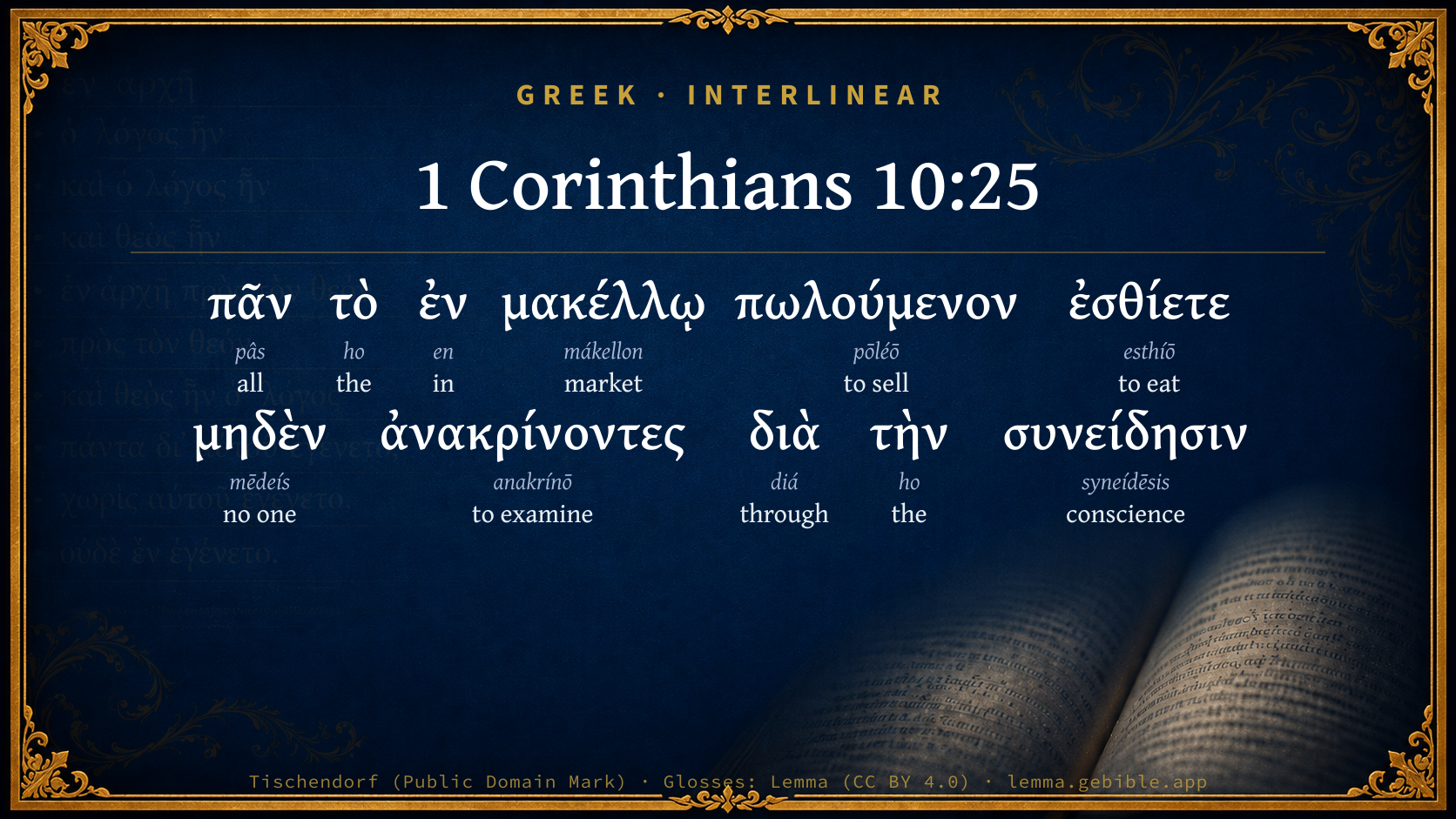
Greek (Tischendorf 8th ed.) 1 Corinthians 10:25 appears in the Greek New Testament. The text above is from the Tischendorf 8th edition. Each word links to its Strong’s number and a concise gloss. Click any word for its full Thayer’s Greek Lexicon entry.
Download image
Cite this verse

1 Corinthians 10:25 (World English Bible). Public Domain. Lemma interlinear Bible study tool, https://lemma.gebible.app/v/1-corinthians/10/25.

Show BibTeX & RIS
BibTeX
RIS
English Translation
Whatever is sold in the butcher shop, eat, asking no question for the sake of conscience,
World English Bible · Public Domain
Highlights
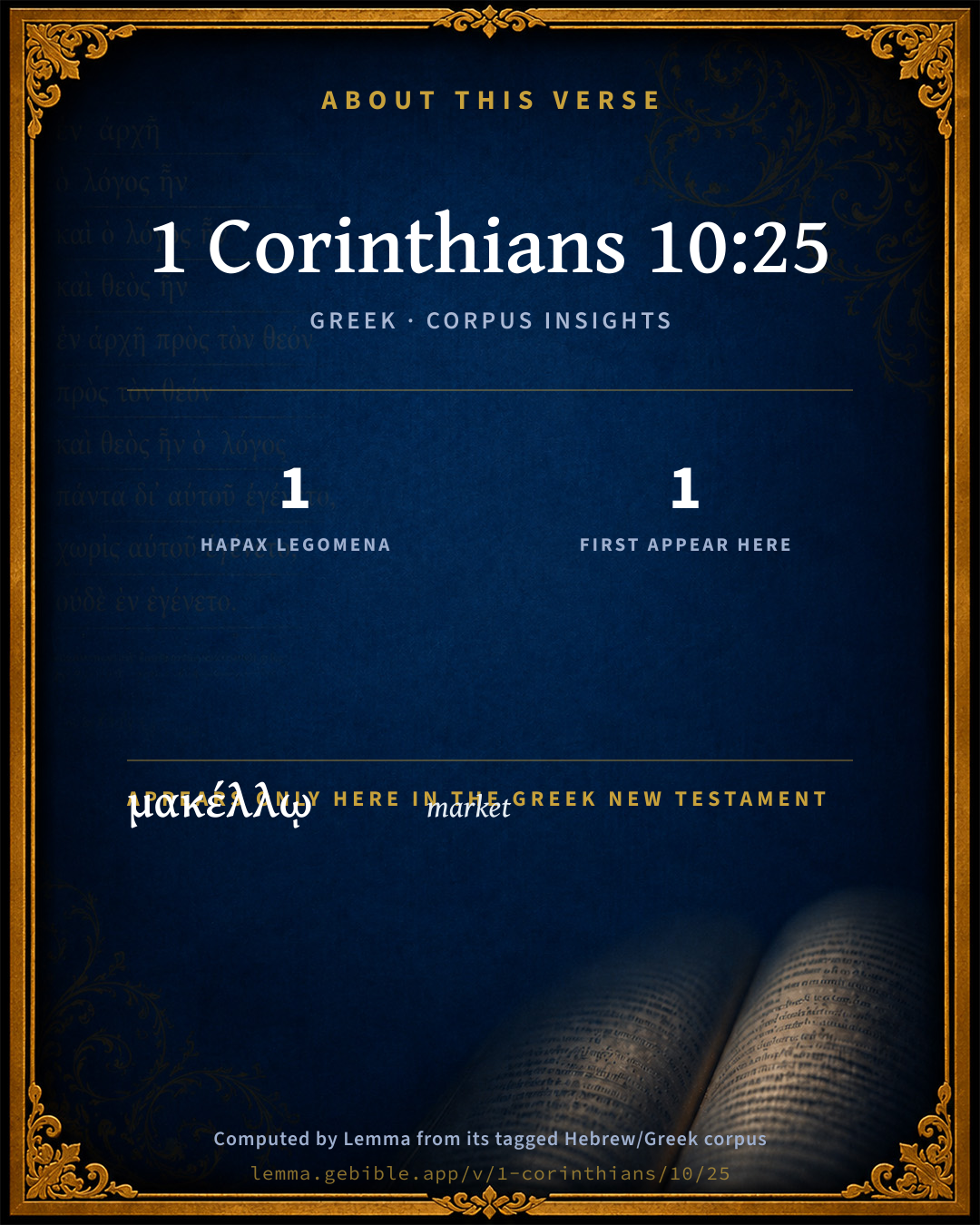
  • 1 hapax legomenon — only here in the Greek New Testament
  • 1 first appearance in the Greek New Testament
Full analysis ↓
Download a study sheet

One document with this verse’s original text, its word-by-word gloss line, the meaning frame, cross-references with their text, attributed commentary, and full source and license credits — printable, and it pastes into notes with its structure intact.

This verse Autodidact and up

Study sheet (.html) Plain text (.txt)

A passage Seminary Student

Up to 50 verses in one chapter. A passage sheet keeps up to 6 commentary sources and 12 cross-references per verse, in the order this page ranks them, and says so on the sheet whenever that leaves anything out. Ask for a single verse and you get the Autodidact verse sheet above.

Everything on this page stays free to read, with no account — the sheet is a download of what is already on screen, not access to it.

Want to remove ads? Support Godless Engineer
Compare translations 3

The same verse in 3 English versions, stacked beneath the original-language interlinear above. Click any original word for its lexicon entry.

Each is an independent rendering of the whole verse — the interlinear is not word-aligned to these translations.

Highlighted words mark where these versions differ — a whole-verse word diff, not a word-by-word alignment.

  • World English Bible Public Domain
    Whatever is sold in the butcher shop, eat, asking no question for the sake of conscience,
  • King James Version Public Domain
    Whatsoever is sold in the shambles, that eat, asking no question for conscience sake:
  • unfoldingWord Literal Text CC BY-SA 4.0
    Eat everything that is being sold in the market, without asking for the sake of the conscience.

unfoldingWord Literal Text — © unfoldingWord, licensed CC BY-SA 4.0. Word-aligned USFM3 via Door43 (git.door43.org/unfoldingWord/en_ult).

Versions to compare (up to 4)

3 of 4 selected

Show all 19 translations

Every available English version of this verse, each an independent rendering of the whole verse.

  • World English Bible Public Domain
    Whatever is sold in the butcher shop, eat, asking no question for the sake of conscience,
  • Berean Standard Bible Public Domain
    Eat anything sold in the meat market without raising questions of conscience,
  • Majority Standard Bible Public Domain
    Eat anything sold in the meat market without raising questions of conscience,
  • King James Version Public Domain
    Whatsoever is sold in the shambles, that eat, asking no question for conscience sake:
  • American Standard Version (1901) Public Domain
    Whatsoever is sold in the shambles, eat, asking no question for conscience' sake,
  • Revised Version (1885) Public Domain
    Whatsoever is sold in the shambles, eat, asking no question for conscience sake;
  • Geneva Bible (1599) Public Domain
    Whatsoeuer is solde in the shambles, eate ye, and aske no question for conscience sake.
  • Douay-Rheims (1899) Public Domain
    Whatsoever is sold in the shambles, eat; asking no question for conscience' sake.
  • Young's Literal Translation Public Domain
    Whatever in the meat-market is sold eat ye, not inquiring, because of the conscience,
  • Literal Standard Version CC BY-SA 4.0
    Eat whatever is sold in the meat-market, not inquiring, because of the conscience,
  • Unlocked Literal Bible CC BY-SA 4.0
    You may eat whatever is sold in the market, without questions of conscience.
  • unfoldingWord Literal Text CC BY-SA 4.0
    Eat everything that is being sold in the market, without asking for the sake of the conscience.
  • Darby Bible Public Domain
    Everything sold in the shambles eat, making no inquiry for conscience sake.
  • World Messianic Bible Public Domain
    Whatever is sold in the butcher shop, eat, asking no question for the sake of conscience,
  • Webster's Bible Public Domain
    Whatever is sold in the provision market, that eat, asking no question for conscience' sake:
  • Free Bible Version CC BY-SA 4.0
    Eat whatever is sold in the market without asking questions because of your conscience,
  • Bible in Basic English Public Domain
    Whatever meat may be had at the public market, take as food without question of right or wrong;
  • Text-Critical English NT CC BY 4.0
    Eat whatever is sold in the meat market, questioning nothing for the sake of conscience,
  • Tyndale New Testament (1534) Public Domain
    What soever is solde in the market that eate and axe no questions for conscience sake.

Literal Standard Version (2020), Covenant Press — licensed CC BY-SA 4.0. Text via the HelloAO Bible API (eBible.org). Unlocked Literal Bible (unfoldingWord) — licensed CC BY-SA 4.0. Text via the HelloAO Bible API (eBible.org). unfoldingWord Literal Text — © unfoldingWord, licensed CC BY-SA 4.0. Word-aligned USFM3 via Door43 (git.door43.org/unfoldingWord/en_ult). Free Bible Version, Dr. Jonathan Gallagher — licensed CC BY-SA 4.0. Text via the HelloAO Bible API (eBible.org).

Word by word

More ways to search: Search by grammar → Find every occurrence → Compare this word →

Practice this passage: Drill this verse → Learn its vocabulary →

About this verse

These counts appear in no published source. They are computed here, from the morphology-tagged text and Lemma’s own curated glosses. What Lemma adds →

11
words
10
distinct lemmas
Pauline Epistles
section

Notable vocabulary

1 hapax legomenon — a word that appears only here in the entire Greek New Testament:

  • μακέλλῳ market G3111

First appearance in Scripture

This word makes its first canonical appearance in the Greek New Testament here:

  • μακέλλῳ market G3111

Shared distinctive vocabulary

ἀνακρίνοντες to examine G350 occurs in 14 verses of the Greek New Testament. Also found in:

Repetition

A word recurs within this verse:

Cross-references

7

Topical passages linked to 1 Corinthians 10:25 in the Treasury of Scripture Knowledge — connected by theme and wording, ordered by reader-vote popularity; previews shown in the World English Bible.

  • 1 Timothy 4:4 For every creature of God is good, and nothing is to be rejected, if it is received with thanksgiving.
  • 1 Corinthians 8:7 However, that knowledge isn't in all men. But some, with consciousness of the idol until now, eat as of a thing sacrificed to an idol, and their conscience, being weak, is defiled.
  • Titus 1:15 To the pure, all things are pure; but to those who are defiled and unbelieving, nothing is pure; but both their mind and their conscience are defiled.
  • Romans 14:14 I know, and am persuaded in the Lord Jesus, that nothing is unclean of itself; except that to him who considers anything to be unclean, to him it is unclean.
  • Acts 10:15 A voice came to him again the second time, "What God has cleansed, you must not call unclean."
  • Romans 13:5 Therefore you need to be in subjection, not only because of the wrath, but also for conscience' sake.
  • 1 Corinthians 10:27–29 But if one of those who don't believe invites you to a meal, and you are inclined to go, eat whatever is set before you, asking no questions for the sake of conscience.

Cross-references courtesy of OpenBible.info (CC BY 4.0).

Commentary

Notes on 1 Corinthians 10:25 from classic Christian and Jewish commentators (each source and its license shown beneath its notes). The classic Christian expositions comment on the surrounding passage and are grouped to its opening verse, so a note may address several verses; the Jewish commentaries on the Tanakh (Rashi and others) are per-verse, so they appear only where the commentator wrote on this verse.

Lemma curates 59 commentaries, every one of them public domain or Creative Commons licensed, each selected and text-cleaned for this edition rather than reprinted as found. About our sources →

Joseph Benson's Commentary

1Co 10:25-26. The apostle now applies this principle to the point in question; and on the ground of it, gives the following rules concerning meats. Whatsoever is sold in the shambles — Though it were offered to idols before, yet being now set openly to sale, the idol is no more honoured therewith, and it is common meat; that you may buy, and eat it in private, either in a friend’s house or your own, asking no question — Whether it has been offered in sacrifice to an idol or not; for conscience’ sake — With a view to satisfy your conscience respecting the lawfulness of eating it. Or the expression, for conscience’ sake, may mean, lest any needless scruple should arise, either in your own or your brother’s conscience, so that you could not eat of it freely, without doubting in yourself, or giving offence to your brother. For the earth is the Lord’s, as the psalmist has expressed it, Psa 24:1, and the fulness thereof — All creatures therein, which were made for man’s use, and are given us freely to enjoy in Christ, 1Ti 4:4; 1Ti 6:17. And no demon hath any power or dominion over them. “By this argument the apostle showed the Corinthians that their knowledge and faith, as Christians, ought to prevent them from asking any questions concerning their food, which might lead the heathen to think that they acknowledged the power of their deities, either to give or to withhold any part of the fulness of the earth from the worshippers of the true God.”

Joseph Benson's Commentary on the Old and New Testaments (1811–1818) — public domain. Text from a community e-Sword module.

Bengel's Gnomon

Johann Albrecht Bengel

1Co 10:25. [89]Μηδὲν ἀνακρίνοντες, asking no questions) whether it has been offered to an idol or not. Curiosity is often more injurious, than simplicity.—διὰ τὴν συνείδησιν, for the sake of the conscience) of another, 1Co 10:29, whose benefit is consulted by keeping silence, lest he should be disturbed.

[89] πᾶν, all) As far as concerns the difference of meats, ver. 26.—V. g.

Bengel's Gnomon of the New Testament — English translation (T&T Clark, Edinburgh, 1860) — public domain. Text from a community e-Sword module.

Meyer's Critical & Exegetical Commentary

Heinrich August Wilhelm Meyer

1Co_10:25. On μάκελλον, shambles, slaughter-house (Varro, de ling. Lat. 4, p. 35; Dio Cass. lxi. 18), see Kypke, II. p. 219. Comp Plut. Mor. 752 C: μακελεῖα. It passed over into the Rabbinical writings also; see Drus. in loc[1702]

μηδὲν ἀνακρίν.] making no investigation (Vulg. interrogantes; not: condemning, as Grotius, Ewald, and others take it, contrary to the meaning of the word), i.e. instituting no inquiry about any of the pieces of meat exposed for sale, as to whether it had been offered in sacrifice or not. The weaker Christians, that is to say, were afraid of the possibility (see on 1Co_8:7) of their buying sacrificial meat at the fleshmarket, because they had not yet risen to see that the flesh of the victims when brought to the public mart had lost its sacrificial character and had become ordinary meat. They would probably, therefore, often enough make anxious inquiries over their purchases whether this or that piece might have been offered at the altar or not. The stronger believers did not act in this way; and Paul approves their conduct, and enjoins all to do the same.

διὰ τὴν συνείδησιν] may be taken as referring either (1) to μηδὲν ἀνακρίνοντες as to the required mode of the πᾶν ἐσθίειν: eat all without inquiry, in order that your conscience may not be troubled, which would be the case if you were told: This is meat offered to idols (so Erasmus, Rosenmüller, Hofmann, and others, following Chrysostom);[1703] or (2) simply to ἀνακρίνοντες: without making any inquiry on grounds of conscience. So Castalio, Calvin, Beza, al[1704], including Billroth and Ewald (the latter, however, rendering: condemning nothing on account of conscience). The second method of connection is preferable, both because it gives the simplest and most direct sense for διὰ τ. συνείδ., and also because of the τοῦ γὰρ Κυρίου κ.τ.λ[1705] that follows,words by which Paul designs to show that, as regards such questions about food, there is really no room for holding a court of conscience to decide upon the lawfulness or unlawfulness of eating. He means then that his readers should partake freely of all flesh sold in the fleshmarket, without for conscience sake entering into an inquiry whether any of it had or had not been sacrificial flesh. The flesh offered for sale was to be flesh to them, and nothing more; conscience had no call whatever to make any inquiry in the matter; for the earth is the Lords, etc., 1Co_10:26. Other interpreters understand the conscience of others to be meant: No investigation should be made … lest, if it turned out to be sacrificial flesh, the conscience of any one should be rendered uneasy, or be defiled by participation in the food; so Rückert, and so in substance Vatablus, Bengel, Mosheim, and others, including Flatt, Pott, Heydenreich, de Wette, Osiander, Maier. Comp 1Co_8:7; 1Co_8:10. But it could occur to none of the apostles readers to take ΤῊΝ ΣΥΝΕΊΔ. as referring to anything but their own individual conscience. It is otherwise in 1Co_10:28, where ΔΙʼ ἘΚΕῖΝΟΝ ΤῸΝ ΜΗΝΎΣ. prepares us for the transition to the conscience of another person; while the ΟὐΧῚ ΤῸΝ ἙΑΥΤΟῦ in 1Co_10:29 shows that in 1Co_10:25; 1Co_10:27 it was just the readers own conscience that was meant.

[1702] n loc. refers to the note of the commentator or editor named on the particular passage.

[1703] Vitandum enim est offendiculum, si incidat, non accersendum, Erasmus adds in his Paraphrase with fine exegetical discernment.

[1704] l. and others; and other passages; and other editions.

[1705] .τ.λ. καὶ τὰ λοιπά.

Meyer — Critical and Exegetical Commentary on the New Testament — English translation by Peter Christie, edited by Frederick Crombie (T&T Clark, 1880) — public domain. Text from a community e-Sword module.

Expositor's Greek Testament

ed. W. Robertson Nicoll

1Co 10:25-26 . The above rule is now applied in the concrete, πὰν τὸ ἐν μακέλλῳ πωλούμενον κ . τ . λ ., “Anything that is on sale in the meat-market eat, not asking any question of conscience”. μάκελλον is a term of late Gr [1547] , borrowed from Latin ( macellum ): possibly a local word, introduced by the colonia ; for the anarthrous ἐν μακ ., cf. note on ἐν σταδίῳ (1Co 9:24 ). μηδὲν ἀνακρίνοντες διὰ συνείδησιν might mean “for conscience’ sake (to avoid embarrassment of conscience) making no enquiry” (Cm [1548] , Er [1549] , Hf [1550] , El [1551] , Holsten), as though addressed to men of weak conscience Bg [1552] however, “propter conscientiam alienam” (referring to 1Co 10:29 ); or, “because of your ( sc . strong) conscience making no enquiry” since you are not troubled with scruples (Est., Mr [1553] , Ed [1554] ); or, “making no enquiry on the ground of conscience,” the adv [1555] phrase simply defining the kind of question deprecated (so Bz [1556] , Hn [1557] , Bt [1558] , Gd [1559] , Ev [1560] ): the last interpretation best suits the generality of the terms, and the connexion with 1Co 10:26 . For ἀνακρίνω , see 1Co 2:14 , 1Co 4:3 , 1Co 9:3 , and notes; it signifies enquiry with a view to judgment at the bar of conscience. μηδέν , acc [1561] of definition , as in Act 10:20 ; Act 11:12 ; Sm [1562] baldly renders it as transitive obj [1563] , “examining nothing” kein Fleischstück untersuchend ! For μὴ in ptpl [1564] clause, see Wr [1565] , p. 606. The citation from Psa 24:1 , recalling the argument of 1Co 8:4 ff., quiets the buyer’s conscience: consecration to an idol cannot deprive the Lord of anything that belongs to “the earth and its fulness,” and which His providence supplies for His servants’ need; cf. Rom 14:6 b , 14, 1Ti 4:4 . πλήρωμα , in its primary sense, id quo res impletur ( cf. Lt [1566] , Colossians , pp. 257 ff.); “terra si arboribus, herbis, animalibus etc., careret, esset tanquam domus supellectile et omnibus instrumentis vacua” (Cv [1567] ).

[1547] Greek, or Grotius’ Annotationes in N.T.

[1548] John Chrysostom’s Homiliœ († 407).

[1549] Erasmus’ In N.T. Annotationes .

[1550] J. C. K. von Hofmann’s Die heilige Schrift N.T. untersucht , ii. 2 (2te Auflage, 1874).

[1551] C. J. Ellicott’s St. Paul’s First Epistle to the Corinthians .

[1552] Bengel’s Gnomon Novi Testamenti.

[1553] Meyer’s Critical and Exegetical Commentary (Eng. Trans.).

[1554] T. C. Edwards’ Commentary on the First Ep. to the Corinthians . 2

[1555] adverb

[1556] Beza’s Nov. Testamentum: Interpretatio et Annotationes (Cantab., 1642).

[1557] C. F. G. Heinrici’s Erklärung der Korintherbriefe (1880), or 1 Korinther in Meyer’s krit.-exegetisches Kommentar (1896).

[1558] J. A. Beet’s St. Paul’s Epp. to the Corinthians (1882).

[1559] F. Godet’s Commentaire sur la prem. Ép. aux Corinthiens (Eng. Trans.).

[1560] T. S. Evans in Speaker’s Commentary .

[1561] accusative case.

[1562] P. Schmiedel, in Handcommentar zum N.T. (1893).

[1563] grammatical object.

[1564]tpl. participial.

[1565] Winer-Moulton’s Grammar of N.T. Greek (8th ed., 1877).

[1566] J. B. Lightfoot’s (posthumous) Notes on Epp. of St. Paul (1895).

[1567] Calvin’s In Nov. Testamentum Commentarii .

The Expositor's Greek Testament, edited by W. Robertson Nicoll (1897–1910) — public domain. Text from a community e-Sword module.

Hodge's Commentary on Romans, Ephesians & First Corinthians

Charles Hodge

1Co_10:25

Whatsoever is sold in the shambles, (that) eat, asking no question for conscience sake:

The general principle that sacrifices might be eaten under any circumstances which deprived the act of a religious character, is here, and in what follows, applied to particular cases. Meat, when exposed for public sale in the market, lost its character as a sacrifice, and might be eaten with impunity. The word μάκελλον is a Latin word which passed into the Greek, and means a meat market.

Eat, asking no questions for conscience sake. This clause admits of three interpretations.

1. It may mean, When you go to the market, buy what you want, and make no matter of conscience about the matter. You need have no conscientious scruples, and therefore ask no questions as to whether the meat had been offered to idols or not. This is the simplest and most natural interpretation. These verses contain the conclusion of the whole discussion. An idol is nothing; the sacrifices are nothing sacred in themselves; but as the heathen are really worshippers of evil spirits, to join in their worship by eating their sacrifices as sacrifices, is idolatry; but to eat them as meat is a matter of indifference; therefore do not make it a matter of conscience. This interpretation is confirmed by the following verse, which assigns the reason why we need have no scruples in the case.

2. Or, the meaning may be, Ask no questions, for fear of awakening scruples in your own mind. A man might eat with a good conscience of meat which he knew not was a sacrifice, when he would have serious scruples if informed that it had been offered to an idol. Therefore it was wise, for his own sake, to ask no questions. Paul, however, would not advise men to act blindfold. If a man thought it wrong to eat meat offered to idols, it would be wrong for him to run the risk of doing so by buying meat in the markets where sacrifices were exposed for sale.

3. Others say the apostle means to caution the strong against instituting such inquiries, for fear of giving rise to scruples in others. In favor of this view it is urged, that throughout the whole discussion the object of the apostle is to induce the strong to respect the conscientious scruples of the weak. And in 1Co_10:29 he says expressly, that he means the conscience of others.

The former of these considerations has not much weight, for we have here general directions suited to all classes. Having shown in the preceding paragraph, that it was idolatrous to eat of these sacrifices under certain circumstances, it was perfectly natural that he should tell both the strong and the weak when they might be eaten without scruple. As to the second argument, it is rather against man in favor of this interpretation. For if, when he means the conscience of another, he expressly says so, the inference is, that when he makes no such explanation, he means the mans own conscience. Besides, the following verse gives the reason why we need not have any scruples in the case, and not why we should regard the scruples of others.

Charles Hodge — Commentary on Romans (1835), First Corinthians (1857), and Ephesians (1856) — public domain. Text from a community e-Sword module.

Geneva Bible (1599)

Geneva Bible translators

The flesh that was sacrificed, was used to be sold in the shambles, and the price returned to the priests.

An applying of the rule to the present matter: Whatsoever is sold in the shambles, you may indifferently buy it as it were at the Lord’s hand, and eat it either at home with the faithful, or being called home to the unfaithful, to wit, in a private banquet: but yet with this exception, unless any man is present which is weak, whose conscience may be offended, by setting meats offered to idols before them: for then you ought to have consideration of their weakness.

Geneva Bible (1599) marginal notes — public domain. Text via Bolls.life.

Jamieson, Fausset & Brown

Robert Jamieson, A. R. Fausset & David Brown

shambles--butchers' stalls; the flesh market.

asking no question--whether it has been offered to an idol or not.

for conscience' sake--If on asking you should hear it had been offered to idols, a scruple would arise in your conscience which was needless, and never would have arisen had you asked no questions.

Jamieson, Fausset & Brown — Commentary Critical and Explanatory on the Whole Bible (1871) — public domain (CC PDM 1.0). Text via the HelloAO Bible API.

Adam Clarke's Commentary

Verse 25. Whatsoever is sold in the shambles, that eat] The case to which the apostle refers is simply this; it was customary to bring the flesh of the animal to market, the blood of which had been poured out in sacrifice to an idol; or, taken more particularly, the case was this; one part of the sacrifice was consumed on the altar of the idol: a second part was dressed and eaten by the sacrificer; and a third belonged to the priest, and was often sold in the shambles. To partake of the second share, or to feast upon the sacrifice, St. Paul absolutely forbids, because this was one part of the religious worship which was paid to the idol; it was sitting down as guests at his table, in token that they were in fellowship with him. This was utterly incompatible with receiving the sacrament of the Lord's Supper, which was the communion of the body and blood of Christ. But as to the third share, the apostle leaves them at liberty either to eat of it or forbear; except that, by eating, their weak brethren should be offended; in that case, though the thing was lawful, it was their duty to abstain. See the notes on 1Co 8:1, c. Hindoos eagerly embrace whatever has been offered to an idol: hence it is common to see the flowers that have been thus offered placed in the hair of a Hindoo. Water that has been thus made sacred is preserved in Hindoo houses, and with it they rub their bodies, and occasionally sip a drop, regarding it as the water of life.-See Ward.

Asking no questions for consciences sake] Dr. Lightfoot observes, that "the Jews were vexed with innumerable scruples in their feasts, as to the eating of the thing, as well as to the company with which they ate and even the manner of their eating. Of fruits and herbs brought to the table, they were to inquire whether they were tithed according to custom; whether they were consecrated by the Truma, or whether they were profane; whether they were clean, or touched with some pollution, c. And concerning flesh set on the table, they were to inquire whether it was of that which had been offered to idols whether it were the flesh of an animal that had been torn by wild beasts; or of that which had been strangled, or not killed according to the canons; &c., &c. All which doubts the liberty of the Gospel abolished as to one's own conscience, with this proviso, that no scandal or offence be cast before another man's weak or scrupulous conscience."

From this it is evident that the apostle had the case of the Jewish converts in view, and not the Gentiles. The latter were not troubled with such extraordinary scrupulousness.

Adam Clarke's Commentary on the Bible (1810–1826) — public domain. Text from a community e-Sword/MySword module.

John Calvin's Commentaries

25. Whatsoever is sold in the shambles He has spoken above of dissembling in connection with idolatry, or, at least, as to those actions which the Corinthians could not engage in, without professing themselves to be the associates of the wicked in their superstitions. He now requires them, not merely to abstain from all professions of idolatry, but also to avoid carefully all occasions of offense, which are wont to arise from the indiscriminate use of things indifferent. For, although there was but one kind of offense on the part of the Corinthians, there were, at the same time different degrees of it. Now, as to the eating of food, he makes, in the first place, this general statement — that it is lawful to eat, with a safe conscience, any kind of food, because the Lord permits it. In the second place, he restricts this liberty as to the use of it — lest weak consciences should be injured. Thus this conclusion is divided into two parts the first relates to liberty and power as to things indifferent: the second to a limitation of it — that the use of it may be regulated in accordance with the rule of love.

Debating nothing ᾿Ανακρίνεσθαι, the word that Paul makes use of, means to reason on both sides, in such a way, that the person’s mind vacillates, inclining now to this side, and then to that. Accordingly, in so far as concerns a distinction of meats, he frees our consciences from all scruple and hesitation; because it is proper that, when we are certain from the word of the Lord that he approves of what we do, we should have ease and tranquillity in our minds.

For conscience sake — that is to say, Before the judgment-seat of God — “In so far as you have to do with God, there is no occasion for your disputing with yourself, whether it be lawful or not. For I allow you to eat freely of all kinds of meat, because the Lord allows you everything without exception.”

John Calvin's Commentaries (1540-1563) — public domain. Text from the Calvin Translation Society English edition (1840s-50s) via the Christian Classics Ethereal Library (ccel.org). Calvin's coverage is partial (roughly two-thirds of the Bible); uncommented books and verses are honest gaps, never fabricated. The 19th-century editor's footnotes and remarks are omitted so the notes are faithfully Calvin's own voice.

Ellicott's Commentary for English Readers

(25) Whatsoever is sold in the shambles.—Here is the practical application of the principle laid down. When a Christian sees meat exposed for sale in the public market let him buy it and eat it; he need not ask any question to satisfy his conscience on the subject. Some of the meat which had been used for sacrificial purposes was afterwards sold in the markets. The weaker Christians feared lest if they unconsciously bought and ate some of that meat they would become thereby defiled. The Apostle’s view is that when once sent into the public market it becomes simply meat, and its previous use gives it no significance. You buy it as meat, and not as part of a sacrifice. Thus the advice here is not at variance with the previous argument in 1Co_10:20-21. The act which is there condemned as a “partaking of the table of devils” is the eating of sacrificial meat at one of the feasts given in the court of the heathen temple, when the meat was avowedly and significantly a portion of the sacrifice. The words “for conscience sake” have been variously interpreted as meaning, (1) Enter into no inquiry, so that your conscience may not be troubled, as it would be if you learned that the meat had been used for sacrifice; or, (2) Ask no question, lest some weak person’s conscience be defiled if they hear that it is sacrificial meat and yet see you eat it. This latter interpretation must be rejected, as the Apostle clearly points out in 1Co_10:28 that he has been here speaking of the person’s own conscience, and only there proceeds to speak of a brother’s conscience.

A Bible Commentary for English Readers, edited by Charles John Ellicott (1878–1897) — public domain. Text from a community e-Sword module.

The Cambridge Bible for Schools and Colleges

gen. ed. J. J. S. Perowne

25. Whatsoever is sold in the shambles] This and the two following verses are directed against over-scrupulousness. Some Christians were afraid to buy meat in the public market, lest it might have been offered in sacrifice to an idol. See note on ch. 1Co_8:1.

asking no question for conscience sake] Rather, entering upon no inquiry. This may be interpreted (1) as directing, that no inquiry was to be made, lest the answer should suggest conscientious scruples, or (2) as urging that no conscientious scruples need be felt which should lead to any necessity for making inquiries. The latter is more in accordance with the robust morality of the Apostle, and with the context The conscience need not be sensitive upon such points; it need not suggest entangling difficulties, where in truth there were none. This is better than to suppose with some, that information was to be kept back in order to avoid anxiety on the part of the scrupulous.

The Cambridge Bible for Schools and Colleges (gen. ed. J. J. S. Perowne; Cambridge University Press, 1878–1918) — public domain. Text from a community e-Sword module.

John Gill's Exposition

Whatsoever is sold in the shambles,.... the word rendered "shambles", here used, is a Latin word, and is made use of by Latin writers in the same sense as here, for a place where food was sold (i). The original of the name is said (k) to be this; one Macellus, a very wicked and profane man, being for his robberies and filthy life condemned to die, a place was built in his house by Aemylius and Fulvius, censors, for selling of provisions, and which from his name was called "Macellum". The Syriac version retains the word here, and so do the Talmudists, and Rabbins (l) frequently; who say (m),

"Nylwqm, the "shambles", and the butchers of Israel, though flesh of them is found in the hand of a stranger, it is free:''

into these places the priests sent to be sold what was offered to their idols, which they could not dispense with themselves, or thought not lawful to make use of; for the Egyptians, as Herodotus says (n), used to cut off the heads of their beasts that were sacrificed, and carry them into the market and sell them to the Greeks, and if there were no buyers they cast them into the river. Now the apostle allows, that such meat that was sold in the shambles might be bought and eat of, but not in an idol's temple; there was a difference between an idol's temple, and eating things sacrificed to idols there, and buying them in shambles or meat market, and eating them at home:

that eat; buy, carry home, dress and eat, in your own houses:

asking no question; whether it was sacrificed to idols, or not:

for conscience sake; either a man's own, which may be hurt, wounded, and defiled, by eating contrary to it, should he know that what he eats had been offered to an idol; whereas if he asks no questions, and knows nothing of the matter, his conscience will not be afflicted: or else another man's that may stand by whilst the meat is bought, and sold; and who hearing questions asked and answered, and yet observes the meat, though sacrificed to idols, dressed and ate by the buyer, his conscience being weak, may be offended and grieved.

(i) Vid. Suet. Vita Jul. Caesar, c. 43. & Tiber. Nero, c. 34. (k) Alex. ab Alex Genial Diet. l. 3. c. 23. (l) T. Hieros. Chagiga, fol. 76. 2. T. Bab. Menachot, fol. 29. 2. Bereshit Rabba, fol. 75. 3. (m) T. Bab. Cholin, fol. 95. 1. (n) L. 2. c. 39.

John Gill's Exposition of the Whole Bible (1746–1763) — public domain (CC PDM 1.0). Text via the HelloAO Bible API.

Trapp's Complete Commentary

John Trapp

25 Whatsoever is sold in the shambles, that eat, asking no question for conscience sake:

Ver. 25. Whatsoever is sold, &c.] A portion of the consecrated flesh was usually sold by the priests, who make their markets of it, as Augustine upon the Romans testifieth.

John Trapp, A Commentary or Exposition upon All the Books of the Old and New Testament (1647–1656) — public domain. Text from a community e-Sword module.

Albert Barnes' Notes on the Bible

Whatsoever is sold in the shambles - In the market. The meat of animals offered in sacrifice would be exposed there to sale as well as other meat. The apostle says that it might be purchased, since the mere fact that it had been offered in sacrifice could not change its quality, or render it unfit for use. They were to abstain from attending on the feasts of the idols in the temple, from partaking of meat that had been offered them, and from celebrations observed expressly in honor of idols; but lest they should become too scrupulous, the apostle tells them that if the meat was offered indiscriminately in the market with other meat, they were not to hesitate to purchase it, or eat it.

Asking no question for conscience’ sake - Not hesitating or doubting, as if it might possibly have been offered in sacrifice. Not being scrupulous, as if it were possible that the conscience should be defiled. This is a good rule still, and may be applied to a great many things. But:

(1) That which is purchased should be in itself lawful and right. It would not be proper for a man to use ardent spirits or any other intoxicating drinks because they were offered for sale, any more than it would be to commit suicide because people offered pistols, and bowie-knives, and halters to sell.

(2) There are many things now concerning which similar questions may be asked; as, e. g. is it right to use the productions of slave-labor, the sugar, cotton, etc., that are the price of blood? Is it right to use that which is known to be made on Sunday; or that which it is known a man has made by a life of dishonesty and crime? The consciences of many persons are tender on all such questions; and the questions are not of easy solution. Some rules may perhaps be suggested arising from the case before us:

If the article is exposed indiscriminately with others in the market, if it be in itself lawfill, if there is no ready mark of distinction, then the apostle would direct as not to hesitate. If the use and purchase of the article would go directly and knowingly to countenance the existence of slavery, to encourage a breach of Sunday, or to the continuance of a course of dishonest living, then it would seem equally clear that it is not right to purchase or to use it. If a man abhors slavery, and violations of Sunday, and dishonesty, then how can he knowingly partake of that which goes to patronize and extend these abominations? If the article is expressly pointed out to him as an article that has been made in this manner, and his partaking of it will be construed into a participation of the crime, then he ought to abstain; see 1Co 10:28. No man is at liberty to patronize slavery, Sunday violations, dishonesty, or licentiousness, in any form. Every man can live without doing it; and where it can be done it should be done. And perhaps there will be no other way of breaking up many of the crimes and cruelties of the earth than for good people to act conscientiously, and to refuse to partake of the avails of sin, and of gain that results from oppression and fraud.

Albert Barnes' Notes on the Bible (1834–1885) — public domain. Text from a community e-Sword/MySword module.

Matthew Poole's English Annotations

It is possible that butchers, before they brought their meat into the market, might offer some part of it to the idol; or it is possible that the priests, who had a share in the beasts offered to idols, or the people that had offered such beasts, who, also had a share returned them, might out of covetousness come and bring’ it to be sold in the market. The apostle directeth the Corinthians in such cases to make no scruple, but eat of it, if it were commonly sold in the shambles; which argued, that the thing in itself, considered nakedly, was not sinful. But yet he would have them in that case ask no questions, whence it came? Or whether it had not been offered to an idol? For the sake of other men’s consciences, lest some others standing by should take notice that they bought and ate such meat. Or their own consciences, lest, though the thing in itself, so separated from a sacred use, and returned to its common use, might be lawfully eaten, yet their consciences should afterwards reflect upon them for the doing of it.

Matthew Poole's English Annotations on the Holy Bible (1683–1685) — public domain. Text from a community e-Sword/MySword module.

Whedon's Commentary on the Bible

Daniel D. Whedon

25. Whatsoever is sold—The meats of idol sacrifices were often exposed to sale in the shambles, especially by the priests, when they had on hand a surplus above their own consumption. To the Christian this was intrinsically as lawful as any other meat.

Shambles—Not markets, nor buildings; but meat stalls in the market. In view of this lawfulness, therefore, without any questions for conscience’ sake, even if well knowing that a pagan priest had just exposed it for sale, the believer might purchase and eat.

Daniel D. Whedon (gen. ed.), Commentary on the Old and New Testaments (1874–1909) — public domain. Text from a community e-Sword module.

The Pulpit Commentary

Whatsoever is sold. By this practical rule of common sense he protects the weak Christian from being daily worried by over scrupulosity. If a Christian merely bought his meat in the open market, no one could suspect him of meaning thereby to connive at or show favour to idolatry. It would, therefore, be needless for him to entertain fantastic scruples about a matter purely indifferent. The fact of its forming part of an idol offering made no intrinsic difference in the food. Shambles; rather food market. Asking no question for conscience sake. Do not trouble your conscience by scruples arising from needless investigation (ajnakrinwn) about the food.

The Pulpit Commentary (1880–1919), ed. H.D.M. Spence-Jones & Joseph S. Exell — public domain. Text from a community e-Sword module.

John Wesley's Explanatory Notes

The apostle now applies this principle to the point in question. Asking no questions - Whether it has been sacrificed or not.

John Wesley, Explanatory Notes Upon the Whole Bible (1754–1765) — public domain. Text via the GEBible commentary corpus.

Kretzmann's Popular Commentary

Paul E. Kretzmann

Rules of conduct:

v. 25. Whatsoever is sold in the shambles that eat, asking no question for conscience’ sake;

v. 26. for the earth is the Lord’s and the fullness thereof.

v. 27. If any of them that believe not bid you to a feast and ye be disposed to go, whatsoever is set before you eat, asking no question for conscience’ sake.

v. 28. But if any man say unto you, This is offered in sacrifice unto idols, eat not for his sake that showed it, and for conscience’ sake; for the earth is the Lord’s and the fullness thereof;

v. 29. conscience, I say, not thine own, but of the other; for why is my liberty judged of another man’s conscience?

v. 30. For if I by grace be a partaker, why am I evil spoken of for that for which I give thanks?

The application of the principles of Christian love to the situation at Corinth was not very difficult. Everything, all the meat that was offered for sale in the meat-market, they might eat. But in doing so, for the sake of their weak brothers, they should not ask questions as to where the meat came from, whether or not it had been sent down from the temple. In this way they would avoid embarrassment in case they, in turn, should be interrogated. This latitude of action Paul substantiates with a passage from Scriptures: For the Lord’s is the earth and its fullness, everything that is found in it, all it contains, Psa 24:1. Christians may therefore use all the gifts of God as found in the world without the slightest hesitation, provided that no hindrance exists such as is referred to here. The apostle intimates, also, that the anxious search for scruples of conscience which some people regard as the essence of Christianity is not founded upon the will of God.

In case a Christian was invited by some unbeliever and thought it best to go, to accept the invitation, the same general rule should be applied. He should eat everything that was served, but again not ask any questions. The chances are that he would be narrowly watched not only by the non-Christian, who would probably use sacrificial meat, but also by any weak Christian that might be present at the same time. But if someone should then remark that sacrificial meat was being served, the Christian should no longer eat of it. Whether the information would be volunteered in a spirit of civility and by the desire to be of service to the Christian’s scruples or in a spirit of mockery, to embarrass him; whatever the occasion or motive, it changes the situation and causes the believer to decline the meat, not for the sake of his own conscience, but for the sake of his weak brother’s. Out of consideration for the scruples of his fellow-Christian the believer will abstain from eating meat under those circumstances. And if the objection is made that the decision concerning what is good and not good must rest with the individual Christian, the apostle would have him remember: For to what end is my liberty judged by another conscience; what advantage will I get out of it if I insist upon eating under these circumstances and then must expect the censure of another man’s scruples who simply cannot see that my course is altogether in accordance with the Word of God? Instead of receiving benefit from his inconsiderate use of his liberty, positive harm may result: If I with thanksgiving partake, why am I blasphemed and condemned on account of that for which I gave thanks? It will be regarded as an act of hypocrisy by the heathen and brothers that have not the right knowledge if a Christian, in such a situation, not only eats, but also offers thanks to God for the food. That is the reason why a Christian, out of deference to the conscience of the weaker brother, and in order to avoid giving offense, will decline to partake of sacrificial meat.

Paul E. Kretzmann, Popular Commentary of the Bible (1921–1924) — public domain. Text from a community e-Sword module.

Burkitt's Expository Notes on the New Testament

William Burkitt

Here the apostle resolves the case, whether it were lawful to buy that meat in the market which had been offered to an idol in the temple.

He determines, 1. That it was; if it be sold in the shambles, it is to be looked upon as common food, and they may freely buy it without any scruple of conscience.

But how came meat to be sold in the shambles, which was offered and sacrificed in the temples of the Gentiles?

Answer, It is probable that the priests, who had a share in the beasts that were offered unto idols, or the people, who had also a share returned them out of their own offerings, did bring such meat to be sold in the market: in this case, says the apostle, ask no questions about it.

Observe, 2. He assigns the reason for it: because the earth is the Lord’s, and the fulness thereof. That is, those things that are sold for food in the market, are to be looked upon as the creatures of God, made for, and sanctified to, the use of man; and therefore you may eat of any creature which the Lord provideth for your food, without scruple of conscience, when others are not scandalized at it. 1Ti 4:4. Every creature of God is good, if received with thanksgiving.

William Burkitt's Expository Notes on the New Testament (1700–1703) — public domain. Text from a community e-Sword module.

Godbey's Commentary on the New Testament

William B. Godbey

25. “Eat everything sold in market, asking no questions for conscience’ sake.” Certainly we have broad liberties amid the clear light of the Pentecostal dispensation. We need not Judaize on swine nor anything else. Yet we must live hygienically, pursuant to our constant duty to our own body, mind and spirit; and we must live prudently, not only on the questions of eating and drinking, but of all others, for the sake of our neighbors.

William B. Godbey, Commentary on the New Testament (1896–1900) — public domain. Text from a community e-Sword module.

McGarvey & Pendleton's Commentaries

J. W. McGarvey

Whatsoever is sold in the shambles, eat, asking no question for conscience' sake ;

J. W. McGarvey (with Philip Y. Pendleton), Commentaries on the New Testament (The Fourfold Gospel, 1914; Acts; and the epistles) — public domain. Text from a community e-Sword/MySword module.

The People's New Testament

B. W. Johnson

25. Whatsoever is sold in the shambles. In the butcher's stalls. This one might eat without question as to whether it had been part of an idol sacrifice or not.

B. W. Johnson's The People's New Testament with Notes (1889–1891) — public domain. Electronic text from the Christian Classics Ethereal Library (CCEL) ThML edition.

unfoldingWord translationNotes

Door43 World Missions Community

you without asking questions of conscience

"you. God wants you to eat the food with a clear conscience"

translationWords

conscience

earth

believe

unfoldingWord translationNotes — © Distant Shores Media and the Door43 World Missions Community, licensed CC BY-SA 4.0. Source: git.door43.org/Door43/en_tn.

Cambridge Greek Testament for Schools and Colleges

25. ἐν μακέλλῳ. This and the two following verses are directed against over-scrupulousness. Some Christians were afraid to buy meat in the public market, lest it might have been offered in sacrifice to an idol. See note on ch. 1Co 8:1. μάκελλος is a Latin word which passed over into Greek and even into Rabbinic.

μηδὲν ἀνακρίνοντες. See note on ch. 1Co 2:14. This may be interpreted (1) as directing, that no inquiry was to be made, lest the answer should suggest conscientious scruples, or (2) as urging that no conscientious scruples need be felt which should lead to any necessity for making inquiries. The latter is more in accordance with the robust morality of the Apostle, and with the context. The conscience need not be sensitive upon such points; it need not suggest entangling difficulties, where in truth there were none. This is better than to suppose with some, that information was to be kept back in order to avoid anxiety on the part of the scrupulous.

Cambridge Greek Testament for Schools and Colleges (Cambridge University Press, 1896; 21 vols, various authors incl. Carr, Maclear, Plummer, Farrar, Lumby, Moule, M. R. James, Simcox) — public domain. Text from a community e-Sword module.

Alford’s Greek Testament

Henry Alford

25.] The key to understanding this and the following verse is, to remember that συνείδησις is used in each case of the conscience of the person spoken of, i.e. in the two first cases, that of the reader,—in the third, as explained by the Apostle, that of the weak brother: see there. Every thing which is being sold (offered for sale) in the flesh-market (μάκελλον is adopted from the Latin. It was also used by the Rabbis, in the form מקולין. See Stanley, and examples in Wetst.), eat, making no enquiry (whether it is meat offered to idols or not), on account of your conscience (to be joined with ἐσθίετε μηδ. ἀνακ., not with ἀνακρίνοντες only,—as is shewn by the parallel below, ver. 28,—where the reason given is joined to ἐσθίετε). The meaning being,—‘eat without enquiry, that your conscience may not be offended,’ If you made enquiry, and heard in reply, that the meat had been offered to idols, your conscience would be offended, and you would eat διὰ προσκόμματος to yourselves. De Wette, al., understand τὴν συν., all through, of the conscience of another, and apply to all the explanation of ver. 29. But as Meyer well observes, no reader could possibly refer τὴν συνείδ. to any one but himself, no other person having been mentioned, until ver. 28, where ἐκεῖνον τὸν μηνύσαντα is introduced, and τὴν συνείδησιν is to be referred (but even then not without special explanation given) to the new subject.

Henry Alford, The Greek Testament (1849–1861) — public domain. Text from a community e-Sword module.

International Critical Commentary

25. ἐν μακέλλῳ. The word occurs nowhere else in Biblical, and is rare in classical, Greek; = macellum, which may be derived from macto = ‘slaughter’ or maceria = ‘enclosure.’ It means ‘provision-market,’ and especially ‘meat-market.’ Probably a great deal of the meat offered for sale (πωλούμενον) came from the sacrifices, especially what was sold to the poor. See Deissmann, Light, p. 274.

μηδὲν ἀνακρίνοντες. ‘Making no inquiry’ as to whether the meat had been offered in sacrifice. It is not likely that the meaning is, ‘not examining any piece of meat,’ because of v. 27. In the market, it might be possible to distinguish sacrificial meat, but not after it had been served at table.

διὰ τὴν συνείδησιν. ‘Out of regard to conscience.’ Is this clause to be taken with μηδὲν ἀνακρίνοντες, or with ἀνακρίνοντες only? If the latter, the meaning is ‘making no conscientious inquiries,’ asking no questions prompted by a scrupulous conscience. Had the order been μηδὲν διὰ τ. συν. ἀνακρ., this would no doubt be the meaning. As the words stand, the former construction is better; ‘For the sake of your conscience making no inquiry,’ asking no questions which might trouble conscience. It is not wise to seek difficulties. The connexion with ἐσθίετε, ‘eat, because your conscience is an enlightened one,’ may safely be rejected.

International Critical Commentary — older volumes (1896–1929), various authors — public domain. Text from a community e-Sword module.

Vincent's Word Studies in the New Testament

Marvin R. Vincent

The shambles [μακελλω] . Only here in the New Testament. It is a Latin word, which is not strange in a Roman colony like Corinth. In sacrifices usually only a part of the victim was consumed. The rest was given to the priests or to the poor, or sold again in the market. Any buyer might therefore unknowingly purchase meat offered to idols.

Asking no question. As to whether the meat had been used in idol sacrifice. See on ch. 1Co 2:14.

Marvin R. Vincent, Word Studies in the New Testament (1887–1900) — public domain. Text from a community e-Sword/MySword module.

Godet's Commentaries

Frédéric Louis Godet

Vv. 25, 26. “Whatsoever is sold in the shambles, eat, asking no question for conscience sake: 26. for the earth is the Lord’s, and the fulness thereof.”

A Christian whose conscience is free from every scruple as to the eating of offered meats, sends and buys meat at the shambles; he has not to ask whether it is or is not sacrificial meat; it is pure in itself, like everything God has created. The term μάκελλον, shambles, is connected with the Latin macellum, and with the old French word mazel. The proper Greek word would have been κρεοπώλιον. — The last words, διὰ τὴν συνείδησιν, for conscience sake, are naturally connected with μηδὲν ἀνακρίνοντες. Edwards also explains it in this way, applying it, however, to a strong conscience: an enlightened and firm conscience is a reason for abstaining from all inquiry. Holsten, on the contrary, alleges that the conscience here, as in the rest of the passage, can only be that of the weak Christian, of which the strong Christian needs not take account when he is eating alone at his own house. But, in these two senses, Paul would have added, as in 1Co 10:29, some qualification or other to indicate of which conscience he meant to speak. The simplest view is to hold that he is thinking of conscience, absolutely speaking, as in our expression: for conscience sake. The falsest interpretation is that of Chrysostom, Erasmus, etc.: “Making no inquiry, and that in order that, if you come to learn that it is meat which has been offered to idols, you may not have the burden of it on your conscience.” This meaning would suppose that the direction is addressed to the weak.

Vv. 26. This is a quotation from Psa 24:1, a passage which, by proclaiming that all that fills the world comes from God and belongs to Him, saps the prejudice of the weak at Corinth at the root. By quoting this saying from the Old Testament, Paul wished to raise the weak to the height of the strong. Heinrici makes the interesting remark that these words of the Psalmist are used among the Jews as a thanksgiving at table.

The second case, that of an invitation to the house of a heathen: 1Co 10:27-30. Again, two alternatives must be distinguished; in the first place, the case of a feast at which no observation is made by any of the guests regarding the meats which are presented.

Frédéric Louis Godet — Commentaries on Luke, John, Romans, and 1 Corinthians — English translation (T&T Clark, Edinburgh, 1870s–1890s) — public domain. Text from a community e-Sword module.

Lesson kit

Teaching starters — assembled from the data on this page, not authored interpretation. Every prompt links to the verse data it draws on. Edit before teaching.

1 Corinthians, in the Pauline Epistles, opens this verse with 11 words (10 distinct Greek lemmas). Its most distinctive word is mákellon (“market”). A historical commentator’s framing appears above. Read the whole chapter for the surrounding context.

Discussion questions

  1. How does “market” (mákellon) shape what this verse is saying?
  2. 1 word here appears nowhere else in the Greek New Testament. Why might the author reach for such rare wording?
  3. This is the first place “market” appears in Scripture (first appears here). What does its debut here establish?
  4. How does Luke 23:14, which shares the word «to examine», read alongside this verse?
  5. What does the repetition of “the” (2× in this one verse) do in this verse?
  6. These translations render this verse differently; the difference is in the English rendering, not the original. What questions does that raise?
  7. Compare how Joseph Benson's Commentary and Bengel's Gnomon read this verse. Where do they agree or differ?

Things to notice

  • 1 word in this verse appears nowhere else in the Greek New Testament.
  • 1 word makes its first canonical appearance in Scripture here.
  • These translations choose different wording for 10 words in this verse.
  • “the” occurs 2× in this single verse.
  • 10 distinct Greek lemmas span 11 words in this verse.

Reading settings

Reading text

Shown beneath each verse's original-language words.

Old Testament
Old Testament edition

Read the OT as the Masoretic Hebrew (MT) or the Greek Septuagint (LXX).

English shown for the Greek Septuagint (in the Hebrew ↔ Greek comparison).

Comparing translations? Open the Compare panel on any verse page to stack up to four side by side.