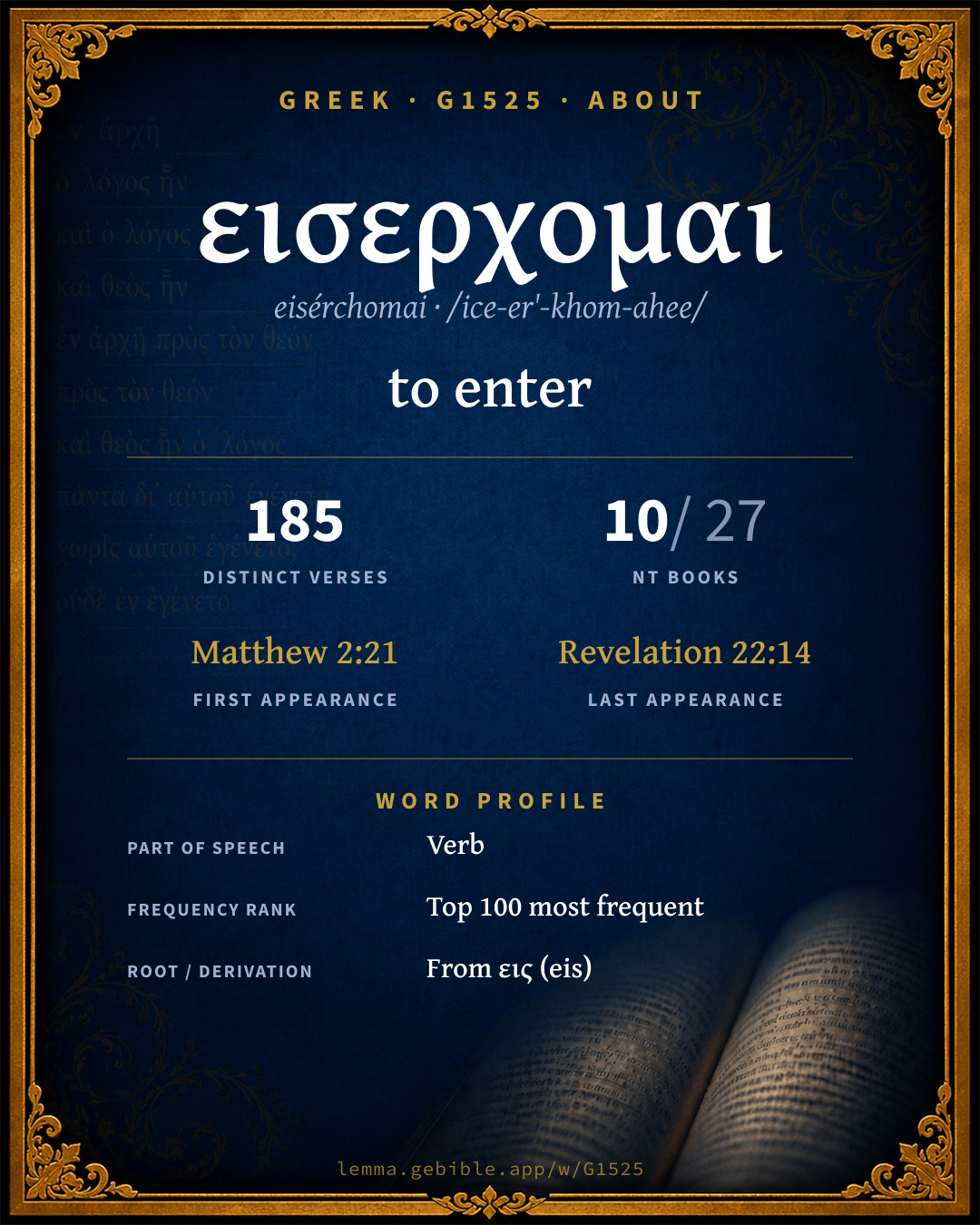
εἰσέρχομαι
to enter
‘to enter’ is one of 2 main senses fuller range ↓
Full lexicon entry — Thayer's Greek Lexicon
From Thayer's Greek Lexicon
Where this word appears
See every Aorist-tense verb in the Greek New Testament →
Grammar key — what these labels mean
Part of speech
- Verb
- An action or state-of-being word.
Tense
- Aorist
- Action viewed as a simple whole, without regard to duration — often past (perfective aspect).
- Future
- Action expected in future time.
- Present
- Ongoing or general action in present time (imperfective aspect).
- Perfect
- A completed past action with continuing present results.
Voice
- Active
- The subject performs the action.
- Middle deponent
- Middle in form but active in meaning.
- Middle or Passive deponent
- Middle/passive in form but active in meaning.
Mood
- Indicative
- States a fact or asks a factual question (the mood of reality).
- Infinitive
- A verbal noun (“to write”), unmarked for person or number.
- Participle
- A verbal adjective (“writing,” “having written”).
- Subjunctive
- Expresses probability, purpose, or possibility (the mood of contingency).
- Imperative
- Expresses a command or request.
Case
- Nominative
- The case of the subject (and the predicate nominative).
- Accusative
- The case of the direct object and of extent.
- Genitive
- The case of source, possession, or “of” — answers “whose / from what.”
- Dative
- The case of the indirect object, means, or location — “to / for / with / in.”
Person
- 3rd person
- The one spoken about (“he / she / it / they”).
- 2nd person
- The one addressed (“you”).
- 1st person
- The speaker (“I / we”).
Gender
- Masculine
- Grammatically masculine.
- Feminine
- Grammatically feminine.
- Neuter
- Grammatically neuter.
Number
- Singular
- One.
- Plural
- More than one.
31 verses where G1525 appears in the Aorist tense in the Book of Matthew. Filtered view — show all forms. Click any verse to open its interlinear word-by-word view. Verse text shown in the World English Bible for context — . Each verse’s Greek form is shown with its reference; the English is not keyword-highlighted, since the data carries no word-level English alignment. Use “Compare translations” on any verse to read it across multiple English versions. This concordance covers the Greek New Testament; Septuagint (Greek Old Testament) occurrences of this word are not indexed here.
Matthew
- Matthew 2:21 εἰσῆλθεν aor act ind 3sg He arose and took the young child and his mother, and came into the land of Israel.
- Matthew 5:20 εἰσέλθητε aor act subj 2pl For I tell you that unless your righteousness exceeds that of the scribes and Pharisees, there is no way you will enter into the Kingdom of Heaven.
- Matthew 6:6 εἴσελθε aor act impv 2sg But you, when you pray, enter into your inner chamber, and having shut your door, pray to your Father who is in secret, and your Father who sees in secret will reward you openly.
- Matthew 7:13 εἰσέλθατε εἰσερχόμενοι aor act impv 2pl pres mid/pass.dep ptcp nom pl masc "Enter in by the narrow gate; for wide is the gate and broad is the way that leads to destruction, and many are those who enter in by it.
- Matthew 8:5 Εἰσελθόντος aor act ptcp gen sg masc When he came into Capernaum, a centurion came to him, asking him,
- Matthew 8:8 εἰσέλθῃς aor act subj 2sg The centurion answered, "Lord, I'm not worthy for you to come under my roof. Just say the word, and my servant will be healed.
- Matthew 9:18 εἰσελθὼν aor act ptcp nom sg masc While he told these things to them, behold, a ruler came and worshiped him, saying, "My daughter has just died, but come and lay your hand on her, and she will live."
- Matthew 9:25 εἰσελθὼν aor act ptcp nom sg masc But when the crowd was put out, he entered in, took her by the hand, and the girl arose.
- Matthew 10:5 εἰσέλθητε aor act subj 2pl Jesus sent these twelve out, and charged them, saying, "Don't go among the Gentiles, and don't enter into any city of the Samaritans.
- Matthew 10:11 εἰσέλθητε aor act subj 2pl Into whatever city or village you enter, find out who in it is worthy; and stay there until you go on.
- Matthew 12:4 εἰσῆλθεν aor act ind 3sg how he entered into the house of God, and ate the show bread, which was not lawful for him to eat, neither for those who were with him, but only for the priests?
- Matthew 12:29 εἰσελθεῖν aor act inf Or how can one enter into the house of the strong man, and plunder his goods, unless he first bind the strong man? Then he will plunder his house.
- Matthew 12:45 εἰσελθόντα aor act ptcp nom pl neut Then he goes, and takes with himself seven other spirits more evil than he is, and they enter in and dwell there. The last state of that man becomes worse than the first. Even so will it be also to this evil generation."
- Matthew 17:25 εἰσελθόντα aor act ptcp acc sg masc He said, "Yes." When he came into the house, Jesus anticipated him, saying, "What do you think, Simon? From whom do the kings of the earth receive toll or tribute? From their children, or from strangers?"
- Matthew 18:3 εἰσέλθητε aor act subj 2pl and said, "Most assuredly I tell you, unless you turn, and become as little children, you will in no way enter into the Kingdom of Heaven.
- Matthew 18:8 εἰσελθεῖν aor act inf If your hand or your foot causes you to stumble, cut it off, and cast it from you. It is better for you to enter into life maimed or crippled, rather than having two hands or two feet to be cast into the eternal fire.
- Matthew 18:9 εἰσελθεῖν aor act inf If your eye causes you to stumble, pluck it out, and cast it from you. It is better for you to enter into life with one eye, rather than having two eyes to be cast into the Gehenna of fire.
- Matthew 19:17 εἰσελθεῖν aor act inf He said to him, "Why do you call me good? No one is good but one, that is, God. But if you want to enter into life, keep the commandments."
- Matthew 19:24 εἰσελθεῖν aor act inf Again I tell you, it is easier for a camel to go through a needle's eye, than for a rich man to enter into the Kingdom of God."
- Matthew 21:10 εἰσελθόντος aor act ptcp gen sg masc When he had come into Jerusalem, all the city was stirred up, saying, "Who is this?"
- Matthew 21:12 εἰσῆλθεν aor act ind 3sg Jesus entered into the temple of God, and drove out all of those who sold and bought in the temple, and overthrew the money-changers' tables and the seats of those who sold the doves.
- Matthew 22:11 εἰσελθὼν aor act ptcp nom sg masc But when the king came in to see the guests, he saw there a man who didn't have on wedding clothing,
- Matthew 22:12 εἰσῆλθες aor act ind 2sg and he said to him, 'Friend, how did you come in here not wearing wedding clothing?' He was speechless.
- Matthew 23:13 εἰσέρχεσθε εἰσερχομένους εἰσελθεῖν pres mid/pass.dep ind 2pl pres mid/pass.dep ptcp acc pl masc aor act inf "Woe to you, scribes and Pharisees, hypocrites! For you devour widows' houses, and as a pretense you make long prayers. Therefore you will receive greater condemnation.
- Matthew 24:38 εἰσῆλθεν aor act ind 3sg For as in those days which were before the flood they were eating and drinking, marrying and giving in marriage, until the day that Noah entered into the ark,
- Matthew 25:10 εἰσῆλθον aor act ind 3pl While they went away to buy, the bridegroom came, and those who were ready went in with him to the marriage feast, and the door was shut.
- Matthew 25:21 εἴσελθε aor act impv 2sg "His lord said to him, 'Well done, good and faithful servant. You have been faithful over a few things, I will set you over many things. Enter into the joy of your lord.'
- Matthew 25:23 εἴσελθε aor act impv 2sg "His lord said to him, 'Well done, good and faithful servant. You have been faithful over a few things, I will set you over many things. Enter into the joy of your lord.'
- Matthew 26:41 εἰσέλθητε aor act subj 2pl Watch and pray, that you don't enter into temptation. The spirit indeed is willing, but the flesh is weak."
- Matthew 26:58 εἰσελθὼν aor act ptcp nom sg masc But Peter followed him from a distance, to the court of the high priest, and entered in and sat with the officers, to see the end.
- Matthew 27:53 εἰσῆλθον aor act ind 3pl and coming out of the tombs after his resurrection, they entered into the holy city and appeared to many.
About this entry
At a glance — auto-summarized from this page’s data, not written by a person. Every figure links to its source below. This summary describes the numbers; it doesn’t interpret them.
At its core, εισερχομαι (eisérchomai) means “to enter.” Scripture first uses it in Matthew 2:21. Spanning 185 verses in 10 books, it ranks among the common words of the Greek New Testament. Its uses concentrate in Luke (25% of all occurrences). Catalogued under 2 senses, its meaning is not single-sense. Each statement above links to its evidence; the full detail follows below.
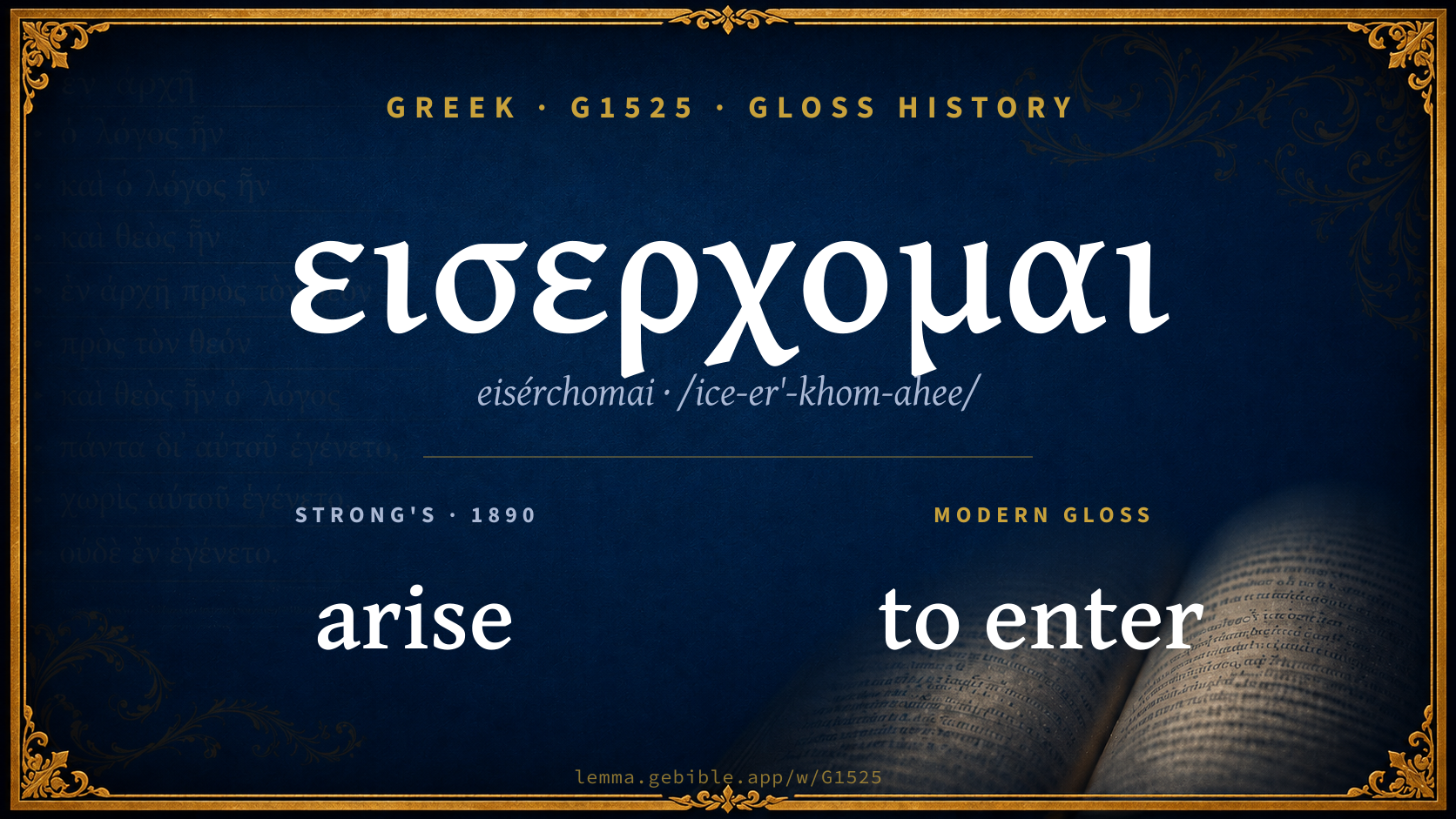
Gloss history
Strong's 1890 vs modern scholarship
About this word
Strong's G1525 catalogs a Greek word from the Greek New Testament.
These counts are not copied from any lexicon or concordance. They are computed here, from the morphology-tagged Greek New Testament. What Lemma adds →
- 185
- distinct verses
- The word appears in 185 distinct verses.
- 10 / 27
- NT books
- The word appears in 10 of 27 New Testament books.
- #81
- by frequency
- Top 100 most frequent Greek words (rank 81 of 5,347 Greek words by occurrence).
View all 185 occurrences in the concordance →
By section of the New Testament
By traditional corpus
Conventional, traditional groupings — biblical authorship is debated, so this is a traditional corpus grouping, not an authorship claim. Some books belong to more than one corpus (Luke is in both the Gospels and the Lukan corpus, and so on), so these shares overlap and need not total 100%. Each figure is a share of the word’s 185 distinct verses.
- Gospels 126 verses · 68%
- Lukan (Luke–Acts) 80 verses · 43%
- Johannine 19 verses · 10%
- Hebrews 15 verses · 8%
- Revelation 5 verses · 3%
- Pauline corpus 4 verses · 2%
- General (Catholic) Epistles 2 verses · 1%
How translations render this word
Counts come from each version’s own published word-to-Strong’s tagging or interlinear alignment — an approximate guide to how each version renders this word, not a word-level alignment the data otherwise carries. Because each total is that version’s own tagged count, the per-version totals vary from one another and need not match the appearance or distinct-verse counts above. These counts may also differ from a printed concordance because Lemma counts each distinctly tagged rendering and does not collapse phrase taggings into a single head-word total. This is a fixed set of word-tagged versions (KJV, ASV, BSB, ULT) and does not change with the reading translation you choose elsewhere. Each version’s license is shown beside its name below (and on Sources).
- King James Version: Enter 32×, Entered 28×, Went 9×
- American Standard Version: Enter 37×, Entered 29×, He entered 16×
- Berean Standard Bible: Enter 35×, Entered 19×, He entered 8×
- unfoldingWord Literal Text: Enter 52×, Entered 24×, Entering 15×
King James Version Public Domain
Renders G1525 across 214 tagged occurrences — most commonly:
Plus other, less common renderings. Plus 59 renderings that appear only once — usually multi-word phrases or single function words the recovered tagging swept in, not distinct renderings.
American Standard Version Public Domain
Renders G1525 across 215 tagged occurrences — most commonly:
Plus other, less common renderings. Plus 55 renderings that appear only once — usually multi-word phrases or single function words the recovered tagging swept in, not distinct renderings.
Berean Standard Bible Public Domain
Renders G1525 across 189 tagged occurrences — most commonly:
Plus other, less common renderings. Plus 49 renderings that appear only once — usually multi-word phrases or single function words the recovered tagging swept in, not distinct renderings. Not rendered by a distinct English word in 5 further occurrences.
unfoldingWord Literal Text CC BY-SA 4.0
Renders G1525 across 219 tagged occurrences — most commonly:
Plus other, less common renderings. Plus 35 renderings that appear only once — usually multi-word phrases or single function words the recovered tagging swept in, not distinct renderings.
Senses in Thayer's
The 2 senses Thayer's distinguishes for this word, in lexicon order (not ranked by frequency or importance). The full entry — with sub-senses — is in the Lexicon Entry tab.
- to go out or come in: to enter
- metaph.
Word origin
Derived from εις (eis) (G1519) — into.
Forms in the corpus
The 44 distinct written forms G1525 takes in the Greek New Testament, most frequent first — each parse links to that tense’s occurrences in the concordance.
Same root — word family
Other Thayer's entries built from the same root as G1525, grouped by Strong’s listed origin. These share a root / origin per the lexicon — not necessarily a shared meaning. Each links to that word’s own entry.
Derives from
Shares the same root
- εισαγω eiságō G1521 to bring in
- εισακουω eisakoúō G1522 to obey
- εισδεχομαι eisdéchomai G1523 to receive
- εισειμι eíseimi G1524 to go in
- εισκαλεω eiskaléō G1528 to invite
- εισοδος eísodos G1529 entrance
- εισπηδαω eispēdáō G1530 to rush in
- εισπορευομαι eisporeúomai G1531 to enter
- ειστρεχω eistréchō G1532 to run in
- εισφερω eisphérō G1533 to bring in
- εν en G1722 in
- εσοπτρον ésoptron G2072 mirror
- εσω ésō G2080 within
- σκυβαλον skýbalon G4657 refuse
Compare all same-root words → Showing 4 of 16 — not the complete family. They share a root, not necessarily a meaning.
Septuagint usage
The same Greek word εισερχομαι appears 593 times in the Greek Old Testament (Septuagint), across 553 verses in 35 books.
- 593
- LXX occurrences
- Tagged occurrences of this Greek word in the Septuagint.
- 553
- verses
- Distinct Septuagint verses containing this word.
- 35 / 39
- OT books
- The word appears in 35 of the 39 Old Testament books.
Sample Septuagint occurrences
- Genesis 6:18 εἰςἔρχομαι
- Exodus 1:1 εἰςἔρχομαι
- Leviticus 9:23 εἰςἔρχομαι
- Numbers 4:5 εἰςἔρχομαι
- Deuteronomy 1:37 εἰςἔρχομαι
- Joshua 1:11 εἰςἔρχομαι
- Judges 3:20 εἰςἔρχομαι
- Ruth 2:18 εἰςἔρχομαι
- 1 Samuel 1:18 εἰςἔρχομαι
- 2 Samuel 1:2 εἰςἔρχομαι
- 1 Kings 1:13 εἰςἔρχομαι
- 2 Kings 3:24 εἰςἔρχομαι
Septuagint occurrences (same lexeme)
Every verse where the same Strong’s number (G1525) appears in the Greek Septuagint — showing the first 50 of 553. Verse text shown in the World English Bible for context; the Greek form is the matched word — the English is not keyword-highlighted.
- Genesis 6:18 εἰςἔρχομαι But I will establish my covenant with you. You shall come into the ark, you, your sons, your wife, and your sons' wives with you.
- Genesis 6:20 εἰςἔρχομαι Of the birds after their kind, of the cattle after their kind, of every creeping thing of the ground after its kind, two of every sort shall come to you, to keep them alive.
- Genesis 7:1 εἰςἔρχομαι Yahweh said to Noah, "Come with all of your household into the ark, for I have seen your righteousness before me in this generation.
- Genesis 7:7 εἰςἔρχομαι Noah went into the ark with his sons, his wife, and his sons' wives, because of the waters of the flood.
- Genesis 7:9 εἰςἔρχομαι went by pairs to Noah into the ark, male and female, as God commanded Noah.
- Genesis 7:13 εἰςἔρχομαι In the same day Noah, and Shem, Ham, and Japheth, the sons of Noah, and Noah's wife, and the three wives of his sons with them, entered into the ark;
- Genesis 7:15 εἰςἔρχομαι They went to Noah into the ark, by pairs of all flesh with the breath of life in them.
- Genesis 7:16 εἰςἔρχομαι Those who went in, went in male and female of all flesh, as God commanded him; and Yahweh shut him in.
- Genesis 12:11 εἰςἔρχομαι It happened, when he was come near to enter into Egypt, that he said to Sarai his wife, "See now, I know that you are a beautiful woman to look on.
- Genesis 12:14 εἰςἔρχομαι It happened that when Abram had come into Egypt, the Egyptians saw that the woman was very beautiful.
- Genesis 16:2 εἰςἔρχομαι Sarai said to Abram," See now, Yahweh has restrained me from bearing. Please go in to my handmaid. It may be that I will obtain children by her." Abram listened to the voice of Sarai.
- Genesis 16:4 εἰςἔρχομαι He went in to Hagar, and she conceived. When she saw that she had conceived, her mistress was despised in her eyes.
- Genesis 19:3 εἰςἔρχομαι He urged them greatly, and they came in with him, and entered into his house. He made them a feast, and baked unleavened bread, and they ate.
- Genesis 19:5 εἰςἔρχομαι They called to Lot, and said to him, "Where are the men who came in to you this night? Bring them out to us, that we may have sex with them."
- Genesis 19:8 εἰςἔρχομαι See now, I have two virgin daughters. Please let me bring them out to you, and do you to them as is good in your eyes. Only don't do anything to these men, because they have come under the shadow of my roof."
- Genesis 19:22 εἰςἔρχομαι Hurry, escape there, for I can't do anything until you get there." Therefore the name of the city was called Zoar.
- Genesis 19:23 εἰςἔρχομαι The sun was risen on the earth when Lot came to Zoar.
- Genesis 19:31 εἰςἔρχομαι The firstborn said to the younger, "Our father is old, and there is not a man in the earth to come in to us after the manner of all the earth.
- Genesis 19:33 εἰςἔρχομαι They made their father drink wine that night: and the firstborn went in, and lay with her father. He didn't know when she lay down, nor when she arose.
- Genesis 19:34 εἰςἔρχομαι It came to pass on the next day, that the firstborn said to the younger, "Behold, I lay last night with my father. Let us make him drink wine again, tonight. You go in, and lie with him, that we may preserve our father's seed."
- Genesis 19:35 εἰςἔρχομαι They made their father drink wine that night also. The younger arose, and lay with him. He didn't know when she lay down, nor when she arose.
- Genesis 20:3 εἰςἔρχομαι But God came to Abimelech in a dream of the night, and said to him, "Behold, you are a dead man, because of the woman whom you have taken. For she is a man's wife."
- Genesis 20:13 εἰςἔρχομαι It happened, when God caused me to wander from my father's house, that I said to her, 'This is your kindness which you shall show to me. Everywhere that we go, say of me, "He is my brother."'"
- Genesis 24:31 εἰςἔρχομαι He said, "Come in, you blessed of Yahweh. Why do you stand outside? For I have prepared the house, and room for the camels."
- Genesis 24:32 εἰςἔρχομαι The man came into the house, and he unloaded the camels. He gave straw and provender for the camels, and water to wash his feet and the feet of the men who were with him.
- Genesis 24:67 εἰςἔρχομαι Isaac brought her into his mother Sarah's tent, and took Rebekah, and she became his wife. He loved her. Isaac was comforted after his mother's death.
- Genesis 29:21 εἰςἔρχομαι Jacob said to Laban, "Give me my wife, for my days are fulfilled, that I may go in to her."
- Genesis 29:23 εἰςἔρχομαι It happened in the evening, that he took Leah his daughter, and brought her to him. He went in to her.
- Genesis 29:30 εἰςἔρχομαι He went in also to Rachel, and he loved also Rachel more than Leah, and served with him yet seven other years.
- Genesis 30:3 εἰςἔρχομαι She said, "Behold, my maid Bilhah. Go in to her, that she may bear on my knees, and I also may obtain children by her."
- Genesis 30:4 εἰςἔρχομαι She gave him Bilhah her handmaid as wife, and Jacob went in to her.
- Genesis 30:10 εἰςἔρχομαι Zilpah, Leah's handmaid, bore Jacob a son.
- Genesis 30:16 εἰςἔρχομαι Jacob came from the field in the evening, and Leah went out to meet him, and said, "You must come in to me; for I have surely hired you with my son's mandrakes." He lay with her that night.
- Genesis 31:33 εἰςἔρχομαι Laban went into Jacob's tent, into Leah's tent, and into the tent of the two maid-servants; but he didn't find them. He went out of Leah's tent, and entered into Rachel's tent.
- Genesis 34:25 εἰςἔρχομαι It happened on the third day, when they were sore, that two of Jacob's sons, Simeon and Levi, Dinah's brothers, each took his sword, came upon the unsuspecting city, and killed all the males.
- Genesis 34:27 εἰςἔρχομαι Jacob's sons came on the dead, and plundered the city, because they had defiled their sister.
- Genesis 38:2 εἰςἔρχομαι Judah saw there a daughter of a certain Canaanite whose name was Shua. He took her, and went in to her.
- Genesis 38:8 εἰςἔρχομαι Judah said to Onan, "Go in to your brother's wife, and perform the duty of a husband's brother to her, and raise up seed to your brother."
- Genesis 38:16 εἰςἔρχομαι He turned to her by the way, and said, "Please come, let me come in to you:" for he didn't know that she was his daughter-in-law. She said, "What will you give me, that you may come in to me?"
- Genesis 38:18 εἰςἔρχομαι He said, "What pledge will I give you?" She said, "Your signet and your cord, and your staff that is in your hand." He gave them to her, and came in to her, and she conceived by him.
- Genesis 39:11 εἰςἔρχομαι It happened about this time, that he went into the house to do his work, and there were none of the men of the house inside.
- Genesis 39:14 εἰςἔρχομαι that she called to the men of her house, and spoke to them, saying, "Behold, he has brought in a Hebrew to us to mock us. He came in to me to lie with me, and I cried with a loud voice.
- Genesis 39:17 εἰςἔρχομαι She spoke to him according to these words, saying, "The Hebrew servant, whom you have brought to us, came in to me to mock me,
- Genesis 40:6 εἰςἔρχομαι Joseph came in to them in the morning, and saw them, and saw that they were sad.
- Genesis 41:21 εἰςἔρχομαι and when they had eaten them up, it couldn't be known that they had eaten them, but they were still ill-favored, as at the beginning. So I awoke.
- Genesis 43:26 εἰςἔρχομαι When Joseph came home, they brought him the present which was in their hand into the house, and bowed down themselves to him to the earth.
- Genesis 43:30 εἰςἔρχομαι Joseph made haste; for his heart yearned over his brother: and he sought a place to weep; and he entered into his room, and wept there.
- Genesis 44:14 εἰςἔρχομαι Judah and his brothers came to Joseph's house, and he was still there. They fell on the ground before him.
- Genesis 46:6 εἰςἔρχομαι They took their cattle, and their goods, which they had gotten in the land of Canaan, and came into Egypt-- Jacob, and all his seed with him,
- Genesis 46:8 εἰςἔρχομαι These are the names of the children of Israel, who came into Egypt, Jacob and his sons: Reuben, Jacob's firstborn.
These are occurrences of the same Greek lexeme (G1525) in the Septuagint — not a translation of any one Hebrew word. The store carries no word-level Hebrew↔Greek alignment, so no Hebrew original is asserted here. Counts come from the recovered LXX Strong's tagging — high-frequency vocabulary is well covered, while rare or late forms may be untagged — so they reflect tagged occurrences and may slightly undercount.