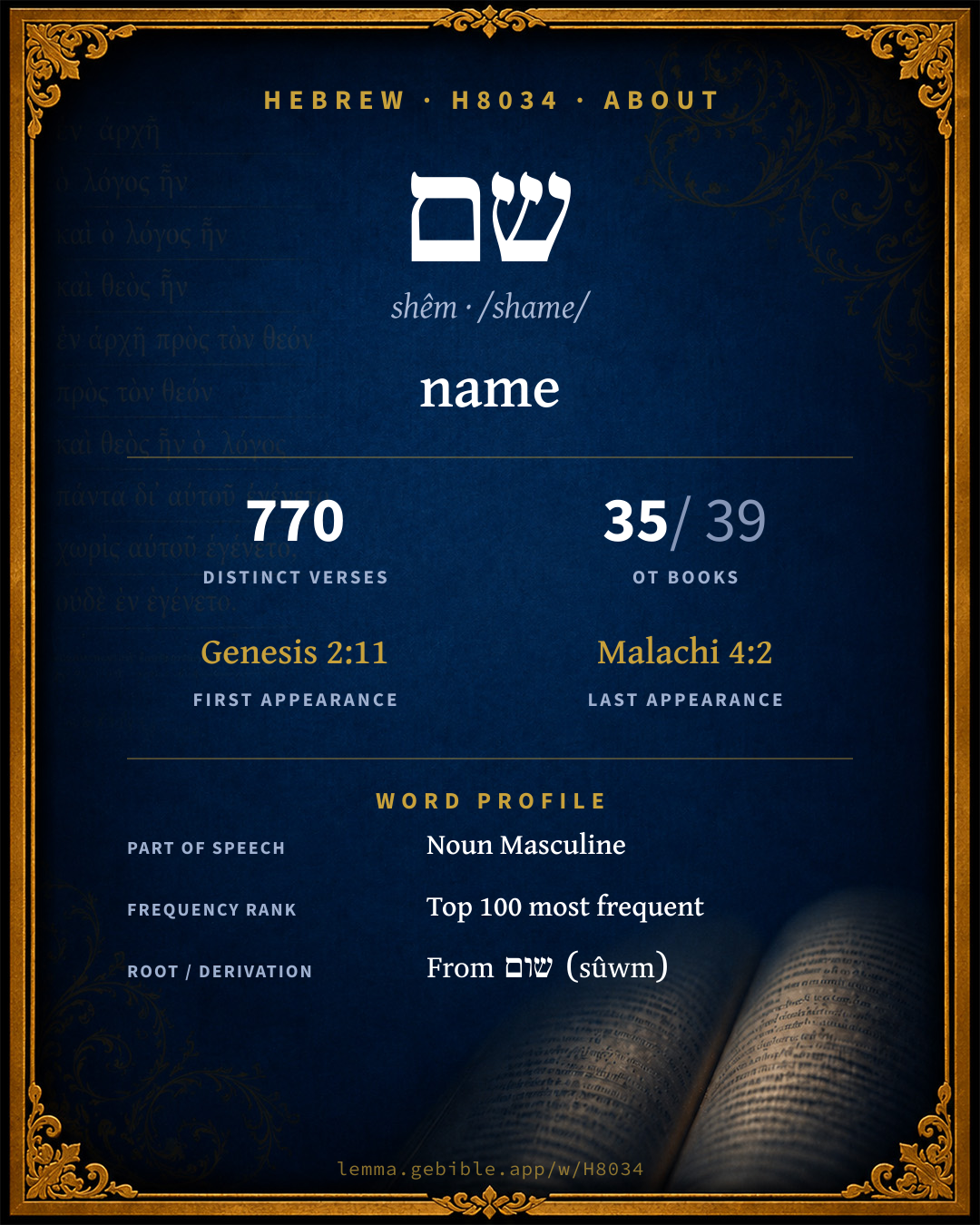
שֵׁם
name
‘name’ is one of 4 main senses fuller range ↓
Full lexicon entry — Brown-Driver-Briggs (BDB)
From Brown-Driver-Briggs (BDB)
Where this word appears
See every Construct-state word in the Hebrew Bible →
Grammar key — what these labels mean
Part of speech
- Noun
- A naming word — a person, place, thing, or idea.
Noun type
- Common
- A common noun — a general class of person, place, or thing (“king,” “city,” “water”), not a specific name.
State
- Construct
- A noun bound to a following noun in a possessive / “of” relationship (the construct chain).
- Absolute
- The independent form of a noun, not bound to a following word.
Gender
- Masculine
- Grammatically masculine.
Number
- Singular
- One.
- Plural
- More than one (in Hebrew, generally three or more).
Every verse where H8034 appears in the Book of Exodus — 36 distinct verses. Click any verse to open its interlinear word-by-word view. Verse text shown in the World English Bible for context — . Each verse’s Hebrew form is shown with its reference; the English is not keyword-highlighted, since the data carries no word-level English alignment. Use “Compare translations” on any verse to read it across multiple English versions. This concordance covers the Hebrew Bible; Septuagint (Greek Old Testament) occurrences are not indexed here.
Exodus
- Exodus 1:1 שְׁמוֹת֙ n c mp cs Now these are the names of the sons of Israel, who came into Egypt (every man and his household came with Jacob):
- Exodus 1:15 שֵׁ֤ם וְ/שֵׁ֥ם n c ms cs conj + n c ms cs The king of Egypt spoke to the Hebrew midwives, of whom the name of the one was Shiphrah, and the name of the other Puah,
- Exodus 2:10 שְׁמ/וֹ֙ n c ms cs + sfx pers 3ms The child grew, and she brought him to Pharaoh's daughter, and he became her son. She named him Moses, and said, "Because I drew him out of the water."
- Exodus 2:22 שְׁמ֖/וֹ n c ms cs + sfx pers 3ms She bore a son, and he named him Gershom, for he said, "I have lived as a foreigner in a foreign land."
- Exodus 3:13 שְּׁמ֔/וֹ n c ms cs + sfx pers 3ms Moses said to God, "Behold, when I come to the children of Israel, and tell them, 'The God of your fathers has sent me to you;' and they ask me, 'What is his name?' What should I tell them?"
- Exodus 3:15 שְּׁמִ֣/י n c ms cs + sfx pers 1cs God said moreover to Moses, "You shall tell the children of Israel this, 'Yahweh, the God of your fathers, the God of Abraham, the God of Isaac, and the God of Jacob, has sent me to you.' This is my name forever, and this is my memorial to all generations.
- Exodus 5:23 בִּ/שְׁמֶ֔/ךָ prep + n c ms cs + sfx pers 2ms For since I came to Pharaoh to speak in your name, he has brought trouble on this people; neither have you delivered your people at all."
- Exodus 6:3 וּ/שְׁמִ֣/י conj + n c ms cs + sfx pers 1cs and I appeared to Abraham, to Isaac, and to Jacob, as God Almighty; but by my name Yahweh I was not known to them.
- Exodus 6:16 שְׁמ֤וֹת n c mp cs These are the names of the sons of Levi according to their generations: Gershon, and Kohath, and Merari; and the years of the life of Levi were one hundred thirty-seven years.
- Exodus 9:16 שְׁמִ֖/י n c ms cs + sfx pers 1cs but indeed for this cause I have made you stand: to show you my power, and that my name may be declared throughout all the earth;
- Exodus 15:3 שְׁמֽ/וֹ n c ms cs + sfx pers 3ms Yahweh is a man of war. Yahweh is his name.
- Exodus 15:23 שְׁמָ֖/הּ n c ms cs + sfx pers 3fs When they came to Marah, they couldn't drink from the waters of Marah, for they were bitter. Therefore the name of it was called Marah.
- Exodus 16:31 שְׁמ֖/וֹ n c ms cs + sfx pers 3ms The house of Israel called the name of it Manna, and it was like coriander seed, white; and its taste was like wafers with honey.
- Exodus 17:7 שֵׁ֣ם n c ms cs He called the name of the place Massah, and Meribah, because the children of Israel quarreled, and because they tested Yahweh, saying, "Is Yahweh among us, or not?"
- Exodus 17:15 שְׁמ֖/וֹ n c ms cs + sfx pers 3ms Moses built an altar, and called the name of it Yahweh our Banner.
- Exodus 18:3 שֵׁ֤ם n c ms cs and her two sons. The name of one son was Gershom, for Moses said, "I have lived as a foreigner in a foreign land".
- Exodus 18:4 וְ/שֵׁ֥ם conj + n c ms cs The name of the other was Eliezer, for he said, "My father's God was my help and delivered me from Pharaoh's sword."
- Exodus 20:7 שֵֽׁם שְׁמ֖/וֹ n c ms cs n c ms cs + sfx pers 3ms "You shall not take the name of Yahweh your God in vain, for Yahweh will not hold him guiltless who takes his name in vain.
- Exodus 20:24 שְׁמִ֔/י n c ms cs + sfx pers 1cs You shall make an altar of earth for me, and shall sacrifice on it your burnt offerings and your peace-offerings, your sheep and your oxen. In every place where I record my name I will come to you and I will bless you.
- Exodus 23:13 וְ/שֵׁ֨ם conj + n c ms cs "Be careful to do all things that I have said to you; and don't invoke the name of other gods, neither let them be heard out of your mouth.
- Exodus 23:21 שְׁמִ֖/י n c ms cs + sfx pers 1cs Pay attention to him, and listen to his voice. Don't provoke him, for he will not pardon your disobedience, for my name is in him.
- Exodus 28:9 שְׁמ֖וֹת n c mp cs You shall take two onyx stones, and engrave on them the names of the children of Israel:
- Exodus 28:10 מִ/שְּׁמֹתָ֔/ם שְׁמ֞וֹת prep + n c mp cs + sfx pers 3mp n c mp cs six of their names on the one stone, and the names of the six that remain on the other stone, in the order of their birth.
- Exodus 28:11 שְׁמֹ֖ת n c mp cs With the work of an engraver in stone, like the engravings of a signet, shall you engrave the two stones, according to the names of the children of Israel: you shall make them to be enclosed in settings of gold.
- Exodus 28:12 שְׁמוֹתָ֜/ם n c mp cs + sfx pers 3mp You shall put the two stones on the shoulder-pieces of the ephod, to be stones of memorial for the children of Israel: and Aaron shall bear their names before Yahweh on his two shoulders for a memorial.
- Exodus 28:21 שְׁמֹ֧ת שְׁמֹתָ֑/ם שְׁמ֔/וֹ n c mp cs n c mp cs + sfx pers 3mp n c ms cs + sfx pers 3ms The stones shall be according to the names of the children of Israel, twelve, according to their names; like the engravings of a signet, everyone according to his name, they shall be for the twelve tribes.
- Exodus 28:29 שְׁמ֨וֹת n c mp cs Aaron shall bear the names of the children of Israel in the breastplate of judgment on his heart, when he goes in to the holy place, for a memorial before Yahweh continually.
- Exodus 31:2 בְ/שֵׁ֑ם prep + n c ms "Behold, I have called by name Bezalel the son of Uri, the son of Hur, of the tribe of Judah:
- Exodus 33:12 בְ/שֵׁ֔ם prep + n c ms Moses said to Yahweh, "Behold, you tell me, 'Bring up this people:' and you haven't let me know whom you will send with me. Yet you have said, 'I know you by name, and you have also found favor in my sight.'
- Exodus 33:17 בְּ/שֵֽׁם prep + n c ms Yahweh said to Moses, "I will do this thing also that you have spoken; for you have found favor in my sight, and I know you by name."
- Exodus 33:19 בְ/שֵׁ֛ם prep + n c ms cs He said, "I will make all my goodness pass before you, and will proclaim the name of Yahweh before you. I will be gracious to whom I will be gracious, and will show mercy on whom I will show mercy."
- Exodus 34:5 בְ/שֵׁ֖ם prep + n c ms cs Yahweh descended in the cloud, and stood with him there, and proclaimed the name of Yahweh.
- Exodus 34:14 שְׁמ֔/וֹ n c ms cs + sfx pers 3ms for you shall worship no other god: for Yahweh, whose name is Jealous, is a jealous God.
- Exodus 35:30 בְּ/שֵׁ֑ם prep + n c ms Moses said to the children of Israel, "Behold, Yahweh has called by name Bezalel the son of Uri, the son of Hur, of the tribe of Judah.
- Exodus 39:6 שְׁמ֖וֹת n c mp cs They worked the onyx stones, enclosed in settings of gold, engraved with the engravings of a signet, according to the names of the children of Israel.
- Exodus 39:14 שְׁמֹ֨ת שְׁמֹתָ֑/ם שְׁמ֔/וֹ n c mp cs n c mp cs + sfx pers 3mp n c ms cs + sfx pers 3ms The stones were according to the names of the children of Israel, twelve, according to their names; like the engravings of a signet, everyone according to his name, for the twelve tribes.
About this entry
At a glance — auto-summarized from this page’s data, not written by a person. Every figure links to its source below. This summary describes the numbers; it doesn’t interpret them.
“name” is the headline sense of the Hebrew noun שם (shêm). Carrying more than one sense, it rewards its full sense range. The Hebrew Bible uses it across 770 verses — among the most common. First canonically at Genesis 2:11, it enters the text early. It shares a root with שום, שום and תשומת. See the sense tree, 770-verse concordance, and the renderings breakdown below.
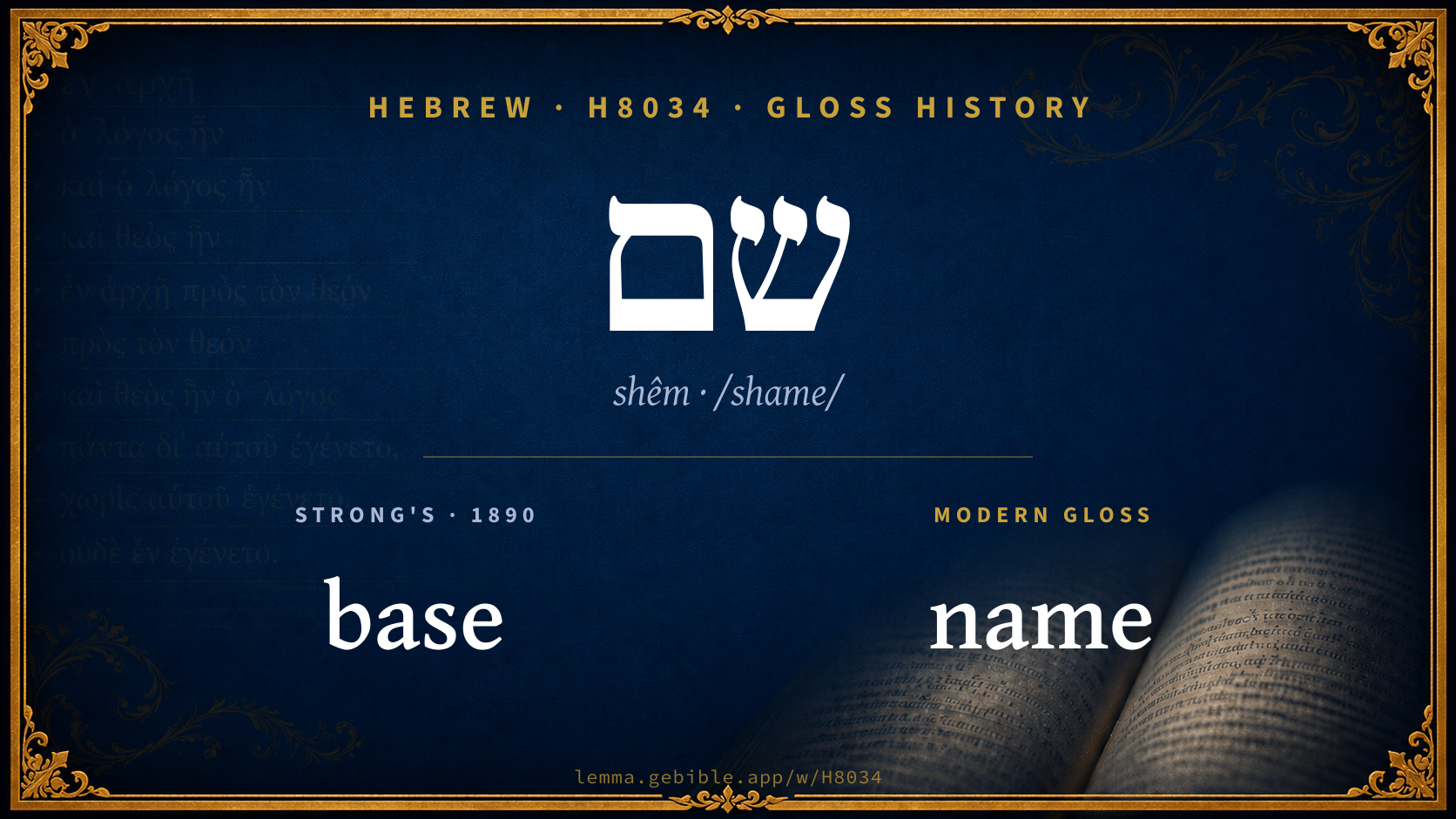
Gloss history
Strong's 1890 vs modern scholarship
About this word
Strong's H8034 catalogs a Hebrew word from the Hebrew Old Testament.
These counts are not copied from any lexicon or concordance. They are computed here, from the morphology-tagged Hebrew Old Testament. What Lemma adds →
- 770
- distinct verses
- The word appears in 770 distinct verses.
- 35 / 39
- OT books
- The word appears in 35 of 39 Old Testament books.
- #51
- by frequency
- Top 100 most frequent Hebrew words (rank 51 of 8,640 Hebrew words by occurrence).
View all 770 occurrences in the concordance →
By section of the Old Testament
By traditional corpus
Conventional, traditional groupings — biblical authorship is debated, so this is a traditional corpus grouping, not an authorship claim. Each share is this word’s portion of its verses in that division of the Hebrew canon. Each figure is a share of the word’s 770 distinct verses.
- Prophets (Nevi'im) 307 verses · 40%
- Writings (Ketuvim) 245 verses · 32%
- Torah (Pentateuch) 218 verses · 28%
How translations render this word
Counts come from each version’s own published word-to-Strong’s tagging or interlinear alignment — an approximate guide to how each version renders this word, not a word-level alignment the data otherwise carries. Because each total is that version’s own tagged count, the per-version totals vary from one another and need not match the appearance or distinct-verse counts above. These counts may also differ from a printed concordance because Lemma counts each distinctly tagged rendering and does not collapse phrase taggings into a single head-word total. This is a fixed set of word-tagged versions (KJV, ASV, BSB, ULT) and does not change with the reading translation you choose elsewhere. Each version’s license is shown beside its name below (and on Sources).
BDB lists this Strong’s number as 2 distinct words (homographs). Each count above pools all of them and is not split by sense — see the Senses section below. A low-frequency rendering may belong to a different one of those words, not the primary meaning.
- King James Version†: Name 598×, Names 47×, Is his name 20×
- American Standard Version†: Name 494×, 's name 46×, Names 39×
- Berean Standard Bible†: Name 510×, Names 37×, Named 36×
- unfoldingWord Literal Text†: Name 422×, Name of 254×, Names 58×
King James Version Public Domain
Renders H8034 across 858† tagged occurrences — most commonly:
Plus other, less common renderings. Plus 78 renderings that appear only once — usually multi-word phrases or single function words the recovered tagging swept in, not distinct renderings. Not rendered by a distinct English word in 6 further occurrences.
American Standard Version Public Domain
Renders H8034 across 858† tagged occurrences — most commonly:
Plus other, less common renderings. Plus 133 renderings that appear only once — usually multi-word phrases or single function words the recovered tagging swept in, not distinct renderings.
Berean Standard Bible Public Domain
Renders H8034 across 769† tagged occurrences — most commonly:
Plus other, less common renderings. Plus 54 renderings that appear only once — usually multi-word phrases or single function words the recovered tagging swept in, not distinct renderings. Not rendered by a distinct English word in 94 further occurrences.
unfoldingWord Literal Text CC BY-SA 4.0
Renders H8034 across 894† tagged occurrences — most commonly:
Plus other, less common renderings. Plus 39 renderings that appear only once — usually multi-word phrases or single function words the recovered tagging swept in, not distinct renderings.
7 senses and sub-senses in the full BDB
What do BDB’s symbols mean?
BDB uses these scholarly abbreviations:
| Symbol | Meaning |
|---|---|
| 𝔊 | the Septuagint (the ancient Greek translation, LXX) |
| 𝔙 | the Vulgate (the Latin translation) |
| 𝔖 | the Syriac version (the Peshitta) |
| 𝔗 | the Targum (the Aramaic translation) |
| ψ | the Psalms |
| √ | root (the underlying root or stem) |
| ‖ | parallel passage (a synonymous or contrasted parallel) |
| † | the dagger: every passage where the word occurs is cited |
The 7 senses and sub-senses the full Brown-Driver-Briggs lexicon distinguishes for this word, in lexicon order (not ranked by frequency), with BDB’s own verbatim wording and sub-sense lettering. Shown in Hebrew script with BDB’s own scholarly abbreviations. The condensed entry is in the Lexicon Entry tab. See also the Forms in the corpus table below.
שם I
- 1. of river Gn 2:11, 13, 14, beasts v 19, 20, city 26:33 (all J) +; שׁ׳ היּוֹם †Ez 24:2, i.e. exact designation of it (+ אֶת־עֶצֶם הַיּ׳ הַזֶּה). e.g. Genesis 2:11
- 2.
- a. usually of pers.: Gn 4:17, 19(×2) (J) +; as signif. 1 S 25:25, cf. Pr 21:24; especially in phr. וַיְהִי אִישׁ … וּשְׁמוֹ אֶלְקָנָה 1 S 1:1, cf. 9:1, 2, Je 37:13 + 28 times; less often as גָּלְיָת שְׁמוֹ 1 S 17:4, cf. Zc 6:12 + 5 times (cf. in Assyrian KraeBAS i. 430); freq. c. קָרָא (q.v. 5 e, 6; Niph. 2, Pu.; note here, נִקְרָא שׁ׳ עַל in token of ownership 2 S 12:28 (v. Dr), Is 4:1); rarely, שִׂים אֶת־שְׁמוֹ אֲבִימֶלֶךְ Ju 8:31, cf. 2 K 17:34; Ne 9:7; וַיָּ֫שֶׂם לָהֶם שׁ׳ Dn 1:7; c. יֵאָמֵר Gn 32:29 (J); change of name is without vb., as Gn 17:15 (P), or (usually) c. יִהְיֶה Gn 35:10 (P) Isr. shall be thy name, cf. 17:5; 1 K 18:31; 1 Ch 22:9, also וַיַּסֵּב אֶת־שְׁמוֹ יְהו׳ 2 K 23:34 = 2 Ch 36:4, cf. 2 K 24:17, and (subj. י׳) שׁ׳ עוֹלָם אֶתֶּן־לוֹ Is 56:5; מַה־שְּׁמֶ֑ךָ Gn 32:28, cf. Ex 3:13; Pr 30:4, מִי שְׁמֶ֑ךָ Ju 13:17; be explicitly mentioned is: וְכֻלָּם בְּשֵׁמוֹת Ezr 10:16, נִקְּבוּ בְשׁ׳ Nu 1:17; 1 Ch 16:41; 2 Ch 28:15; 31:19; Ezr 8:20, הַבָּאִים בְּשׁ׳ 1 Ch 4:38, וַיָּבֹאוּ הַכְּתוּבִים בְּשׁ׳ v 41; of things, וּבְשֵׁמוֹת תִּפְקְדוּ Nu 4:32 (P), + v 27 (read בְּשֵׁמֹת 𝔊 Di Baen Gray); יְדַעְתִּיךָ בְּשֵׁם Ex 33:12 (subj. י׳), i.e. acknowledge thee, personally (as mine), cf. v 17 (both J); בְּשׁ׳ פ׳ as the representative of 1 S 25:5, 9 1 K 21:8 Je 29:25 Est 2:22; 3:12; 8:8(×2), 10 (cf. also 3). e.g. Genesis 4:17
- b. = reputation; (1) וַאֲגַדְּלָה שְׁמֶ֑ךָ Gn 12:2 (J), וְעָשִׂתִי לְךָ שׁ׳ גָּדוֹל כְּשֵׁם הַגְּדֹלִים אֲשֶׁר בָּאָרֶץ 2 S 7:9; †make oneself a name וְנַעֲשֶׂה לָנוּ שׁ׳ Gn 11:4 (J), וַיַּעַשׂ לוֹ שׁ׳ 2 S 8:13, of י׳ Je 32:20, hence Ne 9:10 Dn 9:15, Is 63:12, 14, so c. שׂוּם 2 S 7:23 = 1 Ch 17:21; וַיֵּצֵא לָךְ שֵׁם בְּ׳ Ez 16:14 (cf. 1 Ch 14:17), 2 Ch 26:15 עַד־לְמֵרָחוֹק, v 8 וַיֵּלֶךְ שְׁמוֹ עַד־לְ׳; 2 S 23:18, 22; = fame, glory, Zp 3:19, 20 Ez 39:13.—34:29 read perhaps שָׁלֹם 𝔊 Siegf Be Toy; Co שָׁלֵם; Krae conj. שָׁמֵן; אַנְשֵׁי הַשֵּׁם Gn 6:4 (J), Nu 16:2 (J), אַנְשֵׁי שַׁמוֹת 1 Ch 5:24; 12:31 (van d. H. v 30); c. neg. בְּנֵי בְלִי־שֵׁם Jb 30:8; (2) bad sense, וְהוֹצִא עָלֶיהָ שֵׁם רָ֑ע Dt 22:14, cf. v 19 Ne 6:13; = byword Ez 23:10; טְמֵאַת הַשּׁ׳ 22:5. e.g. Genesis 12:2
- c. especially as giving a man a kind of posthumous life, especially in his sons, אֵין־לִי בֵן בַּעֲבוּר הַזְכִּיר שְׁמִי 2 S 18:18, לְהָקִים לְאָחִיו שֵׁם בְּ׳ Dt 25:7, cf. v 6 Ru 4:5, 10, without whom it is blotted out, etc., Dt 25:6, cf. Nu 27:4 (P), Ru 4:10, so that to destroy one’s name = extirpate family (and שֵׁם sometimes is ‖ זֶרַע) 1 S 24:22 (Gi v 21), 2 S 14:7 (‖ שְׁאֵרִית), so of peoples Dt 7:24; 9:14; 12:3 Is 14:22 +; לֹא יָזָּרַע מִשִּׁמְךָ עוֹד Na 1:14 (of Nineveh); כֵּן יעֲמֹד זַרְעֲכֶם וְשִׁמְכֶם Is 66:22; more abstr. (‖ זֵכֶר) Jb 18:17 Pr 10:7. e.g. 2 Samuel 18:18
- 3. name, as designation of God, specif. of י׳ (especially Je Ez Is 2, 3 ψψ):—first (in Hex) in phr. ק׳ בְּשׁ׳ י׳ Gn 4:26 (J), call with, i.e. use the name י׳ in worship, so 12:8; 13:4; 21:33; 26:35 + (v. קרא 2 c); hence, of place of worship, בְּכָל־הַמָּקוֹם אֲשֶׁר אַזְכִּיר אֶת־שְׁמִי שָׁם Ex 20:24 (Gi v 21); אֶת־שְׁמוֹ שָׁם [לְשַׁכֵּן] לָשׂוּם Dt 12:5, 11 +; בָּנָה בַּיִת לִשְׁמִי 2 S 7:13 + often; people come לְשׁ׳ י׳ Jos 9:9 (RD), so לְמַעַן שׁ׳ 1 K 8:41 = 2 Ch 6:32, Is 60:9; seek it ψ 83:17; swear with בְּשׁ׳ י׳ 1 S 20:42 Dt 6:13; 10:20 Lv 19:12, cf. (לַשָּׁוְא) Ex 20:7(×2) = Dt 5:11(×2); תָּפַשׂ שׁ׳ י׳ Pr 30:9; נִקְרָא שְׁמִי עַל־, etc., in token of ownership (cf. 2 a), Je 7:10 + (v. p. 896 a); = his reputation, fame, c. עָשָׂה לוֹ, v. 1 b (1), cf. Jos 7:9; בְּשׁ׳ י׳, i.e. as his representative Ex 5:23 (J), 1 S 17:45 Dt 10:8 2 S 6:18 2 K 2:24 + (v. 2 a ad fin.); especially as embodying the (revealed) character of י׳: י׳ שְׁמוֹ Am 5:8; 9:6 Je 33:2, זֶה שְּׁמִי לְעֹלָם Ex 3:15 (E; ‖ זֵכֶר; fundamental passage), 6:3 (P); צְבָאוֹת שְׁמוֹ (א׳) י׳ Am 4:13; 5:27 Je 10:16; 46:18 + 10 times Je Is 2, י׳ קַנָּא שְׁמוּ Ex 34:14 (J; cf. 20:5 Na 1:2), קָדוֹשׁ שׁ׳ Is 57:15, שׁ׳ קָדְשִׁי[וֹ] Am 2:7 Ez 39:7; 43:7 ψ 103:1 + often; hence object of knowledge Is 52:6 Je 48:17, יֹדְעֵי שְׁמֶ֑ךָ ψ 9:11 (‖ דֹּרְשֶׁיךָ), love Is 56:6, אֹהֲבֵי שׁ׳ ψ 5:12; 69:37; 119:132, fear 61:6, especially of praise, etc. (הִלֵּל, הִזְכִּיר, הוֹדָה, בֵּרַךְ, etc.): לְשִׁמְךָ אֲזַמֵּר 2 S 22:50 (‖ אוֹדְךָ, and so very often ‖ י׳) = ψ 18:50, cf. 1 Ch 16:10; 29:13 ψ 45:18 Is 26:13 1 K 8:33, 35 = 2 Ch 6:24, 26 ψ 8:2, 10 +; הָבוּ לי׳ כְּבוֹד שְׁמוֹ 29:2; 96:8, and many combinations; opp. חִלֵּל אֶת־שׁ׳ א׳ Lv 18:21 +, נקב שׁ׳ י׳ 24:16, נִאֵץ שׁ׳ ψ 74:10, 18, etc.; הַשּׁ׳ הַנִּכְבָּד וְהַנּוֹרָא Dt 28:58, cf. Ne 1:11, לְמַעַן שִׁמְךָ, in appeals to י׳ to act according to his character Je 14:7, 21 Ez 20:9, 14 Is 48:9; 66:5 ψ 25:11; 31:4 +; שׁ׳ י׳ is powerful agent, בְּשִׁמְךָ הוֹשִׁיעֵנִי 54:3 (‖ בִּגְבוּרָתְךָ), cf. 124:8; of מַלְאַךְ י׳, י׳ says שְׁמִי בְּקִרְבּוֹ Ex 23:21 (E); הַשֵּׁם Lv 24:11 is prob. scribal substitution for word י׳ (already beginning to be thought ineffable, especially c. וַיִּקֹּב cf. GeiUrschr. 273 f. Di Dr-Wh Baen); on development of this usage, and Jewish use of הַשּׁ׳ as personif. or hypostasis, v. LevyNHWB s. v. Jastr s. v..—קָרוֹב שְׁמֶ֑ךָ ψ 75:2 is striking, but doubtful, קֹרְאֵי שׁ׳, Du קָרָנוּ בִשׁ׳ (= קָרָאנוּ). e.g. Genesis 4:26
- 4. of false gods, use forbidden Ex 23:13 (E), Jos 23:7 (RD), cf. Ho 2:19 ψ 16:4; speak בְּשֵׁם אלהים אחרים Dt 18:20; קָרָא בְשׁ׳ א׳ 1 K 18:24, 25, 26; יֵלְכוּ בְשׁ׳ א׳ Mi 4:5. e.g. Exodus 23:13
- 5. = memorial, monument Is 55:13 (‖ אוֹת; so Che Du > = fame Di-Kit), יָד וָשֵׁם טוֹב מִבָּנִים וגו׳ 56:5 (with word-play on שׁ׳ 2 c). e.g. Isaiah 55:13
שם II m. first son of Noah
Senses from the full Brown-Driver-Briggs lexicon (Brown, Driver, Briggs; Oxford 1906 — public domain), digitized via Sefaria, supplemented by the OpenScriptures HebrewLexicon (CC BY 4.0). Full attribution on Sources.
Word origin
I. n.m. 2 S 7:9 name (√ unknown; Thes שׁמה, cf. BaZMG xii (1887), 635; LagBN 160 ושּׁם, Arabic وَسَمَ brand, mark, cf. RSK 213, 303 ff. Köii. 1. 104; NH = BH (especially הַשֵּׁם = יהוה), Ph. שם Lzb 377; Assyrian šumu; Sab. סם HomChr 124; Ethiopic ስmም Arabic إِسْمٌ, أُسْمٌ, سِمٌ, سُمٌ, Aramaic שֵׁם, שְׁמָא, also שׁוּם, שֻׁם (Köii. 1. 512), ܫܶܡ, ܫܡܳܐ, Old Aramaic, Palm. שם Lzb 377);—abs. שׁ׳ Gn 6:4 +; cstr. שׁ׳ Gn 12:8 +, rarely שֶׁם־ 1 S 8:2 +; sf. שְׁמִי Ex 3:15 +, שִׁמְךָ Gn 32:9 +, שְׁמֶ֑ךָ 1 K 18:31 +, etc.; pl. שֵׁמוֹת (rarely שֵׁמֹת) Gn 2:20 +; cstr. שְׁמוֹת Ex 6:16 +, sf. שְׁמוֹתָם Nu 13:4 +, שְׁמוֹתָן Ez 23:4(×2);—name:
II. n.pr.m. first son of Noah;—Gn 5:32; 6:10; 7:13; 10:1, 22, 31; 11:10(×2), 11 (all P), 9:18, 23, 26, 27; 10:21 (all J), 1 Ch 1:4, 17, 24; Σημ.
— Brown-Driver-Briggs (Oxford 1906, public domain), digitized via Sefaria, supplemented by the OpenScriptures HebrewLexicon (CC BY 4.0). See Sources.
Derived from שום (sûwm) (H7760) — to put.
Jastrow Dictionary
A second Hebrew/Aramaic lexicon for comparison, covering Aramaic and post-biblical (Talmudic, Targumic, Midrashic) usage that the biblical-Hebrew BDB does not. Matched by lemma rather than by Strong’s number, so a lemma may carry more than one Jastrow headword (shown separately below), and the entries cover usage well beyond the Bible.
שָׁם
- (b. h.) there, thither. Macc. II, 7 אינו יוצא מִשָּׁם לעולם he dare not go away from there (the city of refuge) all his life time; שם תהא דירתו שם וכ׳ there he must live, there he must die &c.; Tosef. ib. III (II), 5. Macc. 4ᵃ שנפל שם which fell thereinto. Ber. V, 4 אם אין שם כהן וכ׳ if no priest besides him is present; a. v. fr.—Cant. R. to VIII, 9 שָׁמָּה, v. רגָּז.—לְשָׁם thither. Ex. R. s. 18; a. fr.
שֵׁם I
- (b. h.) pr. n. m. Shem, son of Noah. Meg. 9ᵇ (ref. to Gen. IX, 27) דבריו … באהלי שם let the speech of Japheth (Greek) dwell in the tents of Shem; v. יָפְיוּת. Gen. R. s. 63, v. עֵבֶר I. Snh. 69ᵇ. Ex. R. s. 18 the Lord said, חייב אני לשם אביהם וכ׳ I am indebted to their (the Assyrians’) father Shem, because he and Japheth took their cloaks and covered with it &c.; a. fr. e.g. Genesis 9:27
שֵׁם II
- v. שׁוּם a. mark, name, title, nature, denomination. Pes. III, 3 לא תקרא לה שם וכ׳ she must not name it (declare it to be Ḥallah) until it is baked. Ter. III, 5 האומר … קרא שם if one says, the priest’s portion of this pile is in it …, he has named it (designated it as T’rumah). Gen. R. s. 25 (ref. to Gen. V, 29) לא השם הוא המדרש … הוא השם וכ׳ the name (נח) and the interpretation (ינחמנו) do not correspond; it ought to be either &c. Ber. II, 8 ליטול … השם, v. נָטַל. Macc. I, 2 לא השם המביאו וכ׳ the title (the legal text) under which the false witness is doomed to lashes, is not the one under which he is bound to pay indemnity. Kinn. I, 3 משם אחד sacrificial birds of the same denomination (intended for the same class of cases), opp. משני שמות of different denominations. Sabb. XII, 3 משם אחד two letters of the alphabet of the same name (אא, בב &c.), opp. משתי שמות two different letters (אב &c.). Ib. שם קטן משם גדול וכ׳ a small name or word as a part (or abbreviation) of a larger one, as שם as a part of שמעון, of שמואל &c. Ib. 103ᵇ שתי אותיות והן שם אחד two identical letters which represent a word, (as שש, which may stand for שֵׁשׁ or שָׂשׂ) &c. Shebu. 3ᵇ, a. fr. לא מן השם הוא זה וכ׳ this comes not under this title (this is not the real reason), but it is because &c. Ker. III, 4 אינו מן השם the offence is not of the same class. Macc. 4ᵇ, a. fr. (על חבירו) מוציא שם רע who spreads an evil report about his neighbor (injures his reputation). Ber. 17ᵃ גדל בשם טוב וכ׳ who has grown up with a good name, and departed life with a good name; a. v. fr.—Esp. הַשֵּׁם or שֵׁם the Divine Name, the Tetragrammaton, contradist. to כינוי attribute; in gen. the Lord. Snh. VII, 5 המגדף … שיפרש השם the blasphemer is not punishable, unless he uses the Name explicitly. Ib. 8 המקלל … בַּשֵּׁם he that curses his father or his mother is not punishable, unless he curses them with the Name. Ib. 56ᵃ בידך את השם בכינוי (not בכינויים) if he curses God by using a divine attribute. Ib. עד שיברך שם בשם unless he curses God and pronounces the Name. Yoma III, 8; IV, 2; VI, 2 (בשם) אנא השם I pray, O Lord (pronouncing the Tetragrammaton). Ib. כשהיו שומעים שם המפורש שהוא יוצא וכ׳ when they heard the Tetragrammaton pronounced &c., v. פָּרַשׁ. Ib. IV, 1 אחד … לַשֵּׁם on one of the lots was written ‘unto the Lord’; של שם the lot bearing the inscription ‘unto the Lord’; a. v. fr.; v. שָׁמַיִם.—Especial uses: כְּשֵׁם שֶׁ־ the same as, as well as. Ber. IX, 5 חייב אדם … כשם שמברך וכ׳ a man is bound to bless God for what is evil as well as he blesses for what is good. Ib. 62ᵃ כשם שנפרעין וכ׳ as well as the dead are called to account &c., v. סַפְדָּן. Sot. V, 1 כשם שהמים … כך וכ׳ as the waters test her, so do they test him. Ib. כשם שאסורה וכ׳, v. בָּעַל; a. v. fr.—בְּשֵׁם, מִשֵּׁם in the name of, in behalf of. Meg. 15ᵃ כל האומר דכר בשם אומרו וכ׳ he who relates a thing in the name of him who said it (gives credit to authority), brings redemption into the world. Peah II, 4 מִשְּׁמוֹ in his own name (as his individual opinion). Y. Taan. I, 64ᵃ הלכה … שאמר משם וכ׳ the rule follows the opinion of …, who said in behalf of &c.; a. v. fr.—לְשֵׁם for the purpose of, for the sake of, as; with reference to. Gitt. 24ᵇ כתב רחמנא לה לִשְׁמָהּ the text (Deut. XXIV, 3) says, ‘unto her’, that means, that it must be written especially for her. Yeb. 47ᵇ, v. שׁוּם II.—Snh. 99ᵇ העוסק בתורה לשמה who studies the Law for its own sake (for no selfish ends). Pes. 50ᵇ לעולם יעסוק … אע"פ שלא לשמה … בא לשמה by all means let a man engage in the study of the Law and in good deeds, even if not for their own sake, for through the work for a selfish purpose he will arrive at the stage of doing good for its own sake. Ib. 13ᵇ, a. e. שחטן לִשְׁמָן וכ׳ if he slaughtered them as such (as festive sacrifices) &c.; זרק דמן שלא לשמן if he sprinkled their blood, having in mind another purpose (another class of sacrifices). Gen. R. s. 25 לשם קרבנו נקרא he was named (נח) with reference to his sacrifice (ניחח, Gen. VIII, 21); לשם נחת וכ׳ he was named (נח) with reference to the rest of the ark (ותנח, Gen. VIII, 4); Yalk. ib. 42 על שם וכ׳; a. v. fr.—עַל שֵׁם (abbrev. ע"ש) with reference to, because. Y. Taan. II, beg. 65ᵃ על שם ואנכי וכ׳ as a reference to (what Abraham said,) ‘and I am but dust and ashes’ (Gen. XVIII, 27). Gen. R. s. 23, v. טְבַרְיָא; a. fr.; v. שׁוּם II.—Pl. שֵׁמוֹת, constr. שְׁמוֹת. Kinn. l. c. Gen. R. s. 26 כל הש׳ הללו וכ׳ all these names indicate rebellion &c., v. מַרְדּוּת I. B. Mets. 114ᵇ עובר בכל הש׳ הללו is guilty under all these titles (texts). Shebu. 35ᵃ יש ש׳ שנמחקין ויש ש׳ וכ׳ there are divine names which may be erased, and such as may not be erased. Y. R. Hash. I, 56ᵈ bot. שְׁ׳ המלאכים, v. מַלְאָךְ; a. fr. e.g. Genesis 5:29
שֵׁם
- Targ. Y. II, Ex. XXXI, 2. Targ. Ps. CXLVII, 4. Targ. O. Gen. VI, 4; a. fr.—Sot. 49ᵃ יהא שְׁמֵיה רבא (abbrev. יה"ש"ר), v. אֲגַדְתָּא. Ab. I, 13, v. נְגַד. Yoma 83ᵇ, v. דּוּק. Ber. 7ᵇ, v. גְּרַם I. Sabb. 8ᵇ (in Hebr. dict.) שמיה הילוך comes under the category of ‘walking’; לא שמיה תשמיש does not come under the category of ‘use.’ Ḥull. 48ᵃ משמיה רר׳ וכ׳ in behalf of &c.; Y. Taan. I, 64ᵃ bot. מן שמיה. Sabb. 145ᵇ שְׁמָאִי my name, v. מָתָא; a. v. fr.—Y. Orl. I, 61ᵃ bot. אית בני נש שְׁמוֹן בריכה וכ׳ there are persons whose name is B’rikah (meaning blessing), as one says, come thou, blessed of the Lord.—Pl. שְׁמָהָן, שְׁמָהָתָא; שְׁמַיָּיא, שְׁמֵי. Targ. Gen. II, 20. Ib. XXVI, 18. Targ. O. Num. I, 5 שְׁמָהַת constr.; Y. שְׁמָהָיַית; a. fr.—Gitt. 11ᵇ שמהתא … בשְׁמָהָתַיְיהוּ other names which Jews frequently adopt for their own, v. נְסַק. Meg. 14ᵇ סניין שְׁמַיְיהוּ, v. סְנֵי; a. fr.
A Dictionary of the Targumim, the Talmud Babli and Yerushalmi, and the Midrashic Literature (Marcus Jastrow; London, Luzac, 1903) — Public Domain. Digitized via Sefaria. Digitized via Sefaria. Full attribution on Sources.
Forms in the corpus
The 236 distinct written forms H8034 takes in the Hebrew Bible, most frequent first — each parse links to that state’s occurrences in the concordance. Hebrew forms include their vowel points and cantillation, so a single lemma takes many written forms.
The 60 most common forms are shown; 176 rarer forms follow in the full concordance.
Same root — word family
Other BDB entries built from the same root as H8034, grouped by Strong’s listed origin. These share a root / origin per the lexicon — not necessarily a shared meaning. Each links to that word’s own entry.
Derives from
Shares the same root
Derived from this word
Proper names from this root
People and places named from this root — a name, not an additional meaning of the word.
- ישימאל Yᵉshîymâʼêl H3450 Jesimiel
- שם Shêm H8035 Shem
- שמאבר Shemʼêber H8038 Shemeber
- שמידע Shᵉmîydâʻ H8061 Shemida
- שמירמות Shᵉmîyrâmôwth H8070 Shemiramoth
Compare all same-root words → Showing 4 of 10 — not the complete family. 5 of the same-root words are proper names (people or places). They share a root, not necessarily a meaning.
Septuagint verse parallels
This word appears in 712 verses that also exist in the Greek Old Testament (Septuagint), out of the 770 Hebrew verses it occurs in. You can read those verses in Greek by switching the Old Testament edition to the Septuagint.
Read these verses in the Septuagint
- Genesis 2:11
- Exodus 1:1
- Leviticus 18:21
- Numbers 1:2
- Deuteronomy 3:14
- Joshua 2:1
- Judges 1:10
- Ruth 1:2
- 1 Samuel 1:1
- 2 Samuel 3:7
- 1 Kings 1:47
- 2 Kings 2:24
This is a verse-level parallel only — the same verses exist in both the Hebrew and Greek Old Testaments. No word-level Hebrew↔Greek correspondence is claimed: the data carries no such alignment, so no Greek word is shown as this Hebrew word’s translation. Coverage is not total — the Septuagint omits the deuterocanon and renumbers the Psalms, so some Hebrew verses have no direct Greek parallel.