
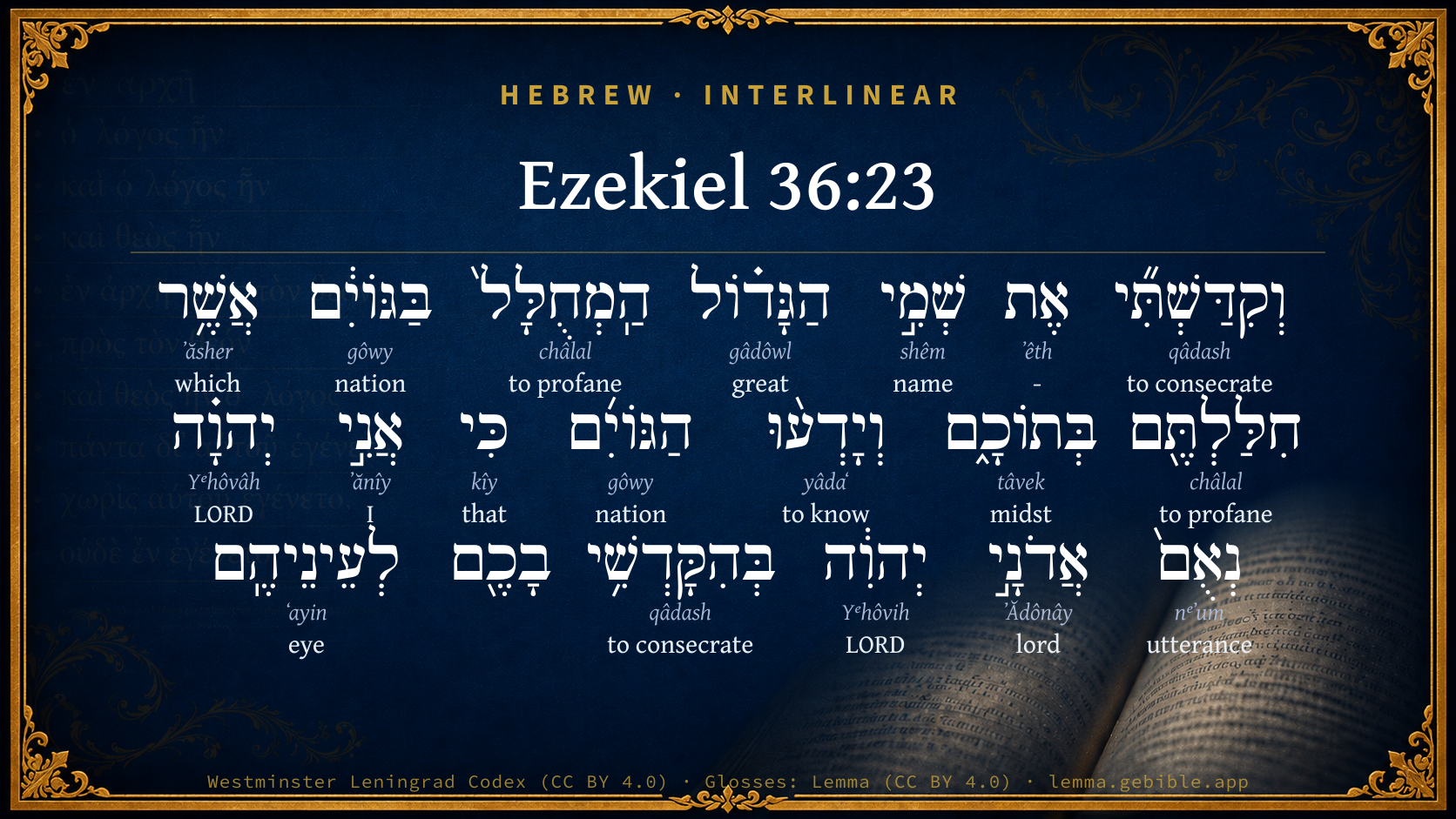
Ezekiel 36:23

Hebrew (Westminster Leningrad Codex) Ezekiel 36:23 appears in the Hebrew Old Testament. The text above is from the Westminster Leningrad Codex. Each word links to its Strong’s number, a concise gloss, and parsing drawn from the Open Scriptures Hebrew Bible morphology. Click any word for its full Brown-Driver-Briggs (BDB) entry.
Download image
Cite this verse

Ezekiel 36:23 (World English Bible). Public Domain. Lemma interlinear Bible study tool, https://lemma.gebible.app/v/ezekiel/36/23.

Show BibTeX & RIS
BibTeX
RIS
English Translation
I will sanctify my great name, which has been profaned among the nations, which you have profaned in the midst of them; and the nations shall know that I am Yahweh, says the Lord Yahweh, when I shall be sanctified in you before their eyes.
World English Bible · Public Domain
Download a study sheet

One document with this verse’s original text, its word-by-word gloss line, the meaning frame, cross-references with their text, attributed commentary, and full source and license credits — printable, and it pastes into notes with its structure intact.

This verse Autodidact and up

Study sheet (.html) Plain text (.txt)

A passage Seminary Student

Up to 50 verses in one chapter. A passage sheet keeps up to 6 commentary sources and 12 cross-references per verse, in the order this page ranks them, and says so on the sheet whenever that leaves anything out. Ask for a single verse and you get the Autodidact verse sheet above.

Everything on this page stays free to read, with no account — the sheet is a download of what is already on screen, not access to it.

Want to remove ads? Support Godless Engineer
Compare translations 3

The same verse in 3 English versions, stacked beneath the original-language interlinear above. Click any original word for its lexicon entry.

Each is an independent rendering of the whole verse — the interlinear is not word-aligned to these translations.

Highlighted words mark where these versions differ — a whole-verse word diff, not a word-by-word alignment.

  • World English Bible Public Domain
    I will sanctify my great name, which has been profaned among the nations, which you have profaned in the midst of them; and the nations shall know that I am Yahweh, says the Lord Yahweh, when I shall be sanctified in you before their eyes.
  • King James Version Public Domain
    And I will sanctify my great name, which was profaned among the heathen, which ye have profaned in the midst of them; and the heathen shall know that I am the LORD, saith the Lord GOD, when I shall be sanctified in you before their eyes.
  • unfoldingWord Literal Text CC BY-SA 4.0
    For I will make my great name holy, which you have profaned among the nations—in the midst of the nations, you profaned it. Then the nations will know that I am Yahweh—this is the Lord Yahweh’s declaration—when you see that I am holy.

unfoldingWord Literal Text — © unfoldingWord, licensed CC BY-SA 4.0. Word-aligned USFM3 via Door43 (git.door43.org/unfoldingWord/en_ult).

Versions to compare (up to 4)

3 of 4 selected

Show all 18 translations

Every available English version of this verse, each an independent rendering of the whole verse.

  • World English Bible Public Domain
    I will sanctify my great name, which has been profaned among the nations, which you have profaned in the midst of them; and the nations shall know that I am Yahweh, says the Lord Yahweh, when I shall be sanctified in you before their eyes.
  • Berean Standard Bible Public Domain
    I will show the holiness of My great name, which has been profaned among the nations—the name you have profaned among them. Then the nations will know that I am the LORD, declares the Lord GOD, when I show My holiness in you before their eyes.
  • Majority Standard Bible Public Domain
    I will show the holiness of My great name, which has been profaned among the nations—the name you have profaned among them. Then the nations will know that I am the LORD, declares the Lord GOD, when I show My holiness in you before their eyes.
  • King James Version Public Domain
    And I will sanctify my great name, which was profaned among the heathen, which ye have profaned in the midst of them; and the heathen shall know that I am the LORD, saith the Lord GOD, when I shall be sanctified in you before their eyes.
  • American Standard Version (1901) Public Domain
    And I will sanctify my great name, which hath been profaned among the nations, which ye have profaned in the midst of them; and the nations shall know that I am Jehovah, saith the Lord Jehovah, when I shall be sanctified in you before their eyes.
  • Revised Version (1885) Public Domain
    And I will sanctify my great name, which hath been profaned among the nations, which ye have profaned in the midst of them; and the nations shall know that I am the LORD, saith the Lord GOD, when I shall be sanctified in you before their eyes.
  • Geneva Bible (1599) Public Domain
    And I wil sanctifie my great Name, which was polluted among the heathen, among whome you haue polluted it, and the heathen shall know that I am the Lord, sayth the Lord God, when I shalbe sanctified in you before their eyes.
  • Douay-Rheims (1899) Public Domain
    And I will sanctify my great name, which was profaned among the Gentiles, which you have profaned in the midst of them: that the Gentiles may know that I am the Lord, saith the Lord of hosts, when I shall be sanctified in you before their eyes.
  • Young's Literal Translation Public Domain
    And I have sanctified My great name, That is profaned among nations, That ye have polluted in your midst, And known have the nations that I `am' Jehovah, An affirmation of the Lord Jehovah, In My being sanctified in you before your eyes.
  • Literal Standard Version CC BY-SA 4.0
    And I have sanctified My great Name, || That is profaned among the nations, || That you have defiled in your midst, || And the nations have known that I [am] YHWH, || A declaration of Lord YHWH, || In My being sanctified in you before your eyes.
  • Unlocked Literal Bible CC BY-SA 4.0
    For I will make my great name holy, which you have profaned among the nations—in the midst of the nations, you profaned it. Then the nations will know that I am Yahweh—this is the Lord Yahweh's declaration—when you see that I am holy.
  • unfoldingWord Literal Text CC BY-SA 4.0
    For I will make my great name holy, which you have profaned among the nations—in the midst of the nations, you profaned it. Then the nations will know that I am Yahweh—this is the Lord Yahweh’s declaration—when you see that I am holy.
  • Darby Bible Public Domain
    And I will hallow my great name, which was profaned among the nations, which ye have profaned in the midst of them; and the nations shall know that I [am] Jehovah, saith the Lord Jehovah, when I shall be hallowed in you before their eyes.
  • World Messianic Bible Public Domain
    I will sanctify my great name, which has been profaned among the nations, which you have profaned among them. Then the nations will know that I am the LORD,” says the Lord GOD, “when I am proven holy in you before their eyes.
  • Webster's Bible Public Domain
    And I will sanctify my great name, which was profaned among the heathen, which ye have profaned in the midst of them; and the heathen shall know that I am the LORD, saith the Lord GOD, when I shall be sanctified in you before their eyes.
  • Free Bible Version CC BY-SA 4.0
    I will reveal the holy nature and importance of my reputation, which has been ruined among the nations, the reputation you have ruined among them. Then the nations will know that I am the Lord, declares the Lord God, when I reveal my holiness through you as they watch.
  • Bible in Basic English Public Domain
    And I will make holy my great name which has been made unclean among the nations, which you have made unclean among them; and it will be clear to the nations that I am the Lord, says the Lord, when I make myself holy in you before their eyes.
  • JPS Tanakh (1917) Public Domain
    And I will sanctify My great name, which hath been profaned among the nations, which ye have profaned in the midst of them; and the nations shall know that I am the LORD, saith the Lord GOD, when I shall be sanctified in you before their eyes.

Literal Standard Version (2020), Covenant Press — licensed CC BY-SA 4.0. Text via the HelloAO Bible API (eBible.org). Unlocked Literal Bible (unfoldingWord) — licensed CC BY-SA 4.0. Text via the HelloAO Bible API (eBible.org). unfoldingWord Literal Text — © unfoldingWord, licensed CC BY-SA 4.0. Word-aligned USFM3 via Door43 (git.door43.org/unfoldingWord/en_ult). Free Bible Version, Dr. Jonathan Gallagher — licensed CC BY-SA 4.0. Text via the HelloAO Bible API (eBible.org).

Word by word

More ways to search: Search by grammar → Find every occurrence → Compare this word →

Practice this passage: Drill this verse → Learn its vocabulary →

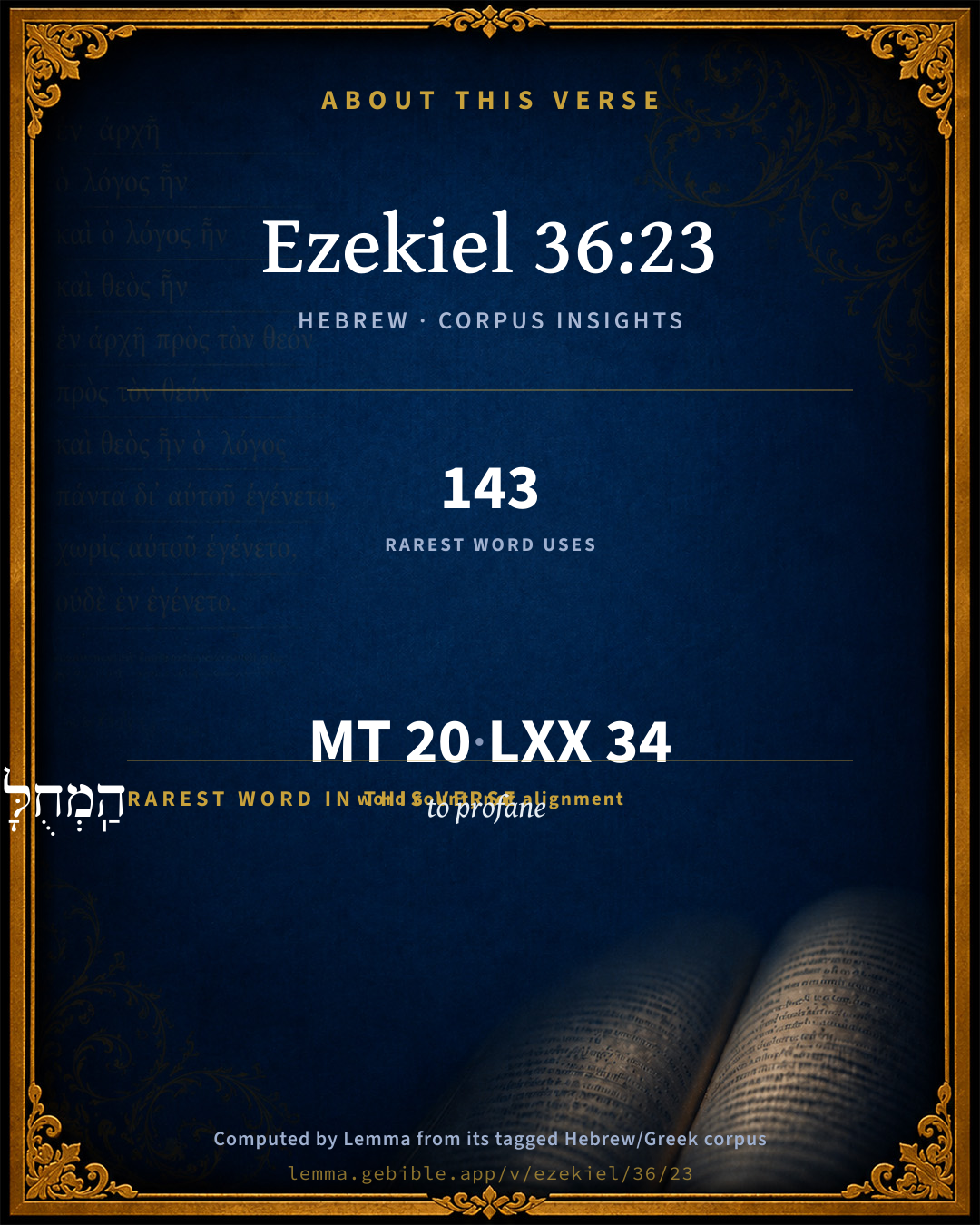
הַֽמְחֻלָּל֙
châlal
H2490
“the · profaned”
Particle, Definite Article + Verb, Pual, Participle Passive, Masculine, Singular, Absolute
Part of Speech
Particle + Verb
Stem
Pual
Form
Participle Passive
Gender
Masculine
Number
Singular
State
Absolute
Full BDB Definition

Origin: a primitive root [compare H2470 ]

TWOT: 660 , 661

to profane, defile, pollute, desecrate, begin - (Niphal) - to profane oneself, defile oneself, pollute oneself - ritually - sexually - to be polluted, be defiled - (Piel) - to profane, make common, defile, pollute - to violate the honour of, dishonour - to violate (a covenant) - to treat as common - (Pual) to profane (name of God) - (Hiphil) - to let be profaned - to begin - (Hophal) to be begun - to wound (fatally), bore through, pierce, bore - (Qal) to pierce - (Pual) to be slain - (Poel) to wound, pierce - (Poal) to be wounded - (Piel) to play the flute or pipe
  1. וְקִדַּשְׁתִּ֞י qâdash H6942 “and · to consecrate” Conjunction + Verb, Piel, Sequential Perfect, 1st Person, Common, Singular
  2. אֶת ʼêth H853 “-” Particle, Direct Object
  3. שְׁמִ֣י shêm H8034 “name · my” Noun, Common, Masculine, Singular, Construct + Suffix, Personal, 1st Person, Common, Singular
  4. הַגָּד֗וֹל gâdôwl H1419 “the · great” Particle, Definite Article + Adjective, Adjective, Masculine, Singular, Absolute
  5. בַּגּוֹיִ֔ם gôwy H1471 “in/at the · nations” Preposition, Determined + Noun, Common, Masculine, Plural, Absolute
  6. אֲשֶׁ֥ר ʼăsher H834 “which” Particle, Relative
  7. חִלַּלְתֶּ֖ם châlal H2490 “to profane” Verb, Piel, Perfect, 2nd Person, Masculine, Plural
  8. בְּתוֹכָ֑ם tâvek H8432 “in/at · midst · their” Preposition + Noun, Common, Masculine, Singular, Construct + Suffix, Personal, 3rd Person, Masculine, Plural
  9. וְיָדְע֨וּ yâdaʻ H3045 “and · to know” Conjunction + Verb, Qal, Sequential Perfect, 3rd Person, Common, Plural
  10. הַגּוֹיִ֜ם gôwy H1471 “the · nations” Particle, Definite Article + Noun, Common, Masculine, Plural, Absolute
  11. כִּי kîy H3588 “that” Conjunction
  12. אֲנִ֣י ʼănîy H589 “I” Pronoun, Personal, 1st Person, Common, Singular
  13. יְהוָ֗ה Yᵉhôvâh H3068 “LORD” Noun, Proper
  14. נְאֻם֙ nᵉʼum H5002 “utterance of” Noun, Common, Masculine, Singular, Construct
  15. אֲדֹנָ֣י ʼĂdônây H136 “Lord · my” Noun, Common, Masculine, Plural, Construct + Suffix, Personal, 1st Person, Common, Singular
  16. יְהוִ֔ה Yᵉhôvih H3069 “LORD” Noun, Proper
  17. בְּהִקָּדְשִׁ֥י qâdash H6942 “in/at · to consecrate · me” Preposition + Verb, Niphal, Infinitive Construct + Suffix, Personal, 1st Person, Common, Singular
  18. לְעֵינֵיהֶֽם ʻayin H5869 “to/for · eyes · their” Preposition + Noun, Common, Both, Dual, Construct + Suffix, Personal, 3rd Person, Masculine, Plural

About this verse

These counts appear in no published source. They are computed here, from the morphology-tagged text and Lemma’s own curated glosses. What Lemma adds →

20
words
16
distinct lemmas
Prophets
section

Grammatical profile

  • 5 verbs
  • 9 nouns
  • 1 adjective
  • 1 pronoun
  • 1 preposition
  • 1 conjunction
  • 2 particles

Verb forms

  • וְקִדַּשְׁתִּ֞י Piel · Sequential Perfect
  • הַֽמְחֻלָּל֙ Pual · Participle Passive
  • חִלַּלְתֶּ֖ם Piel · Perfect
  • וְיָדְע֨וּ Qal · Sequential Perfect
  • בְּהִקָּדְשִׁ֥י Niphal · Infinitive Construct

Repetition

Words recur within this verse — often emphatic in Hebrew:

  • וְקִדַּשְׁתִּ֞י to consecrate H6942 ×2
  • הַֽמְחֻלָּל֙ to profane H2490 ×2
  • בַּגּוֹיִ֔ם nation H1471 ×2

Hebrew & Septuagint length

In English translation the verse runs 45 words from the Hebrew and 40 from the Septuagint (LXX English) — closely comparable.

A rough comparison of the two English renderings, which tokenize alike — not a word-level alignment.

Word counts can differ between the Hebrew and the Greek without any difference in meaning — e.g. the Hebrew direct-object marker אֵת has no separate Greek word, and Greek often adds the article ὁ.

In the original languages it is 20 Hebrew tokens and 34 Greek tokens — but the two are counted differently (Hebrew bundles its prefixes and suffixes into one token; the Greek is in lemma form), so that isn’t a like-for-like length.

Cross-references

18

Topical passages linked to Ezekiel 36:23 in the Treasury of Scripture Knowledge — connected by theme and wording, ordered by reader-vote popularity; previews shown in the World English Bible.

  • Ezekiel 20:41 As a sweet savor will I accept you, when I bring you out from the peoples, and gather you out of the countries in which you have been scattered; and I will be sanctified in you in the sight of the nations.
  • Isaiah 5:16 But Yahweh of Hosts is exalted in justice, And God the Holy One is sanctified in righteousness.
  • Ezekiel 39:7 My holy name will I make known in the midst of my people Israel; neither will I allow my holy name to be profaned any more: and the nations shall know that I am Yahweh, the Holy One in Israel.
  • Psalms 46:10 "Be still, and know that I am God. I will be exalted among the nations. I will be exalted in the earth."
  • Psalms 126:1–3 When Yahweh brought back those who returned to Zion, We were like those who dream.
  • Ezekiel 39:28 They shall know that I am Yahweh their God, in that I caused them to go into captivity among the nations, and have gathered them to their own land; and I will leave none of them any more there;
  • 1 Peter 2:9 But you are a chosen race, a royal priesthood, a holy nation, a people for God's own possession, that you may show forth the excellencies of him who called you out of darkness into his marvelous light:
  • Ezekiel 28:22 and say, Thus says the Lord Yahweh: Behold, I am against you, Sidon; and I will be glorified in the midst of you; and they shall know that I am Yahweh, when I shall have executed judgments in her, and shall be sanctified in her.
  • Ezekiel 38:22–23 With pestilence and with blood will I enter into judgment with him; and I will rain on him, and on his hordes, and on the many peoples who are with him, an overflowing shower, and great hailstones, fire, and sulfur.
  • Daniel 2:47 The king answered to Daniel, and said, Of a truth your God is the God of gods, and the Lord of kings, and a revealer of secrets, seeing you have been able to reveal this secret.
  • Daniel 3:28–29 Nebuchadnezzar spoke and said, Blessed be the God of Shadrach, Meshach, and Abednego, who has sent his angel, and delivered his servants who trusted in him, and have changed the king's word, and have yielded their bodies, that they might not serve nor worship any god, except their own God.
  • Daniel 4:2–3 It has seemed good to me to show the signs and wonders that the Most High God has worked toward me.
  • Daniel 4:34–37 At the end of the days I, Nebuchadnezzar, lifted up my eyes to heaven, and my understanding returned to me, and I blessed the Most High, and I praised and honored him who lives forever; for his dominion is an everlasting dominion, and his kingdom from generation to generation.
  • Daniel 6:26–27 I make a decree, that in all the dominion of my kingdom men tremble and fear before the God of Daniel; for he is the living God, and steadfast forever, His kingdom that which shall not be destroyed; and his dominion shall be even to the end.
  • Exodus 15:4–16 Pharaoh's chariots and his host has he cast into the sea; His chosen captains are sunk in the Red Sea.
  • Numbers 20:12–13 Yahweh said to Moses and Aaron, Because you didn't believe in me, to sanctify me in the eyes of the children of Israel, therefore you shall not bring this assembly into the land which I have given them.
  • Psalms 102:13–16 You will arise and have mercy on Zion; For it is time to have pity on her. Yes, the set time has come.
  • 1 Peter 3:15 But sanctify the Lord God in your hearts; and always be ready to give an answer to everyone who asks you a reason concerning the hope that is in you, with humility and fear:

Cross-references courtesy of OpenBible.info (CC BY 4.0).

Hebrew and Greek witnesses Masoretic Hebrew ↔ Greek Septuagint

The same verse in the two great witnesses to the Old Testament, shown verse-for-verse.

These are two independent witnesses, not word-aligned to each other, and the Septuagint is shown in lemma (dictionary) form.

Hebrew Ezekiel 36:23 Masoretic · Westminster Leningrad Codex

וְקִדַּשְׁתִּ֞י אֶת שְׁמִ֣י הַגָּד֗וֹל הַֽמְחֻלָּל֙ בַּגּוֹיִ֔ם אֲשֶׁ֥ר חִלַּלְתֶּ֖ם בְּתוֹכָ֑ם וְיָדְע֨וּ הַגּוֹיִ֜ם כִּי אֲנִ֣י יְהוָ֗ה נְאֻם֙ אֲדֹנָ֣י יְהוִ֔ה בְּהִקָּדְשִׁ֥י בָכֶ֖ם לְעֵינֵיהֶֽם

I will sanctify my great name, which has been profaned among the nations, which you have profaned in the midst of them; and the nations shall know that I am Yahweh, says the Lord Yahweh, when I shall be sanctified in you before their eyes.

World English Bible · Public Domain

Greek LXX Ezekiel 36:23 Septuagint · lemma form

καί ἁγιάζω ὁ ὄνομα ἐγώ ὁ μέγας ὁ βεβηλόω ἐν ὁ ἔθνος ὅς βεβηλόω ἐν μέσος αὐτός καί γιγνώσκω ὁ ἔθνος ὅτι ἐγώ εἰμί κύριος ἐν ὁ ἁγιάζω ἐγώ ἐν σύ κατά ὀφθαλμός αὐτός

And I will sanctify my great name, which was profaned among the nations, which you⌃ profaned in the midst of them; and the nations shall know that I am the Lord, when I am sanctified among you before their eyes.

LXX2012 (modern English Septuagint) · Public Domain

Hebrew: Westminster Leningrad Codex (CC BY 4.0). Greek: Septuagint (public domain); English from LXX2012 (modern English Septuagint) (Public Domain). How the Septuagint differs from the Hebrew →

Targum (Aramaic paraphrase)

1

The Targum is the ancient Jewish Aramaic paraphrase of the Hebrew Scriptures — an interpretive translation, not the Hebrew text itself. Onkelos (literal) and Pseudo-Jonathan (expansive) render the Torah, and Jonathan the Prophets. Coverage is partial: where no permissively-licensed English translation exists for a verse, only the Aramaic is shown. This is verse-level text, not a word-by-word alignment to the Hebrew.

  1. Targum Jonathan Prophets (Joshua–Malachi)
    וַאֲקַדֵישׁ יַת שְׁמִי רַבָּא דְאִתְחַל בֵּינֵי עַמְמַיָא דְאַחֵילְתּוּן בֵּינֵיהוֹן וְיֵדְעוּן עַמְמַיָא אֲרֵי אֲנָא יְיָ אֲמַר יְיָ אֱלֹהִים כַּד אֶתְקַדֵשׁ בְּכוֹן לְעֵינֵיהוֹן:

    (no public-domain English translation for this verse)

    Targum Jonathan — Aramaic: “Mikraot Gedolot” (public domain). English: “Sefaria Community Translation” (CC0 1.0 (public-domain dedication)); “London "Chaldee Paraphrase," 1871” (public domain). Text via Sefaria.

Commentary

Notes on Ezekiel 36:23 from classic Christian and Jewish commentators (each source and its license shown beneath its notes). The classic Christian expositions comment on the surrounding passage and are grouped to its opening verse, so a note may address several verses; the Jewish commentaries on the Tanakh (Rashi and others) are per-verse, so they appear only where the commentator wrote on this verse.

Lemma curates 59 commentaries, every one of them public domain or Creative Commons licensed, each selected and text-cleaned for this edition rather than reprinted as found. About our sources →

Trapp's Complete Commentary

John Trapp

Eze 36:23 And I will sanctify my great name, which was profaned among the heathen, which ye have profaned in the midst of them; and the heathen shall know that I [am] the LORD, saith the Lord GOD, when I shall be sanctified in you before their eyes.

Ver. 23. And I will sanctify my great name.] I will recover my reputation among the heathen, by declaring my justice in your punishment, and my mercy in your restoration. God, as he is moved by his own grace to do his people good, so he aimeth therein at his own glory.

John Trapp, A Commentary or Exposition upon All the Books of the Old and New Testament (1647–1656) — public domain. Text from a community e-Sword module.

The Biblical Illustrator

Joseph S. Exell

Eze_36:23

I will sanctify My great name.

God glorified in redemption

Passing over the special application of these words to the Jews, and looking at them in their prophetical connection with the scheme of redemption, I remark--

I. That God might have vindicated His honour and sanctified His name in our destruction. Two methods of glorifying His name are open to God. He is free to choose either; but by the one or the other way He will exact His full tale of glory from every man. In Egypt, for instance, He was glorified in the high-handed destruction of His enemies; and glorified also in the same land by the high-handed salvation of His people. In the one case He proved how strong His arm was to smite, and in the other how strong it was to save. In like manner God sanctified His name on the plains of Sodom, sanctifying it, on the one hand, in the destruction of His enemies, and on the other, in the preservation of Lot. Since there are two ways open to God, by either of which He may sanctify His great name, He might therefore, at the fall, have vindicated His justice by swift and unsparing vengeance, by destroying the whole human family. What unsparing vengeance did He execute on the fallen angels! Of these there was no wreck or remnant saved. Not one escaped. No ark floated on the waters to which, like Noahs dove, a flying angel, pursued by wrath, might turn his weary wing. Can it be doubted that the measure meted out to fallen angels, God might have meted out to fallen men?--sanctifying His great name in our ruin rather than in our redemption. Now, before I show how He sanctifies Himself in the redemption of His people, let me warn you, that what God might have done with all, He shall do with some; certainly do with all those who despise and reject, or even neglect salvation. This day I set before you life and death. Will you do His will in heaven, or suffer it in hell?

II. God sanctifies His name and glorifies Himself in our redemption. It is easy to destroy, to inflict irreparable injury on character, virtue, life. Falling with murderous strokes on yonder noble tree, the woodmans axe demolishes in a few hours what it has required the springs and summers, the dews and showers and sunbeams of centuries to raise. It is both more difficult and more noble to repair than to destroy. In this material body man destroys what God only can make; but in this more precious and immortal soul, Satan destroys what God only can save. It needs but a devil to ruin a human spirit; it needs Divinity to redeem it. Excepting, of course, the preachers--for with Paul we magnify our office--of all earthly employments it appears to me that the physicians is the noblest; and that of all arts the healing art is the highest, offering to genius and benevolence their noblest field. In the eye of reason, and of a humanity that weeps over a suffering world, his is surely the nobler vocation, and if not more honoured, the more honourable calling, who sheds blood not to kill, but cure; who wounds, not that the bleeding may die, but live; and whose genius ransacks earth and ocean in search of means to preserve life, to remove deformity, to repair decay, to invigorate failing powers, and restore the rose of health to pallid cheeks. His aim is not to inflict pain, but relieve it; not to destroy a father, but, boldly standing between him and death, to save an anxious wife from widowhood, and these little children from an orphans lot. And if, although they be woven around no coronet, those are fairer and fresher laurels which are won by saving than by slaying, if it is a nobler thing to rescue life than destroy it, even when its destruction is an act of justice, then, on the same principle, God most glorified Himself when revealed in the flesh, and, speaking by His Son, He descended on a guilty world; His purpose this, I came not to judge the world, but to save it; and this His character, the Lord God, merciful and gracious, long-suffering, and abundant in goodness and truth.

I. His power is glorified in the work of salvation. The path of redemption is marked, and its pages are crowded with stupendous miracles. At one time God stays the waves of the sea; at another He stops the wheels of the sun; and now, reversing the machinery of heaven to confirm His Word, He makes the shadow travel backwards on the dial of Ahaz. Heaven descends to earth, and its exalted inhabitants, mingling with men, walk the stage of redemption. But to glance at the change wrought by redemption on man himself, what amazing power does it display! What a glorious combination of benevolence and omnipotence! Punishment is confessedly easier than reformation. Nothing is more easy than, by the hand of an executioner, to rid society of a criminal; but to soften his stony heart, to turn his steps from the paths of crime, to wean him from vice, to get him to fall in love with virtue, to make the cunning rogue, the brutal ruffian, an honest, high-minded, kind, and tender man--ah! that is another thing. Hence, among politicians callous of heart, and deaf to the groans of suffering humanity, the preference given to prisons over schools, to punishment over prevention. Well, then, since it is confessedly easier--easier, but not better, nor cheaper--to punish than reform, I say that Gods power is more illustriously displayed in pardoning one guilty, in purifying one polluted man, than if the law had been left to take her sternest course, and bury our entire family in the ruins of the fall. The power of divinity culminates in grace. Oh, that we also may be made its monuments, built up by the hands of an eternal Spirit to the memory and glory of the Cross!

II. His wisdom is glorified in redemption. That work associates such transcendent wisdom with love, power, and mercy that the Saviour of man is called the wisdom of God. The apostle selects the definite article, and pronounces Christ to be the power of God and the wisdom of God. Nor can the propriety of the language be doubted, if we reflect but for a moment on what a hard task Wisdom was set, what a difficult problem she was called to solve, when man was to be saved. She had to forge a key that could unlock the grave; she had to build a lifeboat that could swim in a sea of fire; he had to construct a ladder long enough to scale the skies; she had to invent a plan whereby justice might be fully satisfied, and yet the guilty saved. The mystery of godliness, God manifest in the flesh, a daysman such as the patriarch desired, with the right hand of divinity to lay on God, and the left hand of humanity to lay on man, and thus the fellow and friend of both, to reconcile the estranged; in short, a man to suffer and a God to satisfy, this was a thought which it never entered the noblest minds to conceive. We find nothing corresponding to it, nor guess nor glimmering of it, in the creeds and religions of a heathen world. Every way but the right one was thought of.

III. His holiness is glorified in redemption. What saith the prophet? Thou art of purer eyes than to behold evil, and canst not look on iniquity. Nothing might appear more strongly to express the holiness of God than this language, Thou canst not look on iniquity; and yet His hatred of sin is more fully illustrated, and much more strongly expressed by the very way in which He saves the sinner; more fully expressed than if, relentless, executing vengeance with an eye that knew no pity, and with a hand that would not spare, He had made an utter end of sinners; such an end that, to borrow the language of the prophet, there was none that moved the wing, or opened the mouth, or peeped. What man, being a father, has not felt this on reading the story of the Roman who pronounced sentence of death upon his own son? Had that sternest of patriots condemned common criminals enough to make the scaffolds of justice and the gutters of Rome run red with blood, such wholesale slaughter had been a feeble expression of his abhorrence of crime compared with the death of this solitary youth. When the culprit, his own child, the infant he had carried in his arms, the once sweet and beautiful boy who had wound himself round a fathers heart, rose to receive the immolating sentence at a fathers lips, that man offered the greatest, costliest sacrifice ever made at the shrine of justice, and earned for Roman virtue a proverbial fame. But that is nothing to the spectacle which redemption offers. The Son of God dies beneath His Fathers hand. Innocence bleed for guilt; Divine innocence for human guilt.

IV. His justice is glorified in redemption. The prophet, addressing God, says, Thou art of purer eyes than to behold evil; but then, as one perplexed, unable to reconcile the attributes of Gods character with the dealings of His Providence, he asks, Wherefore lookest Thou upon them that deal treacherously, and holdest Thy tongue when the wicked devoureth the man that is more righteous than he? This question implies that clouds and darkness are round about Jehovahs throne. Still, whatever mysterious shadow present events may seem to cast upon His justice, and to whatever trial, as in the wrongs of a Joseph or David, faith may be put, in believing that there is a just God upon earth, His justice appears as conspicuous in redemption as was the Cross, which illustrated that justice to the crowd on Calvary. Sinners, indeed, are pardoned, but then, their sins are punished; the guilty are acquitted, but then, their guilt is condemned; the sinner lives, but then, the surety dies; the debtor is discharged, but not till the debt is paid.

V. His mercy is glorified in redemption. To do justice to God, to the Saviour, and to our subject, we must be careful to distinguish between pity and mercy. The poor old man, into whose trembling hand you drop your alms as he begs his way onward to a grave, where, his head sheltered beneath the sod, he shall feel neither cold nor hunger, appeals to your compassion, not to your mercy. He has done you no wrong. He has not stolen your goods, nor traduced your character, nor inflicted injury on your person, nor in any way whatever disturbed your peace; and so it is only pity that walks forth in the charity which shares its bread with the hungry, and spares a corner of an ample cloak to cover the nakedness of the poor. Mercy is a higher attribute; an act of mercy is a far nobler achievement. She sits enthroned among the Graces. On her heavenly wings man rises to his loftiest elevation, makes his nearest approach and closest similitude to God. This distinction between compassion and mercy is clearly enunciated in the sacred Scriptures. We are told that like as a father pitieth his children, so the Lord pitieth them that fear Him; bat the Lord is merciful to them that fear Him not. He so loved the world as to give up His Son to die for it; but more than that, He commended His love to us, in that, while we were yet sinners, Christ died for us. We pity simple suffering; but let pity and love be extended to guilty suffering, and you have now the very element and heavenly essence of mercy. Mercy is the forgiveness of an injury. Pity relieves a sufferer, but mercy pardons a sinner. Now, understanding mercy to be the forgiveness of a wrong, the pardon of a sinner, the kindness of the injured to the injurer, where, I ask, as in redemption, where but in redemption, is this crowning attribute of the Godhead to be seen?

VI. In redemption, God is glorified in the complete discomfiture of all His and our enemies.

1. He is glorified by Satans defeat. Observe yonder skilful wrestler! He embraces his antagonist, and, lifting him from the ground with the power of an athlete, he holds him aloft. Ah! he raises, but to dash him back on the earth with a heavier fall. So fared it with the Evil One. God permits him to push on his sap and mine, to scale the walls, to carry the citadel by assault, and plant for a time his defiant standard on the battlements of this world, just that from his, proud eminence He may hurl Satan into a deeper hell; and, angels rejoicing in mans salvation, and devils discomfited in their leaders defeat, both friends and foes might be constrained to say, Hast thou an arm like God, or canst thou thunder with a voice like His!

2. While God is glorified by Satans defeat, He is glorified also by the very time and manner of it. Here are no marks of haste. Not for four days, nor even four years, but for the long-drawn out period of four thousand years, Satan holds all but undisturbed possession of his conquest. God leaves the invader ample time to entrench himself; to found, to strengthen, to establish, to extend his kingdom. And why? bat that a Redeemers power might appear the more triumphant in its ignominious, and more complete in its total overthrow.

3. God is not only glorified in Satans defeat, and also in the time and manner of it, but preeminently glorified in the instrument of it. Man falls; the world is lost; Satan triumphs. And how does God pluck the victory from his hands? He might have hurled thunderbolts at his audacious head. Summoning the forces of heaven, He might have overwhelmed this enemy, and borne him back to hell by legions of embattled angels. Not thus is the Prince of Darkness defeated. He is met and mastered by a solitary man. Out of the mouth of a babe and suckling God ordaineth strength, and by the heel of a man of sorrows He crushes the Serpents head. A son of man is the saviour of his race; a brother rises up in the house of exile to redeem his brethren; a conqueror is born in the conquered family. Never was tide of battle so strangely, completely, triumphantly turned. (T. Guthrie, D. D.)

The Biblical Illustrator, edited by Joseph S. Exell (c. 1880s–1900s) — public domain. Text from a community e-Sword module.

Geneva Bible (1599)

Geneva Bible translators

Or, your.

Geneva Bible (1599) marginal notes — public domain. Text via Bolls.life.

Jamieson, Fausset & Brown

Robert Jamieson, A. R. Fausset & David Brown

sanctify--vindicate and manifest as holy, in opposition to the heathen reproaches of it brought on by the Jews' sins and their punishment (see on Eze 36:20).

sanctified in you--that is, in respect of you; I shall be regarded in their eyes as the Holy One, and righteous in My dealings towards you (Eze 20:41; Eze 28:22).

Jamieson, Fausset & Brown — Commentary Critical and Explanatory on the Whole Bible (1871) — public domain (CC PDM 1.0). Text via the HelloAO Bible API.

Adam Clarke's Commentary

Verse 23. I will sanctify my great name] By changing your hearts and your conduct, I shall show my hatred to vice, and my love to holiness: but it is not for your sakes, but for my holy name's sake, that I shall do you good in your latter days.

Adam Clarke's Commentary on the Bible (1810–1826) — public domain. Text from a community e-Sword/MySword module.

Ellicott's Commentary for English Readers

(23) Before their eyes.—The Hebrew text as it stands has your eyes, as in the margin. Many manuscripts and other authorities have their. Either of them admits of an excellent sense; but the reading your brings out the important truth that God must first be sanctified in the eyes of the people themselves by their repentance and moral reformation, and then, through them and the consequent blessing upon them, He will be sanctified in the eyes of the heathen also.

A Bible Commentary for English Readers, edited by Charles John Ellicott (1878–1897) — public domain. Text from a community e-Sword module.

The Cambridge Bible for Schools and Colleges

gen. ed. J. J. S. Perowne

23. sanctify my great name] To sanctify is the opposite of to profane. As the latter term means to detract from the power, majesty or purity of Jehovah, or from any of those attributes which belong to his godhead, to sanctify is to manifest or make these attributes conspicuous. Hence the effect of Jehovah’s sanctifying his name is that the heathen know him to be Jehovah—God alone and all that which he is who is God alone. In Eze_36:22 “holy name,” here “great name”; “greatness” is an element in “holiness.”

be sanctified in you] Or reflexive: shew myself holy—where “holy” embraces the attributes of Deity as a whole. Israel is the subject through which Jehovah shews himself to be God, i.e. by his operations in Israel in the sight of the nations.

24 seq. These operations are his restoration and regeneration of Israel. It is certainly possible that the more internal operations of Jehovah on Israel (Eze_36:25 seq.)—his washing them with clean water and putting a new spirit within them that they shall walk in his statutes, are considered part of Jehovah’s sanctifying of himself in the sight of the nations. They do express better what Jehovah is than a mere exhibition of power, cf. Eze_39:23-24; Isa_61:3; Isa_62:2. At the same time this more general idea seems to pass from the prophet’s mind in the delight with which he dwells on Israel’s religious regeneration. The wider idea is at any rate returned to in Eze_36:33 seq.

The Cambridge Bible for Schools and Colleges (gen. ed. J. J. S. Perowne; Cambridge University Press, 1878–1918) — public domain. Text from a community e-Sword module.

John Gill's Exposition

And I will sanctify my great name,.... The same with his holy name; for his greatness lies in his holiness; which name he sanctifies when he clears it from all charges and imputations; when he makes it appear to be holy and himself to be glorious in holiness; when he vindicates the honour of his name, not in a way of punishment, as he justly might, but in a way of grace and mercy; he sanctifies his name when he proclaims it, a God gracious and merciful; for it was in this way and manner he determined to make himself illustrious and glorious, and do honour to his name:

which was profaned among the Heathen, which ye have profaned in the midst of them; this is repeated again and again, to show the heinousness of this sin, how ill he took it at their hands, and what a concern it gave him:

and the Heathen shall know that I am the Lord, saith the Lord God, when I shall be sanctified in you before their eyes; when the Lord shall fulfil his promises, and deliver his people; when he shall sanctify, justify, and save them; and he shall be sanctified, served, and worshipped by them, and among them: it will be taken notice of by infidels themselves; and they shall hereby know, and be obliged to acknowledge, that the God of Israel is the only Lord God; that he is true and faithful to his word, righteous and holy, in his ways, the Lord God omniscient and omnipotent.

John Gill's Exposition of the Whole Bible (1746–1763) — public domain (CC PDM 1.0). Text via the HelloAO Bible API.

Matthew Poole's English Annotations

Will sanctify, by clearing it up, and removing the objection that the Jews’ sufferings and sins among the Babylonians had raised.

My great name; they gave the heathen occasion to think meanly and contemptibly of me, but I will show I am as great as good, in both infinite.

Was profaned: see Eze 36:20,22.

Which ye have profaned; God chargeth the Jews with the blasphemies the heathen cast on God, the Jews were the cause of them, and they are therefore justly imputed to the Jews.

That I am the Lord; by what I do, the heathen shall know what I am, and from the great and good things I do for you, performing my promises, and purifying you, shall see I am great, good, faithful, and holy; then shall I be sanctified in you, as I have been profaned by you in their eyes: and so it was, Psa 127:2.

Matthew Poole's English Annotations on the Holy Bible (1683–1685) — public domain. Text from a community e-Sword/MySword module.

The Pulpit Commentary

I will sanctify my great Name; i.e. the name of my holiness. (Deu_28:58; Psa_8:1; Mal_1:11) As Israel"s dispersion had caused that Name to be profaned, so Israel"s restoration would secure that it should be magnified among the heathen, (Eze_38:23) who should learn from this event that their previous ideas of Jehovah, as a feeble and local divinity, had been wrong. The question whether your eyes, as in the Hebrew text, or "their eyes," as in many ancient versions, should be read is debated. The latter reading appears to be demanded by the usus loquendi of Ezekiel, (see Eze_20:41 Eze_28:25 Eze_38:16 Eze_39:27) and is adopted by both English versions as well as by interpreters of eminence; but other expositors of equal name adhere to the former reading on the ground that the sanctifying of Jehovah"s Name in the eyes of Israel was an indispensable preliminary to its sanctification in the eyes of the heathen. Havernick regards "their eyes" as "an obvious emendation to relieve a difficulty," to which in no case should criticism accord the preference; while Keil gives it the preference, though admitting that "your eyes" can be justified.

The Pulpit Commentary (1880–1919), ed. H.D.M. Spence-Jones & Joseph S. Exell — public domain. Text from a community e-Sword module.

John Wesley's Explanatory Notes

I will sanctify my great name - They gave the heathen occasion to think meanly of me, but I will shew I am as great as good. When God performs what he hath sworn by his holiness, then he sanctifies his name.

John Wesley, Explanatory Notes Upon the Whole Bible (1754–1765) — public domain. Text via the GEBible commentary corpus.

Rashi

Rabbi Shlomo Yitzchaki (Rashi)

And I will sanctify My...Name Now what is the sanctification? “I will take you from among the nations.”

Rashi on the Tanakh — English translations: “The Judaica Press complete Tanach with Rashi, translated by A. J. Rosenberg” (CC BY 4.0); “Pentateuch with Rashi's commentary by M. Rosenbaum and A.M. Silbermann, 1929-1934” (public domain); “The Metsudah Tanach series, Lakewood, N.J” (CC BY 4.0); and “The Book of Joshua, Metsudah Publications, 1997” (CC BY 4.0). Text via Sefaria.

Lesson kit

Teaching starters — assembled from the data on this page, not authored interpretation. Every prompt links to the verse data it draws on. Edit before teaching.

Ezekiel, in the Prophets, opens this verse with 20 words (16 distinct Hebrew lemmas). Its most distinctive word is châlal (“to profane”). A historical commentator’s framing appears above. Read the whole chapter for the surrounding context.

Discussion questions

  1. How does “to profane” (châlal) shape what this verse is saying?
  2. How does Ezekiel 20:41, which shares this passage’s theme, read alongside this verse?
  3. What does the repetition of “to consecrate” (2× in this one verse) do in this verse?
  4. The translations on this page render this verse differently — a whole-verse word diff, not a word-by-word alignment. What might account for the different wordings?
  5. «וְקִדַּשְׁתִּ֞י» is a Piel Sequential Perfect verb. How does that grammatical form shape the action described?
  6. Compare how Trapp's Complete Commentary and The Biblical Illustrator read this verse. Where do they agree or differ?

Things to notice

Reading settings

Reading text

Shown beneath each verse's original-language words.

Old Testament
Old Testament edition

Read the OT as the Masoretic Hebrew (MT) or the Greek Septuagint (LXX).

English shown for the Greek Septuagint (in the Hebrew ↔ Greek comparison).

Comparing translations? Open the Compare panel on any verse page to stack up to four side by side.