
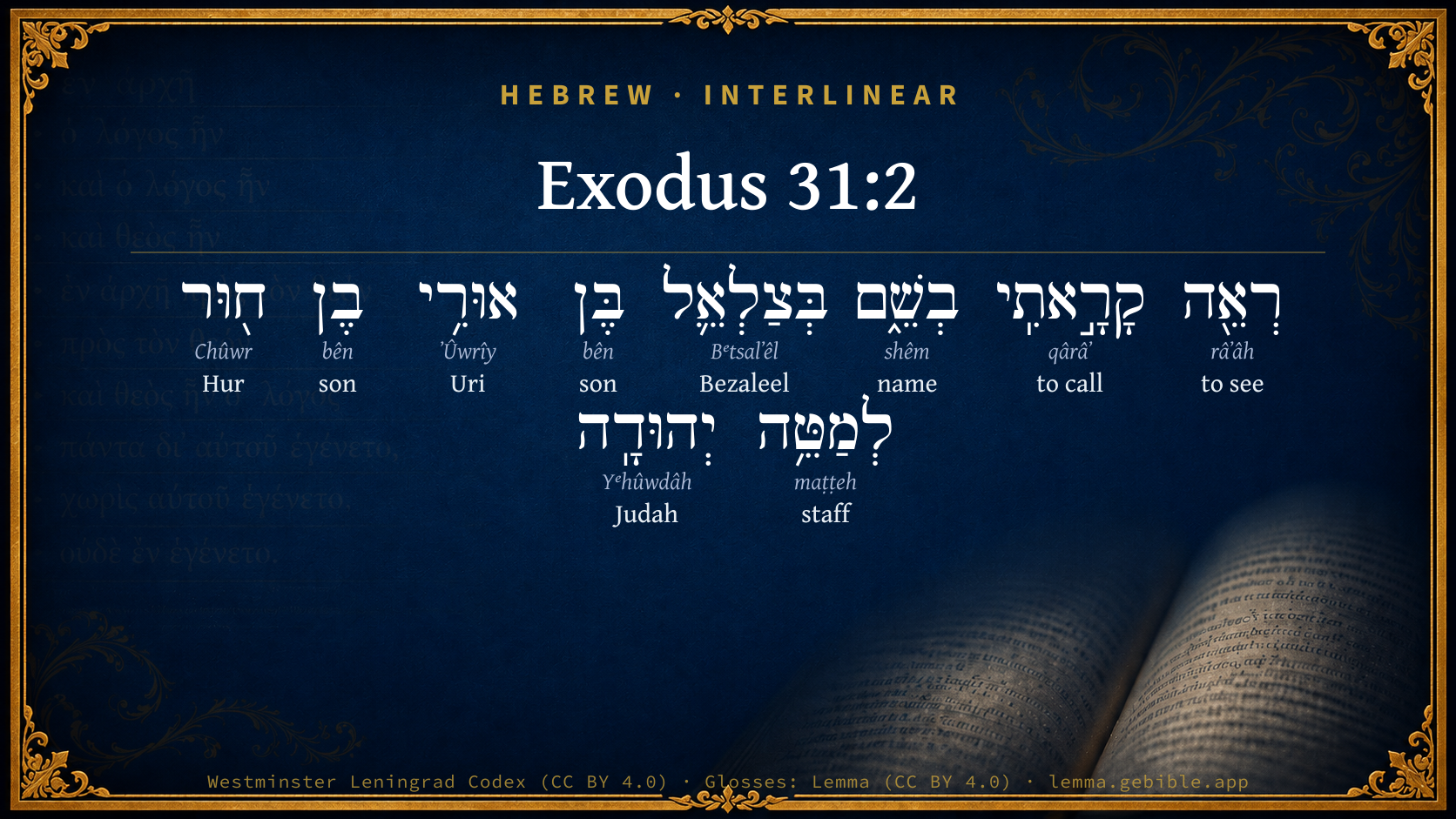
Exodus 31:2

Hebrew (Westminster Leningrad Codex) Exodus 31:2 appears in the Hebrew Old Testament. The text above is from the Westminster Leningrad Codex. Each word links to its Strong’s number, a concise gloss, and parsing drawn from the Open Scriptures Hebrew Bible morphology. Click any word for its full Brown-Driver-Briggs (BDB) entry.
Download image
Cite this verse

Exodus 31:2 (World English Bible). Public Domain. Lemma interlinear Bible study tool, https://lemma.gebible.app/v/exodus/31/2.

Show BibTeX & RIS
BibTeX
RIS
English Translation
"Behold, I have called by name Bezalel the son of Uri, the son of Hur, of the tribe of Judah:
World English Bible · Public Domain
Highlights
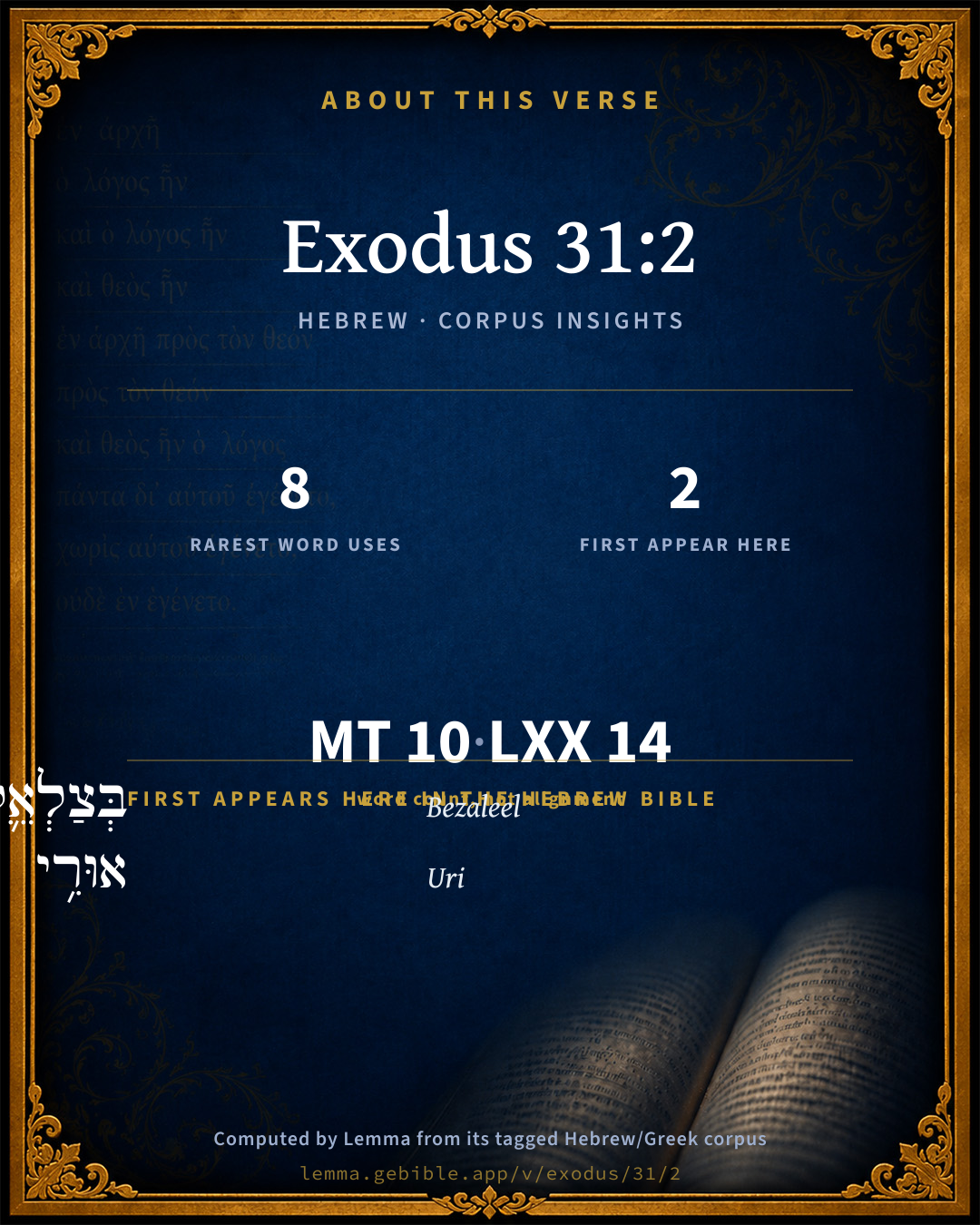
  • 2 first appearances in the Hebrew Bible
Full analysis ↓
Download a study sheet

One document with this verse’s original text, its word-by-word gloss line, the meaning frame, cross-references with their text, attributed commentary, and full source and license credits — printable, and it pastes into notes with its structure intact.

This verse Autodidact and up

Study sheet (.html) Plain text (.txt)

A passage Seminary Student

Up to 50 verses in one chapter. A passage sheet keeps up to 6 commentary sources and 12 cross-references per verse, in the order this page ranks them, and says so on the sheet whenever that leaves anything out. Ask for a single verse and you get the Autodidact verse sheet above.

Everything on this page stays free to read, with no account — the sheet is a download of what is already on screen, not access to it.

Want to remove ads? Support Godless Engineer
Compare translations 3

The same verse in 3 English versions, stacked beneath the original-language interlinear above. Click any original word for its lexicon entry.

Each is an independent rendering of the whole verse — the interlinear is not word-aligned to these translations.

Highlighted words mark where these versions differ — a whole-verse word diff, not a word-by-word alignment.

  • World English Bible Public Domain
    "Behold, I have called by name Bezalel the son of Uri, the son of Hur, of the tribe of Judah:
  • King James Version Public Domain
    See, I have called by name Bezaleel the son of Uri, the son of Hur, of the tribe of Judah:
  • unfoldingWord Literal Text CC BY-SA 4.0
    “See, I have called by name Bezalel son of Uri son of Hur, from the tribe of Judah.

unfoldingWord Literal Text — © unfoldingWord, licensed CC BY-SA 4.0. Word-aligned USFM3 via Door43 (git.door43.org/unfoldingWord/en_ult).

Versions to compare (up to 4)

3 of 4 selected

Show all 18 translations

Every available English version of this verse, each an independent rendering of the whole verse.

  • World English Bible Public Domain
    "Behold, I have called by name Bezalel the son of Uri, the son of Hur, of the tribe of Judah:
  • Berean Standard Bible Public Domain
    “See, I have called by name Bezalel son of Uri, the son of Hur, of the tribe of Judah.
  • Majority Standard Bible Public Domain
    “See, I have called by name Bezalel son of Uri, the son of Hur, of the tribe of Judah.
  • King James Version Public Domain
    See, I have called by name Bezaleel the son of Uri, the son of Hur, of the tribe of Judah:
  • American Standard Version (1901) Public Domain
    See, I have called by name Bezalel the son of Uri, the son of Hur, of the tribe of Judah:
  • Revised Version (1885) Public Domain
    See, I have called by name Bezalel the son of Uri, the son of Hur, of the tribe of Judah:
  • Geneva Bible (1599) Public Domain
    Behold, I haue called by name, Bezaleel the sonne of Vri, the sonne of Hur of the tribe of Iudah,
  • Douay-Rheims (1899) Public Domain
    Behold, I have called by name Beseleel the son of Uri the son of Hur of the tribe of Juda,
  • Young's Literal Translation Public Domain
    `See, I have called by name Bezaleel, son of Uri, son of Hur, of the tribe of Judah,
  • Literal Standard Version CC BY-SA 4.0
    “See, I have called by name Bezaleel, son of Uri, son of Hur, of the tribe of Judah,
  • Unlocked Literal Bible CC BY-SA 4.0
    “See, I have called by name Bezalel son of Uri son of Hur, from the tribe of Judah.
  • unfoldingWord Literal Text CC BY-SA 4.0
    “See, I have called by name Bezalel son of Uri son of Hur, from the tribe of Judah.
  • Darby Bible Public Domain
    See, I have called by name Bezaleel the son of Uri, the son of Hur, of the tribe of Judah,
  • World Messianic Bible Public Domain
    “Behold, I have called by name Bezalel the son of Uri, the son of Hur, of the tribe of Judah.
  • Webster's Bible Public Domain
    See, I have called by name Bezaleel the son of Uri, the son of Hur, of the tribe of Judah:
  • Free Bible Version CC BY-SA 4.0
    “I have chosen by name Bezalel, son of Uri, son of Hur, from the tribe of Judah.
  • Bible in Basic English Public Domain
    I have made selection of Bezalel, the son of Uri, by name, the son of Hur, of the tribe of Judah:
  • JPS Tanakh (1917) Public Domain
    'See, I have called by name Bezalel the son of Uri, the son of Hur, of the tribe of Judah;

Literal Standard Version (2020), Covenant Press — licensed CC BY-SA 4.0. Text via the HelloAO Bible API (eBible.org). Unlocked Literal Bible (unfoldingWord) — licensed CC BY-SA 4.0. Text via the HelloAO Bible API (eBible.org). unfoldingWord Literal Text — © unfoldingWord, licensed CC BY-SA 4.0. Word-aligned USFM3 via Door43 (git.door43.org/unfoldingWord/en_ult). Free Bible Version, Dr. Jonathan Gallagher — licensed CC BY-SA 4.0. Text via the HelloAO Bible API (eBible.org).

Word by word

More ways to search: Search by grammar → Find every occurrence → Compare this word →

Practice this passage: Drill this verse → Learn its vocabulary →

About this verse

These counts appear in no published source. They are computed here, from the morphology-tagged text and Lemma’s own curated glosses. What Lemma adds →

10
words
9
distinct lemmas
Pentateuch
section

Notable vocabulary

The rarest word here is אוּרִ֥י Uri H221 — appearing just 8 times in the whole Hebrew Bible.

First appearance in Scripture

These words make their first canonical appearance in the Hebrew Bible here:

  • בְּצַלְאֵ֛ל Bezaleel H1212
  • אוּרִ֥י Uri H221

Shared distinctive vocabulary

אוּרִ֥י Uri H221 occurs in 7 verses of the Hebrew Bible. Also found in:

Grammatical profile

  • 2 verbs
  • 8 nouns

Verb forms

  • רְאֵ֖ה Qal · Imperative
  • קָרָ֣אתִֽי Qal · Perfect

Repetition

A word recurs within this verse — often emphatic in Hebrew:

Hebrew & Septuagint length

In English translation the verse runs 20 words from the Hebrew and 20 from the Septuagint (LXX English) — the same length.

A rough comparison of the two English renderings, which tokenize alike — not a word-level alignment.

Word counts can differ between the Hebrew and the Greek without any difference in meaning — e.g. the Hebrew direct-object marker אֵת has no separate Greek word, and Greek often adds the article ὁ.

In the original languages it is 10 Hebrew tokens and 14 Greek tokens — but the two are counted differently (Hebrew bundles its prefixes and suffixes into one token; the Greek is in lemma form), so that isn’t a like-for-like length.

Cross-references

9

Topical passages linked to Exodus 31:2 in the Treasury of Scripture Knowledge — connected by theme and wording, ordered by reader-vote popularity; previews shown in the World English Bible.

  • Exodus 35:30 Moses said to the children of Israel, "Behold, Yahweh has called by name Bezalel the son of Uri, the son of Hur, of the tribe of Judah.
  • Exodus 36:1 "Bezalel and Oholiab shall work with every wise-hearted man, in whom Yahweh has put wisdom and understanding to know how to work all the work for the service of the sanctuary, according to all that Yahweh has commanded."
  • John 3:27 John answered, "A man can receive nothing, unless it has been given him from heaven.
  • Exodus 33:12 Moses said to Yahweh, "Behold, you tell me, 'Bring up this people:' and you haven't let me know whom you will send with me. Yet you have said, 'I know you by name, and you have also found favor in my sight.'
  • Exodus 33:17 Yahweh said to Moses, "I will do this thing also that you have spoken; for you have found favor in my sight, and I know you by name."
  • Exodus 37:1 Bezalel made the ark of acacia wood. Its length was two and a half cubits, and its breadth a cubit and a half, and a cubit and a half its height.
  • 1 Chronicles 2:19–20 Azubah died, and Caleb took to him Ephrath, who bore him Hur.
  • Isaiah 45:3–4 and I will give you the treasures of darkness, and hidden riches of secret places, that you may know that it is I, Yahweh, who call you by your name, even the God of Israel.

Cross-references courtesy of OpenBible.info (CC BY 4.0).

Hebrew and Greek witnesses Masoretic Hebrew ↔ Greek Septuagint

The same verse in the two great witnesses to the Old Testament, shown verse-for-verse.

These are two independent witnesses, not word-aligned to each other, and the Septuagint is shown in lemma (dictionary) form.

Hebrew Exodus 31:2 Masoretic · Westminster Leningrad Codex

רְאֵ֖ה קָרָ֣אתִֽי בְשֵׁ֑ם בְּצַלְאֵ֛ל בֶּן אוּרִ֥י בֶן ח֖וּר לְמַטֵּ֥ה יְהוּדָֽה

"Behold, I have called by name Bezalel the son of Uri, the son of Hur, of the tribe of Judah:

World English Bible · Public Domain

Greek LXX Exodus 31:2 Septuagint · lemma form

ἰδού ἀνακαλέω ἐκ ὄνομα ὁ βεσελεηλ ὁ ὁ ουριας ὁ ωρ ὁ φυλή ιουδα

Behold, I have called by name Beseleel the son of Urias the son of Or, of the tribe of Juda.

LXX2012 (modern English Septuagint) · Public Domain

Hebrew: Westminster Leningrad Codex (CC BY 4.0). Greek: Septuagint (public domain); English from LXX2012 (modern English Septuagint) (Public Domain). How the Septuagint differs from the Hebrew →

Targum (Aramaic paraphrase)

2

The Targum is the ancient Jewish Aramaic paraphrase of the Hebrew Scriptures — an interpretive translation, not the Hebrew text itself. Onkelos (literal) and Pseudo-Jonathan (expansive) render the Torah, and Jonathan the Prophets. Coverage is partial: where no permissively-licensed English translation exists for a verse, only the Aramaic is shown. This is verse-level text, not a word-by-word alignment to the Hebrew.

  1. Targum Onkelos Torah (Genesis–Deuteronomy)
    חֲזֵי דְרַבֵּיתִי בְשׁוּם בְּצַלְאֵל בַּר אוּרִי בַּר חוּר לְשִׁבְטָא דִיהוּדָה:

    (no public-domain English translation for this verse)

    Targum Onkelos — Aramaic: “Onkelos Genesis” (public domain); “Onkelos Exodus” (public domain); “Onkelos Leviticus” (public domain); “Onkelos Numbers” (public domain); “Onkelos Deuteronomy” (public domain). English: “Sefaria Community Translation” (CC0 1.0 (public-domain dedication)); “J.W. Etheridge. The Targums of Onkelos and Jonathan Ben Uzziel on the Pentateuch. London: Longmans, Green, 1862” (public domain). Text via Sefaria.

  2. Targum Pseudo-Jonathan Torah (Genesis–Deuteronomy)
    חֲמֵי משֶׁה דְּקַרְיַית בְּשׁוּם טַב בְּצַלְאֵל בַּר אוּרִי בַּר חוּר לְשִׁבְטָא דִיהוּדָה

    Look, Mosheh, I have called by name the good Bezalel: bar Uri bar Hur, of the tribe of Jehudah,

    Targum Pseudo-Jonathan — Aramaic: “Targum Jonathan on Genesis” (public domain); “Targum Jonathan on Exodus” (public domain); “Targum Jonathan on Leviticus” (public domain); “Targum Jonathan on Numbers” (public domain); “Targum Jonathan on Deuteronomy” (public domain). English: “The Targum of Jonathan ben Uzziel, trans. J. W. Etheridge, London, 1862” (public domain). Text via Sefaria.

Commentary

Notes on Exodus 31:2 from classic Christian and Jewish commentators (each source and its license shown beneath its notes). The classic Christian expositions comment on the surrounding passage and are grouped to its opening verse, so a note may address several verses; the Jewish commentaries on the Tanakh (Rashi and others) are per-verse, so they appear only where the commentator wrote on this verse.

Lemma curates 59 commentaries, every one of them public domain or Creative Commons licensed, each selected and text-cleaned for this edition rather than reprinted as found. About our sources →

Trapp's Complete Commentary

John Trapp

Exo 31:2 See, I have called by name Bezaleel the son of Uri, the son of Hur, of the tribe of Judah:

Ver. 2. The son of Hur.] Of that Hur mentioned in Exo 17:12; Exo 24:14.

John Trapp, A Commentary or Exposition upon All the Books of the Old and New Testament (1647–1656) — public domain. Text from a community e-Sword module.

Geneva Bible (1599)

Geneva Bible translators

I have chosen and made meet, Exod. 35:30.

Geneva Bible (1599) marginal notes — public domain. Text via Bolls.life.

Adam Clarke's Commentary

Verse 2. I have called by name Bezaleel] That is, I have particularly appointed this person to be the chief superintendent of the whole work. His name is significant, בצלאל betsal-el, in or under the shadow of God, meaning, under the especial protection of the Most High. He was the son of Uri, the son of Hur, the son of Caleb or Chelubai, the son of Esron, the son of Pharez, the son of Judah. See 1Ch 2:5, 1Ch 2:9, 1Ch 2:18-20, and See Clarke on Ex 17:10.

Adam Clarke's Commentary on the Bible (1810–1826) — public domain. Text from a community e-Sword/MySword module.

Ellicott's Commentary for English Readers

(2) I have called by name.—It is a high honour to be called of God by name. He thus calls only those whom He appoints to some great work, as Moses (Exo_3:4; Exo_33:12), Samuel (1Sa_3:10), and Cyrus (Isa_45:3-4).

Bezaleel the son of Uri, the son of Hur.—Hur, the grandfather of Bezaleel, is generally supposed to be identical with the Hur who supported Moses’s hands (Exo_17:12), and was left joint regent with Aaron when Moses went up into Mount Sinai (Exo_24:14). There is, however, no evidence of this beyond the identity of the name.

Of the tribe of Judah.—Descended from Judah through Pharez, Hezron, and Caleb (1Ch_2:5; 1Ch_2:18-20).

A Bible Commentary for English Readers, edited by Charles John Ellicott (1878–1897) — public domain. Text from a community e-Sword module.

The Cambridge Bible for Schools and Colleges

gen. ed. J. J. S. Perowne

2. called by name] i.e. specially chosen: cf. Isa_45:3-4 (of Cyrus).

Bĕẓal’çl] i.e. ‘In the shadow (i.e. protection, Num_14:9 RVm.) of God’; cf. the Ass. name Ina-ṣilli-Bel, ‘In the shadow of Bel’ (cited by Bä.). There are no sufficient grounds for identifying the Ḥur here with the Ḥur of Exo_17:10, Exo_24:14. The whole series Ḥur, Uri, Bĕẓal’çl occurs again in 1Ch_2:19 f., in the ‘family’ of Caleb, one of the three leading clans of Judah; but the relation of the two series of names to each other is uncertain: 1Sa_30:14 appears to shew that even in David’s time the Caleb-clan was not yet actually part of Judah (comp. the writer’s Genesis, p. 327; and DB., EB., s.v. Caleb).

In v. 6 Oholiab is associated with Bĕẓal’çl; but Bĕẓal’çl is evidently regarded as the constructor in chief: he always takes the first place (Exo_36:1-2; cf. Exo_38:22 f.), and is often mentioned alone (Exo_37:1, and implicitly in vv. 10, 17, 25, &c.).

The Cambridge Bible for Schools and Colleges (gen. ed. J. J. S. Perowne; Cambridge University Press, 1878–1918) — public domain. Text from a community e-Sword module.

John Gill's Exposition

See, I have called by name Bezaleel,.... Had pitched upon, chosen, and distinguished him particularly from all other men to be the architect or chief master builder of the tabernacle, and to be the director and overseer of the whole work relating to it: the Targums of Jonathan and Jerusalem paraphrase it,""I have called with a good name Bezaleel";''as if respect was to be had to his name Bezaleel, as given him by God, and very expressive and significant; whereas the phrase of calling "by name" does not signify the imposing of a name upon him, but the singular and personal choice of him to an office: indeed, his name Bezaleel is very significant, and may be rendered, "in the shadow of God"; and he was under the shadow, influence, and protection of the Lord, and was called to be concerned in making those things, which were shadows of good things to come; and he may be considered in all as a type of Christ, who is the chief and master builder of his church, has the care and oversight of it, and under whom others work; for except he built the house, they labour in vain that build it; he was called by name, or eminently chosen to this work, he took not this honour to himself, but was called of God, as Bezaleel was, and was hid and abode under the shadow of the Almighty all the while he was concerned in it, see Psa 91:1.

the son of Uri, the son of Hur, of the tribe of Judah; Bezaleel's father's name was Uri, which signifies, "my light"; and his grandfather's name Hur, which has the signification of liberty or freedom; the same that Moses left with Aaron to judge the people of Israel during his stay in the mount, and is thought to have been the husband of Miriam; so that his grandfather being living, he may be supposed to be but a young man: the Jews say (n) he was but thirteen years of age when he was employed in this service, but that is not probable; though indeed his antitype, when but twelve years of age, said, "wist ye not that I must be about my Father's business?" his Father, whom he calls Uri, my light, Psa 27:1 he being the brightness of his Father's glory, and the express image of his person; and is the Son of God that makes men free, and they are free indeed; and of whom it is evident that he sprung out of the tribe of Judah, a tribe greatly honoured of God.

(n) Shalshalet Hakabala, fol. 6. 2.

John Gill's Exposition of the Whole Bible (1746–1763) — public domain (CC PDM 1.0). Text via the HelloAO Bible API.

Haydock's Catholic Bible Commentary

By name. I have fixed upon and taken into my service, as Isaias xliii. 1.

George Leo Haydock (1774–1849), Haydock's Catholic Family Bible and Commentary, 1859 edition — public domain. Excludes Psalms (Douay-Rheims chapter numbering differs from Protestant) and Deuterocanonical books (Catholic canon only).

Matthew Poole's English Annotations

He seems to be the same mentioned 1Ch 2:20

Matthew Poole's English Annotations on the Holy Bible (1683–1685) — public domain. Text from a community e-Sword/MySword module.

The Pulpit Commentary

I have called by name. God "calls by name" only those whom he appoints to some high office, as Moses, (Exo_3:4 Exo_33:12) Cyrus, (Isa_45:3, Isa_45:4) and here Bezaleel and Aholiab. He honours us highly in even condescending to "know us by name," still more in "calling" us. Bezaleel is traced to Judah in Chronicles through five ancestors Uri, Hur, Caleb, Hezron, and Pharez, Judah"s son by Tamar. The genealogy, though less contracted than most of those in Exodus, probably contains two or three omissions. The son of Hur. Hur, the grandfather of Bezaleel, is thought to be the person mentioned in Exo_17:10, and Exo_24:14.

The Pulpit Commentary (1880–1919), ed. H.D.M. Spence-Jones & Joseph S. Exell — public domain. Text from a community e-Sword module.

John Wesley's Explanatory Notes

See I have called Bezaleel, the grandson of Hur, probably that Hur who had helped to hold up Moses's hand, chap. xvii, 10-12, and was at this time in commission with Aaron for the government of the people in the absence of Moses. Aholiab of the tribe of Dan. is appointed next to Bezaleel, and partner with him. Hiram, who was the head-workman in the building of Solomon's temple, was also of the tribe of Daniel, 2 Chron. ii, 14.

John Wesley, Explanatory Notes Upon the Whole Bible (1754–1765) — public domain. Text via the GEBible commentary corpus.

Rashi

Rabbi Shlomo Yitzchaki (Rashi)

קראתי בשם I HAVE CALLED BY NAME — to accomplish My work — BEZALEL.

Rashi on the Tanakh — English translations: “The Judaica Press complete Tanach with Rashi, translated by A. J. Rosenberg” (CC BY 4.0); “Pentateuch with Rashi's commentary by M. Rosenbaum and A.M. Silbermann, 1929-1934” (public domain); “The Metsudah Tanach series, Lakewood, N.J” (CC BY 4.0); and “The Book of Joshua, Metsudah Publications, 1997” (CC BY 4.0). Text via Sefaria.

Ramban (Nachmanides)

Rabbi Moshe ben Nachman (Ramban / Nachmanides)

SEE, I HAVE CALLED BY NAME BEZALEL THE SON OF URI, THE SON OF HUR. G-d said to Moses, See, I have called by name, and Moses said to Israel, See, the Eternal hath called by name. The reason for this is because Israel in Egypt had been crushed under the work in mortar and in brick, and had acquired no knowledge of how to work with silver and gold, and the cutting of precious stones, and had never seen them at all. It was thus a wonder that there was to be found amongst them such a great wise-hearted man who knew how to work with silver and gold, and in cutting of stones [for setting] and in carving of wood, a craftsman, an embroiderer, and a weaver. For even amongst those who study before the experts, you cannot find one who is proficient in all these crafts. And even those who know them and are used to doing them, if their hands are continually engaged in [work with] lime and mud, lose the ability to do with them such artistic and delicate work. Moreover, he [i.e. Bezalel] was a great Sage in wisdom, and in understanding, and in knowledge, to understand the secret of the Tabernacle and all its vessels, why they were commanded and to what they hinted. Therefore G-d said to Moses that when he sees this wonder he should know that I filled him with the spirit of G-d, to know all these things in order that he would make the Tabernacle. For it was His Will to make the Tabernacle in the wilderness, and He created him for His glory, “Whatsoever the Holy One, blessed be He, created in His world He created it but for His glory.” Bezalel thus was born for that sacred purpose, as the thought continues to be unfolded by Ramban. for it is He that called the generations from the beginning, it being similar in meaning to the verse, Before I formed thee in the belly I knew thee, and before thou camest forth out of the womb I sanctified thee. The same type of expression we find in the verse, See that the Eternal hath given you the Sabbath; therefore He giveth you on the sixth day the bread of two days. Our Rabbis have on this topic a Midrash: “G-d showed Moses the book of the first man and told him: ‘Each person I have given a role from that moment on, and Bezalel too I have given a role already then, as it is said, See, I have called by name Bezalel.’” This is similar to what I have explained. The Rabbis have also said: “Bezalel knew how to combine the letters with which heaven and earth were created.” The purport of this saying is that the Tabernacle alludes to these matters [heaven and earth], and he knew and understood its secret.

Ramban (Nachmanides) on the Tanakh — English translation: “Commentary on the Torah by Ramban (Nachmanides). Translated and annotated by Charles B. Chavel. New York, Shilo Pub. House, 1971-1976” (CC BY 4.0). Text via Sefaria.

Lesson kit

Teaching starters — assembled from the data on this page, not authored interpretation. Every prompt links to the verse data it draws on. Edit before teaching.

Exodus, in the Pentateuch, opens this verse with 10 words (9 distinct Hebrew lemmas). Its most distinctive word is ʼÛwrîy (“Uri”). A historical commentator’s framing appears above. Read the whole chapter for the surrounding context.

Discussion questions

  1. How does “Uri” (ʼÛwrîy) shape what this verse is saying?
  2. 2 words here appear for the first time in Scripture. What is being introduced at this debut?
  3. Exodus 35:30 shares the word «Uri» with this verse. How do the two illuminate each other?
  4. “son” occurs 2× in this one verse. What is the effect of the repetition?
  5. These translations render this verse differently; the difference is in the English rendering, not the original. What questions does that raise?
  6. The verb «רְאֵ֖ה» is Qal Imperative. How does its form color the action?
  7. Reading how Trapp's Complete Commentary and Geneva Bible (1599) read this verse, where do the two commentators agree and where do they part?

Things to notice

Reading settings

Reading text

Shown beneath each verse's original-language words.

Old Testament
Old Testament edition

Read the OT as the Masoretic Hebrew (MT) or the Greek Septuagint (LXX).

English shown for the Greek Septuagint (in the Hebrew ↔ Greek comparison).

Comparing translations? Open the Compare panel on any verse page to stack up to four side by side.