
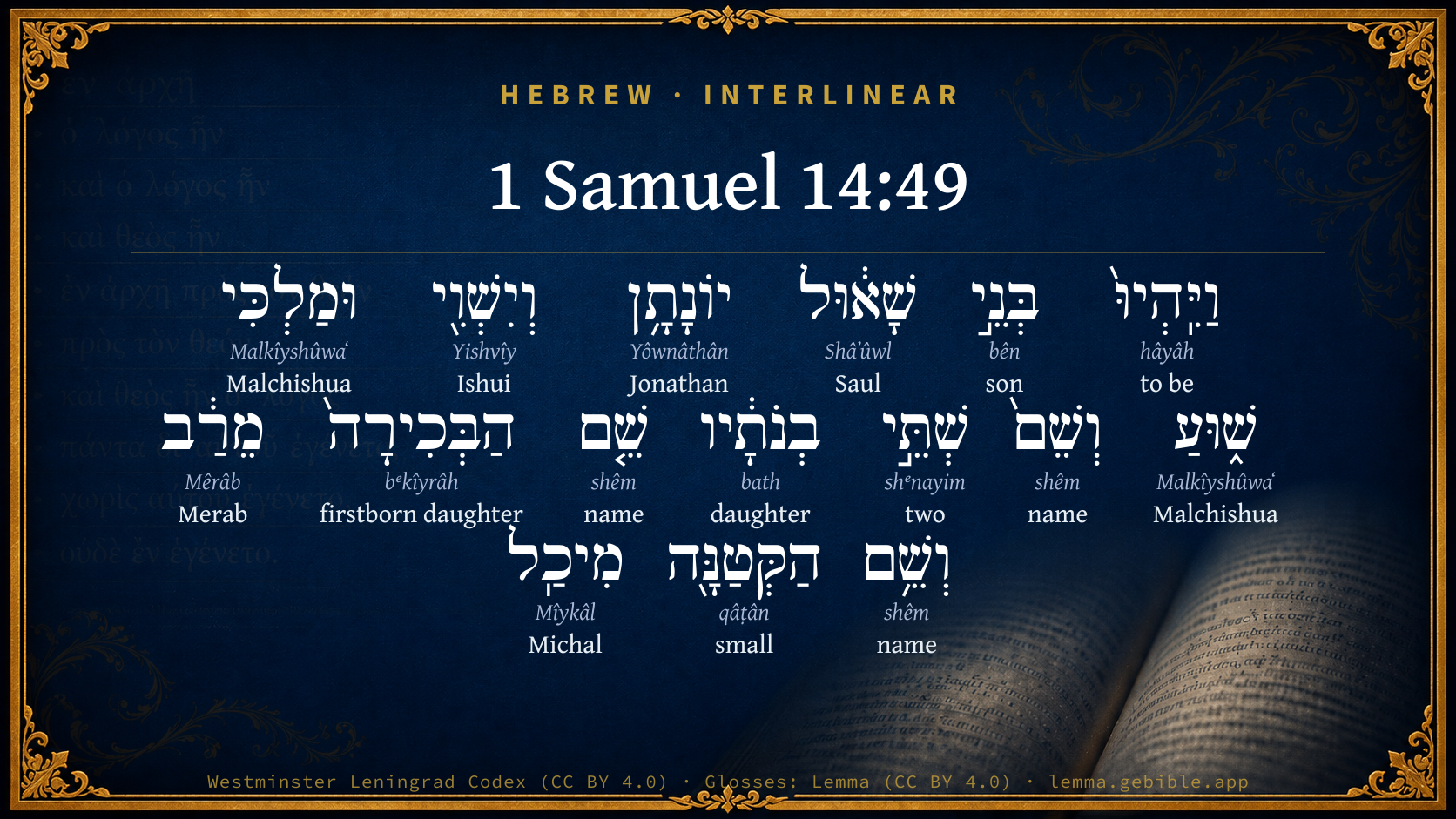
1 Samuel 14:49

Hebrew (Westminster Leningrad Codex) 1 Samuel 14:49 appears in the Hebrew Old Testament. The text above is from the Westminster Leningrad Codex. Each word links to its Strong’s number, a concise gloss, and parsing drawn from the Open Scriptures Hebrew Bible morphology. Click any word for its full Brown-Driver-Briggs (BDB) entry.
Download image
Cite this verse

1 Samuel 14:49 (World English Bible). Public Domain. Lemma interlinear Bible study tool, https://lemma.gebible.app/v/1-samuel/14/49.

Show BibTeX & RIS
BibTeX
RIS
English Translation
Now the sons of Saul were Jonathan, and Ishvi, and Malchishua; and the names of his two daughters were these: the name of the firstborn Merab, and the name of the younger Michal:
World English Bible · Public Domain
Highlights
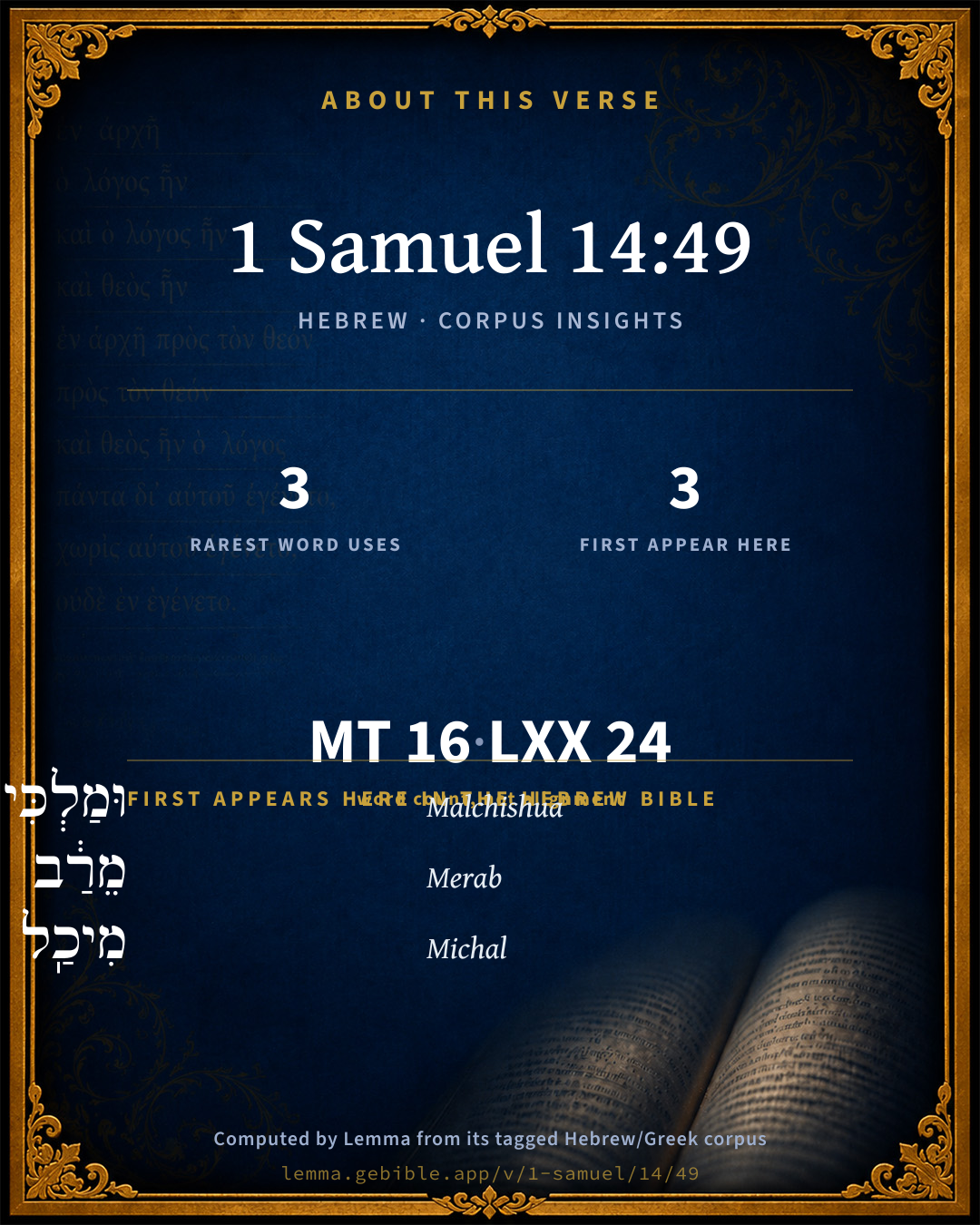
  • 3 first appearances in the Hebrew Bible
Full analysis ↓
Download a study sheet

One document with this verse’s original text, its word-by-word gloss line, the meaning frame, cross-references with their text, attributed commentary, and full source and license credits — printable, and it pastes into notes with its structure intact.

This verse Autodidact and up

Study sheet (.html) Plain text (.txt)

A passage Seminary Student

Up to 50 verses in one chapter. A passage sheet keeps up to 6 commentary sources and 12 cross-references per verse, in the order this page ranks them, and says so on the sheet whenever that leaves anything out. Ask for a single verse and you get the Autodidact verse sheet above.

Everything on this page stays free to read, with no account — the sheet is a download of what is already on screen, not access to it.

Want to remove ads? Support Godless Engineer
Compare translations 3

The same verse in 3 English versions, stacked beneath the original-language interlinear above. Click any original word for its lexicon entry.

Each is an independent rendering of the whole verse — the interlinear is not word-aligned to these translations.

Highlighted words mark where these versions differ — a whole-verse word diff, not a word-by-word alignment.

  • World English Bible Public Domain
    Now the sons of Saul were Jonathan, and Ishvi, and Malchishua; and the names of his two daughters were these: the name of the firstborn Merab, and the name of the younger Michal:
  • King James Version Public Domain
    Now the sons of Saul were Jonathan, and Ishui, and Melchishua: and the names of his two daughters were these; the name of the firstborn Merab, and the name of the younger Michal:
  • unfoldingWord Literal Text CC BY-SA 4.0
    Now the sons of Saul were Jonathan and Ishvi and Malchi-Shua. And the names of the two of his daughters: the name of the firstborn, Merab, and the name of the younger, Michal.

unfoldingWord Literal Text — © unfoldingWord, licensed CC BY-SA 4.0. Word-aligned USFM3 via Door43 (git.door43.org/unfoldingWord/en_ult).

Versions to compare (up to 4)

3 of 4 selected

Show all 18 translations

Every available English version of this verse, each an independent rendering of the whole verse.

  • World English Bible Public Domain
    Now the sons of Saul were Jonathan, and Ishvi, and Malchishua; and the names of his two daughters were these: the name of the firstborn Merab, and the name of the younger Michal:
  • Berean Standard Bible Public Domain
    Now the sons of Saul were Jonathan, Ishvi, and Malchishua. His two daughters were named Merab (his firstborn) and Michal (his younger daughter).
  • Majority Standard Bible Public Domain
    Now the sons of Saul were Jonathan, Ishvi, and Malchishua. His two daughters were named Merab (his firstborn) and Michal (his younger daughter).
  • King James Version Public Domain
    Now the sons of Saul were Jonathan, and Ishui, and Melchishua: and the names of his two daughters were these; the name of the firstborn Merab, and the name of the younger Michal:
  • American Standard Version (1901) Public Domain
    Now the sons of Saul were Jonathan, and Ishvi, and Malchishua; and the names of his two daughters were these: the name of the first-born Merab, and the name of the younger Michal:
  • Revised Version (1885) Public Domain
    Now the sons of Saul were Jonathan, and Ishvi, and Malchishua: and the names of his two daughters were these; the name of the firstborn Merab, and the name of the younger Michal:
  • Geneva Bible (1599) Public Domain
    Nowe the sonnes of Saul were Ionathan, and Ishui, and Malchishua: and the names of his two daughters, the elder was called Merab, and the yonger was named Michal.
  • Douay-Rheims (1899) Public Domain
    And the sons of Saul, were Jonathan, and Jessui, and Melchisua: and the names of his two daughters, the name of the firstborn was Merob, and the name of the younger Michol.
  • Young's Literal Translation Public Domain
    And the sons of Saul are Jonathan, and Ishui, and Melchi-Shua; as to the name of his two daughters, the name of the first-born `is' Merab, and the name of the younger Michal;
  • Literal Standard Version CC BY-SA 4.0
    And the sons of Saul are Jonathan, and Ishui, and Melchi-Shua; as for the name of his two daughters, the name of the firstborn [is] Merab, and the name of the younger Michal;
  • Unlocked Literal Bible CC BY-SA 4.0
    The sons of Saul were Jonathan, Ishvi, and Malki-Shua. The names of his two daughters were Merab, the firstborn, and Michal, the younger.
  • unfoldingWord Literal Text CC BY-SA 4.0
    Now the sons of Saul were Jonathan and Ishvi and Malchi-Shua. And the names of the two of his daughters: the name of the firstborn, Merab, and the name of the younger, Michal.
  • Darby Bible Public Domain
    And the sons of Saul were Jonathan, and Jishvi, and Malchi-shua. And the names of his two daughters: the name of the firstborn Merab, and the name of the younger Michal.
  • World Messianic Bible Public Domain
    Now the sons of Saul were Jonathan, Ishvi, and Malchishua; and the names of his two daughters were these: the name of the firstborn Merab, and the name of the younger Michal.
  • Webster's Bible Public Domain
    Now the sons of Saul were Jonathan, and Ishui, and Melchi-shua: and the names of his two daughters were these; the name of the first-born Merab, and the name of the younger Michal:
  • Free Bible Version CC BY-SA 4.0
    Saul's sons were Jonathan, Ishvi, and Malchishua. The names of his two daughters were Merab (the firstborn), and Michal (the younger one).
  • Bible in Basic English Public Domain
    Now the sons of Saul were Jonathan and Ishvi and Malchi-shua; and these are the names of his daughters: the older was named Merab and the younger Michal;
  • JPS Tanakh (1917) Public Domain
    Now the sons of Saul were Jonathan, and Ishvi, and Malchi-shua; and the names of his two daughters were these: the name of the first-born Merab, and the name of the younger Michal;

Literal Standard Version (2020), Covenant Press — licensed CC BY-SA 4.0. Text via the HelloAO Bible API (eBible.org). Unlocked Literal Bible (unfoldingWord) — licensed CC BY-SA 4.0. Text via the HelloAO Bible API (eBible.org). unfoldingWord Literal Text — © unfoldingWord, licensed CC BY-SA 4.0. Word-aligned USFM3 via Door43 (git.door43.org/unfoldingWord/en_ult). Free Bible Version, Dr. Jonathan Gallagher — licensed CC BY-SA 4.0. Text via the HelloAO Bible API (eBible.org).

Word by word

More ways to search: Search by grammar → Find every occurrence → Compare this word →

Practice this passage: Drill this verse → Learn its vocabulary →

מֵרַ֔ב
Mêrâb
H4764
“Merab”
Noun, Proper
Part of Speech
Noun
Type
Proper
Full BDB Definition

Origin: from H7231

TWOT: None

Merab = "increase" - the eldest daughter of king Saul; promised to David but given instead to Adriel the Meholathite; mother of 5 children
  1. וַיִּֽהְיוּ֙ hâyâh H1961 “and · to be” Conjunction + Verb, Qal, Sequential Imperfect, 3rd Person, Masculine, Plural
  2. בְּנֵ֣י bên H1121 “sons of” Noun, Common, Masculine, Plural, Construct
  3. שָׁא֔וּל Shâʼûwl H7586 “Saul” Noun, Proper
  4. יוֹנָתָ֥ן Yôwnâthân H3129 “Jonathan” Noun, Proper
  5. וְיִשְׁוִ֖י Yishvîy H3440 “and · Ishui” Conjunction + Noun, Proper
  6. וּמַלְכִּי Malkîyshûwaʻ H4444 “and · Malchishua” Conjunction + Noun, Proper
  7. שׁ֑וּעַ Malkîyshûwaʻ H4444 “Malchishua” Noun, Proper
  8. וְשֵׁם֙ shêm H8034 “and · name of” Conjunction + Noun, Common, Masculine, Singular, Construct
  9. שְׁתֵּ֣י shᵉnayim H8147 “two” Adjective, Cardinal number, Feminine, Dual, Construct
  10. בְנֹתָ֔יו bath H1323 “daughters · his” Noun, Common, Feminine, Plural, Construct + Suffix, Personal, 3rd Person, Masculine, Singular
  11. שֵׁ֤ם shêm H8034 “name of” Noun, Common, Masculine, Singular, Construct
  12. הַבְּכִירָה֙ bᵉkîyrâh H1067 “the · firstborn daughter” Particle, Definite Article + Noun, Common, Feminine, Singular, Absolute
  13. וְשֵׁ֥ם shêm H8034 “and · name of” Conjunction + Noun, Common, Masculine, Singular, Construct
  14. הַקְּטַנָּ֖ה qâṭân H6996 “the · small” Particle, Definite Article + Adjective, Adjective, Feminine, Singular, Absolute
  15. מִיכַֽל Mîykâl H4324 “Michal” Noun, Proper

About this verse

These counts appear in no published source. They are computed here, from the morphology-tagged text and Lemma’s own curated glosses. What Lemma adds →

16
words
13
distinct lemmas
Historical
section

Notable vocabulary

The rarest word here is מֵרַ֔ב Merab H4764 — appearing just 3 times in the whole Hebrew Bible.

First appearance in Scripture

These words make their first canonical appearance in the Hebrew Bible here:

  • וּמַלְכִּי Malchishua H4444
  • מֵרַ֔ב Merab H4764
  • מִיכַֽל Michal H4324

Shared distinctive vocabulary

מֵרַ֔ב Merab H4764 occurs in 3 verses of the Hebrew Bible. Also found in:

Grammatical profile

  • 1 verb
  • 13 nouns
  • 2 adjectives

Verb forms

  • וַיִּֽהְיוּ֙ Qal · Sequential Imperfect

Repetition

Words recur within this verse — often emphatic in Hebrew:

  • וְשֵׁם֙ name H8034 ×3
  • וּמַלְכִּי Malchishua H4444 ×2

Hebrew & Septuagint length

In English translation the verse runs 33 words from the Hebrew and 33 from the Septuagint (LXX English) — the same length.

A rough comparison of the two English renderings, which tokenize alike — not a word-level alignment.

Word counts can differ between the Hebrew and the Greek without any difference in meaning — e.g. the Hebrew direct-object marker אֵת has no separate Greek word, and Greek often adds the article ὁ.

In the original languages it is 16 Hebrew tokens and 24 Greek tokens — but the two are counted differently (Hebrew bundles its prefixes and suffixes into one token; the Greek is in lemma form), so that isn’t a like-for-like length.

Cross-references

7

Topical passages linked to 1 Samuel 14:49 in the Treasury of Scripture Knowledge — connected by theme and wording, ordered by reader-vote popularity; previews shown in the World English Bible.

  • 1 Samuel 31:2 The Philistines followed hard on Saul and on his sons; and the Philistines killed Jonathan, and Abinadab, and Malchishua, the sons of Saul.
  • 1 Chronicles 8:33 Ner became the father of Kish; and Kish became the father of Saul; and Saul became the father of Jonathan, and Malchishua, and Abinadab, and Eshbaal.
  • 2 Samuel 6:20–23 Then David returned to bless his household. Michal the daughter of Saul came out to meet David, and said, How glorious was the king of Israel today, who uncovered himself today in the eyes of the handmaids of his servants, as one of the vain fellows shamelessly uncovers himself!
  • 1 Chronicles 9:39 Ner became the father of Kish; and Kish became the father of Saul; and Saul became the father of Jonathan, and Malchishua, and Abinadab, and Eshbaal.
  • 1 Samuel 18:7–21 The women sang one to another as they played, and said, Saul has slain his thousands, David his ten thousands.
  • 1 Samuel 25:44 Now Saul had given Michal his daughter, David's wife, to Palti the son of Laish, who was of Gallim.
  • 2 Samuel 3:13–16 He said, Well; I will make a league with you; but one thing I require of you: that is, you shall not see my face, except you first bring Michal, Saul's daughter, when you come to see my face.

Cross-references courtesy of OpenBible.info (CC BY 4.0).

Hebrew and Greek witnesses Masoretic Hebrew ↔ Greek Septuagint

The same verse in the two great witnesses to the Old Testament, shown verse-for-verse.

These are two independent witnesses, not word-aligned to each other, and the Septuagint is shown in lemma (dictionary) form.

Hebrew 1 Samuel 14:49 Masoretic · Westminster Leningrad Codex

וַיִּֽהְיוּ֙ בְּנֵ֣י שָׁא֔וּל יוֹנָתָ֥ן וְיִשְׁוִ֖י וּמַלְכִּי שׁ֑וּעַ וְשֵׁם֙ שְׁתֵּ֣י בְנֹתָ֔יו שֵׁ֤ם הַבְּכִירָה֙ מֵרַ֔ב וְשֵׁ֥ם הַקְּטַנָּ֖ה מִיכַֽל

Now the sons of Saul were Jonathan, and Ishvi, and Malchishua; and the names of his two daughters were these: the name of the firstborn Merab, and the name of the younger Michal:

World English Bible · Public Domain

Greek LXX 1 Samuel 14:49 Septuagint · lemma form

καί εἰμί υἱός σαούλ ιωναθαν καί ιεσσιου καί μελχισα καί ὄνομα ὁ δύο θυγάτηρ αὐτός ὄνομα ὁ πρωτότοκος μεροβ καί ὄνομα ὁ δεύτερος μελχολ

And the sons of Saul were Jonathan, and Jessiu, and Melchisa: and these were the names of his two daughters, the name of the firstborn Merob, and the name of the second Melchol.

LXX2012 (modern English Septuagint) · Public Domain

Hebrew: Westminster Leningrad Codex (CC BY 4.0). Greek: Septuagint (public domain); English from LXX2012 (modern English Septuagint) (Public Domain). How the Septuagint differs from the Hebrew →

Targum (Aramaic paraphrase)

1

The Targum is the ancient Jewish Aramaic paraphrase of the Hebrew Scriptures — an interpretive translation, not the Hebrew text itself. Onkelos (literal) and Pseudo-Jonathan (expansive) render the Torah, and Jonathan the Prophets. Coverage is partial: where no permissively-licensed English translation exists for a verse, only the Aramaic is shown. This is verse-level text, not a word-by-word alignment to the Hebrew.

  1. Targum Jonathan Prophets (Joshua–Malachi)
    וַהֲווֹ בְּנֵי שָׁאוּל יוֹנָתָן וְיִשְׁוִי וּמַלְכִּישׁוּעַ וְשׁוּם תַּרְתֵּין בְּנָתֵיהּ שׁוּם רַבְּתָא מֵרַב וְשׁוּם זְעֶרְתָּא מִיכָל:

    (no public-domain English translation for this verse)

    Targum Jonathan — Aramaic: “Mikraot Gedolot” (public domain). English: “Sefaria Community Translation” (CC0 1.0 (public-domain dedication)); “London "Chaldee Paraphrase," 1871” (public domain). Text via Sefaria.

Commentary

Notes on 1 Samuel 14:49 from classic Christian and Jewish commentators (each source and its license shown beneath its notes). The classic Christian expositions comment on the surrounding passage and are grouped to its opening verse, so a note may address several verses; the Jewish commentaries on the Tanakh (Rashi and others) are per-verse, so they appear only where the commentator wrote on this verse.

Lemma curates 59 commentaries, every one of them public domain or Creative Commons licensed, each selected and text-cleaned for this edition rather than reprinted as found. About our sources →

Trapp's Complete Commentary

John Trapp

1Sa 14:49 Now the sons of Saul were Jonathan, and Ishui, and Melchishua: and the names of his two daughters [were these]; the name of the firstborn Merab, and the name of the younger Michal:

Ver. 49. Now the sons of Saul were Jonathan, &c.] Ishbosheth is not once named, because he was an ουτιδανος, not fit for war, and so of no account amongst them: yet he came to be a king, and the youngest daughter Michal a queen. Let no man despise the day of small things.

John Trapp, A Commentary or Exposition upon All the Books of the Old and New Testament (1647–1656) — public domain. Text from a community e-Sword module.

Joseph Benson's Commentary

1Sa 14:49. And Ishui — Called also Abinadab, 1Sa 31:2. Ish- bosheth, Saul’s other son, is here omitted because the sacred historian intended to mention only those of Saul’s sons who went with him into the battles here recorded, and who were afterward slain with him.

Joseph Benson's Commentary on the Old and New Testaments (1811–1818) — public domain. Text from a community e-Sword module.

Tyndale Open Study Notes

Tyndale Open Resources

14:49-51 This information about Saul’s family, placed here rather than at the end of his reign, hints that his reign was essentially over and he would not be succeeded by one of his sons.

14:49 Saul’s sons included: Another of Saul’s sons was named Abinadab (31:2). • Ishbosheth means “man of shame” (see study note on 2 Sam 2:8). He was also called Esh-baal (“man of Baal”). He served briefly as a rival king over the northern tribes during David’s early years (2 Sam 2:8-11).

Tyndale Open Study Notes — © Tyndale Open Resources, licensed CC BY-SA 4.0. Text via the HelloAO Bible API.

Geneva Bible (1599)

Geneva Bible translators

Which was the Wife of David, 1 Sam. 18:27.

Called also Abinadab, 1 Sam. 31:2.

Geneva Bible (1599) marginal notes — public domain. Text via Bolls.life.

Adam Clarke's Commentary

Verse 49. Now the sons of Saul] We do not find Ishbosheth here. Calmet says it was "because he was too young, and did not go with him to the war, for he mentions only those who were with him." Why then mention his daughters and his wife? Did they go with him to the war?

Adam Clarke's Commentary on the Bible (1810–1826) — public domain. Text from a community e-Sword/MySword module.

Ellicott's Commentary for English Readers

(49) The sons of Saul.—The three brave sons who perished with their father in the battle on Mount Gilboa are apparently mentioned here, the only difficulty being the middle name, “Ishui,” which occurs nowhere else, save in two genealogies as that of a son of Asher (Gen_46:17; 1Ch_7:30). It is supposed to be the same as the Abinadab mentioned in that battle. His two daughters, Merab and Michal, are speciallynamed, probably owing to their connection with the history of David (1Sa_18:17-21), the elder of them having been promised to him in marriage, and the younger being actually wedded to him.

A Bible Commentary for English Readers, edited by Charles John Ellicott (1878–1897) — public domain. Text from a community e-Sword module.

The Cambridge Bible for Schools and Colleges

gen. ed. J. J. S. Perowne

49. Ishui] Since in ch. 1Sa_31:2 and 1Ch_10:2, the names of the sons who fell with Saul at Gilboa are given as Jonathan, Abinadab and Melchishua, and in the genealogies of 1Ch_8:33; 1Ch_9:39 these three are again mentioned with the addition of Esh-Baal or Ish-bosheth, it seems probable that Ishui is identical with Abinadab. Either Ishui was a second name, or it is a corruption of the Heb. word for “and the second.” Cp. note on 1Sa_8:2.

The Cambridge Bible for Schools and Colleges (gen. ed. J. J. S. Perowne; Cambridge University Press, 1878–1918) — public domain. Text from a community e-Sword module.

John Gill's Exposition

And the sons of Saul were Jonathan,.... Who seems to be his firstborn, of whom, his valour and success, we read in this and the preceding chapter:

and Ishui; the same with Abinadab, Ch1 8:33 for he had two names:

and Melchishua; and besides these three there was another, whose name was Ishbosheth, sometimes called Eshbaal, Sa2 2:8 who succeeded him in the kingdom; for which reason Abarbinel thinks he is not mentioned here, because he was a king; though it is generally supposed the reason why these only are named is, because they went out to war with him, and died with him, but this did not; he had other children by a concubine, or secondary wife, whose name was Rizpah, not mentioned here, Sa2 21:8,

and the names of his two daughters were these, the name of the firstborn Merab; who was afterwards married to Adriel the Meholathite, Sa1 18:19 and the name of the younger Michal; who became the wife of David, Sa1 18:27.

John Gill's Exposition of the Whole Bible (1746–1763) — public domain (CC PDM 1.0). Text via the HelloAO Bible API.

Albert Barnes' Notes on the Bible

This enumeration of Saul’s children and chief officers is according to the analogy of the subsequent annals of David and Solomen’s reign. But the one here called Ishui, is elsewhere (marginal references) called Abi-nadab; and a fourth son, Esh-baal or Ish-bosheth, is here omitted.

Albert Barnes' Notes on the Bible (1834–1885) — public domain. Text from a community e-Sword/MySword module.

Haydock's Catholic Bible Commentary

Sons, who accompanied Saul in his wars. Isboseth was too young. --- Jessui is called Abinadab, 1 Paralipomenon viii. 33. (Calmet)

George Leo Haydock (1774–1849), Haydock's Catholic Family Bible and Commentary, 1859 edition — public domain. Excludes Psalms (Douay-Rheims chapter numbering differs from Protestant) and Deuterocanonical books (Catholic canon only).

Matthew Poole's English Annotations

Ishui, called also Abinadab, 1Sa 31:2; 1Ch 8:33. Ishbosheth, Saul’s other son, is here omitted, because he intended to mention only those of his sons who went with him into the battles here mentioned, and who were afterwards slain with him.

Matthew Poole's English Annotations on the Holy Bible (1683–1685) — public domain. Text from a community e-Sword/MySword module.

Whedon's Commentary on the Bible

Daniel D. Whedon

49. Ishui — Supposed to be the same as Abinadab, mentioned 1Sa_31:2; 1Ch_8:33; 1Ch_9:39.

Malchi-shua — This name is sometimes spelled Melchi-shua.

His two daughters — Of whom we read again in chapter 1Sa_18:17-28.

Daniel D. Whedon (gen. ed.), Commentary on the Old and New Testaments (1874–1909) — public domain. Text from a community e-Sword module.

The Pulpit Commentary

Saul"s family and kindred. Three sons only of Saul are here mentioned, apparently those slain at the battle of Mount Gilboa, where, however, Ishui is named Abinadab. (1Sa_31:2, as also in 1Ch_8:33 1Ch_9:39) A fourth son, Esh-baal, subsequently called Ishbosheth, is omitted. The daughters, Merab and Michal, are mentioned because of the history in 1Sa_18:17-21.

The Pulpit Commentary (1880–1919), ed. H.D.M. Spence-Jones & Joseph S. Exell — public domain. Text from a community e-Sword module.

John Wesley's Explanatory Notes

Ishui - Called also Abinadab. chap. xxxi, 2. Ishbosheth, Saul's other son is here omitted, because he intended to mention only those of his sons who went with him into the battles here mentioned, and who were afterwards slain with him.

John Wesley, Explanatory Notes Upon the Whole Bible (1754–1765) — public domain. Text via the GEBible commentary corpus.

unfoldingWord translationNotes

Door43 World Missions Community

General Information:

This is background information on Saul's family.

Ishvi ... Malki-Shua

These are names of men. (See: How to Translate Names)

Merab ... Michal

These are names of women. (See: How to Translate Names)

Ahinoam ... Ahimaaz

These are names of women. (See: How to Translate Names)

Abner ... Ner ... Kish ... Abiel

These are names of men. (See: How to Translate Names)

translationWords

name

firstborn

Abner

unfoldingWord translationNotes — © Distant Shores Media and the Door43 World Missions Community, licensed CC BY-SA 4.0. Source: git.door43.org/Door43/en_tn.

Lesson kit

Teaching starters — assembled from the data on this page, not authored interpretation. Every prompt links to the verse data it draws on. Edit before teaching.

1 Samuel, in the Historical, opens this verse with 16 words (13 distinct Hebrew lemmas). Its most distinctive word is Mêrâb (“Merab”). A historical commentator’s framing appears above. Read the whole chapter for the surrounding context.

Discussion questions

  1. How does “Merab” (Mêrâb) shape what this verse is saying?
  2. 3 words here appear for the first time in Scripture. What is being introduced at this debut?
  3. 1 Samuel 18:17 shares the word «Merab» with this verse. How do the two illuminate each other?
  4. “name” occurs 3× in this one verse. What is the effect of the repetition?
  5. The translations on this page render this verse differently — a whole-verse word diff, not a word-by-word alignment. What might account for the different wordings?
  6. The verb «וַיִּֽהְיוּ֙» is Qal Sequential Imperfect. How does its form color the action?
  7. Reading how Trapp's Complete Commentary and Joseph Benson's Commentary read this verse, where do the two commentators agree and where do they part?

Things to notice

Reading settings

Reading text

Shown beneath each verse's original-language words.

Old Testament
Old Testament edition

Read the OT as the Masoretic Hebrew (MT) or the Greek Septuagint (LXX).

English shown for the Greek Septuagint (in the Hebrew ↔ Greek comparison).

Comparing translations? Open the Compare panel on any verse page to stack up to four side by side.