Exodus 20:7

Hebrew (Westminster Leningrad Codex) Exodus 20:7 appears in the Hebrew Old Testament. The text above is from the Westminster Leningrad Codex. Each word links to its Strong’s number, a concise gloss, and parsing drawn from the Open Scriptures Hebrew Bible morphology. Click any word for its full Brown-Driver-Briggs (BDB) entry.
Download image
Cite this verse

Exodus 20:7 (World English Bible). Public Domain. Lemma interlinear Bible study tool, https://lemma.gebible.app/v/exodus/20/7.

Show BibTeX & RIS
BibTeX
RIS
English Translation
"You shall not take the name of Yahweh your God in vain, for Yahweh will not hold him guiltless who takes his name in vain.
World English Bible · Public Domain
Highlights
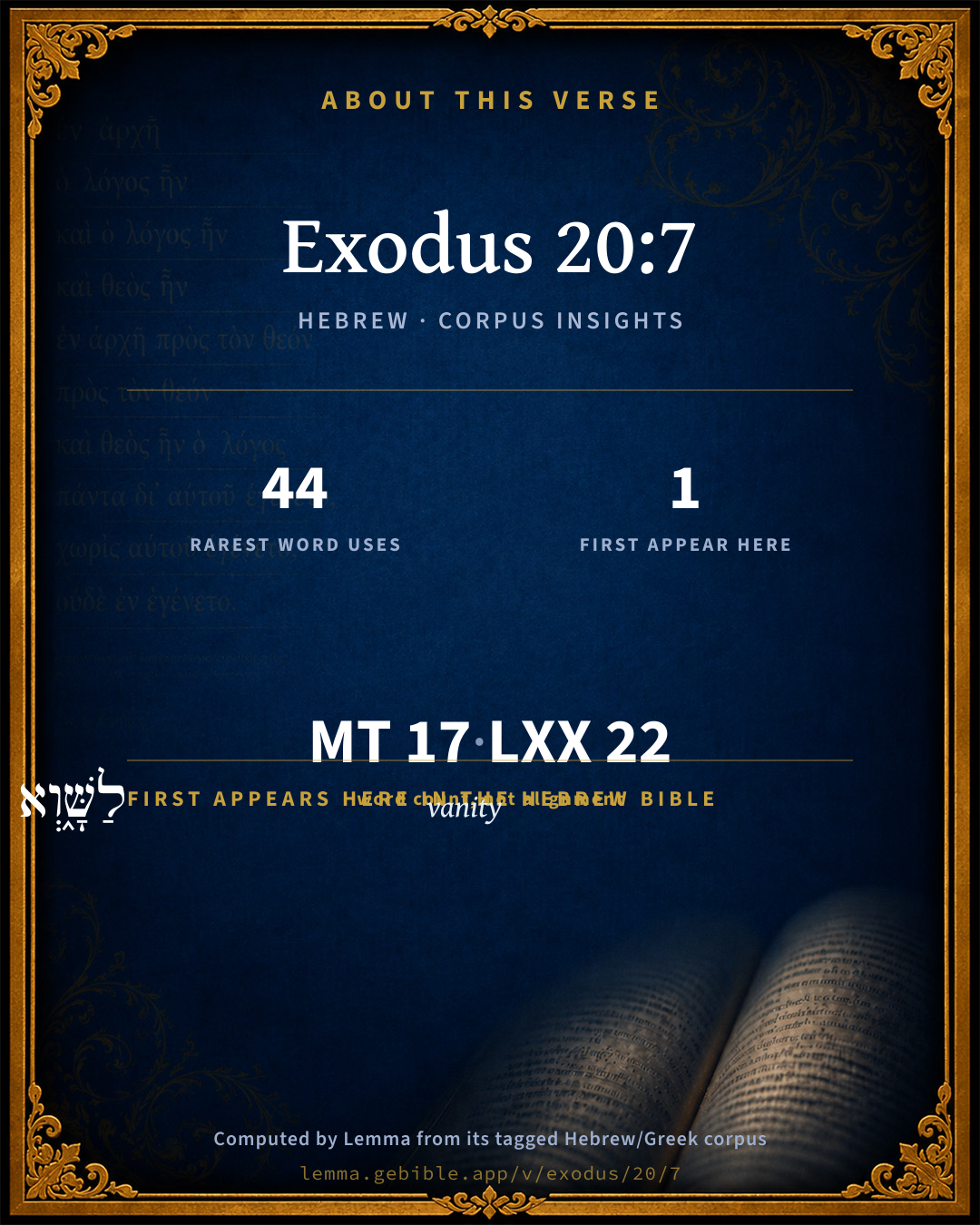
  • 1 first appearance in the Hebrew Bible
Full analysis ↓
Download a study sheet

One document with this verse’s original text, its word-by-word gloss line, the meaning frame, cross-references with their text, attributed commentary, and full source and license credits — printable, and it pastes into notes with its structure intact.

This verse Autodidact and up

Study sheet (.html) Plain text (.txt)

A passage Seminary Student

Up to 50 verses in one chapter. A passage sheet keeps up to 6 commentary sources and 12 cross-references per verse, in the order this page ranks them, and says so on the sheet whenever that leaves anything out. Ask for a single verse and you get the Autodidact verse sheet above.

Everything on this page stays free to read, with no account — the sheet is a download of what is already on screen, not access to it.

Want to remove ads? Support Godless Engineer
Compare translations 3

The same verse in 3 English versions, stacked beneath the original-language interlinear above. Click any original word for its lexicon entry.

Each is an independent rendering of the whole verse — the interlinear is not word-aligned to these translations.

Highlighted words mark where these versions differ — a whole-verse word diff, not a word-by-word alignment.

  • World English Bible Public Domain
    "You shall not take the name of Yahweh your God in vain, for Yahweh will not hold him guiltless who takes his name in vain.
  • King James Version Public Domain
    Thou shalt not take the name of the LORD thy God in vain; for the LORD will not hold him guiltless that taketh his name in vain.
  • unfoldingWord Literal Text CC BY-SA 4.0
    You shall not lift up the name of Yahweh your God with emptiness, for Yahweh will not leave unpunished anyone who lifts up my name with emptiness.

unfoldingWord Literal Text — © unfoldingWord, licensed CC BY-SA 4.0. Word-aligned USFM3 via Door43 (git.door43.org/unfoldingWord/en_ult).

Versions to compare (up to 4)

3 of 4 selected

Show all 18 translations

Every available English version of this verse, each an independent rendering of the whole verse.

  • World English Bible Public Domain
    "You shall not take the name of Yahweh your God in vain, for Yahweh will not hold him guiltless who takes his name in vain.
  • Berean Standard Bible Public Domain
    You shall not take the name of the LORD your God in vain, for the LORD will not leave anyone unpunished who takes His name in vain.
  • Majority Standard Bible Public Domain
    You shall not take the name of the LORD your God in vain, for the LORD will not leave anyone unpunished who takes His name in vain.
  • King James Version Public Domain
    Thou shalt not take the name of the LORD thy God in vain; for the LORD will not hold him guiltless that taketh his name in vain.
  • American Standard Version (1901) Public Domain
    Thou shalt not take the name of Jehovah thy God in vain; for Jehovah will not hold him guiltless that taketh his name in vain.
  • Revised Version (1885) Public Domain
    Thou shalt not take the name of the LORD thy God in vain; for the LORD will not hold him guiltless that taketh his name in vain.
  • Geneva Bible (1599) Public Domain
    Thou shalt not take the Name of the Lord thy God in vaine: for the Lord will not hold him guiltles that taketh his Name in vayne.
  • Douay-Rheims (1899) Public Domain
    Thou shalt not take the name of the Lord thy God in vain: for the Lord will not hold him guiltless that shall take the name of the Lord his God in vain.
  • Young's Literal Translation Public Domain
    `Thou dost not take up the name of Jehovah thy God for a vain thing, for Jehovah acquitteth not him who taketh up His name for a vain thing.
  • Literal Standard Version CC BY-SA 4.0
    You do not take up the Name of your God YHWH for a vain thing, for YHWH does not acquit him who takes up His Name for a vain thing.
  • Unlocked Literal Bible CC BY-SA 4.0
    You must not take the name of Yahweh your God, in vain, for I will not hold guiltless anyone who takes my name in vain.
  • unfoldingWord Literal Text CC BY-SA 4.0
    You shall not lift up the name of Yahweh your God with emptiness, for Yahweh will not leave unpunished anyone who lifts up my name with emptiness.
  • Darby Bible Public Domain
    Thou shalt not idly utter the name of Jehovah thy God; for Jehovah will not hold him guiltless that idly uttereth his name.
  • World Messianic Bible Public Domain
    “You shall not misuse the name of the LORD your God, for the LORD will not hold him guiltless who misuses his name.
  • Webster's Bible Public Domain
    Thou shalt not take the name of the LORD thy God in vain: for the LORD will not hold him guiltless that taketh his name in vain.
  • Free Bible Version CC BY-SA 4.0
    You must not use the name of the Lord your God in a wrong way, for the Lord will not forgive anyone who uses his name in a wrong way.
  • Bible in Basic English Public Domain
    You are not to make use of the name of the Lord your God for an evil purpose; whoever takes the Lord's name on his lips for an evil purpose will be judged a sinner by the Lord
  • JPS Tanakh (1917) Public Domain
    Thou shalt not take the name of the LORD thy God in vain; for the LORD will not hold him guiltless that taketh His name in vain.

Literal Standard Version (2020), Covenant Press — licensed CC BY-SA 4.0. Text via the HelloAO Bible API (eBible.org). Unlocked Literal Bible (unfoldingWord) — licensed CC BY-SA 4.0. Text via the HelloAO Bible API (eBible.org). unfoldingWord Literal Text — © unfoldingWord, licensed CC BY-SA 4.0. Word-aligned USFM3 via Door43 (git.door43.org/unfoldingWord/en_ult). Free Bible Version, Dr. Jonathan Gallagher — licensed CC BY-SA 4.0. Text via the HelloAO Bible API (eBible.org).

Word by word

More ways to search: Search by grammar → Find every occurrence → Compare this word →

Practice this passage: Drill this verse → Learn its vocabulary →

יְנַקֶּה֙
nâqâh
H5352
“to be pure”
Verb, Piel, Imperfect, 3rd Person, Masculine, Singular
Part of Speech
Verb
Stem
Piel
Form
Imperfect
Person
3rd Person
Gender
Masculine
Number
Singular
Full BDB Definition

Origin: a primitive root

TWOT: 1412

to be empty, be clear, be pure, be free, be innocent, be desolate, be cut off - (Qal) to be empty, be clean, be pure - (Niphal) - to be cleaned out, be purged out - to be clean, be free from guilt, be innocent - to be free, be exempt from punishment - to be free, be exempt from obligation - (Piel) - to hold innocent, acquit - to leave unpunished
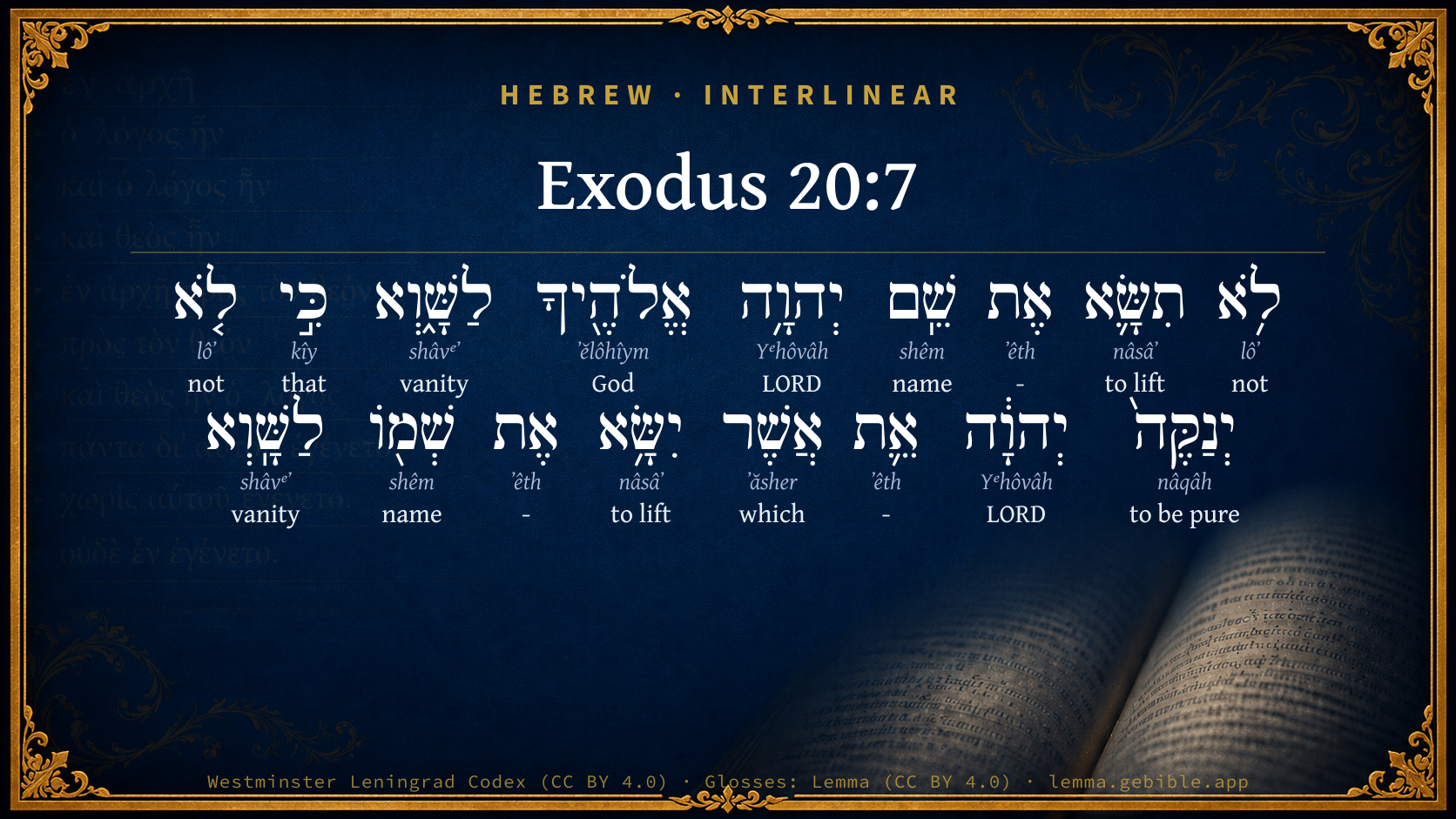
  1. לֹ֥א lôʼ H3808 “not” Particle, Negative
  2. תִשָּׂ֛א nâsâʼ H5375 “to lift” Verb, Qal, Imperfect, 2nd Person, Masculine, Singular
  3. אֶת ʼêth H853 “-” Particle, Direct Object
  4. שֵֽׁם shêm H8034 “name of” Noun, Common, Masculine, Singular, Construct
  5. יְהוָ֥ה Yᵉhôvâh H3068 “LORD” Noun, Proper
  6. אֱלֹהֶ֖יךָ ʼĕlôhîym H430 “God(s) · your” Noun, Common, Masculine, Plural, Construct + Suffix, Personal, 2nd Person, Masculine, Singular
  7. לַשָּׁ֑וְא shâvᵉʼ H7723 “to/for the · vanity” Preposition, Determined + Noun, Common, Masculine, Singular, Absolute
  8. כִּ֣י kîy H3588 “that” Conjunction
  9. לֹ֤א lôʼ H3808 “not” Particle, Negative
  10. יְהוָ֔ה Yᵉhôvâh H3068 “LORD” Noun, Proper
  11. אֵ֛ת ʼêth H853 “-” Particle, Direct Object
  12. אֲשֶׁר ʼăsher H834 “which” Particle, Relative
  13. יִשָּׂ֥א nâsâʼ H5375 “to lift” Verb, Qal, Imperfect, 3rd Person, Masculine, Singular
  14. אֶת ʼêth H853 “-” Particle, Direct Object
  15. שְׁמ֖וֹ shêm H8034 “name · his” Noun, Common, Masculine, Singular, Construct + Suffix, Personal, 3rd Person, Masculine, Singular
  16. לַשָּֽׁוְא shâvᵉʼ H7723 “to/for the · vanity” Preposition, Determined + Noun, Common, Masculine, Singular, Absolute

About this verse

These counts appear in no published source. They are computed here, from the morphology-tagged text and Lemma’s own curated glosses. What Lemma adds →

17
words
10
distinct lemmas
Pentateuch
section

First appearance in Scripture

This word makes its first canonical appearance in the Hebrew Bible here:

  • לַשָּׁ֑וְא vanity H7723

Shared distinctive vocabulary

יְנַקֶּה֙ to be pure H5352 occurs in 33 verses of the Hebrew Bible. Also found in:

Grammatical profile

  • 3 verbs
  • 7 nouns
  • 1 conjunction
  • 6 particles

Verb forms

  • תִשָּׂ֛א Qal · Imperfect
  • יְנַקֶּה֙ Piel · Imperfect
  • יִשָּׂ֥א Qal · Imperfect

Repetition

Words recur within this verse — often emphatic in Hebrew:

  • תִשָּׂ֛א to lift H5375 ×2
  • שֵֽׁם name H8034 ×2
  • יְהוָ֥ה LORD H3068 ×2
  • לַשָּׁ֑וְא vanity H7723 ×2
  • לֹ֥א not H3808 ×2

Hebrew & Septuagint length

In English translation the verse runs 25 words from the Hebrew and 28 from the Septuagint (LXX English) — closely comparable.

A rough comparison of the two English renderings, which tokenize alike — not a word-level alignment.

Word counts can differ between the Hebrew and the Greek without any difference in meaning — e.g. the Hebrew direct-object marker אֵת has no separate Greek word, and Greek often adds the article ὁ.

In the original languages it is 17 Hebrew tokens and 22 Greek tokens — but the two are counted differently (Hebrew bundles its prefixes and suffixes into one token; the Greek is in lemma form), so that isn’t a like-for-like length.

Cross-references

18

Topical passages linked to Exodus 20:7 in the Treasury of Scripture Knowledge — connected by theme and wording, ordered by reader-vote popularity; previews shown in the World English Bible.

  • Deuteronomy 5:11 "You shall not take the name of Yahweh your God in vain: for Yahweh will not hold him guiltless who takes his name in vain.
  • Leviticus 19:12 "'You shall not swear by my name falsely, and profane the name of your God. I am Yahweh.
  • James 5:12 But above all things, my brothers, don't swear, neither by heaven, nor by the earth, nor by any other oath; but let your "yes" be "yes," and your "no," "no;" so that you don't fall into hypocrisy.
  • Matthew 5:33–37 "Again you have heard that it was said to them of old time, 'You shall not make false vows, but shall perform to the Lord your vows,'
  • Psalms 50:14–16 Offer to God the sacrifice of thanksgiving. Pay your vows to the Most High.
  • Jeremiah 4:2 and you shall swear, As Yahweh lives, in truth, in justice, and in righteousness; and the nations shall bless themselves in him, and in him shall they glory.
  • Joshua 9:20 This we will do to them, and let them live; lest wrath be on us, because of the oath which we swore to them.
  • Matthew 26:63–64 But Jesus held his peace. The high priest answered him, "I adjure you by the living God, that you tell us whether you are the Christ, the Son of God."
  • Joshua 2:12 Now therefore, please swear to me by Yahweh, since I have dealt kindly with you, that you also will deal kindly with my father's house, and give me a true token;
  • Joshua 2:17 The men said to her, We will be guiltless of this your oath which you have made us to swear.
  • Matthew 23:16–22 "Woe to you, you blind guides, who say, 'Whoever swears by the temple, it is nothing; but whoever swears by the gold of the temple, he is obligated.'
  • Hebrews 6:16–17 For men indeed swear by a greater one, and in every dispute of theirs the oath is final for confirmation.
  • Leviticus 24:11–16 The son of the Israelite woman blasphemed the Name, and cursed; and they brought him to Moses. His mother's name was Shelomith, the daughter of Dibri, of the tribe of Dan.
  • Proverbs 30:9 Lest I be full, deny you, and say, 'Who is Yahweh?' Or lest I be poor, and steal, And so dishonor the name of my God.
  • Deuteronomy 10:20 You shall fear Yahweh your God; him shall you serve; and to him shall you cleave, and by his name shall you swear.
  • 2 Samuel 21:1–2 There was a famine in the days of David three years, year after year; and David sought the face of Yahweh. Yahweh said, It is for Saul, and for his bloody house, because he put to death the Gibeonites.
  • 2 Corinthians 1:23 But I call God for a witness to my soul, that I didn't come to Corinth to spare you.
  • 1 Kings 2:9 Now therefore don't hold him guiltless, for you are a wise man; and you will know what you ought to do to him, and you shall bring his gray head down to Sheol with blood.

Cross-references courtesy of OpenBible.info (CC BY 4.0).

Hebrew and Greek witnesses Masoretic Hebrew ↔ Greek Septuagint

The same verse in the two great witnesses to the Old Testament, shown verse-for-verse.

These are two independent witnesses, not word-aligned to each other, and the Septuagint is shown in lemma (dictionary) form.

Hebrew Exodus 20:7 Masoretic · Westminster Leningrad Codex

לֹ֥א תִשָּׂ֛א אֶת שֵֽׁם יְהוָ֥ה אֱלֹהֶ֖יךָ לַשָּׁ֑וְא כִּ֣י לֹ֤א יְנַקֶּה֙ יְהוָ֔ה אֵ֛ת אֲשֶׁר יִשָּׂ֥א אֶת שְׁמ֖וֹ לַשָּֽׁוְא

"You shall not take the name of Yahweh your God in vain, for Yahweh will not hold him guiltless who takes his name in vain.

World English Bible · Public Domain

Greek LXX Exodus 20:7 Septuagint · lemma form

οὐ λαμβάνω ὁ ὄνομα κύριος ὁ θεός σύ ἐπί μάταιος οὐ γάρ μή καθαρίζω κύριος ὁ λαμβάνω ὁ ὄνομα αὐτός ἐπί μάταιος

You shall not take the name of the Lord your God in vain; for the Lord your God will not acquit him that takes his name in vain.

LXX2012 (modern English Septuagint) · Public Domain

On this verse, The Biblical Illustrator discusses the Septuagint’s reading. Read the note in Commentary ↓

Hebrew: Westminster Leningrad Codex (CC BY 4.0). Greek: Septuagint (public domain); English from LXX2012 (modern English Septuagint) (Public Domain). How the Septuagint differs from the Hebrew →

Targum (Aramaic paraphrase)

2

The Targum is the ancient Jewish Aramaic paraphrase of the Hebrew Scriptures — an interpretive translation, not the Hebrew text itself. Onkelos (literal) and Pseudo-Jonathan (expansive) render the Torah, and Jonathan the Prophets. Coverage is partial: where no permissively-licensed English translation exists for a verse, only the Aramaic is shown. This is verse-level text, not a word-by-word alignment to the Hebrew.

  1. Targum Onkelos Torah (Genesis–Deuteronomy)
    לָא תֵימֵי יָת שְׁמָא דַיְיָ אֱלָהָךְ לְמַגָנָא אֲרֵי לָא יִזַכֵּי יְיָ יָת דִיֵימֵי בִשְׁמֵהּ לְשִׁקְרָא:

    (no public-domain English translation for this verse)

    Targum Onkelos — Aramaic: “Onkelos Genesis” (public domain); “Onkelos Exodus” (public domain); “Onkelos Leviticus” (public domain); “Onkelos Numbers” (public domain); “Onkelos Deuteronomy” (public domain). English: “Sefaria Community Translation” (CC0 1.0 (public-domain dedication)); “J.W. Etheridge. The Targums of Onkelos and Jonathan Ben Uzziel on the Pentateuch. London: Longmans, Green, 1862” (public domain). Text via Sefaria.

  2. Targum Pseudo-Jonathan Torah (Genesis–Deuteronomy)
    עַמִּי בֵּית יִשְרָאֵל לָא יִשְׁתְּבַּע חַד מִנְכוֹן בְּשׁוּם מֵימְרָא דַיְיָ אֱלָהָכוֹן עַל מַגָּן אֲרוּם לָא מִזַכֵּי יְיָ בְּיוֹם דִּינָא רַבָּא יַת כָּל מַאן דְּמִשְׁתְּבַע בִּשְׁמֵיהּ עַל מַגָּן

    My people of the house of Israel, Let no one of you swear by the name of the Word of the Lord your God in vain; for in the day of the great judgment the Lord will not hold guiltless any one who sweareth by His name in vain.

    Targum Pseudo-Jonathan — Aramaic: “Targum Jonathan on Genesis” (public domain); “Targum Jonathan on Exodus” (public domain); “Targum Jonathan on Leviticus” (public domain); “Targum Jonathan on Numbers” (public domain); “Targum Jonathan on Deuteronomy” (public domain). English: “The Targum of Jonathan ben Uzziel, trans. J. W. Etheridge, London, 1862” (public domain). Text via Sefaria.

Commentary

Notes on Exodus 20:7 from classic Christian and Jewish commentators (each source and its license shown beneath its notes). The classic Christian expositions comment on the surrounding passage and are grouped to its opening verse, so a note may address several verses; the Jewish commentaries on the Tanakh (Rashi and others) are per-verse, so they appear only where the commentator wrote on this verse.

Lemma curates 59 commentaries, every one of them public domain or Creative Commons licensed, each selected and text-cleaned for this edition rather than reprinted as found. About our sources →

Trapp's Complete Commentary

John Trapp

Exo 20:7 Thou shalt not take the name of the LORD thy God in vain; for the LORD will not hold him guiltless that taketh his name in vain.

Ver. 7. The Name of the Lord.] That "holy and reverend" Name; {Psa 111:9} that Nomen Maiestativum, as Tertullian callcth it; "dreadful among the heathen." {Mal 1:14} The very Turks at this day chastise the Christians that live amongst them for their oaths and blasphemies darted up against God and Christ. The Jews also are much offended thereat, and it should be no small grief to us to hear it. When one of Darius’s eunuchs saw Alexander the Great setting his feet upon a low table that had been highly esteemed by his master, he wept. Being asked the reason by Alexander, he said, it was to see the thing that his master so highly esteemed, to be now contemned, and made his footstool. {a} {See Trapp (for summary of Law) on "Exo 20:17"}

{a} Diod. Sic., lib. xvii.

John Trapp, A Commentary or Exposition upon All the Books of the Old and New Testament (1647–1656) — public domain. Text from a community e-Sword module.

The Biblical Illustrator

Joseph S. Exell

Exo_20:7

Thou shalt not take the name of the Lord thy God in vain.

The Third Commandment

The name of God stands for Himself and for that which He has revealed of Himself, not for our thoughts about Him. It is not surprising that this great name was invested with a superstitious sanctity. Even the Jews used it rarely. There is a tradition that it was heard but once a year, when it was uttered by the high-priest on the great day of atonement. In reading the Scriptures it became customary never to pronounce it, but to replace it with another Divine name, which was regarded as less awful and august. The Third Commandment requires something very different from this ceremonial homage to His name. His name stands for Himself, and it is to Him that our reverence is due.

I. We may transgress the commandment in many ways.

1. By perjury.

2. By swearing.

3. By the practice of finding material for jesting in Holy Scripture.

4. By the habit of scoffing at those who profess to live a religious life, and taking every opportunity of sneering at their imperfections.

II. It is not enough to avoid the sin of profanity; we are bound to cultivate and to manifest that reverence for Gods majesty and holiness which lies at the root of all religion, We have to worship Him. It is the pure in heart who see God, and only when we see God face to face can we worship Him in spirit and in truth. (R. W. Dale, D. D.)

On taking Gods name in vain

I. The first expression to which I refer is, the name of the Lord thy God, or strictly, the name of Jehovah thy God. The name of the Lord is not, on the one hand, the mere articulate sound by which the mouth expresses the idea of Deity, nor is the phrase, on the other hand, a simple synonym for God. It holds up God in His special character of Jehovah, the covenant-making and covenant-keeping God of His own dear people. The name of Jehovah means God, known and served under His revealed aspect of mercy, God appreciated as the pardoner of sin and giver of the Spirit, the Jehovah or keeper of His precious promises to His people. For example, of the antediluvian piety it is said: Then began men to call upon the name of the Lord--i.e., it was then that distinctive recognition was made of Gods special provision of mercy for sinners. His name of Jehovah was received as indicating His relation to His believing people. A name is an expression of the personal substance--an exhibition of the essential character. Gods name by which He delights to be known among men, is Love. His character of compassion is especially displayed in His Word, and hence the Psalmist says: Thou hast magnified Thy Word above all Thy name--that is, of all revelations of Gods character, all expressions of His being, the written Word is most full and complete. Here is the way of pardon and acceptance clearly portrayed. Another conspicuous display of Gods character, but only local and temporary in its personal contact, while universal in its possible application, is in the Lord Jesus Christ; and so Jesus is in a high sense the name of Jehovah. If. The second expression to which our attention should be directed is the phrase, to take in vain. The literal rendering is, Thou shalt not lift up the name of Jehovah thy God lightly. Taking Gods name in vain is the flippant and thoughtless use of Gods name. It is the taking up the name in the vacant, purposeless way in which we pluck off a leaf as we pass along the road--the use of the name, not only where the purpose is evil, but where there is no defined purpose at all. Again, there may be not only an absence of evil purpose, but, beyond an absence of all purpose, there may even be a purpose of good, but this purpose may be seized upon in so rash and ill-advised a way that the use of the Divine name in it is a taking the name in vain, just as Uzzahs touching the ark of God, even to stay it upon the cart and prevent its fall, was a sin of profanity, and called for the Divine punishment.

1. In respect to Gods verbal name, we are not to be satisfied with our freedom from the coarse profanity which culture and good breeding forbid, but we are to remove the habit of using the holy name in ordinary conversation in which the use has no religious character. We are not to call a wretched and forlorn person or thing God-forsaken, or to hail a gift as a God-send, when, in using these epithets, we have no design to use their full meaning, and therefore have not the proper attitude of mind for their utterance.

2. In respect to Gods written Word, we are to take it up with reverence both in our hearts and on our tongues.

3. But chiefly, in relation to Jesus and the great eternal truths which the Holy Spirit introduces to the soul. To each man comes through his conscience a summons from God to give heed to his future spiritual and eternal condition. If you slight that summons, given to you in the gospel, you are taking Gods name in vain. (H. Crosby, D. D.)

The Third Commandment

I. The Divine prohibition--

1. Forbids perjury.

2. Forbids hypocrisy--insincere worship.

3. Forbids profanity.

II. The Divine warning. Being in its very nature the most godless of sins, God from His very nature cannot allow it to go unpunished. Did you ever read that remarkable assertion of the famous mathematician, Charles Babbage, in the Ninth Bridgwater Treatise, to the effect that the slightest word, though it be but a whispered interjection, vibrating in the air, sets in operation a series of changes which undulate to the very outskirts of creation, rising and falling like an everlasting tide? The whole material universe is a mighty whispering-gallery, in which the Infinite One is everlastingly hearing every word, every whisper, breathed by every human being, from the day Adam pronounced his first vocable in Eden to the day when human time shall be no more. If, then, the scarcely audible rustle of an unconscious aspen leaf sets in inexorable motion atom after atom--from leaf to tree, from tree to earth, from earth to star, till the whole material creation responds in undulation--think you that an oath, spoken by conscious, responsible man, will ever die away, or go unpunished? Oh, no! Jehovah will not hold him guiltless that taketh His name in vain. (G. D. Boardman.)

The Third Commandment

There are other ways besides making an image of Him by which the conception of Deity can be lowered. Man by his words embodies his thoughts of God as really as when by his hands he carves an image of Him. It bears significantly upon certain usages which tend, though perhaps unconsciously, to dissociate the name of God from the, deep reverence which should invest it. Among these is the habit, formed often unthinkingly, of using frequent and almost meaningless repetitions of the name of God in prayer. Akin to this evil, and one equally opposed to the spirit of the Third Command, is the familiar and endearing use of Gods name in prayer. Some, while praying, employ epithets as if they were on terms of special intimacy, and almost of equality, with their Heavenly Father. Christ has, indeed, taught us to call God Father; but He has, in the same breath, bid us gather around the name these reverent words, which art in heaven, hallowed be Thy name. And there is nothing in Scripture to indicate a less hallowed aspect toward Christ in prayer than toward the Father. With what unvarying reverence do Paul and John, in their Epistles, refer to the ascended and glorified Redeemer! A true acquaintance with God produces reverence for Him; a correct knowledge of Christ exalts Him far above all principality and power, and gives Him a name that is above every name. (P. B. Davis.)

The Third Commandment

I. What is required. The holy and reverent use of Gods names, titles, attributes, ordinances, words, and works.

II. What is forbidden. All profaning or abusing of anything whereby God makes Himself known. This command is broken two ways--

1. By not using the name of God as is required (Mal_2:2). So as many duties as are required, so many sins there are in omitting these duties. Hence this command is broken by our not hallowing and glorifying Gods name, by not taking up the name of God into our minds, lips, and lives.

2. By profaning or abusing of the name of God; that is, anything whereby God makes Himself known.

1. When it is used ignorantly, as it was by the Athenians, whom the apostle Paul charges with worshipping God ignorantly (Act_18:23).

2. When it is used vainly and irreverently, that is, lightly and rashly.

3. When the name of God is used superstitiously.

4. When it is used profanely and wickedly.

(1) Profane swearing.

(2) Sinful imprecations or cursings, whereby people pray for some evil against themselves or others, whether absolutely or conditionally.

(3) Perjury is falsehood confirmed with an oath.

(4) Blasphemy, which is a wronging of the majesty of God, by speeches tending to His reproach.

Having spoken of the more gross and palpable breaches of this command, I shall now consider other ways how the Lords name is abused and taken in vain.

1. With respect to His names and titles. They are taken in vain--

(1) When they are not improved for those uses to which they natively attend (see Mal_1:6).

(2) When we make an ill use of them, either to encourage ourselves in sin by them, or to drive us away from Him by terror, or to any other use dishonourable to God, and contrary to the intent of the revelation of them to us.

2. With respect to His attributes, Gods name is abused--

(1) By the working of unbelief against them, doubting of, questioning, and denying them.

(2) By the aversion of the heart unto them, and its rising against them (Rom_8:7).

(3) By using them to wrong ends and purposes. Thus the mercy of God is abused to encouragement in sin; His patience to continuance in it; His justice to desperation, etc. (Ecc_8:11; Rom_2:4-5).

3. With respect to His ordinances. The name of God is abused in ordinances when we do not go about them after the right manner, etc.

4. With respect to His Word, men are guilty of profaning the name of God--

(1) By misimproving and misapplying the Word of God, as the Pharisees did (Mat_5:1-48; Eze_13:19).

(2) Jesting upon it (Jer_23:33).

(3) Using it to the maintenance of erroneous principles, unprofitable questions, and vain janglings (2Ti_2:14-15).

5. With respect to His works, men are guilty of profaning the name of God, when they use the works and creatures of God to sinful lusts and practices.

6. Men profane the name of God, in respect of religion, and the profession of it.

(1) By maligning, scorning, and reviling religion, and the profession of it.

(2) By a hypocritical profession.

(3) By a scandalous walk.

III. The reason annexed. This is, that however the breakers of this commandment may escape punishment from men, yet the Lord our God will not suffer them to escape His righteous judgment.

1. Whence it is that men think so lightly of the profaning of the name of God, so that in effect they hold themselves guiltless.

(1) It proceeds from that wicked and malicious spirit the devil (Jam_3:6).

(2) it springs from the low and mean thoughts they have of God and His dreadful name (Psa_36:1-2).

(3) There are many profanations of the name of God, that untender men will not allow to be such. They are not and will not be convinced of a fault in them, as in obsecrations, appeals to God, adjurations, etc. But a due sense of the majesty of that name would clear peoples minds in these things (Mat_5:37).

(4) There are many profanations of that name which men do not at all observe, as profaning that holy name in duties by formality, and want of faith and fervency.

(5) It proceeds from the passion of anger or malice.

(6) Custom in taking the name of God in vain takes away the sense of it.

(7) Swearing proceeds from unwatchfulness.

(8) In some it proceeds from vanity and hellish bravery.

2. Whence it is that profaners of the name of God escape punishment from men.

(1) Little zeal for Gods honour.

(2) Those who ought to put in operation the laws against swearing are themselves often guilty of that sin.

3. I proceed to show how God will not let men escape with it; that He will by no means hold them guiltless. Consider that the profaning of the name of God is a sin--

(1) That brings wrath upon a land (Hos_4:1-2; Jer_5:7; Jer_5:9).

(2) It brings wrath upon families (Zec_5:3-4).

(3) It brings a curse upon particular persons.

4. What is the great evil of this sin, that it is so severely punished?

(1) It is a sin that is directly against God, His glorious greatness and infinite majesty.

(2) It is a direct violation of the law of God, Swear not at all; Thou shalt not take the name of the Lord thy God in vain. Have you no respect to the authority of God?

(3) It is not only a violation of the law of God, but a breach of mens laws.

(4) It is a sin that has a peculiar contempt of God in it, striking most directly against His honour (Psa_139:20).

(5) It is most directly contrary to the great end of all Divine revelation. The first petition in the Lords Prayer is, Hallowed be Thy name.

(6) It has a particular malignity in it, and in a most special manner proceeds from the devil, as it has less to carry us to it than ordinary sins have. What profit or pleasure can be derived from it?

(7) Common swearers and cursers will be found to be men either of consciences already seared, or next door to it. I shall conclude all with a very short word of improvement.

1. How can these lands escape a stroke that have so much of this guilt to answer for?

2. I warn all gross profaners of the name of God to repent and flee to the blood of Christ for pardon; certifying, that if ye do not, ye shall lie under the wrath of God for ever.

3. Let us endeavour not only to reform ourselves, but contribute to the reformation of others in this point. ( T. Boston. D. D.)

The Third Commandment

I. What is meant by the name of God?

II. How is Gods name taken in vain?

1. We take Gods name in vain when we use it lightly or without thinking.

2. It is taking this name in vain when we use it falsely, or speak what is not true in connection with it.

3. But we break this commandment also when we use Gods name profanely.

III. Why should we not take this name in vain?

1. Because it is useless.

2. Because it is cowardly.

3. Because it is vulgar.

4. Because it is wicked.

5. Because it is dangerous. (R. Newton, D. D.)

The guilt of profaneness

1. God has forbidden all profane language, in a manner the most solemn, and best adapted to make the deepest impression on the hearts and consciences of men.

2. Taking the name of God in vain is destructive of all religion. A profane person cannot love, nor fear, nor obey, nor trust in God.

3. The profanation of Gods name tends to weaken and destroy the force and obligation of every civil government. The profanation of Gods name directly tends to bring religion and oaths into contempt; and when these are brought into contempt, how can civil government be administered to preserve the property, liberty, or lives of the subjects?

4. Profane swearing is the most unnatural sin in this wicked world. It does not originate from any natural propensity, instinct, or appetite in the human mind, but is contrary to every dictate of reason and conscience. No one ever heard profane language for the first time without being shocked. No child ever uses it until he has learned it from others.

5. To use profane language is below the dignity of any man. It requires no superior knowledge, learning, or intellectual talents to take the name of God in vain, or to rise to the highest attainments in the art of swearing.

6. Profane swearing is a vice which never lives alone. Who ever knew a profane swearer that was free from every other vice? It is true, a profane swearer may not be a liar, a thief, or a drunkard; but it is the nature and tendency of his profaneness to lead him into these and all other vices. For it takes off the most powerful restraints that can be laid upon the human mind.

7. Profane swearing is a land-defiling iniquity. It is a moral infection, a spreading leprosy, and more infectious than any natural disease. It is a sin which can be more easily and oftener repeated than any other sin. The profane man can utter his oaths and imprecations every hour in the day, and every day in the week, wherever he is, and wherever he goes, as long as he lives.

8. Profane swearing is a sin, which exhibits infallible evidence, that those who are guilty of it are pursuing the broad road which leads to future and endless ruin. (N. Emmons, D. D.)

Taking Gods name in vain

There is a three-fold swearing forbidden.

1. Vain swearing; when men in their ordinary discourse let fly oaths.

2. Vile swearing; horrid, prodigious oaths not to be named.

3. Forswearing; this is a heaven-daring sin: Ye shall not swear by My name falsely, neither shalt thou profane the name of thy God. Perjury is a calling God to witness to a lie. In righteousness, therefore, it must not be an unlawful oath. In judgment, therefore, it must not be a rash oath. In truth, therefore, it must not be a false oath.

4. We take Gods name in vain by rash and unlawful vows. (T. Watson.)

The law of reverence

What God approves is not the parade of homage for the letter, but the inward homage of the soul for what the name represents.

I. In relation to public duty.

1. Perjury. Worthily to take an oath being one of the loftiest of human actions, it follows that to take it unworthily is one of the most infamous of crimes. The perjurer professes to believe in God. His pretence is that he confides in the presence, truth, majesty, justice of God. Yet he dons this fair cloak of piety that he may get a lie believed! It is a dastardly attempt to make the righteous God his partner in wronging the innocent, by leading a jury to an unjust verdict, and a judge to an unrighteous sentence.

2. Blasphemy: to impute evil to God; to scoff at the holiness and power of God; to assume the prerogatives of God.

II. In relation to private speech

1. Profane swearing. Leave expletives to those who have more words than ideas, and more tongue than brains. Be sure that reverence is the saving salt of society, and the very soul of virtue.

2. Flippant talk of sacred things.

III. In relation to Divine worship.

1. They who are in the pulpit are there on purpose to lift up the name of God like a standard. Let them beware that they do not, through utterance of false doctrine, lift it for a lie! Let them beware of turning their piety into a mercantile profession, or using it for unworthy ends! Let them beware of preaching Christ out of strife, and of the opposite vice of perfunctory utterance; or unawares they may lift up the name of God for a thing of nought!

2. They who are in the pew need the warning also. We want reverence in the house of prayer--reverence in attitude, reverence in demeanour, reverence in worship. (W. J. Woods, B. A.)

On oaths

1. For the matter of an oath, assertory oaths must be of things that are--

(1) True.

(2) Weighty.

(3) They must be such to our knowledge.

Again, promissory oaths must be things just and lawful, possible, profitable, and in our power, and which to our knowledge are such.

2. The form must be, By the true God, it being a peculiar part of His worship.

3. Its rise must be edification, that is, Gods glory, our own vindication, or our neighbours good, or the call of a magistrate putting us to it.

4. As to the expressions in which it is conceived, or the thing sworn, it is required that it sought not only truth to, and in the mans meaning that sweareth, but that the expressions be plain and intelligible to his meaning and understanding to whom the oath is given; otherwise it deludeth, but doth not clear.

5. As to the right manner of swearing, these things ought to be noticed--

(1) That it be in judgment, that we understand the thing we swear, and the nature of our oath, and Him we swear by (Jer_4:2).

(2) Fear and reverence in going about it, as being in an especial way in Gods own sight.

(3) Singleness in the end, that it be not to deceive any, but to express the truth only and faithfully, called righteousness (Jer_4:2). (J. Durham.)

The Third Commandment

For the Lord, etc.

1. This implies that the sin under consideration may be lightly thought of, and rarely punished, among men.

2. It is an aggravation of this sin, that there seems to be very little temptation to the commission of it.

3. In the next place, it is a sin most pernicious to those who indulge it, and to those with whom they are connected.

4. In conclusion, I observe that God notices, records, and will certainly, in this world or the next, avenge the insults done to His majesty by a violation of this command. (G. Clayton.)

Rules to avoid profanity

1. Beware of the first rudiments and beginnings of oaths, if thou wouldst not learn them.

2. Subdue, as much as you can, all inordinate passion and anger.

3. Labour to possess thy heart and over-awe it with the most serious considerations and apprehensions of the greatness and majesty of God. (Bp. E. Hopkins.)

A proper use to be made of the gift of speech

The Third Commandment shows man at the head of the material creation with the crowning glory of intelligent speech, and, as a social being, possessing the power of speech as the highest instrument of his social nature. God reveals Himself to him by word, by name, as to a speaking being, making language a bond of union between Him and man. God commands him to use this great gift in His worship, in honouring Him.

1. The tongue is the glory of man, and the glory of the tongue is to voice the praises of God. All nature praises God as it obeys His laws. Man stands at the head of creation to take up its many notes of praise and give them intelligent utterance. He stands thus not as a single individual, a great High Priest, but as a race whose myriad voices are to join and mingle in a vast chorus of intelligent and harmonious praise. We are to speak of Him, and to Him, with adoration. He is our Creator, Preserver, Governor, and Judge. We are to speak of Him, and to Him, with love and praise. Our lips should quiver with emotion when we speak of Him who is our Father and our Saviour. We are to speak to Him in His worship, and of Him to each other, only in such a way as shall promote His worship in our own hearts and in the hearts of others.

2. The command is in the prohibitory form. Man has broken this law, and is prone to break it. His voice is silent often when it should be praising God. A man uses the name of God as an exclamation of surprise at some trivial thing or assertion of another, or to sustain some unimportant statement of his own. Sometimes a story is dull, and the story-teller seasons it with a few oaths; or some joke is without point, and so a curse is used to awaken a laugh. Man calls God to make sport for him. A man has become accustomed to exaggerate or to speak falsely, and, conscious that others hesitate to believe him, he continually calls upon the truth-loving God to witness to his lies. Sometimes he becomes heated in argument, or angry under contradiction, or in a quarrel, and he calls upon God to curse him if he is not right, or in his anger he calls upon God to curse the one who irritates him. Sometimes he so loses control of himself that curses pour out of his lips as dense smoke out of a chimney. (F. S. Schenck.)

No excuse for swearing

The swearer tries to excuse himself. I did not mean it. I was only in fun. There are some things not the proper subjects of fun. Surely a man ought not to make fun of God, or of invoking the wrath of God upon himself or others. But the swearer says: It is a relief for me to swear. It cools off my heated spirits. Often it is the reverse, adding fuel to the flame, not only to himself, but to others, especially those he curses. But if it is a relief, what is it a relief of? It is a relief to the storm-cloud to throw out its lightnings, because it is over-charged with electricity. So it is a relief for you to throw out your cursing because you are over-charged with cursing. Your heart is so full of hatred that when stirred in anger it overflows in curses. You had far better bring such a heart to God with a strong cry for mercy. Again the swearer says: I know it is wrong, but it is a habit I have fallen into to such an extent that I often swear without knowing it. Do you not see that habit does not excuse but rather aggravates the offence? No one can become wicked at once. Your habit only shows how often you have sinned, how far you have gone down in this kind of wickedness. Again the swearer says: I may as well say it as think it. You should not think an oath or curse. But it is worse to speak it. The letter of the law forbids the word, and so checks the evil in the heart, and at any rate prevents its injuring others. You gain inward control by outward control. Come toward the spirit of the law, checking the thought by obeying the letter. You keep yourself also from being a curse. The swearer is a moral blight in a community, his oath-speaking is a spreading infection, he is himself a curse to others. (F. S. Schenck.)

Speaking of God

The positive side, underlying the negative, is the requirement that our speech of God shall fit our thought of God, and our thought of Him shall fit His name; that our words shall mirror our affection, and our affection be a true reflection of His beauty and sweetness; that cleansed lips shall reverently utter the name above every name, which, after all speech, must remain unspoken; and that we shall feel it to be not the least wonderful or merciful of His condescensions, that He is extolled with our tongues. (A. Maclaren, D. D.)

God not to be trifled with

It is enough to make the blood curdle, to think of the name of God bandied about as a bauble and plaything of fools. This offence cannot go unpunished. If there be a God, He must vindicate His own majesty and glory. It is the very spirit and essence of all evil, the very core of iniquity. If you could see it as it is, in the naked enormity of its guilt, you would flee from it as from the very pestilence of death. You may sport with the whirlwind and trifle with the storm, you may lay your hand upon the lions mane and play with the leopards spots, you may go to the very crater of a burning volcano, and laugh at the lava which it belches out in thunder; you may trifle with any and everything; but trifle not with God. Let there be one holy thing upon which you dare not lay a profane hand, and let that be the name of God. (J. H. Thornwell, D. D.)

Reverence

To swear by his gods was the most common usage of the heathen; and it grew out of a worship that of necessity debased the heart of moral reverence. Unbelief comes oftener from irreverent association than intellectual doubt. The sneer of a Voltaire has killed more than all his arguments; for, in Paleys keen words, who can refute a sneer? The youth who grows in the midst of profane minds imbibes a scorn of truth before he has searched a single doctrine, as the breath of an infected garment may engender disease. In this light you perceive how this old commandment covers the whole ground of our Christian conduct. So shall we build our piety, as Israel built the Temple; without, the costliest work that faith could rear; the walls overlaid with gold, each door carved with cherubim and palms and open flowers: each pillar with its chapiters and wreaths; its vessels, its lamps, its censers of the beaten gold of Ophir; a house of God, finished throughout all the parts thereof; but within, the Holy of Holies, where the unseen God dwells alone behind the veil of the heart! (E. A. Washburn, D. D.)

Frivolous use of Scripture

Nothing is more easy than to create a laugh by a grotesque association of some frivolity with the grave and solemn words of Holy Scripture. But surely this is profanity of the worst kind. By this Book the religious life of men is quickened and sustained. It contains the highest revelations of Himself which God has made to man. It directly addresses the conscience and the heart, and all the noblest faculties of our nature, exalting our idea of duty, consoling us in sorrow, redeeming us from sin and despair, and inspiring us with the hope of immortal blessedness and glory. Listening to its words, millions have heard the very voice of God. It is associated with the sanctity of many generations of saints. Such a book cannot be a fit material for the manufacture of jests. For my own part, though I do not accept Dr. Johnsons well-known saying, that a man who would make a pun would pick a pocket, I should be disposed to say that a man who deliberately and consciously uses the words of Christ, of apostles, and of prophets, for mere purposes of merriment, might have chalked a caricature on the wall of the Holy of Holies, or scrawled a witticism on the sepulchre in Josephs garden. (R. W. Dale, D. D.)

Irreverence in prayer

An aged minister told me, says a correspondent of the Morning Star, that when he was a young man, he had, on a certain occasion, been praying in a family, and in his prayer he had made a very frequent and energetic use of the terms Good God, and God Almighty. At the close of his prayer, a little child, about four years of age, came to his mother and said, Mother, I dont like to hear that minister pray. Why? inquired the mother. Because, replied the child, he swears so when he prays. This reproof from the child broke the minister of swearing when he prayed. Prayer is petition, and no one would use the name of a ruler to whom he was making a petition in as harsh a manner as many use the name of the great God.

Profanity known to God

A coachman, pointing to one of his horses, said to a traveller, That horse, sir, knows when I swear at him. Yes, replied the traveller; and so does your Maker.

Swearer rebuked

Mr. Meikle, a gentleman of eminent piety, was a surgeon at Carnwath, in Scotland. He was once called to attend a gentleman who had been stung in the face by a wasp or bee, and found him very impatient, and swearing, on account of his pain, in great wrath. Oh, doctor, said he, I am in great torment; can you any way help? Do not fear, replied Mr. M., all will be over in a little while. Still, however, the gentleman continued to swear, and at length his attendant determined to reprove him. I see nothing the matter, said he, only it might have been in a better place. Where might it have been? asked the sufferer. Why, on the tip of your tongue.

Payment for swearing

What does Satan pay you for swearing? asked one gentleman of another. He dont pay me anything, was the reply. Well you work cheap--to lay aside the character of a gentleman; to inflict so much pain on your friends and civil people; to suffer; and, lastly, to risk your own precious soul, and for nothing--you certainly do work cheap, very cheap indeed.

Satanic swearing

A thoughtless, conceited young man was boasting of the number of languages he knew. In French he was a complete Parisian; Spanish and Portuguese were as familiar to him as his old gloves. In Italy he had passed for a native. Now and then he popped out an oath, swearing that he thought he knew almost all languages. An elderly man, who had listened attentively to his address, suddenly stopped him by asking him if he were at all acquainted with the language of Canaan. (J. Cope.)

Swearing reproved

A good old man was once in company with a gentleman, who occasionally introduced into conversation the words devil, deuce, etc., and who at last took the name of God in vain. Stop, sir, said the old man, I said nothing while you only used freedoms with the name of your own master, but I insist upon it that you shall use no freedoms with the name of mine.

A wise prohibition

It is interesting to know that when St. Pauls Cathedral was in building, Sir Christopher Wren, the architect, caused a printed notice to be affixed to the scaffolding, threatening with instant dismissal any workman guilty of swearing within those sacred precincts.

Profanity subjects the soul to Satan

In ancient feudal times, when a man paid a small peppercorn rent to the landlord, it was in token of submission. It was no onerous burden. But when the landholder fell to fighting with some neighbouring chief or baron, or when he was summoned by the king to join the royal army into France, the peppercorn submission brought its corresponding penalty and danger. The payee was bound to follow in the barons train, to make any sacrifices required by the landholder, and encounter any dangers, even death, in his service. Such are profane expressions. They are tokens of submission to Satan, and the prince of darkness does not scruple to make the utterers testify their allegiance whenever it suits him. Oaths are light things. Blasphemies are rents too readily paid to the prince of this world; but they bring in their train heavy responsibilities from which there is no escape, except by sincere repentance.

Profanity

The perniciousness of profanity is its vulgarizing names that should never be uttered save with reverence and awe. The old monks, in their cloistered work on sacred manuscripts, wiped the pen and breathed an invocation before writing the name of the Most High. A great deal of the religious apathy of our day is the natural recoil of the heart from language about Deity and sacred things which shocks the sensibilities and makes piety seem akin to blasphemy.

Reverence for Gods name

That great and good man, the Hon. Robert Boyle, a nobleman, a statesman, and an author, during his lifetime, before he ever said the name of God, always made a hush, a pause!

A signal light

I once knew a sweet little girl called Mary. Her papa was the captain of a big ship, and sometimes the went with him to sea, and it was on one of these trips that the incident, of which I am going to tell you, happened. One day she sat on a coil of rope, watching old Jim clean the signal lamps. What are you doing? she asked. I am trimming the signal lamps, miss, said old Jim. What are they for? asked Mary. To keep other ships from running into us, miss; if we do not hang out our lights, we might be wrecked. Mary watched him for some time, and then she ran away and seemed to forget all about the signal lights; but she did, not, as was afterwards shown. The next day she came to watch old Jim trim the lamps, and after he had seated her on the coil of rope, he turned to do his work. Just then the wind carried away one of his cloths, and old Jim began to swear awfully. Mary slipped from her place and ran into the cabin; but she soon came back, and put a folded paper into his hand. Old Jim opened it, and there, printed in large letters--for Mary was too young to write--were these words: Thou shalt not take the name of the Lord thy God in vain, for the Lord will not hold him guiltless that taketh His name in vain. The old man looked into her face, and asked: What is this, Miss Mary? It is a signal light, please. I saw that a bad ship was running against you because you did not have your signal lights hung out, so I thought you had forgotten it, said Mary. Old Jim bowed his head and wept like a little child. At last he said: You are right, missy. I had forgotten it. My mother taught me that very commandment when I was no bigger than you; and for the future I will hang out my signal lights, for I might be quite wrecked by that bad ship, as you call these oaths. Old Jim has a large Bible now, which Mary gave him, and on the cover he has painted: Signal lights for souls bound for heaven. (Great Thoughts.)

Clothed with cursing

I remember, some time since, hearing of a rich man who had a large plantation. He was the most terribly profane man that had ever been known in the neighbourhood. He could hardly speak a word on any subject without mingling it with oaths. It was perfectly shocking to hear him speak. At length he was seized with a stroke of something like paralysis. This left him in good health, only he had lost the use of his limbs. And the remarkable thing about it was, that the power of speech was taken away from him, except that he could still swear. Profane words were all that he could utter. He used to be carried about his plantation by his servants in a sort of hand-carriage, and the only words that ever felt from his lips were dreadful oaths and curses. How awful this must have been! What a terrible illustration it affords of that passage of Scripture in which God says that because the wicked love cursing it shall come into their bones like oil, and they shall clothe themselves with cursing like a garment! (Psa_109:17-19) Surely this man was so clothed. A dreadful garment it must have been to wear!

A just reproof

As the Rev. Dr. Gifford was one day showing the British Museum to some strangers, he was much shocked by the profane language of a young gentleman belonging to the party. Taking down an ancient copy of the Septuagint, he showed it to the youth, who, on seeing it, exclaimed, Oh! I can read this. Then, said the doctors read that passage, pointing to the Third Commandment.

The Biblical Illustrator, edited by Joseph S. Exell (c. 1880s–1900s) — public domain. Text from a community e-Sword module.

Joseph Benson's Commentary

Exo 20:7. The third commandment is concerning the manner of our worship: where we have, 1st, A strict prohibition. Thou shalt not take the name of the Lord thy God in vain — Supposing that, having taken Jehovah for their God, they would make mention of his name, this command gives a caution not to mention it in vain, and it is still as needful as ever. We take God’s name in vain, 1st, By hypocrisy, making profession of God’s name, but not living up to that profession. 2d, By covenant-breaking. If we make promises to God, and perform not to the Lord our vows, we take his name in vain. 3d, By rash swearing, mentioning the name of God, or any of his attributes, in the form of an oath, without any just occasion for it, to no good purpose, or to no good. 4th, By false swearing, which some think is chiefly intended in the letter of the commandment. 5th, By using the name of God lightly and carelessly. The profanation of the form of devotion is forbidden, as well as the profanation of the forms of swearing; as also, the profanation of any of those things whereby God makes himself known. For the Lord will not hold him guiltless — Magistrates, that punish other offences, may not think themselves concerned to take notice of this; but God, who is jealous for his honour, will not connive at it. The sinner may perhaps hold himself guiltless, and think there is no harm in it; to obviate which suggestion, the threatening is thus expressed, God will not hold him guiltless. But more is implied, that God will himself be the avenger of those that take his name in vain; and they will find it a fearful thing to fall into the hands of the living God.

Joseph Benson's Commentary on the Old and New Testaments (1811–1818) — public domain. Text from a community e-Sword module.

Whedon's Commentary on the Bible

Daniel D. Whedon

THE THIRD COMMANDMENT, Exo_20:7.

7. Thou shalt not take the name — If Jehovah is God alone, and if all artificial attempts to produce a likeness of him deserve such fearful visitations as the preceding verses show, it follows that his name should be held in highest honour. The Jews have a tradition that the whole world trembled when this commandment was proclaimed, and Eben Ezra, as quoted by Kalisch, enhances the seriousness of the prohibition by the consideration that, while other crimes, as murder and adultery, cannot be committed at any time, “he who has once accustomed himself to use superfluous oaths swears in one day to an infinite amount, and that habit at last becomes so familiar to him that he scarcely knows that he swears; and if you reproachfully ask him why he swore just now he will swear that he has not sworn, so great is the power of the habit; and, at last, almost his every assertion will be preceded by an oath.” The import of the commandment is seen in the three words, name, take, and vain. The word name in such texts comprehends all that is in the being and nature of God; not merely the title by which the Deity is designated, but all and every thing which is indicated by the various names, attributes, and perfections of the one true God. To take the name is to lift it up, put it into prominence. Compare the expression, “raise a false report,” in chap. xxiii, 1, where the Hebrew word is the same, (נשׂא.) To get the full meaning here intended we must at the same time consider the qualifying adverbial phrase in vain, (לשׁוא.) To lift a name in vain is to make a vain or false use of it; to employ it in a manner damaging to truth and piety. The Hebrew phrase is by many exegetes translated for falsehood, and so is nearly equivalent to לשׁקר, in Lev_19:12 : “Thou shalt not swear by my name falsely, neither shalt thou profane the name of thy God.” The prohibition contemplates, not only all vile blasphemy, but also, doubtless, all irreverent use of the divine name, and accordingly comprehends perjury also, as when “a man vows a vow unto the Lord, or swears an oath to bind his soul with a bond,” and then breaks his word, or profanes it by failing to observe his oath. Comp. Num_30:2. Hence the strictures of Jesuson this subject, Mat_5:33-37, where see Whedon’s notes. The great remedy of all this is: “Swear not at all,” (Mat_5:34; Jas_5:12,) but rather “sanctify the Lord God in your hearts.” 1Pe_3:15.

Will not hold him guiltless — Will not treat him as innocent, and allow him to go unpunished.

Daniel D. Whedon (gen. ed.), Commentary on the Old and New Testaments (1874–1909) — public domain. Text from a community e-Sword module.

The Preacher's Complete Homiletical Commentary

Joseph S. Exell (gen. ed.)

CRITICAL NOTES.—

Exo_20:7. Take in vain.] Rather: “utter loud” (as for the purpose of solemn attestation) “for falsehood,” i.e., in the service of falsehood, to confirm falsehood.

(1.) The word nâsâ, from the primary notion of “taking up,” “lifting,” “lifting up,” comes to mean, when applied to the voice, the lifting up or elevating of the voice in public utterance (cf. Isa_3:7; Isa_24:14; Isa_42:2), and hence obtains the signification, in certain connections, of uttering aloud.

(2.) The word shav means not only “vanity” but also “falsehood” (cf. Deu_5:20; Eze_12:24; Hos_10:4; Jon_2:9). The last cited passage is worthy of special notice: “lying vanities;” habley shav = “vanities of falsehood,” where the qualifying notion of “falsehood” is expressly conveyed by the word shav. The more fundamental result thus obtained,—in harmony with the downright prohibition of murder, adultery, theft, &c., favours the view that nothing less than the awful crime of perjury is here forbidden; so that, as Kalisch says, “our verse contains what is more distinctly expressed in Lev_19:12, ‘Ye shall not swear by My name falsely.’ ”

MAIN HOMILETICS OF THE PARAGRAPH.—Exo_20:7

THE THIRD COMMANDMENT

I. What is meant by the name of God?

1. By the name of God is often understood God Himself; for to call on God’s name and on Himself are one.

2. Properly hereby is understood His titles, as God, Jehovah, the Lord, Holy, Just, &c.

3. More largely it is taken for whatsoever He maketh use of for making Himself known.

II. What is meant by taking His name in vain?

1. False swearing, or blasphemy, charming, and what is wrong as to the matter. Nor

(2) only profane abusing of the Lord’s name when the matter is right, but by rashness, precipitancy, frequency in swearing. Nor

(3) doth it mean unnecessary swearing when it may be forborne. But

(4) in vain when it is not made use of to good purpose; that is, to God’s honour—perjury, levity, scoffing.

III. Why the Lord is so peremptory in urging this command.

1. That He may set out His own greatness and work reverence of Him in the hearts of His people.

2. Because His name is dreadful and glorious.

3. Because this is the way to curb atheism and profanity, which the devil driveth on by these steps; first to think little of God, and then to profane His name.

4. God’s name is precious, and given to His people for a great refuge (Pro_18:10). God is a Friend in Covenant, yet so that relation may not in the least wear out His honour, and our due distance with Him (Deu_28:58). Because this honoureth God, and adorneth the possession of the gospel before others; whereas irreverence therein dishonourath God. Look through your public duties, if there be not much taking of God’s name in vain. Look through your private duties in families, reading, praying, singing, saying grace; how little regard is had to the name of God in these! Look through secret duties between God and you. Look through occasional duties, as when we say it is God’s will. In the writing of books and letters. Accidental mention of God’s name, in salutations. Consider narrations of Scripture history. Let us not take the name of God in vain in any of these things.—See Denham.

ILLUSTRATIONS

BY

THE REV. WILLIAM ADAMSON

Profanity! Exo_20:7. In ancient feudal times, when a man paid a small “peppercorn rent” to the landlord, it was in token of submission. It was no onerous burden. But when the “landholder” fell to fighting with some neighbouring chief or baron, or when he was summoned by the king to join the royal army into France, the “peppercorn submission” brought its corresponding penalty and danger. The payee was bound to follow in the baron’s train, to make any sacrifices required by the landholder, and encounter any dangers, even death, in his service. Such are “profane expressions.” They are tokens of submission to Satan, and the prince of darkness does not scruple to make the utterers testify their allegiance whenever it suits him. Oaths are light things. Blasphemies are rents too readily paid to the “prince of this world;” but they bring in their train heavy responsibilities from which there is no escape, except by sincere repentance.

“Take not His name, who made thy mouth, in vain;

It gets thee nothing, and hath no excuse.”

—Herbert.

Profanity! Exo_20:7.

(1) When the name, titles, and attributes of God are lightly, falsely, and profanely employed, this link is broken. And it is to be feared that many ignorantly do this in prayer. We have read about a good man once, who made it a rule always to pause and took up before he uttered the name of God. That action was the index of his heart. He stood in awe of God. His holy name was to him holy.

(2) A Southern planter had a favourite negro servant, who always made a low and solemn bow whenever his master uttered the Divine name. On being asked why he did this, he replied, that he never heard that great name mentioned but it filled his soul with awe and reverence. How many fear not frequently and foolishly in their prayers to take God’s name in vain—i.e., to make it common—to utter it carelessly and irreverently!

“Oh! may we never dare

To act that wicked part;

Nor offer up a prayer

That comes not from the heart;

Or speak that Name in careless phrase

That heaven adores, and earth obeys.”

Profane-Penalty! Exo_20:7. (I) In one of the loghouses so common in the southern counties of Vermont sat a man watching a fearful snowstorm. He was on his way across the Green Mountains, and was determined to reach home that day. When urged to tarry with his host, and not brave the perils of the increasing storm, he profanely declared that he would go though God Almighty stood in the way. But he never reached home. He was found dead near a large tree, partly supported by its trunk. His body was bent forward, and his ghastly intent features told the stubbornness with which he had profanely taken Jehovah’s name in vain. For more than thirty years that tree stood by the solitary road, scored to the branches with names, letters, and hieroglyphics of death,—a silent rehearsal of the Sinaitic speech: “The Lord will not hold him guiltless that taketh His name in vain.”

(2) A profane coachman, pointing to one of the horses he was driving, said to a pious traveller, “That horse knows when I swear.” To this remark his listener made the solemn retort, “Yes, and so does ONE ABOVE.”

“Look to thyself, then deal no more with oaths,

Lest He that hears against thee sends His woes.”

The Preacher's Complete Homiletical Commentary (gen. ed. Joseph S. Exell; Funk & Wagnalls, c. 1892) — public domain (pre-1929). A full-Bible homiletical/sermon-outline anthology covering 65 of 66 books (2 John is absent from the source module). Text from a community e-Sword module.

Tyndale Open Study Notes

Tyndale Open Resources

20:7 In Hebrew, one’s name connotes nature and character (see study note on 3:13-22). To make the name of God empty (NLT, misuse) is to do anything that makes him appear insignificant or worthless. One way to do this is to invoke his name in an oath we do not mean to keep. But there are other, even more significant ways to bring shame on God’s name (see Num 20:12; Amos 2:7; cp. Matt 6:9).

Tyndale Open Study Notes — © Tyndale Open Resources, licensed CC BY-SA 4.0. Text via the HelloAO Bible API.

Geneva Bible (1599)

Geneva Bible translators

Either by swearing falsely or rashly by his Name, or by contemning it.

Geneva Bible (1599) marginal notes — public domain. Text via Bolls.life.

Adam Clarke's Commentary

THE THIRD COMMANDMENT

Against false swearing, blasphemy, and

irreverent use of the name of God.

Verse 7. Thou shalt not take the name of the Lord thy God in vain] This precept not only forbids all false oaths, but all common swearing where the name of God is used, or where he is appealed to as a witness of the truth. It also necessarily forbids all light and irreverent mention of God, or any of his attributes; and this the original word לשוא lashshav particularly imports: and we may safely add to all these, that every prayer, ejaculation, c., that is not accompanied with deep reverence and the genuine spirit of piety, is here condemned also. In how many thousands of instances is this commandment broken in the prayers, whether read or extempore, of inconsiderate, bold, and presumptuous worshippers! And how few are there who do not break it, both in their public and private devotions! How low is piety when we are obliged in order to escape damnation, to pray to God to "pardon the sins of our holy things!"

Even heathens thought that the names of their gods should be treated with reverence.

Παντως μεν δη καλον επι ηδευμα, θεων ονοματα μη χραινειν ῥᾳδιως, εχοντα ὡς εχουσιν ἡμων ἑκαστοτε τα πολλα οἱ πλειστοι καθαροτητος τε και ἁγνειας τα περι τους θεους.

"It is most undoubtedly right not easily to pollute the names of the gods, using them as we do common names but to watch with purity and holiness all things belonging to the gods."

The Lord will not hold him guiltless, c.] Whatever the person himself may think or hope, however he may plead in his own behalf, and say he intends no evil, &c. if he in any of the above ways, or in any other way, takes the name of God in vain, God will not hold him guiltless - he will account him guilty and punish him for it. Is it necessary to say to any truly spiritual mind, that all such interjections as O God! my God! good God! good Heavens! &c., &c., are formal positive breaches of this law? How many who pass for Christians are highly criminal here!

Adam Clarke's Commentary on the Bible (1810–1826) — public domain. Text from a community e-Sword/MySword module.

Ellicott's Commentary for English Readers

(7) Thou shalt not take the name of the Lord thy God in vain.—The Hebrew is ambiguous, as is to some extent the English translation. Most modern critics regard the phrase used as forbidding false swearing only; but some think that it forbids also “profane” or “vain swearing.” Our Lord’s comment in the Sermon on the Mount favours the view that false swearing alone was actually forbidden by the Law, since He proceeds to condemn profane swearing on His own authority: “But I say unto you” (Mat_5:34). False swearing is among the greatest insults that man can offer to God, and, as being such, is naturally forbidden in the first table, which teaches us our duty to God. It is also destructive of civil society; and hence it is again forbidden in the second table (Exo_20:16), which defines our duties to our neighbour. The laws of all organised States necessarily forbid it, and generally under a very severe penalty. The Jewish Law condemned the false witness to suffer the punishment which his evidence was calculated to inflict (Deu_19:19). The Egyptians visited perjury with death or mutilation. The Greeks were content to punish it with a heavy fine, and ultimately with the loss of civil rights. The Romans, in the more ancient times, inflicted the death penalty. It was generally believed, alike in Egypt, in Greece, and in Rome, that the anger of the gods was especially provoked by this crime, and that a Divine Nemesis pursued those who committed it, and made them suffer for their sin, either in their own person or in that of their posterity.

The Lord will not hold him guiltless.—Punishment will assuredly overtake the perjured man, if not in this life, then in another. Jehovah will vindicate His own honour.

A Bible Commentary for English Readers, edited by Charles John Ellicott (1878–1897) — public domain. Text from a community e-Sword module.

The Cambridge Bible for Schools and Colleges

gen. ed. J. J. S. Perowne

7. The third commandment. The name of God to be treated with reverence.

take … in vain] properly, take up (viz. upon the lips, as Exo_23:1, Psa_15:3; Psa_16:4) … for unreality (Di. ‘zur Nichtigkeit’)—i.e. make use of it for any idle, frivolous, or insincere purpose. The root idea of shâw’, is what is groundless or unsubstantial: hence in a material sense it means unreal, vain (Psa_60:11); and in a moral sense it denotes what is empty, frivolous, or insincere: cf. Exo_23:1 ‘Thou shalt not take up a groundless report’; Psa_24:4 ‘hath not lifted up his soul (i.e. directed his desires) unto unreality’ (i.e. to what is either frivolous or insincere): in the Psalms it is generally rendered vanity, but it often really means what we should call insincerity, as Psa_12:3, Psa_41:6 (see the Glossary in the writer’s Parallel Psalter, p. 464). God’s name is to be treated with reverence; it is not to be desecrated either by false swearing (Lev_19:12 (H), Jer_5:2; Jer_7:9, Zec_5:4, Mal_3:5), or by being used disrespectfully for any other frivolous or idle purpose, as in cursing or reviling, or to support false pretensions of being able to use magic or divination, or to predict the future (Jer_27:15).

hold … guiltless] i.e. leave unpunished, as 1Ki_2:9 shews is implied and as the word is sometimes actually rendered, e.g. Pro_6:29 Jer_25:29. Cf. Jer_34:7, with the note.

The Cambridge Bible for Schools and Colleges (gen. ed. J. J. S. Perowne; Cambridge University Press, 1878–1918) — public domain. Text from a community e-Sword module.

John Gill's Exposition

Thou shall not take the name of the Lord God in vain,.... Make use of the name Lord or God, or any other name and epithet of the divine Being, in a light and trifling way, without any show of reverence of him, and affection to him; whereas the name of God ought never to be mentioned but in a grave and serious manner, and with an awe of the greatness of his majesty upon the mind. The Targums of Onkelos and Jonathan restrain this to swearing by the name of the Lord; and so the Jewish writers generally interpret it either of swearing lightly, rashly, or falsely; and to this it may very well be extended, though not limited; and so forbids, as all profane oaths; imprecations, and curses by the name of God, which the mouths of wicked men are full of, so swearing by it in matters trivial, and of no importance; for swearing even by the name of the Lord ought not to be used but in matters of moment and consequence, for the confirmation of a thing, and putting an end to strife, and where a matter cannot be determined and decided without an appeal to God. And great care should be taken that a man swears to that which is true, and not false; for false swearing, or perjury, is a very grievous sin, and as it is strictly forbidden, it is severely punished by the Lord, as follows; see Lev 19:12, this is the third command, and the reason enforcing it follows:

for the Lord will not hold him guiltless that taketh his name is vain; will not look upon him as an innocent person, and treat him as such; will not acquit and discharge him as just and righteous; but on the contrary will consider him as a guilty person, a profaner of his name, and a transgressor of his law, and will condemn and punish him, if not in this world, yet in the world to come; and so the Targum of Jonathan, by way of explanation, adds,"in the day of the great judgment;''see Mal 3:5.

John Gill's Exposition of the Whole Bible (1746–1763) — public domain (CC PDM 1.0). Text via the HelloAO Bible API.

Haydock's Catholic Bible Commentary

In vain. On trifling occasions, rashly, or falsely. "Those who swear often, diminish their credit among the wise." (Philo)

George Leo Haydock (1774–1849), Haydock's Catholic Family Bible and Commentary, 1859 edition — public domain. Excludes Psalms (Douay-Rheims chapter numbering differs from Protestant) and Deuterocanonical books (Catholic canon only).

Matthew Poole's English Annotations

Or, not carry, or not take, or lift up, to wit, in or into thy mouth, as the phrase is more fully expressed, Job 4:2; Psa 16:4; 50:16. So men are said to take up a proverb, or a lamentation, Isa 14:4; Eze 26:17. The name of the Lord; not only the proper name of the Lord, but any of his attributes, ordinances, and works, by which God hath made himself known. In vain; or unto vanity, or vainly. Either,

1. Falsely, or in a false oath; thou shalt not swear falsely by the name of the Lord, or not lift up the name of God into thy mouth in an oath to the confirmation of a lie. Or,

2. In vain, as we render it, and as the word schave is frequently used, as Job 7:3; 15:31; Psa 60:11; 89:47; Isa 1:13. You shall not use the name of God, either in oaths or in common discourse, lightly, rashly, irreverently, or unnecessarily, or without weighty or sufficient cause. Which being a duty enjoined not only in many places of sacred Scripture, but also in the apocryphal Sir 23:15-17, and even by heathen authors, as Plato in his Book of Laws, and it being evident by the light of nature to man’s reason, it were strange if it were not here understood; especially considering that it is most reasonable to take these short laws in the most comprehensive sense, such as this, not the former, is; for the prohibition of using it vainly and rashly doth certainly include that of swearing by it falsely, but this latter doth not include the former. Besides, the former exposition restrains the words to swearing, whereas the words are more general, and speak of any taking God’s name into their mouths, either by oaths or any other way. And it becomes not us to set limits to God’s words where God hath set none. It is also here to be observed, as well as in the other commands, that when this sin is forbidden, the contrary duty is commanded, to wit, to use the name of God, both in swearing and otherwise, holily, cautiously, and reverently.

Guiltless, or, innocent, i.e. free from guilt, and the punishment of it: the meaning is, the Lord will look upon him as a guilty person, and will severely punish him. And so this or the like phrase is used 1Ki 2:9. And it is a common figure, called meiosis, where more is understood than is expressed, as 1Sa 12:21; Psa 25:3; Pro 10:2. And this reason is here added, because sinners of this sort are usually held innocent by men, either because they cannot discover their fault when they forswear themselves, or because they take no care to punish the abusers of God’s name by vain and customary oaths, curses, or blasphemies: q.d. Though men spare them, I will assuredly punish them.

Matthew Poole's English Annotations on the Holy Bible (1683–1685) — public domain. Text from a community e-Sword/MySword module.

The Pulpit Commentary

Thou shalt not take the name of the Lord thy God in vain. It is disputed whether this is a right rendering. Shav in Hebrew means both "vanity" and,"falsehood;" so that the Third Commandment may forbid either "vain-swearing" or simply "false-swearing. It is in favor of the latter interpretation, that our Lord seems to contrast his own prohibition of unnecessary oaths with the ancient prohibition of false oaths in the words have heard that it hath been said by" (or "to") "them of old time Thou shalt not forswear thyself, but shelf perform unto the Lord thine oaths. But I say unto you Swear not at all". (Mat_5:33-34) It is also in favour of the command being levelled against false-swearing, that perjury should naturally, as a great sin, have a special prohibition directed against it in the Decalogue, while vain-swearing, as a little sin, would scarcely seem entitled to such notice. Perjury has always been felt to be one of the greatest both of moral and of social offences. It implies an absolute want of any reverence at all for God; and it destroys civil society by rendering the administration of justice impossible. There has been a general horror of it among all civilised nations. The Egyptians punished perjury with death. The Greeks thought that a divine Nemesis pursued the perjured man, and brought destruction both upon himself and upon his Offspring.(herod. 6:86). The Romans regarded the perjurer as infamous, and the object of Divine vengeance in the other world (Cic. De Leg. 2:9). The threat contained in the words Lord will not hold him guiltless may be taken as an argument on either side. If viewed as equivalent to "the Lord will punish severely" (Kalisch), it accords best with the view that perjury was intended; if taken literally, it would suit best a lesser sin, of which men ordinarily think little.

The Third Commandment. Profanity forbidden.

This Commandment clearly comes as an appropriate sequel to the two preceding ones. Those who are Jehovah"s, and who are therefore bound to glorify and serve him alone, depend on him alone, and keep themselves from all the degradations and obscuring influences of image worship, are now directed to the further duty of avoiding all irreverent and empty use of the sacred name. With respect to this, there must have been a very real danger in Israel. We have only to observe the licence of modern colloquial speech in this respect, we have only to call to mind some of the most common expletives in English, French, and German, and we shall then better understand that there may have been a great deal of the same sad and careless licence among the ancient Hebrews. Not that we are to suppose Jehovah directed this command exclusively or even chiefly against profane swearers in the ordinary sense of the term. They are included, but after all they are only a small part of those to whom the commandment is directed. It is quite possible for a man to keep above all coarseness and vulgarity of speech, and yet in God"s sight be far worse than a habitual swearer. Many are concerned to avoid profane swearing, not because it is offensive to God, but because it is ungentlemanly. It needs no devoutness or religious awe to understand the couplet:

Immodest words admit of no defence, For want of decency is want of sense.

And there is as much want of decency in profane words as in immodest ones. The thing to be considered is not only the words we avoid, but the words we use. Out of the abundance of the heart the mouth will speak. This commandment, like the rest, must be kept positively, or it cannot be kept negatively. If we are found making a serious and habitual use of God"s name in a right way, then, and only then, shall we be kept effectually from using it in a wrong one.

I Evidently the first thing to keep us from empty words with respect to God is TO KEEP FROM ALL EMPTINESS AND SHALLOWNESS OF THOUGHT WITH RESPECT TO HIM. Thinking is but speaking to oneself; and God"s commandment really means that we must labour at all times to have right and sufficient thoughts concerning him. We might almost say, take care of the thought and the speech will take care of itself. All our thinking about God, as about every topic of thought, should be in the direction of what is practical and profitable. Blessed is he who has made the great discovery, that of the unseen cause and guide, behind all things that are seen, he can only get profitable knowledge as that Great Unseen is pleased to give it. We who live amid the great declarations of the Gospel are really thinking of God in a vain and displeasing way as long as we suppose it possible to get any true knowledge of him except in Christ. Right knowledge of God, and therefore profitable thoughts of him must be gained by experimental personal search into the riches of God in Christ Jesus. Thinking of this sort will not be vain, shallow, fugitive thinking, seeing that it springs out of apprehended, personal necessities, has an immutable basis of fact, a rewarding element of hope, and is continually freshened by a feeling of gratitude towards one who has conferred on us unspeakable benefits. Surely it is a dreadful sin to think little, to think seldom, and to think wrongly of that profoundly compassionate God, who so loved the world that he gave his only begotten Son, to save it from perishing by the gift of eternal life. No thoughts of ours indeed can measure the fulness of that sublime love, and we shall even fall short of what the holiest and devoutest of men can reach; but there is all the more need why we should labour in constant meditation on the saving ways of God, according to our abilities. Put the word "God" on a sheet of paper, and then try to write underneath all that the name suggests, particularly all that it suggests in the way of individual benefit. Perhaps the writing may come to an end very soon, and even what is written be so vague and valueless as to make you feel that this commandment of God here is not a vain one so far as concerns you.

II THEN WE MUST NOT TAKE THE SAME OF GOD IN VAIN, IN OUR INTERCOURSE WITH OUR FELLOW-MEN. God, our God, with all his claims and all his benefits, cannot be spoken about too much in the circles of men, if only he is spoken about in a right way: but that right wayhow hard it is to attain. Much speaking concerning him, even by those who do it officially, is very dishonouring to his name and hindering to his rule in the hearts of men. Preachers of the word of life and duty, the word concerning divine gifts and requirements, need to take great heed in this respect, for whenever they speak without proper impressions as to the solemnity of their message, they are assuredly taking God"s name m vain. There has also to be a consideration of the audience. The words of God"s truth and salvation must be as far as possible words in season, not wasted, as pearls before swine. It needs that we should strive and watch incessantly to have all attainable fitness as the witnesses of God. Jesus would not have the testimony of demons to his Messiahship, but chose, prepared, and sanctified such men as he saw to be suitable; and then when he had found fit witnesses, even though few, he sent them forth to bear their testimony, sure that it would be sufficient for all who had the right mind to receive it. It is awful, when one only considers it, in how many instances God"s name is taken in vain, by the use of it to sanctify unholy ends, justify unrighteousness, and give to error what dignity and force can be gained from an appeal to divine authority. When the Scriptures were quoted to justify slavery, what was this but taking the name of God in vain? How much of it there must have been in theological controversy, where disputants have got so embittered by partisan spirit that they would twist Scripture in any way so as to get God on their side, instead of labouring as honest men to be on the side of God. Look at the glutton sitting down to pamper his stomach from the loaded table; but first of all he must go through the customary grace and make a show of eating and drinking to the glory of God in heaven, when in truth the god he really worships is his greedy, insatiable belly. We may do many things in the name of the Lord, but that does not make them the Lord"s things. "Lord, Lord" may ever be on our lips, we may even get a very general reputation for our devotedness to God and goodness; but all this may not prevent us from hearing at the last, "Depart from me, ye that work iniquity.

III Most particularly we must guard against profanity IN OUR APPROACHES TO GOD. If we are his at all, there must be constant approaches to him, and his name therefore must be constantly on our lips.

1. We must guard against formality. We must not take a name on our lips that expresses no felt reality. To confess sins and needs and supplicate pardon and supply when the heart is far away from the throne of grace, is certainly taking God"s name in vain.

2. We must guard against coming in other than the appointed way. A very elaborate and comprehensive prayer may be constructed to the God of nature and providence, but even though it may seem to be of use for a while, it will show its emptiness in the end if God"s own appointment of mediation through Christ Jesus be neglected. Do not let us deceive ourselves with words and aspirations that are only dissipated into the air. For a suppliant to know of Christ and yet ignore his mediation, is assuredly to take God"s name in vain, however honest the ignoring may be.

3. Then surely there is an empty use of God"s name in prayer, if we ask in other than the appointed order. The order of thought in all right approach to God is such as our Great Teacher has himself presented to us. Is it the sinner who is coming, wretched and burdened? Jesus approves the prayer, "God be merciful to me a sinner." Sinners never take the name of God in vain, if they come to him with two feelings blended in one irrepressible cry, the feeling of God"s anger with all sin and the feeling of his unfailing compassion for the sinner. Or if it be the disciple and servant who is coming to God, then the order of thought for his approach Jesus has also given. We must ever think of him as our Father in heaven, and first of all of such things as will sanctify his name, advance his kingdom and procure the perfect doing of his will on earth. We must make all our approaches to God with our hearts entirely submitted to him, otherwise we shall only find that we are taking his name in vain. Y.

Vers. 7, 8. The first commandment deals with the object of worship; the second, with the manner of worship; in the third and fourth we have the method of worship, true reverence and genuine devotion.

I THE THIRD COMMANDMENT.

1. Obedience to the letter insufficient. None ever obeyed it thus more strictly than the Jews did. The Sacred Name, called the shuddering name; only pronounced once annually by the High Priest on the Great Day of Atonement. So strictly was the command kept that the true pronunciation of the name is lost to us. Even in our own Bibles we have evidence of the ancient practice, "The LORD" being used as a substitute for Jehovah. Yet, with all this, of Eze_36:20. The name, which was never uttered by the lips, was yet profaned by the conduct of the worshippers. We, too, may never perjure ourselves, or speak profanely, yet the tenor of our whole life may bring God"s name into contempt. The commonest excuse made by those who never enter a place of worship is based upon the inconsistent conduct of those who frequent such places regularly. They may not go themselves, but they know well enough who do go, and they know also the kind of lives which they who do go are leading.

2. The true obedience. They who worship God must worship him in spirit and in truth. True reverence is a thing of the heart, which shines through and illuminates the conduct. This leads us to:

II THE FOURTH COMMANDMENT. True reverence will best show itself in copying the example of the person reverenced. The fourth commandment shows us God"s example made plain for a man to copy.

1. The rest-day to be kept holy.

(1) Nature teaches us that a rest-day, a Sabbath, is a necessity. He who works seven days a week is a bad economist of his time. He simply shortens life. The body must be laid aside the sooner to keep its disregarded Sabbaths in the grave.

(2) The Holy-day is no less necessary than the holiday. Man"s nature is complex, and his spirit needs rest and refreshment, quite as surely as his body needs them. Illust.: You may shut up a man"s piano, but that only rests the instrument, it does not necessarily rest the instrumentalist.

1. The rest for a man"s spirit is only to be obtained by sharing the spiritual rest of God; if the holiday be not a holy-day this spiritual rest will still be lacking.

2. The days of labour to be modelled on Gods pattern. Labour as much commanded as rest; but labour, as rest, after the Divine model. All that God does, he does earnestly and thoroughly. To work as God works is to work with the heart as well as with the hands. (Col_3:23) One cannot wonder that the rest-day is profaned, when the days of toil are profaned no less, when a man"s chief object seems to be not to do his work, but to have done with it. If God had worked as we work, he could scarcely have called his work "very good." The world by now would have been a dilapidated chaos, more appalling than the waste from which it sprang. The commandment is not "Six days shalt thou loiter," but "Six days shalt thou labour.

CONCLUDING REFLECTIONS. Mere literal keeping of the commandments may bring them and their author into contempt. We can only "magnify the law and make it honourable" by keeping it from the heart outwards. The Jews kept the third and fourth commandments literally enough. Our own Sunday legislation dates from the time of Charles II, when, of all times, God"s law was, perhaps, the most fearfully profaned. "My son, give me thine heart," that is the invitation which first requires to be accepted. If we would really keep the commandments, let our prayer be: "Lord have mercy upon us, and incline our hearts to keep thy law. G.

The Pulpit Commentary (1880–1919), ed. H.D.M. Spence-Jones & Joseph S. Exell — public domain. Text from a community e-Sword module.

John Wesley's Explanatory Notes

The third commandment is concerning the manner of our worship; Where we have,

1. A strict prohibition. Thou shalt not take the name of the Lord thy God in vain - Supposing that, having taken Jehovah for their God, they would make mention of his name, this command gives a caution not to mention it in vain, and it is still as needful as ever. We take God's name in vain, First, By hypocrisy, making profession of God's name, but not living up to that profession. Secondly, By covenant breaking. If we make promises to God, and perform not to the Lord our vows, we take his name in vain. Thirdly, By rash swearing, mentioning the name of God, or any of his attributes, in the form of an oath, without any just occasion for it, but to no purpose, or to no good purpose. Fourthly, By false- swearing, which some think is chiefly intended in the letter of the commandment. Fifthly, By using the name of God lightly and carelessly. The profanation of the form of devotion is forbidden, as well as the profanation of the forms of swearing; as also, the profanation of any of those things whereby God makes himself known. For the Lord will not hold him guiltless - Magistrates that punish other offenses, may not think themselves concerned to take notice of this; but God, who is jealous for his honour, will not connive at it. The sinner may perhaps hold himself guiltless, and think there is no harm in it; to obviate which suggestion, the threatening is thus expressed, God will not hold him guiltless - But more is implied, that God will himself be the avenger of those that take his name in vain; and they will find it a fearful thing to fall into the hands of the living God.

John Wesley, Explanatory Notes Upon the Whole Bible (1754–1765) — public domain. Text via the GEBible commentary corpus.

Keil & Delitzsch

C. F. Keil & F. Delitzsch

The Third Word, "Thou shalt not take the name of Jehovah thy God in vain," is closely connected with the former two. Although there is no God beside Jehovah, the absolute One, and His divine essence cannot be seen or conceived of under any form, He had made known the glory of His nature in His name (Exo 3:14., Exo 6:2), and this was not to be abused by His people. שׁם נשׁא does not mean to utter the name (נשׁא never has this meaning), but in all the passages in which it has been so rendered it retains its proper meaning, "to take up, life up, raise;" e.g., to take up or raise (begin) a proverb (Num 23:7; Job 27:1), to lift up a song (Psa 81:3), or a prayer (Isa 37:4). And it is evident from the parallel in Psa 24:4, "to lift up his soul to vanity," that it does not mean "to utter" here. שׁוא does not signify a lie (שׁקר), but according to its etymon שׁאה, to be waste, it denotes that which is waste and disorder, hence that which is empty, vain, and nugatory, for which there is no occasion. The word prohibits all employment of the name of God for vain and unworthy objects, and includes not only false swearing, which is condemned in Lev 19:12 as a profanation of the name of Jehovah, but trivial swearing in the ordinary intercourse of life, and every use of the name of God in the service of untruth and lying, for imprecation, witchcraft, or conjuring; whereas the true employment of the name of God is confined to "invocation, prayer, praise, and thanksgiving," which proceeds from a pure, believing heart. The natural heart is very liable to transgress this command, and therefore it is solemnly enforced by the threat, "for Jehovah will not hold him guiltless" (leave him unpunished), etc.

Keil & Delitzsch — Biblical Commentary on the Old Testament (1861–1891) — public domain (CC PDM 1.0). Text via the HelloAO Bible API. (Old Testament only.)

unfoldingWord translationNotes

Door43 World Missions Community

take the name of Yahweh your God

"use the name of Yahweh your God"

in vain

"carelessly" or "without proper respect"

I will not hold guiltless

This double-negative can be stated as a positive. AT: "I will certainly consider guilty" or "I will certainly punish" (See: Double Negatives)

translationWords

name

vain

unfoldingWord translationNotes — © Distant Shores Media and the Door43 World Missions Community, licensed CC BY-SA 4.0. Source: git.door43.org/Door43/en_tn.

Rashi

Rabbi Shlomo Yitzchaki (Rashi)

לשוא IN VAIN — for no valid reason, idly. What is a שבועת שוא, an oath taken for no valid reason? If one takes an oath declaring something, the nature of which is evident, to be different from what it is: e. g., swearing about a stone pillar that it is of gold (Shevuot 29a).

Rashi on the Tanakh — English translations: “The Judaica Press complete Tanach with Rashi, translated by A. J. Rosenberg” (CC BY 4.0); “Pentateuch with Rashi's commentary by M. Rosenbaum and A.M. Silbermann, 1929-1934” (public domain); “The Metsudah Tanach series, Lakewood, N.J” (CC BY 4.0); and “The Book of Joshua, Metsudah Publications, 1997” (CC BY 4.0). Text via Sefaria.

Ramban (Nachmanides)

Rabbi Moshe ben Nachman (Ramban / Nachmanides)

LO THISA’ (THOU SHALT NOT TAKE) THE NAME OF THE ETERNAL THY G-D IN VAIN. This verse has already been explained in the words of our Rabbis. He prohibits [here] swearing by the Glorious Name in vain, such as swearing that which is contrary to facts known to man, or swearing to [the truth of] a self-evident fact. For example: if one swears that a pillar of marble is of gold, or that it is of marble, and the pillar is right before them and they recognize it as such [that it is of marble].By way of the plain meaning of Scripture, the verse also prohibits the taking of the Glorious Name in vain upon one’s lips [even without an oath], the usage of the term [lo thisa] being similar to these expressions: ‘Lo thisa’ (Thou shalt not utter) a false report; Nor ‘esa’ (do I take) their names upon my lips. Speaking is called thisa, [which literally means “lifting”], because the speaker thereby lifts up his voice. Similarly: ‘masa’ (The burden) of the word of the Eternal; also, In that day ‘yisa’ (shall he swear), saying: I will not be a healer, which means that he will lift up his voice to say so. And in truth, this — [i.e., just taking G-d’s Name in vain even without an oath] — is also forbidden, and in the language of the Sages, it is called “pronouncing the Name of Heaven to no purpose.” Thus our Rabbis have already said: 2. “Whence do we know that [in dedicating a beast for a sacrifice] a man should not say, ‘Unto the Eternal this is a whole-offering,’ or ‘Unto the Eternal this is a sin-offering,’ but instead he should say, ‘This is a whole-offering unto the Eternal,’ ‘This is a sin-offering unto the Eternal’? Scripture therefore says, an offering unto the Eternal. And must we not reason by using the method of kal vachomer?, Note 208. If the Torah said of him who is about to dedicate [something to Heaven], ‘Let My Name not rest on it until [he has first said] korban (sacrifice)’, is it not logical [that we must not pronounce the Name of Heaven to no purpose]!”He has placed this commandment after the prohibition of idolatry, because just as it is proper to fear the Great and Fearful Name by not giving His Glory to another, so it is fitting to give glory to His Name. He who takes it in vain profanes it, similar to that which is written, And ye shall not swear by My Name falsely, so that thou profane not the Name of thy G-d. Just as He was stringent in the case of idolatry and wrote the punishment [for transgression], i.e., that He is a jealous G-d, visiting the iniquity of the fathers upon the children, so did He record here the punishment that He will not hold him guiltless. He used this expression instead of saying that He will visit his sin upon him, [as He did in the case of idolatry], because people who swear [in vain] do not consider it a real sin, and they think it is proper that He forgive them. Therefore He said that whosoever toucheth that shall not go unpunished. Rabbi Abraham ibn Ezra has written appropriately on this verse. Now the language of this verse, the Name of the Eternal thy G-d, implies that it is as if Moses was speaking, and so also in the case of all the following commandments, whereas in the first two verses G-d is speaking: I; Who brought thee out; before Me; For I; Of them that love Me and keep My commandments. It is for this reason that our Rabbis of blessed memory have said: “We heard the two commandments — I am the Eternal thy G-d and Thou shalt have no other gods — from the Almighty Himself,” for they are the root of everything. But Rabbi Abraham ibn Ezra asked [concerning this tradition of the Rabbis] that Scripture says, And G-d spoke all these words, and still more clearly it is written [following the Ten Commandments], These words the Eternal spoke unto all your assembly, and again it is written there, And He wrote them down upon two Tablets of stone, 4:13. meaning that as He said the Ten Commandments to all your assembly, so He wrote them down upon the Tablets! I will explain to you the tradition of our Rabbis [that we heard the first two commandments from the Almighty Himself]. Surely all Israel heard the entire Ten Commandments from the mouth of G-d, as the literal meaning of Scripture indicates. But in the first two commandments, they heard the utterance of speech and understood their words even as Moses understood them. Therefore He spoke to them directly [in the first person], just as a master speaks to his servant, as I have mentioned. From then on, in the rest of the commandments, they heard a voice of speech but they did not understand it, and it became necessary for Moses to explain to them each and every commandment until they understood it from Moses. And so [the Rabbis] explained:. In explanation thereof, the Sages said in the Mechilta that Moses brought to them every commandment as he heard it.” I have not been able to identify the exact quotation in the Mechilta. Moses spoke, and G-d answered him by a voice. Therefore [the rest of the Ten Commandments] were addressed by G-d to Moses so that he should tell them thus. The reason [that the first two commandments were spoken to the people directly by G-d] was so that they should all be prophets in the belief of G-d, [His existence, and His Unity], and in the prohibition of idolatry, as I have explained., 19:9. Those are the root of the whole Torah and the commandments, just as He said, Assemble Me the people, and I will make them hear My words, that they may learn to fear Me all the days. But in the rest of the Ten Commandments, they received their explanation from the mouth of Moses after having heard a voice of words, Verse 12. while in all other commandments [of the whole Torah], they believed in Moses completely.

Ramban (Nachmanides) on the Tanakh — English translation: “Commentary on the Torah by Ramban (Nachmanides). Translated and annotated by Charles B. Chavel. New York, Shilo Pub. House, 1971-1976” (CC BY 4.0). Text via Sefaria.

Lesson kit

Teaching starters — assembled from the data on this page, not authored interpretation. Every prompt links to the verse data it draws on. Edit before teaching.

Exodus, in the Pentateuch, opens this verse with 17 words (10 distinct Hebrew lemmas). Its most distinctive word is nâqâh (“to be pure”). A historical commentator’s framing appears above. Read the whole chapter for the surrounding context.

Discussion questions

  1. The word nâqâh carries the sense “to be pure.” How does it shape the verse?
  2. This is the first place “vanity” appears in Scripture (first appears here). What does its debut here establish?
  3. How does Genesis 24:8, which shares the word «to be pure», read alongside this verse?
  4. What does the repetition of “to lift” (2× in this one verse) do in this verse?
  5. These translations render this verse differently. What is at stake in choosing one wording over another?
  6. «תִשָּׂ֛א» is a Qal Imperfect verb. How does that grammatical form shape the action described?
  7. Compare how Trapp's Complete Commentary and The Biblical Illustrator read this verse. Where do they agree or differ?

Things to notice

Reading settings

Reading text

Shown beneath each verse's original-language words.

Old Testament
Old Testament edition

Read the OT as the Masoretic Hebrew (MT) or the Greek Septuagint (LXX).

English shown for the Greek Septuagint (in the Hebrew ↔ Greek comparison).

Comparing translations? Open the Compare panel on any verse page to stack up to four side by side.