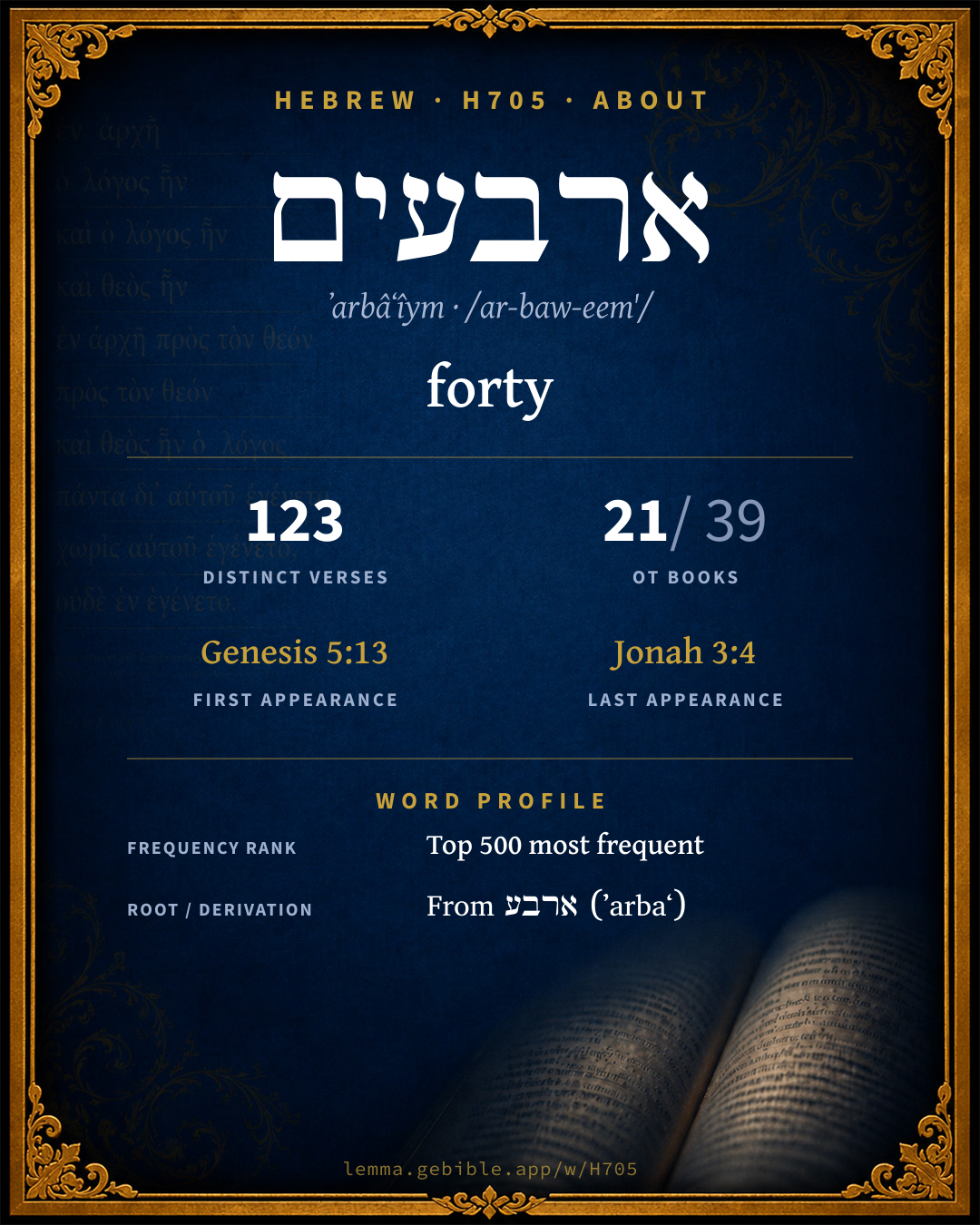
אַרְבָּעִים
forty
Full lexicon entry — Brown-Driver-Briggs (BDB)
From Brown-Driver-Briggs (BDB)
Where this word appears
Grammar key — what these labels mean
Part of speech
- Adjective
- A word that describes or qualifies a noun.
State
- Absolute
- The independent form of a noun, not bound to a following word.
Gender
- Both
- Attested as both masculine and feminine.
Number
- Plural
- More than one (in Hebrew, generally three or more).
Every verse where H705 appears — 123 distinct verses across 21 books. Click any verse to open its interlinear word-by-word view. Verse text shown in the World English Bible for context — . Each verse’s Hebrew form is shown with its reference; the English is not keyword-highlighted, since the data carries no word-level English alignment. Use “Compare translations” on any verse to read it across multiple English versions. This concordance covers the Hebrew Bible; Septuagint (Greek Old Testament) occurrences are not indexed here.
Genesis 12 verses
- Genesis 5:13 אַרְבָּעִ֣ים adj Cardinal number bp Kenan lived after he became the father of Mahalalel eight hundred forty years, and became the father of sons and daughters
- Genesis 7:4 אַרְבָּעִ֣ים וְ/אַרְבָּעִ֖ים adj Cardinal number bp conj + Adjective Cardinal number bp In seven days, I will cause it to rain on the earth for forty days and forty nights. Every living thing that I have made, I will destroy from the surface of the ground."
- Genesis 7:12 אַרְבָּעִ֣ים וְ/אַרְבָּעִ֖ים adj Cardinal number bp conj + Adjective Cardinal number bp The rain was on the earth forty days and forty nights.
- Genesis 7:17 אַרְבָּעִ֥ים adj Cardinal number bp The flood was forty days on the earth. The waters increased, and lifted up the ark, and it was lifted up above the earth.
- Genesis 8:6 אַרְבָּעִ֣ים adj Cardinal number bp It happened at the end of forty days, that Noah opened the window of the ark which he had made,
- Genesis 18:28 אַרְבָּעִ֖ים adj Cardinal number bp What if there will lack five of the fifty righteous? Will you destroy all the city for lack of five?" He said, "I will not destroy it, if I find forty-five there."
- Genesis 18:29 אַרְבָּעִ֑ים הָ/אַרְבָּעִֽים adj Cardinal number bp ptcl def.art + Adjective Cardinal number bp He spoke to him yet again, and said, "What if there are forty found there?" He said, "I will not do it for the forty's sake."
- Genesis 25:20 אַרְבָּעִ֣ים adj Cardinal number bp Isaac was forty years old when he took Rebekah, the daughter of Bethuel the Syrian of Paddan Aram, the sister of Laban the Syrian, to be his wife.
- Genesis 26:34 אַרְבָּעִ֣ים adj Cardinal number bp When Esau was forty years old, he took as wife Judith, the daughter of Beeri the Hittite, and Basemath, the daughter of Elon the Hittite.
- Genesis 32:15 אַרְבָּעִים֙ adj Cardinal number bp thirty milk camels and their colts, forty cows, ten bulls, twenty she-donkeys and ten foals.
- Genesis 47:28 וְ/אַרְבָּעִ֥ים conj + Adjective Cardinal number bp Jacob lived in the land of Egypt seventeen years. So the days of Jacob, the years of his life, were one hundred forty-seven years.
- Genesis 50:3 אַרְבָּעִ֣ים adj Cardinal number bp Forty days were fulfilled for him, for that is how many the days it takes to embalm. The Egyptians wept for him for seventy days.
Exodus 7 verses
- Exodus 16:35 אַרְבָּעִ֣ים adj Cardinal number bp The children of Israel ate the manna forty years, until they came to an inhabited land. They ate the manna until they came to the borders of the land of Canaan.
- Exodus 24:18 אַרְבָּעִ֣ים וְ/אַרְבָּעִ֖ים adj Cardinal number bp conj + Adjective Cardinal number bp Moses entered into the midst of the cloud, and went up on the mountain; and Moses was on the mountain forty days and forty nights.
- Exodus 26:19 וְ/אַרְבָּעִים֙ conj + Adjective Cardinal number bp You shall make forty sockets of silver under the twenty boards; two sockets under one board for its two tenons, and two sockets under another board for its two tenons.
- Exodus 26:21 וְ/אַרְבָּעִ֥ים conj + Adjective Cardinal number bp and their forty sockets of silver; two sockets under one board, and two sockets under another board.
- Exodus 34:28 אַרְבָּעִ֥ים וְ/אַרְבָּעִ֣ים adj Cardinal number bp conj + Adjective Cardinal number bp He was there with Yahweh forty days and forty nights; he neither ate bread, nor drank water. He wrote on the tablets the words of the covenant, the ten commandments.
- Exodus 36:24 וְ/אַרְבָּעִים֙ conj + Adjective Cardinal number bp He made forty sockets of silver under the twenty boards; two sockets under one board for its two tenons, and two sockets under another board for its two tenons.
- Exodus 36:26 וְ/אַרְבָּעִ֥ים conj + Adjective Cardinal number bp and their forty sockets of silver; two sockets under one board, and two sockets under another board.
Leviticus 1 verse
Numbers 19 verses
- Numbers 1:21 וְ/אַרְבָּעִ֛ים conj + Adjective Cardinal number bp those who were numbered of them, of the tribe of Reuben, were forty-six thousand five hundred.
- Numbers 1:25 וְ/אַרְבָּעִים֙ conj + Adjective Cardinal number bp those who were numbered of them, of the tribe of Gad, were forty-five thousand six hundred fifty.
- Numbers 1:33 אַרְבָּעִ֥ים adj Cardinal number bp those who were numbered of them, of the tribe of Ephraim, were forty thousand five hundred.
- Numbers 1:41 וְ/אַרְבָּעִ֛ים conj + Adjective Cardinal number bp those who were numbered of them, of the tribe of Asher, were forty-one thousand five hundred.
- Numbers 2:11 וְ/אַרְבָּעִ֛ים conj + Adjective Cardinal number bp His division, and those who were numbered of it, were forty-six thousand five hundred.
- Numbers 2:15 וְ/אַרְבָּעִים֙ conj + Adjective Cardinal number bp His division, and those who were numbered of them, were forty-five thousand six hundred fifty.
- Numbers 2:19 אַרְבָּעִ֥ים adj Cardinal number bp His division, and those who were numbered of them, were forty thousand five hundred.
- Numbers 2:28 וְ/אַרְבָּעִ֛ים conj + Adjective Cardinal number bp His division, and those who were numbered of them, were forty-one thousand and five hundred.
- Numbers 13:25 אַרְבָּעִ֥ים adj Cardinal number bp They returned from spying out the land at the end of forty days.
- Numbers 14:33 אַרְבָּעִ֣ים adj Cardinal number bp Your children shall be wanderers in the wilderness forty years, and shall bear your prostitution, until your dead bodies be consumed in the wilderness.
- Numbers 14:34 אַרְבָּעִ֣ים אַרְבָּעִ֖ים adj Cardinal number bp adj Cardinal number bp After the number of the days in which you spied out the land, even forty days, for every day a year, shall you bear your iniquities, even forty years, and you shall know my alienation.
- Numbers 26:7 וְ/אַרְבָּעִים֙ conj + Adjective Cardinal number bp These are the families of the Reubenites; and those who were numbered of them were forty-three thousand seven hundred thirty.
- Numbers 26:18 אַרְבָּעִ֥ים adj Cardinal number bp These are the families of the sons of Gad according to those who were numbered of them, forty thousand and five hundred.
- Numbers 26:41 וְ/אַרְבָּעִ֛ים conj + Adjective Cardinal number bp These are the sons of Benjamin after their families; and those who were numbered of them were forty-five thousand six hundred.
- Numbers 26:50 וְ/אַרְבָּעִ֛ים conj + Adjective Cardinal number bp These are the families of Naphtali according to their families; and those who were numbered of them were forty-five thousand four hundred.
- Numbers 32:13 אַרְבָּעִ֖ים adj Cardinal number bp Yahweh's anger was kindled against Israel, and he made them wander back and forth in the wilderness forty years, until all the generation, who had done evil in the sight of Yahweh, was consumed.
- Numbers 33:38 הָֽ/אַרְבָּעִ֗ים ptcl def.art + Adjective Cardinal number bp Aaron the priest went up into Mount Hor at the commandment of Yahweh, and died there, in the fortieth year after the children of Israel were come out of the land of Egypt, in the fifth month, on the first day of the month.
- Numbers 35:6 אַרְבָּעִ֥ים adj Cardinal number bp The cities which you shall give to the Levites, they shall be the six cities of refuge, which you shall give for the manslayer to flee to: and besides them you shall give forty-two cities.
- Numbers 35:7 אַרְבָּעִ֥ים adj Cardinal number bp All the cities which you shall give to the Levites shall be forty-eight cities; them [shall you give] with their suburbs.
Deuteronomy 11 verses
- Deuteronomy 1:3 בְּ/אַרְבָּעִ֣ים prep + Adjective Cardinal number bp It happened in the fortieth year, in the eleventh month, on the first day of the month, that Moses spoke to the children of Israel, according to all that Yahweh had given him in commandment to them;
- Deuteronomy 2:7 אַרְבָּעִ֣ים adj Cardinal number bp For Yahweh your God has blessed you in all the work of your hand; he has known your walking through this great wilderness: these forty years Yahweh your God has been with you; you have lacked nothing.
- Deuteronomy 8:2 אַרְבָּעִ֥ים adj Cardinal number bp You shall remember all the way which Yahweh your God has led you these forty years in the wilderness, that he might humble you, to prove you, to know what was in your heart, whether you would keep his commandments, or not.
- Deuteronomy 8:4 אַרְבָּעִ֥ים adj Cardinal number bp Your clothing didn't grow old on you, neither did your foot swell, these forty years.
- Deuteronomy 9:9 אַרְבָּעִ֥ים וְ/אַרְבָּעִ֣ים adj Cardinal number bp conj + Adjective Cardinal number bp When I was gone up onto the mountain to receive the tables of stone, even the tables of the covenant which Yahweh made with you, then I stayed on the mountain forty days and forty nights; I did neither eat bread nor drink water.
- Deuteronomy 9:11 אַרְבָּעִ֣ים וְ/אַרְבָּעִ֖ים adj Cardinal number bp conj + Adjective Cardinal number bp It came to pass at the end of forty days and forty nights, that Yahweh gave me the two tables of stone, even the tables of the covenant.
- Deuteronomy 9:18 אַרְבָּעִ֥ים וְ/אַרְבָּעִ֣ים adj Cardinal number bp conj + Adjective Cardinal number bp I fell down before Yahweh, as at the first, forty days and forty nights; I did neither eat bread nor drink water; because of all your sin which you sinned, in doing that which was evil in the sight of Yahweh, to provoke him to anger.
- Deuteronomy 9:25 אַרְבָּעִ֥ים אַרְבָּעִ֥ים adj Cardinal number bp adj Cardinal number bp So I fell down before Yahweh the forty days and forty nights that I fell down, because Yahweh had said he would destroy you.
- Deuteronomy 10:10 אַרְבָּעִ֣ים וְ/אַרְבָּעִ֖ים adj Cardinal number bp conj + Adjective Cardinal number bp I stayed on the mountain, as at the first time, forty days and forty nights: and Yahweh listened to me that time also; Yahweh would not destroy you.
- Deuteronomy 25:3 אַרְבָּעִ֥ים adj Cardinal number bp Forty stripes he may give him, he shall not exceed; lest, if he should exceed, and beat him above these with many stripes, then your brother should seem vile to you.
- Deuteronomy 29:5 אַרְבָּעִ֥ים adj Cardinal number bp I have led you forty years in the wilderness: your clothes have not grown old on you, and your shoe has not grown old on your foot.
Joshua 5 verses
- Joshua 4:13 כְּ/אַרְבָּעִ֥ים prep + Adjective Cardinal number bp about forty thousand ready armed for war passed over before Yahweh to battle, to the plains of Jericho.
- Joshua 5:6 אַרְבָּעִ֣ים adj Cardinal number bp For the children of Israel walked forty years in the wilderness, until all the nation, even the men of war who came forth out of Egypt, were consumed, because they didn't listen to the voice of Yahweh: to whom Yahweh swore that he wouldn't let them see the land which Yahweh swore to their fathers that he would give us, a land flowing with milk and honey.
- Joshua 14:7 אַרְבָּעִ֨ים adj Cardinal number bp Forty years old was I when Moses the servant of Yahweh sent me from Kadesh-barnea to spy out the land; and I brought him word again as it was in my heart.
- Joshua 14:10 אַרְבָּעִ֨ים adj Cardinal number bp Now, behold, Yahweh has kept me alive, as he spoke, these forty-five years, from the time that Yahweh spoke this word to Moses, while Israel walked in the wilderness: and now, behold, I am this day eighty-five years old.
- Joshua 21:41 אַרְבָּעִ֥ים adj Cardinal number bp All the cities of the Levites in the midst of the possession of the children of Israel were forty-eight cities with their suburbs.
Judges 7 verses
- Judges 3:11 אַרְבָּעִ֣ים adj Cardinal number bp The land had rest forty years. Othniel the son of Kenaz died.
- Judges 5:8 בְּ/אַרְבָּעִ֥ים prep + Adjective Cardinal number bp They chose new gods; Then was war in the gates: Was there a shield or spear seen Among forty thousand in Israel?
- Judges 5:31 אַרְבָּעִ֥ים adj Cardinal number bp So let all your enemies perish, Yahweh: But let those who love him be as the sun when he goes forth in his might. The land had rest forty years.
- Judges 8:28 אַרְבָּעִ֥ים adj Cardinal number bp So Midian was subdued before the children of Israel, and they lifted up their heads no more. The land had rest forty years in the days of Gideon.
- Judges 12:6 אַרְבָּעִ֥ים adj Cardinal number bp then said they to him, Say now Shibboleth; and he said Sibboleth; for he couldn't manage to pronounce it right: then they laid hold on him, and killed him at the fords of the Jordan. There fell at that time of Ephraim forty-two thousand.
- Judges 12:14 אַרְבָּעִ֣ים adj Cardinal number bp He had forty sons and thirty sons' sons, who rode on seventy donkey colts: and he judged Israel eight years.
- Judges 13:1 אַרְבָּעִ֥ים adj Cardinal number bp The children of Israel again did that which was evil in the sight of Yahweh; and Yahweh delivered them into the hand of the Philistines forty years.
1 Samuel 2 verses
- 1 Samuel 4:18 אַרְבָּעִ֥ים adj Cardinal number bp It happened, when he made mention of the ark of God, that [Eli] fell from off his seat backward by the side of the gate; and his neck broke, and he died: for he was an old man, and heavy. He had judged Israel forty years.
- 1 Samuel 17:16 אַרְבָּעִ֥ים adj Cardinal number bp The Philistine drew near morning and evening, and presented himself forty days.
2 Samuel 4 verses
- 2 Samuel 2:10 אַרְבָּעִ֨ים adj Cardinal number bp Ish-bosheth, Saul's son, was forty years old when he began to reign over Israel, and he reigned two years. But the house of Judah followed David.
- 2 Samuel 5:4 אַרְבָּעִ֥ים adj Cardinal number bp David was thirty years old when he began to reign, and he reigned forty years.
- 2 Samuel 10:18 וְ/אַרְבָּעִ֥ים conj + Adjective Cardinal number bp The Syrians fled before Israel; and David killed of the Syrians [the men of] seven hundred chariots, and forty thousand horsemen, and struck Shobach the captain of their host, so that he died there.
- 2 Samuel 15:7 אַרְבָּעִ֣ים adj Cardinal number bp It happened at the end of forty years, that Absalom said to the king, please let me go and pay my vow, which I have vowed to Yahweh, in Hebron.
1 Kings 9 verses
- 1 Kings 2:11 אַרְבָּעִ֖ים adj Cardinal number bp The days that David reigned over Israel were forty years; seven years reigned he in Hebron, and thirty-three years reigned he in Jerusalem.
- 1 Kings 4:26 אַרְבָּעִ֥ים adj Cardinal number bp Solomon had forty thousand stalls of horses for his chariots, and twelve thousand horsemen.
- 1 Kings 6:17 וְ/אַרְבָּעִ֥ים conj + Adjective Cardinal number bp The house, that is, the temple before [the oracle], was forty cubits [long].
- 1 Kings 7:3 אַרְבָּעִ֖ים adj Cardinal number bp It was covered with cedar above over the forty-five beams, that were on the pillars; fifteen in a row.
- 1 Kings 7:38 אַרְבָּעִ֨ים adj Cardinal number bp He made ten basins of brass: one basin contained forty baths; and every basin was four cubits; and on very one of the ten bases one basin.
- 1 Kings 11:42 אַרְבָּעִ֖ים adj Cardinal number bp The time that Solomon reigned in Jerusalem over all Israel was forty years.
- 1 Kings 14:21 אַרְבָּעִ֣ים adj Cardinal number bp Rehoboam the son of Solomon reigned in Judah. Rehoboam was forty-one years old when he began to reign, and he reigned seventeen years in Jerusalem, the city which Yahweh had chosen out of all the tribes of Israel, to put his name there: and his mother's name was Naamah the Ammonitess.
- 1 Kings 15:10 וְ/אַרְבָּעִ֤ים conj + Adjective Cardinal number bp Forty-one years reigned he in Jerusalem: and his mother's name was Maacah the daughter of Abishalom.
- 1 Kings 19:8 אַרְבָּעִ֥ים וְ/אַרְבָּעִ֣ים adj Cardinal number bp conj + Adjective Cardinal number bp He arose, and ate and drink, and went in the strength of that food forty days and forty nights to Horeb the Mount of God.
2 Kings 5 verses
- 2 Kings 2:24 אַרְבָּעִ֥ים adj Cardinal number bp He looked behind him and saw them, and cursed them in the name of Yahweh. There came forth two she-bears out of the wood, and mauled forty-two lads of them.
- 2 Kings 8:9 אַרְבָּעִ֣ים adj Cardinal number bp So Hazael went to meet him, and took a present with him, even of every good thing of Damascus, forty camels' burden, and came and stood before him, and said, Your son Benhadad king of Syria has sent me to you, saying, Shall I recover of this sickness?
- 2 Kings 10:14 אַרְבָּעִ֤ים adj Cardinal number bp He said, Take them alive. They took them alive, and killed them at the pit of the shearing-house, even two and forty men; neither left he any of them.
- 2 Kings 12:1 וְ/אַרְבָּעִ֣ים conj + Adjective Cardinal number bp In the seventh year of Jehu began Jehoash to reign; and he reigned forty years in Jerusalem: and his mother's name was Zibiah of Beersheba.
- 2 Kings 14:23 אַרְבָּעִ֥ים adj Cardinal number bp In the fifteenth year of Amaziah the son of Joash king of Judah Jeroboam the son of Joash king of Israel began to reign in Samaria, [and reigned] forty-one years.
1 Chronicles 5 verses
- 1 Chronicles 5:18 אַרְבָּעִ֨ים adj Cardinal number bp The sons of Reuben, and the Gadites, and the half-tribe of Manasseh, of valiant men, men able to bear buckler and sword, and to shoot with bow, and skillful in war, were forty-four thousand seven hundred and sixty, that were able to go forth to war.
- 1 Chronicles 12:36 אַרְבָּעִ֥ים adj Cardinal number bp Of Asher, such as were able to go out in the host, who could set the battle in array, forty thousand.
- 1 Chronicles 19:18 וְ/אַרְבָּעִ֥ים conj + Adjective Cardinal number bp The Syrians fled before Israel; and David killed of the Syrians [the men of] seven thousand chariots, and forty thousand footmen, and killed Shophach the captain of the host.
- 1 Chronicles 26:31 הָֽ/אַרְבָּעִ֜ים ptcl def.art + Adjective Cardinal number bp Of the Hebronites was Jerijah the chief, even of the Hebronites, according to their generations by fathers' [houses]. In the fortieth year of the reign of David they were sought for, and there were found among them mighty men of valor at Jazer of Gilead.
- 1 Chronicles 29:27 אַרְבָּעִ֖ים adj Cardinal number bp The time that he reigned over Israel was forty years; he reigned seven years in Hebron, and thirty-three [years] reigned he in Jerusalem.
2 Chronicles 5 verses
- 2 Chronicles 9:30 אַרְבָּעִ֥ים adj Cardinal number bp Solomon reigned in Jerusalem over all Israel forty years.
- 2 Chronicles 12:13 אַרְבָּעִ֣ים adj Cardinal number bp So king Rehoboam strengthened himself in Jerusalem, and reigned: for Rehoboam was forty-one years old when he began to reign, and he reigned seventeen years in Jerusalem, the city which Yahweh had chosen out of all the tribes of Israel, to put his name there: and his mother's name was Naamah the Ammonitess.
- 2 Chronicles 16:13 אַרְבָּעִ֥ים adj Cardinal number bp Asa slept with his fathers, and died in the one and fortieth year of his reign.
- 2 Chronicles 22:2 אַרְבָּעִ֨ים adj Cardinal number bp Forty-two years old was Ahaziah when he began to reign; and he reigned one year in Jerusalem: and his mother's name was Athaliah the daughter of Omri.
- 2 Chronicles 24:1 וְ/אַרְבָּעִ֣ים conj + Adjective Cardinal number bp Joash was seven years old when he began to reign; and he reigned forty years in Jerusalem: and his mother's name was Zibiah, of Beersheba.
Ezra 7 verses
- Ezra 2:8 וְ/אַרְבָּעִ֥ים conj + Adjective Cardinal number bp The children of Zattu, nine hundred forty-five.
- Ezra 2:10 אַרְבָּעִ֥ים adj Cardinal number bp The children of Bani, six hundred forty-two.
- Ezra 2:24 אַרְבָּעִ֥ים adj Cardinal number bp The children of Azmaveth, forty-two.
- Ezra 2:25 וְ/אַרְבָּעִ֥ים conj + Adjective Cardinal number bp The children of Kiriath Arim, Chephirah, and Beeroth, seven hundred forty-three.
- Ezra 2:34 אַרְבָּעִ֥ים adj Cardinal number bp The children of Jericho, three hundred forty-five.
- Ezra 2:38 אַרְבָּעִ֥ים adj Cardinal number bp The children of Pashhur, one thousand two hundred forty-seven.
- Ezra 2:66 אַרְבָּעִ֥ים adj Cardinal number bp Their horses were seven hundred thirty-six; their mules, two hundred forty-five;
Nehemiah 12 verses
- Nehemiah 5:15 אַרְבָּעִ֔ים adj Cardinal number bp But the former governors who were before me were chargeable to the people, and took of them bread and wine, besides forty shekels of silver; yes, even their servants bore rule over the people: but I didn't do so, because of the fear of God.
- Nehemiah 7:13 אַרְבָּעִ֥ים adj Cardinal number bp The children of Zattu, eight hundred forty-five.
- Nehemiah 7:15 אַרְבָּעִ֥ים adj Cardinal number bp The children of Binnui, six hundred forty-eight.
- Nehemiah 7:28 אַרְבָּעִ֥ים adj Cardinal number bp The men of Beth Azmaveth, forty-two.
- Nehemiah 7:29 אַרְבָּעִ֥ים adj Cardinal number bp The men of Kiriath Jearim, Chephirah, and Beeroth, seven hundred forty-three.
- Nehemiah 7:36 אַרְבָּעִ֥ים adj Cardinal number bp The children of Jericho, three hundred forty-five.
- Nehemiah 7:41 אַרְבָּעִ֥ים adj Cardinal number bp The children of Pashhur, one thousand two hundred forty-seven.
- Nehemiah 7:44 אַרְבָּעִ֥ים adj Cardinal number bp The singers: the children of Asaph, one hundred forty-eight.
- Nehemiah 7:62 וְ/אַרְבָּעִ֥ים conj + Adjective Cardinal number bp The children of Delaiah, the children of Tobiah, the children of Nekoda, six hundred forty-two.
- Nehemiah 7:67 וְ/אַרְבָּעִ֥ים conj + Adjective Cardinal number bp besides their men-servants and their maid-servants, of whom there were seven thousand three hundred thirty-seven: and they had two hundred forty-five singing men and singing women.
- Nehemiah 9:21 וְ/אַרְבָּעִ֥ים conj + Adjective Cardinal number bp Yes, forty years did you sustain them in the wilderness, [and] they lacked nothing; their clothes didn't grow old, and their feet didn't swell.
- Nehemiah 11:13 אַרְבָּעִ֣ים adj Cardinal number bp and his brothers, chiefs of fathers' [houses], two hundred forty-two; and Amashsai the son of Azarel, the son of Ahzai, the son of Meshillemoth, the son of Immer,
Job 1 verse
Psalms 1 verse
Jeremiah 1 verse
Ezekiel 6 verses
- Ezekiel 4:6 אַרְבָּעִ֣ים adj Cardinal number bp Again, when you have accomplished these, you shall lie on your right side, and shall bear the iniquity of the house of Judah: forty days, each day for a year, have I appointed it to you.
- Ezekiel 29:11 אַרְבָּעִ֥ים adj Cardinal number bp No foot of man shall pass through it, nor foot of animal shall pass through it, neither shall it be inhabited forty years.
- Ezekiel 29:12 אַרְבָּעִ֖ים adj Cardinal number bp I will make the land of Egypt a desolation in the midst of the countries that are desolate; and her cities among the cities that are laid waste shall be a desolation forty years; and I will scatter the Egyptians among the nations, and will disperse them through the countries.
- Ezekiel 29:13 אַרְבָּעִ֤ים adj Cardinal number bp For thus says the Lord Yahweh: At the end of forty years will I gather the Egyptians from the peoples where they were scattered;
- Ezekiel 41:2 אַרְבָּעִ֣ים adj Cardinal number bp The breadth of the entrance was ten cubits; and the sides of the entrance were five cubits on the one side, and five cubits on the other side: and he measured the length of it, forty cubits, and the breadth, twenty cubits.
- Ezekiel 46:22 אַרְבָּעִ֣ים adj Cardinal number bp In the four corners of the court there were courts enclosed, forty [cubits] long and thirty broad: these four in the corners were of one measure.
Amos 2 verses
- Amos 2:10 אַרְבָּעִ֣ים adj Cardinal number bp Also I brought you up out of the land of Egypt, And led you forty years in the wilderness, To possess the land of the Amorite.
- Amos 5:25 אַרְבָּעִ֥ים adj Cardinal number bp "Did you bring to me sacrifices and offerings in the wilderness forty years, house of Israel?
Jonah 1 verse
About this entry
At a glance — auto-summarized from this page’s data, not written by a person. Every figure links to its source below. This summary describes the numbers; it doesn’t interpret them.
ארבעים — transliterated ʼarbâʻîym — is a Hebrew word carrying the sense “forty.” Its English rendering has broadened — “forty” classically, “were” (unfoldingWord Literal Text) in modern versions; see the renderings breakdown. Spanning 123 verses in 21 books, it ranks among the common words of the Hebrew Bible. Its earliest occurrence is Genesis 5:13. Sharing its root, it stands alongside ארבע, ארבע and ארבעתים. See the sense tree, 123-verse concordance, and the renderings breakdown below.
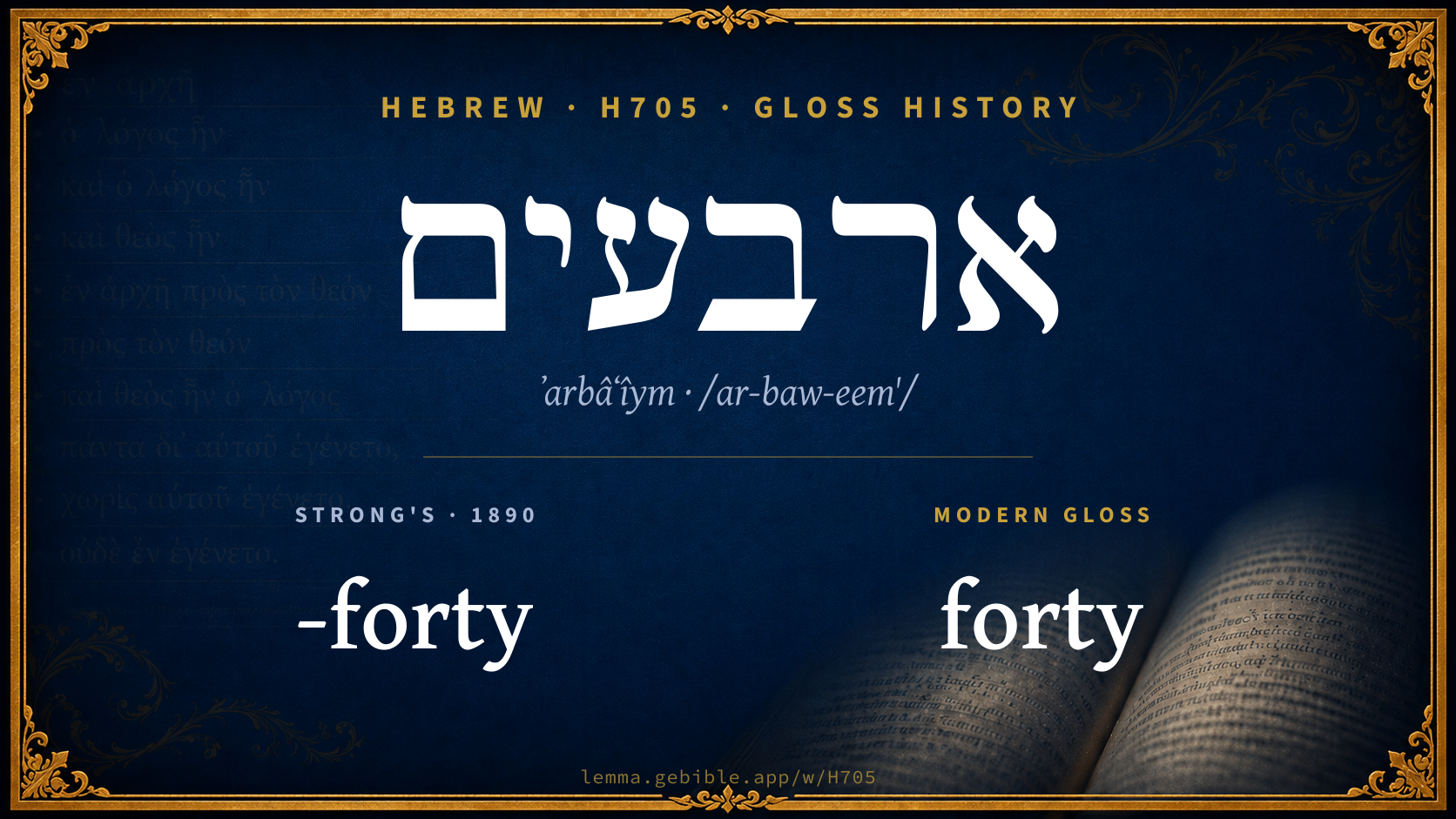
Gloss history
Strong's 1890 vs modern scholarship
About this word
Strong's H705 catalogs a Hebrew word from the Hebrew Old Testament.
These counts are not copied from any lexicon or concordance. They are computed here, from the morphology-tagged Hebrew Old Testament. What Lemma adds →
- 123
- distinct verses
- The word appears in 123 distinct verses.
- 21 / 39
- OT books
- The word appears in 21 of 39 Old Testament books.
- #329
- by frequency
- Top 500 most frequent Hebrew words (rank 329 of 8,640 Hebrew words by occurrence).
View all 123 occurrences in the concordance →
By section of the Old Testament
By traditional corpus
Conventional, traditional groupings — biblical authorship is debated, so this is a traditional corpus grouping, not an authorship claim. Each share is this word’s portion of its verses in that division of the Hebrew canon. Each figure is a share of the word’s 123 distinct verses.
- Torah (Pentateuch) 50 verses · 41%
- Prophets (Nevi'im) 42 verses · 34%
- Writings (Ketuvim) 31 verses · 25%
How translations render this word
Counts come from each version’s own published word-to-Strong’s tagging or interlinear alignment — an approximate guide to how each version renders this word, not a word-level alignment the data otherwise carries. Because each total is that version’s own tagged count, the per-version totals vary from one another and need not match the appearance or distinct-verse counts above. These counts may also differ from a printed concordance because Lemma counts each distinctly tagged rendering and does not collapse phrase taggings into a single head-word total. This is a fixed set of word-tagged versions (KJV, ASV, BSB, ULT) and does not change with the reading translation you choose elsewhere. Each version’s license is shown beside its name below (and on Sources).
BDB lists this Strong’s number as 2 distinct words (homographs). Each count above pools all of them and is not split by sense — see the Senses section below. A low-frequency rendering may belong to a different one of those words, not the primary meaning.
- King James Version†: Forty 95×, Were forty 12×, Was forty 8×
- American Standard Version†: Forty 89×, Were forty 10×, Was forty 8×
- Berean Standard Bible†: Forty 71×, Fortieth 3×, Forty-five 3×
- unfoldingWord Literal Text†: Were 28×, Forty 23×, And 18×
King James Version Public Domain
Renders H705 across 136† tagged occurrences — most commonly:
Plus 16 renderings that appear only once — usually multi-word phrases or single function words the recovered tagging swept in, not distinct renderings.
American Standard Version Public Domain
Renders H705 across 136† tagged occurrences — most commonly:
Plus 21 renderings that appear only once — usually multi-word phrases or single function words the recovered tagging swept in, not distinct renderings.
Berean Standard Bible Public Domain
Renders H705 across 98† tagged occurrences — most commonly:
Plus 15 renderings that appear only once — usually multi-word phrases or single function words the recovered tagging swept in, not distinct renderings. Not rendered by a distinct English word in 37 further occurrences.
unfoldingWord Literal Text CC BY-SA 4.0
Renders H705 across 86† tagged occurrences — most commonly:
Plus 7 renderings that appear only once — usually multi-word phrases or single function words the recovered tagging swept in, not distinct renderings. Not rendered by a distinct English word in 57 further occurrences.
9 senses and sub-senses in the full BDB
What do BDB’s symbols mean?
BDB uses these scholarly abbreviations:
| Symbol | Meaning |
|---|---|
| 𝔊 | the Septuagint (the ancient Greek translation, LXX) |
| 𝔙 | the Vulgate (the Latin translation) |
| 𝔖 | the Syriac version (the Peshitta) |
| 𝔗 | the Targum (the Aramaic translation) |
| ψ | the Psalms |
| √ | root (the underlying root or stem) |
| ‖ | parallel passage (a synonymous or contrasted parallel) |
| † | the dagger: every passage where the word occurs is cited |
The 9 senses and sub-senses the full Brown-Driver-Briggs lexicon distinguishes for this word, in lexicon order (not ranked by frequency), with BDB’s own verbatim wording and sub-sense lettering. Shown in Hebrew script with BDB’s own scholarly abbreviations. The condensed entry is in the Lexicon Entry tab. See also the Forms in the corpus table below.
- 1. sine num. al.:
- a. usually appos. bef. n., especially שָׁנָה, יוֹם (sing.): אַרְבָּעִים שָׁנָה Ju 3:11; 1 S 4:18; Am 2:10; 5:25 + 29 times; א׳ יוֹם Gn 7:17; 1 K 19:8; Jon 3:4 + 6 times, א׳ יוֹם וְא׳ לַיְלָה Gn 7:4, 12; Ex 24:18 + 7 times; also א׳ בַּת †1 K 7:38, א׳ גָּמָל †2 K 8:9, א׳ אַמָּה †Ez 41:2 and (אַמָּה om.) 46:22, but א׳ בָּאַמָּה †1 K 6:17 (v. אַמָּה); א׳ אֶלֶף Nu 1:33; 2:19; 26:18; Jos 4:13; Ju 5:8; 2 S 10:18; 1 K 5:6; 1 Ch 12:37 (van d. H. v 36), 19:18 (v. also infr.); rarely sq. n.pl., א׳ בָּנִים Ju 12:14, א׳ אֲדָנִים Ex 26:19, 21; 36:24, 26 (P).—(As round no. Gn 7:17; Ju 3:11; 5:31; 8:28; 1 S 4:18 +). e.g. Judges 3:11
- b. after n. pl., פָּרוֹת א׳ Gn 32:16 (E), שְׁקָלִים א׳ Ne 5:15. e.g. Genesis 32:16
- c. n. om. Gn 18:29, הָא׳ v 29; א׳ יַכֶּנּוּ Dt 25:3 forty (blows) may he smite him. e.g. Genesis 18:29
- 2. c. num. al.:
- a. before unit, + n. s., 40 + 1 שָׁנָה 1 K 14:21; 15:10; 2 K 14:23; 40 + 2 שָׁנָה 2 Ch 22:2, אִישׁ 2 K 10:14, עִיר Nu 35:6, אֶלֶף Ju 12:6; 40 + 5 שָׁנָה Jos 14:10 (JE), etc. (12 times); + n. pl. יְלָדִים 2 K 2:24; after n. pl. הָעַמּוּדִים + 40 + 5 1 K 7:3; n. om. 40 + 5 Gn 18:28, cf. Ezr 2:24 = Ne 7:28. e.g. 1 Kings 14:21
- b. after unit, 9 + 40 שָׁנָה Lv 25:8 (H); 1 + 40 אֶלֶף Nu 1:41; 2:28, etc. (9 times Nu, P). e.g. Leviticus 25:8
- c. c. hundreds, 40 שָׁנָה + 800 שָׁנָה Gn 5:13 (P); 100 + 40 שָׁנָה Jb 42:16; + units, 7 שָׁנִים + 40 + 100 שָׁנָה Gn 47:28 (P); but (Ezr Ne, mostly pred., without n.), 900 + 40 + 5 Ezr 2:8, cf. v 25 Ne 7:62, and (א׳ without וְ) 600, 40 + 2 Ezr 2:10, v. also ‖ Ne 7:15; Ezr 2:34 = Ne 7:36; Ezr 2:66 = Ne 7:68 (ver. om. Baer Gi), Ne 7:13, 29, 44; 1000, 200, 40 + 7 Ezr 2:38 = Ne 7:41; n.pl. 200 + 40 + 5 Ne 7:67, n.pl. 200, 40 + 2 11:13; also n. s. נֶפֶשׁ 700, 40 + 5 Je 52:30. e.g. Genesis 5:13
- 3. as ordinal, בְּא׳ שָׁנָה Dt 1:3 in the fortieth year; also בִּשְׁנַת הָא׳ Nu 33:38; 1 Ch 26:31; בִּשְׁנַת א׳ וְאַחַת 2 Ch 16:13 in the forty-first year. e.g. Deuteronomy 1:3
Senses from the full Brown-Driver-Briggs lexicon (Brown, Driver, Briggs; Oxford 1906 — public domain), digitized via Sefaria, supplemented by the OpenScriptures HebrewLexicon (CC BY 4.0). Full attribution on Sources.
Word origin
n.pl. indecl. a forty;—
— Brown-Driver-Briggs (Oxford 1906, public domain), digitized via Sefaria, supplemented by the OpenScriptures HebrewLexicon (CC BY 4.0). See Sources.
Derived from ארבע (ʼarbaʻ) (H702) — four.
Jastrow Dictionary
A second Hebrew/Aramaic lexicon for comparison, covering Aramaic and post-biblical (Talmudic, Targumic, Midrashic) usage that the biblical-Hebrew BDB does not. Matched by lemma rather than by Strong’s number, so a lemma may carry more than one Jastrow headword (shown separately below), and the entries cover usage well beyond the Bible.
אַרְבָּעָה I
- , אַרְבַּע f. (b. h.) four (frequently represented by ד׳). Ḥag. 14ᵇ א׳ נכנסו וכ׳ four men entered into theosophical speculation; a. fr.—Constr. אַרְבַּעַת followed by singul. Y. Ber. I, 2ᶜ אַרְבַּעַת מיל = אַרְבָּעָה מילין; Y. Yoma III, beg. 40ᵇ; (cmp. Gen. R. s. 50).—Pl. אַרְבָּעִים (מ׳) forty. Sabb. VII, 2 א׳ חסר אחת thirty nine.—Macc. I, 1, a. fr. לוקה א׳ receives forty (thirty nine) lashes; v. ib. III, 10.
A Dictionary of the Targumim, the Talmud Babli and Yerushalmi, and the Midrashic Literature (Marcus Jastrow; London, Luzac, 1903) — Public Domain. Digitized via Sefaria. Digitized via Sefaria. Full attribution on Sources.
Forms in the corpus
The 21 distinct written forms H705 takes in the Hebrew Bible, most frequent first — each parse links to that state’s occurrences in the concordance. Hebrew forms include their vowel points and cantillation, so a single lemma takes many written forms.
| Form | Parsing | Example | Uses |
|---|---|---|---|
| אַרְבָּעִ֥ים | Adjective, Cardinal number, Both, Plural, Absolute | Amos 5:25 | 45 |
| אַרְבָּעִ֣ים | Adjective, Cardinal number, Both, Plural, Absolute | Amos 2:10 | 28 |
| וְ/אַרְבָּעִ֥ים | Adjective, Cardinal number, Both, Plural, Absolute | Exodus 26:21 | 11 |
| אַרְבָּעִ֖ים | Adjective, Cardinal number, Both, Plural, Absolute | Ezekiel 29:12 | 8 |
| וְ/אַרְבָּעִ֖ים | Adjective, Cardinal number, Both, Plural, Absolute | Deuteronomy 9:11 | 7 |
| אַרְבָּעִ֨ים | Adjective, Cardinal number, Both, Plural, Absolute | 1 Chronicles 5:18 | 6 |
| וְ/אַרְבָּעִ֛ים | Adjective, Cardinal number, Both, Plural, Absolute | Numbers 1:21 | 6 |
| וְ/אַרְבָּעִ֣ים | Adjective, Cardinal number, Both, Plural, Absolute | Deuteronomy 9:9 | 6 |
| וְ/אַרְבָּעִים֙ | Adjective, Cardinal number, Both, Plural, Absolute | Exodus 26:19 | 5 |
| אַרְבָּעִ֤ים | Adjective, Cardinal number, Both, Plural, Absolute | Ezekiel 29:13 | 2 |
| אַרְבָּ֘עִ֤ים | Adjective, Cardinal number, Both, Plural, Absolute | Psalms 95:10 | 1 |
| אַרְבָּעִ֑ים | Adjective, Cardinal number, Both, Plural, Absolute | Genesis 18:29 | 1 |
| אַרְבָּעִ֔ים | Adjective, Cardinal number, Both, Plural, Absolute | Nehemiah 5:15 | 1 |
| אַרְבָּעִים֙ | Adjective, Cardinal number, Both, Plural, Absolute | Genesis 32:15 | 1 |
| בְּ/אַרְבָּעִ֣ים | Adjective, Cardinal number, Both, Plural, Absolute | Deuteronomy 1:3 | 1 |
| בְּ/אַרְבָּעִ֥ים | Adjective, Cardinal number, Both, Plural, Absolute | Judges 5:8 | 1 |
| הָ/אַרְבָּעִֽים | Adjective, Cardinal number, Both, Plural, Absolute | Genesis 18:29 | 1 |
| הָֽ/אַרְבָּעִ֗ים | Adjective, Cardinal number, Both, Plural, Absolute | Numbers 33:38 | 1 |
| הָֽ/אַרְבָּעִ֜ים | Adjective, Cardinal number, Both, Plural, Absolute | 1 Chronicles 26:31 | 1 |
| וְ/אַרְבָּעִ֤ים | Adjective, Cardinal number, Both, Plural, Absolute | 1 Kings 15:10 | 1 |
| כְּ/אַרְבָּעִ֥ים | Adjective, Cardinal number, Both, Plural, Absolute | Joshua 4:13 | 1 |
Same root — word family
Other BDB entries built from the same root as H705, grouped by Strong’s listed origin. These share a root / origin per the lexicon — not necessarily a shared meaning. Each links to that word’s own entry.
Derives from
Shares the same root
Proper names from this root
People and places named from this root — a name, not an additional meaning of the word.
Compare all same-root words → Showing 4 of 5 — not the complete family. 1 of the same-root words is a proper name (a person or place). They share a root, not necessarily a meaning.
Septuagint verse parallels
This word appears in 108 verses that also exist in the Greek Old Testament (Septuagint), out of the 123 Hebrew verses it occurs in. You can read those verses in Greek by switching the Old Testament edition to the Septuagint.
Read these verses in the Septuagint
- Genesis 5:13
- Exodus 16:35
- Leviticus 25:8
- Numbers 1:21
- Deuteronomy 1:3
- Joshua 4:13
- Judges 3:11
- 1 Samuel 4:18
- 2 Samuel 2:10
- 1 Kings 2:11
- 2 Kings 2:24
- 1 Chronicles 5:18
This is a verse-level parallel only — the same verses exist in both the Hebrew and Greek Old Testaments. No word-level Hebrew↔Greek correspondence is claimed: the data carries no such alignment, so no Greek word is shown as this Hebrew word’s translation. Coverage is not total — the Septuagint omits the deuterocanon and renumbers the Psalms, so some Hebrew verses have no direct Greek parallel.