
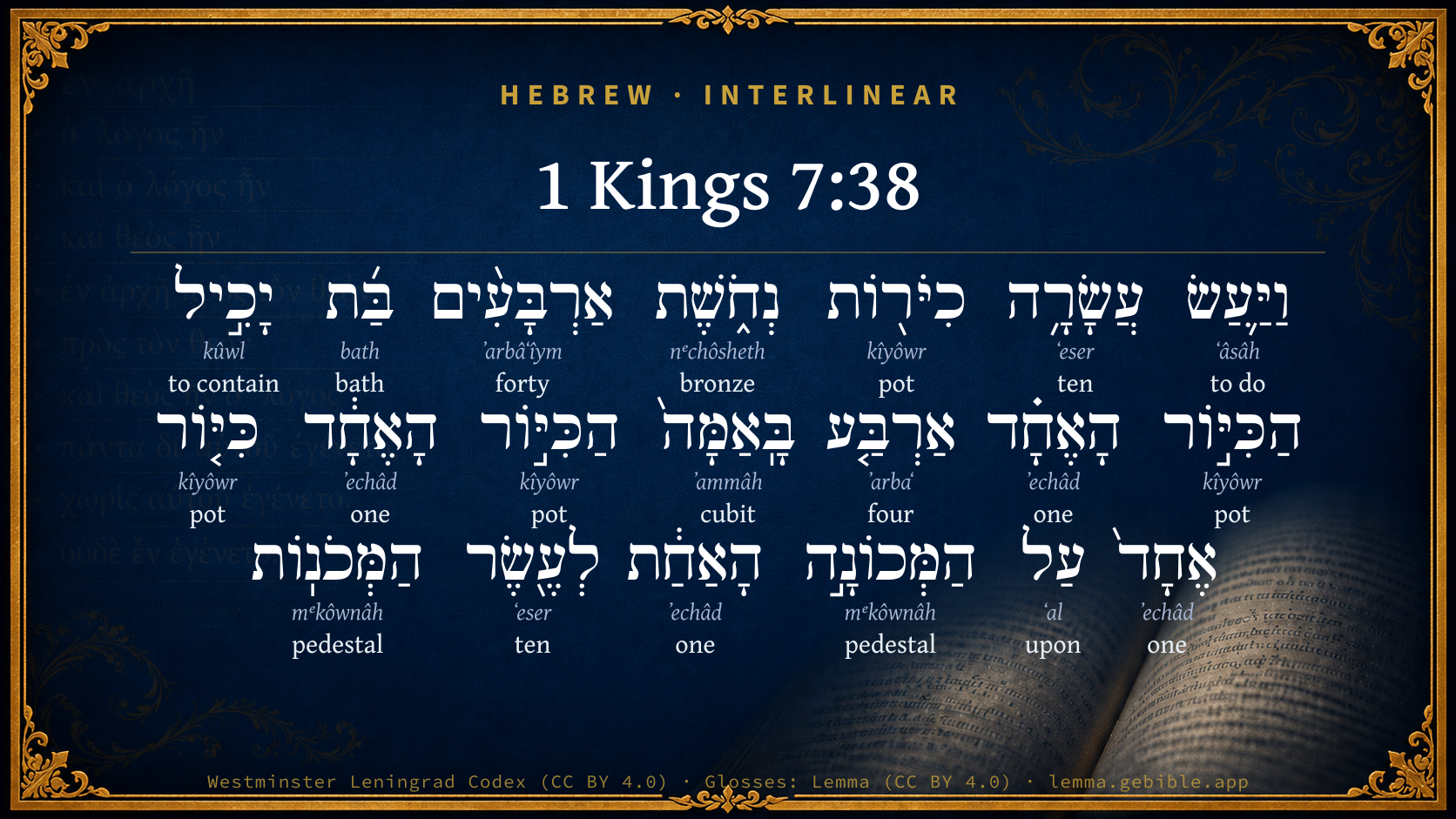
1 Kings 7:38

Hebrew (Westminster Leningrad Codex) 1 Kings 7:38 appears in the Hebrew Old Testament. The text above is from the Westminster Leningrad Codex. Each word links to its Strong’s number, a concise gloss, and parsing drawn from the Open Scriptures Hebrew Bible morphology. Click any word for its full Brown-Driver-Briggs (BDB) entry.
Download image
Cite this verse

1 Kings 7:38 (World English Bible). Public Domain. Lemma interlinear Bible study tool, https://lemma.gebible.app/v/1-kings/7/38.

Show BibTeX & RIS
BibTeX
RIS
English Translation
He made ten basins of brass: one basin contained forty baths; and every basin was four cubits; and on very one of the ten bases one basin.
World English Bible · Public Domain
Download a study sheet

One document with this verse’s original text, its word-by-word gloss line, the meaning frame, cross-references with their text, attributed commentary, and full source and license credits — printable, and it pastes into notes with its structure intact.

This verse Autodidact and up

Study sheet (.html) Plain text (.txt)

A passage Seminary Student

Up to 50 verses in one chapter. A passage sheet keeps up to 6 commentary sources and 12 cross-references per verse, in the order this page ranks them, and says so on the sheet whenever that leaves anything out. Ask for a single verse and you get the Autodidact verse sheet above.

Everything on this page stays free to read, with no account — the sheet is a download of what is already on screen, not access to it.

Want to remove ads? Support Godless Engineer
Compare translations 3

The same verse in 3 English versions, stacked beneath the original-language interlinear above. Click any original word for its lexicon entry.

Each is an independent rendering of the whole verse — the interlinear is not word-aligned to these translations.

Highlighted words mark where these versions differ — a whole-verse word diff, not a word-by-word alignment.

  • World English Bible Public Domain
    He made ten basins of brass: one basin contained forty baths; and every basin was four cubits; and on very one of the ten bases one basin.
  • King James Version Public Domain
    Then made he ten lavers of brass: one laver contained forty baths: and every laver was four cubits: and upon every one of the ten bases one laver.
  • unfoldingWord Literal Text CC BY-SA 4.0
    And he made ten bronze basins. One basin contained 40 baths. One basin four by the cubit. One basin on one stand, for the ten stands.

unfoldingWord Literal Text — © unfoldingWord, licensed CC BY-SA 4.0. Word-aligned USFM3 via Door43 (git.door43.org/unfoldingWord/en_ult).

Versions to compare (up to 4)

3 of 4 selected

Show all 18 translations

Every available English version of this verse, each an independent rendering of the whole verse.

  • World English Bible Public Domain
    He made ten basins of brass: one basin contained forty baths; and every basin was four cubits; and on very one of the ten bases one basin.
  • Berean Standard Bible Public Domain
    He also made ten bronze basins, each holding forty baths and measuring four cubits across, one basin for each of the ten stands.
  • Majority Standard Bible Public Domain
    He also made ten bronze basins, each holding forty baths and measuring four cubits across, one basin for each of the ten stands.
  • King James Version Public Domain
    Then made he ten lavers of brass: one laver contained forty baths: and every laver was four cubits: and upon every one of the ten bases one laver.
  • American Standard Version (1901) Public Domain
    And he made ten lavers of brass: one laver contained forty baths; and every laver was four cubits; and upon very one of the ten bases one laver.
  • Revised Version (1885) Public Domain
    And he made ten lavers of brass: one laver contained forty baths: and every laver was four cubits: and upon every one of the ten bases one laver.
  • Geneva Bible (1599) Public Domain
    Then made he ten caldrons of brasse, one caldron conteyned fourty Baths: and euery caldron was foure cubites, one caldron was vpon one base throughout the ten bases.
  • Douay-Rheims (1899) Public Domain
    He made also ten lavers of brass: one laver contained four bases, and was of four cubits: and upon every base, in all ten, he put as many lavers.
  • Young's Literal Translation Public Domain
    And he maketh ten lavers of brass; forty baths doth the one laver contain, four by the cubit `is' the one laver, one laver on the one base `is' to the ten bases;
  • Literal Standard Version CC BY-SA 4.0
    And he makes ten lavers of bronze; the one laver contains forty baths [and] the one laver [is] four by the cubit; one laver on the one base [is] for [each of] the ten bases;
  • Unlocked Literal Bible CC BY-SA 4.0
    Huram made ten basins of bronze. One basin could hold forty baths of water. Each basin was four cubits across and there was one basin on each of ten stands.
  • unfoldingWord Literal Text CC BY-SA 4.0
    And he made ten bronze basins. One basin contained 40 baths. One basin four by the cubit. One basin on one stand, for the ten stands.
  • Darby Bible Public Domain
    And he made ten lavers of brass: one laver contained forty baths; every laver was four cubits; upon every one of the ten bases one laver.
  • World Messianic Bible Public Domain
    He made ten basins of bronze. One basin contained forty baths. Every basin measured four cubits. One basin was on every one of the ten bases.
  • Webster's Bible Public Domain
    Then he made ten lavers of brass: one laver contained forty baths: and every laver was four cubits: and upon every one of the ten bases one laver.
  • Free Bible Version CC BY-SA 4.0
    Then he made ten bronze basins. Each one held forty baths and measured four cubits across, one basin for each of the ten carts.
  • Bible in Basic English Public Domain
    And he made ten brass washing-vessels, everyone taking forty baths, and measuring four cubits; one vessel was placed on every one of the ten bases.
  • JPS Tanakh (1917) Public Domain
    And he made ten lavers of brass: one laver contained forty baths; and every laver was four cubits; and upon every one of the ten bases one laver.

Literal Standard Version (2020), Covenant Press — licensed CC BY-SA 4.0. Text via the HelloAO Bible API (eBible.org). Unlocked Literal Bible (unfoldingWord) — licensed CC BY-SA 4.0. Text via the HelloAO Bible API (eBible.org). unfoldingWord Literal Text — © unfoldingWord, licensed CC BY-SA 4.0. Word-aligned USFM3 via Door43 (git.door43.org/unfoldingWord/en_ult). Free Bible Version, Dr. Jonathan Gallagher — licensed CC BY-SA 4.0. Text via the HelloAO Bible API (eBible.org).

Word by word

More ways to search: Search by grammar → Find every occurrence → Compare this word →

Practice this passage: Drill this verse → Learn its vocabulary →

בַּ֜ת
bath
H1324
“bath”
Noun, Common, Both, Singular, Absolute
Part of Speech
Noun
Type
Common
Gender
Both
Number
Singular
State
Absolute
Full BDB Definition

Origin: probably from the same as H1327

TWOT: 298a

bath, a unit of liquid measure, equal to dry measure ephah
  1. וַיַּ֛עַשׂ ʻâsâh H6213 “and · to do” Conjunction + Verb, Qal, Sequential Imperfect, 3rd Person, Masculine, Singular
  2. עֲשָׂרָ֥ה ʻeser H6235 “ten” Adjective, Cardinal number, Masculine, Singular, Absolute
  3. כִיֹּר֖וֹת kîyôwr H3595 “pots of” Noun, Common, Masculine, Plural, Construct
  4. נְחֹ֑שֶׁת nᵉchôsheth H5178 “bronze” Noun, Common, Feminine, Singular, Absolute
  5. אַרְבָּעִ֨ים ʼarbâʻîym H705 “forty” Adjective, Cardinal number, Both, Plural, Absolute
  6. יָכִ֣יל kûwl H3557 “to contain” Verb, Hiphil, Imperfect, 3rd Person, Masculine, Singular
  7. הַכִּיּ֣וֹר kîyôwr H3595 “the · pot” Particle, Definite Article + Noun, Common, Masculine, Singular, Absolute
  8. הָאֶחָ֗ד ʼechâd H259 “the · one” Particle, Definite Article + Adjective, Cardinal number, Masculine, Singular, Absolute
  9. אַרְבַּ֤ע ʼarbaʻ H702 “four” Adjective, Cardinal number, Feminine, Singular, Absolute
  10. בָּֽאַמָּה֙ ʼammâh H520 “in/at the · cubit” Preposition, Determined + Noun, Common, Feminine, Singular, Absolute
  11. הַכִּיּ֣וֹר kîyôwr H3595 “the · pot” Particle, Definite Article + Noun, Common, Masculine, Singular, Absolute
  12. הָאֶחָ֔ד ʼechâd H259 “the · one” Particle, Definite Article + Adjective, Cardinal number, Masculine, Singular, Absolute
  13. כִּיּ֤וֹר kîyôwr H3595 “pot” Noun, Common, Masculine, Singular, Absolute
  14. אֶחָד֙ ʼechâd H259 “one” Adjective, Cardinal number, Masculine, Singular, Absolute
  15. עַל ʻal H5921 “upon” Preposition
  16. הַמְּכוֹנָ֣ה mᵉkôwnâh H4350 “the · pedestal” Particle, Definite Article + Noun, Common, Feminine, Singular, Absolute
  17. הָאַחַ֔ת ʼechâd H259 “the · one” Particle, Definite Article + Adjective, Cardinal number, Feminine, Singular, Absolute
  18. לְעֶ֖שֶׂר ʻeser H6235 “to/for · ten” Preposition + Adjective, Cardinal number, Feminine, Singular, Absolute
  19. הַמְּכֹנֽוֹת mᵉkôwnâh H4350 “the · pedestals” Particle, Definite Article + Noun, Common, Feminine, Plural, Absolute

About this verse

These counts appear in no published source. They are computed here, from the morphology-tagged text and Lemma’s own curated glosses. What Lemma adds →

20
words
12
distinct lemmas
Historical
section

Notable vocabulary

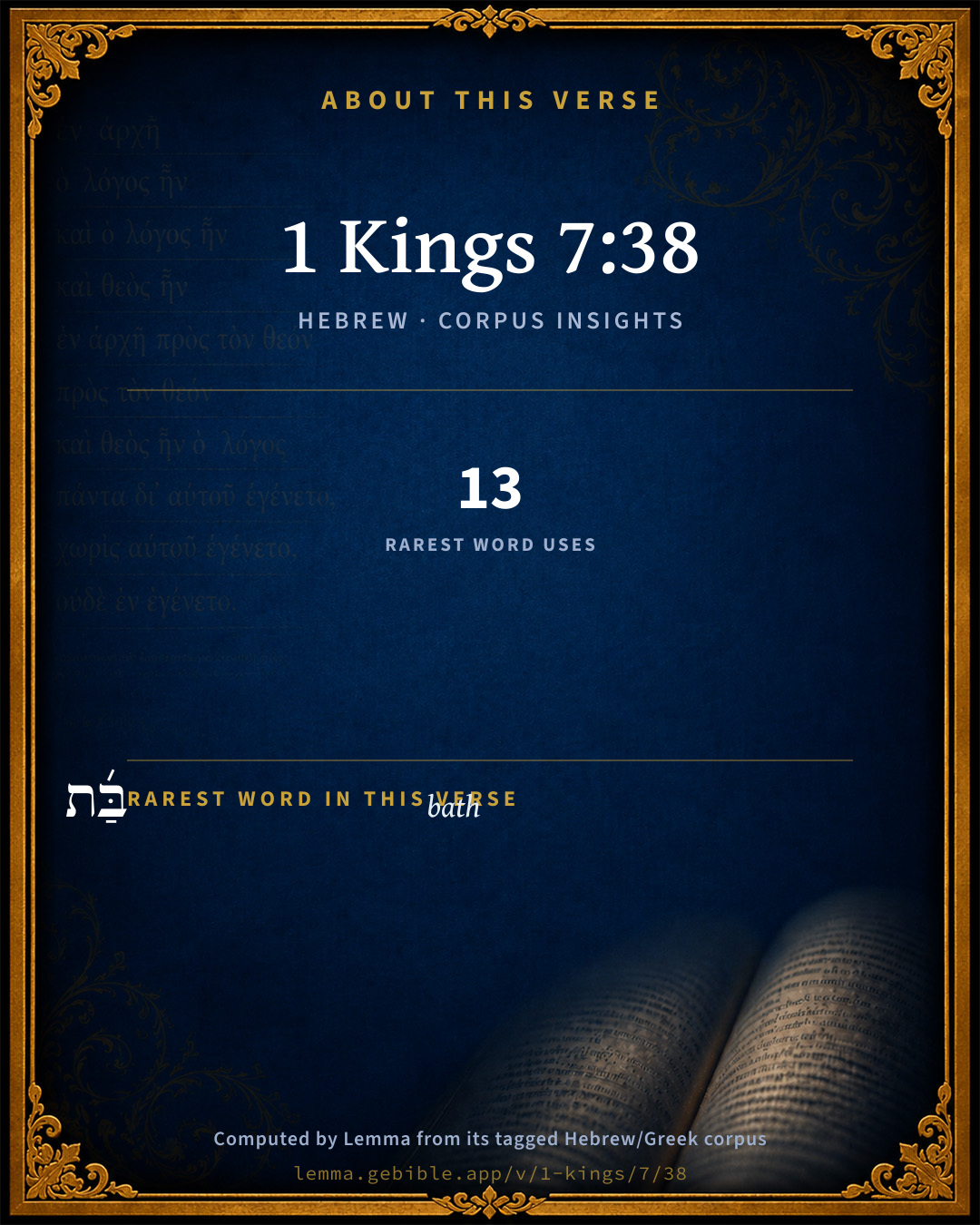
The rarest word here is בַּ֜ת bath H1324 — appearing just 13 times in the whole Hebrew Bible.

Shared distinctive vocabulary

בַּ֜ת bath H1324 occurs in 8 verses of the Hebrew Bible. Also found in:

Grammatical profile

  • 2 verbs
  • 9 nouns
  • 8 adjectives
  • 1 preposition

Verb forms

  • וַיַּ֛עַשׂ Qal · Sequential Imperfect
  • יָכִ֣יל Hiphil · Imperfect

Repetition

Words recur within this verse — often emphatic in Hebrew:

  • כִיֹּר֖וֹת pot H3595 ×4
  • הָאֶחָ֗ד one H259 ×4
  • עֲשָׂרָ֥ה ten H6235 ×2
  • הַמְּכוֹנָ֣ה pedestal H4350 ×2

Hebrew & Septuagint length

In English translation the verse runs 27 words from the Hebrew and 26 from the Septuagint (LXX English) — closely comparable.

A rough comparison of the two English renderings, which tokenize alike — not a word-level alignment.

Word counts can differ between the Hebrew and the Greek without any difference in meaning — e.g. the Hebrew direct-object marker אֵת has no separate Greek word, and Greek often adds the article ὁ.

Cross-references

10

Topical passages linked to 1 Kings 7:38 in the Treasury of Scripture Knowledge — connected by theme and wording, ordered by reader-vote popularity; previews shown in the World English Bible.

  • Exodus 30:17–21 Yahweh spoke to Moses, saying,
  • Exodus 30:28 the altar of burnt offering with all its utensils, and the basin with its base.
  • Exodus 38:8 He made the basin of brass, and its base of brass, out of the mirrors of the ministering women who ministered at the door of the tent of meeting.
  • Exodus 40:11–12 You shall anoint the basin and its base, and sanctify it.
  • 2 Chronicles 4:6–22 He made also ten basins, and put five on the right hand, and five on the left, to wash in them; such things as belonged to the burnt-offering they washed in them; but the sea was for the priests to wash in.
  • Zechariah 13:1 "In that day there will be a spring opened to the house of David and to the inhabitants of Jerusalem, for sin and for uncleanness.
  • Hebrews 9:10 being only (with meats and drinks and various washings) fleshly ordinances, imposed until a time of reformation.
  • Hebrews 10:22 let's draw near with a true heart in fullness of faith, having our hearts sprinkled from an evil conscience, and having our body washed with pure water,
  • 1 John 1:7 But if we walk in the light, as he is in the light, we have fellowship with one another, and the blood of Jesus Christ, his Son, cleanses us from all sin.
  • Revelation 7:14 I told him, "My lord, you know." He said to me, "These are those who came out of the great tribulation. They washed their robes, and made them white in the Lamb's blood.

Cross-references courtesy of OpenBible.info (CC BY 4.0).

Hebrew and Greek witnesses Masoretic Hebrew ↔ Greek Septuagint

The same verse in the two great witnesses to the Old Testament, shown verse-for-verse.

These are two independent witnesses, not word-aligned to each other, and the Septuagint is shown in lemma (dictionary) form.

Hebrew 1 Kings 7:38 Masoretic · Westminster Leningrad Codex

וַיַּ֛עַשׂ עֲשָׂרָ֥ה כִיֹּר֖וֹת נְחֹ֑שֶׁת אַרְבָּעִ֨ים בַּ֜ת יָכִ֣יל הַכִּיּ֣וֹר הָאֶחָ֗ד אַרְבַּ֤ע בָּֽאַמָּה֙ הַכִּיּ֣וֹר הָאֶחָ֔ד כִּיּ֤וֹר אֶחָד֙ עַל הַמְּכוֹנָ֣ה הָאַחַ֔ת לְעֶ֖שֶׂר הַמְּכֹנֽוֹת

He made ten basins of brass: one basin contained forty baths; and every basin was four cubits; and on very one of the ten bases one basin.

World English Bible · Public Domain

Greek LXX 1 Kings 7:38 Septuagint · lemma form

καί ὁ οἶκος αὐτός οἰκοδομέω σαλωμών τρισκαίδεκα ἔτος

And he made ten brazen lavers, each laver containing forty baths, and measuring four cubits, each laver placed on a several base throughout the ten bases.

LXX2012 (modern English Septuagint) · Public Domain

Hebrew: Westminster Leningrad Codex (CC BY 4.0). Greek: Septuagint (public domain); English from LXX2012 (modern English Septuagint) (Public Domain). How the Septuagint differs from the Hebrew →

Targum (Aramaic paraphrase)

1

The Targum is the ancient Jewish Aramaic paraphrase of the Hebrew Scriptures — an interpretive translation, not the Hebrew text itself. Onkelos (literal) and Pseudo-Jonathan (expansive) render the Torah, and Jonathan the Prophets. Coverage is partial: where no permissively-licensed English translation exists for a verse, only the Aramaic is shown. This is verse-level text, not a word-by-word alignment to the Hebrew.

  1. Targum Jonathan Prophets (Joshua–Malachi)
    וַעֲבַד עַשְׂרָא כִיוֹרִין דִנְחָשָׁא אַרְבְּעִין בֵּיתִין בִּרְטִיבָא מַחְסִיל לִכִיוֹרָא חָד אַרְבַּע אַמִין כִּיוֹרָא חָד כִּיוֹרָא חָד עַל בְּסִיסָא חֲדָא לַעֲסַר בְּסִיסַיָא:

    (no public-domain English translation for this verse)

    Targum Jonathan — Aramaic: “Mikraot Gedolot” (public domain). English: “Sefaria Community Translation” (CC0 1.0 (public-domain dedication)); “London "Chaldee Paraphrase," 1871” (public domain). Text via Sefaria.

Commentary

Notes on 1 Kings 7:38 from classic Christian and Jewish commentators (each source and its license shown beneath its notes). The classic Christian expositions comment on the surrounding passage and are grouped to its opening verse, so a note may address several verses; the Jewish commentaries on the Tanakh (Rashi and others) are per-verse, so they appear only where the commentator wrote on this verse.

Lemma curates 59 commentaries, every one of them public domain or Creative Commons licensed, each selected and text-cleaned for this edition rather than reprinted as found. About our sources →

Trapp's Complete Commentary

John Trapp

1Ki 7:38 Then made he ten lavers of brass: one laver contained forty baths: [and] every laver was four cubits: [and] upon every one of the ten bases one laver.

Ver. 38. Then made he ten lavers of brass.] And all to show the filthiness of sin, and the necessity of Christ’s blood, {1Jn 1:7 Zec 13:1} wherewith the holy priesthood of his chosen must be washed and sanctified in action and affection, before their service can be accepted. {Eph 5:26}

John Trapp, A Commentary or Exposition upon All the Books of the Old and New Testament (1647–1656) — public domain. Text from a community e-Sword module.

Joseph Benson's Commentary

1Ki 7:38-39. He made ten lavers of brass — Which were to stand upon the bases before mentioned. One laver contained forty baths — See 1Ki 7:26; from whence it will appear, that each of these lavers contained ten barrels of water. And every laver was four cubits — Some think they were of this height. But it is more likely that these words relate to the diameter of them, which was four cubits, and then their compass was twelve cubits. He put five bases on the right side — That is, on the south side. See 1Ki 6:8. Of the house — Of the court where the priests ministered, and where, as occasion required, they washed either their hands or feet, or the parts of the sacrifices. Five on the left side of the house — That is, on the north side of that court, which is here opposed to the right or south side. Over against the south — That is, in the south-east part, where the offerings were prepared. So that, as soon as the priests entered, which they did at the east gate, they might have water to wash their hands and their feet.

Joseph Benson's Commentary on the Old and New Testaments (1811–1818) — public domain. Text from a community e-Sword module.

Geneva Bible (1599)

Geneva Bible translators

To keep waters for the use of the sacrifices.

Geneva Bible (1599) marginal notes — public domain. Text via Bolls.life.

Adam Clarke's Commentary

Verse 38. Then made he ten lavers] These were set on the ten bases or pedestals, and were to hold water for the use of the priests in their sacred office, particularly to wash the victims that were to be offered as a burnt-offering, as we learn from 2Ch 4:6; but the brazen sea was for the priests to wash in. The whole was a building of vast art, labour, and expense.

Adam Clarke's Commentary on the Bible (1810–1826) — public domain. Text from a community e-Sword/MySword module.

The Cambridge Bible for Schools and Colleges

gen. ed. J. J. S. Perowne

38. Then made he] It is only the simple copulative And.

The Cambridge Bible for Schools and Colleges (gen. ed. J. J. S. Perowne; Cambridge University Press, 1878–1918) — public domain. Text from a community e-Sword module.

John Gill's Exposition

And he put five bases on the right side of the house,.... On the south side, which is commonly understood; that is, of the courts of the priests, where they were placed for their use: and five on the left side of the house; on the north, as it must be, if the south is on the right; though as the entrance into the temple was at the east, when a man went in, the north must be on the right, and the south on the left; and this seems to be the position by what follows:

and he set the sea on the right side of the house eastward, over against the south; and therefore the right side must be the north, which is opposite to the south; the sea seems to have stood northeast, which was for the priests to wash in before they entered on divine service; see Gill on Exo 30:20 hence it became customary with the Heathens to wash before they performed any religious worship (e), particularly the hands and feet (f).

(e) Vid. Virgil. Bucolic. Eclog. 8. "affer aquam", &c. Aeneid. 2. "attrectare nefas", &c. Macrob. Saturnal. l. 3. c. l. (f) Vid. Sperling de Bapt. Ethnic. p. 88, 89, 101.

John Gill's Exposition of the Whole Bible (1746–1763) — public domain (CC PDM 1.0). Text via the HelloAO Bible API.

Albert Barnes' Notes on the Bible

Every laver was four cubits - Assuming height to be intended, and taking the cubit at 20 inches, the entire height of the lavers as they stood upon their wheeled stands would seem to have been 13 ft. 9 in. It is evident, therefore, that the water must have been drawn from them, as from the “molten sea,” through cocks or taps.

Albert Barnes' Notes on the Bible (1834–1885) — public domain. Text from a community e-Sword/MySword module.

Haydock's Catholic Bible Commentary

CHAPTER VII.

George Leo Haydock (1774–1849), Haydock's Catholic Family Bible and Commentary, 1859 edition — public domain. Excludes Psalms (Douay-Rheims chapter numbering differs from Protestant) and Deuterocanonical books (Catholic canon only).

Matthew Poole's English Annotations

Forty baths; ten barrels; of which See Poole "1Ki 7:26".

Matthew Poole's English Annotations on the Holy Bible (1683–1685) — public domain. Text from a community e-Sword/MySword module.

Whedon's Commentary on the Bible

Daniel D. Whedon

38. Ten lavers — One laver to stand on each of the ten bases.

Forty baths — Three hundred and fifty-five gallons.

Every laver was four cubits — In diameter at the mouth.

Daniel D. Whedon (gen. ed.), Commentary on the Old and New Testaments (1874–1909) — public domain. Text from a community e-Sword module.

The Pulpit Commentary

Then made he ten layers of brass: one laver contained forty baths i.e. , about 340 gals., if we accept the account of Josephus, Ant 8:2.9. But see on ver. 26: and every laver was four cubits. It is uncertain whether the height or the diameter is meant. Keil decides for the latter and four cubits, the width of the sides of the stand, may well have been also the diameter of the basin on the ground that as" the basins were set upon (l) the stands," it can hardly refer to the height. But it is worthy of remark that "the height of all the ether parts has been mentioned" (Rawlinson). See vers. 27, 32, 35, and without this particular we could not calculate the entire height, which, if the laver were four cubits, would be about thirteen feet. This surprising size is accounted for by remembering the height of the altar, to which the fat and other sacrificial portions had to be transferred from the laver): and upon every one of the ten bases one laver. Ten layers would not be at all too many when we remember the prodigious number of victims which were occasionally offered.

The Pulpit Commentary (1880–1919), ed. H.D.M. Spence-Jones & Joseph S. Exell — public domain. Text from a community e-Sword module.

unfoldingWord translationNotes

Door43 World Missions Community

Huram made ten ... He made five ... He set

Huram would have commanded his workers to do this work. AT: "Huram had them make ten ... Human had them make five ... Huram commanded them to set" (See: Metonymy)

forty baths

A bath is a unit of volume equal to about 22 liters. AT: "about 88 liters" or "about 90 liters" (See: Biblical Volume)

four cubits

A cubit is 46 centimeters. AT: "about 1.8 meters" (See: Biblical Distance)

the south-facing side ... the north-facing side

"the south side ... the north side"

on the east corner, facing toward the south of the temple

"near the southeast corner of the temple"

translationWords

bronze

temple

unfoldingWord translationNotes — © Distant Shores Media and the Door43 World Missions Community, licensed CC BY-SA 4.0. Source: git.door43.org/Door43/en_tn.

Rashi

Rabbi Shlomo Yitzchaki (Rashi)

He made ten [copper wash] basins. It is written in Divrei Hayomim, “the parts of the burnt-offering they rinsed with them.”

Rashi on the Tanakh — English translations: “The Judaica Press complete Tanach with Rashi, translated by A. J. Rosenberg” (CC BY 4.0); “Pentateuch with Rashi's commentary by M. Rosenbaum and A.M. Silbermann, 1929-1934” (public domain); “The Metsudah Tanach series, Lakewood, N.J” (CC BY 4.0); and “The Book of Joshua, Metsudah Publications, 1997” (CC BY 4.0). Text via Sefaria.

Lesson kit

Teaching starters — assembled from the data on this page, not authored interpretation. Every prompt links to the verse data it draws on. Edit before teaching.

1 Kings, in the Historical, opens this verse with 20 words (12 distinct Hebrew lemmas). Its most distinctive word is bath (“bath”). A historical commentator’s framing appears above. Read the whole chapter for the surrounding context.

Discussion questions

  1. How does “bath” (bath) shape what this verse is saying?
  2. How does 1 Kings 7:26, which shares the word «bath», read alongside this verse?
  3. What does the repetition of “pot” (4× in this one verse) do in this verse?
  4. The translations on this page render this verse differently — a whole-verse word diff, not a word-by-word alignment. What might account for the different wordings?
  5. «וַיַּ֛עַשׂ» is a Qal Sequential Imperfect verb. How does that grammatical form shape the action described?
  6. Compare how Trapp's Complete Commentary and Joseph Benson's Commentary read this verse. Where do they agree or differ?

Things to notice

Reading settings

Reading text

Shown beneath each verse's original-language words.

Old Testament
Old Testament edition

Read the OT as the Masoretic Hebrew (MT) or the Greek Septuagint (LXX).

English shown for the Greek Septuagint (in the Hebrew ↔ Greek comparison).

Comparing translations? Open the Compare panel on any verse page to stack up to four side by side.