Numbers 35:7

Hebrew (Westminster Leningrad Codex) Numbers 35:7 appears in the Hebrew Old Testament. The text above is from the Westminster Leningrad Codex. Each word links to its Strong’s number, a concise gloss, and parsing drawn from the Open Scriptures Hebrew Bible morphology. Click any word for its full Brown-Driver-Briggs (BDB) entry.
Download image
Cite this verse

Numbers 35:7 (World English Bible). Public Domain. Lemma interlinear Bible study tool, https://lemma.gebible.app/v/numbers/35/7.

Show BibTeX & RIS
BibTeX
RIS
English Translation
All the cities which you shall give to the Levites shall be forty-eight cities; them [shall you give] with their suburbs.
World English Bible · Public Domain
Download a study sheet

One document with this verse’s original text, its word-by-word gloss line, the meaning frame, cross-references with their text, attributed commentary, and full source and license credits — printable, and it pastes into notes with its structure intact.

This verse Autodidact and up

Study sheet (.html) Plain text (.txt)

A passage Seminary Student

Up to 50 verses in one chapter. A passage sheet keeps up to 6 commentary sources and 12 cross-references per verse, in the order this page ranks them, and says so on the sheet whenever that leaves anything out. Ask for a single verse and you get the Autodidact verse sheet above.

Everything on this page stays free to read, with no account — the sheet is a download of what is already on screen, not access to it.

Want to remove ads? Support Godless Engineer
Compare translations 3

The same verse in 3 English versions, stacked beneath the original-language interlinear above. Click any original word for its lexicon entry.

Each is an independent rendering of the whole verse — the interlinear is not word-aligned to these translations.

Highlighted words mark where these versions differ — a whole-verse word diff, not a word-by-word alignment.

  • World English Bible Public Domain
    All the cities which you shall give to the Levites shall be forty-eight cities; them [shall you give] with their suburbs.
  • King James Version Public Domain
    So all the cities which ye shall give to the Levites shall be forty and eight cities: them shall ye give with their suburbs.
  • unfoldingWord Literal Text CC BY-SA 4.0
    All the cities that you shall give to the Levites shall be 48 cities, them and their pasturelands.

unfoldingWord Literal Text — © unfoldingWord, licensed CC BY-SA 4.0. Word-aligned USFM3 via Door43 (git.door43.org/unfoldingWord/en_ult).

Versions to compare (up to 4)

3 of 4 selected

Show all 18 translations

Every available English version of this verse, each an independent rendering of the whole verse.

  • World English Bible Public Domain
    All the cities which you shall give to the Levites shall be forty-eight cities; them [shall you give] with their suburbs.
  • Berean Standard Bible Public Domain
    The total number of cities you give the Levites will be forty-eight, with their corresponding pasturelands.
  • Majority Standard Bible Public Domain
    The total number of cities you give the Levites will be forty-eight, with their corresponding pasturelands.
  • King James Version Public Domain
    So all the cities which ye shall give to the Levites shall be forty and eight cities: them shall ye give with their suburbs.
  • American Standard Version (1901) Public Domain
    All the cities which ye shall give to the Levites shall be forty and eight cities; them `shall ye give' with their suburbs.
  • Revised Version (1885) Public Domain
    All the cities which ye shall give to the Levites shall be forty and eight cities: them shall ye give with their suburbs.
  • Geneva Bible (1599) Public Domain
    All the cities which yee shall giue to the Leuites, shalbe eight and fourtie cities: them shall ye giue with their suburbes.
  • Douay-Rheims (1899) Public Domain
    That is, in all forty-eight with their suburbs.
  • Young's Literal Translation Public Domain
    all the cities which ye give to the Levites `are' forty and eight cities, them and their suburbs.
  • Literal Standard Version CC BY-SA 4.0
    all the cities which you give to the Levites [are] forty-eight cities, them and their outskirts.
  • Unlocked Literal Bible CC BY-SA 4.0
    The cities that you give to the Levites will total forty-eight. You must give their pasturelands with them.
  • unfoldingWord Literal Text CC BY-SA 4.0
    All the cities that you shall give to the Levites shall be 48 cities, them and their pasturelands.
  • Darby Bible Public Domain
    all the cities that ye shall give to the Levites shall be forty-eight cities, they and their suburbs.
  • World Messianic Bible Public Domain
    All the cities which you shall give to the Levites shall be forty-eight cities together with their pasture lands.
  • Webster's Bible Public Domain
    So all the cities which ye shall give to the Levites shall be forty and eight cities: them shall ye give with their suburbs.
  • Free Bible Version CC BY-SA 4.0
    The total number of towns you are to give the Levites is forty-eight, along with their pastures.
  • Bible in Basic English Public Domain
    Forty-eight towns are to be given to the Levites, all with land round them.
  • JPS Tanakh (1917) Public Domain
    All the cities which ye shall give to the Levites shall be forty and eight cities: them shall ye give with the open land about them.

Literal Standard Version (2020), Covenant Press — licensed CC BY-SA 4.0. Text via the HelloAO Bible API (eBible.org). Unlocked Literal Bible (unfoldingWord) — licensed CC BY-SA 4.0. Text via the HelloAO Bible API (eBible.org). unfoldingWord Literal Text — © unfoldingWord, licensed CC BY-SA 4.0. Word-aligned USFM3 via Door43 (git.door43.org/unfoldingWord/en_ult). Free Bible Version, Dr. Jonathan Gallagher — licensed CC BY-SA 4.0. Text via the HelloAO Bible API (eBible.org).

Word by word

More ways to search: Search by grammar → Find every occurrence → Compare this word →

Practice this passage: Drill this verse → Learn its vocabulary →

וּשְׁמֹנֶ֖ה
shᵉmôneh
H8083
“and · eight”
Conjunction + Adjective, Cardinal number, Feminine, Singular, Absolute
Part of Speech
Conjunction + Adjective
Type
Cardinal number
Gender
Feminine
Number
Singular
State
Absolute
Full BDB Definition

Origin: apparently from H8082 through the idea of plumpness

TWOT: 2411a

eight, eighth - eight (as cardinal number) - eighth (as ordinal number) - in combination with other numbers
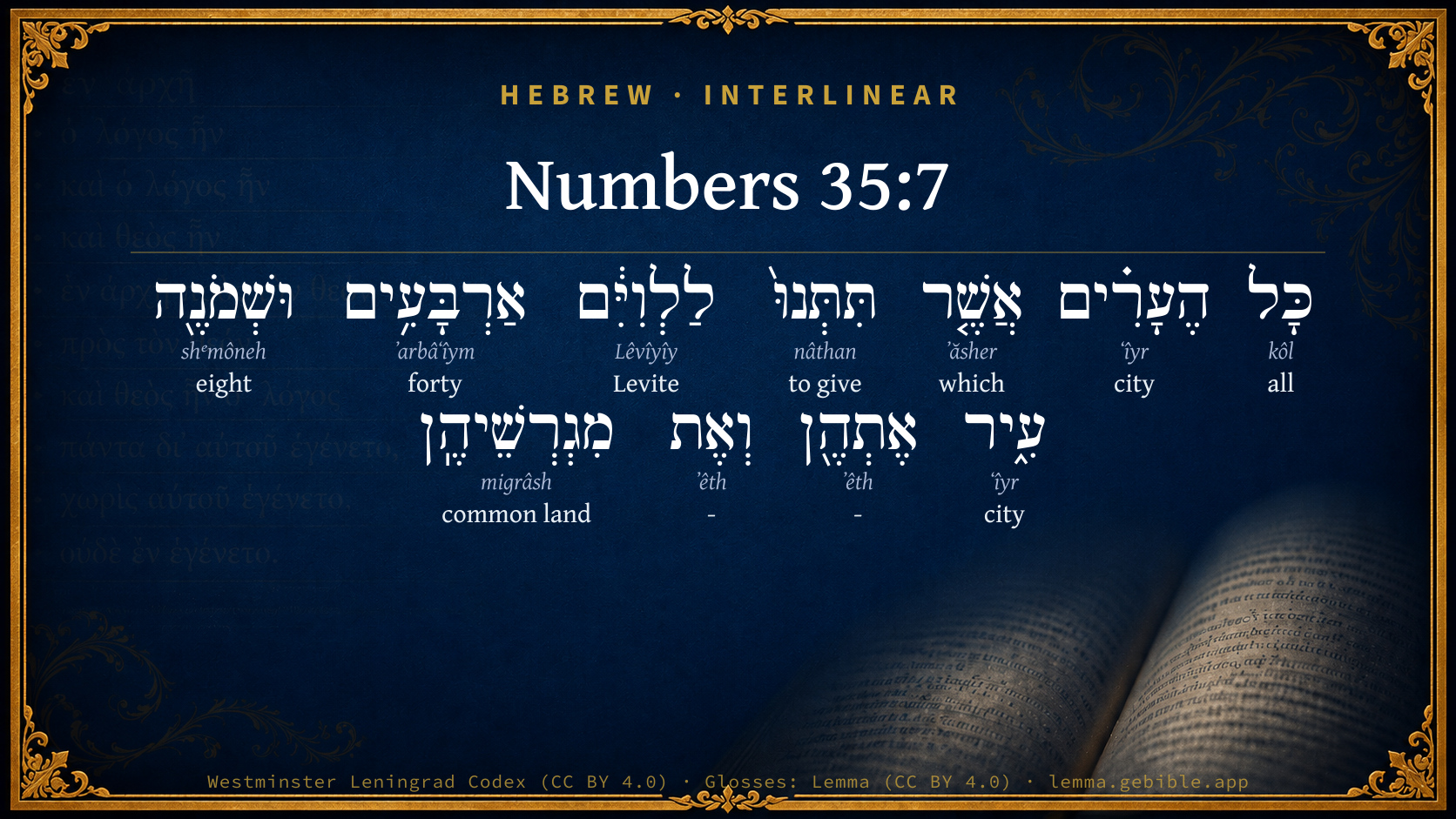
  1. כָּל kôl H3605 “all of” Noun, Common, Masculine, Singular, Construct
  2. הֶעָרִ֗ים ʻîyr H5892 “the · cities” Particle, Definite Article + Noun, Common, Feminine, Plural, Absolute
  3. אֲשֶׁ֤ר ʼăsher H834 “which” Particle, Relative
  4. תִּתְּנוּ֙ nâthan H5414 “to give” Verb, Qal, Imperfect, 2nd Person, Masculine, Plural
  5. לַלְוִיִּ֔ם Lêvîyîy H3881 “to/for the · Levites” Preposition, Determined + Noun, Gentilic, Masculine, Plural, Absolute
  6. אַרְבָּעִ֥ים ʼarbâʻîym H705 “forty” Adjective, Cardinal number, Both, Plural, Absolute
  7. עִ֑יר ʻîyr H5892 “city” Noun, Common, Feminine, Singular, Absolute
  8. אֶתְהֶ֖ן ʼêth H853 “- · them” Particle, Direct Object + Suffix, Personal, 3rd Person, Feminine, Plural
  9. וְאֶת ʼêth H853 “and · -” Conjunction + Particle, Direct Object
  10. מִגְרְשֵׁיהֶֽן migrâsh H4054 “common lands · their” Noun, Common, Masculine, Plural, Construct + Suffix, Personal, 3rd Person, Feminine, Plural

About this verse

These counts appear in no published source. They are computed here, from the morphology-tagged text and Lemma’s own curated glosses. What Lemma adds →

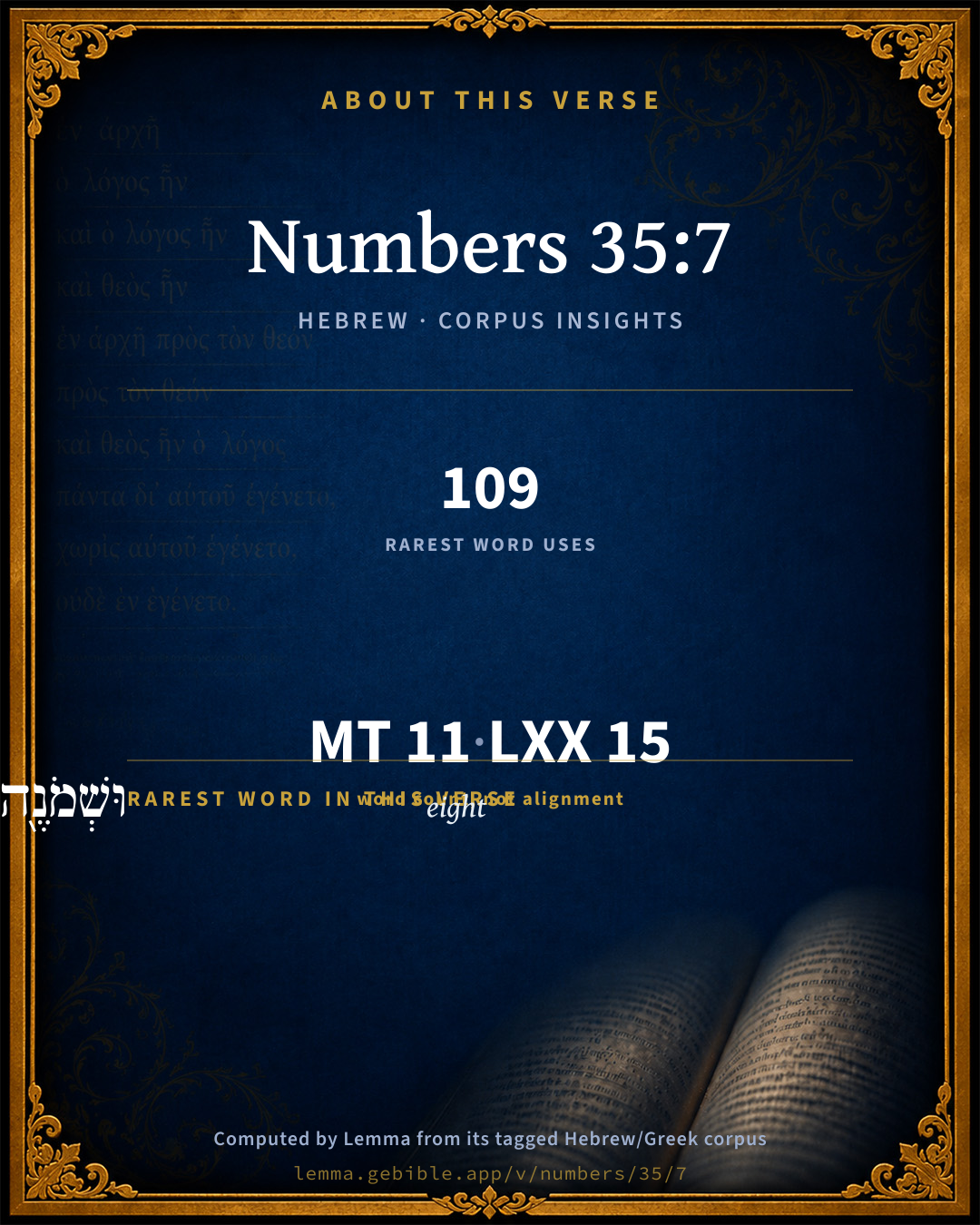
11
words
9
distinct lemmas
Pentateuch
section

Grammatical profile

  • 1 verb
  • 5 nouns
  • 2 adjectives
  • 3 particles

Verb forms

  • תִּתְּנוּ֙ Qal · Imperfect

Repetition

A word recurs within this verse — often emphatic in Hebrew:

  • הֶעָרִ֗ים city H5892 ×2

Hebrew & Septuagint length

In English translation the verse runs 21 words from the Hebrew and 14 from the Septuagint (LXX English) — the Septuagint runs noticeably shorter here. See the side-by-side →

A rough comparison of the two English renderings, which tokenize alike — not a word-level alignment.

Word counts can differ between the Hebrew and the Greek without any difference in meaning — e.g. the Hebrew direct-object marker אֵת has no separate Greek word, and Greek often adds the article ὁ.

In the original languages it is 11 Hebrew tokens and 15 Greek tokens — but the two are counted differently (Hebrew bundles its prefixes and suffixes into one token; the Greek is in lemma form), so that isn’t a like-for-like length.

Cross-references

2

Topical passages linked to Numbers 35:7 in the Treasury of Scripture Knowledge — connected by theme and wording, ordered by reader-vote popularity; previews shown in the World English Bible.

  • Joshua 21:3–42 The children of Israel gave to the Levites out of their inheritance, according to the commandment of Yahweh, these cities with their suburbs.
  • 1 Chronicles 6:54–81 Now these are their dwelling-places according to their encampments in their borders: to the sons of Aaron, of the families of the Kohathites (for theirs was the [first] lot),

Cross-references courtesy of OpenBible.info (CC BY 4.0).

Hebrew and Greek witnesses Masoretic Hebrew ↔ Greek Septuagint

The same verse in the two great witnesses to the Old Testament, shown verse-for-verse.

Here the Septuagint runs noticeably shorter than the Hebrew — LXX2012 (modern English Septuagint) 14 words vs World English Bible 21. A rough length comparison of the two English translations, not a word-level alignment — read both below.

These are two independent witnesses, not word-aligned to each other, and the Septuagint is shown in lemma (dictionary) form.

Hebrew Numbers 35:7 Masoretic · Westminster Leningrad Codex

כָּל הֶעָרִ֗ים אֲשֶׁ֤ר תִּתְּנוּ֙ לַלְוִיִּ֔ם אַרְבָּעִ֥ים וּשְׁמֹנֶ֖ה עִ֑יר אֶתְהֶ֖ן וְאֶת מִגְרְשֵׁיהֶֽן

All the cities which you shall give to the Levites shall be forty-eight cities; them [shall you give] with their suburbs.

World English Bible · Public Domain

Greek LXX Numbers 35:7 Septuagint · lemma form

πᾶς ὁ πόλις δίδωμι ὁ λευίτης τεσσαράκοντα καί ὀκτώ πόλις οὗτος καί ὁ προάστειον αὐτός

You⌃ shall give to the Levites in all forty-eight cities, them and their suburbs.

LXX2012 (modern English Septuagint) · Public Domain

Hebrew: Westminster Leningrad Codex (CC BY 4.0). Greek: Septuagint (public domain); English from LXX2012 (modern English Septuagint) (Public Domain). How the Septuagint differs from the Hebrew →

Targum (Aramaic paraphrase)

2

The Targum is the ancient Jewish Aramaic paraphrase of the Hebrew Scriptures — an interpretive translation, not the Hebrew text itself. Onkelos (literal) and Pseudo-Jonathan (expansive) render the Torah, and Jonathan the Prophets. Coverage is partial: where no permissively-licensed English translation exists for a verse, only the Aramaic is shown. This is verse-level text, not a word-by-word alignment to the Hebrew.

  1. Targum Onkelos Torah (Genesis–Deuteronomy)
    כָּל קִרְוַיָא דִי תִתְּנוּן לְלֵוָאֵי אַרְבְּעִין וְתַמְנֵי קִרְוִין יָתְהֶן וְיָת רְוָחֵיהֶן

    (no public-domain English translation for this verse)

    Targum Onkelos — Aramaic: “Onkelos Genesis” (public domain); “Onkelos Exodus” (public domain); “Onkelos Leviticus” (public domain); “Onkelos Numbers” (public domain); “Onkelos Deuteronomy” (public domain). English: “Sefaria Community Translation” (CC0 1.0 (public-domain dedication)); “J.W. Etheridge. The Targums of Onkelos and Jonathan Ben Uzziel on the Pentateuch. London: Longmans, Green, 1862” (public domain). Text via Sefaria.

  2. Targum Pseudo-Jonathan Torah (Genesis–Deuteronomy)
    כָּל קִירְוַיָא דְתִתְּנוּן לְלֵיוָאֵי אַרְבְּעִין וְתַמְנֵי קוּרְיַין יַתְהוֹן וְיַת פְּדוֹרְוַולְהוֹן

    All the cities that you give to the Levites shall be forty-eight cities with their suburbs.

    Targum Pseudo-Jonathan — Aramaic: “Targum Jonathan on Genesis” (public domain); “Targum Jonathan on Exodus” (public domain); “Targum Jonathan on Leviticus” (public domain); “Targum Jonathan on Numbers” (public domain); “Targum Jonathan on Deuteronomy” (public domain). English: “The Targum of Jonathan ben Uzziel, trans. J. W. Etheridge, London, 1862” (public domain). Text via Sefaria.

Commentary

Notes on Numbers 35:7 from classic Christian and Jewish commentators (each source and its license shown beneath its notes). The classic Christian expositions comment on the surrounding passage and are grouped to its opening verse, so a note may address several verses; the Jewish commentaries on the Tanakh (Rashi and others) are per-verse, so they appear only where the commentator wrote on this verse.

Lemma curates 59 commentaries, every one of them public domain or Creative Commons licensed, each selected and text-cleaned for this edition rather than reprinted as found. About our sources →

Trapp's Complete Commentary

John Trapp

Num 35:7 [So] all the cities which ye shall give to the Levites [shall be] forty and eight cities: them [shall ye give] with their suburbs.

Ver. 7. Shall be forty and eight cities.] Thus the Levites were dispersed throughout the land for instruction of the people; so ought ministers of the gospel, who are fitly called the salt of the earth, that being sprinkled up and down, may keep the rest (as flesh) from rotting and putrifying.

John Trapp, A Commentary or Exposition upon All the Books of the Old and New Testament (1647–1656) — public domain. Text from a community e-Sword module.

John Gill's Exposition

So all the cities which ye shall give to the Levites shall be forty eight cities,.... Of these forty eight cities, their names, and what tribes they were in, and which of them were particularly cities of refuge, an account is given in Jos 21:10,

them shall ye give, with their suburbs; according to the dimensions before prescribed.

John Gill's Exposition of the Whole Bible (1746–1763) — public domain (CC PDM 1.0). Text via the HelloAO Bible API.

The Pulpit Commentary

Forty and eight cities. The Levites numbered nearly 50, 000 souls, (see on Num_26:62) so that each Levitical city would have an average population of about 1000 to start with. There seems no sufficient reason for supposing that they shared their towns with men of the surrounding tribe. Even if the provision made for their habitation was excessive at first (which does not appear), yet their rate of increase should have been exceptionally high, inasmuch as they were not liable to military service. It is possible that mystical reasons led to the selection of the number forty-eight (12 x 4, both typical of universality), but it is at least equally probable that it was determined by the actual numbers of the tribe.

The Pulpit Commentary (1880–1919), ed. H.D.M. Spence-Jones & Joseph S. Exell — public domain. Text from a community e-Sword module.

Lesson kit

Teaching starters — assembled from the data on this page, not authored interpretation. Every prompt links to the verse data it draws on. Edit before teaching.

Numbers, in the Pentateuch, opens this verse with 11 words (9 distinct Hebrew lemmas). Its most distinctive word is shᵉmôneh (“eight”). The Greek Septuagint runs shorter here. A historical commentator’s framing appears above. Read the whole chapter for the surrounding context.

Discussion questions

  1. The word shᵉmôneh carries the sense “eight.” How does it shape the verse?
  2. How does Joshua 21:3–42, which shares this passage’s theme, read alongside this verse?
  3. What does the repetition of “city” (2× in this one verse) do in this verse?
  4. The Septuagint runs shorter here than the Hebrew. What might account for the difference?
  5. The translations on this page render this verse differently — a whole-verse word diff, not a word-by-word alignment. What might account for the different wordings?
  6. «תִּתְּנוּ֙» is a Qal Imperfect verb. How does that grammatical form shape the action described?
  7. Compare how Trapp's Complete Commentary and John Gill's Exposition read this verse. Where do they agree or differ?

Things to notice

Reading settings

Reading text

Shown beneath each verse's original-language words.

Old Testament
Old Testament edition

Read the OT as the Masoretic Hebrew (MT) or the Greek Septuagint (LXX).

English shown for the Greek Septuagint (in the Hebrew ↔ Greek comparison).

Comparing translations? Open the Compare panel on any verse page to stack up to four side by side.