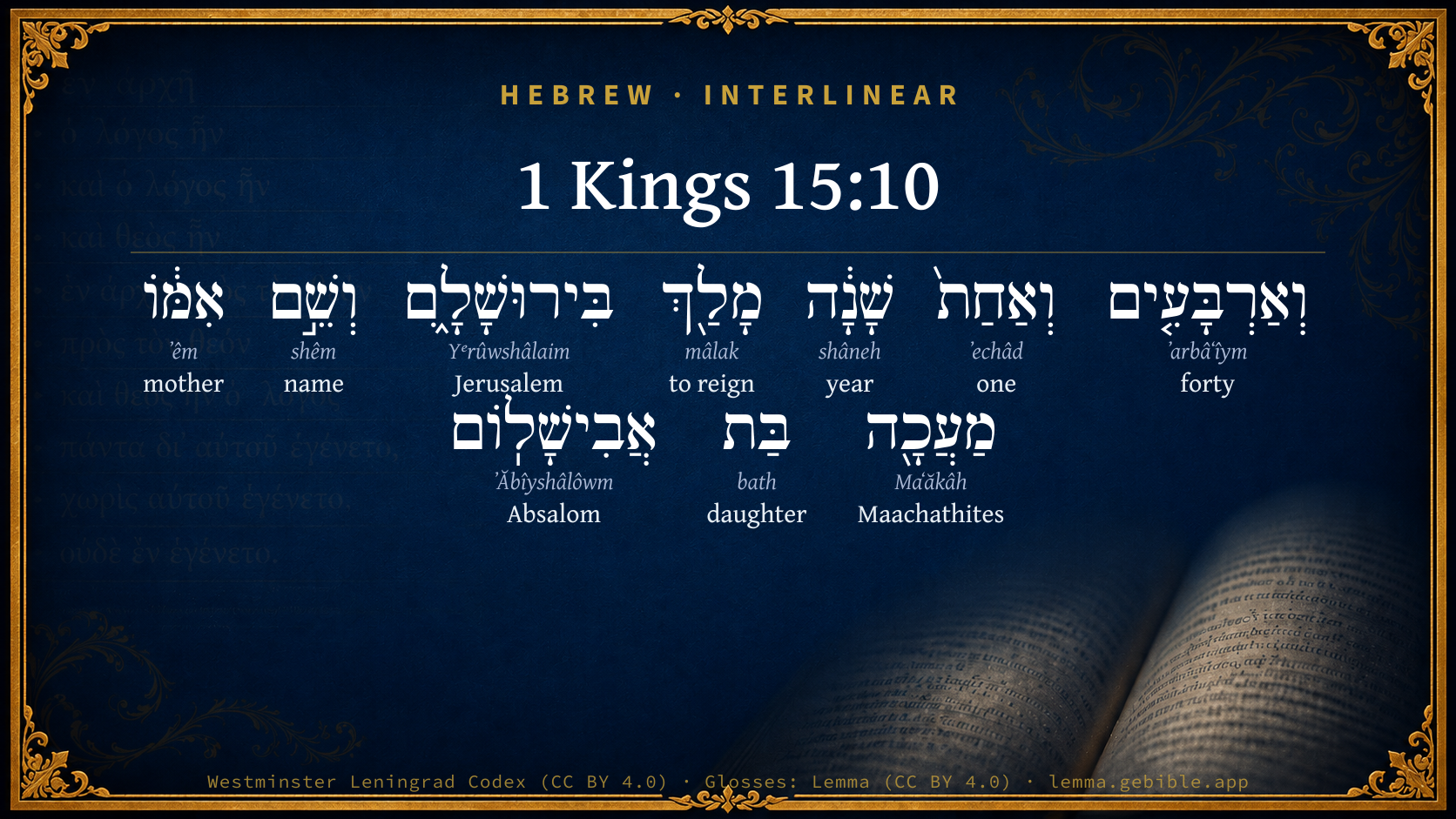
1 Kings 15:10

Hebrew (Westminster Leningrad Codex) 1 Kings 15:10 appears in the Hebrew Old Testament. The text above is from the Westminster Leningrad Codex. Each word links to its Strong’s number, a concise gloss, and parsing drawn from the Open Scriptures Hebrew Bible morphology. Click any word for its full Brown-Driver-Briggs (BDB) entry.
Download image
Cite this verse

1 Kings 15:10 (World English Bible). Public Domain. Lemma interlinear Bible study tool, https://lemma.gebible.app/v/1-kings/15/10.

Show BibTeX & RIS
BibTeX
RIS
English Translation
Forty-one years reigned he in Jerusalem: and his mother's name was Maacah the daughter of Abishalom.
World English Bible · Public Domain
Download a study sheet

One document with this verse’s original text, its word-by-word gloss line, the meaning frame, cross-references with their text, attributed commentary, and full source and license credits — printable, and it pastes into notes with its structure intact.

This verse Autodidact and up

Study sheet (.html) Plain text (.txt)

A passage Seminary Student

Up to 50 verses in one chapter. A passage sheet keeps up to 6 commentary sources and 12 cross-references per verse, in the order this page ranks them, and says so on the sheet whenever that leaves anything out. Ask for a single verse and you get the Autodidact verse sheet above.

Everything on this page stays free to read, with no account — the sheet is a download of what is already on screen, not access to it.

Want to remove ads? Support Godless Engineer
Compare translations 3

The same verse in 3 English versions, stacked beneath the original-language interlinear above. Click any original word for its lexicon entry.

Each is an independent rendering of the whole verse — the interlinear is not word-aligned to these translations.

Highlighted words mark where these versions differ — a whole-verse word diff, not a word-by-word alignment.

  • World English Bible Public Domain
    Forty-one years reigned he in Jerusalem: and his mother's name was Maacah the daughter of Abishalom.
  • King James Version Public Domain
    And forty and one years reigned he in Jerusalem. And his mother's name was Maachah, the daughter of Abishalom.
  • unfoldingWord Literal Text CC BY-SA 4.0
    And he reigned 41 years in Jerusalem. And the name of his mother was Maacah the daughter of Abishalom.

unfoldingWord Literal Text — © unfoldingWord, licensed CC BY-SA 4.0. Word-aligned USFM3 via Door43 (git.door43.org/unfoldingWord/en_ult).

Versions to compare (up to 4)

3 of 4 selected

Show all 18 translations

Every available English version of this verse, each an independent rendering of the whole verse.

  • World English Bible Public Domain
    Forty-one years reigned he in Jerusalem: and his mother's name was Maacah the daughter of Abishalom.
  • Berean Standard Bible Public Domain
    and he reigned in Jerusalem forty-one years. His grandmother’s name was Maacah daughter of Abishalom.
  • Majority Standard Bible Public Domain
    and he reigned in Jerusalem forty-one years. His grandmother’s name was Maacah daughter of Abishalom.
  • King James Version Public Domain
    And forty and one years reigned he in Jerusalem. And his mother's name was Maachah, the daughter of Abishalom.
  • American Standard Version (1901) Public Domain
    And forty and one years reigned he in Jerusalem: and his mother's name was Maacah the daughter of Abishalom.
  • Revised Version (1885) Public Domain
    And forty and one years reigned he in Jerusalem: and his mother’s name was Maacah the daughter of Abishalom.
  • Geneva Bible (1599) Public Domain
    He reigned in Ierusalem one and fourtie yeere, and his mothers name was Maachah the daughter of Abishalom.
  • Douay-Rheims (1899) Public Domain
    And he reigned one end forty years in Jerusalem. His mother's name was Maacha, the daughter of Abessalom.
  • Young's Literal Translation Public Domain
    and forty and one years he hath reigned in Jerusalem, and the name of his mother `is' Maachah daughter of Abishalom.
  • Literal Standard Version CC BY-SA 4.0
    and he has reigned forty-one years in Jerusalem, and the name of his mother [is] Maachah daughter of Abishalom.
  • Unlocked Literal Bible CC BY-SA 4.0
    He ruled forty-one years in Jerusalem. His grandmother's name was Maacah, the daughter of Abishalom.
  • unfoldingWord Literal Text CC BY-SA 4.0
    And he reigned 41 years in Jerusalem. And the name of his mother was Maacah the daughter of Abishalom.
  • Darby Bible Public Domain
    and he reigned forty-one years in Jerusalem; and his mother's name was Maachah, daughter of Abishalom.
  • World Messianic Bible Public Domain
    He reigned forty-one years in Jerusalem. His mother’s name was Maacah the daughter of Abishalom.
  • Webster's Bible Public Domain
    And forty and one years reigned he in Jerusalem. And his mother's name was Maachah, the daughter of Abishalom.
  • Free Bible Version CC BY-SA 4.0
    He reigned in Jerusalem forty-one years. His grandmother's name was Maacah, daughter of Abishalom.
  • Bible in Basic English Public Domain
    And he was king for forty-one years in Jerusalem; his mother's name was Maacah, the daughter of Abishalom.
  • JPS Tanakh (1917) Public Domain
    And forty and one years reigned he in Jerusalem; and his mother's name was Maacah the daughter of Abishalom.

Literal Standard Version (2020), Covenant Press — licensed CC BY-SA 4.0. Text via the HelloAO Bible API (eBible.org). Unlocked Literal Bible (unfoldingWord) — licensed CC BY-SA 4.0. Text via the HelloAO Bible API (eBible.org). unfoldingWord Literal Text — © unfoldingWord, licensed CC BY-SA 4.0. Word-aligned USFM3 via Door43 (git.door43.org/unfoldingWord/en_ult). Free Bible Version, Dr. Jonathan Gallagher — licensed CC BY-SA 4.0. Text via the HelloAO Bible API (eBible.org).

Word by word

More ways to search: Search by grammar → Find every occurrence → Compare this word →

Practice this passage: Drill this verse → Learn its vocabulary →

מַעֲכָ֖ה
Maʻăkâh
H4601
“Maachathites”
Noun, Proper
Part of Speech
Noun
Type
Proper
Full BDB Definition

Origin: from H4600

TWOT: None

Maachathites = "pressure (literally she has pressed)" - father of Achish, king of Gath at the beginning of Solomon's reign (noun proper masculine) - father of Hanan, one of David's mighty warriors (noun proper masculine) - a Simeonite, father of Shephatiah, prince of his tribe in the reign of David (noun proper masculine) - son of Nahor by concubine Reumah (noun proper masculine) - daughter of king Talmai of Geshur, wife of David, and mother of Absalom (noun proper feminine) - daughter of Absalom, wife of king Rehoboam of Judah, and mother of king Abijam of Judah (noun proper feminine) - concubine of Caleb the son of Hezron (noun proper feminine) - wife of Machir of the tribe of Manasseh (noun proper feminine) - wife of Jehiel, father of Gibeon (noun proper feminine) - a mercenary people hired to fight David (noun proper)
  1. וְאַרְבָּעִ֤ים ʼarbâʻîym H705 “and · forty” Conjunction + Adjective, Cardinal number, Both, Plural, Absolute
  2. וְאַחַת֙ ʼechâd H259 “and · one” Conjunction + Adjective, Cardinal number, Feminine, Singular, Absolute
  3. שָׁנָ֔ה shâneh H8141 “year” Noun, Common, Feminine, Singular, Absolute
  4. מָלַ֖ךְ mâlak H4427 “to reign” Verb, Qal, Perfect, 3rd Person, Masculine, Singular
  5. בִּירוּשָׁלִָ֑ם Yᵉrûwshâlaim H3389 “in/at · Jerusalem” Preposition + Noun, Proper
  6. וְשֵׁ֣ם shêm H8034 “and · name of” Conjunction + Noun, Common, Masculine, Singular, Construct
  7. אִמּ֔וֹ ʼêm H517 “mother · his” Noun, Common, Feminine, Singular, Construct + Suffix, Personal, 3rd Person, Masculine, Singular
  8. בַּת bath H1323 “daughter of” Noun, Common, Feminine, Singular, Construct
  9. אֲבִישָׁלֽוֹם ʼĂbîyshâlôwm H53 “Absalom” Noun, Proper

About this verse

These counts appear in no published source. They are computed here, from the morphology-tagged text and Lemma’s own curated glosses. What Lemma adds →

10
words
10
distinct lemmas
Historical
section

Notable vocabulary

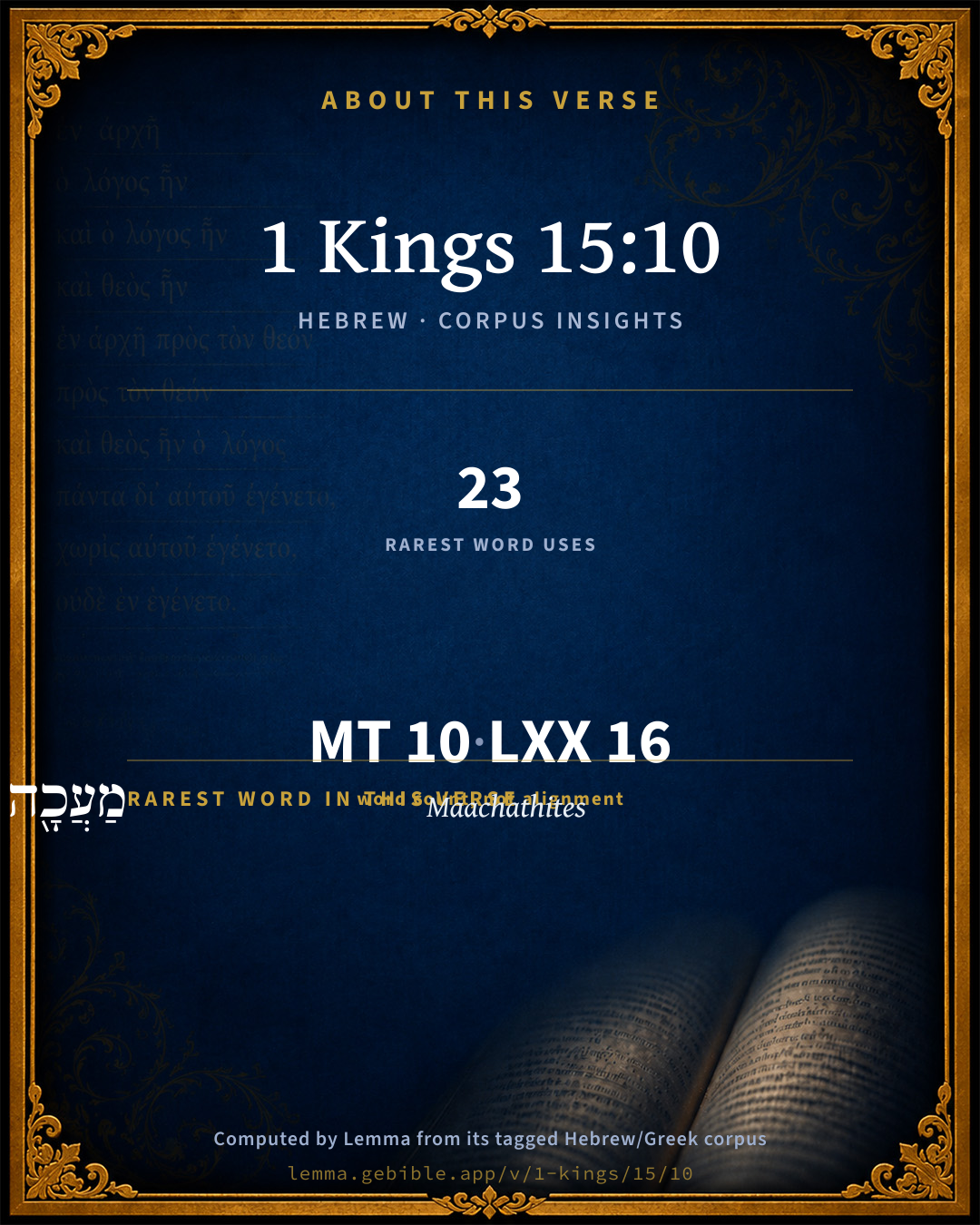
The rarest word here is מַעֲכָ֖ה Maachathites H4601 — appearing just 23 times in the whole Hebrew Bible.

Shared distinctive vocabulary

מַעֲכָ֖ה Maachathites H4601 occurs in 23 verses of the Hebrew Bible. Also found in:

Grammatical profile

  • 1 verb
  • 7 nouns
  • 2 adjectives

Verb forms

  • מָלַ֖ךְ Qal · Perfect

Hebrew & Septuagint length

In English translation the verse runs 16 words from the Hebrew and 16 from the Septuagint (LXX English) — the same length.

A rough comparison of the two English renderings, which tokenize alike — not a word-level alignment.

Word counts can differ between the Hebrew and the Greek without any difference in meaning — e.g. the Hebrew direct-object marker אֵת has no separate Greek word, and Greek often adds the article ὁ.

In the original languages it is 10 Hebrew tokens and 16 Greek tokens — but the two are counted differently (Hebrew bundles its prefixes and suffixes into one token; the Greek is in lemma form), so that isn’t a like-for-like length.

Cross-references

4

Topical passages linked to 1 Kings 15:10 in the Treasury of Scripture Knowledge — connected by theme and wording, ordered by reader-vote popularity; previews shown in the World English Bible.

  • 1 Kings 15:2 Three years reigned he in Jerusalem: and his mother's name was Maacah the daughter of Abishalom.
  • 1 Kings 15:13 Also Maacah his mother he removed from being queen, because she had made an abominable image for an Asherah; and Asa cut down her image, and burnt it at the brook Kidron.
  • 2 Chronicles 11:20–21 After her he took Maacah the daughter of Absalom; and she bore him Abijah, and Attai, and Ziza, and Shelomith.
  • 2 Chronicles 13:2 Three years reigned he in Jerusalem: and his mother's name was Micaiah the daughter of Uriel of Gibeah. There was war between Abijah and Jeroboam.

Cross-references courtesy of OpenBible.info (CC BY 4.0).

Hebrew and Greek witnesses Masoretic Hebrew ↔ Greek Septuagint

The same verse in the two great witnesses to the Old Testament, shown verse-for-verse.

These are two independent witnesses, not word-aligned to each other, and the Septuagint is shown in lemma (dictionary) form.

Hebrew 1 Kings 15:10 Masoretic · Westminster Leningrad Codex

וְאַרְבָּעִ֤ים וְאַחַת֙ שָׁנָ֔ה מָלַ֖ךְ בִּירוּשָׁלִָ֑ם וְשֵׁ֣ם אִמּ֔וֹ מַעֲכָ֖ה בַּת אֲבִישָׁלֽוֹם

Forty-one years reigned he in Jerusalem: and his mother's name was Maacah the daughter of Abishalom.

World English Bible · Public Domain

Greek LXX 1 Kings 15:10 Septuagint · lemma form

καί τεσσαράκοντα καί εἷς ἔτος βασιλεύω ἐν ἰερουσαλήμ καί ὄνομα ὁ μήτηρ αὐτός ανα θυγάτηρ αβεσσαλωμ

And he reigned forty-one years in Jerusalem: and his mother's name was Ana, daughter of Abessalom.

LXX2012 (modern English Septuagint) · Public Domain

On this verse, The Cambridge Bible for Schools and Colleges discusses the Septuagint’s reading. Read the note in Commentary ↓

Hebrew: Westminster Leningrad Codex (CC BY 4.0). Greek: Septuagint (public domain); English from LXX2012 (modern English Septuagint) (Public Domain). How the Septuagint differs from the Hebrew →

Targum (Aramaic paraphrase)

1

The Targum is the ancient Jewish Aramaic paraphrase of the Hebrew Scriptures — an interpretive translation, not the Hebrew text itself. Onkelos (literal) and Pseudo-Jonathan (expansive) render the Torah, and Jonathan the Prophets. Coverage is partial: where no permissively-licensed English translation exists for a verse, only the Aramaic is shown. This is verse-level text, not a word-by-word alignment to the Hebrew.

  1. Targum Jonathan Prophets (Joshua–Malachi)
    וְאַרְבְּעִין וַחֲדָא שְׁנִין מְלַךְ בִּירוּשְׁלֵם וְשׁוּם אִמֵיהּ מַעֲכָה בַּת אֲבִישָׁלוֹם:

    (no public-domain English translation for this verse)

    Targum Jonathan — Aramaic: “Mikraot Gedolot” (public domain). English: “Sefaria Community Translation” (CC0 1.0 (public-domain dedication)); “London "Chaldee Paraphrase," 1871” (public domain). Text via Sefaria.

Commentary

Notes on 1 Kings 15:10 from classic Christian and Jewish commentators (each source and its license shown beneath its notes). The classic Christian expositions comment on the surrounding passage and are grouped to its opening verse, so a note may address several verses; the Jewish commentaries on the Tanakh (Rashi and others) are per-verse, so they appear only where the commentator wrote on this verse.

Lemma curates 59 commentaries, every one of them public domain or Creative Commons licensed, each selected and text-cleaned for this edition rather than reprinted as found. About our sources →

Trapp's Complete Commentary

John Trapp

1Ki 15:10 And forty and one years reigned he in Jerusalem. And his mother’s name [was] Maachah, the daughter of Abishalom.

Ver. 10. And forty and one years reigned he.] His father Abijam was soon cut off for his wickedness: Asa, that he might reform a state so far out of order, had a long reign granted him. Think the same of Queen Mary and Queen Elizabeth. Asa reigned in Judah, in the times of the reigns of eight kings in Israel.

And his mother’s name was Maachah.] That is, His grandmother’s, who was a most wicked woman, nec tamen Asa mores eius retinuit, saith Vatablus, yet Asa kept himself uncorrupted by her, which was no small commendation. Pliny {a} praiseth young Quadratus, quod in deliciis aviae degens viveret tamen severisime, for that he lived strictly under the government of a loose grandmother.

{a} Epist., lib. vii.

John Trapp, A Commentary or Exposition upon All the Books of the Old and New Testament (1647–1656) — public domain. Text from a community e-Sword module.

Joseph Benson's Commentary

1Ki 15:10-11. His mother’s name — That is, his grandmother’s, as appears from 1Ki 15:2. She is called his mother in the same sense in which David is called Abijam’s father, 1Ki 15:3; that is, his progenitor. And his grandmother’s name may be here mentioned, rather than his mother’s, because his mother was either an obscure person, or was dead, or unwilling to take care of the education of her son, and so he was educated by the grandmother, who, though she poisoned his father Abijam with her idolatrous principles, (1Ki 15:12,) yet could not infect Asa, nor withhold him from prosecuting his good purposes of reforming religion. Asa did that which was right — As to the government of his kingdom, and the reformation and establishment of God’s worship; in the eyes of the Lord — That is right indeed which is so in God’s eyes. Those are approved whom he commendeth. As did David his father — Whom he made his pattern; worshipping the Lord alone, and taking away all idols, as it here follows.

Joseph Benson's Commentary on the Old and New Testaments (1811–1818) — public domain. Text from a community e-Sword module.

Tyndale Open Study Notes

Tyndale Open Resources

15:10 forty-one years: The first ten years of Asa’s long reign were peaceful (2 Chr 14:1-7), perhaps due to his father’s decisive victory over Jeroboam.

Tyndale Open Study Notes — © Tyndale Open Resources, licensed CC BY-SA 4.0. Text via the HelloAO Bible API.

Geneva Bible (1599)

Geneva Bible translators

That is, his grandmother, as David is oft times called father of them, whose grandfather he was.

Geneva Bible (1599) marginal notes — public domain. Text via Bolls.life.

Jamieson, Fausset & Brown

Robert Jamieson, A. R. Fausset & David Brown

ASA'S GOOD REIGN. (Kg1 15:9-22)

his mother's name was Maachah--She was properly his grandmother, and she is here called "the king's mother," from the post of dignity which at the beginning of his reign she possessed. Asa, as a constitutional monarch, acted like the pious David, laboring to abolish the traces and polluting practices of idolatry, and in pursuance of his impartial conduct, he did not spare delinquents even of the highest rank.

Jamieson, Fausset & Brown — Commentary Critical and Explanatory on the Whole Bible (1871) — public domain (CC PDM 1.0). Text via the HelloAO Bible API.

Adam Clarke's Commentary

Verse 10. His mother's name] Our translators thought that grandmother was likely to be the meaning, and therefore have put it in the margin.

The daughter of Abishalom.] She is called, says Calmet, the daughter of Absalom, according to the custom of the Scriptures, which give the name of daughter indifferently to the niece, the grand-daughter, and great grand-daughter.

Adam Clarke's Commentary on the Bible (1810–1826) — public domain. Text from a community e-Sword/MySword module.

Ellicott's Commentary for English Readers

(10) His mother’s name was Maachah.—Maachah was (see 1Ki_15:2) the wife of Rehoboam, and, therefore, grandmother of Asa. She appears, however, still to have retained the place of “queen-mother,” to the exclusion of the real mother of the king.

A Bible Commentary for English Readers, edited by Charles John Ellicott (1878–1897) — public domain. Text from a community e-Sword module.

The Cambridge Bible for Schools and Colleges

gen. ed. J. J. S. Perowne

10. And his mother’s name was Maachah, the daughter of Abishalom] The most probable explanation of this clause, which is the same as in 1Ki_15:2 above, is that the word ‘mother’ is here used for ‘grandmother,’ and that Asa’s own mother sank into small importance in comparison with her mother-in-law. Clearly Maachah was a leader of the idol worship in the land, which made it necessary for Asa to deprive her of her influence. On the power wielded in the East by a queen-mother, see 1Ki_2:19 note. The LXX. (Vat.) gives ‘Ana’ as the name of Asa’s mother, and not ‘Maachah,’ but this is not supported by any other evidence.

The Cambridge Bible for Schools and Colleges (gen. ed. J. J. S. Perowne; Cambridge University Press, 1878–1918) — public domain. Text from a community e-Sword module.

John Gill's Exposition

But the high places were not removed,.... That is, such as had been used for the worship of God, before the temple was built, which yet now should have been removed, since sacrifice was now only to be offered there; but he might think they were still lawful, or the people had such an opinion of them, that it was difficult and dangerous to attempt to remove them; otherwise high places for idolatry were removed by him, Ch2 14:3,

nevertheless, Asa's heart was perfect all his days; he was sincere in the worship of God, and did everything to the best of his knowledge and capacity for restoring true religion, and destroying idolatry.

John Gill's Exposition of the Whole Bible (1746–1763) — public domain (CC PDM 1.0). Text via the HelloAO Bible API.

Albert Barnes' Notes on the Bible

Mother’s name - Rather, “grandmother’s.” The Jews cal any male ancestor, however remote, a father, and any female ancestor a mother (compare 1Ki 15:2; Gen 3:20). This Maachah was the favorite wife of Rehoboam 2Ch 11:21, and the mother of Abijam. The way in which she is here mentioned strongly favors the notion that the position of queen-mother was a definite one at the court, and could only be held by one person at a time.

Albert Barnes' Notes on the Bible (1834–1885) — public domain. Text from a community e-Sword/MySword module.

Haydock's Catholic Bible Commentary

His mother’s, &c. That is, his grandmother; unless we suppose, which is not improbable, that the Maacha here named is different from the Maacha mentioned [in] ver. 2. (Challoner) --- She was probably another grand-daughter of David’s son, (Calmet) as such are frequently styled simply daughters. So David is called the father of Asa, (ver. 11.; Haydock) though he was really his great-grandfather. (Menochius)

George Leo Haydock (1774–1849), Haydock's Catholic Family Bible and Commentary, 1859 edition — public domain. Excludes Psalms (Douay-Rheims chapter numbering differs from Protestant) and Deuterocanonical books (Catholic canon only).

Matthew Poole's English Annotations

i. e. His grandmother’s, as appears from 1Ki 15:2, who is called his mother, as David is called Abijam’s father, 1Ki 15:3, and this Asa’s father, 1Ki 15:11. And so the names of father, and mother, and sons, and daughters are oft taken, both in sacred and profane authors, for grandparents and grandchildren. And his grandmother’s name may be here mentioned rather than his mother’s, because his mother was either an obscure person, or was long since dead, or indisposed or unwilling to take care of the education of her son, and so he was educated by the grandmother, who, though she did poison his father Abijam with her idolatrous principles, 1Ki 15:12, yet could not infect Asa, nor withhold him from prosecuting his good purposes of reforming religion; which is here remembered to his praise.

Matthew Poole's English Annotations on the Holy Bible (1683–1685) — public domain. Text from a community e-Sword/MySword module.

Whedon's Commentary on the Bible

Daniel D. Whedon

ASA’S REIGN, 1Ki_15:9-24.

10. His mother’s name was Maachah — She was his father’s mother, (see on 1Ki_15:2,) and therefore, properly speaking, his grandmother, as the margin rightly explains. The word אם, mother, like בן, son, and בת, daughter, is capable of such indefinite usage. Asa’s grandmother is mentioned here because of her prominent position as queen-mother, (compare 1Ki_15:13,) and as such she probably exercised the regal functions during the earlier years of his reign, while he was yet too young.

Daniel D. Whedon (gen. ed.), Commentary on the Old and New Testaments (1874–1909) — public domain. Text from a community e-Sword module.

The Pulpit Commentary

And forty and one years reigned he in Jerusalem Corn. a Lapide points out that Ass saw eight kings of Israel on the throne, Jeroboam, Nadab, Baasha, Elah, Zimri, Tibni, Omri, and Ahab. And his mother"s or grandmother"s, as margin name was Maachah, the daughter of Abishalom. The same words as in ver. 2, and the reference can hardly be to a different person. Bahr indeed questions whether can here stand for grandmother,

(1) because in every other case it designates the king"s mother,

(2) Because the mother of the king, and not the grandmother, enjoyed the dignity and position of Gebirah (ver. 13; 2Ch_15:16) Some would read for Abishalom, Uriel of Gibeah; others, strengthened by the Michaiah of 2Ch_13:2, think the historian mistaken in mentioning the name of Abijam"s mother (ver. 2; 2Ch_11:21) as Maachah. The difficulty by no means admits of a ready solution, but perhaps the best explanation is that the grandmother, Maachah, Rehoboam"s favourite wife, retained her position, possibly by force of character, or because Asa"s mother was dead. It is not certain, however, that if the latter had lived she would have displaced Maashah, of whose influence and imperious temper we have several indications; e.g., in the appointment of her son, though not the firstborn, to succeed his father, and in her open maintenance of idol worship, and above all in the fact that she was publicly deposed by Asa.

The Pulpit Commentary (1880–1919), ed. H.D.M. Spence-Jones & Joseph S. Exell — public domain. Text from a community e-Sword module.

John Wesley's Explanatory Notes

Mother's - That is, his grandmother's, as appears from ver. 2, who is called his mother, as David is called Abijam's father, ver. 3. And his grand-mother's name may be here mentioned, rather than his mother's, because his mother was either an obscure person, or was dead, or unwilling to take care of the education of her son, and so he was educated by the grand-mother, who, though she poisoned his father Abijam with her idolatrous principles, ver. 12, yet could not infect Asa, nor withhold him from prosecuting his good purposes of reforming religion.

John Wesley, Explanatory Notes Upon the Whole Bible (1754–1765) — public domain. Text via the GEBible commentary corpus.

Lesson kit

Teaching starters — assembled from the data on this page, not authored interpretation. Every prompt links to the verse data it draws on. Edit before teaching.

1 Kings, in the Historical, opens this verse with 10 words (10 distinct Hebrew lemmas). Its most distinctive word is Maʻăkâh (“Maachathites”). A historical commentator’s framing appears above. Read the whole chapter for the surrounding context.

Discussion questions

  1. What does “Maachathites” (Maʻăkâh) contribute to the verse as a whole?
  2. Genesis 22:24 shares the word «Maachathites» with this verse. How do the two illuminate each other?
  3. These translations render this verse differently. What is at stake in choosing one wording over another?
  4. The verb «מָלַ֖ךְ» is Qal Perfect. How does its form color the action?
  5. Reading how Trapp's Complete Commentary and Joseph Benson's Commentary read this verse, where do the two commentators agree and where do they part?

Things to notice

Reading settings

Reading text

Shown beneath each verse's original-language words.

Old Testament
Old Testament edition

Read the OT as the Masoretic Hebrew (MT) or the Greek Septuagint (LXX).

English shown for the Greek Septuagint (in the Hebrew ↔ Greek comparison).

Comparing translations? Open the Compare panel on any verse page to stack up to four side by side.