Genesis 32:15

Hebrew (Westminster Leningrad Codex) Genesis 32:15 appears in the Hebrew Old Testament. The text above is from the Westminster Leningrad Codex. Each word links to its Strong’s number, a concise gloss, and parsing drawn from the Open Scriptures Hebrew Bible morphology. Click any word for its full Brown-Driver-Briggs (BDB) entry.
Download image
Cite this verse

Genesis 32:15 (World English Bible). Public Domain. Lemma interlinear Bible study tool, https://lemma.gebible.app/v/genesis/32/15.

Show BibTeX & RIS
BibTeX
RIS
English Translation
thirty milk camels and their colts, forty cows, ten bulls, twenty she-donkeys and ten foals.
World English Bible · Public Domain
Highlights
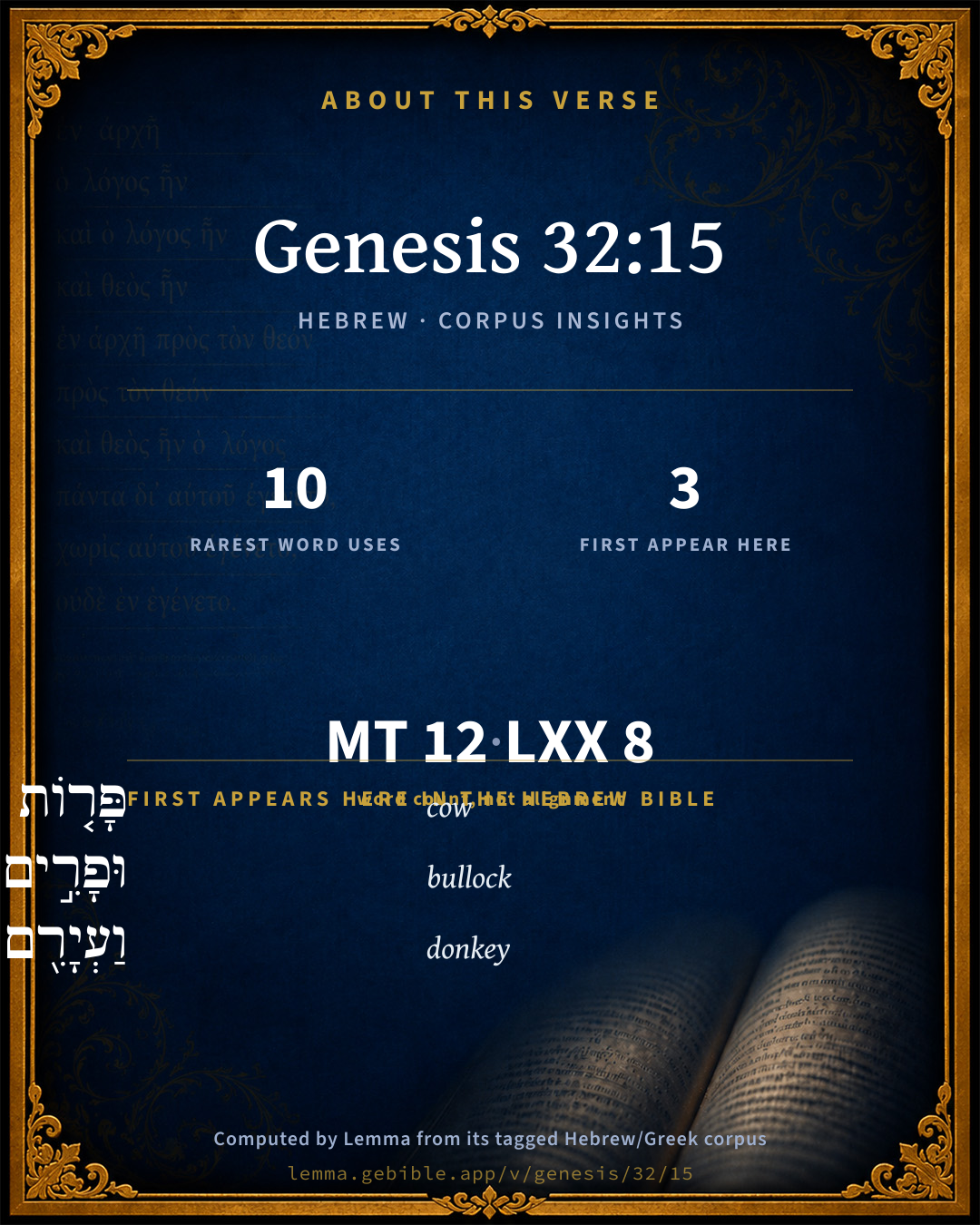
  • 3 first appearances in the Hebrew Bible
Full analysis ↓
Download a study sheet

One document with this verse’s original text, its word-by-word gloss line, the meaning frame, cross-references with their text, attributed commentary, and full source and license credits — printable, and it pastes into notes with its structure intact.

This verse Autodidact and up

Study sheet (.html) Plain text (.txt)

A passage Seminary Student

Up to 50 verses in one chapter. A passage sheet keeps up to 6 commentary sources and 12 cross-references per verse, in the order this page ranks them, and says so on the sheet whenever that leaves anything out. Ask for a single verse and you get the Autodidact verse sheet above.

Everything on this page stays free to read, with no account — the sheet is a download of what is already on screen, not access to it.

Want to remove ads? Support Godless Engineer
Compare translations 3

The same verse in 3 English versions, stacked beneath the original-language interlinear above. Click any original word for its lexicon entry.

Each is an independent rendering of the whole verse — the interlinear is not word-aligned to these translations.

Highlighted words mark where these versions differ — a whole-verse word diff, not a word-by-word alignment.

  • World English Bible Public Domain
    thirty milk camels and their colts, forty cows, ten bulls, twenty she-donkeys and ten foals.
  • King James Version Public Domain
    Thirty milch camels with their colts, forty kine, and ten bulls, twenty she asses, and ten foals.
  • unfoldingWord Literal Text CC BY-SA 4.0
    thirty nursing camels and their young, forty cows and ten bulls, twenty female donkeys and ten male donkeys.

unfoldingWord Literal Text — © unfoldingWord, licensed CC BY-SA 4.0. Word-aligned USFM3 via Door43 (git.door43.org/unfoldingWord/en_ult).

Versions to compare (up to 4)

3 of 4 selected

Show all 18 translations

Every available English version of this verse, each an independent rendering of the whole verse.

  • World English Bible Public Domain
    thirty milk camels and their colts, forty cows, ten bulls, twenty she-donkeys and ten foals.
  • Berean Standard Bible Public Domain
    30 milk camels with their young, 40 cows, 10 bulls, 20 female donkeys, and 10 male donkeys.
  • Majority Standard Bible Public Domain
    30 milk camels with their young, 40 cows, 10 bulls, 20 female donkeys, and 10 male donkeys.
  • King James Version Public Domain
    Thirty milch camels with their colts, forty kine, and ten bulls, twenty she asses, and ten foals.
  • American Standard Version (1901) Public Domain
    thirty milch camels and their colts, forty cows and ten bulls, twenty she-asses and ten foals.
  • Revised Version (1885) Public Domain
    thirty milch camels and their colts, forty kine and ten bulls, twenty she-asses and ten foals.
  • Geneva Bible (1599) Public Domain
    Thirtie mylche camels with their coltes, fourtie kine, and ten bullockes, twentie she asses and ten foles.
  • Douay-Rheims (1899) Public Domain
    Thirty milch camels with their colts, forty kine, and twenty bulls, twenty she asses, and ten of their foals.
  • Young's Literal Translation Public Domain
    suckling camels and their young ones thirty, cows forty, and bullocks ten, she-asses twenty, and foals ten;
  • Literal Standard Version CC BY-SA 4.0
    suckling camels and their young ones thirty, cows forty, and bullocks ten, female donkeys twenty, and foals ten;
  • Unlocked Literal Bible CC BY-SA 4.0
    thirty milking camels and their colts, forty cows and ten bulls, twenty female donkeys and ten male donkeys.
  • unfoldingWord Literal Text CC BY-SA 4.0
    thirty nursing camels and their young, forty cows and ten bulls, twenty female donkeys and ten male donkeys.
  • Darby Bible Public Domain
    thirty milch camels with their colts; forty kine, and ten bulls; twenty she-asses, and ten young asses.
  • World Messianic Bible Public Domain
    thirty milk camels and their colts, forty cows, ten bulls, twenty female donkeys and ten foals.
  • Webster's Bible Public Domain
    Thirty milch camels with their colts, forty cows and ten bulls, twenty she-asses and ten foals.
  • Free Bible Version CC BY-SA 4.0
    30 female camels with their young, 40 cows, 10 bulls; 20 female donkeys, 10 male donkeys.
  • Bible in Basic English Public Domain
    Thirty camels with their young ones, forty cows, ten oxen, twenty asses, and ten young asses.
  • JPS Tanakh (1917) Public Domain
    (32-16) thirty milch camels and their colts, forty kine and ten bulls, twenty she-asses and ten foals.

Literal Standard Version (2020), Covenant Press — licensed CC BY-SA 4.0. Text via the HelloAO Bible API (eBible.org). Unlocked Literal Bible (unfoldingWord) — licensed CC BY-SA 4.0. Text via the HelloAO Bible API (eBible.org). unfoldingWord Literal Text — © unfoldingWord, licensed CC BY-SA 4.0. Word-aligned USFM3 via Door43 (git.door43.org/unfoldingWord/en_ult). Free Bible Version, Dr. Jonathan Gallagher — licensed CC BY-SA 4.0. Text via the HelloAO Bible API (eBible.org).

Word by word

More ways to search: Search by grammar → Find every occurrence → Compare this word →

Practice this passage: Drill this verse → Learn its vocabulary →

וַעְיָרִ֖ם
ʻayir
H5895
“and · donkeys”
Conjunction + Noun, Common, Masculine, Plural, Absolute
Part of Speech
Conjunction + Noun
Type
Common
Gender
Masculine
Number
Plural
State
Absolute
Full BDB Definition

Origin: from H5782 in the sense of raising (ie bearing a burden)

TWOT: 1616a

he-ass, male ass
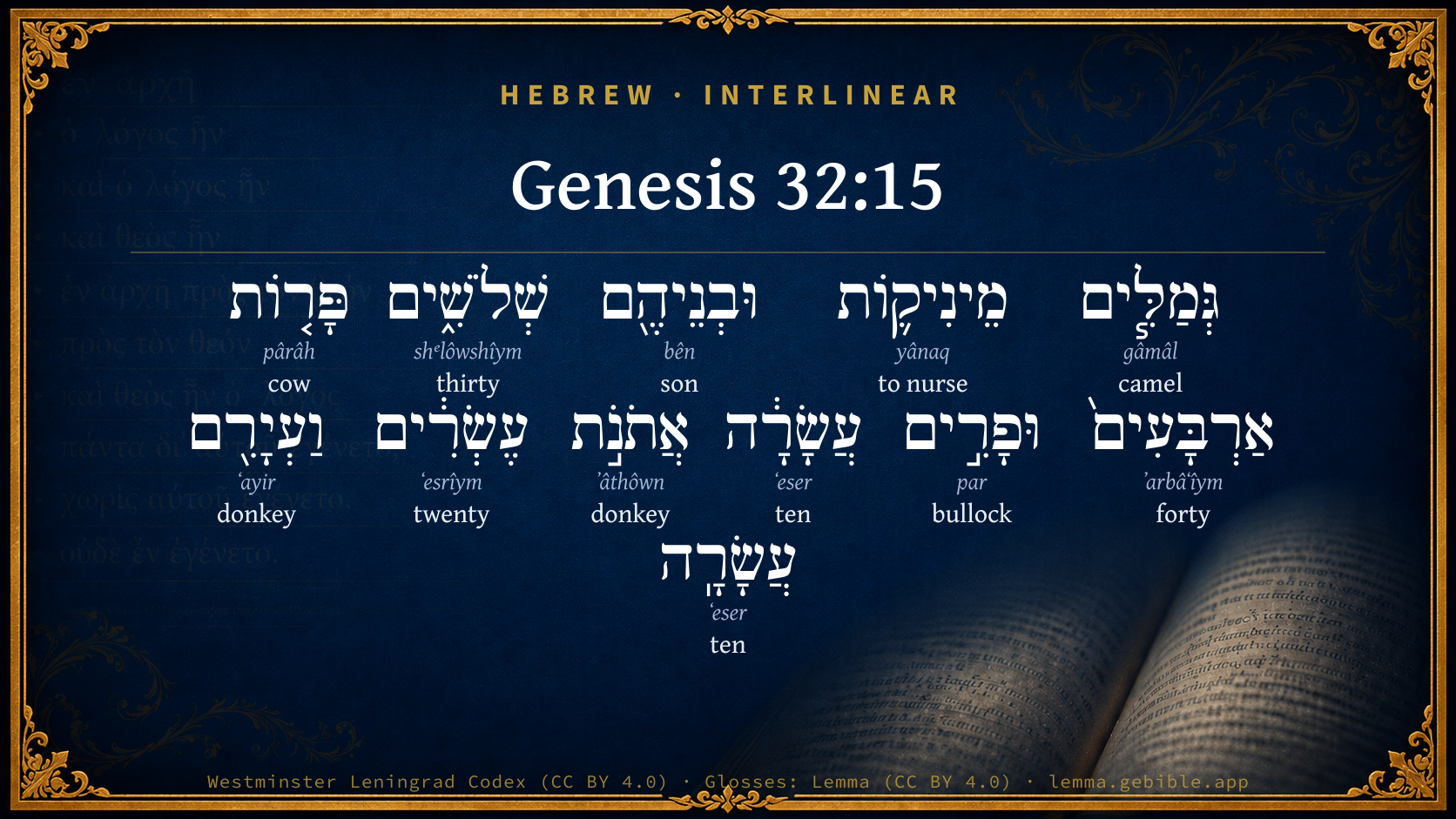
  1. גְּמַלִּ֧ים gâmâl H1581 “camels” Noun, Common, Masculine, Plural, Absolute
  2. מֵינִיק֛וֹת yânaq H3243 “nursing” Verb, Hiphil, Participle Active, Feminine, Plural, Absolute
  3. וּבְנֵיהֶ֖ם bên H1121 “and · sons · their” Conjunction + Noun, Common, Masculine, Plural, Construct + Suffix, Personal, 3rd Person, Masculine, Plural
  4. שְׁלֹשִׁ֑ים shᵉlôwshîym H7970 “thirty” Adjective, Cardinal number, Both, Plural, Absolute
  5. פָּר֤וֹת pârâh H6510 “cows” Noun, Common, Feminine, Plural, Absolute
  6. אַרְבָּעִים֙ ʼarbâʻîym H705 “forty” Adjective, Cardinal number, Both, Plural, Absolute
  7. וּפָרִ֣ים par H6499 “and · bullocks” Conjunction + Noun, Common, Masculine, Plural, Absolute
  8. עֲשָׂרָ֔ה ʻeser H6235 “ten” Adjective, Cardinal number, Masculine, Singular, Absolute
  9. אֲתֹנֹ֣ת ʼâthôwn H860 “donkeys” Noun, Common, Feminine, Plural, Absolute
  10. עֶשְׂרִ֔ים ʻesrîym H6242 “twenty” Adjective, Cardinal number, Both, Plural, Absolute
  11. עֲשָׂרָֽה ʻeser H6235 “ten” Adjective, Cardinal number, Masculine, Singular, Absolute

About this verse

These counts appear in no published source. They are computed here, from the morphology-tagged text and Lemma’s own curated glosses. What Lemma adds →

12
words
11
distinct lemmas
Pentateuch
section

Notable vocabulary

The rarest word here is וַעְיָרִ֖ם donkey H5895 — appearing just 10 times in the whole Hebrew Bible.

First appearance in Scripture

These words make their first canonical appearance in the Hebrew Bible here:

  • פָּר֤וֹת cow H6510
  • וּפָרִ֣ים bullock H6499
  • וַעְיָרִ֖ם donkey H5895

Shared distinctive vocabulary

וַעְיָרִ֖ם donkey H5895 occurs in 8 verses of the Hebrew Bible. Also found in:

Grammatical profile

  • 1 verb
  • 6 nouns
  • 5 adjectives

Verb forms

  • מֵינִיק֛וֹת Hiphil · Participle Active

Repetition

A word recurs within this verse — often emphatic in Hebrew:

  • עֲשָׂרָ֔ה ten H6235 ×2

Hebrew & Septuagint length

In English translation the verse runs 15 words from the Hebrew and 15 from the Septuagint (LXX English) — the same length.

A rough comparison of the two English renderings, which tokenize alike — not a word-level alignment.

Word counts can differ between the Hebrew and the Greek without any difference in meaning — e.g. the Hebrew direct-object marker אֵת has no separate Greek word, and Greek often adds the article ὁ.

In the original languages it is 12 Hebrew tokens and 8 Greek tokens — but the two are counted differently (Hebrew bundles its prefixes and suffixes into one token; the Greek is in lemma form), so that isn’t a like-for-like length.

Hebrew and Greek witnesses Masoretic Hebrew ↔ Greek Septuagint

The same verse in the two great witnesses to the Old Testament, shown verse-for-verse.

These are two independent witnesses, not word-aligned to each other, and the Septuagint is shown in lemma (dictionary) form.

Hebrew Genesis 32:15 Masoretic · Westminster Leningrad Codex

גְּמַלִּ֧ים מֵינִיק֛וֹת וּבְנֵיהֶ֖ם שְׁלֹשִׁ֑ים פָּר֤וֹת אַרְבָּעִים֙ וּפָרִ֣ים עֲשָׂרָ֔ה אֲתֹנֹ֣ת עֶשְׂרִ֔ים וַעְיָרִ֖ם עֲשָׂרָֽה

thirty milk camels and their colts, forty cows, ten bulls, twenty she-donkeys and ten foals.

World English Bible · Public Domain

Greek LXX Genesis 32:15 Septuagint · lemma form

αἴξ διακόσιοι τράγος εἴκοσι πρόβατον διακόσιοι κριός εἴκοσι

milch camels, and their foals, thirty, forty kine, ten bulls, twenty asses, and ten colts.

LXX2012 (modern English Septuagint) · Public Domain

Hebrew: Westminster Leningrad Codex (CC BY 4.0). Greek: Septuagint (public domain); English from LXX2012 (modern English Septuagint) (Public Domain). How the Septuagint differs from the Hebrew →

Targum (Aramaic paraphrase)

2

The Targum is the ancient Jewish Aramaic paraphrase of the Hebrew Scriptures — an interpretive translation, not the Hebrew text itself. Onkelos (literal) and Pseudo-Jonathan (expansive) render the Torah, and Jonathan the Prophets. Coverage is partial: where no permissively-licensed English translation exists for a verse, only the Aramaic is shown. This is verse-level text, not a word-by-word alignment to the Hebrew.

  1. Targum Onkelos Torah (Genesis–Deuteronomy)
    עִזֵּי מָאתָן וּתְיָשַׁיָא עֶסְרִין רְחֵלִין מָאתָן וְדִכְרִין עֶסְרִין

    (no public-domain English translation for this verse)

    Targum Onkelos — Aramaic: “Onkelos Genesis” (public domain); “Onkelos Exodus” (public domain); “Onkelos Leviticus” (public domain); “Onkelos Numbers” (public domain); “Onkelos Deuteronomy” (public domain). English: “Sefaria Community Translation” (CC0 1.0 (public-domain dedication)); “J.W. Etheridge. The Targums of Onkelos and Jonathan Ben Uzziel on the Pentateuch. London: Longmans, Green, 1862” (public domain). Text via Sefaria.

  2. Targum Pseudo-Jonathan Torah (Genesis–Deuteronomy)
    עִזֵי מָאתָן וּבַרְחֵי עַשְרִין רְחִילֵי מָאתָן וְדִיכְרֵי עַשְרִין

    she--goats two hundred, and he--goats twenty; ewes two hundred and rams twenty:

    Targum Pseudo-Jonathan — Aramaic: “Targum Jonathan on Genesis” (public domain); “Targum Jonathan on Exodus” (public domain); “Targum Jonathan on Leviticus” (public domain); “Targum Jonathan on Numbers” (public domain); “Targum Jonathan on Deuteronomy” (public domain). English: “The Targum of Jonathan ben Uzziel, trans. J. W. Etheridge, London, 1862” (public domain). Text via Sefaria.

Commentary

Notes on Genesis 32:15 from classic Christian and Jewish commentators (each source and its license shown beneath its notes). The classic Christian expositions comment on the surrounding passage and are grouped to its opening verse, so a note may address several verses; the Jewish commentaries on the Tanakh (Rashi and others) are per-verse, so they appear only where the commentator wrote on this verse.

Lemma curates 59 commentaries, every one of them public domain or Creative Commons licensed, each selected and text-cleaned for this edition rather than reprinted as found. About our sources →

Adam Clarke's Commentary

Verse 15. Ten bulls] The Syriac and Vulgate have twenty; but ten is a sufficient proportion to the forty kine. By all this we see that Jacob was led to make restitution for the injury he had done to his brother. Restitution for injuries done to man is essentially requisite if in our power. He who can and will not make restitution for the wrongs he has done, can have no claim even on the mercy of God.

Adam Clarke's Commentary on the Bible (1810–1826) — public domain. Text from a community e-Sword/MySword module.

John Gill's Exposition

Thirty milch camels with their colts,.... Milch camels were in great esteem in the eastern countries; their milk being, as Aristotle (y) and Pliny (z) say, the sweetest of all milk:

forty kine and ten bulls; one bull to ten cows; the same proportion as in the goats and rams:

twenty she asses and ten foals; and supposing thirty colts belonging to the camels; the present consisted of five hundred and eighty head of cattle: a large number to spare out of his flocks and herds, that he had acquired in six years' time; and showed a generous disposition as well as prudence, to part with so much in order to secure the rest.

(y) Hist. Animal. l. 6. c. 26. (z) Nat. Hist. l. 11. c. 41. & 28. 9.

John Gill's Exposition of the Whole Bible (1746–1763) — public domain (CC PDM 1.0). Text via the HelloAO Bible API.

Haydock's Catholic Bible Commentary

Camels. The milk of these animals is most exquisite, being mixed with three parts water. Pliny, Natural History xi. 41, who says, "They give milk till they be with young again." The Arabs feed chiefly on their milk and flesh. (St. Jerome, contra Jor. ii.) The value of all these presents, may give us some idea of the prodigious wealth which God had heaped upon Jacob in the space of six years! (Haydock)

George Leo Haydock (1774–1849), Haydock's Catholic Family Bible and Commentary, 1859 edition — public domain. Excludes Psalms (Douay-Rheims chapter numbering differs from Protestant) and Deuterocanonical books (Catholic canon only).

Rashi

Rabbi Shlomo Yitzchaki (Rashi)

עזים מאתים ותישים עשרים TWO HUNDRED SHE GOATS AND TWENTY HE GOATS — Two hundred she goats have need of twenty he goats, and so too in the case of all the various species the males were in number according to the need of the females. In Genesis Rabbah an inference is made from here as regards the minimum period imperative for the marital duty imposed by the Torah. I am unable however to show exactly how this inference is arrived at. But it appears to me that we may learn from here at least that this period is not the same for every person, but that it depends upon the amount of labour imposed upon him by his occupation.

Rashi on the Tanakh — English translations: “The Judaica Press complete Tanach with Rashi, translated by A. J. Rosenberg” (CC BY 4.0); “Pentateuch with Rashi's commentary by M. Rosenbaum and A.M. Silbermann, 1929-1934” (public domain); “The Metsudah Tanach series, Lakewood, N.J” (CC BY 4.0); and “The Book of Joshua, Metsudah Publications, 1997” (CC BY 4.0). Text via Sefaria.

Radak

Rabbi David Kimhi (Radak)

עזים מאתים, Yaakov the shepherd knew precisely how many male animals were required to service a flock of female animals to achieve the best results. Sheep and goats have similar requirements in this respect.

Radak on the Tanakh — English translations: “Sefaria Community Translation” (CC0 1.0 (public-domain dedication)); “Eliyahu Munk, HaChut Hameshulash” (CC BY 4.0); “Rabbi Mike Feuer, Jerusalem Anthology” (CC BY 4.0); and “R. David Kimhi on the first book of Psalms, Translated by R.G. Finch, London, 1919” (public domain). Text via Sefaria.

Lesson kit

Teaching starters — assembled from the data on this page, not authored interpretation. Every prompt links to the verse data it draws on. Edit before teaching.

Genesis, in the Pentateuch, opens this verse with 12 words (11 distinct Hebrew lemmas). Its most distinctive word is ʻayir (“donkey”). A historical commentator’s framing appears above. Read the whole chapter for the surrounding context.

Discussion questions

  1. The word ʻayir carries the sense “donkey.” How does it shape the verse?
  2. 3 words make their first appearance in Scripture here. What does this debut establish?
  3. How does Genesis 49:11, which shares the word «donkey», read alongside this verse?
  4. What does the repetition of “ten” (2× in this one verse) do in this verse?
  5. These translations render this verse differently. What is at stake in choosing one wording over another?
  6. «מֵינִיק֛וֹת» is a Hiphil Participle Active verb. How does that grammatical form shape the action described?
  7. Compare how Adam Clarke's Commentary and John Gill's Exposition read this verse. Where do they agree or differ?

Things to notice

Reading settings

Reading text

Shown beneath each verse's original-language words.

Old Testament
Old Testament edition

Read the OT as the Masoretic Hebrew (MT) or the Greek Septuagint (LXX).

English shown for the Greek Septuagint (in the Hebrew ↔ Greek comparison).

Comparing translations? Open the Compare panel on any verse page to stack up to four side by side.