
Numbers 35:6

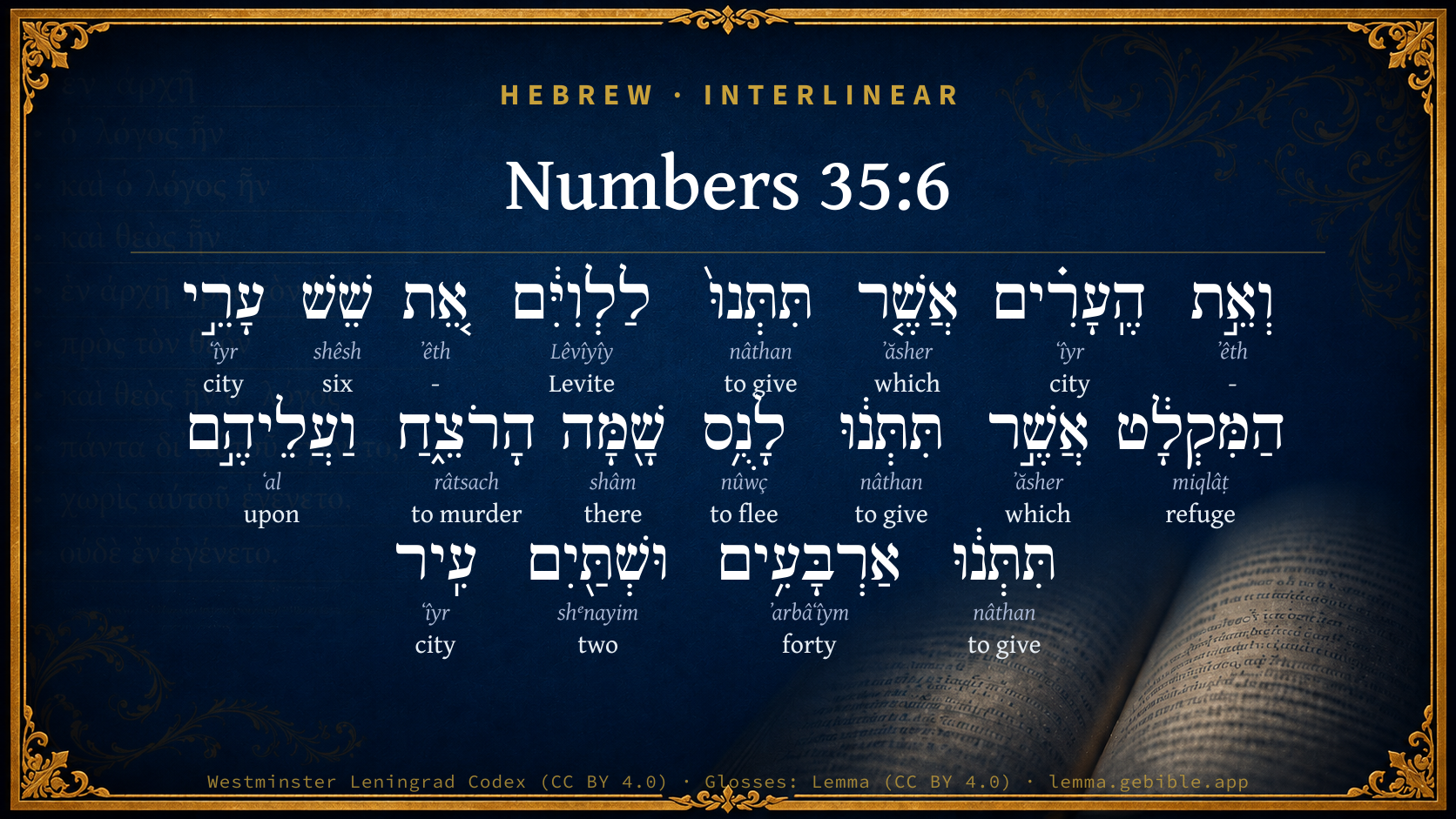
Hebrew (Westminster Leningrad Codex) Numbers 35:6 appears in the Hebrew Old Testament. The text above is from the Westminster Leningrad Codex. Each word links to its Strong’s number, a concise gloss, and parsing drawn from the Open Scriptures Hebrew Bible morphology. Click any word for its full Brown-Driver-Briggs (BDB) entry.
Download image
Cite this verse

Numbers 35:6 (World English Bible). Public Domain. Lemma interlinear Bible study tool, https://lemma.gebible.app/v/numbers/35/6.

Show BibTeX & RIS
BibTeX
RIS
English Translation
The cities which you shall give to the Levites, they shall be the six cities of refuge, which you shall give for the manslayer to flee to: and besides them you shall give forty-two cities.
World English Bible · Public Domain
Highlights
  • 1 first appearance in the Hebrew Bible
Full analysis ↓
Download a study sheet

One document with this verse’s original text, its word-by-word gloss line, the meaning frame, cross-references with their text, attributed commentary, and full source and license credits — printable, and it pastes into notes with its structure intact.

This verse Autodidact and up

Study sheet (.html) Plain text (.txt)

A passage Seminary Student

Up to 50 verses in one chapter. A passage sheet keeps up to 6 commentary sources and 12 cross-references per verse, in the order this page ranks them, and says so on the sheet whenever that leaves anything out. Ask for a single verse and you get the Autodidact verse sheet above.

Everything on this page stays free to read, with no account — the sheet is a download of what is already on screen, not access to it.

Want to remove ads? Support Godless Engineer
Compare translations 3

The same verse in 3 English versions, stacked beneath the original-language interlinear above. Click any original word for its lexicon entry.

Each is an independent rendering of the whole verse — the interlinear is not word-aligned to these translations.

Highlighted words mark where these versions differ — a whole-verse word diff, not a word-by-word alignment.

  • World English Bible Public Domain
    The cities which you shall give to the Levites, they shall be the six cities of refuge, which you shall give for the manslayer to flee to: and besides them you shall give forty-two cities.
  • King James Version Public Domain
    And among the cities which ye shall give unto the Levites there shall be six cities for refuge, which ye shall appoint for the manslayer, that he may flee thither: and to them ye shall add forty and two cities.
  • unfoldingWord Literal Text CC BY-SA 4.0
    And along with the cities which you shall give to the Levites, you shall give six cities of refuge to which the one who kills may flee, and in addition to them you shall give 42 cities.

unfoldingWord Literal Text — © unfoldingWord, licensed CC BY-SA 4.0. Word-aligned USFM3 via Door43 (git.door43.org/unfoldingWord/en_ult).

Versions to compare (up to 4)

3 of 4 selected

Show all 18 translations

Every available English version of this verse, each an independent rendering of the whole verse.

  • World English Bible Public Domain
    The cities which you shall give to the Levites, they shall be the six cities of refuge, which you shall give for the manslayer to flee to: and besides them you shall give forty-two cities.
  • Berean Standard Bible Public Domain
    Six of the cities you give the Levites are to be appointed as cities of refuge, to which a manslayer may flee. In addition to these, give the Levites forty-two other cities.
  • Majority Standard Bible Public Domain
    Six of the cities you give the Levites are to be appointed as cities of refuge, to which a manslayer may flee. In addition to these, give the Levites forty-two other cities.
  • King James Version Public Domain
    And among the cities which ye shall give unto the Levites there shall be six cities for refuge, which ye shall appoint for the manslayer, that he may flee thither: and to them ye shall add forty and two cities.
  • American Standard Version (1901) Public Domain
    And the cities which ye shall give unto the Levites, they shall be the six cities of refuge, which ye shall give for the manslayer to flee unto: and besides them ye shall give forty and two cities.
  • Revised Version (1885) Public Domain
    And the cities which ye shall give unto the Levites, they shall be the six cities of refuge, which ye shall give for the manslayer to flee thither: and beside them ye shall give forty and two cities.
  • Geneva Bible (1599) Public Domain
    And of the cities which yee shall giue vnto the Leuites, there shalbe sixe cities for refuge, which ye shall appoint, that he which killeth, may flee thither: and to them yee shall adde two and fourtie cities more.
  • Douay-Rheims (1899) Public Domain
    And among the cities, which you shall give to the Levites, six shall be separated for refuge to fugitives, that he who hath shed blood may flee to them: and besides these there shall be other forty-two cities,
  • Young's Literal Translation Public Domain
    `And the cities which ye give to the Levites `are' the six cities of refuge, which ye give for the fleeing thither of the man-slayer, and besides them ye give forty and two cities;
  • Literal Standard Version CC BY-SA 4.0
    And the cities which you give to the Levites [are] the six cities of refuge, which you give for the fleeing there of the manslayer, and besides them you give forty-two cities;
  • Unlocked Literal Bible CC BY-SA 4.0
    Six of the cities that you will give to Levites must serve as cities of refuge. You must provide these as places to which a person who has killed someone can flee. Also provide forty-two other cities.
  • unfoldingWord Literal Text CC BY-SA 4.0
    And along with the cities which you shall give to the Levites, you shall give six cities of refuge to which the one who kills may flee, and in addition to them you shall give 42 cities.
  • Darby Bible Public Domain
    And [among] the cities that ye shall give unto the Levites [shall be] the six cities of refuge, which ye shall appoint for the manslayer, that he may flee thither, -- and besides them ye shall give forty-two cities:
  • World Messianic Bible Public Domain
    “The cities which you shall give to the Levites, they shall be the six cities of refuge, which you shall give for the man slayer to flee to. Besides them you shall give forty-two cities.
  • Webster's Bible Public Domain
    And among the cities which ye shall give to the Levites there shall be six cities for refuge, which ye shall appoint for the man-slayer, that he may flee thither: and to them ye shall add forty and two cities.
  • Free Bible Version CC BY-SA 4.0
    Six of the towns you give the Levites are to be sanctuary towns, where a person who kills someone can run for protection. As well as these towns, give the Levites forty-two more.
  • Bible in Basic English Public Domain
    And the towns which you give the Levites are to be the six safe places to which the taker of life may go in flight; and in addition you are to give them forty-two towns.
  • JPS Tanakh (1917) Public Domain
    And the cities which ye shall give unto the Levites, they shall be the six cities of refuge, which ye shall give for the manslayer to flee thither; and beside them ye shall give forty and two cities.

Literal Standard Version (2020), Covenant Press — licensed CC BY-SA 4.0. Text via the HelloAO Bible API (eBible.org). Unlocked Literal Bible (unfoldingWord) — licensed CC BY-SA 4.0. Text via the HelloAO Bible API (eBible.org). unfoldingWord Literal Text — © unfoldingWord, licensed CC BY-SA 4.0. Word-aligned USFM3 via Door43 (git.door43.org/unfoldingWord/en_ult). Free Bible Version, Dr. Jonathan Gallagher — licensed CC BY-SA 4.0. Text via the HelloAO Bible API (eBible.org).

Word by word

More ways to search: Search by grammar → Find every occurrence → Compare this word →

Practice this passage: Drill this verse → Learn its vocabulary →

הַמִּקְלָ֔ט
miqlâṭ
H4733
“the · refuge”
Particle, Definite Article + Noun, Common, Masculine, Singular, Absolute
Part of Speech
Particle + Noun
Type
Common
Gender
Masculine
Number
Singular
State
Absolute
Full BDB Definition

Origin: from H7038 in the sense of taking in

TWOT: 2026a

refuge, asylum
  1. וְאֵ֣ת ʼêth H853 “and · -” Conjunction + Particle, Direct Object
  2. הֶֽעָרִ֗ים ʻîyr H5892 “the · cities” Particle, Definite Article + Noun, Common, Feminine, Plural, Absolute
  3. אֲשֶׁ֤ר ʼăsher H834 “which” Particle, Relative
  4. תִּתְּנוּ֙ nâthan H5414 “to give” Verb, Qal, Imperfect, 2nd Person, Masculine, Plural
  5. לַלְוִיִּ֔ם Lêvîyîy H3881 “to/for the · Levites” Preposition, Determined + Noun, Gentilic, Masculine, Plural, Absolute
  6. אֵ֚ת ʼêth H853 “-” Particle, Direct Object
  7. שֵׁשׁ shêsh H8337 “six” Adjective, Cardinal number, Feminine, Singular, Absolute
  8. עָרֵ֣י ʻîyr H5892 “cities of” Noun, Common, Feminine, Plural, Construct
  9. אֲשֶׁ֣ר ʼăsher H834 “which” Particle, Relative
  10. תִּתְּנ֔וּ nâthan H5414 “to give” Verb, Qal, Imperfect, 2nd Person, Masculine, Plural
  11. לָנֻ֥ס nûwç H5127 “to flee” Preposition + Verb, Qal, Infinitive Construct
  12. שָׁ֖מָּה shâm H8033 “there · toward” Adverb + Suffix, Demonstrative
  13. הָרֹצֵ֑חַ râtsach H7523 “the · murdering” Particle, Definite Article + Verb, Qal, Participle Active, Masculine, Singular, Absolute
  14. וַעֲלֵיהֶ֣ם ʻal H5921 “and · upon · them” Conjunction + Preposition + Suffix, Personal, 3rd Person, Masculine, Plural
  15. תִּתְּנ֔וּ nâthan H5414 “to give” Verb, Qal, Imperfect, 2nd Person, Masculine, Plural
  16. אַרְבָּעִ֥ים ʼarbâʻîym H705 “forty” Adjective, Cardinal number, Both, Plural, Absolute
  17. וּשְׁתַּ֖יִם shᵉnayim H8147 “and · two” Conjunction + Adjective, Cardinal number, Feminine, Dual, Absolute
  18. עִֽיר ʻîyr H5892 “city” Noun, Common, Feminine, Singular, Absolute

About this verse

These counts appear in no published source. They are computed here, from the morphology-tagged text and Lemma’s own curated glosses. What Lemma adds →

19
words
13
distinct lemmas
Pentateuch
section

Notable vocabulary

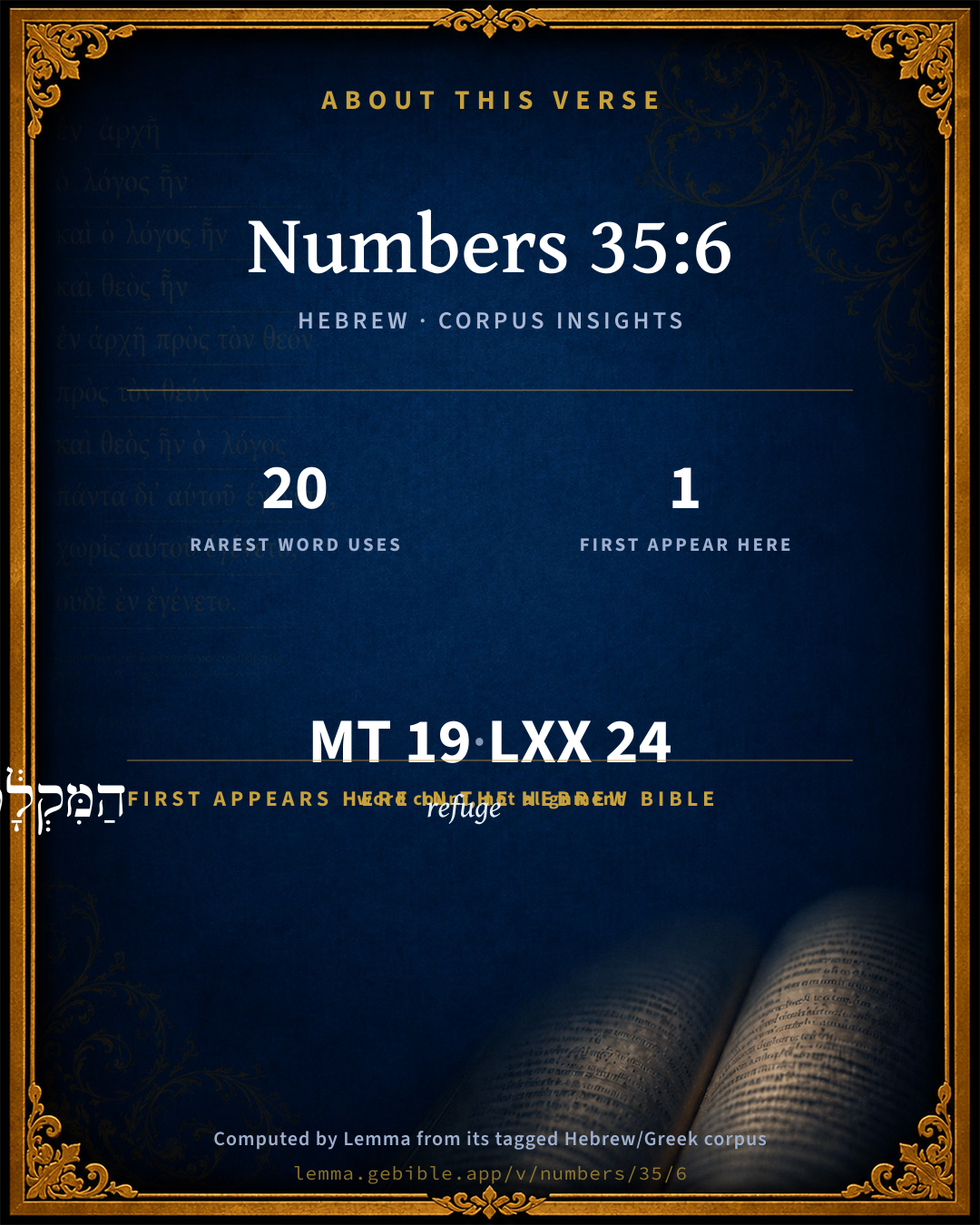
The rarest word here is הַמִּקְלָ֔ט refuge H4733 — appearing just 20 times in the whole Hebrew Bible.

First appearance in Scripture

This word makes its first canonical appearance in the Hebrew Bible here:

  • הַמִּקְלָ֔ט refuge H4733

Shared distinctive vocabulary

הַמִּקְלָ֔ט refuge H4733 occurs in 20 verses of the Hebrew Bible. Also found in:

Grammatical profile

  • 5 verbs
  • 5 nouns
  • 3 adjectives
  • 1 preposition
  • 1 adverb
  • 4 particles

Verb forms

  • תִּתְּנוּ֙ Qal · Imperfect
  • תִּתְּנ֔וּ Qal · Imperfect
  • לָנֻ֥ס Qal · Infinitive Construct
  • הָרֹצֵ֑חַ Qal · Participle Active
  • תִּתְּנ֔וּ Qal · Imperfect

Repetition

Words recur within this verse — often emphatic in Hebrew:

  • הֶֽעָרִ֗ים city H5892 ×3
  • תִּתְּנוּ֙ to give H5414 ×3
  • אֲשֶׁ֤ר which H834 ×2

Hebrew & Septuagint length

In English translation the verse runs 35 words from the Hebrew and 31 from the Septuagint (LXX English) — closely comparable.

A rough comparison of the two English renderings, which tokenize alike — not a word-level alignment.

Word counts can differ between the Hebrew and the Greek without any difference in meaning — e.g. the Hebrew direct-object marker אֵת has no separate Greek word, and Greek often adds the article ὁ.

In the original languages it is 19 Hebrew tokens and 24 Greek tokens — but the two are counted differently (Hebrew bundles its prefixes and suffixes into one token; the Greek is in lemma form), so that isn’t a like-for-like length.

Cross-references

16

Topical passages linked to Numbers 35:6 in the Treasury of Scripture Knowledge — connected by theme and wording, ordered by reader-vote popularity; previews shown in the World English Bible.

  • Joshua 21:3 The children of Israel gave to the Levites out of their inheritance, according to the commandment of Yahweh, these cities with their suburbs.
  • Joshua 21:13 To the children of Aaron the priest they gave Hebron with its suburbs, the city of refuge for the manslayer, and Libnah with its suburbs,
  • Joshua 21:21 They gave them Shechem with its suburbs in the hill-country of Ephraim, the city of refuge for the manslayer, and Gezer with its suburbs,
  • Joshua 21:27 To the children of Gershon, of the families of the Levites, out of the half-tribe of Manasseh [they gave] Golan in Bashan with its suburbs, the city of refuge for the manslayer, and Be-eshterah with its suburbs; two cities.
  • Joshua 21:32 Out of the tribe of Naphtali, Kedesh in Galilee with its suburbs, the city of refuge for the manslayer, and Hammothdor with its suburbs, and Kartan with its suburbs; three cities.
  • Joshua 21:36 Out of the tribe of Reuben, Bezer with its suburbs, and Jahaz with its suburbs,
  • Joshua 21:38 Out of the tribe of Gad, Ramoth in Gilead with its suburbs, the city of refuge for the manslayer, and Mahanaim with its suburbs,
  • Psalms 9:9 Yahweh will also be a high tower for the oppressed; A high tower in times of trouble.
  • Numbers 35:13–14 The cities which you shall give shall be for you six cities of refuge.
  • Deuteronomy 4:41–43 Then Moses set apart three cities beyond the Jordan toward the sunrise;
  • Joshua 20:2–9 Speak to the children of Israel, saying, Assign you the cities of refuge, of which I spoke to you by Moses,
  • Psalms 62:7–8 With God is my salvation and my honor. The rock of my strength, and my refuge, is in God.
  • Psalms 142:4–5 Look on my right, and see; For there is no one who is concerned for me. Refuge has fled from me. No one cares for my soul.
  • Isaiah 4:6 There will be a pavilion for a shade in the daytime from the heat, and for a refuge and for a shelter from storm and from rain.
  • Matthew 11:28 "Come to me, all you who labor and are heavily burdened, and I will give you rest.
  • Hebrews 6:18 that by two immutable things, in which it is impossible for God to lie, we may have a strong encouragement, who have fled for refuge to take hold of the hope set before us.

Cross-references courtesy of OpenBible.info (CC BY 4.0).

Hebrew and Greek witnesses Masoretic Hebrew ↔ Greek Septuagint

The same verse in the two great witnesses to the Old Testament, shown verse-for-verse.

These are two independent witnesses, not word-aligned to each other, and the Septuagint is shown in lemma (dictionary) form.

Hebrew Numbers 35:6 Masoretic · Westminster Leningrad Codex

וְאֵ֣ת הֶֽעָרִ֗ים אֲשֶׁ֤ר תִּתְּנוּ֙ לַלְוִיִּ֔ם אֵ֚ת שֵׁשׁ עָרֵ֣י הַמִּקְלָ֔ט אֲשֶׁ֣ר תִּתְּנ֔וּ לָנֻ֥ס שָׁ֖מָּה הָרֹצֵ֑חַ וַעֲלֵיהֶ֣ם תִּתְּנ֔וּ אַרְבָּעִ֥ים וּשְׁתַּ֖יִם עִֽיר

The cities which you shall give to the Levites, they shall be the six cities of refuge, which you shall give for the manslayer to flee to: and besides them you shall give forty-two cities.

World English Bible · Public Domain

Greek LXX Numbers 35:6 Septuagint · lemma form

καί ὁ πόλις δίδωμι ὁ λευίτης ὁ ἕξ πόλις ὁ φυγαδευτήριον ὅς δίδωμι φεύγω ἐκεῖ ὁ φονεύω καί πρός οὗτος τεσσαράκοντα καί δύο πόλις

And you⌃ shall give the cities to the Levites, the six cities of refuge which you⌃ shall give for the slayer to flee there, and in addition to these, forty-two cities.

LXX2012 (modern English Septuagint) · Public Domain

On this verse, John Gill's Exposition discusses the Septuagint’s reading. Read the note in Commentary ↓

Hebrew: Westminster Leningrad Codex (CC BY 4.0). Greek: Septuagint (public domain); English from LXX2012 (modern English Septuagint) (Public Domain). How the Septuagint differs from the Hebrew →

Targum (Aramaic paraphrase)

2

The Targum is the ancient Jewish Aramaic paraphrase of the Hebrew Scriptures — an interpretive translation, not the Hebrew text itself. Onkelos (literal) and Pseudo-Jonathan (expansive) render the Torah, and Jonathan the Prophets. Coverage is partial: where no permissively-licensed English translation exists for a verse, only the Aramaic is shown. This is verse-level text, not a word-by-word alignment to the Hebrew.

  1. Targum Onkelos Torah (Genesis–Deuteronomy)
    וְיָת קִרְוַיָא דִי תִתְּנוּן לְלֵוָאֵי יָת שִׁית קִרְוֵי שֵׁזָבוּתָא דִי תִתְּנוּן לְמֵעֲרַק תַּמָן קָטוֹלָא וַעֲלֵיהוֹן תִּתְּנוּן אַרְבְּעִין וְתַרְתֵּין קִרְוִין

    (no public-domain English translation for this verse)

    Targum Onkelos — Aramaic: “Onkelos Genesis” (public domain); “Onkelos Exodus” (public domain); “Onkelos Leviticus” (public domain); “Onkelos Numbers” (public domain); “Onkelos Deuteronomy” (public domain). English: “Sefaria Community Translation” (CC0 1.0 (public-domain dedication)); “J.W. Etheridge. The Targums of Onkelos and Jonathan Ben Uzziel on the Pentateuch. London: Longmans, Green, 1862” (public domain). Text via Sefaria.

  2. Targum Pseudo-Jonathan Torah (Genesis–Deuteronomy)
    וְיַת קִרְוַיָא דְתִתְּנוּן לְלֵיוָאֵי יַת שִׁית קוֹרְיַין דִקְלָטִין קָטוֹלָא לְמֵיעֲרוֹק לְתַמָן קָטוֹלָא וַעֲלֵיהוֹן תִּתְּנוּן אַרְבְּעִין וְתַרְתֵּין קוֹרְיָין

    And of the cities you give to the Levites, six shall be for refuges to manslayers, that the manslayer may escape thither. Beside these you shall give them forty-two other cities.

    Targum Pseudo-Jonathan — Aramaic: “Targum Jonathan on Genesis” (public domain); “Targum Jonathan on Exodus” (public domain); “Targum Jonathan on Leviticus” (public domain); “Targum Jonathan on Numbers” (public domain); “Targum Jonathan on Deuteronomy” (public domain). English: “The Targum of Jonathan ben Uzziel, trans. J. W. Etheridge, London, 1862” (public domain). Text via Sefaria.

Commentary

Notes on Numbers 35:6 from classic Christian and Jewish commentators (each source and its license shown beneath its notes). The classic Christian expositions comment on the surrounding passage and are grouped to its opening verse, so a note may address several verses; the Jewish commentaries on the Tanakh (Rashi and others) are per-verse, so they appear only where the commentator wrote on this verse.

Lemma curates 59 commentaries, every one of them public domain or Creative Commons licensed, each selected and text-cleaned for this edition rather than reprinted as found. About our sources →

Jamieson, Fausset & Brown

Robert Jamieson, A. R. Fausset & David Brown

CITIES OF REFUGE. (Num 35:6-8)

there shall be six cities for refuge, which ye shall appoint for the manslayer--The establishment of those privileged sanctuaries among the cities of the Levites is probably traceable to the idea, that they would be the most suitable and impartial judges--that their presence and counsels might calm or restrain the stormy passions of the blood avenger--and that, from their being invested with the sacred character, they might be types of Christ, in whom sinners find a refuge from the destroyer (see Deu 4:43; Jos 20:8).

Jamieson, Fausset & Brown — Commentary Critical and Explanatory on the Whole Bible (1871) — public domain (CC PDM 1.0). Text via the HelloAO Bible API.

Ellicott's Commentary for English Readers

(6, 7, 8) And among the cities which ye shall give . . . —The construction of this verse is involved; or, rather, there is a suspension of the subject in Num_35:6, and a resumption of it in Num_35:7-8. The verses may be rendered thus: And as to the cities which ye shall give to the Levites, viz., the six cities of refuge which ye shall give that the manslayer may flee thither (and in addition to these ye shall give forty and two cities); as to all the cities which ye shall give to the Levites, viz., forty and eight cities, them and their suburbs; now as to the cities which ye shall give from the possession of the children of Israel; from the many ye shall take many, and from the few ye shall take few . . . It had already been announced in general terms that a place should be appointed whither any one should flee who had unintentionally smitten a man so that he died, and had not lain in wait with a view to commit murder (Exo_21:12-13). In the verses which follow, the law is delivered at length, and is repeated and further expanded in Deu_19:1-13. There were many reasons why all the cities of refuge were Levitical cities. Of these reasons the chief probably were:—(1) That these cities were specially consecrated to the Lord (see Jos_20:7, “And they appointed,” &c.—Heb., consecrated); and (2) that it was to the priests and Levites that the people looked as administrators of justice.

A Bible Commentary for English Readers, edited by Charles John Ellicott (1878–1897) — public domain. Text from a community e-Sword module.

Trapp's Complete Commentary

John Trapp

Num 35:6 And among the cities which ye shall give unto the Levites [there shall be] six cities for refuge, which ye shall appoint for the manslayer, that he may flee thither: and to them ye shall add forty and two cities.

Ver. 6. That he may flee thither.] All sins then are not equal, as the Stoics held; neither are all to be alike punished, as by Draco’s laws they were, in a manner. Those laws were said to be written, not with black, but with blood, because they punished every peccadillo almost with death, as idleness, stealing of pot herbs, &c. Aristotle gives them this small commendation, that they are not worth remembrance, but only for their great severity.

John Trapp, A Commentary or Exposition upon All the Books of the Old and New Testament (1647–1656) — public domain. Text from a community e-Sword module.

Joseph Benson's Commentary

Num 35:6-7. Cities for refuge — Or, of escape for manslayers. And these cities are assigned among the Levites, partly because they might be presumed to be the most proper and impartial judges between manslayers and wilful murderers; partly because their presence and authority would more effectually bridle the passions of the avenger of blood who might pursue him thither; and perhaps to signify that it is only in Christ (whom the Levitical priests represented) that sinners find refuge and safety from the destroyer. Three of these cities of refuge were in the land of Canaan, and three on the other side Jordan, (Num 35:14,) and the names of them are set down, Jos 20:7-8. Of the forty-eight cities given to the Levites, thirteen were appointed for the priests.

Joseph Benson's Commentary on the Old and New Testaments (1811–1818) — public domain. Text from a community e-Sword module.

Whedon's Commentary on the Bible

Daniel D. Whedon

CITIES OF REFUGE, Num_35:6-34.

The right of shelter and impunity, (jus asyli,) by fleeing to sacred places, was afforded to the guilty and the unfortunate by the ancient Greeks and Romans. When abuses arose and justice was grossly outraged, the limitation of this privilege was necessary to the preservation of society. Tacitus records the increase of criminals because of the increase of places of asylum among the Greeks and Romans. This merciful and wise provision of Mosaism, so far as the spirit of the age allowed it, prevented all family hatred and war from ever taking place, as was inevitably the case among the other nations, where any bloodshed whatever, whether wilful or accidental, laid the homicide open to the duty of revenge by the relatives of the slain person, who again in their turn were then similarly watched and hunted by the opposite party, until a family war of extermination was the sad heritage of succeeding generations.

6. Cities for refuge… manslayer — Jos_20:1-9, notes.

Daniel D. Whedon (gen. ed.), Commentary on the Old and New Testaments (1874–1909) — public domain. Text from a community e-Sword module.

Keil & Delitzsch

C. F. Keil & F. Delitzsch

Of these cities which were given up to the Levites, six were to serve as cities of refuge (see at Num 35:12) for manslayers, and in addition to these (עליהם, over upon them) the Israelites were to give of their possessions forty-two others, that is to say, forty-eight in all; and they were to do this, giving much from every tribe that had much, and little from the one which had little (Num 26:54). With the accusatives הערים את and ערי שׁשׁ עת (Num 35:6), the writer has already in his mind the verbs תּרבּוּ and תּמעיטוּ of Num 35:8, where he takes up the object again in the word והערים. According to Josh 21, the Levites received nine cities in the territory of Judah and Simeon, four in the territory of each of the other tribes, with the exception of Naphtali, in which there were only three, that is to say, ten in the land to the east of the Jordan, and thirty-eight in Canaan proper, of which the thirteen given up by Judah, Simeon, and Benjamin were assigned to the families of the priests, and the other thirty-five to the three Levitical families. This distribution of the Levites among all the tribes - by which the curse of division and dispersion in Israel, which had been pronounced upon Levi in Jacob's blessing (Gen 49:7), was changed into a blessing both for the Levites themselves and also for all Israel - was in perfect accordance with the election and destination of this tribe. Called out of the whole nation to be the peculiar possession of Jehovah, to watch over His covenant, and teach Israel His rights and His law (Deu 33:9-10; Lev 10:11; Deu 31:9-13), the Levites were to form and set forth among all the tribes the ἐκλογή of the nation of Jehovah's possession, and by their walk as well as by their calling to remind the Israelites continually of their own divine calling; to foster and preserve the law and testimony of the Lord in Israel, and to awaken and spread the fear of God and piety among all the tribes. Whilst their distribution among all the tribes corresponded to this appointment, the fact that they were not scattered in all the towns and villages of the other tribes, but were congregated together in separate towns among the different tribes, preserved them from the disadvantages of standing alone, and defended them from the danger of moral and spiritual declension. Lastly, in the number forty-eight, the quadrupling of the number of the tribes (twelve) is unmistakeable. Now, as the number four is the seal of the kingdom of God in the world, the idea of the kingdom of God is also represented in the four times twelve towns (cf. Bhr, Symbolik, ii. pp. 50, 51).

Keil & Delitzsch — Biblical Commentary on the Old Testament (1861–1891) — public domain (CC PDM 1.0). Text via the HelloAO Bible API. (Old Testament only.)

Tyndale Open Study Notes

Tyndale Open Resources

35:6-34 Six of the Levites’ towns had a special purpose as cities of refuge, places where a person who has accidentally killed someone can flee for safety. This unusual institution illustrates the humanitarian aspect of Hebrew law (see also Deut 4:41-43; 19:1-13; Josh 20). These six Levitical towns provided a safe haven in cases of accidental or involuntary manslaughter (cp. Exod 21:12-14). Just as the forty-eight Levite towns were widely distributed across Israel’s territories, the six cities of refuge were dispersed so they would be widely accessible (see Josh 20:7-8). These designated settlements supplemented the role of the altar as a temporary place of asylum (e.g., 1 Kgs 1:50-53; 2:28-34; cp. Exod 21:14). Other ancient peoples provided special places of asylum or refuge, often at the altar (see Exod 21:12-14; 1 Kgs 2:28-34), but only ancient Israel established whole settlements as places of sanctuary, reflecting a special interest in social justice.

Tyndale Open Study Notes — © Tyndale Open Resources, licensed CC BY-SA 4.0. Text via the HelloAO Bible API.

John Gill's Exposition

And among the cities which ye shall give unto the Levites,.... The number of which is not yet expressed, but is afterwards: there shall be

six cities for refuge; a sort of asylums, of which there were many among the Heathens, perhaps in imitation of these, for persons to have recourse to for safety, when in danger of life: the Septuagint render the words, "cities of flight" (b); or to flee unto, which certainly was the use of them: to this the apostle alludes when he speaks of some that fled for refuge, to lay hold on the hope set before them, Heb 6:18, the word (c) used for refuge signifies "gathering or receiving", for here persons in distress gathered or betook themselves; and here they were received, retained, protected, and sheltered: what and where these six cities were to be, and were, is after shown:

which ye shall appoint for the manslayer; not for any and everyone, not for one that killed a man presumptuously and purposely, through enmity and malice, but for one that did it ignorantly, unawares, and without design:

that he may flee thither; with all haste, after the commission of the fact; and, to facilitate his flight, and that he might have no interruption in it, the sanhedrim were obliged to prepare the ways to the cities of refuge, and to make them fit and large; and they removed everything that might cause him to stumble; and they did not leave in the way neither an hillock, nor a dale, nor a river but they made a bridge over it, that nothing might retard him that fled thither, as it is said:

thou shalt prepare thee a way; Deu 19:3 and the breadth of the way to the cities of refuge was not less than thirty two cubits; and at the parting of ways (on posts erected) were written, "refuge, refuge", so that the slayer might know (the way) and turn there (as this directed him): and on the fifteenth of Adar or February, they met every year, to take care of this business (d); and they also appointed two disciples of the wise men, or two studious and understanding persons, to accompany him, not so much for the direction of the way, as lest the avenger of blood should meet with him, and slay him in the way; and who were to talk to him, and persuade him not to do it, suggesting to him that it was not done designedly, but unawares, and that it would be a bad thing to kill a man for what he did not intend to do, and which was done without any malice or enmity to the person killed, and with such like words to cool and appease the avenger (e):

and to them ye shall add forty two cities; according to the Jewish writers these also were cities of refuge; for so they say (f),"all the cities of the Levites receive or are refuges, every one of them is a city of refuge, as it is said, "and to them ye shall add", &c. the Scripture makes them all alike for refuge: what difference is there between cities of refuge, which are separated for refuge, and the rest of the cities of the Levites? the gates of the cities of refuge receive, whether according to knowledge or not, (which Mr. Selden (g) interprets, whether the inhabitants will or not; but the sense of Maimonides elsewhere (h), and of other writers, is plainly this, whether according to the knowledge and intention of the manslayer or not, whether he knows it to be a city of refuge or :not, and whether he purposely came thither for safety or not,) and he that enters into them is safe; but the rest of the cities of the Levites do not receive, but according to knowledge (when the manslayer knowingly and designedly came thither for shelter); and a manslayer that dwells in a city of refuge gives no more for his house, but he that dwells in the other cities of the Levites gives more (or pays for it) to the owner of the house;''but though this is their unanimous opinion, it rather seems, according to the letter of the Scripture, that only six were cities of refuge, and the rest were for the Levites to dwell in by themselves.

(b) , Sept. (c) "receptus", Junius & Tremellius; "collectionis", Piscator; R. Sol. Ohel Moed, fol. 82. 1. "proprie significat collectionem vel retentionem", Munster. (d) Maimon. Hilchot Rotzeach, c. 8. sect. 5. (e) Misn. Maccot, c. 2. sect. 5. & Maimon. & Bartenora in ib. (f) Maimon. ut supra, (d)) sect. 11. (g) De Jure Natarae & Gentium, l. 4. c. 2. p. 489. (h) Maimon. & Bartenora in Misn. Maccot, l. 2. sect. 4.

John Gill's Exposition of the Whole Bible (1746–1763) — public domain (CC PDM 1.0). Text via the HelloAO Bible API.

Albert Barnes' Notes on the Bible

The Levitical cities were in an special manner the Lord’s; and therefore the places of refuge, where the manslayer might remain under the protection of a special institution devised by divine mercy, were appropriately selected from among them. No doubt also the Priests and Levites would be the fittest persons to administer the law in the doubtful cases which would be sure to occur: compare Num 35:24 note.

Albert Barnes' Notes on the Bible (1834–1885) — public domain. Text from a community e-Sword/MySword module.

Haydock's Catholic Bible Commentary

Cities. Maimonides pretends, that all forty-eight cities of the Levites were asylums; though only six were bound to receive the fugitive gratis. Moses had promised a place of refuge, which he now grants, Exodus xxi. 13. The altar and temple enjoyed the like privilege: the latter even till its destruction. (Philo) --- Josephus mentions only six cities of refuge. Those who could not be supposed to have killed a person designedly were not obliged to flee to them; as, on the other hand, the murderer was not permitted to enter, if his malice were notorious, or his negligence extreme. (Rabbins ep. Selden, Jur. iv. 2.) To be secured at the altar of holocausts, it was necessary to touch the grate. If the judges declared that the person’s case was such as the law admitted, he was conducted away, under a strong guard, to one of the cities; or, if he were deemed unworthy, he was put to death, out of the holy place. The altar was commonly the refuge only of priests. Those who were not of Hebrew extraction, could not claim the rights of an asylum, according to the Rabbins. But the contrary seems to be asserted, ver. 15. The roads to the cities of refuge were to be kept in good repair, and in case more than six should be found necessary, three others might be appointed, Deuteronomy xix. 3, 8. This privilege is founded on the law of nature, which decrees that the life of the innocent man, who has had the misfortune to kill another, should not be taken away. Other nations extended this right to almost every crime, that the weak might have an opportunity of defending themselves. The sons of Hercules erected for this purpose the altar of mercy, at Athens. Some of the pagan temples could protect even the greatest criminals, as well as the innocent, who might fear oppression. Those of Apollo, at Delphos, of Bacchus, at Ephesus, &c., were very famous. See Marsham, Chron. sæc. 13. Tiberius found it necessary to recall these privileges among the Greeks, as they were greatly abused. (Tacitus, An. iii. 6.) But his decree ws not much regarded. The Romans had their asylums also, at Naples, &c., where those who had been condemned to die, might be secure. Rome itself was an asylum for all strangers, as St. Augustine remarks, City of God i. The Christian emperors afforded the like privileges to our churches. But some who were guilty of the crimes of adultery, murder, heresy, &c., were deprived of the benefit. (Calmet) --- Those who fled to the altar among the Jews were first to be purified; (Philo) and if they had committed murder publicly, like Joab, they were dragged away, 3 Kings ii. (Tirinus)

George Leo Haydock (1774–1849), Haydock's Catholic Family Bible and Commentary, 1859 edition — public domain. Excludes Psalms (Douay-Rheims chapter numbering differs from Protestant) and Deuterocanonical books (Catholic canon only).

Matthew Poole's English Annotations

For refuge, or, of receipt, or escape, or resort, to wit, for man-slayers; and these cities are assigned among the

Levites, partly, because they might be presumed to be the most proper and impartial judges between man-slayers and wilful murderers; partly, because their presence, and counsel, and authority would more effectually bridle the passions of the avenger of blood who might pursue him thither; and partly, to signify that it is only in Christ (whom the Levitical priests did represent) that sinners find refuge and safety from the destroyer. The names of these cities, we have Deu 4:41,43; Jos 20:8.

For the man-slayer, such as is here described, Num 35:11,15,22,23.

Matthew Poole's English Annotations on the Holy Bible (1683–1685) — public domain. Text from a community e-Sword/MySword module.

The Pulpit Commentary

And among the cities. Rather, "and the cities." taw kai taleiv . The construction is broken, or rather is continuous throughout verses 6-8, the accusative being repeated. Six cities for refuge. See below on verse 11.

The Pulpit Commentary (1880–1919), ed. H.D.M. Spence-Jones & Joseph S. Exell — public domain. Text from a community e-Sword module.

John Wesley's Explanatory Notes

Cities for refuge - Or, of escape for manslayers: And these cities are assigned among the Levites, partly because they might be presumed to be the most proper and impartial Judges between man-slayers, and wilful murderers; partly because their presence and authority would more effectually bridle the passions of the avenger of blood who might pursue him thither; and perhaps to signify, that it is only in Christ (whom the Levitical priests represented) that sinners find refuge and safety from the destroyer.

John Wesley, Explanatory Notes Upon the Whole Bible (1754–1765) — public domain. Text via the GEBible commentary corpus.

Scofield Reference Notes

C. I. Scofield

refuge

The cities of refuge are types of Christ sheltering the sinner from judgment.

Psa 46:1; Psa 142:5; Isa 4:6; Exo 21:13; Deu 19:2-9; Rom 8:1; Rom 8:33; Rom 8:34; Php 3:9; Heb 6:18; Heb 6:19.

The Scofield Reference Bible (1917 edition), notes by C. I. Scofield — public domain. Text from a community e-Sword module.

unfoldingWord translationNotes

Door43 World Missions Community

a person who has killed someone

This refers to people who have killed someone, but it had not yet been determined whether they killed the person intentionally or accidentally.

forty-two ... forty-eight

"42 ... 48" (See: Numbers)

translationWords

refuge

accuse

unfoldingWord translationNotes — © Distant Shores Media and the Door43 World Missions Community, licensed CC BY-SA 4.0. Source: git.door43.org/Door43/en_tn.

Lesson kit

Teaching starters — assembled from the data on this page, not authored interpretation. Every prompt links to the verse data it draws on. Edit before teaching.

Numbers, in the Pentateuch, opens this verse with 19 words (13 distinct Hebrew lemmas). Its most distinctive word is miqlâṭ (“refuge”). A historical commentator’s framing appears above. Read the whole chapter for the surrounding context.

Discussion questions

  1. The word miqlâṭ carries the sense “refuge.” How does it shape the verse?
  2. The word “refuge” first appears here in Scripture. What is being introduced at this debut?
  3. Numbers 35:11 shares the word «refuge» with this verse. How do the two illuminate each other?
  4. “city” occurs 3× in this one verse. What is the effect of the repetition?
  5. These translations render this verse differently. What is at stake in choosing one wording over another?
  6. The verb «תִּתְּנוּ֙» is Qal Imperfect. How does its form color the action?
  7. Reading how Jamieson, Fausset & Brown and Ellicott's Commentary for English Readers read this verse, where do the two commentators agree and where do they part?

Things to notice

Reading settings

Reading text

Shown beneath each verse's original-language words.

Old Testament
Old Testament edition

Read the OT as the Masoretic Hebrew (MT) or the Greek Septuagint (LXX).

English shown for the Greek Septuagint (in the Hebrew ↔ Greek comparison).

Comparing translations? Open the Compare panel on any verse page to stack up to four side by side.