
Nehemiah 11:13

Hebrew (Westminster Leningrad Codex) Nehemiah 11:13 appears in the Hebrew Old Testament. The text above is from the Westminster Leningrad Codex. Each word links to its Strong’s number, a concise gloss, and parsing drawn from the Open Scriptures Hebrew Bible morphology. Click any word for its full Brown-Driver-Briggs (BDB) entry.
Download image
Cite this verse

Nehemiah 11:13 (World English Bible). Public Domain. Lemma interlinear Bible study tool, https://lemma.gebible.app/v/nehemiah/11/13.

Show BibTeX & RIS
BibTeX
RIS
English Translation
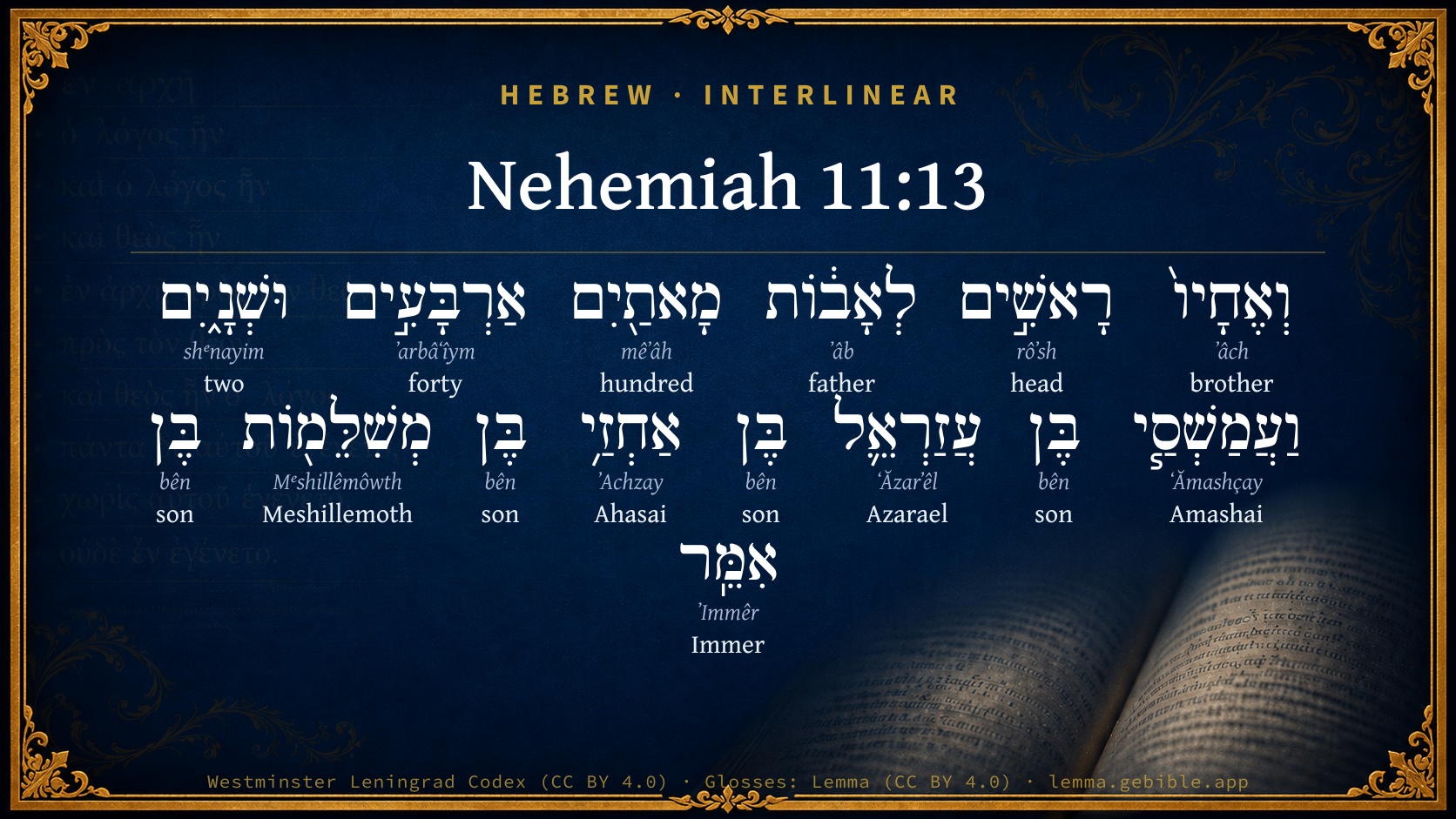
and his brothers, chiefs of fathers' [houses], two hundred forty-two; and Amashsai the son of Azarel, the son of Ahzai, the son of Meshillemoth, the son of Immer,
World English Bible · Public Domain
Highlights
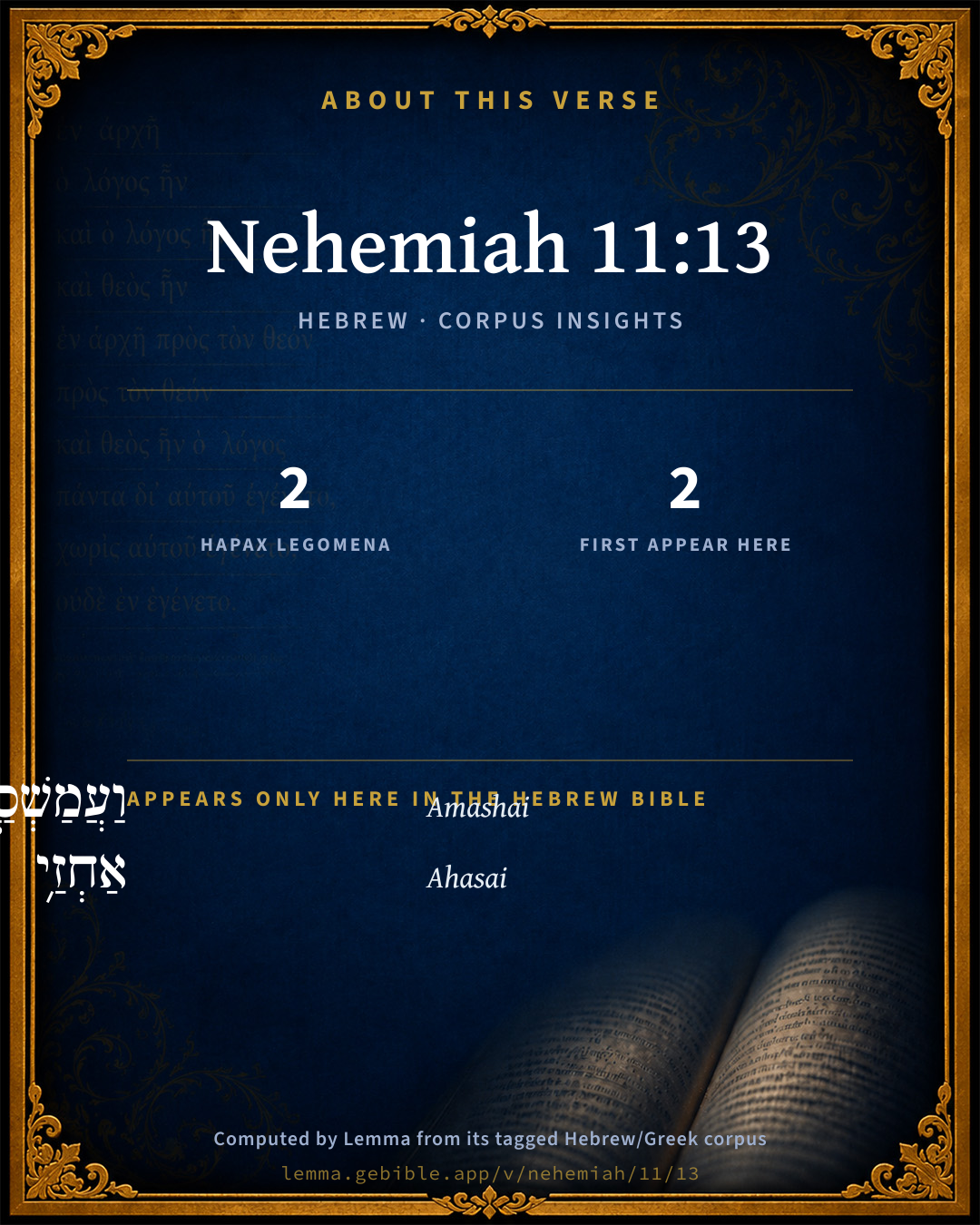
  • 2 hapax legomena — only here in the Hebrew Bible
  • 2 first appearances in the Hebrew Bible
Full analysis ↓
Download a study sheet

One document with this verse’s original text, its word-by-word gloss line, the meaning frame, cross-references with their text, attributed commentary, and full source and license credits — printable, and it pastes into notes with its structure intact.

This verse Autodidact and up

Study sheet (.html) Plain text (.txt)

A passage Seminary Student

Up to 50 verses in one chapter. A passage sheet keeps up to 6 commentary sources and 12 cross-references per verse, in the order this page ranks them, and says so on the sheet whenever that leaves anything out. Ask for a single verse and you get the Autodidact verse sheet above.

Everything on this page stays free to read, with no account — the sheet is a download of what is already on screen, not access to it.

Want to remove ads? Support Godless Engineer
Compare translations 3

The same verse in 3 English versions, stacked beneath the original-language interlinear above. Click any original word for its lexicon entry.

Each is an independent rendering of the whole verse — the interlinear is not word-aligned to these translations.

Highlighted words mark where these versions differ — a whole-verse word diff, not a word-by-word alignment.

  • World English Bible Public Domain
    and his brothers, chiefs of fathers' [houses], two hundred forty-two; and Amashsai the son of Azarel, the son of Ahzai, the son of Meshillemoth, the son of Immer,
  • King James Version Public Domain
    And his brethren, chief of the fathers, two hundred forty and two: and Amashai the son of Azareel, the son of Ahasai, the son of Meshillemoth, the son of Immer,
  • unfoldingWord Literal Text CC BY-SA 4.0
    and his brothers, the heads of fathers, were 242; and Amashsai, the son of Azarel, the son of Ahzai, the son of Meshillemoth, the son of Immer;

unfoldingWord Literal Text — © unfoldingWord, licensed CC BY-SA 4.0. Word-aligned USFM3 via Door43 (git.door43.org/unfoldingWord/en_ult).

Versions to compare (up to 4)

3 of 4 selected

Show all 18 translations

Every available English version of this verse, each an independent rendering of the whole verse.

  • World English Bible Public Domain
    and his brothers, chiefs of fathers' [houses], two hundred forty-two; and Amashsai the son of Azarel, the son of Ahzai, the son of Meshillemoth, the son of Immer,
  • Berean Standard Bible Public Domain
    and his associates, the leaders of families—242 men; Amashai son of Azarel, the son of Ahzai, the son of Meshillemoth, the son of Immer;
  • Majority Standard Bible Public Domain
    and his associates, the leaders of families—242 men; Amashai son of Azarel, the son of Ahzai, the son of Meshillemoth, the son of Immer;
  • King James Version Public Domain
    And his brethren, chief of the fathers, two hundred forty and two: and Amashai the son of Azareel, the son of Ahasai, the son of Meshillemoth, the son of Immer,
  • American Standard Version (1901) Public Domain
    and his brethren, chiefs of fathers' `houses', two hundred forty and two; and Amashsai the son of Azarel, the son of Ahzai, the son of Meshillemoth, the son of Immer,
  • Revised Version (1885) Public Domain
    and his brethren, chiefs of fathers’ houses, two hundred forty and two: and Amashsai the son of Azarel, the son of Ahzai, the son of Meshillemoth, the son of Immer,
  • Geneva Bible (1599) Public Domain
    And his brethren, chiefe of the fathers, two hundreth and two and fourtie: and Amashsai the sonne of Azareel, the sonne of Ahazai, the sonne of Meshilemoth, the sonne of Immer:
  • Douay-Rheims (1899) Public Domain
    And his brethren the chiefs of the fathers: two hundred forty-two. And Amassai the son of Azreel, the son of Ahazi, the son of Mosollamoth, the son of Emmer,
  • Young's Literal Translation Public Domain
    and his brethren, heads of fathers, two hundred forty and two; and Amashsai son of Azareel, son of Ahazai, son of Meshillemoth, son of Immer,
  • Literal Standard Version CC BY-SA 4.0
    and his brothers, heads of fathers, two hundred forty-two; and Amashsai son of Azareel, son of Ahazai, son of Meshillemoth, son of Immer,
  • Unlocked Literal Bible CC BY-SA 4.0
    His brothers were heads of clans, 242 men; and Amashsai son of Azarel son of Ahzai son of Meshillemoth son of Immer,
  • unfoldingWord Literal Text CC BY-SA 4.0
    and his brothers, the heads of fathers, were 242; and Amashsai, the son of Azarel, the son of Ahzai, the son of Meshillemoth, the son of Immer;
  • Darby Bible Public Domain
    and his brethren, chief fathers, two hundred and forty-two; and Amassai the son of Azareel, the son of Ahzai, the son of Meshillemoth, the son of Immer;
  • World Messianic Bible Public Domain
    and his brothers, chiefs of fathers’ households, two hundred forty-two; and Amashsai the son of Azarel, the son of Ahzai, the son of Meshillemoth, the son of Immer,
  • Webster's Bible Public Domain
    And his brethren, chief of the fathers, two hundred forty and two: and Amashai the son of Azareel, the son of Ahasai, the son of Meshillemoth, the son of Immer,
  • Free Bible Version CC BY-SA 4.0
    and those who worked with him, family leaders, a total of 242; and Amashsai, son of Azarel, son of Ahzai, son of Meshillemoth, son of Immer,
  • Bible in Basic English Public Domain
    And his brothers, heads of families, two hundred and forty-two; and Amashsai, the son of Azarel, the son of Ahzai, the son of Meshillemoth, the son of Immer,
  • JPS Tanakh (1917) Public Domain
    and his brethren, chiefs of fathers' houses, two hundred forty and two; and Amashsai the son of Azarel, the son of Ahzai, the son of Meshillemoth, the son of Immer,

Literal Standard Version (2020), Covenant Press — licensed CC BY-SA 4.0. Text via the HelloAO Bible API (eBible.org). Unlocked Literal Bible (unfoldingWord) — licensed CC BY-SA 4.0. Text via the HelloAO Bible API (eBible.org). unfoldingWord Literal Text — © unfoldingWord, licensed CC BY-SA 4.0. Word-aligned USFM3 via Door43 (git.door43.org/unfoldingWord/en_ult). Free Bible Version, Dr. Jonathan Gallagher — licensed CC BY-SA 4.0. Text via the HelloAO Bible API (eBible.org).

Word by word

More ways to search: Search by grammar → Find every occurrence → Compare this word →

Practice this passage: Drill this verse → Learn its vocabulary →

וַעֲמַשְׁסַ֧י
ʻĂmashçay
H6023
“and · Amashai”
Conjunction + Noun, Proper
Part of Speech
Conjunction + Noun
Type
Proper
Full BDB Definition

Origin: probably from H6006

TWOT: None

Amashai = "burdensome" - a priest, son of Azareel in the time of Nehemiah
  1. וְאֶחָיו֙ ʼâch H251 “and · brothers · his” Conjunction + Noun, Common, Masculine, Plural, Construct + Suffix, Personal, 3rd Person, Masculine, Singular
  2. רָאשִׁ֣ים rôʼsh H7218 “heads” Noun, Common, Masculine, Plural, Absolute
  3. לְאָב֔וֹת ʼâb H1 “to/for · fathers” Preposition + Noun, Common, Masculine, Plural, Absolute
  4. מָאתַ֖יִם mêʼâh H3967 “hundred” Adjective, Cardinal number, Both, Dual, Absolute
  5. אַרְבָּעִ֣ים ʼarbâʻîym H705 “forty” Adjective, Cardinal number, Both, Plural, Absolute
  6. וּשְׁנָ֑יִם shᵉnayim H8147 “and · two” Conjunction + Adjective, Cardinal number, Masculine, Dual, Absolute
  7. בֶּן bên H1121 “son of” Noun, Common, Masculine, Singular, Construct
  8. עֲזַרְאֵ֛ל ʻĂzarʼêl H5832 “Azarael” Noun, Proper
  9. בֶּן bên H1121 “son of” Noun, Common, Masculine, Singular, Construct
  10. אַחְזַ֥י ʼAchzay H273 “Ahasai” Noun, Proper
  11. בֶּן bên H1121 “son of” Noun, Common, Masculine, Singular, Construct
  12. מְשִׁלֵּמ֖וֹת Mᵉshillêmôwth H4919 “Meshillemoth” Noun, Proper
  13. בֶּן bên H1121 “son of” Noun, Common, Masculine, Singular, Construct
  14. אִמֵּֽר ʼImmêr H564 “Immer” Noun, Proper

About this verse

These counts appear in no published source. They are computed here, from the morphology-tagged text and Lemma’s own curated glosses. What Lemma adds →

15
words
12
distinct lemmas
Historical
section

Notable vocabulary

2 hapax legomena — words that appear only here in the entire Hebrew Bible:

  • וַעֲמַשְׁסַ֧י Amashai H6023
  • אַחְזַ֥י Ahasai H273

First appearance in Scripture

These words make their first canonical appearance in the Hebrew Bible here:

  • וַעֲמַשְׁסַ֧י Amashai H6023
  • אַחְזַ֥י Ahasai H273

Shared distinctive vocabulary

מְשִׁלֵּמ֖וֹת Meshillemoth H4919 occurs in 2 verses of the Hebrew Bible. Also found in:

Grammatical profile

  • 12 nouns
  • 3 adjectives

Repetition

A word recurs within this verse — often emphatic in Hebrew:

Hebrew and Greek witnesses Masoretic Hebrew ↔ Greek Septuagint

The same verse in the two great witnesses to the Old Testament, shown verse-for-verse.

These are two independent witnesses, not word-aligned to each other, and the Septuagint is shown in lemma (dictionary) form.

Hebrew Nehemiah 11:13 Masoretic · Westminster Leningrad Codex

וְאֶחָיו֙ רָאשִׁ֣ים לְאָב֔וֹת מָאתַ֖יִם אַרְבָּעִ֣ים וּשְׁנָ֑יִם וַעֲמַשְׁסַ֧י בֶּן עֲזַרְאֵ֛ל בֶּן אַחְזַ֥י בֶּן מְשִׁלֵּמ֖וֹת בֶּן אִמֵּֽר

and his brothers, chiefs of fathers' [houses], two hundred forty-two; and Amashsai the son of Azarel, the son of Ahzai, the son of Meshillemoth, the son of Immer,

World English Bible · Public Domain

Greek LXX Structure differs

The Septuagint has no separate book of Nehemiah. Its Greek text is the second half of Esdras B (2 Esdras), chapters 11–23; Ezra is the first half (1–10).

A verse-for-verse comparison isn’t shown here because the chapters and verses don’t line up. Switch to the LXX edition with the MT / LXX toggle above to read the Greek directly.

Hebrew: Westminster Leningrad Codex (CC BY 4.0). Greek: Septuagint (public domain); English from a public-domain English Septuagint. How the Septuagint differs from the Hebrew →

Commentary

Notes on Nehemiah 11:13 from classic Christian and Jewish commentators (each source and its license shown beneath its notes). The classic Christian expositions comment on the surrounding passage and are grouped to its opening verse, so a note may address several verses; the Jewish commentaries on the Tanakh (Rashi and others) are per-verse, so they appear only where the commentator wrote on this verse.

Lemma curates 59 commentaries, every one of them public domain or Creative Commons licensed, each selected and text-cleaned for this edition rather than reprinted as found. About our sources →

The Cambridge Bible for Schools and Colleges

gen. ed. J. J. S. Perowne

13. chief of the fathers] R.V. chiefs of fathers’ houses. From the technical use of the term ‘chiefs of fathers’ houses,’ it is obvious that the figure 242 denotes the number of the retainers of Adaiah and ‘his brethren,’ who were ‘chiefs of fathers’ houses.’

Amashai (R.V. Amashsai) the son of Azareel (R.V. Azarel), the son of Ahasai (R.V. Ahzai), the son of Meshillemoth] In 1Ch_9:12, ‘Maasai the son of Adiel, the son of Jahzerah, the son of Meshullam, the son of Meshillemith’ is clearly the same person. A comparison of the names here will illustrate the way in which proper names were liable to be confused and altered in the process of copying; it will also show how in one list some names are omitted from the full genealogy.

Immer] Cf. Neh_7:40; Ezr_2:37.

The Cambridge Bible for Schools and Colleges (gen. ed. J. J. S. Perowne; Cambridge University Press, 1878–1918) — public domain. Text from a community e-Sword module.

John Gill's Exposition

And Mattaniah the son of Micha, the son of Zabdi, the son of Asaph,.... Zabdi is called Zichri in Ch1 9:15

was the principal to begin the thanksgiving in prayer: he was the precentor, or led the song at the time of the daily sacrifice, in which prayer was also made, as in many of the songs, hymns, and psalms of David:

and Bakbukiah the second among his brethren; he was the next singer, or deputy to Mattaniah; perhaps the same that is called Bakbakkar, Ch1 9:15

and Abda the son of Shammua; called Obadiah the son of Shemaiah, Ch1 9:16

the son of Galal, the son of Jeduthun: one of the three principal singers.

John Gill's Exposition of the Whole Bible (1746–1763) — public domain (CC PDM 1.0). Text via the HelloAO Bible API.

Haydock's Catholic Bible Commentary

Amassai. Or (1 Paralipomenon ix. 12.) Maasai, the son of Adiel, the son of Jezra, the son of Mosollam, the son of Mosollamoth, the son of Emmer.

George Leo Haydock (1774–1849), Haydock's Catholic Family Bible and Commentary, 1859 edition — public domain. Excludes Psalms (Douay-Rheims chapter numbering differs from Protestant) and Deuterocanonical books (Catholic canon only).

unfoldingWord translationNotes

Door43 World Missions Community

His brothers

the brothers of Adaiah, the son of Jeroham (Nehemiah 11:12).

brothers

This word is a metaphor for 1) fellow Israelites or 2) people who did the same work. AT: "associates" or "fellow workers" (See: Metaphor)

242 men

"two hundred and forty-two men" (See: Numbers)

Amashsai ... Azarel ... Ahzai ... Meshillemoth ... Immer ... Zabdiel ... Haggedolim

These are the names of men. (See: How to Translate Names)

128 courageous fighting men

"one hundred and twenty-eight courageous fighting men." These were "valiant warriors" or "courageous warriors." (See: Numbers)

translationWords

head

family

son

unfoldingWord translationNotes — © Distant Shores Media and the Door43 World Missions Community, licensed CC BY-SA 4.0. Source: git.door43.org/Door43/en_tn.

Rashi

Rabbi Shlomo Yitzchaki (Rashi)

rulers over the fathers’ houses the heads of the fathers’ houses of the priestly families.

Rashi on the Tanakh — English translations: “The Judaica Press complete Tanach with Rashi, translated by A. J. Rosenberg” (CC BY 4.0); “Pentateuch with Rashi's commentary by M. Rosenbaum and A.M. Silbermann, 1929-1934” (public domain); “The Metsudah Tanach series, Lakewood, N.J” (CC BY 4.0); and “The Book of Joshua, Metsudah Publications, 1997” (CC BY 4.0). Text via Sefaria.

Lesson kit

Teaching starters — assembled from the data on this page, not authored interpretation. Every prompt links to the verse data it draws on. Edit before teaching.

Nehemiah, in the Historical, opens this verse with 15 words (12 distinct Hebrew lemmas). Its most distinctive word is ʻĂmashçay (“Amashai”). A historical commentator’s framing appears above. Read the whole chapter for the surrounding context.

Discussion questions

  1. The word ʻĂmashçay carries the sense “Amashai.” How does it shape the verse?
  2. 2 words here appear nowhere else in the Hebrew Bible. Why might the author reach for such rare wording?
  3. 2 words make their first appearance in Scripture here. What does this debut establish?
  4. How does 2 Chronicles 28:12, which shares the word «Meshillemoth», read alongside this verse?
  5. What does the repetition of “son” (4× in this one verse) do in this verse?
  6. These translations render this verse differently. What is at stake in choosing one wording over another?
  7. Compare how The Cambridge Bible for Schools and Colleges and John Gill's Exposition read this verse. Where do they agree or differ?

Things to notice

  • 2 words in this verse appear nowhere else in the Hebrew Bible.
  • 2 words make their first canonical appearance in Scripture here.
  • These translations choose different wording for 17 words in this verse.
  • “son” occurs 4× in this single verse.
  • 12 distinct Hebrew lemmas span 15 words in this verse.

Reading settings

Reading text

Shown beneath each verse's original-language words.

Old Testament
Old Testament edition

Read the OT as the Masoretic Hebrew (MT) or the Greek Septuagint (LXX).

English shown for the Greek Septuagint (in the Hebrew ↔ Greek comparison).

Comparing translations? Open the Compare panel on any verse page to stack up to four side by side.