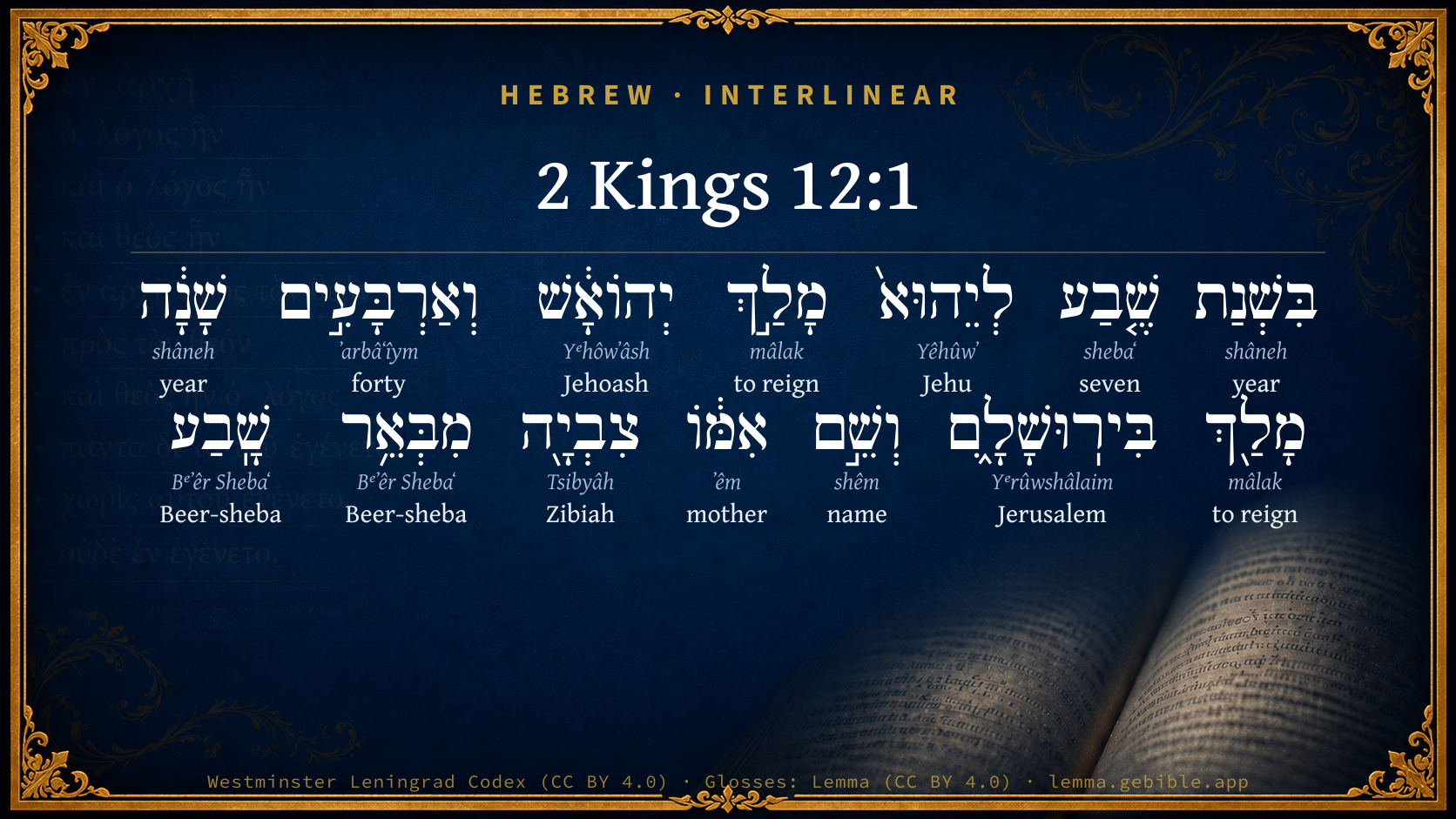
2 Kings 12:1

Hebrew (Westminster Leningrad Codex) 2 Kings 12:1 appears in the Hebrew Old Testament. The text above is from the Westminster Leningrad Codex. Each word links to its Strong’s number, a concise gloss, and parsing drawn from the Open Scriptures Hebrew Bible morphology. Click any word for its full Brown-Driver-Briggs (BDB) entry.
Download image
Cite this verse

2 Kings 12:1 (World English Bible). Public Domain. Lemma interlinear Bible study tool, https://lemma.gebible.app/v/2-kings/12/1.

Show BibTeX & RIS
BibTeX
RIS
English Translation
In the seventh year of Jehu began Jehoash to reign; and he reigned forty years in Jerusalem: and his mother's name was Zibiah of Beersheba.
World English Bible · Public Domain
Highlights
  • 1 first appearance in the Hebrew Bible
Full analysis ↓
Download a study sheet

One document with this verse’s original text, its word-by-word gloss line, the meaning frame, cross-references with their text, attributed commentary, and full source and license credits — printable, and it pastes into notes with its structure intact.

This verse Autodidact and up

Study sheet (.html) Plain text (.txt)

A passage Seminary Student

Up to 50 verses in one chapter. A passage sheet keeps up to 6 commentary sources and 12 cross-references per verse, in the order this page ranks them, and says so on the sheet whenever that leaves anything out. Ask for a single verse and you get the Autodidact verse sheet above.

Everything on this page stays free to read, with no account — the sheet is a download of what is already on screen, not access to it.

Want to remove ads? Support Godless Engineer
Compare translations 3

The same verse in 3 English versions, stacked beneath the original-language interlinear above. Click any original word for its lexicon entry.

Each is an independent rendering of the whole verse — the interlinear is not word-aligned to these translations.

Highlighted words mark where these versions differ — a whole-verse word diff, not a word-by-word alignment.

  • World English Bible Public Domain
    In the seventh year of Jehu began Jehoash to reign; and he reigned forty years in Jerusalem: and his mother's name was Zibiah of Beersheba.
  • King James Version Public Domain
    In the seventh year of Jehu Jehoash began to reign; and forty years reigned he in Jerusalem. And his mother's name was Zibiah of Beersheba.
  • unfoldingWord Literal Text CC BY-SA 4.0
    In the year of seven to Jehu, Joash reigned. And he reigned 40 years in Jerusalem. And the name of his mother Zibiah, from Beersheba.

unfoldingWord Literal Text — © unfoldingWord, licensed CC BY-SA 4.0. Word-aligned USFM3 via Door43 (git.door43.org/unfoldingWord/en_ult).

Versions to compare (up to 4)

3 of 4 selected

Show all 18 translations

Every available English version of this verse, each an independent rendering of the whole verse.

  • World English Bible Public Domain
    In the seventh year of Jehu began Jehoash to reign; and he reigned forty years in Jerusalem: and his mother's name was Zibiah of Beersheba.
  • Berean Standard Bible Public Domain
    In the seventh year of Jehu, Joash became king, and he reigned in Jerusalem forty years. His mother’s name was Zibiah; she was from Beersheba.
  • Majority Standard Bible Public Domain
    In the seventh year of Jehu, Joash became king, and he reigned in Jerusalem forty years. His mother’s name was Zibiah; she was from Beersheba.
  • King James Version Public Domain
    In the seventh year of Jehu Jehoash began to reign; and forty years reigned he in Jerusalem. And his mother's name was Zibiah of Beersheba.
  • American Standard Version (1901) Public Domain
    In the seventh year of Jehu began Jehoash to reign; and he reigned forty years in Jerusalem: and his mother's name was Zibiah of Beer-sheba.
  • Revised Version (1885) Public Domain
    In the seventh year of Jehu began Jehoash to reign; and he reigned forty years in Jerusalem: and his mother’s name was Zibiah of Beer-sheba.
  • Geneva Bible (1599) Public Domain
    In the seuenth yere of Iehu Iehoash began to reigne, and reigned fourty yeres in Ierusalem, and his mothers name was Zibiah of Beer-sheba.
  • Douay-Rheims (1899) Public Domain
    In the seventh year of Jehu Joas began to reign: and he reigned forty years in Jerusalem. The name of his mother was Sebia of Bersabee.
  • Young's Literal Translation Public Domain
    In the seventh year of Jehu reigned hath Jehoash, and forty years he hath reigned in Jerusalem, and the name of his mother `is' Zibiah of Beer-Sheba,
  • Literal Standard Version CC BY-SA 4.0
    In the seventh year of Jehu, Jehoash has reigned, and he has reigned forty years in Jerusalem, and the name of his mother [is] Zibiah of Beer-Sheba,
  • Unlocked Literal Bible CC BY-SA 4.0
    In the seventh year of Jehu, the reign of Joash began; he reigned for forty years in Jerusalem. His mother's name was Zibiah, of Beersheba.
  • unfoldingWord Literal Text CC BY-SA 4.0
    In the year of seven to Jehu, Joash reigned. And he reigned 40 years in Jerusalem. And the name of his mother Zibiah, from Beersheba.
  • Darby Bible Public Domain
    In the seventh year of Jehu, Jehoash began to reign; and he reigned forty years in Jerusalem; and his mother's name was Zibiah of Beer-sheba.
  • World Messianic Bible Public Domain
    Jehoash began to reign in the seventh year of Jehu, and he reigned forty years in Jerusalem. His mother’s name was Zibiah of Beersheba.
  • Webster's Bible Public Domain
    In the seventh year of Jehu, Jehoash began to reign; and forty years reigned he in Jerusalem. And his mother's name was Zibiah of Beer-sheba.
  • Free Bible Version CC BY-SA 4.0
    Joash became king in the seventh year of the reign of Jehu, and he reigned in Jerusalem for forty years. His mother's name was Zibiah of Beersheba.
  • Bible in Basic English Public Domain
    In the seventh year of Jehu's rule, Jehoash became king; and he was ruling for forty years in Jerusalem; his mother's name was Zibiah of Beer-sheba.
  • JPS Tanakh (1917) Public Domain
    (12-2) In the seventh year of Jehu began Jehoash to reign; and he reigned forty years in Jerusalem; and his mother's name was Zibiah of Beer-sheba.

Literal Standard Version (2020), Covenant Press — licensed CC BY-SA 4.0. Text via the HelloAO Bible API (eBible.org). Unlocked Literal Bible (unfoldingWord) — licensed CC BY-SA 4.0. Text via the HelloAO Bible API (eBible.org). unfoldingWord Literal Text — © unfoldingWord, licensed CC BY-SA 4.0. Word-aligned USFM3 via Door43 (git.door43.org/unfoldingWord/en_ult). Free Bible Version, Dr. Jonathan Gallagher — licensed CC BY-SA 4.0. Text via the HelloAO Bible API (eBible.org).

Word by word

More ways to search: Search by grammar → Find every occurrence → Compare this word →

Practice this passage: Drill this verse → Learn its vocabulary →

צִבְיָ֖ה
Tsibyâh
H6645
“Zibiah”
Noun, Proper
Part of Speech
Noun
Type
Proper
Full BDB Definition

Origin: for H6646

TWOT: None

Zibiah = "roe" - a native of Beersheba, wife of king Ahaziah and mother of king Joash both of Judah
  1. בִּשְׁנַת shâneh H8141 “in/at · year of” Preposition + Noun, Common, Feminine, Singular, Construct
  2. שֶׁ֤בַע shebaʻ H7651 “seven” Adjective, Cardinal number, Feminine, Singular, Absolute
  3. לְיֵהוּא֙ Yêhûwʼ H3058 “to/for · Jehu” Preposition + Noun, Proper
  4. מָלַ֣ךְ mâlak H4427 “to reign” Verb, Qal, Perfect, 3rd Person, Masculine, Singular
  5. יְהוֹאָ֔שׁ Yᵉhôwʼâsh H3060 “Jehoash” Noun, Proper
  6. וְאַרְבָּעִ֣ים ʼarbâʻîym H705 “and · forty” Conjunction + Adjective, Cardinal number, Both, Plural, Absolute
  7. שָׁנָ֔ה shâneh H8141 “year” Noun, Common, Feminine, Singular, Absolute
  8. מָלַ֖ךְ mâlak H4427 “to reign” Verb, Qal, Perfect, 3rd Person, Masculine, Singular
  9. בִּירֽוּשָׁלִָ֑ם Yᵉrûwshâlaim H3389 “in/at · Jerusalem” Preposition + Noun, Proper
  10. וְשֵׁ֣ם shêm H8034 “and · name of” Conjunction + Noun, Common, Masculine, Singular, Construct
  11. אִמּ֔וֹ ʼêm H517 “mother · his” Noun, Common, Feminine, Singular, Construct + Suffix, Personal, 3rd Person, Masculine, Singular
  12. מִבְּאֵ֥ר Bᵉʼêr Shebaʻ H884 “from · Beer-sheba” Preposition + Noun, Proper
  13. שָֽׁבַע Bᵉʼêr Shebaʻ H884 “Beer-sheba” Noun, Proper

About this verse

These counts appear in no published source. They are computed here, from the morphology-tagged text and Lemma’s own curated glosses. What Lemma adds →

14
words
11
distinct lemmas
Historical
section

Notable vocabulary

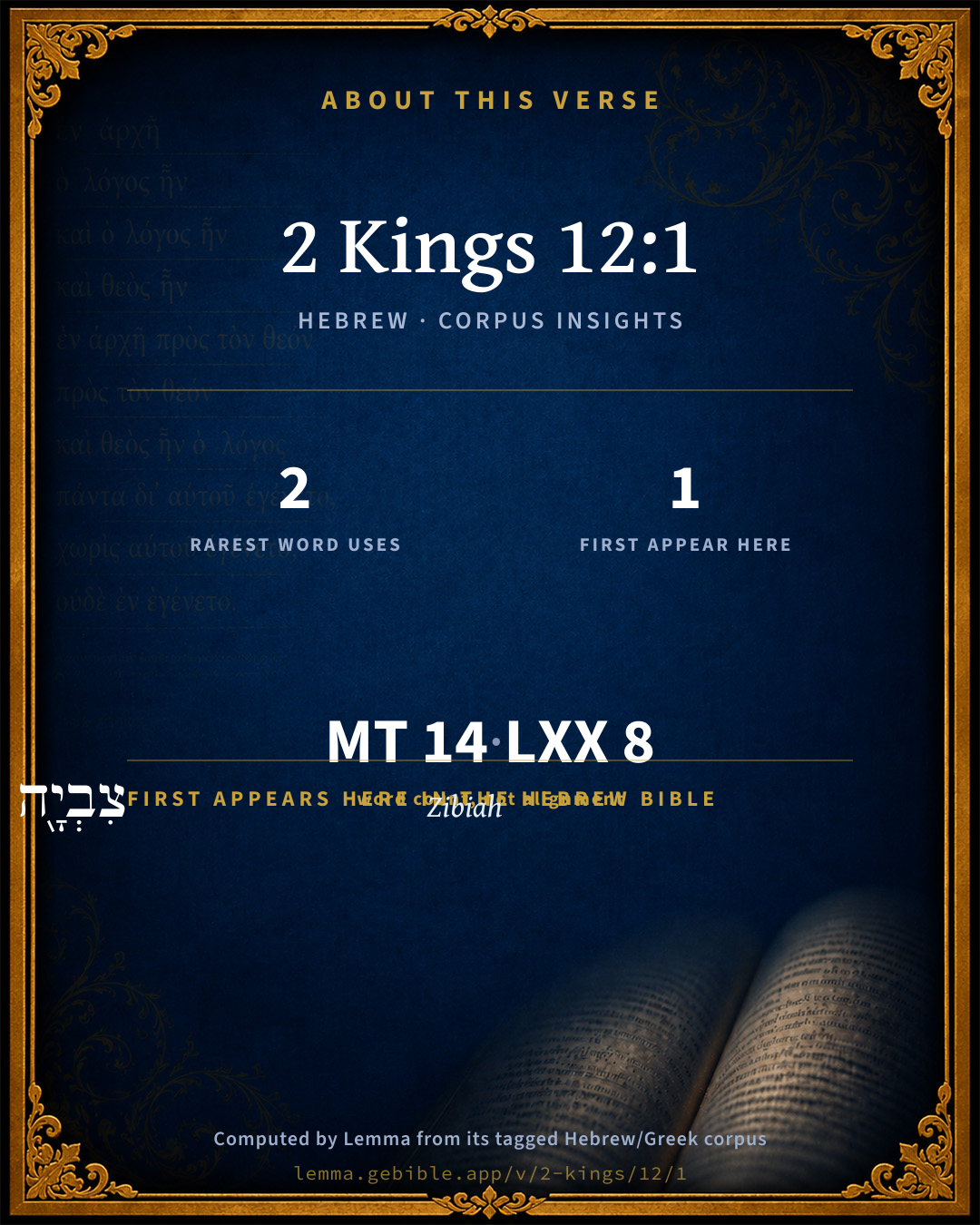
The rarest word here is צִבְיָ֖ה Zibiah H6645 — appearing just 2 times in the whole Hebrew Bible.

First appearance in Scripture

This word makes its first canonical appearance in the Hebrew Bible here:

  • צִבְיָ֖ה Zibiah H6645

Shared distinctive vocabulary

צִבְיָ֖ה Zibiah H6645 occurs in 2 verses of the Hebrew Bible. Also found in:

Grammatical profile

  • 2 verbs
  • 10 nouns
  • 2 adjectives

Verb forms

  • מָלַ֣ךְ Qal · Perfect
  • מָלַ֖ךְ Qal · Perfect

Repetition

Words recur within this verse — often emphatic in Hebrew:

  • בִּשְׁנַת year H8141 ×2
  • מָלַ֣ךְ to reign H4427 ×2
  • מִבְּאֵ֥ר Beer-sheba H884 ×2

Hebrew & Septuagint length

In English translation the verse runs 25 words from the Hebrew and 25 from the Septuagint (LXX English) — the same length.

A rough comparison of the two English renderings, which tokenize alike — not a word-level alignment.

Word counts can differ between the Hebrew and the Greek without any difference in meaning — e.g. the Hebrew direct-object marker אֵת has no separate Greek word, and Greek often adds the article ὁ.

In the original languages it is 14 Hebrew tokens and 8 Greek tokens — but the two are counted differently (Hebrew bundles its prefixes and suffixes into one token; the Greek is in lemma form), so that isn’t a like-for-like length.

Cross-references

5

Topical passages linked to 2 Kings 12:1 in the Treasury of Scripture Knowledge — connected by theme and wording, ordered by reader-vote popularity; previews shown in the World English Bible.

  • 2 Kings 9:27 But when Ahaziah the king of Judah saw this, he fled by the way of the garden-house. Jehu followed after him, and said, Smite him also in the chariot: [and they struck him] at the ascent of Gur, which is by Ibleam. He fled to Megiddo, and died there.
  • 2 Kings 11:1–4 Now when Athaliah the mother of Ahaziah saw that her son was dead, she arose and destroyed all the seed royal.
  • 2 Kings 11:21 Jehoash was seven years old when he began to reign.
  • 1 Chronicles 3:11 Joram his son, Ahaziah his son, Joash his son,
  • 2 Chronicles 24:1–14 Joash was seven years old when he began to reign; and he reigned forty years in Jerusalem: and his mother's name was Zibiah, of Beersheba.

Cross-references courtesy of OpenBible.info (CC BY 4.0).

Hebrew and Greek witnesses Masoretic Hebrew ↔ Greek Septuagint

The same verse in the two great witnesses to the Old Testament, shown verse-for-verse.

These are two independent witnesses, not word-aligned to each other, and the Septuagint is shown in lemma (dictionary) form.

Hebrew 2 Kings 12:1 Masoretic · Westminster Leningrad Codex

בִּשְׁנַת שֶׁ֤בַע לְיֵהוּא֙ מָלַ֣ךְ יְהוֹאָ֔שׁ וְאַרְבָּעִ֣ים שָׁנָ֔ה מָלַ֖ךְ בִּירֽוּשָׁלִָ֑ם וְשֵׁ֣ם אִמּ֔וֹ צִבְיָ֖ה מִבְּאֵ֥ר שָֽׁבַע

In the seventh year of Jehu began Jehoash to reign; and he reigned forty years in Jerusalem: and his mother's name was Zibiah of Beersheba.

World English Bible · Public Domain

Greek LXX 2 Kings 12:1 Septuagint · lemma form

υἱός ἔτος ἑπτά ιωας ἐν ὁ βασιλεύω αὐτός

Joas began to reign in the seventh year of Ju, and he reigned forty years in Jerusalem: and his mother's name was Sabia of Bersabee.

LXX2012 (modern English Septuagint) · Public Domain

Hebrew: Westminster Leningrad Codex (CC BY 4.0). Greek: Septuagint (public domain); English from LXX2012 (modern English Septuagint) (Public Domain). How the Septuagint differs from the Hebrew →

Targum (Aramaic paraphrase)

1

The Targum is the ancient Jewish Aramaic paraphrase of the Hebrew Scriptures — an interpretive translation, not the Hebrew text itself. Onkelos (literal) and Pseudo-Jonathan (expansive) render the Torah, and Jonathan the Prophets. Coverage is partial: where no permissively-licensed English translation exists for a verse, only the Aramaic is shown. This is verse-level text, not a word-by-word alignment to the Hebrew.

  1. Targum Jonathan Prophets (Joshua–Malachi)
    בַּר שְׁבַע שְׁנִין יְהוֹאָשׁ כַּד מְלָךְ:

    (no public-domain English translation for this verse)

    Targum Jonathan — Aramaic: “Mikraot Gedolot” (public domain). English: “Sefaria Community Translation” (CC0 1.0 (public-domain dedication)); “London "Chaldee Paraphrase," 1871” (public domain). Text via Sefaria.

Commentary

Notes on 2 Kings 12:1 from classic Christian and Jewish commentators (each source and its license shown beneath its notes). The classic Christian expositions comment on the surrounding passage and are grouped to its opening verse, so a note may address several verses; the Jewish commentaries on the Tanakh (Rashi and others) are per-verse, so they appear only where the commentator wrote on this verse.

Lemma curates 59 commentaries, every one of them public domain or Creative Commons licensed, each selected and text-cleaned for this edition rather than reprinted as found. About our sources →

Matthew Henry's Commentary

The general account here given of Joash is, 1. That he reigned forty years. As he began his reign when he was very young, he might, in the course of nature, have continued much longer, for he was cut off when he was but forty-seven years old, Kg2 12:1. 2. That he did that which was right as long as Jehoiada lived to instruct him, Kg2 12:2. Many young men have come too soon to an estate - have had wealth, and power, and liberty, before they knew how to use them - and it has been of bad consequence to them; but against this danger Joash was well guarded by having such a good director as Jehoiada was, so wise, and experienced, and faithful to him, and by having so much wisdom as to hearken to him and be directed by him, even when he was grown up. Note, It is a great mercy to young people, and especially to young princes, and all young men of consequence, to be under good direction, and to have those about them that will instruct them to do that which is right in the sight of the Lord; and they then do wisely and well for themselves when they are willing to be counselled and ruled by such. A child left to himself brings his mother to shame, but a child left to such a tuition may bring himself to honour and comfort. 3. That the high places were not taken away, Kg2 12:3. Up and down the country they had altars both for sacrifice and incense, to the honour of the God of Israel only, but in competition with, and at least in tacit contempt of, his altar at Jerusalem. These private altars, perhaps, had been more used in the late bad reigns than formerly, because it was not safe to go up to Jerusalem, nor was the temple-service performed as it should have been; and, it may be, Jehoiada connived at them, because some well-meaning people were glad of them when they could not have better, and he hoped that the reforming of the temple, and putting things into a good posture there, would by degrees draw people from their high places and they would dwindle of themselves; or perhaps neither the king nor the priest had zeal enough to carry on their reformation so far, nor courage and strength enough to encounter such an inveterate usage.

Matthew Henry's Commentary on the Whole Bible (1708–1710) — public domain (CC PDM 1.0). Text via the HelloAO Bible API.

The Cambridge Bible for Schools and Colleges

gen. ed. J. J. S. Perowne

Ch. 2Ki_12:1-16. Joash reigns well but the high places are not removed. The house of the Lord is restored (2Ch_24:1-14)

1. Jehoash began to reign, and forty years reigned he in Jerusalem] The R.V. puts the words into the usual order in these recitals, by placing ‘began’ before ‘Jehoash’ and ‘he reigned’ before ‘forty years’.

The Cambridge Bible for Schools and Colleges (gen. ed. J. J. S. Perowne; Cambridge University Press, 1878–1918) — public domain. Text from a community e-Sword module.

Trapp's Complete Commentary

John Trapp

2Ki 12:1 In the seventh year of Jehu Jehoash began to reign; and forty years reigned he in Jerusalem. And his mother’s name [was] Zibiah of Beersheba.

Ver. 1. Forty years reigned he in Jerusalem.] A great part of these years, Jehoiada lived with him; and so long, did he not "eat and drink, and do judgment and justice, and then it was well with him?" as Jer 22:15.

John Trapp, A Commentary or Exposition upon All the Books of the Old and New Testament (1647–1656) — public domain. Text from a community e-Sword module.

The Preacher's Complete Homiletical Commentary

Joseph S. Exell (gen. ed.)

THE RESTORATION OF THE TEMPLE BY JOASH

CRITICAL AND EXPLANATORY NOTES.—

2Ki_12:2. Jehoash did right all his days wherein Jehoiada, &c.—The word “wherein” may be rendered because, and that alters the meaning from during the period in which Jehoiada instructed him, into “all his days,” i.e., during the king’s entire life, because Jehoiada instructed him. This difference of meaning depends on the preservation or rejection of the suffix ו in the word יָמָיו. The account, however, in the Chronicles is, that Jehoash acted rightly “all the days of Jehoiada the priest.” But the grammatical construction of the sentence in Kings requires אֶשֶר because, rather than “wherein.”

2Ki_12:3. But the high places were not taken away—See Notes on 1Ki_3:2. Consider the popular fondness for the evil practices, the youthfulness of the king, and the sanction given to all such idolatrous iniquities during the evil sway of Athaliah, and this inability to suppress so gross an impiety is not unaccountable.

HOMILETICS OF 2Ki_12:1-3

THE WORTH OF GODLY COUNSEL

I. That godly counsel is a powerful help to a consistent and upright life. “And Jehoash did that which was right in the sight of the Lord.” There is nothing in the history to lead us to suspect the sincerity of Jehoash’s religious devotion in the earlier years of his reign. He was carefully instructed in his infancy, and grew up in the midst of godly influences. His religious character was moulded under the wise and capable counsel of good Jehoiada. It is an unspeakable advantage to grow up under the fostering shelter of a good and holy life. A few words of warning or encouragement at the right moment have often saved a soul from ruin. “Good counsels observed are chains to grace which, neglected, prove halters to strange undutiful children.” Sometimes bad men will give good advice, and the man who can take it and act upon it shows his good sense and superiority. He who is wise enough in youth to take the advice of his seniors, unites the vivacity and enterprise of early, with the wisdom and gravity of later, life.

II. That godly counsel is potent with some only when under the direct influence of a living personal example. “All his days wherein Jehoiada the priest instructed him.” While Jehoiada lived, Joash faithfully observed the covenant he had made with Jehovah, and, though the fact is not stated, it is implied that he afterwards departed from the counsels of his benefactor. This defection is related in the Chronicles. It is difficult to do wrong in the presence of the good; their holy and upright example is a rebuke and a deterrent to every evil tendency. The influence of Samuel was a powerful check upon the impulsive rashness and violence of Saul; and when that influence was withdrawn, it is not difficult to trace the degeneracy of the unhappy monarch, and how speedily he came to his doom. We shall never know how much we owe to the holy and consistent lives of those with whom we come in frequent contact. “A virtuous man,” says Felltham, “shining in the purity of a righteous life, is a light-house set by the seaside, whereby the mariners both sail aright and avoid danger; but he that lives in noted sins is a false lantern which ship-wrecks those that trust him. Nothing awakens our sleeping virtues like the noble acts of our predecessors. They are flaming beacons that fame and time have set on hills to call us to a defence of virtue whensoever vice invades the commonwealth of man.” We all need the encouraging influence of example; but there are some natures so feeble in moral stamina that they cannot stand alone. They have been so accustomed to depend upon others, that when their adviser fails them, they succumb. It would seem Joash’s was such a nature.

III. That godly counsel does not always avail to bring about the thorough reform of long standing abuses. “But the high places were not taken away” (2Ki_12:3). The popular fondness for the private and disorderly rites performed in the groves and recesses of hills was so inveterate that even the most powerful monarchs had been unable to accomplish their suppression; no wonder that in the early reign of a young king, and after the gross irregularities that had been allowed during the mal-administration of Athaliah, the difficulty of putting an end to the superstitions associated with the high places was greatly increased (Jamieson). Besides, Jehoiada, while acting with surprising energy in the restoration of the dynasty, was an old man—a hundred years old when Joash was crowned, and he lived thirty years after. He might therefore feel himself unable to cope with the demolition of long-established customs that had baffled and defied younger and stronger men. If his counsel halted at this point, it was so far defective. He knew the danger to Judah of these idolatrous practices, and should not only have counselled their extinction, but have had the courage of carrying out what he counselled. The unreformed abuses were a snare to the people in after years, and, as the sequel showed, led to the ruin of the king whose career begun so auspiciously.

LESSONS:—

1. They who give counsel to others should be exemplary themselves.

2. It is the mark of a noble nature to receive counsel and profit by it without taking offence.

3. We should be prepared to carry out to its consequences the counsel we give to others.

GERM NOTES ON THE VERSES

2Ki_12:1-3. That which appears to be the greatest misfortune for a child, to be left fatherless and motherless at an early age, often becomes a great blessing in the gracious providence of God. What would have become of Jehoash if he had been brought up at the court of his idolatrous father and his depraved mother? God gave him in Jehoiada far more than he had lost in his father and his mother. None need instruction more than those who are called to govern; there is no more responsible calling than that of instructing those who will have to rule. Unfortunately, this task is rarely intrusted to those who, like Jehoiada, are fitted for it by age, learning, experience, and piety.

2Ki_12:2. A faithful teacher. I. A great boon to a young and inexperienced king. II. Has the opportunity of exerting a potent and widespread influence for good. III. Is all the more powerful when associated with a consistent religious character.

—The part played by Jehoiada raised the priesthood to an importance which, with the single exception of Eli, it had never before attained in the history of the Jewish nation, and which it never afterwards altogether lost. Through the priesthood the lineage of David had been saved, and the worship of Jehovah restored in Judah even more successfully than it had been in Samaria through the prophets. During the minority of Joash, Jehoiada virtually reigned. The very office was in some sense created by himself. He was regarded as a second founder of the Order, so that in after days he, rather than Aaron, is described as the chief (Jer_29:26).—Stanley.

—A statesman, we are told, should follow public opinion. Doubtless as a coachman follows his horses, having firm hold on the reins, and guiding them.—Hare.

2Ki_12:3. The inveterate evils of idolatry. I. Have a powerful ally in the corruptions of human nature. II. Are the occasion of worse evils in the future. III. Survive the most violent efforts of reform. IV. Can be cured only by thorough eradication.

—Even these holy and just hands came short of what they might have done. The high places remained still: those altars were erected to the true God, but in a wrong place. It is a marvel if there be not some blemishes found in the best government. I doubt Jehoiada shall once buy it dear that he did not his utmost.—Bp. Hall.

—Custom had so prevailed that Jehoiada durst not advise the king to cross the people in this superstition, lest it should cause a tumult; lest they should more regard commotioners than commissioners, and be more guided by rage than by right—violence and obstinacy, like two untamed horses, drawing their desires in a blind-fold career, as it fell out in England when King Edward VI. began to reform. Trapp.

—Rulers ought not to allow themselves to be restrained from carrying out what is good and right from any fear of persons, lest they may possibly incur the disfavour of the people. There never was a prince who was not himself guilty of faults and errors, as we see here from the example of Jehoash, who did not abolish the sacrifices on the high places.—Lange.

The Preacher's Complete Homiletical Commentary (gen. ed. Joseph S. Exell; Funk & Wagnalls, c. 1892) — public domain (pre-1929). A full-Bible homiletical/sermon-outline anthology covering 65 of 66 books (2 John is absent from the source module). Text from a community e-Sword module.

Keil & Delitzsch

C. F. Keil & F. Delitzsch

(1-5). Reign of Joash. - Kg2 12:1 (1, 2). His age on ascending the throne, viz., seven years (cf. Kg2 11:4). - Commencement and length of his reign. His mother's name was Zibiah of Beersheba.

Kg2 12:2

(3). Joash did that which was right in the eyes of the Lord וגו אשׁר כּל־ימין, "all his days that," etc., i.e., during the whole period of his life that Jehoiada instructed him (for אשׁר after substantives indicating time, place, and mode, see Ewald, 331, c., 3; and for the use of the suffix attached to the noun defined by וגו אשׁר, compare Kg2 13:14); not "all his life long, because Jehoiada had instructed him," although the Athnach under ימין favours this view. For Jehoiada had not instructed him before he began to reign, but he instructed him after he had been raised to the throne at the age of seven years, that is to say, so long as Jehoiada himself lived. The יהוידע כּל־ימי of the Chronicles is therefore a correct explanation. But after Jehoiada's death, Joash yielded to the petitions of the princes of Judah that he would assent to their worshipping idols, and at length went so far as to stone the son of his benefactor, the prophet Zechariah, on account of his candid reproof of this apostasy (Ch2 24:17-22).

Kg2 12:3

(4). But the worship on the high places was not entirely suppressed, notwithstanding the fact that Jehoiada instructed him (on this standing formula see the Comm. on Kg1 15:14).

Keil & Delitzsch — Biblical Commentary on the Old Testament (1861–1891) — public domain (CC PDM 1.0). Text via the HelloAO Bible API. (Old Testament only.)

The Annotated Bible

Arno C. Gaebelein

4. Jehoash, the Temple Repaired, and the Death of Jehoash

CHAPTER 12

1. Jehoash’s (Joash) Reign (2Ki 12:1-3; 2Ch 24:2)

2. The Failure of the Priests (2Ki 12:4-8; 2Ch 24:4-5)

3. The Temple Repaired (2Ki 12:9-16; 2Ch 24:8-14)

4. Hazael and Jehoash (2Ki 12:17-18)

5. The Death of Joash (2Ki 12:19-21; 2Ch 24:25-27)

Great things had the Lord done both in Israel and in Judah. As we have seen there were numerous divine interpositions in the downward course, but all led to the final judgments upon both. Revivals took place, but they were not lasting and the reactions which followed produced a greater apostasy. This also is the course of the present age, which will end in a greater departure from God and in a corresponding greater judgment than Israel’s. “The people had fallen away from the divine purpose of their national calling, and become untrue to the meaning of their national history. From this point of view the temporary success of these reform movements may be regarded as a divine protest against the past. But they ultimately failed because all deeper spiritual elements had passed away from rulers and people.” “And still deeper lessons come to us. There is not a more common, nor can there be a more fatal mistake in religion or in religious movements than to put confidence in mere negations, or to expect from them lasting results for good. A negation without a corresponding affirmation is of no avail for spiritual purposes. We must speak because we believe; we deny that which is false only because we affirm and cherish the opposite truth. Otherwise we may resist; and enlist unspiritual men, but we shall not work any deliverance in the land” (A. Edersheim).

The reign of Jehoash had begun well. The record tells us that he did that which was right in the sight of the LORD as long as Jehoiada was priest. But what happened after the departure of Jehoiada? The answer is indicated in verse 3 and fully given in 2Ch 24:17-22. The king, who had received such kindness from Jehoiada, ordered the stoning of Zechariah, the son of Jehoiada, because he delivered a faithful message to the king against his idolatry.

The leading work of Jehoash’s reign was the repairing of the temple. This had become necessary because the family of Athaliah had broken it up and used the dedicated things in the worship of Baal (2Ch 24:7). The king took the initiative, but the neglect of the priests made the work practically impossible. Then the work was taken up in earnest by Jehoiada, and voluntary contributions received. A large sum was collected which was exclusively used for the repairing of the temple. When this was completed the balance was used for the purchase of the sacred vessels (2Ch 24:14).

Then Hazael began his wicked work and threatened Jerusalem. Joash bought him off by turning over to him all the hallowed things of the temple and the treasures of the palace. Not a word is said that Jehoash sought the Lord or prayed. It shows only too clearly that Jehovah, the present help in time of trouble, had been forgotten. The death of the king, murdered in the house of Millo followed soon. In our annotations of Chronicles we shall hear more of his history. Then Amaziah reigned in his stead.

Arno C. Gaebelein, The Annotated Bible (1913–1922) — public domain. Text from a community e-Sword module.

Tyndale Open Study Notes

Tyndale Open Resources

12:1 Joash reigned from 835 to 796 BC.

Tyndale Open Study Notes — © Tyndale Open Resources, licensed CC BY-SA 4.0. Text via the HelloAO Bible API.

Adam Clarke's Commentary

CHAPTER XII

Jehoash reigns well under the instructions of Jehoiada the

priest, 1-3.

He directs the repairing of the temple; the account of what

was done, 4-16.

Hazael takes Gath; and, proceeding to besiege Jerusalem, is

prevented by Jehoash, who gives him all the treasures and

hallowed things of the house of the Lord, 17, 18.

The servants of Jehoash conspire against and slay him, 19-21.

NOTES ON CHAP. XII

Adam Clarke's Commentary on the Bible (1810–1826) — public domain. Text from a community e-Sword/MySword module.

Ellicott's Commentary for English Readers

XII.

THE REIGN OF JEHOASH, OR JOASH. (Comp. 2 Chronicles 24)

(1) Forty years.—A common round number. David and Solomon are each said to have reigned forty years.

His mother’s name.—The author of these short abstracts generally gives this particular in regard to the kings of Judah.

Beer-sheba.—A famous Simeonite sanctuary, and resort of pilgrims (Amo_5:5; Amo_8:14).

A Bible Commentary for English Readers, edited by Charles John Ellicott (1878–1897) — public domain. Text from a community e-Sword module.

John Gill's Exposition

In the seventh year of Jehu Jehoash began to reign,.... So that he reigned twenty one or twenty two years contemporary with Jehu's reign, for Jehu reigned twenty eight years:

and forty years reigned he in Jerusalem; the same number of years David and Solomon reigned:

and his mother's name was Zibiah of Beersheba; a city in the tribe of Simeon, in the extreme part of the land of Canaan southward; her name in the Chaldee dialect is Tabitha, the same with Dorcas in Greek, Act 9:36.

John Gill's Exposition of the Whole Bible (1746–1763) — public domain (CC PDM 1.0). Text via the HelloAO Bible API.

Dummelow's Commentary on the Holy Bible

J. R. Dummelow

Joash repairs the Temple

2. All his days] According to 2Ch_24:17.; Joash took to evil courses after the death of Jehoiada.

3. The high places, etc.] The worship at the 'high places' was first abolished by Hezekiah, and then, after its renewal by Manasseh, by Josiah.

4. The money.. is set at] RV 'the money of the persons for whom each man is rated.' The money devoted to the repair of the Temple was that received for (a) the supply of vessels dedicated to the Temple services; (b) the redemption of vows (Lev_27:2-8); (c) free-will offerings. According to 2Ch_24:6, 2Ch_24:9 the chief source of the money was the halfshekel appointed by Moses to be paid by every Israelite for the maintenance of the Tent of the Testimony (Exo_30:11-16). The account] RM 'the numbering.'

9. The altar] i.e. the altar of burnt offering, outside the Temple building: cp. 2Ch_24:8. The door would be the entrance into the Temple court.

11. Told] RV, 'weighed out.'

13. There were not made] 2Ch_24:14 has 'were made,' perhaps having in view the surplus remaining after the repairs of the Temple were completed.

16. The trespass money, etc.] RV 'money for guilt offerings and money for sin offerings.' Some suppose that fines are meant, but the money may have been applied to the purchase of victims for sacrifices: see Leviticus 4, 5.

17. Gath] one of the five Philistine cities; to reach it Hazael must have marched through the kingdom of Israel, and his, invasion is probably to be connected with the attacks upon Jehu and Jehoahaz (2Ki_10:32; 2Ki_13:3-4). For the movement upon Jerusalem see 2Ch_24:23-24, where it is stated that Jehoash sustained a severe defeat before he surrendered his treasure.

19. The rest of the acts of Joash] see 2Ch_24:17-27 which relates that after Jehoiada's death Joash departed from the Lord, and even killed Zechariah, the son of Jehoiada, who had rebuked him for his idolatry.

20. The house of Millo] If Millo was a fort in Jerusalem (see on 1Ki_9:15) 'the house' was perhaps a palace attached to it.

21. Jozachar] in 2Ch_24:26 (where 'Jozachar' is corrupted into 'Zabad') the conspiracy is described as intended to avenge the death of Zechariah: see on 2Ch_24:19.

J. R. Dummelow, A Commentary on the Holy Bible (Macmillan, 1909) — public domain. Text from a community e-Sword module.

The Pulpit Commentary

Vers. 1-21. THE REIGN OF JOASH. THE REPAIR OF THE TEMPLE. WAR OF JOASH WITH HAZAEL, AND HIS DEATH BY A CONSPIRACY.

Vers. 1-3. The writer of Kings is extremely brief and incomplete in his account of the reign of Joash. He seems to have had a great tenderness for him, and to have determined that he would put on record nothing to his discredit. We have to go to Chronicles (2Ch 24) for a complete account, and for an estimate of the real character of the king and of his reign. Both writers appear to have drawn from the same original document, but the writer of Kings made large omissions from it. In a few points only is his narrative fuller than Chronicles.

In the seventh year of Jehu. Athaliah began to reign very soon after the accession of Jehu, (2Ki_11:1) and reigned six full years (ver. 3). The first year of Joash was thus parallel with Jehu"s seventh. Jehoash or Joash, as he is called sometimes in Kings, (2Ki_11:2 2Ki_13:1, 2Ki_13:10) and always in Chroniclesbegan to reign; and forty years reigned he in Jerusalem the writer of Chronicles (2Ch_24:1) and Josephus ("Ant. Jud:," 9:8. agreeand his mother"s name was Zibiah of Beersheba. Josephus calls her "Sabia.

HOMILIES BY C.H. IRWIN. Vers. 1-3. The influence of a wise counselor.

"Joash did that which was right in the sight of the Lord all his days wherein Jehoiada the priest instructed him.

I MUCH DEPENDS UPON THE CHARACTER OF THE SOVEREIGN. Compare England under the Stuarts with England under Cromwell or Queen Victoria. An impure and licentious court demoralizes a whole nation. A pure court is a standing rebuke to iniquity in high places. We have much need to pray "for kings, and for all that are in authority." We have much need to be thankful for the character and life of our present sovereign.

II THE NATIONAL LIFE LARGELY DEPENDS UPON THE CHARACTER OF THE NATION"S COUNSELLORS. In our limited monarchy the "ministers of the Crown" are virtually the rulers of the nation. How important that a Christian nation should have Christen rulers, Christian legislators! The time has surely come when the voice of the Christian people of the British empire should be much more heard in Parliament. It is not so much the politics of party we need, as the politics of Christianity. We want rulers who will remember that "righteousness exalteth a nation." We want our laws to be based upon the eternal law of God. We want legislators who have the fear of God before their eyes. Christian people need to be aroused to their duty in this matter. They should see to it that, so far as they can secure it, Christian men are chosen to represent them in the legislature of the nation. C.H.I.

HOMILIES BY D. THOMAS Vers. 1-21. The history of Joash.

"In the seventh year," etc. The whole story of Joash is soon told. He was a son of Ahaziah, and the only one of his children who escaped the murderous policy of Athaliah. "It would seem that this child, whom the pity and affection of a pious aunt (Jehosheba) had preserved, was the only surviving male representative of the line of Solomon. Jehoram, his grandfather, who married Athaliah, in order to strengthen his position on the throne, slew all his brethren, and all his own sons were slain in an incursion by the Arabians, except Ahaziah, the youngest, who succeeded him; while on the death of Ahaziah, his wicked mother, Athaliah, "arose and destroyed all the seed royal of the house of Judah," except the little child Joash, who was rescued from her grasp. So that the unholy alliances formed by the descendants of Solomon, and the manifold disorders then accruing, had reduced everything to the verge of ruin. Measures were concerted by Jehoiada, the high priest, for getting rid of Athaliah, and placing Joash on the throne, after he had attained to the age of seven; and having in his youth the wise and the faithful round his throne, the earlier part of the reign of Joash was in accordance with the great principles of the theocracy. The Lord"s house was repaired and set in order, while the temple and idols of Baal were thrown down. But after Jehoiada"s death, persons of a different stamp got about him, and, notwithstanding the great and laudable zeal which he had shown for the proper restoration of God"s house and worship, a return was made to idolatry to such an extent as to draw forth severe denunciations from Zechariah, the son of Jehoiada. Even this was not the worst, for the faithfulness of Zechariah was repaid with violence; he was even stoned to death, and this, it is said, at the express command of the king. The martyred priest exclaimed as he expired, "The Lord look upon it, and require;" and it was required as in a whirlwind of wrath. For a Syrian host, under Hazael, made an incursion into Judaea, and both carried off much treasure and executed summary judgment on many in Jerusalem, not excepting Joash himself, whom they left in an enfeebled state, and who was shortly afterwards fallen upon and slain by his servants. Such was the unhappy termination of a career which began in much promise of good, and the cloud under which he died even followed him to the tomb, for while he was buried in the city of David, it was not in the sepulchers of the kings of Judah. He reigned forty years from B.C. 878 to 838." The narrative, whether we regard it as inspired or not, reminds us of five things worth considering the dilapidating influence of time upon the best material productions of mankind; the incongruity of worldly rulers busying themselves in religious institutions; the value of the co-operative principle in the enterprises of mankind; the potency of the religious element in the nature of even depraved people; and the power of money to subdue enemies.

I THE DILAPIDATING INFLUENCE OF TIME UPON THE BEST MATERIAL PRODUCTIONS OF MANKIND. Joash here called upon the priests and the people "to repair the breaches of the house," i.e. the temple. The temple, therefore, though it had not been built more than about a hundred and sixty years, had got into a state of dilapidation, there were breaches in it; where the breaches were we are not told, whether in the roof, the floor, the walls, or in the ceiling. The crumbling hand of time had touched it. No human superstructure, perhaps, ever appeared on the earth built of better materials, or in a better way, than the temple of Solomon. It was the wonder of ages. Notwithstanding this, it was subject to the invincible law of decay. The law of dilapidation seems universal throughout organic nature; the trees of the forest, the flowers of the field, and the countless tribes of sentient life that crowd the ocean, earth, and air, all fall into decay; and so also with the material productions of feeble man. Throughout the civilized world we see mansions, churches, cathedrals, palaces, villages, towns, and cities, in ruins. All compound bodies tend to dissolution; there is nothing enduring but primitive elements or substances. This being so, how astoundingly preposterous is man"s effort to perpetuate his memory in material monuments! The only productions of men that defy the touch of time, and that are enduring, are true thoughts, pure sympathies, and noble deeds. He who builds up the temple of a true moral character produces a superstructure that will last through the sweep of ages, the wreck of thrones, and the crash of doom.

II THE INCONGRUITY OF WORLDLY RULERS BUSYING THEMSELVES IN RELIGIOUS INSTITUTIONS. Joash was no saint, the root of the matter was not in him; he had no vital and ruling sympathy with the Supreme Being, yet he seemed zealous in the work of repairing the temple. "Then King Joash called for Jehoiada the priest, and the other priests, and said unto them, Why repair ye not the breaches of the house? now therefore receive no more money of your acquaintance, but deliver it for the breaches of the house." Though the conduct of corrupt men in busying themselves with things pertaining to religion is incongruous, alas! it is not uncommon. Such conduct generally springs from one of two things, or from both policy or superstition. The religion that is popular, whether it be true or false, rulers recognize and sanction. They use the religious element in the community as a means by which to strengthen their thrones and augment their fame. Not only, indeed, are kings actuated thus, but even the corrupt tradesman, lawyer, doctor, etc., must show some interest in the popular religion in order to succeed in his secular pursuits. But superstition as well as policy often prompts corrupt men to busy themselves in matters of religion. Do not many build and beautify churches and subscribe to religions institutions, hoping thereby to escape perdition and to ensure the favor of Heaven? Alas! some of the corruptest men are often most busy in religious affairs. The man that betrayed the Son of God at the last Passover was most busy on that awful night; "his hand was on the table.

III THE VALUE OF THE CO-OPERATIVE PRINCIPLE IN THE ENTERPRISES OF MANKIND. It would seem that the work of repairing the temple was so great that no one man could have accomplished it. Hence the king called earnestly for the cooperation of all. "And Jehoash said to the priests, All the money of the dedicated things that is brought into the house of the Lord, even the money of every one that passeth the account, the money that every man is set at, and all the money that cometh into any man"s heart to bring into the house of the Lord, let the priests take it to them, every man of his acquaintance: and let them repair the breaches of the house." They obeyed his voice. The people gave the money, and all set to work; the "priest that kept the door," the "high priest," the "carpenters," the "masons," the" builders," the "hewers of stone," etc. By this unity of action "they repaired the house of the Lord." Two remarks may be made concerning the principle of cooperation.

1. It is a principle that should govern all men in the undertakings of life. It was never the purpose of the Almighty that man should act alone for himself, should pursue alone his own individual interests. Men may, and often do, make large fortunes by it, but they destroy their own peace of mind, degrade their natures, and outrage the Divine laws of society. Men are all members of one great body; and was ever a member made to work alone? No; but for the good of the whole, the common weal.

2. It is a principle that has done and is doing wonders in the undertakings of life. Our colleges, hospitals, railways, etc., are all the products of cooperation. The more men get intellectually enlightened and morally improved, the more this principle will be put into operation. This principle, however, has its limits. In spiritual matters it must not infringe the realm of individual responsibility. There is no partnership in moral responsibility. Each man must think, repent, and believe for himself. "Every man must bear his own burden.

IV THE POTENCY OF THE RELIGIOUS ELEMENT EVEN IN DEPRAVITY. At this time Israel was morally almost as corrupt as the heathen nations. From the beginning Israel was the Church of God in little more than a metaphorical sense. Never in the history of the world has there been a member of the true Church whose sympathies with Jehovah were not supreme. But how many of the Jews had this supreme sympathy? Notwithstanding this, the religious sentiment was in them, as in all men, a constituent part of their natures; and this sentiment is here appealed to, and roused into excitement; and, being excited, men poured forth their treasures and employed their energies for the repairing of the temple. This element in man often sleeps under the influence of depravity, but mountains of depravity cannot crush it; it lies in human nature as the mightiest latent force. Peter the Hermit, Savanorola the priest, Wesley the Methodist, and others in every age, have roused it into mighty action, even amongst the most ignorant and depraved of the race. Cunning priests and crafty king/have appealed to it as the strongest force that can bear them on to the realization of their miserable ends. The truly good and godly must appeal to it if they would accomplish any great work for mankind. By its right action only can men rise; by its dormancy or wrong development men must inevitably fall.

V THE POWER OF MONEY TO SUBDUE ENEMIES. "Hazael King of Syria... set his face to go up to Jerusalem. And Joash King of Judah took all the hallowed things that... his fathers... had dedicated and all the gold that was found in the treasures of the house of the Lord... and sent it to Hazael King of Syria: and he went away from Jerusalem." Here is a man, a proud, daring monarch, who was determined to invade Judaea, and to take possession of Jerusalem, relinquishing his designs. What was the force that broke his purpose? Money. It is said that Joash sent gold to Hazael, "and he went away from Jerusalem." Truly money answereth for all things. Money can arrest the march of armies and terminate the fiercest campaigns. After contending armies have destroyed their thousands, it is money alone that brings the battle to a close. Money is the soul of all pacifying treaties. What fools the rulers of the people are not to employ money to prevent war and turn it away from their country! Enemies can be conquered by gifts. Evil can only be overcome by good. "If thine enemy hunger, offer him bread to cat; and if he be thirsty, give him water to drink: for in so doing thou shalt heap coals of fire upon his head. D.T.

HOMILIES BY J. ORR Vers. 1-3. A mixed character.

The reign of Joash began with bright hopes, showed for a while excellent promise, yet ended ingloriously. To explain this we may consider

I JOASH"S ADVANTAGES.

1. He had a pious education. As a child he was brought up by his aunt Jehosheba, who, with her husband the high priest, would instill into his mind the principles of true godliness. In his strict seclusion he was kept free from sights of vice. Like Timothy, he would be taught from a child to know the things that make wise unto salvation. (2Ti_3:15) To have an early training of this kind is an inestimable advantage.

2. He had a good counselor. The early education of our own Queen Victoria was carefully conducted with a view to the royal office she was afterwards to fill. It would not be otherwise with young Joash. Jehoiada would carefully impress upon his mind the principles of good government, and, after his coronation, this holy man continued to be his guide and counselor. So it is said, "Jehoash did that which was right in the sight of the Lord all his days wherein Jehoiada the priest instructed him." It is a happy thing when a king is willing to receive counsel from older and wiser heads than his own (cf. 1Ki_12:6-11)

3. He had an excellent opportunity. Joash started with every advantage for reigning well. The people were animated with hatred of idolatry from the experience they had had of it in Athaliah"s reign; they were enthusiastic in their return to the worship of Jehovah; they had inaugurated the restoration of the line of David by a new covenant with God, and by zealous acts of reform. The tide was with Joash, if he had shown strength of character sufficient to avail himself of it.

II JOASH"S WEAKNESS. Circumstances test men, and it was to be proved that, with all his advantages, Joash was a weak king.

1. He lacked independence of judgment. Whether the early seclusion of his life had anything to do with this, we cannot tell; but it seems plain that he was not a king accustomed to think and act for himself, but one who was easily influenced and led by others. His nature was passive clay, on which the judgment of others stamped itself. While Jehoiada lived, he allowed himself to be led by him; and when this good priest and counselor died, he allowed himself as readily to be turned into evil courses by the wicked nobility. (2Ch_24:17, 2Ch_24:18)

2. He lacked firmness of will. This defect flowed from the feebleness of judgment now indicated, Joash knew the right, but he had not the courage or persistence to do it when pressure was brought to bear on him in an opposite direction, His life thus proved at last a wretched failure. Notwithstanding Jehoiada"s kindness to him, he was betrayed at length into shedding the blood of Zechariah, his benefactor"s sea. (2Ch_24:20-22)

3. He lacked true surrender of heart to God. This was the prime defect in his character. His goodness, such as it was and for a time it seemed perfectly genuine was the result of natural amiableness, of early training, of external influences; it did not spring from a root of true conviction. Therefore, when the sun was up, it was scorched, and withered away. (Mat_13:6) It was goodness like the morning cloud, and the early dew unenduring. (Hos_6:3) The lesson we learn is the need of a radical change of heart as the foundation of true and enduring piety.

III JOASH"S IMPERFECT REFORMS. The one point noticed about him at this stage is that, while reforming the worship of the temple, the high places were not taken away as commanded by the Law. This was a reform, it is to be allowed, not easily achieved, but had Joash been a man of more character he might have accomplished it, as Hezekiah did after him. (2Ki_18:4) The fact that he did not attempt it, though popular feeling was so strongly on his side, is an evidence of that weak line in his character which came more clearly to light when Jehoiada was removed. J.O.

The Pulpit Commentary (1880–1919), ed. H.D.M. Spence-Jones & Joseph S. Exell — public domain. Text from a community e-Sword module.

John Wesley's Explanatory Notes

Jehoash reigns well while Jehoiada lives, ver. 1-3. Repairs the temple, ver. 4-16. Compounds with Hazael, ver. 17, 18. Dies ingloriously, ver. 19-21.

John Wesley, Explanatory Notes Upon the Whole Bible (1754–1765) — public domain. Text via the GEBible commentary corpus.

Kretzmann's Popular Commentary

Paul E. Kretzmann

The Temple Repaired

v. 1. In the seventh year of Jehu, the king of Israel who had eradicated Baal-worship in Israel, Jehoash began to reign; and forty years reigned he in Jerusalem. And his mother’s name, which is mentioned on account of the influence of the queen-mother in an Oriental harem, was Zibiah of Beersheba.

v. 2. And Jehoash did that which was right in the sight of the Lord all his days wherein Jehoiada, the priest, instructed him; as long as this staunch, faithful, God-fearing priest lived, he permitted himself to be guided by his instruction.

v. 3. But the high places were not taken away; the people still sacrificed and burned Incense in the high places, they persisted in using the hills for the erection and maintenance of altars, to Jehovah indeed, but against His wish. It was most unfortunate that a change in the behavior of Jehoash took place after the death of Jehoiada, 2Ch 24:17-22.

v. 4. And Jehoash said to the priests, in the first part of his reign, while he was still being guided in all his undertakings by the faithful old high priest, All the money of the dedicated things, such as were consecrated to Jehovah by special vow or commandment, that is brought into the house of the Lord, even the money of every one that passeth the account, literally, "the money of valuation of a man, that which the priest assessed him upon the completion of a vow, Lev 27:2 ff. the money that every man is set at, the half-shekel poll-tax, Exo 30:13-15, and all the money that cometh into any man’s heart to bring into the house of the Lord, all the free-will offerings outside of the fixed contributions, Exo 13:2-12; Num 18:15-17,

v. 5. let the priests take it to them, every man of his acquaintance, the people of his own city and district; and let them repair the breaches of the house, where the Temple was in need of repairs on account of the ravages of time and through the willful destruction of Athaliah, 2Ch 24:7, wheresoever any breach shall be found.

v. 6. But it was so that in the three and twentieth year of King Jehoash the priests had not repaired the breaches of the house, the reason for this strange neglect not being given. Cf 2Ch 24:5.

v. 7. Then King Jehoash called for Jehoiada, the priest, and the other priests, and said unto them, Why repair ye not the breaches of the house? The matter having been left to their discretion, the priests had probably used all the money for the needs of the worship. Now, therefore, receive no more money of your acquaintance, but deliver it for the breaches of the house. The entire matter had not been carried forward with the energy which its importance demanded, and so new measures were determined upon.

v. 8. And the priests consented to receive no more money of the people, they would no longer act as collectors and custodians of these contributions, neither to repair the breaches of the house, the responsibility for the repairs would no longer rest upon them. It was the usual case of burdening the men in the office of the ministry with business affairs. Cf Act 6:2.

v. 9. But Jehoiada, the priest, took a chest, and bored a hole in the lid of it, where the money-contributions of every form could be dropped, and set it beside the altar, on the right side as one cometh into the house of the Lord, on the right side of the entrance to the priests’ court, near the altar of burnt offering, Cf 2Ch 24:9-10; and the priests that kept the door, those whose duty consisted in guarding the threshold of the inner court, put therein all the money that was brought into the house of the Lord.

v. 10. And it was so, when they saw that there was much money in the chest, that the king’s scribe, his chief civil secretary, as representing the state in this public affair, and the high priest came up, and they put up in bags, binding it up in special receptacles for the purpose, and told the money that was found in the house of the Lord, estimating the sum which had been received by weighing the bags.

v. 11. And they gave the money, being told, into the hands of them that did the work, the contractors in charge of the repairs, that had the oversight of the house of the Lord; and they laid it out, literally, "let it go forth," to the carpenters and builders that wrought upon the house of the Lord,

v. 12. and to masons and hewers of stone, and to buy timber and hewed stone to repair the breaches of the house of the Lord, and for all that was laid out for the house to repair it. The fund was used to pay the wages of the different workmen, and to purchase the necessary building materials.

v. 13. Howbeit, there were not made for the house of the Lord, namely, while the work of repairing was going on, bowls of silver, snuffers, basins, trumpets, any vessels of gold, or vessels of silver, Cf 1Ki 7:50, of the money that was brought into the house of the Lord;

v. 14. but they gave that to the workmen, and repaired therewith the house of the Lord. It was only after all the repair work was finished that gold and silver utensils were procured with the money remaining, 2Ch 24:14.

v. 15. Moreover, they reckoned not with the men, into whose hand they delivered the money to be bestowed on workmen, they demanded no account of funds received and dispensed of the overseers of the building; for they dealt faithfully, implicit trust was placed in their integrity.

v. 16. The trespass-money and sin-money was not brought into the house of the Lord; it was the priests’; they lost no revenue on account of the entire arrangement, for the income from these two sources still remained, Num 5:8-9; Lev 5:16; Lev 6:24. Even today it is a work well pleasing to God, if Christians serve the Lord with their offerings for the extension of His kingdom at home and abroad. And the leaders of the Church do well in setting the duty of believers before them always, lest the work of the Lord be hindered.

Paul E. Kretzmann, Popular Commentary of the Bible (1921–1924) — public domain. Text from a community e-Sword module.

unfoldingWord translationNotes

Door43 World Missions Community

In the seventh year of Jehu

"During year 7 of the reign of Jehu over Israel" (See: Numbers)

the reign of Joash began

"Joash began to reign over Judah"

Zibiah

This was the name of a woman. (See: How to Translate Names)

Zibiah, of Beersheba

"Zibiah, from the city of Beersheba"

what was right in the eyes of Yahweh

The eyes represent seeing, and seeing represents thoughts or judgment. AT: "what Yahweh judges to be right" or "what Yahweh considers to be right" (See: Metaphor)

instructing him

"teaching him"

But the high places were not taken away

This can be stated in active form. AT: "But the people did not destroy the high places" (See: Active or Passive)

The people still sacrificed and burned incense on the high places

Yawheh forbid the people to worship at these place. This can be made explicit. AT: "The people continued to go to places that were unacceptable to Yahweh, to make sacrifices and burn incense" (See: Assumed Knowledge and Implicit Information)

translationWords

Jehu

reign

Joash

Jerusalem

Beersheba

Yahweh

Jehoiada

priest

high place

sacrifice

incense

unfoldingWord translationNotes — © Distant Shores Media and the Door43 World Missions Community, licensed CC BY-SA 4.0. Source: git.door43.org/Door43/en_tn.

Lesson kit

Teaching starters — assembled from the data on this page, not authored interpretation. Every prompt links to the verse data it draws on. Edit before teaching.

2 Kings, in the Historical, opens this verse with 14 words (11 distinct Hebrew lemmas). Its most distinctive word is Tsibyâh (“Zibiah”). A historical commentator’s framing appears above. Read the whole chapter for the surrounding context.

Discussion questions

  1. How does “Zibiah” (Tsibyâh) shape what this verse is saying?
  2. The word “Zibiah” first appears here in Scripture. What is being introduced at this debut?
  3. 2 Chronicles 24:1 shares the word «Zibiah» with this verse. How do the two illuminate each other?
  4. “year” occurs 2× in this one verse. What is the effect of the repetition?
  5. These translations render this verse differently; the difference is in the English rendering, not the original. What questions does that raise?
  6. The verb «מָלַ֣ךְ» is Qal Perfect. How does its form color the action?
  7. Reading how Matthew Henry's Commentary and The Cambridge Bible for Schools and Colleges read this verse, where do the two commentators agree and where do they part?

Things to notice

Reading settings

Reading text

Shown beneath each verse's original-language words.

Old Testament
Old Testament edition

Read the OT as the Masoretic Hebrew (MT) or the Greek Septuagint (LXX).

English shown for the Greek Septuagint (in the Hebrew ↔ Greek comparison).

Comparing translations? Open the Compare panel on any verse page to stack up to four side by side.