Ezekiel 29:11

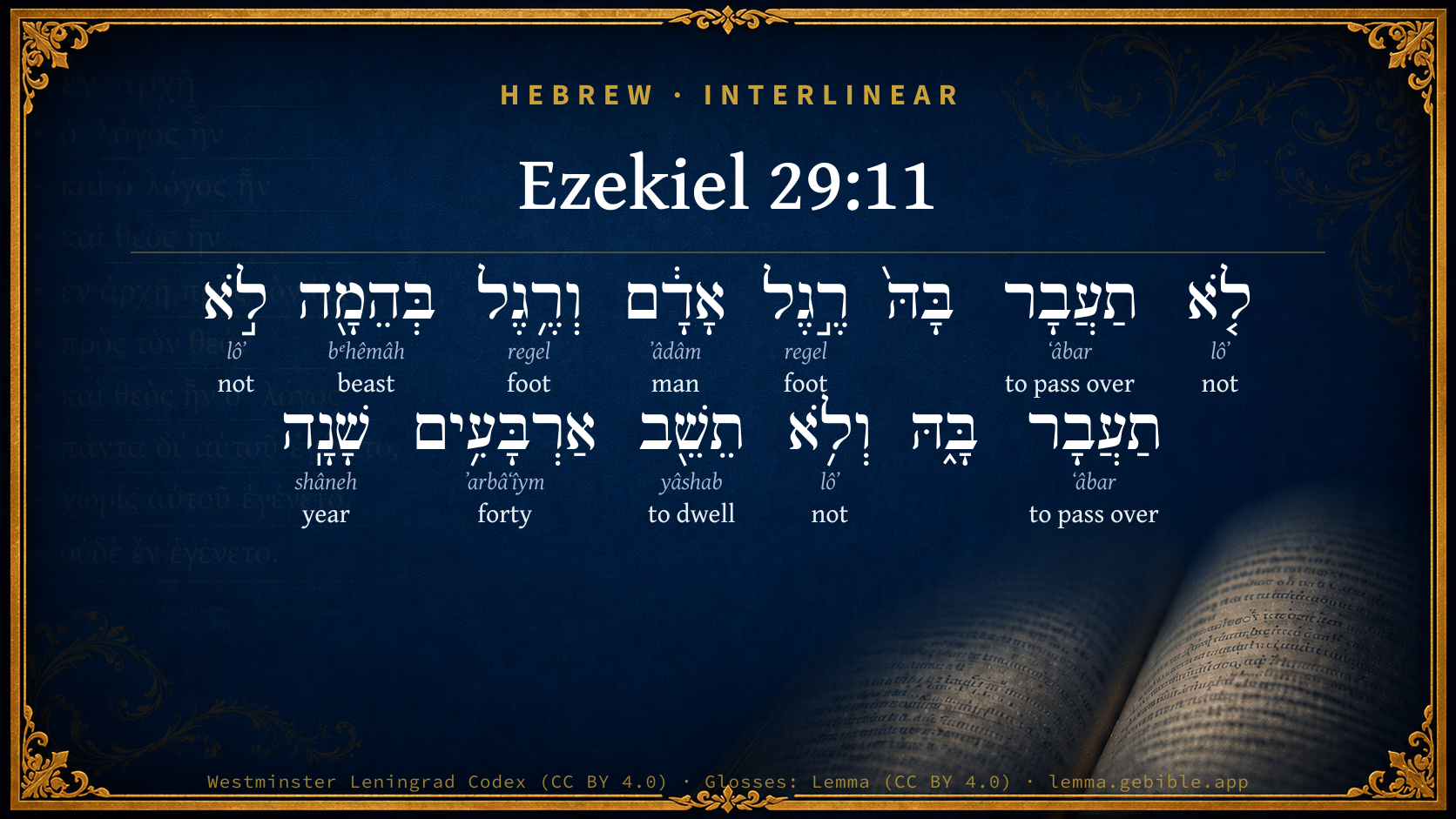
Hebrew (Westminster Leningrad Codex) Ezekiel 29:11 appears in the Hebrew Old Testament. The text above is from the Westminster Leningrad Codex. Each word links to its Strong’s number, a concise gloss, and parsing drawn from the Open Scriptures Hebrew Bible morphology. Click any word for its full Brown-Driver-Briggs (BDB) entry.
Download image
Cite this verse

Ezekiel 29:11 (World English Bible). Public Domain. Lemma interlinear Bible study tool, https://lemma.gebible.app/v/ezekiel/29/11.

Show BibTeX & RIS
BibTeX
RIS
English Translation
No foot of man shall pass through it, nor foot of animal shall pass through it, neither shall it be inhabited forty years.
World English Bible · Public Domain
Download a study sheet

One document with this verse’s original text, its word-by-word gloss line, the meaning frame, cross-references with their text, attributed commentary, and full source and license credits — printable, and it pastes into notes with its structure intact.

This verse Autodidact and up

Study sheet (.html) Plain text (.txt)

A passage Seminary Student

Up to 50 verses in one chapter. A passage sheet keeps up to 6 commentary sources and 12 cross-references per verse, in the order this page ranks them, and says so on the sheet whenever that leaves anything out. Ask for a single verse and you get the Autodidact verse sheet above.

Everything on this page stays free to read, with no account — the sheet is a download of what is already on screen, not access to it.

Want to remove ads? Support Godless Engineer
Compare translations 3

The same verse in 3 English versions, stacked beneath the original-language interlinear above. Click any original word for its lexicon entry.

Each is an independent rendering of the whole verse — the interlinear is not word-aligned to these translations.

Highlighted words mark where these versions differ — a whole-verse word diff, not a word-by-word alignment.

  • World English Bible Public Domain
    No foot of man shall pass through it, nor foot of animal shall pass through it, neither shall it be inhabited forty years.
  • King James Version Public Domain
    No foot of man shall pass through it, nor foot of beast shall pass through it, neither shall it be inhabited forty years.
  • unfoldingWord Literal Text CC BY-SA 4.0
    No man’s foot will pass through it, and no wild animal’s foot will pass through it. It will not be inhabited for forty years.

unfoldingWord Literal Text — © unfoldingWord, licensed CC BY-SA 4.0. Word-aligned USFM3 via Door43 (git.door43.org/unfoldingWord/en_ult).

Versions to compare (up to 4)

3 of 4 selected

Show all 18 translations

Every available English version of this verse, each an independent rendering of the whole verse.

  • World English Bible Public Domain
    No foot of man shall pass through it, nor foot of animal shall pass through it, neither shall it be inhabited forty years.
  • Berean Standard Bible Public Domain
    No foot of man or beast will pass through, and it will be uninhabited for forty years.
  • Majority Standard Bible Public Domain
    No foot of man or beast will pass through, and it will be uninhabited for forty years.
  • King James Version Public Domain
    No foot of man shall pass through it, nor foot of beast shall pass through it, neither shall it be inhabited forty years.
  • American Standard Version (1901) Public Domain
    No foot of man shall pass through it, nor foot of beast shall pass through it, neither shall it be inhabited forty years.
  • Revised Version (1885) Public Domain
    No foot of man shall pass through it, nor foot of beast shall pass through it, neither shall it be inhabited forty years.
  • Geneva Bible (1599) Public Domain
    No foote of man shall passe by it, nor foote of beast shall passe by it, neither shall it be inhabited fourtie yeeres.
  • Douay-Rheims (1899) Public Domain
    The foot of man shall not pass through it, neither shall the foot of beasts go through it: nor shall it be inhabited during forty years.
  • Young's Literal Translation Public Domain
    Not pass over into it doth a foot of man, Yea, the foot of beast doth not pass into it, Nor is it inhabited forty years.
  • Literal Standard Version CC BY-SA 4.0
    A foot of man does not pass over into it, || Indeed, the foot of beast does not pass into it, || Nor is it inhabited forty years.
  • Unlocked Literal Bible CC BY-SA 4.0
    No man's foot will pass through it, and no wild animal's foot will pass through it. It will not be inhabited for forty years.
  • unfoldingWord Literal Text CC BY-SA 4.0
    No man’s foot will pass through it, and no wild animal’s foot will pass through it. It will not be inhabited for forty years.
  • Darby Bible Public Domain
    No foot of man shall pass through it, nor shall foot of beast pass through it, nor shall it be inhabited, forty years.
  • World Messianic Bible Public Domain
    No foot of man will pass through it, nor will any animal foot pass through it. It won’t be inhabited for forty years.
  • Webster's Bible Public Domain
    No foot of man shall pass through it, nor foot of beast shall pass through it, neither shall it be inhabited forty years.
  • Free Bible Version CC BY-SA 4.0
    No one, human or animal, will travel that way or live there for forty years.
  • Bible in Basic English Public Domain
    No foot of man will go through it and no foot of beast, and it will be unpeopled for forty years.
  • JPS Tanakh (1917) Public Domain
    No foot of man shall pass through it, nor foot of beast shall pass through it, neither shall it be inhabited forty years.

Literal Standard Version (2020), Covenant Press — licensed CC BY-SA 4.0. Text via the HelloAO Bible API (eBible.org). Unlocked Literal Bible (unfoldingWord) — licensed CC BY-SA 4.0. Text via the HelloAO Bible API (eBible.org). unfoldingWord Literal Text — © unfoldingWord, licensed CC BY-SA 4.0. Word-aligned USFM3 via Door43 (git.door43.org/unfoldingWord/en_ult). Free Bible Version, Dr. Jonathan Gallagher — licensed CC BY-SA 4.0. Text via the HelloAO Bible API (eBible.org).

Word by word

More ways to search: Search by grammar → Find every occurrence → Compare this word →

Practice this passage: Drill this verse → Learn its vocabulary →

אַרְבָּעִ֥ים
ʼarbâʻîym
H705
“forty”
Adjective, Cardinal number, Both, Plural, Absolute
Part of Speech
Adjective
Type
Cardinal number
Gender
Both
Number
Plural
State
Absolute
Full BDB Definition

Origin: multiple of H702

TWOT: 2106b

forty
  1. לֹ֤א lôʼ H3808 “not” Particle, Negative
  2. תַעֲבָר ʻâbar H5674 “to pass over” Verb, Qal, Imperfect, 3rd Person, Feminine, Singular
  3. רֶ֣גֶל regel H7272 “foot of” Noun, Common, Feminine, Singular, Construct
  4. אָדָ֔ם ʼâdâm H120 “man” Noun, Common, Masculine, Singular, Absolute
  5. וְרֶ֥גֶל regel H7272 “and · foot of” Conjunction + Noun, Common, Feminine, Singular, Construct
  6. בְּהֵמָ֖ה bᵉhêmâh H929 “beast” Noun, Common, Feminine, Singular, Absolute
  7. לֹ֣א lôʼ H3808 “not” Particle, Negative
  8. תַעֲבָר ʻâbar H5674 “to pass over” Verb, Qal, Imperfect, 3rd Person, Feminine, Singular
  9. וְלֹ֥א lôʼ H3808 “and · not” Conjunction + Particle, Negative
  10. תֵשֵׁ֖ב yâshab H3427 “to dwell” Verb, Qal, Imperfect, 3rd Person, Feminine, Singular
  11. שָׁנָֽה shâneh H8141 “year” Noun, Common, Feminine, Singular, Absolute

About this verse

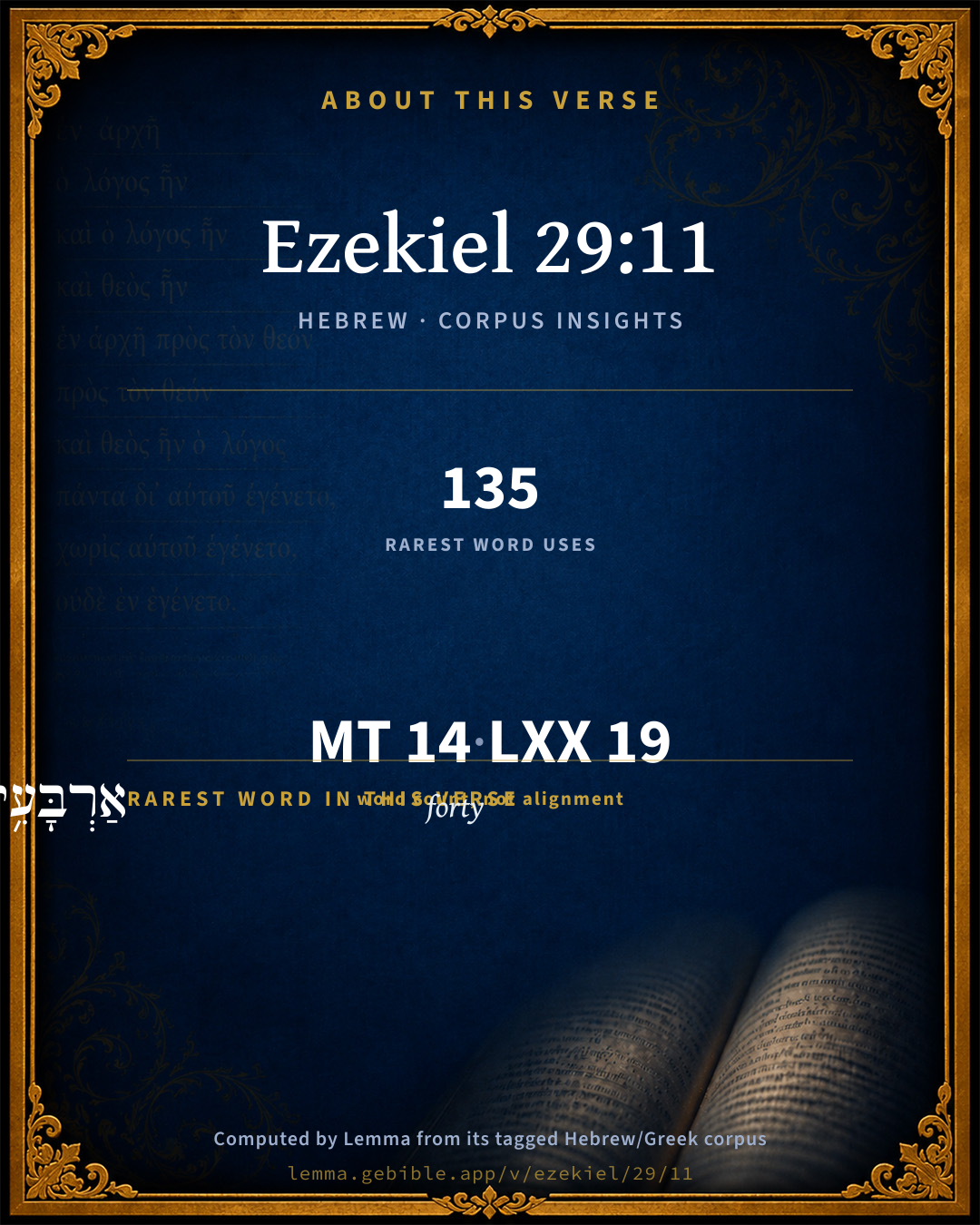
These counts appear in no published source. They are computed here, from the morphology-tagged text and Lemma’s own curated glosses. What Lemma adds →

14
words
8
distinct lemmas
Prophets
section

Grammatical profile

  • 3 verbs
  • 5 nouns
  • 1 adjective
  • 2 prepositions
  • 3 particles

Verb forms

  • תַעֲבָר Qal · Imperfect
  • תַעֲבָר Qal · Imperfect
  • תֵשֵׁ֖ב Qal · Imperfect

Repetition

Words recur within this verse — often emphatic in Hebrew:

  • תַעֲבָר to pass over H5674 ×2
  • רֶ֣גֶל foot H7272 ×2
  • לֹ֤א not H3808 ×3

Hebrew & Septuagint length

In English translation the verse runs 23 words from the Hebrew and 26 from the Septuagint (LXX English) — closely comparable.

A rough comparison of the two English renderings, which tokenize alike — not a word-level alignment.

Word counts can differ between the Hebrew and the Greek without any difference in meaning — e.g. the Hebrew direct-object marker אֵת has no separate Greek word, and Greek often adds the article ὁ.

In the original languages it is 14 Hebrew tokens and 19 Greek tokens — but the two are counted differently (Hebrew bundles its prefixes and suffixes into one token; the Greek is in lemma form), so that isn’t a like-for-like length.

Cross-references

12

Topical passages linked to Ezekiel 29:11 in the Treasury of Scripture Knowledge — connected by theme and wording, ordered by reader-vote popularity; previews shown in the World English Bible.

  • Ezekiel 32:13 I will destroy also all the animals of it from beside many waters; neither shall the foot of man trouble them any more, nor the hoofs of animals trouble them.
  • Jeremiah 43:11–12 He shall come, and shall strike the land of Egypt; such as are for death [shall be given] to death, and such as are for captivity to captivity, and such as are for the sword to the sword.
  • 2 Chronicles 36:21 to fulfill the word of Yahweh by the mouth of Jeremiah, until the land had enjoyed its Sabbaths: [for] as long as it lay desolate it kept Sabbath, to fulfill seventy years.
  • Isaiah 23:15 It shall come to pass in that day, that Tyre shall be forgotten seventy years, according to the days of one king: after the end of seventy years it shall be to Tyre as in the song of the prostitute.
  • Isaiah 23:17 It shall happen after the end of seventy years, that Yahweh will visit Tyre, and she shall return to her hire, and shall play the prostitute with all the kingdoms of the world on the surface of the earth.
  • Jeremiah 25:11–12 This whole land shall be a desolation, and an astonishment; and these nations shall serve the king of Babylon seventy years.
  • Jeremiah 29:10 For thus says Yahweh, After seventy years are accomplished for Babylon, I will visit you, and perform my good word toward you, in causing you to return to this place.
  • Ezekiel 30:10–13 Thus says the Lord Yahweh: I will also make the multitude of Egypt to cease, by the hand of Nebuchadrezzar king of Babylon.
  • Ezekiel 31:12 Strangers, the terrible of the nations, have cut him off, and have left him: on the mountains and in all the valleys his branches are fallen, and his boughs are broken by all the watercourses of the land; and all the peoples of the earth are gone down from his shadow, and have left him.
  • Ezekiel 33:28 I will make the land a desolation and an astonishment; and the pride of her power shall cease; and the mountains of Israel shall be desolate, so that none shall pass through.
  • Ezekiel 36:28 You shall dwell in the land that I gave to your fathers; and you shall be my people, and I will be your God.
  • Daniel 9:2 in the first year of his reign I, Daniel, understood by the books the number of the years about which the word of Yahweh came to Jeremiah the prophet, for the accomplishing of the desolations of Jerusalem, even seventy years.

Cross-references courtesy of OpenBible.info (CC BY 4.0).

Hebrew and Greek witnesses Masoretic Hebrew ↔ Greek Septuagint

The same verse in the two great witnesses to the Old Testament, shown verse-for-verse.

These are two independent witnesses, not word-aligned to each other, and the Septuagint is shown in lemma (dictionary) form.

Hebrew Ezekiel 29:11 Masoretic · Westminster Leningrad Codex

לֹ֤א תַעֲבָר בָּהּ֙ רֶ֣גֶל אָדָ֔ם וְרֶ֥גֶל בְּהֵמָ֖ה לֹ֣א תַעֲבָר בָּ֑הּ וְלֹ֥א תֵשֵׁ֖ב אַרְבָּעִ֥ים שָׁנָֽה

No foot of man shall pass through it, nor foot of animal shall pass through it, neither shall it be inhabited forty years.

World English Bible · Public Domain

Greek LXX Ezekiel 29:11 Septuagint · lemma form

οὐ μή διαἔρχομαι ἐν αὐτός πούς ἄνθρωπος καί πούς κτῆνος οὐ μή διαἔρχομαι αὐτός καί οὐ καταοἰκέω τεσσαράκοντα ἔτος

No foot of man shall pass through it, and no foot of beast shall pass through it, and it shall not be inhabited for forty years.

LXX2012 (modern English Septuagint) · Public Domain

Hebrew: Westminster Leningrad Codex (CC BY 4.0). Greek: Septuagint (public domain); English from LXX2012 (modern English Septuagint) (Public Domain). How the Septuagint differs from the Hebrew →

Targum (Aramaic paraphrase)

1

The Targum is the ancient Jewish Aramaic paraphrase of the Hebrew Scriptures — an interpretive translation, not the Hebrew text itself. Onkelos (literal) and Pseudo-Jonathan (expansive) render the Torah, and Jonathan the Prophets. Coverage is partial: where no permissively-licensed English translation exists for a verse, only the Aramaic is shown. This is verse-level text, not a word-by-word alignment to the Hebrew.

  1. Targum Jonathan Prophets (Joshua–Malachi)
    לָא תֶעְבַּר בָּהּ רִגְלָא דִי אֱנָשָׁא וְרִגְלָא דִי בְעִירָא לָא תֶעְבַּר בָהּ וְלָא תִתְיַתֵּב אַרְבְּעִין שְׁנִין:

    (no public-domain English translation for this verse)

    Targum Jonathan — Aramaic: “Mikraot Gedolot” (public domain). English: “Sefaria Community Translation” (CC0 1.0 (public-domain dedication)); “London "Chaldee Paraphrase," 1871” (public domain). Text via Sefaria.

Commentary

Notes on Ezekiel 29:11 from classic Christian and Jewish commentators (each source and its license shown beneath its notes). The classic Christian expositions comment on the surrounding passage and are grouped to its opening verse, so a note may address several verses; the Jewish commentaries on the Tanakh (Rashi and others) are per-verse, so they appear only where the commentator wrote on this verse.

Lemma curates 59 commentaries, every one of them public domain or Creative Commons licensed, each selected and text-cleaned for this edition rather than reprinted as found. About our sources →

Ellicott's Commentary for English Readers

(11) Neither shall it be inhabited forty years.—In Eze_29:9-12 a state of desolation is predicted for Egypt, which, if understood in the literal sense of the words, has certainly never been fulfilled. In Eze_29:9 it is said that it “shall be desolate and waste,” and this is repeated with emphasis in Eze_29:10; while in Eze_29:11 it is declared that neither foot of man nor foot of beast shall pass through it. There is also a difficulty in regard to the time of “forty years,” mentioned in Eze_29:11-13. No such definite period can be made out from history. The two difficulties go together, and the former is explained by the latter. It has already been seen in Eze_4:6 that the prophet represents the calamity of Judah in the historic terms of their former suffering in the wilderness, without thereby intending either any specific time or any precise repetition of the same troubles they had then experienced. He does the same thing here in regard to Egypt. The people are to pass into a condition like that of the Israelites in the wilderness, in which they were to endure the judgment of God upon their sins. This is expressed, after the manner of Ezekiel, in strong concrete terms, the literal fulfilment of which was neither intended nor expected.

A Bible Commentary for English Readers, edited by Charles John Ellicott (1878–1897) — public domain. Text from a community e-Sword module.

Trapp's Complete Commentary

John Trapp

Eze 29:11 No foot of man shall pass through it, nor foot of beast shall pass through it, neither shall it be inhabited forty years.

Ver. 11. No foot of man or beast shall pass through it.] This was solitudo solitudinis indeed, a dreadful desolation. When it happened no history mentioneth, but that it was so is most sure. Oh the dismal effects of sin in all ages, as now in various parts of Turkey, utterly unpeopled, though once flourishing!

John Trapp, A Commentary or Exposition upon All the Books of the Old and New Testament (1647–1656) — public domain. Text from a community e-Sword module.

Jamieson, Fausset & Brown

Robert Jamieson, A. R. Fausset & David Brown

forty years--answering to the forty years in which the Israelites, their former bondsmen, wandered in "the wilderness" (compare Note, see on Eze 29:5). JEROME remarks the number forty is one often connected with affliction and judgment. The rains of the flood in forty days brought destruction on the world. Moses, Elias, and the Saviour fasted forty days. The interval between Egypt's overthrow by Nebuchadnezzar and the deliverance by Cyrus, was about forty years. The ideal forty years' wilderness state of social and political degradation, rather than a literal non-passing of man or beast for that term, is mainly intended (so Eze 4:6; Isa 19:2, Isa 19:11).

Jamieson, Fausset & Brown — Commentary Critical and Explanatory on the Whole Bible (1871) — public domain (CC PDM 1.0). Text via the HelloAO Bible API.

The Cambridge Bible for Schools and Colleges

gen. ed. J. J. S. Perowne

11. No foot of man] See Eze_32:13, cf. Eze_33:28, Eze_35:7; Jer_2:6. The desolation of Egypt shall continue forty years, the period of Chaldean supremacy (cf. Eze_4:6).

The Cambridge Bible for Schools and Colleges (gen. ed. J. J. S. Perowne; Cambridge University Press, 1878–1918) — public domain. Text from a community e-Sword module.

John Gill's Exposition

No foot of man shall pass through it,.... This must be understood not strictly, but with some limitation; it cannot be thought that Egypt was so depopulated as that there should not be a single passenger in it; but that there should be few inhabitants in it, or that there should be scarce any that should come into it for traffic; it should not be frequented as it had been at least there should be very few that travelled in it, in comparison of what had:

no foot of beast shall pass through it: no droves of sheep and oxen, and such like useful cattle, only beasts of prey should dwell in it:

neither shall it be inhabited forty years: afterwards, Eze 29:17, a prophecy is given out concerning the destruction of it by Nebuchadnezzar, which was in the twenty seventh year, that is, of Jeconiah's captivity; now allowing three years for the fulfilment of that prophecy, or forty years, a round number put for forty three years, they will end about the time that Cyrus conquered Babylon, at which time the seventy years' captivity of the Jews ended; and very likely the captivity of the Egyptians also. The Jews pretend to give a reason why Egypt lay waste just forty years, because the famine, signified in Pharaoh's dream, was to have lasted, as they make it out, forty two years; whereas, according to them, it continued only two years; and, instead of the other forty years of famine, Egypt must be forty years uninhabited: this is mentioned both by Jarchi and Kimchi.

John Gill's Exposition of the Whole Bible (1746–1763) — public domain (CC PDM 1.0). Text via the HelloAO Bible API.

Haydock's Catholic Bible Commentary

Years, till the third of Cyrus, who gave liberty to all the captives at the beginning of his reign, ver. 13. (Calmet) --- Amasis reigned forty-four years in Lower Egypt, (Herodotus iii. 10.) over the few whom Nabuchodonosor spared.

George Leo Haydock (1774–1849), Haydock's Catholic Family Bible and Commentary, 1859 edition — public domain. Excludes Psalms (Douay-Rheims chapter numbering differs from Protestant) and Deuterocanonical books (Catholic canon only).

Matthew Poole's English Annotations

No foot of man; not strictly to be taken, but in an accommodated sense, or comparatively to what once was, or so little traffic and passing to and fro, that no footsteps or tracks of men were found. It is a Scripture hyperbole, as Luk 19:44; Isa 14:31; Eze 26:14,21.

Nor foot of beast; of profitable, useful, and tractable, as sheep, oxen, and horses; but of wild beasts too many are in the desolate places of that part of the world.

Neither shall it be inhabited forty years: accounting these years from the first wastings of Egypt by their civil dissensions and wars, some nine or ten years before Nebuchadnezzar subdued and wasted it, which he did in the thirty-fifth, thirty-sixth, and thirty-seventh years of his reign, or thereabout. So that these forty years will fall in about the thirtieth year of Jeconiah’s captivity, and end with the seventieth year of the captivity, which was the first of Cyrus.

Matthew Poole's English Annotations on the Holy Bible (1683–1685) — public domain. Text from a community e-Sword/MySword module.

Whedon's Commentary on the Bible

Daniel D. Whedon

11. Neither shall it be inhabited forty years — This prophecy was never literally fulfilled. It is a poetic description of the results of a campaign which laid waste the country and interrupted the traffic. (Compare Eze_4:6; Eze_32:13.) The forty years is a symbolic number. (See introduction to chapter 40, and general Introduction, VIII.) No one doubts that Egypt was in trouble at this very time. The brave General Nes-Hor tells us on his funeral statue how the “Aamu [Asiatics] and all the wretched Northerners from the land of Sati [Mesopotamia] wasted and plundered” the country as far as Nubia, ravaging the temple at Elephantine, etc. The fact that Nes-Hor claims to have driven back the invaders before they plundered Nubia proves that they had at least reached Syene. (See note Eze_29:10.) It is more probable that the Aamu, being satisfied with their booty, or being overcome with the heat, returned of their own accord. The Egyptians claimed victories under such circumstances (Wiedemann, Zeits. fur Aeg. Sprach, 1878; Maspero and Brugsch, Zeits., 1884; Expositor, x; Tiele, Geschichte; Kuenen, Onderzoek).

Daniel D. Whedon (gen. ed.), Commentary on the Old and New Testaments (1874–1909) — public domain. Text from a community e-Sword module.

The Pulpit Commentary

Neither shall it be inhabited forty years. It need hardly be said that history reveals no such period of devastation. Nor, indeed, would anything but the most prosaic literalism justify us in looking for it. We are dealing with the language of a poet-prophet, which is naturally that of hyperbole, and so the "forty years" stand, as, perhaps, elsewhere, (Jud_1:3:11 5:31, etc.) for a period of undefined duration, and the picture of a land on which no man or beast sets foot for that of a time of desolation, and consequent cessation of all the customary traffic along the Nile. Such a period, there is reason to believe, did follow on the conquests of Nebuchadnezzar. It is implied in Vers. 17-21, which carry us to a date seventeen years later than that of the verse with which we are now dealing; and also in Jer_43:10-12. Josephus ("Contra Apion," 1:20) speaks of Nebuchadnezzar as having invaded Libya. The reign of Amasis, which followed on the deposition of Hophra, was one of general prosperity as regards commerce and culture, but Egypt ceased to be one of the great world-powers after the time of Nebuchadnezzar and fell easily into the hands of the Persians under Cambyses. It is noticeable that Ezekiel does not, like Isaiah, (Isa_19:18-25) connect the future of Egypt with any Messianic expectations.

The Pulpit Commentary (1880–1919), ed. H.D.M. Spence-Jones & Joseph S. Exell — public domain. Text from a community e-Sword module.

John Wesley's Explanatory Notes

Forty years - These forty years began about the thirtieth year of Jeconiah's captivity, and end with the seventieth year of the captivity, which was the first of Cyrus.

John Wesley, Explanatory Notes Upon the Whole Bible (1754–1765) — public domain. Text via the GEBible commentary corpus.

unfoldingWord translationNotes

Door43 World Missions Community

General Information:

Yahweh continues giving Ezekiel his message to Pharaoh.

No man's foot will pass through it

Here "man's foot" represents people. AT: "No man will walk through the land of Egypt" (See: Synecdoche)

no wild animal's foot will pass through it

Here "animal's foot" represents animals. AT: "not even a wild animal will walk through it" (See: Synecdoche)

For I will make the land of Egypt a desolation

The abstract noun "desolation" can be expressed with the adjective "desolate." AT: "For I will make the land of Egypt desolate" (See: Abstract Nouns)

I will scatter Egypt among the nations

Here "Egypt" represents the people of Egypt, and "scatter" represents causing them to move to other places. AT: "I will scatter the Egyptians among the nations" or "I will make the people of Egypt go and live among the nations" (See: Metonymy and Metaphor)

translationWords

desolate

waste

Egypt

nation

disperse

unfoldingWord translationNotes — © Distant Shores Media and the Door43 World Missions Community, licensed CC BY-SA 4.0. Source: git.door43.org/Door43/en_tn.

Rashi

Rabbi Shlomo Yitzchaki (Rashi)

neither shall it be inhabited for forty years Forty-two years of famine were decreed in Pharaoh’s dream, corresponding to the three times the dream is written. He saw seven bad cows and seven bad ears of grain (Gen. 41) and he told it to Joseph; hence we have [it mentioned] twice, and Joseph said to him, “The seven thin and bad cows and the seven empty ears,” totaling forty-two for the famine. But they had only two, as it is stated (ibid. 45:6): “For it is two years now that the famine has been on earth,” and when Jacob came down to Egypt, the famine ceased, for behold in the third year they sowed, as it is stated (ibid. 47:19): “and then you give us seed that we may live etc.,” and the forty years were paid to them now: “neither shall it be inhabited for forty years.”

תֵּשֵּׁב means sera asijiee in Old French. will be settled, peopled.

Rashi on the Tanakh — English translations: “The Judaica Press complete Tanach with Rashi, translated by A. J. Rosenberg” (CC BY 4.0); “Pentateuch with Rashi's commentary by M. Rosenbaum and A.M. Silbermann, 1929-1934” (public domain); “The Metsudah Tanach series, Lakewood, N.J” (CC BY 4.0); and “The Book of Joshua, Metsudah Publications, 1997” (CC BY 4.0). Text via Sefaria.

Lesson kit

Teaching starters — assembled from the data on this page, not authored interpretation. Every prompt links to the verse data it draws on. Edit before teaching.

Ezekiel, in the Prophets, opens this verse with 14 words (8 distinct Hebrew lemmas). Its most distinctive word is ʼarbâʻîym (“forty”). A historical commentator’s framing appears above. Read the whole chapter for the surrounding context.

Discussion questions

  1. How does “forty” (ʼarbâʻîym) shape what this verse is saying?
  2. Ezekiel 32:13 shares this passage’s theme. How do the two illuminate each other?
  3. “to pass over” occurs 2× in this one verse. What is the effect of the repetition?
  4. These translations render this verse differently; the difference is in the English rendering, not the original. What questions does that raise?
  5. The verb «תַעֲבָר» is Qal Imperfect. How does its form color the action?
  6. Reading how Ellicott's Commentary for English Readers and Trapp's Complete Commentary read this verse, where do the two commentators agree and where do they part?

Things to notice

Reading settings

Reading text

Shown beneath each verse's original-language words.

Old Testament
Old Testament edition

Read the OT as the Masoretic Hebrew (MT) or the Greek Septuagint (LXX).

English shown for the Greek Septuagint (in the Hebrew ↔ Greek comparison).

Comparing translations? Open the Compare panel on any verse page to stack up to four side by side.