
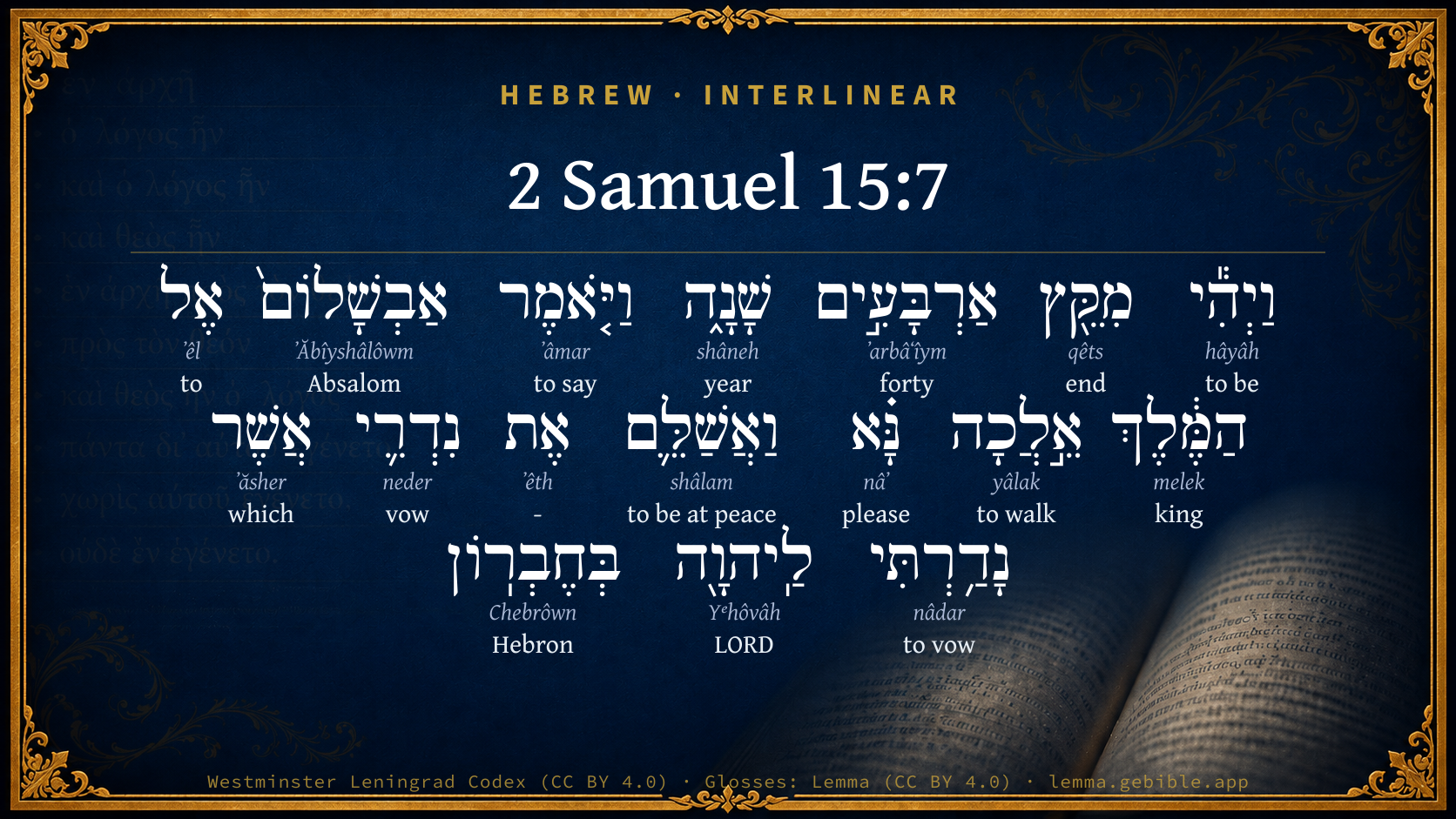
2 Samuel 15:7

Hebrew (Westminster Leningrad Codex) 2 Samuel 15:7 appears in the Hebrew Old Testament. The text above is from the Westminster Leningrad Codex. Each word links to its Strong’s number, a concise gloss, and parsing drawn from the Open Scriptures Hebrew Bible morphology. Click any word for its full Brown-Driver-Briggs (BDB) entry.
Download image
Cite this verse

2 Samuel 15:7 (World English Bible). Public Domain. Lemma interlinear Bible study tool, https://lemma.gebible.app/v/2-samuel/15/7.

Show BibTeX & RIS
BibTeX
RIS
English Translation
It happened at the end of forty years, that Absalom said to the king, please let me go and pay my vow, which I have vowed to Yahweh, in Hebron.
World English Bible · Public Domain
Download a study sheet

One document with this verse’s original text, its word-by-word gloss line, the meaning frame, cross-references with their text, attributed commentary, and full source and license credits — printable, and it pastes into notes with its structure intact.

This verse Autodidact and up

Study sheet (.html) Plain text (.txt)

A passage Seminary Student

Up to 50 verses in one chapter. A passage sheet keeps up to 6 commentary sources and 12 cross-references per verse, in the order this page ranks them, and says so on the sheet whenever that leaves anything out. Ask for a single verse and you get the Autodidact verse sheet above.

Everything on this page stays free to read, with no account — the sheet is a download of what is already on screen, not access to it.

Want to remove ads? Support Godless Engineer
Compare translations 3

The same verse in 3 English versions, stacked beneath the original-language interlinear above. Click any original word for its lexicon entry.

Each is an independent rendering of the whole verse — the interlinear is not word-aligned to these translations.

Highlighted words mark where these versions differ — a whole-verse word diff, not a word-by-word alignment.

  • World English Bible Public Domain
    It happened at the end of forty years, that Absalom said to the king, please let me go and pay my vow, which I have vowed to Yahweh, in Hebron.
  • King James Version Public Domain
    And it came to pass after forty years, that Absalom said unto the king, I pray thee, let me go and pay my vow, which I have vowed unto the LORD, in Hebron.
  • unfoldingWord Literal Text CC BY-SA 4.0
    And it happened at the end of 40 years that Absalom said to the king, “Please may I go, and may I fulfill in Hebron my vow that I vowed to Yahweh.

unfoldingWord Literal Text — © unfoldingWord, licensed CC BY-SA 4.0. Word-aligned USFM3 via Door43 (git.door43.org/unfoldingWord/en_ult).

Versions to compare (up to 4)

3 of 4 selected

Show all 18 translations

Every available English version of this verse, each an independent rendering of the whole verse.

  • World English Bible Public Domain
    It happened at the end of forty years, that Absalom said to the king, please let me go and pay my vow, which I have vowed to Yahweh, in Hebron.
  • Berean Standard Bible Public Domain
    After four years had passed, Absalom said to the king, “Please let me go to Hebron to fulfill a vow I have made to the LORD.
  • Majority Standard Bible Public Domain
    After four years had passed, Absalom said to the king, “Please let me go to Hebron to fulfill a vow I have made to the LORD.
  • King James Version Public Domain
    And it came to pass after forty years, that Absalom said unto the king, I pray thee, let me go and pay my vow, which I have vowed unto the LORD, in Hebron.
  • American Standard Version (1901) Public Domain
    And it came to pass at the end of forty years, that Absalom said unto the king, I pray thee, let me go and pay my vow, which I have vowed unto Jehovah, in Hebron.
  • Revised Version (1885) Public Domain
    And it came to pass at the end of forty years, that Absalom said unto the king, I pray thee, let me go and pay my vow, which I have vowed unto the LORD, in Hebron.
  • Geneva Bible (1599) Public Domain
    And after fourtie yeeres, Absalom sayd vnto the King, I pray thee, let me go to Hebron, and render my vowe which I haue vowed vnto the Lord.
  • Douay-Rheims (1899) Public Domain
    And after forty years, Absalom said to king David: Let me go, and pay my vows which I have vowed to the Lord in Hebron.
  • Young's Literal Translation Public Domain
    And it cometh to pass, at the end of forty years, that Absalom saith unto the king, `Let me go, I pray thee, and I complete my vow, that I vowed to Jehovah in Hebron,
  • Literal Standard Version CC BY-SA 4.0
    And it comes to pass, at the end of forty years, that Absalom says to the king, “Please let me go, and I complete my vow that I vowed to YHWH in Hebron,
  • Unlocked Literal Bible CC BY-SA 4.0
    It came about at the end of four years that Absalom said to the king, “Please let me go and pay a vow that I have made to Yahweh in Hebron.
  • unfoldingWord Literal Text CC BY-SA 4.0
    And it happened at the end of 40 years that Absalom said to the king, “Please may I go, and may I fulfill in Hebron my vow that I vowed to Yahweh.
  • Darby Bible Public Domain
    And it came to pass at the end of forty years, that Absalom said to the king, I pray thee, let me go and pay in Hebron my vow which I have vowed to Jehovah.
  • World Messianic Bible Public Domain
    At the end of forty years, Absalom said to the king, “Please let me go and pay my vow, which I have vowed to the LORD, in Hebron.
  • Webster's Bible Public Domain
    And it came to pass after forty years, that Absalom said to the king, I pray thee, let me go and pay my vow, which I have vowed to the LORD, in Hebron.
  • Free Bible Version CC BY-SA 4.0
    Four years later Absalom asked the king, “Please let me go to Hebron to fulfill a promise I made to the Lord.
  • Bible in Basic English Public Domain
    Now at the end of four years, Absalom said to the king, Let me go to Hebron and give effect to the oath which I made to the Lord:
  • JPS Tanakh (1917) Public Domain
    And it came to pass at the end of forty years, that Absalom said unto the king: 'I pray thee, let me go and pay my vow, which I have vowed unto the LORD, in Hebron.

Literal Standard Version (2020), Covenant Press — licensed CC BY-SA 4.0. Text via the HelloAO Bible API (eBible.org). Unlocked Literal Bible (unfoldingWord) — licensed CC BY-SA 4.0. Text via the HelloAO Bible API (eBible.org). unfoldingWord Literal Text — © unfoldingWord, licensed CC BY-SA 4.0. Word-aligned USFM3 via Door43 (git.door43.org/unfoldingWord/en_ult). Free Bible Version, Dr. Jonathan Gallagher — licensed CC BY-SA 4.0. Text via the HelloAO Bible API (eBible.org).

Word by word

More ways to search: Search by grammar → Find every occurrence → Compare this word →

Practice this passage: Drill this verse → Learn its vocabulary →

נָדַ֥רְתִּי
nâdar
H5087
“to vow”
Verb, Qal, Perfect, 1st Person, Common, Singular
Part of Speech
Verb
Stem
Qal
Form
Perfect
Person
1st Person
Gender
Common
Number
Singular
Full BDB Definition

Origin: a primitive root

TWOT: 1308

to vow, make a vow - (Qal) to vow a vow
  1. וַיְהִ֕י hâyâh H1961 “and · to be” Conjunction + Verb, Qal, Sequential Imperfect, 3rd Person, Masculine, Singular
  2. מִקֵּ֖ץ qêts H7093 “from · end of” Preposition + Noun, Common, Masculine, Singular, Construct
  3. אַרְבָּעִ֣ים ʼarbâʻîym H705 “forty” Adjective, Cardinal number, Both, Plural, Absolute
  4. שָׁנָ֑ה shâneh H8141 “year” Noun, Common, Feminine, Singular, Absolute
  5. וַיֹּ֤אמֶר ʼâmar H559 “and · to say” Conjunction + Verb, Qal, Sequential Imperfect, 3rd Person, Masculine, Singular
  6. אַבְשָׁלוֹם֙ ʼĂbîyshâlôwm H53 “Absalom” Noun, Proper
  7. אֶל ʼêl H413 “to” Preposition
  8. הַמֶּ֔לֶךְ melek H4428 “the · king” Particle, Definite Article + Noun, Common, Masculine, Singular, Absolute
  9. אֵ֣לֲכָה yâlak H3212 “to walk” Verb, Qal, Cohortative, 1st Person, Common, Singular
  10. נָּ֗א nâʼ H4994 “please” Particle, Interjection
  11. וַאֲשַׁלֵּ֛ם shâlam H7999 “and · to be at peace” Conjunction + Verb, Piel, Cohortative, 1st Person, Common, Singular
  12. אֶת ʼêth H853 “-” Particle, Direct Object
  13. נִדְרִ֛י neder H5088 “vow · my” Noun, Common, Masculine, Singular, Construct + Suffix, Personal, 1st Person, Common, Singular
  14. אֲשֶׁר ʼăsher H834 “which” Particle, Relative
  15. לַֽיהוָ֖ה Yᵉhôvâh H3068 “to/for · LORD” Preposition + Noun, Proper
  16. בְּחֶבְרֽוֹן Chebrôwn H2275 “in/at · Hebron” Preposition + Noun, Proper

About this verse

These counts appear in no published source. They are computed here, from the morphology-tagged text and Lemma’s own curated glosses. What Lemma adds →

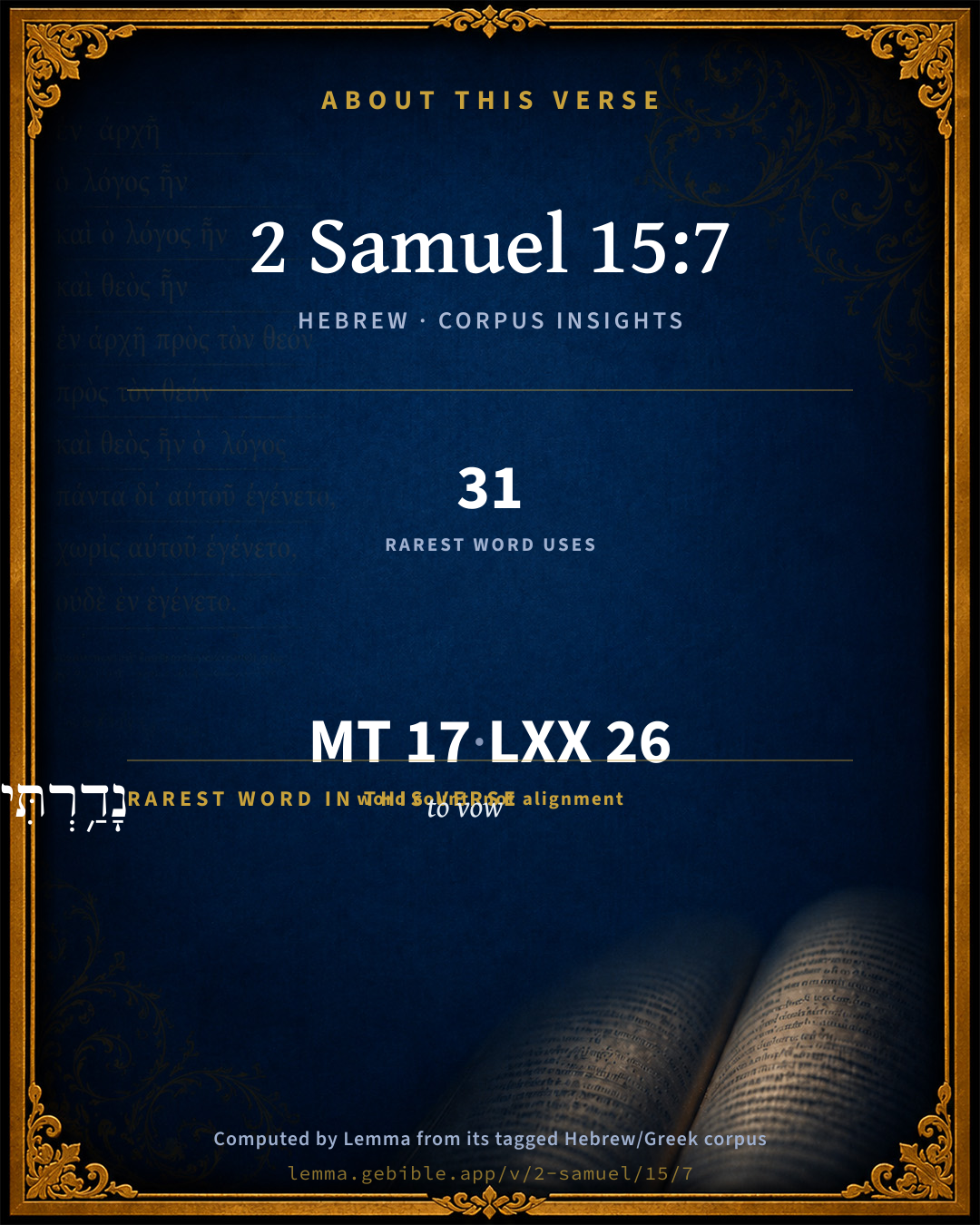
17
words
17
distinct lemmas
Historical
section

Shared distinctive vocabulary

נָדַ֥רְתִּי to vow H5087 occurs in 28 verses of the Hebrew Bible. Also found in:

Grammatical profile

  • 5 verbs
  • 7 nouns
  • 1 adjective
  • 1 preposition
  • 3 particles

Verb forms

  • וַיְהִ֕י Qal · Sequential Imperfect
  • וַיֹּ֤אמֶר Qal · Sequential Imperfect
  • אֵ֣לֲכָה Qal · Cohortative
  • וַאֲשַׁלֵּ֛ם Piel · Cohortative
  • נָדַ֥רְתִּי Qal · Perfect

Hebrew & Septuagint length

In English translation the verse runs 30 words from the Hebrew and 30 from the Septuagint (LXX English) — the same length.

A rough comparison of the two English renderings, which tokenize alike — not a word-level alignment.

Word counts can differ between the Hebrew and the Greek without any difference in meaning — e.g. the Hebrew direct-object marker אֵת has no separate Greek word, and Greek often adds the article ὁ.

In the original languages it is 17 Hebrew tokens and 26 Greek tokens — but the two are counted differently (Hebrew bundles its prefixes and suffixes into one token; the Greek is in lemma form), so that isn’t a like-for-like length.

Cross-references

8

Topical passages linked to 2 Samuel 15:7 in the Treasury of Scripture Knowledge — connected by theme and wording, ordered by reader-vote popularity; previews shown in the World English Bible.

  • Isaiah 58:4 Behold, you fast for strife and contention, and to strike with the fist of wickedness: you don't fast this day so as to make your voice to be heard on high.
  • 1 Samuel 16:1–2 Yahweh said to Samuel, How long will you mourn for Saul, seeing I have rejected him from being king over Israel? fill your horn with oil, and go: I will send you to Jesse the Bethlehemite; for I have provided me a king among his sons.
  • 1 Samuel 16:13 Then Samuel took the horn of oil, and anointed him in the midst of his brothers: and the Spirit of Yahweh came mightily on David from that day forward. So Samuel rose up, and went to Ramah.
  • 2 Samuel 13:24–27 Absalom came to the king, and said, See now, your servant has sheep-shearers; let the king, I pray you, and his servants go with your servant.
  • 2 Samuel 13:38 So Absalom fled, and went to Geshur, and was there three years.
  • Proverbs 21:27 The sacrifice of the wicked is an abomination: How much more, when he brings it with a wicked mind!
  • Matthew 2:8 He sent them to Bethlehem, and said, "Go and search diligently for the young child. When you have found him, bring me word, so that I also may come and worship him."
  • Matthew 23:13 "Woe to you, scribes and Pharisees, hypocrites! For you devour widows' houses, and as a pretense you make long prayers. Therefore you will receive greater condemnation.

Cross-references courtesy of OpenBible.info (CC BY 4.0).

Hebrew and Greek witnesses Masoretic Hebrew ↔ Greek Septuagint

The same verse in the two great witnesses to the Old Testament, shown verse-for-verse.

These are two independent witnesses, not word-aligned to each other, and the Septuagint is shown in lemma (dictionary) form.

Hebrew 2 Samuel 15:7 Masoretic · Westminster Leningrad Codex

וַיְהִ֕י מִקֵּ֖ץ אַרְבָּעִ֣ים שָׁנָ֑ה וַיֹּ֤אמֶר אַבְשָׁלוֹם֙ אֶל הַמֶּ֔לֶךְ אֵ֣לֲכָה נָּ֗א וַאֲשַׁלֵּ֛ם אֶת נִדְרִ֛י אֲשֶׁר נָדַ֥רְתִּי לַֽיהוָ֖ה בְּחֶבְרֽוֹן

It happened at the end of forty years, that Absalom said to the king, please let me go and pay my vow, which I have vowed to Yahweh, in Hebron.

World English Bible · Public Domain

Greek LXX 2 Samuel 15:7 Septuagint · lemma form

καί γίγνομαι ἀπό τέλος τεσσαράκοντα ἔτος καί εἶπον αβεσσαλωμ πρός ὁ πατήρ αὐτός πορεύομαι δή καί ἀποτίνω ὁ εὐχή ἐγώ ὅς εὔχομαι ὁ κύριος ἐν χεβρων

And it came to pass after forty years, that Abessalom said to his father, I will go now, and pay my vows, which I vowed to the Lord in Chebron.

LXX2012 (modern English Septuagint) · Public Domain

On this verse, Adam Clarke's Commentary discusses the Septuagint’s reading. Read the note in Commentary ↓

Hebrew: Westminster Leningrad Codex (CC BY 4.0). Greek: Septuagint (public domain); English from LXX2012 (modern English Septuagint) (Public Domain). How the Septuagint differs from the Hebrew →

Targum (Aramaic paraphrase)

1

The Targum is the ancient Jewish Aramaic paraphrase of the Hebrew Scriptures — an interpretive translation, not the Hebrew text itself. Onkelos (literal) and Pseudo-Jonathan (expansive) render the Torah, and Jonathan the Prophets. Coverage is partial: where no permissively-licensed English translation exists for a verse, only the Aramaic is shown. This is verse-level text, not a word-by-word alignment to the Hebrew.

  1. Targum Jonathan Prophets (Joshua–Malachi)
    וַהֲוָה מִסוֹף אַרְבְּעִין שְׁנִין וַאֲמַר אַבְשָׁלוֹם לְמַלְכָּא אַזִיל כְּעַן וַאֲשַׁלֵם יַת נִדְרִי דִנְדָרִית קֳדָם יְיָ בְּחֶבְרוֹן:

    (no public-domain English translation for this verse)

    Targum Jonathan — Aramaic: “Mikraot Gedolot” (public domain). English: “Sefaria Community Translation” (CC0 1.0 (public-domain dedication)); “London "Chaldee Paraphrase," 1871” (public domain). Text via Sefaria.

Commentary

Notes on 2 Samuel 15:7 from classic Christian and Jewish commentators (each source and its license shown beneath its notes). The classic Christian expositions comment on the surrounding passage and are grouped to its opening verse, so a note may address several verses; the Jewish commentaries on the Tanakh (Rashi and others) are per-verse, so they appear only where the commentator wrote on this verse.

Lemma curates 59 commentaries, every one of them public domain or Creative Commons licensed, each selected and text-cleaned for this edition rather than reprinted as found. About our sources →

Matthew Henry's Commentary

We have here the breaking out of Absalom's rebellion, which he had long been contriving. It is said to be after forty years, Sa2 15:7. But whence it is to be dated we are not told; not from David's beginning his reign, for then it would fall in the last year of his life, which is not probable; but either from his first anointing by Samuel seven years before, or rather (I think) from the people's desiring a king, and the first change of the government into a monarchy, which might be about ten years before David began to reign; it is fitly dated thence, to show that the same restless spirit was still working, and still they were given to change: as fond now of a new man as then of a new model. So it fell about the thirtieth year of David's reign. Absalom's plot being now ripe for execution,

I. The place he chose for the rendezvous of his party was Hebron, the place where he was born and where his father began his reign and continued it several years, which would give some advantage to his pretensions. Every one knew Hebron to be a royal city; and it lay in the heart of Judah's lot, in which tribe, probably, he thought his interest strong.

II. The pretence he had both to go thither and to invite his friends to him there was to offer a sacrifice to God, in performance of a vow he had made during his banishment, Sa2 15:7, Sa2 15:8. We have cause enough to suspect that he had not made any such vow; it does not appear that he was so religiously inclined. But he that stuck not at murder and treason would not make conscience of a lie to serve his purpose. If he said he had made such a vow, nobody could disprove him. Under this pretence, 1. He got leave of his father to go to Hebron. David would be well pleased to hear that his son, in his exile, was so desirous to return to Jerusalem, not only his father's city, but the city of the living God, - that he looked up to God, to bring him back, - that he had vowed, if he were brought back, to serve the Lord, whose service he had hitherto neglected, - and that now, being brought back, he remembered his vow, and resolved to perform it. If he think fit to do it in Hebron, rather than in Sion or Gibeon, the good king is so well pleased with the thing itself that he will not object against his choice of the place. See how willing tender parents are to believe the best concerning their children, and, upon the least indication of good, to hope, even concerning those that have been untoward, that they will repent and reform. But how easy is it for children to take advantage of their good parents' credulity, and to impose upon them with the show of religion, while still they are what they were! David was overjoyed to hear that Absalom inclined to serve the Lord, and therefore readily gave him leave to go to Hebron, and to go thither with solemnity. 2. He got a good number of sober substantial citizens to go along with him, Sa2 15:11. There went 200 men, probably of the principal men of Jerusalem, whom he invited to join with him in his feast upon his sacrifice; and they went in their simplicity, not in the least suspecting that Absalom had any bad design in this journey. He knew that it was to no purpose to tempt them into his plot: they were inviolably firm to David. But he drew them in to accompany him, that the common people might think that they were in his interest, and that David was deserted by some of his best friends. Note, It is no new thing for very good men, and very good things, to be made use of by designing men to put a colour upon bad practices. When religion is made a stalking-horse, and sacrifice a shoeing-horn, to sedition and usurpation it is not to be wondered at if some that were well affected to religion, as these followers of Absalom here, are imposed upon by the fallacy, and drawn in to give countenance to that, with their names, which in their heart they abhor, not having known the depths of Satan.

III. The project he laid was to get himself proclaimed king throughout all the tribes of Israel upon a signal given, Sa2 15:10. Spies were sent abroad, to be ready in every country to receive the notice with satisfaction and acclamations of joy, and to make the people believe that the news was both very true and very good, and that they were all concerned to take up arms for their new king. Upon the sudden spreading of this proclamation, "Absalom reigns in Hebron," some would conclude that David was dead, others that he had resigned: and thus those that were in the secret would draw in many to appear for Absalom, and to come into his assistance, who, if they had rightly understood the matter, would have abhorred the thought of it, but, being drawn in, would adhere to him. See what artifices ambitious men use for the compassing of their ends; and in matters of state, as well as in matters of religion, let us not be forward to believe every spirit, but try the spirits.

IV. The person he especially courted and relied upon in this affair was Ahithophel, a politic thinking man, and one that had a clear head and a great compass of thought, that had been David's counsellor, his guide and his acquaintance (Psa 55:13), his familiar friend, in whom he trusted, who did eat of his bread, Psa 41:9. But, upon some disgust of David's against him, or his against David, he was banished, or retired from public business, and lived privately in the country. How should a man of such good principles as David, and a man of such corrupt principles as Ahithophel, long agree? A fitter tool Absalom could not find in all the kingdom than one that was so great a statesman, and yet was disaffected to the present ministry. While Absalom was offering his sacrifices, in performance of his pretended vow, he sent for this man. So much was his heart on the projects of his ambition that he could not stay to make an end of his devotion, which showed what his eye was upon in all, and that it was but for a pretence that he made long offerings.

V. The party that joined with him proved at last very considerable. The people increased continually with Absalom, which made the conspiracy strong and formidable. Every one whom he had complimented and caressed (pronouncing his matters right and good, especially if afterwards the cause went against him) not only came himself, but made all the interest he could for him, so that he wanted not for numbers. The majority is no certain rule to judge of equity by. All the world wondered after the beast. Whether Absalom formed this design merely in the height of his ambition and fondness to rule, or whether there was not in it also malice against his father and revenge for his banishment and confinement, though this punishment was so much less than he deserved, does not appear. But, generally, that which aims at the crown aims at the head that wears it.

Matthew Henry's Commentary on the Whole Bible (1708–1710) — public domain (CC PDM 1.0). Text via the HelloAO Bible API.

Trapp's Complete Commentary

John Trapp

2Sa 15:7 And it came to pass after forty years, that Absalom said unto the king, I pray thee, let me go and pay my vow, which I have vowed unto the LORD, in Hebron.

Ver. 7. And it came to pass after forty years.] Not after four years, as Josephus hath it, but after forty years, via, after David’s first anointing by Samuel, say some, {1Sa 16:13} seven or eight years before he began his reign in Hebron, and ending about seven years before his death. Others of good note begin the computation of these forty years at the time that Israel asked a king, as if it intimated thus much, - They would needs have a king. They shall now have so many kings that they know not well which to follow; and many of them shall perish in following the usurper. Samuel had foretold the people then - but they regarded not his words - that a king would "take their sons and appoint them for himself, for his chariots, and to be his horsemen, and some to run before his chariots." {1Sa 8:11} Now they see it fulfilled in Absalom, who affected the kingdom; and by this passage, after forty years, are reminded of their sin, and what a heavy burden they had brought upon themselves. Codomannus gathereth, that for the time of the year, it was between the feasts of the passover and Pentecost; because Barzillai the Gileadite brought to David for a present "parched corn, and beans, and lentiles, and parched pulse." {2Sa 17:28}

Let me go and pay my vow.] Here religion is made a cloak to rebellion, as in the Papacy is ordinary. He knew well that his pious father would be full glad to hear that he was a votary, and would further him all that might be.

John Trapp, A Commentary or Exposition upon All the Books of the Old and New Testament (1647–1656) — public domain. Text from a community e-Sword module.

The Biblical Illustrator

Joseph S. Exell

2Sa_15:7-8

I pray thee let me go and pay my vow, which I have vowed unto the Lord.

Diplomatic insincerity

Of royal dissemblers like Absalom history records numerous parallels, notably Charles II., who, in his dealings with the Scots, solely to win them over to his cause, took the Covenant with all the solemnity of a pious Covenant, also Napoleon Bonaparte, who, when in Egypt seeking to reconcile the people to his rule, announced: We Frenchmen are true Mussulmans. Have not we destroyed the Pope, who called upon Europe to make war upon the Mussulmans. After the capture of Cairo this adept at diplomatic insincerity was to be seen seated in the great mosque at the feast of the prophets, sitting cross-legged as he repeated the words of the Koran, and edified the sacred college by his piety. (Charles Deal.)

The Biblical Illustrator, edited by Joseph S. Exell (c. 1880s–1900s) — public domain. Text from a community e-Sword module.

Joseph Benson's Commentary

2Sa 15:7. After forty years — That is, as some say, from the change of the government into a monarchy, which change took place about ten years before David began to reign. So that this fell out about the thirtieth year of his reign. But the Syriac and Arabic, whom Houbigant follows, read, After four years; that is, from the time of his father’s reconciliation with him. Josephus, Theodoret, the manuscripts mentioned in the Benedictine edition of Jerome’s version, the canon of the Hebrew verity, (supposed to be made about the ninth century, and altered by some correcting hand,) the reading of the famous Latin Bible of Sextus, the Latin manuscript in Exeter college library, marked C. 2. 13., and the ancient Latin manuscript written in Gothic characters, the variations of which are published in Blanchini’s Vindiciæ, all have it, four; so that Grotius, and, after him, Patrick, were well supported in having pronounced so decisively, that it would admit of no doubt that an error had crept into the text, and that instead of ארבעים, arbagnim, forty, should be read ארבע, arbang, four. See Kennicott’s Dissert., vol. 2. p. 358, and Houbigant’s note. Let me go and pay my vow which I have vowed to the Lord in Hebron — To wit, to perform there by some solemn sacrifice. As Delaney is of opinion that a very grievous sickness of David gave Absalom occasion to take the forementioned steps, so he thinks that his father’s unexpected recovery, perhaps through God’s extraordinary influence, broke Absalom’s measures for some time, and made him postpone his wicked purpose. In the mean time, his popularity had all the field he could wish. As all the people of Israel resorted to Jerusalem thrice in every year, on the three solemn festivals, he had so often an opportunity of paying his court, and insinuating his poison, till the infection spread through the whole body of the realm, and wanted nothing but a fair occasion to display itself in all its malignity, which Absalom sought by going to Hebron.

Joseph Benson's Commentary on the Old and New Testaments (1811–1818) — public domain. Text from a community e-Sword module.

Keil & Delitzsch

C. F. Keil & F. Delitzsch

Absalom's rebellion. - Sa2 15:7, Sa2 15:8. After the lapse of forty (?) years Absalom said to the king, "Pray I will go (i.e., pray allow me to go) and perform a vow in Hebron which I vowed to the Lord during my stay at Geshur" (Sa2 15:8). The number forty is altogether unsuitable, as it cannot possibly be understood either as relating to the age of Absalom or to the year of David's reign: for Absalom was born at Hebron after David had begun to reign, and David only reigned forty years and a half in all, and Absalom's rebellion certainly did not take place in the last few weeks of his reign. It is quite as inappropriate to assume, as the terminus a quo of the forty years, either the commencement of Saul's reign, as several of the Rabbins have done, as well as the author of the marginal note in Cod. 380 of De Rossi (שאול למלכות), or the anointing of David at Bethlehem, as Luther (in the marginal note) and Lightfoot do; for the word "after" evidently refers to some event in the life of Absalom, to which allusion has previously been made, namely, either to the time of his reconciliation with David (Sa2 14:33), or (what is not so probable) to the period of his return from Geshur to Jerusalem (Sa2 14:23). Consequently the reading adopted by the Syriac, Arabic, and Vulgate, also by Theodoret and others, viz., "four years," must certainly be the correct one, and not "forty days," which we find in Codd. 70 and 96 in Kennicott, since forty days would be far too short a time for maturing the rebellion. It is true, that with the reading ארבּע we should expect, as a rule, the plural שׁנים. At the same time, the numbers from two to ten are sometimes construed with a singular noun (e.g., Kg2 22:1; cf. Gesenius, 120, 2). The pretended vow was, that if Jehovah would bring him back to Jerusalem, he would serve Jehovah. את־יהוה עבד, "to do a service to Jehovah," can only mean to offer a sacrifice, which is the explanation given by Josephus. The Chethib ישׁיב is not the infinitive, but the imperfect Hiphil: si reduxerit, reduxerit me, which is employed in an unusual manner instead of the inf. absol., for the sake of emphasis. The Keri ישׁוּב would have to be taken as an adverb "again;" but this is quite unnecessary.

Keil & Delitzsch — Biblical Commentary on the Old Testament (1861–1891) — public domain (CC PDM 1.0). Text via the HelloAO Bible API. (Old Testament only.)

Tyndale Open Study Notes

Tyndale Open Resources

15:7 After four years: Hebrew reads forty years, which would put Absalom’s uprising in David’s last year as king and create many chronological difficulties with events that happened afterward (also see study note on 15:1-19). The Greek and Syriac reading is much more likely. • fulfill a vow: Unlike the freewill offering of devotion and gratitude that a worshiper promised to God, this type of offering was to fulfill a promise to God (see Gen 28:20-22; Judg 11:30-31; 1 Sam 1:11). Absalom was probably lying (cp. 1 Sam 20:28-29).

Tyndale Open Study Notes — © Tyndale Open Resources, licensed CC BY-SA 4.0. Text via the HelloAO Bible API.

Geneva Bible (1599)

Geneva Bible translators

Counting from the time that the Israelites had asked a King of Samuel.

Geneva Bible (1599) marginal notes — public domain. Text via Bolls.life.

Jamieson, Fausset & Brown

Robert Jamieson, A. R. Fausset & David Brown

after forty years--It is generally admitted that an error has here crept into the text, and that instead of "forty," we should read with the Syriac and Arabic versions, and JOSEPHUS, "four years"--that is, after Absalom's return to Jerusalem, and his beginning to practice the base arts of gaining popularity.

my vow, which I have vowed unto the Lord--during his exile in Geshur. The purport of it was, that whenever God's providence should pave the way for his re-establishment in Jerusalem, he would offer a sacrifice of thanksgiving. Hebron was the spot selected for the performance of this vow, ostensibly as being his native place (Sa2 3:3), and a famous high place, where sacrifices were frequently offered before the temple was built; but really as being in many respects the most suitable for the commencement of his rebellious enterprise. David, who always encouraged piety and desired to see religious engagements punctually performed, gave his consent and his blessing.

Jamieson, Fausset & Brown — Commentary Critical and Explanatory on the Whole Bible (1871) — public domain (CC PDM 1.0). Text via the HelloAO Bible API.

Adam Clarke's Commentary

Verse 7. After forty years] There is no doubt that this reading is corrupt, though supported by the commonly printed Vulgate, the Septuagint, and the Chaldee. But the Syriac has [Syriac] arba shanin, FOUR years; the Arabic the same [Arabic] arba shinin, FOUR years; and Josephus has the same; so also the Sixtine edition of the Vulgate, and several MSS. of the same version. Theodoret also reads four, not forty; and most learned men are of opinion that ארבעים arbaim, FORTY, is an error for אברע arba, FOUR; yet this reading is not supported by any Hebrew MS. yet discovered. But two of those collated by Dr. Kennicott have יום yom instead of שנה shanah, i.e., forty DAYS, instead of forty YEARS; and this is a reading more likely to be true than that in the commonly received text. We know that Absalom did stay THREE years with his grandfather at Geshur, 2Sa 13:38; and this probably was a year after his return: the era, therefore, may be the time of his slaying his brother Amnon; and the four years include the time from his flight till the conspiracy mentioned here.

Adam Clarke's Commentary on the Bible (1810–1826) — public domain. Text from a community e-Sword/MySword module.

Ellicott's Commentary for English Readers

(7) After forty years.—The reading is certainly incorrect. Absalom was born after David began his reign in Hebron, and his whole reign was only forty years. Absalom therefore was not yet forty at his death. The reading found in the Syriac and most MSS. of the Vulgate, and adopted by Josephus, four years, is probably correct. It remains uncertain from what point this four years is to be reckoned; probably it is from Absalom’s return to Jerusalem.

Pay my vow . . . in Hebron.—We have no means of knowing whether this vow was real or fictitious; certainly Absalom now uses it as a pretext, and yet there is nothing improbable in his having actually made such a vow during his exile. Hebron was the place of his birth and childhood, as well as a holy city from very ancient times, and was thus a suitable place for the performance of his vow; it was also at a convenient distance from Jerusalem, and had been the royal city of David for the first seven years of his reign. It was thus well adapted to be the starting place of Absalom’s rebellion, and it is not unlikely, moreover, that the men of Hebron may have resented the transfer of the capital to Jerusalem, and therefore have lent a willing ear to Absalom. Like many other culprits, Absalom veils his crime under the cloak of religion, pretending submission to his father, and receiving his blessing at the very moment when he is striking at his crown and his life.

A Bible Commentary for English Readers, edited by Charles John Ellicott (1878–1897) — public domain. Text from a community e-Sword module.

The Cambridge Bible for Schools and Colleges

gen. ed. J. J. S. Perowne

7–12. Absalom’s conspiracy

7. after forty years] There is no obvious date from which forty years could be reckoned in this way without specifying what point of time was intended. In place of forty we must read four with Josephus and some of the ancient versions. The four years are to be reckoned in all probability from the time of Absalom’s reconciliation to David. They were spent in preparing for the conspiracy by ingratiating himself with the people in the way described in the preceding verses.

in Hebron] The fact that Hebron was his birth-place would make the wish to pay his vow there instead of at Jerusalem seem sufficiently natural.

The Cambridge Bible for Schools and Colleges (gen. ed. J. J. S. Perowne; Cambridge University Press, 1878–1918) — public domain. Text from a community e-Sword module.

John Gill's Exposition

And it came to pass after forty years,.... Or four years; so long it was from the reconciliation of Absalom to David, as Josephus (f) says; and so read Theodoret on the place, the Syriac and Arabic versions: but some say it was either forty years from the time Israel first had a king; and which might be an era of reckoning with the Jews, as the era of Seleucidae was with the Greeks, on the like account; or from the time Saul slew the priests at Nob, as Jerom (g); or from the time of David's being anointed by Samuel; or this was the year of Absalom's age, or of David's reign: but these, and other attempts made to account for this passage, are not entirely satisfactory; and therefore one may be tempted to conclude there must be a mistake in the copy, of "arbaim" for "arba", forty for four; which makes it quite easy, and confirms the first sense:

that Absalom said unto the king, I pray thee, let me go and pay my vow,

which I have vowed unto the Lord, in Hebron; not what he vowed in Hebron; for according to his own account he had vowed it in Geshur, as in Sa2 15:8; but his request is, that he might pay it in Hebron; which place he fixed upon, being his native place, and where David was anointed king; and which, being about twenty miles from Jerusalem, was at a proper distance to lay the scene of his conspiracy in, and bring it to perfection.

(f) Antiqu. l. 7. c. 9. sect. 1. (g) Trad. Heb. in 2 lib. Reg. fol. 78. M.

John Gill's Exposition of the Whole Bible (1746–1763) — public domain (CC PDM 1.0). Text via the HelloAO Bible API.

Albert Barnes' Notes on the Bible

Forty years - An obvious clerical error, though a very ancient one for four years, which may date from Absalom’s return from Geshur, or from his reconciliation with David, or from the commencement of the criminal schemes to which 2Sa 15:1 refers.

Hebron - This, as having been the old capital of David’s kingdom and Absalom’s birthplace, was well chosen. It was a natural center, had probably many inhabitants discontented at the transfer of the government to Jerusalem, and contained many of the friends of Absalom’s youth. As the place of his birth (compare 1Sa 20:6), it afforded a plausible pretext for holding there the great sacrificial feast (“the serving the Lord,” 2Sa 15:8), which Absalom pretended to have vowed to hold to the glory of God.

Albert Barnes' Notes on the Bible (1834–1885) — public domain. Text from a community e-Sword/MySword module.

Haydock's Catholic Bible Commentary

Forty, which Vatable dates from the time when the people petitioned for a king; Salien, from the first anointing of David. (Menochius) --- It is probable enough that this number has been substituted instead of four, which Josephus, Theodoret, Syriac, Arabic, and many Latin manuscripts read; and Absalom would employ this term in securing the interest of Israel, before he declared himself openly their king. (Calmet) --- He had been so long at Jerusalem, since his return. (Salien) --- The canon of Hebrew verity, supposed to be made about the ninth century, is said (by Martinnay; Haydock) to be altered by some correcting hand, from four to forty. (Kennicott) --- This is the famous Memmian canon, which Theodulph, bishop of Orleans, is believed to have ordered, as the standard of truth, according to the Hebrew copies of that day: (Haydock) and this seems to have guided the Ben. editor of St. Jerome’s works, and of his translation; so that it is no wonder if "the printed copies agree in so many places with the corrupted Hebrew." Canon Memmianus pure leget juxta Hebræum, quod nos edidimus. (Note on 2 Paralipomenon xiii. 3, 17.) The Vulgate of Sixtus V, in that passage, as well as in the present, reads the smaller numbers, as he was guided by the best Latin copies, whereas Clement VIII has also consulted "the Hebrew fountains." The former, says Kennicott, (Diss. ii. p. 205) "seems to have been printed on a juster plan....and the old Latin version is likely to be found more pure in the edition of Sixtus than in that of Clement, since the latter seems to have corrected his Latin by the modern (i.e., the corrupted) Hebrew copies." Dr. James observes, that "almost all the Latin editions received in the Church, for many years, (preceding 1590) agree with Sixtus," who here reads quatuor, with many others; so that Grotius is well supported in having pronounced so decisively, "without doubt there is a mistake, two letters having been added at the end of arba. The thing itself declares that four years had elapsed." (Kennicott) --- It appears to be indubitable, that some mistakes have taken place with regard to numbers. But that this place is incorrect may not be so certain, as the chronology of Salien, Usher, &c., explains it well enough. The Hebrew text was esteemed more correct when the last editions of St. Jerome, and of the Vulgate, were given, than it is at present. (Haydock)

George Leo Haydock (1774–1849), Haydock's Catholic Family Bible and Commentary, 1859 edition — public domain. Excludes Psalms (Douay-Rheims chapter numbering differs from Protestant) and Deuterocanonical books (Catholic canon only).

Matthew Poole's English Annotations

After forty years.

Quest. Whence are these to be computed?

Answ. Not from Absalom’s birth; for he was born in Hebron some considerable time after David had begun his reign, 2Sa 3:3, much less from the time of his vow made, or of his return from banishment; but either, first, From the time of David’s election or designation to the kingdom. 1Sa 16:13. Or, secondly, From the beginning of Saul’s reign; which being a solemn time, and observable for the change of the government in Israel, might very fitly be made an epochs, from which the computation or account of times begin; as the Greeks and Romans began their accounts in the same manner, and upon the same ground. Or rather, thirdly, From the beginning of David’s reign, who reigned forty years; and so the words may be rendered, about or towards the end of forty years, i. e. in the beginning of the fortieth year. And so this very phrase is used Deu 15:1, At the end of every seven years, i.e. in the seventh year, even from the beginning of it, as is manifested and confessed. So in a like expression, After three days will I rise again, Mar 8:31, i.e. on the beginning of the third day, when Christ did rise; the number of three days being then completed when the third day is begun. And the forty years are here expressed as one motive or inducement to Absalom to rebel, because now his father’s end grew near; and one of the Hebrew doctors affirms, that there was a tradition, or rumour, or prediction, that David should reign but forty years. And Absalom might easily understand that David intended to decline him, and to make Solomon his successor, as well by the conscience of his own wickedness and unfitness for so great a trust, as by that eminent wisdom and piety which appeared in Solomon in his tender years, and that great respect and affection which his father must needs have and manifest to him upon this account, and by that promise and oath given to Bathsheba concerning his succession mentioned 1Ki 1:30, but made before that time, which also might come to Absalom’s ear. Against this opinion two things are objected: first, That David was in the time of this rebellion a strong man, for he marched on foot, 2Sa 15:30, whereas in his last year he was very infirm and bedrid. Secondly, That after this rebellion was ended divers other things happened, as the three years’ famine, 2Sa 21:1, and other things following in the history. But it may be answered to the first, that David might in the beginning of his last year have so much strength and vigour left as to march on foot, especially when he did so humble and afflict himself, as it is apparent he did, 2Sa 15:30; and yet through his tedious marches, and the tormenting cares, fears, and griefs of his soul for Absalom, might be so strangely and suddenly impaired, as in the end of the same year to be very feeble and bedrid, it being a very common accident, especially in old men, and upon extraordinary occasions, to languish and decline exceedingly, and to fall from some competent degree of health and rigour, to be very infirm and bedrid, and that in the space of a few months. And to the second objection, That those histories related 2Sa 21, &c., though they be placed after this rebellion, yet indeed were done before it; the proof of which see on 2Sa 21:1. For it is so confessed and evident, that things are not always placed in the same order in which they were done, that it is a rule of the Hebrews, and approved by other learned men, Non datur pri us et posterius in Saetia literis; that is, There is no first and last in the order of Scripture relations. And here is a plain reason for this transplacing of this history, which is allowed in other like cases, that when once the history of Tamar’s rape had been mentioned, it was very fit to subjoin the relation of all the mischiefs which followed upon that occasion. If any infidel will yet cavil with this text and number of years, let him know, that instead of forty, the Syriac, and Arabic, and Josephus the Jew read four years; and that it is much more rational to acknowledge an error of the scribe, who copied out the sacred text, than upon so frivolous a ground to question the Divine authority of the Holy Scriptures. And that some men choose the latter way rather than the former, is an evidence that they are infidels by the choice of their wills, more than by the strength of their reasons.

Let me go and pay my vow: he pretends piety, which he knew would please his father, and easily procure his consent.

Hebron is mentioned as the place, not where the vow was made, for that was at Geshur, 2Sa 15:8, but where he intended to perform it. The pretence for which was, that he was born in this place, 2Sa 3:3, and that here was a famous high place; and, till the temple was built, it was permitted to sacrifice upon the high places.

Matthew Poole's English Annotations on the Holy Bible (1683–1685) — public domain. Text from a community e-Sword/MySword module.

Whedon's Commentary on the Bible

Daniel D. Whedon

7. After forty years — This is an error in the text, for David reigned but forty years in all, (1Ki_2:11,) and he certainly had reigned many years before Absalom’s rebellion. The Syriac and Arabic versions read four years, and with this agrees Josephus; and this, in the opinion of nearly all critics, is to be regarded as the true reading. The meaning is, four years after his restoration to the royal favour.

My vow — Whether Absalom ever made any such vow as he here pretends is altogether uncertain. Most probably it was only a pretext to enable him the better to carry out his plans of rebellion.

Daniel D. Whedon (gen. ed.), Commentary on the Old and New Testaments (1874–1909) — public domain. Text from a community e-Sword module.

The Pulpit Commentary

After forty years. As Absalom was born in Hebron after David was made king, (2Sa_3:3) and as David"s whole reign lasted only forty years and six months, the reading "forty" is evidently incorrect. Suggestions, such, for instance, as that the forty years are to be reckoned from the desire of the Israelites to have a king, or from the anointing of David by Samuel, are merely methods of evading a difficulty. The Syriac, however, and the Vulgate except the Codex Amiatinus, which reads "forty," supported by Josephus and some manuscripts have "four years," which would give ample, yet not too long, time for the growth of Absalom"s popularity, and of dissatisfaction at David"s tardy administration of justice. In Hebron. Absalom chose this town, beth as being his birthplace, and also because it was on the road to Geshur, (1Sa_27:8) whither flight might be necessary should the enterprise fail. He hoped also to win to his cause some of the powerful tribe of Judah, though it generally was the mainstay of David"s throne. Local sacrifices were still customary, (see note on 1Sa_16:2) and the visit of the king"s son for such a purpose would be celebrated by a general holiday and much feasting at Hebron. As Ewald remarks, David"s confidence and want of suspicion were the results of a noble-minded generosity. And besides, there was no state police ever on the watch, and ready to put an unfavourable construction on all that was done; and probably David was even pleased at his son"s popularity, and took his professions as proof that he would be a just and wise ruler on succeeding to his father"s place. Perhaps, too, he was glad at this indication of religious feeling on Absalom"s part; for a father is sure to look on the better side of his son"s acts. tie had been tardy enough in fulfilling his vow, but it seemed to David that conscience had at last prevailed, and that right was to be done.

HOMILIES BY G. WOOD Vers. 7-9.

Absalom"s pious vow.

David and his ministers must have been singularly blind and negligent to have allowed Absalom so far to have prepared the way for the revolution he contemplated as he must have done before asking permission to go to Hebron. Nor does the permission itself show less blindness. David should have known his son better than to have so readily believed that he was likely to have made a pious vow, and to be burdened in conscience by its long non-fulfilment, especially as he had allowed four years (ver. 7, not "forty") to elapse before taking steps for its fulfilment. But David"s foolish fondness prepared him to be easily imposed upon by favourite children. The purport of the pretended vow appears from what follows. It was to hold solemn sacrificial services at Hebron in thanksgiving for his return to his home and reconciliation with his father. Hebron was chosen because it was the place of his birth and early life, where he would have many friends; and the first capital of the kingdom, where many may have been still disaffected to David on account of his transfer of the court to Jerusalem. Sacrificial services were chosen as furnishing a plausible pretext for a large gathering of leading men who either were already disaffected, or, if going to the festival (like the two hundred from Jerusalem, ver. 11) "in their simplicity," knowing nothing, might be won over by Absalom"s representations. In his representations to his father we have a glaring instance of

I HYPOCRITICAL PRETENCES IN RELIGION.

1. Their nature. They are imitations of real piety; and the closer the imitation the more likely are they to deceive and be successful in their object. Hypocrites are actors of a part, and the more skilful the actor the stronger the impression of reality. What more natural than the vow Absalom said he had made, and the language in which he describes it? A good Hebrew prince, banished from home and kingdom, and with his prospects for the future darkened thereby, might well have longed to return, prayed to God to restore him, and vowed that, if his prayer were answered, he would make some singular demonstration of his gratitude. Absalom most likely lied when he said he had so vowed, as well as offered the sacrifices only as a cloak of wickedness. The counterfeit, however, illustrates the genuine; and in this case suggests that in great trouble we should seek relief and deliverance from God; that earnest prayer may be accompanied by promises of special acts of thanksgiving, and that, when deliverance comes, we should scrupulously perform the vows we have uttered. (see Psa_66:13, et seq.)

2. The motives frets which they proceed. These are as various as the objects which men pursue, and the attainment of which they think may be furthered by the appearance of piety. In Absalom the ultimate aim was the throne; the intermediate were the concealment from David of his purposes, the obtaining of leave of absence from Jerusalem, and opportunity for assembling his partisans and others around him, and maturing his plans with them, before striking the decisive blow. Hypocrites sometimes pretend to piety in order to conceal their wickedness and practise it without suspicion; sometimes with a view to gain; (Mat_23:14) sometimes to obtain credit for virtues they do not possess, (Act_5:1-8) and secure praise from men. (Mat_6:2) In times of persecution the object may be to avoid penalties; and any measure of favour shown to the professors of a particular creed, or of disability imposed on others, is a direct incentive to hypocrisy. How much do they promote hypocrisy amongst the poor who administer their charity in the form of "doles" given away after public worship, or carefully limited to those who attend particular religious services! Again, the hypocrite may pretend to a religion he does not possess, in order to obtain customers in his business from religious people, or to ingratiate himself with his piously disposed fellow citizens, in order to obtain a seat in the town council, or in parliament, or other position in public life. How many large girls to churches and chapels might be thus accounted for! Or the motive may be to secure the favour of parents, uncles, or aunts, with a view to a good place in their wills. Or, again, the forms of religion may be kept up because it is the habit of respectable society, without any real attachment to religion. Nor must we omit another motive. Piety may be seen to be necessary to secure deliverance from hell and admission to heaven; and, in total ignorance of the nature of piety, its forms may be adopted with that view. But this is rather formalism than deliberate hypocrisy. The two run into each other. It follows that hypocrisy is a sin most likely to be committed where real religion is prevalent and honoured. Absalom would not have pretended to piety if his father had not been religious; and when and where religion is disregarded, no one would think of professing it from unworthy motives. Though, to be sure, the general prevalence of formal religion may present the same temptation as that of real godliness. When, however, ungodliness and vice prevail in the neighbourhood or the circle in which a man moves, he may pretend to be worse than he is from motives similar to those which induce others to pretend to be better than they are.

II THEIR ENORMOUS WICKEDNESS AND SURE DOOM.

1. They evince such knowledge of the nature, grounds, and obligations of piety as enhances the guilt of their impiety.

2. They insult God. By offering him what is worthless as if it were precious; and treating him as if he were unable to distinguish between the real and the unreal, or did not care, so long as his creatures pay homage to him, whether it be with the heart or not.

1. They deceive and defraud men. Imposing upon them with a mere appearance of goodness; inducing them to honour what is detestable and

2. reward the unworthy; and diverting from genuine goodness its due notice and reward.

3. They seriously injure those who are guilty of them. They eat like a canker into the moral nature. A single act of hypocrisy affects injuriously the whole character, and throws suspicion on all that looks good. Habitual hypocrisy tends to destroy the possibility of sincere goodness, and to render salvation impossible.

4. They deserve and ensure "the greater damnation. (Mat_23:14) It is impossible that the imposition can last or ultimately be successful. It will be exploded, exposed, and punished in the great day of revelation and judgment. G.W. (1Co_4:5)

The Pulpit Commentary (1880–1919), ed. H.D.M. Spence-Jones & Joseph S. Exell — public domain. Text from a community e-Sword module.

John Wesley's Explanatory Notes

After forty years - From the change of the government, into a monarchy, which was about ten years before David began to reign. So this fell out about the thirtieth year of his reign.

John Wesley, Explanatory Notes Upon the Whole Bible (1754–1765) — public domain. Text via the GEBible commentary corpus.

Scofield Reference Notes

C. I. Scofield

forty

Some authorities read "four."

The Scofield Reference Bible (1917 edition), notes by C. I. Scofield — public domain. Text from a community e-Sword module.

unfoldingWord translationNotes

Door43 World Missions Community

It came about

This phrase is used to introduce the next event in the story line. (See: Introduction of a New Event)

at the end of four years that Absalom

This refers to four years after he returned to Jerusalem. AT: "fours years after Absalom had returned to Jerusalem, he" (See: Assumed Knowledge and Implicit Information)

and pay a vow that I have made to Yahweh in Hebron

"to Hebron and there fulfill a vow that I have made to Yahweh"

For your servant

Here Absalom refers to himself this way to honor the king.

translationWords

year

Absalom

king

vow

Yahweh

Hebron

servant

life

Geshur

Aram

Jerusalem

worship

unfoldingWord translationNotes — © Distant Shores Media and the Door43 World Missions Community, licensed CC BY-SA 4.0. Source: git.door43.org/Door43/en_tn.

Rashi

Rabbi Shlomo Yitzchaki (Rashi)

At the end of forty years. [After] Yisroel had asked Shmuel for a king this rebellion and weakening of the kingdom occurred.

I would like to go. To Chevron.

And fulfill the vows [of bringing sacrifices] Our Rabbis said, "[Avsholom wanted] to bring lambs from Chevron because there, the lambs were fat."

Rashi on the Tanakh — English translations: “The Judaica Press complete Tanach with Rashi, translated by A. J. Rosenberg” (CC BY 4.0); “Pentateuch with Rashi's commentary by M. Rosenbaum and A.M. Silbermann, 1929-1934” (public domain); “The Metsudah Tanach series, Lakewood, N.J” (CC BY 4.0); and “The Book of Joshua, Metsudah Publications, 1997” (CC BY 4.0). Text via Sefaria.

Lesson kit

Teaching starters — assembled from the data on this page, not authored interpretation. Every prompt links to the verse data it draws on. Edit before teaching.

2 Samuel, in the Historical, opens this verse with 17 words (17 distinct Hebrew lemmas). Its most distinctive word is nâdar (“to vow”). A historical commentator’s framing appears above. Read the whole chapter for the surrounding context.

Discussion questions

  1. The word nâdar carries the sense “to vow.” How does it shape the verse?
  2. Genesis 28:20 shares the word «to vow» with this verse. How do the two illuminate each other?
  3. These translations render this verse differently; the difference is in the English rendering, not the original. What questions does that raise?
  4. The verb «וַיְהִ֕י» is Qal Sequential Imperfect. How does its form color the action?
  5. Reading how Matthew Henry's Commentary and Trapp's Complete Commentary read this verse, where do the two commentators agree and where do they part?

Things to notice

Reading settings

Reading text

Shown beneath each verse's original-language words.

Old Testament
Old Testament edition

Read the OT as the Masoretic Hebrew (MT) or the Greek Septuagint (LXX).

English shown for the Greek Septuagint (in the Hebrew ↔ Greek comparison).

Comparing translations? Open the Compare panel on any verse page to stack up to four side by side.