

Deuteronomy 8:4

Hebrew (Westminster Leningrad Codex) Deuteronomy 8:4 appears in the Hebrew Old Testament. The text above is from the Westminster Leningrad Codex. Each word links to its Strong’s number, a concise gloss, and parsing drawn from the Open Scriptures Hebrew Bible morphology. Click any word for its full Brown-Driver-Briggs (BDB) entry.
Download image
Cite this verse

Deuteronomy 8:4 (World English Bible). Public Domain. Lemma interlinear Bible study tool, https://lemma.gebible.app/v/deuteronomy/8/4.

Show BibTeX & RIS
BibTeX
RIS
English Translation
Your clothing didn't grow old on you, neither did your foot swell, these forty years.
World English Bible · Public Domain
Highlights Full analysis ↓
Download a study sheet

One document with this verse’s original text, its word-by-word gloss line, the meaning frame, cross-references with their text, attributed commentary, and full source and license credits — printable, and it pastes into notes with its structure intact.

This verse Autodidact and up

Study sheet (.html) Plain text (.txt)

A passage Seminary Student

Up to 50 verses in one chapter. A passage sheet keeps up to 6 commentary sources and 12 cross-references per verse, in the order this page ranks them, and says so on the sheet whenever that leaves anything out. Ask for a single verse and you get the Autodidact verse sheet above.

Everything on this page stays free to read, with no account — the sheet is a download of what is already on screen, not access to it.

Want to remove ads? Support Godless Engineer
Compare translations 3

The same verse in 3 English versions, stacked beneath the original-language interlinear above. Click any original word for its lexicon entry.

Each is an independent rendering of the whole verse — the interlinear is not word-aligned to these translations.

Highlighted words mark where these versions differ — a whole-verse word diff, not a word-by-word alignment.

  • World English Bible Public Domain
    Your clothing didn't grow old on you, neither did your foot swell, these forty years.
  • King James Version Public Domain
    Thy raiment waxed not old upon thee, neither did thy foot swell, these forty years.
  • unfoldingWord Literal Text CC BY-SA 4.0
    Your clothing did not wear out from upon you, and your feet did not swell up these 40 years.

unfoldingWord Literal Text — © unfoldingWord, licensed CC BY-SA 4.0. Word-aligned USFM3 via Door43 (git.door43.org/unfoldingWord/en_ult).

Versions to compare (up to 4)

3 of 4 selected

Show all 18 translations

Every available English version of this verse, each an independent rendering of the whole verse.

  • World English Bible Public Domain
    Your clothing didn't grow old on you, neither did your foot swell, these forty years.
  • Berean Standard Bible Public Domain
    Your clothing did not wear out and your feet did not swell during these forty years.
  • Majority Standard Bible Public Domain
    Your clothing did not wear out and your feet did not swell during these forty years.
  • King James Version Public Domain
    Thy raiment waxed not old upon thee, neither did thy foot swell, these forty years.
  • American Standard Version (1901) Public Domain
    Thy raiment waxed not old upon thee, neither did thy foot swell, these forty years.
  • Revised Version (1885) Public Domain
    Thy raiment waxed not old upon thee, neither did thy foot swell, these forty years.
  • Geneva Bible (1599) Public Domain
    Thy raiment waxed not olde vpon thee, neither did thy foote swell those fourtie yeeres.
  • Douay-Rheims (1899) Public Domain
    Thy raiment, with which thou wast covered, hath not decayed for age, and thy foot is not worn, lo this is the fortieth year,
  • Young's Literal Translation Public Domain
    `Thy raiment hath not worn out from off thee, and thy foot hath not swelled these forty years,
  • Literal Standard Version CC BY-SA 4.0
    Your raiment has not worn out from off you, and your foot has not swelled these forty years,
  • Unlocked Literal Bible CC BY-SA 4.0
    Your clothing did not wear out and fall off you, and your feet did not swell up during those forty years.
  • unfoldingWord Literal Text CC BY-SA 4.0
    Your clothing did not wear out from upon you, and your feet did not swell up these 40 years.
  • Darby Bible Public Domain
    Thy clothing grew not old upon thee, neither did thy foot swell, these forty years.
  • World Messianic Bible Public Domain
    Your clothing didn’t grow old on you, neither did your foot swell, these forty years.
  • Webster's Bible Public Domain
    Thy raiment hath not become old upon thee, neither hath thy foot swelled these forty years.
  • Free Bible Version CC BY-SA 4.0
    During these forty years your clothing didn't wear out and your feet didn't swell up.
  • Bible in Basic English Public Domain
    Through all these forty years your clothing did not get old or your feet become tired.
  • JPS Tanakh (1917) Public Domain
    Thy raiment waxed not old upon thee, neither did thy foot swell, these forty years.

Literal Standard Version (2020), Covenant Press — licensed CC BY-SA 4.0. Text via the HelloAO Bible API (eBible.org). Unlocked Literal Bible (unfoldingWord) — licensed CC BY-SA 4.0. Text via the HelloAO Bible API (eBible.org). unfoldingWord Literal Text — © unfoldingWord, licensed CC BY-SA 4.0. Word-aligned USFM3 via Door43 (git.door43.org/unfoldingWord/en_ult). Free Bible Version, Dr. Jonathan Gallagher — licensed CC BY-SA 4.0. Text via the HelloAO Bible API (eBible.org).

Word by word

More ways to search: Search by grammar → Find every occurrence → Compare this word →

Practice this passage: Drill this verse → Learn its vocabulary →

בָצֵ֑קָה
bâtsêq
H1216
“to swell”
Verb, Qal, Perfect, 3rd Person, Feminine, Singular
Part of Speech
Verb
Stem
Qal
Form
Perfect
Person
3rd Person
Gender
Feminine
Number
Singular
Full BDB Definition

Origin: a primitive root

TWOT: 269

(Qal) to swell, become blistered
  1. שִׂמְלָ֨תְךָ֜ simlâh H8071 “garment · your” Noun, Common, Feminine, Singular, Construct + Suffix, Personal, 2nd Person, Masculine, Singular
  2. לֹ֤א lôʼ H3808 “not” Particle, Negative
  3. בָֽלְתָה֙ bâlâh H1086 “to wear out” Verb, Qal, Perfect, 3rd Person, Feminine, Singular
  4. מֵֽעָלֶ֔יךָ ʻal H5921 “from · upon · you” Preposition + Preposition + Suffix, Personal, 2nd Person, Masculine, Singular
  5. וְרַגְלְךָ֖ regel H7272 “and · foot · your” Conjunction + Noun, Common, Feminine, Singular, Construct + Suffix, Personal, 2nd Person, Masculine, Singular
  6. לֹ֣א lôʼ H3808 “not” Particle, Negative
  7. זֶ֖ה zeh H2088 “this” Pronoun, Demonstrative, Masculine, Singular
  8. אַרְבָּעִ֥ים ʼarbâʻîym H705 “forty” Adjective, Cardinal number, Both, Plural, Absolute
  9. שָׁנָֽה shâneh H8141 “year” Noun, Common, Feminine, Singular, Absolute

About this verse

These counts appear in no published source. They are computed here, from the morphology-tagged text and Lemma’s own curated glosses. What Lemma adds →

10
words
9
distinct lemmas
Pentateuch
section

Notable vocabulary

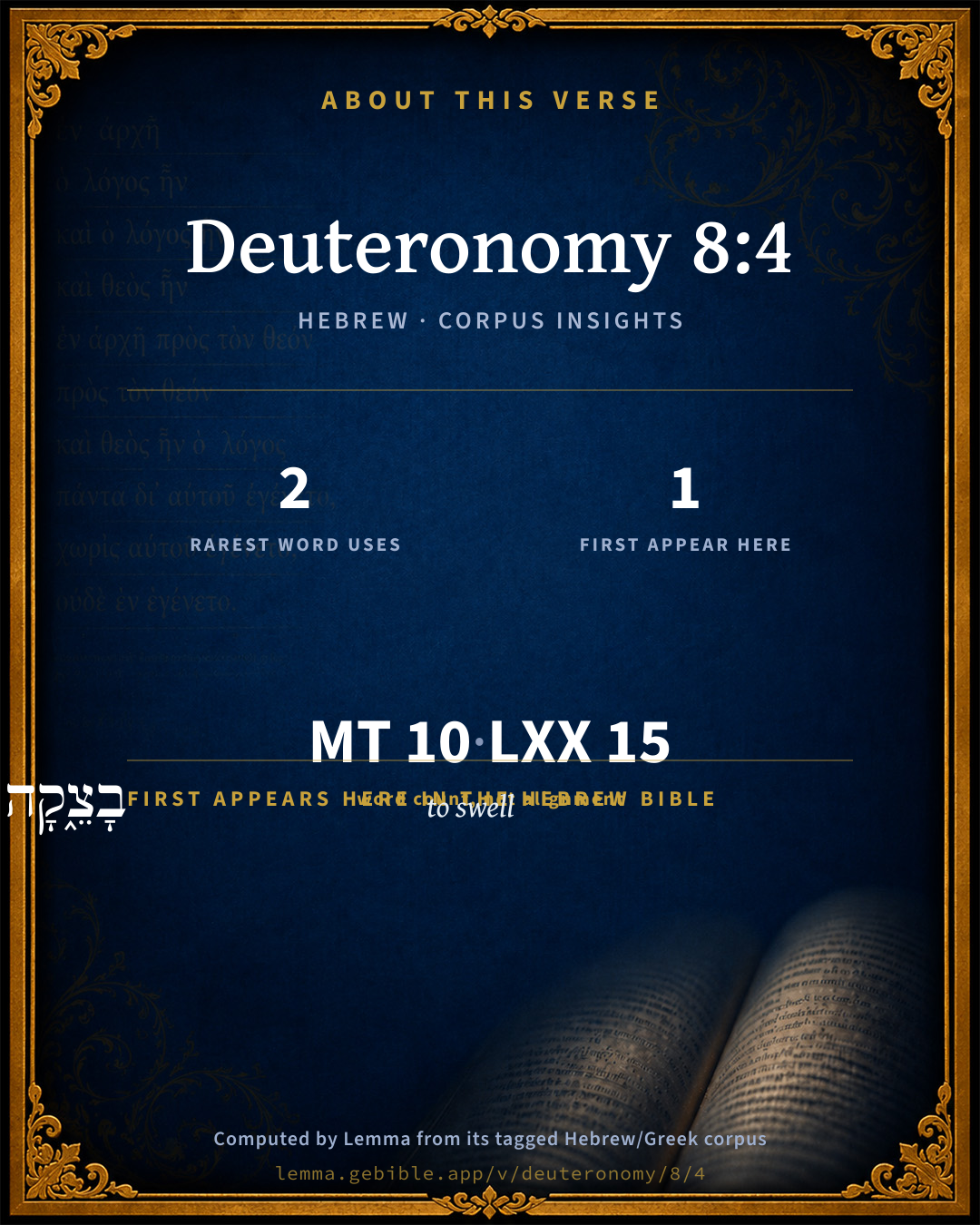
The rarest word here is בָצֵ֑קָה to swell H1216 — appearing just 2 times in the whole Hebrew Bible.

First appearance in Scripture

This word makes its first canonical appearance in the Hebrew Bible here:

  • בָצֵ֑קָה to swell H1216

Shared distinctive vocabulary

בָצֵ֑קָה to swell H1216 occurs in 2 verses of the Hebrew Bible. Also found in:

Grammatical profile

  • 2 verbs
  • 3 nouns
  • 1 adjective
  • 1 pronoun
  • 1 preposition
  • 2 particles

Verb forms

  • בָֽלְתָה֙ Qal · Perfect
  • בָצֵ֑קָה Qal · Perfect

Repetition

A word recurs within this verse — often emphatic in Hebrew:

Hebrew & Septuagint length

In English translation the verse runs 15 words from the Hebrew and 26 from the Septuagint (LXX English) — the Septuagint runs noticeably longer here. See the side-by-side →

A rough comparison of the two English renderings, which tokenize alike — not a word-level alignment.

Word counts can differ between the Hebrew and the Greek without any difference in meaning — e.g. the Hebrew direct-object marker אֵת has no separate Greek word, and Greek often adds the article ὁ.

In the original languages it is 10 Hebrew tokens and 15 Greek tokens — but the two are counted differently (Hebrew bundles its prefixes and suffixes into one token; the Greek is in lemma form), so that isn’t a like-for-like length.

Cross-references

2

Topical passages linked to Deuteronomy 8:4 in the Treasury of Scripture Knowledge — connected by theme and wording, ordered by reader-vote popularity; previews shown in the World English Bible.

  • Deuteronomy 29:5 I have led you forty years in the wilderness: your clothes have not grown old on you, and your shoe has not grown old on your foot.
  • Nehemiah 9:21 Yes, forty years did you sustain them in the wilderness, [and] they lacked nothing; their clothes didn't grow old, and their feet didn't swell.

Cross-references courtesy of OpenBible.info (CC BY 4.0).

Hebrew and Greek witnesses Masoretic Hebrew ↔ Greek Septuagint

The same verse in the two great witnesses to the Old Testament, shown verse-for-verse.

Here the Septuagint runs noticeably longer than the Hebrew — LXX2012 (modern English Septuagint) 26 words vs World English Bible 15. A rough length comparison of the two English translations, not a word-level alignment — read both below.

These are two independent witnesses, not word-aligned to each other, and the Septuagint is shown in lemma (dictionary) form.

Hebrew Deuteronomy 8:4 Masoretic · Westminster Leningrad Codex

שִׂמְלָ֨תְךָ֜ לֹ֤א בָֽלְתָה֙ מֵֽעָלֶ֔יךָ וְרַגְלְךָ֖ לֹ֣א בָצֵ֑קָה זֶ֖ה אַרְבָּעִ֥ים שָׁנָֽה

Your clothing didn't grow old on you, neither did your foot swell, these forty years.

World English Bible · Public Domain

Greek LXX Deuteronomy 8:4 Septuagint · lemma form

ὁ ἱμάτιον σύ οὐ κατατρίβω ἀπό σύ ὁ πούς σύ οὐ τυλόω ἰδού τεσσαράκοντα ἔτος

Your garments grew not old from off you, your shoes were not worn from off you, your feet were not painfully hardened, behold! these forty years.

LXX2012 (modern English Septuagint) · Public Domain

On this verse, John Gill's Exposition discusses the Septuagint’s reading. Read the note in Commentary ↓

Hebrew: Westminster Leningrad Codex (CC BY 4.0). Greek: Septuagint (public domain); English from LXX2012 (modern English Septuagint) (Public Domain). How the Septuagint differs from the Hebrew →

Targum (Aramaic paraphrase)

2

The Targum is the ancient Jewish Aramaic paraphrase of the Hebrew Scriptures — an interpretive translation, not the Hebrew text itself. Onkelos (literal) and Pseudo-Jonathan (expansive) render the Torah, and Jonathan the Prophets. Coverage is partial: where no permissively-licensed English translation exists for a verse, only the Aramaic is shown. This is verse-level text, not a word-by-word alignment to the Hebrew.

  1. Targum Onkelos Torah (Genesis–Deuteronomy)
    כְּסוּתָךְ לָא אִבְלִיאַת מִנָךְ וּמְסָנָךְ לָא יְחֵפוּ דְנַן אַרְבְּעִין שְׁנִין

    (no public-domain English translation for this verse)

    Targum Onkelos — Aramaic: “Onkelos Genesis” (public domain); “Onkelos Exodus” (public domain); “Onkelos Leviticus” (public domain); “Onkelos Numbers” (public domain); “Onkelos Deuteronomy” (public domain). English: “Sefaria Community Translation” (CC0 1.0 (public-domain dedication)); “J.W. Etheridge. The Targums of Onkelos and Jonathan Ben Uzziel on the Pentateuch. London: Longmans, Green, 1862” (public domain). Text via Sefaria.

  2. Targum Pseudo-Jonathan Torah (Genesis–Deuteronomy)
    כְּסוּתְכוֹן לָא בְּלַת מֵעִילַוֵי גּוּשְׁמֵיכוֹן וְרִגְלֵיכוֹן לָא הֲלִיכַן מְיַיחְפִּין דְּנָן אַרְבְּעִין שְׁנִין

    Your raiment hath not waxen old upon your bodies, and your feet have not gone without covering these forty years.

    Targum Pseudo-Jonathan — Aramaic: “Targum Jonathan on Genesis” (public domain); “Targum Jonathan on Exodus” (public domain); “Targum Jonathan on Leviticus” (public domain); “Targum Jonathan on Numbers” (public domain); “Targum Jonathan on Deuteronomy” (public domain). English: “The Targum of Jonathan ben Uzziel, trans. J. W. Etheridge, London, 1862” (public domain). Text via Sefaria.

Commentary

Notes on Deuteronomy 8:4 from classic Christian and Jewish commentators (each source and its license shown beneath its notes). The classic Christian expositions comment on the surrounding passage and are grouped to its opening verse, so a note may address several verses; the Jewish commentaries on the Tanakh (Rashi and others) are per-verse, so they appear only where the commentator wrote on this verse.

Lemma curates 59 commentaries, every one of them public domain or Creative Commons licensed, each selected and text-cleaned for this edition rather than reprinted as found. About our sources →

Trapp's Complete Commentary

John Trapp

Deu 8:4 Thy raiment waxed not old upon thee, neither did thy foot swell, these forty years.

Ver. 4. Thy raiment weaved not old.] It was not the worse for wearing, but grew as their bodies did, as some are of opinion. They needed not to trouble themselves with those anxious thoughts of heathens, what they should eat, drink, or put on. Never was prince served and supplied in such state as these Israelites were.

John Trapp, A Commentary or Exposition upon All the Books of the Old and New Testament (1647–1656) — public domain. Text from a community e-Sword module.

Joseph Benson's Commentary

Deu 8:4. Thy raiment waxed not old upon thee — The common interpretation of these words is, that, by a constant miracle, their clothes did not so much as decay, nor their foot swell, or, as some render it, grow callous, by so long travelling in hot and stony places. But Le Clerc thinks “it is hardly to be imagined that Moses, whose principal intention was to record the miracles which God wrought for the Israelites in the wilderness, should have mentioned this so transiently, and, as it were, by the by, if it really had been wrought to that extent, especially as it would have been one of the greatest of them. For there must indeed have been as many miracles wrought as there were persons in the camp, and that not only once, but daily, and for the space of forty years. And if we add to this, that their clothes grew in proportion to their stature, as in that case they must have done, unless they had more coats than one apiece, a greater miracle can hardly be conceived. He observes further, that God is never wont to work miracles unless they be quite necessary; yet here is one of the greatest miracles without any necessity at all. For, as the Israelites had flocks of sheep and goats in the wilderness, and certainly were not ignorant of the art of weaving, as appears from the curious work of the tabernacle, and as nothing hindered them from trafficking with their Arabian neighbours, it is evident they might have been supplied with clothes in the common way, either by making or purchasing them. This being the case, is it not as reasonable to believe that God would have fed the Israelites with manna, after their settlement in Canaan, as that he would have preserved their clothes from decay, during their abode in the wilderness, when there was no necessity for their being thus clothed by a miracle?” He therefore explains Moses’s words thus: Thy raiment waxed not old — That is, “Providence has been so liberal in supplying your wants in this desert land, that you have never been under the necessity of letting your clothes grow old upon your backs, but have always been supplied with new before the old were worn out. Nor did your feet swell — Namely, for want of shoes to defend them.” Agreeably to this interpretation, in Deu 29:5, instead of Thy foot did not swell, it is, Thy shoe did not wax old upon thy feet; that is, “You were not reduced, through poverty, to wear shoes till they were grown so old and torn that they could not defend your feet against tumours, and other inconveniences, arising from heat and rugged ways.” This interpretation, it must be observed, is not peculiar to Le Clerc; Spanheim, Burman, Bynæus, Budæus, Calmet, and many others have adopted it.

Joseph Benson's Commentary on the Old and New Testaments (1811–1818) — public domain. Text from a community e-Sword module.

Geneva Bible (1599)

Geneva Bible translators

As they that go barefooted.

Geneva Bible (1599) marginal notes — public domain. Text via Bolls.life.

Jamieson, Fausset & Brown

Robert Jamieson, A. R. Fausset & David Brown

Thy raiment waxed not old upon thee, neither did thy foot swell, these forty years--What a striking miracle was this! No doubt the Israelites might have brought from Egypt more clothes than they wore at their outset; they might also have obtained supplies of various articles of food and raiment in barter with the neighboring tribes for the fleeces and skins of their sheep and goats; and in furnishing them with such opportunities the care of Providence appeared. But the strong and pointed terms which Moses here uses (see also Deu 29:5) indicate a special or miraculous interposition of their loving Guardian in preserving them amid the wear and tear of their nomadic life in the desert. Thirdly, Moses expatiated on the goodness of the promised land.

Jamieson, Fausset & Brown — Commentary Critical and Explanatory on the Whole Bible (1871) — public domain (CC PDM 1.0). Text via the HelloAO Bible API.

Adam Clarke's Commentary

Verse 4. Thy raiment waxed not old, c.] The plain meaning of this much-tortured text appears to me to be this: "God so amply provided for them all the necessaries of life, that they never were obliged to wear tattered garments, nor were their feet injured for lack of shoes or sandals." If they had carvers, engravers, silversmiths, and jewellers among them, as plainly appears from the account we have of the tabernacle and its utensils, is it to be wondered at if they also had habit and sandal makers, c., &c., as we are certain they had weavers, embroiderers, and such like? And the traffic which we may suppose they carried on with the Moabites, or with travelling hordes of Arabians, doubtless supplied them with the materials though, as they had abundance of sheep and neat cattle, they must have had much of the materials within themselves. It is generally supposed that God, by a miracle, preserved their clothes from wearing out: but if this sense be admitted, it will require, not one miracle, but a chain of the most successive and astonishing miracles ever wrought, to account for the thing for as there were not less than 600,000 males born in the wilderness, it would imply, that the clothes of the infant grew up with the increase of his body to manhood, which would require a miracle to be continually wrought on every thread, and on every particle of matter of which that thread was composed. And this is not all; it would imply that the clothes of the parent became miraculously lessened to fit the body of the child, with whose growth they were again to stretch and grow, &c. No such miraculous interference was necessary.

Adam Clarke's Commentary on the Bible (1810–1826) — public domain. Text from a community e-Sword/MySword module.

Ellicott's Commentary for English Readers

(4) Thy raiment waxed not old upon thee.—The Jewish commentators say that it grew with their growth, from childhood to manhood. We cannot say that anything miraculous is certainly intended, though it is not impossible. It may mean that God in His providence directed them to clothe themselves in a manner suitable to their journey and their mode of life, just as He taught them how to make and clothe His own tabernacle with various fabrics and coverings of skin. This tabernacle, which was God’s dwelling, was (like the Temple) a figure of man. (Comp. Eze_16:10 : “I clothed thee also with broidered work, and shod thee with badgers’ skin.”)

Neither did thy foot swell.—Just as those who were to die in the wilderness could not live, so those who were to enter Canaan were preserved in health through the journey thither. It seems allowable to point out the spiritual interpretation of the passage also. If “the way” that God leads any of His children through this present evil world should seem long, and should entail constant need of renewal and cleansing in His sight, He provides us with “raiment that waxes not old,” in the everlasting righteousness of His Son, and also in the good works which He prepares for us to walk in—that “fine linen which is the righteousness of saints.” He also says of those that wait on the Lord that they shall “walk, and not faint” (Isa_40:31).

A Bible Commentary for English Readers, edited by Charles John Ellicott (1878–1897) — public domain. Text from a community e-Sword module.

The Cambridge Bible for Schools and Colleges

gen. ed. J. J. S. Perowne

4. Thy raiment waxed not old upon thee] Similarly Deu_29:5, Pl.; Neh_9:21. On raiment see Deu_24:13.

neither did thy fool swell] or rise in blisters, only here and Neh_9:21. Rhetorically applied to the nation as a whole; the Pl. passages dwell more on the damage to the nation and the destruction of one whole generation of them during the forty years, cp. Deu_2:14.

The Cambridge Bible for Schools and Colleges (gen. ed. J. J. S. Perowne; Cambridge University Press, 1878–1918) — public domain. Text from a community e-Sword module.

John Gill's Exposition

Thy raiment waxed not old upon thee, &c. They wanted not clothes all the forty years they were in the wilderness; which some account for by the rising generation being supplied with the clothes of those that died in the wilderness, and with the spoils they took from Amalek, Exo 17:1 and others, as Aben Ezra observes, remark that they brought much clothes with them out of Egypt, which no doubt they did; see Exo 12:35 and he adds, as worthy of notice, that the manna they lived upon did not produce sweat, which is prejudicial to clothes; but be it so, that they were sufficiently provided with clothes, it must be miraculous that these clothes they wore should not wax old. This, in a spiritual sense, may denote the righteousness of Christ, which is often compared to raiment, the property of which is, that it never waxes old, wears out, or decays; it is an everlasting righteousness, and will never be abolished, but will answer for the saints in a time to come; see Isa 51:6 neither did thy foot swell these forty years; or puff up like paste, as Jarchi explains it, which is often the case in long journeys; the Septuagint version is, "did not become callous"; a callousness or hardness is frequently produced by travelling; in Deu 29:5 it is explained of the shoes on their feet not waxing old; so Ben Melech, and the Targums of Onkelos and Jonathan, and the Syriac and Arabic versions here, "thy feet were not naked", were not without shoes; these were no more wore out by travel than their clothes upon their backs, and this was equally as miraculous: the Gibeonites, pretending to come from a far country, and to have travelled much and long, put on old garments and old shoes, to make it probable and plausible, Jos 9:5. This may be an emblem of the perseverance of the saints in faith and holiness: shoes upon the feet denote a Gospel conversation, which is very beautiful, Sol 7:1 the feet of saints being shod with the preparation of the Gospel of peace; which, as shoes to the feet, guides and directs the Christian walk, strengthens and makes fit for walking, keeps tight and preserves from slipping and falling, and protects from what is harmful, accompanied by the power and grace of God.

the feet of saints being shod with the preparation of the Gospel of peace; which, as shoes to the feet, guides and directs the Christian walk, strengthens and makes fit for walking, keeps tight and preserves from slipping and falling, and protects from what is harmful, accompanied by the power and grace of God.

Deuteronomy 8:5

deu 8:5

deu 8:5

deu 8:5Thou shalt also consider in thine heart,.... Frequently think of, and meditate upon, revolve in their thoughts, well weigh in their minds, and take into thorough and deliberate consideration in their hearts; it being a matter of great moment and importance to them for their peace and comfort and the glory of God, namely, what follows:

that as a man chasteneth his son, so the Lord thy God chasteneth thee; that they stood in the same relation to God as a son to a father, and therefore happy and honourable; that all their afflictions came from God, were appointed, sent, directed, and overruled by him for his own glory and their good; that these were the chastenings and corrections of a father, and were not done in wrath, but in love, and therefore should be patiently endured; and it became them to consider well from what hand they came, and in what manner, and for what ends and purposes, how they ought to behave under them, and what they should do, as follows.

John Gill's Exposition of the Whole Bible (1746–1763) — public domain (CC PDM 1.0). Text via the HelloAO Bible API.

Albert Barnes' Notes on the Bible

They had clothes, it would seem, in abundance (compare Exo 12:34-35) at the beginning of the 40 years; and during those years they had many sheep and oxen, and so must have had much material for clothing always at command. No doubt also they carried on a traffic in these, as in other commodities, with the Moabites and the nomadic tribes of the desert. Such ordinary supplies must not be shut out of consideration, even if they were on occasions supplemented by extraordinary providences of God, as was undoubtedly the case with their food.

Albert Barnes' Notes on the Bible (1834–1885) — public domain. Text from a community e-Sword/MySword module.

Haydock's Catholic Bible Commentary

Worn, for want of shoes, chap. xxix. 5. (Chaldean) This miracle of the Hebrews, being so well provided with raiment in a desert country, is mentioned, 2 Esdras ix. 21. Cosmas (B. v.) allows only that merchants constantly supplied them, and Abenezra thinks that they had brought plenty for change out of Egypt. (Calmet) --- But the Scripture seems to acknowledge something more wonderful; namely, the good condition of the people’s feet, and of their garments, after they had been worn for such a length of time. As their numbers had not increased, the children might be supplied with the clothes of the deceased; so that there is no need of making the miracle still greater, by asserting, as some have done, that the garments grew larger with the bodies of those who wore them. (Haydock) --- The miracle was in favour both of good and bad, like manna, &c. (Tirinus)

George Leo Haydock (1774–1849), Haydock's Catholic Family Bible and Commentary, 1859 edition — public domain. Excludes Psalms (Douay-Rheims chapter numbering differs from Protestant) and Deuterocanonical books (Catholic canon only).

Matthew Poole's English Annotations

Thy raiment did not wear away through age, which they must needs have done without a miracle;

neither did thy foot swell, notwithstanding thy long and hard travels, which also was miraculous.

Matthew Poole's English Annotations on the Holy Bible (1683–1685) — public domain. Text from a community e-Sword/MySword module.

Whedon's Commentary on the Bible

Daniel D. Whedon

4. Thy raiment waxed not old upon thee — Literally, did not fall from thee. Some of the Jewish interpreters, and some Christian commentators, have held that by supernatural means provision was made for the durability of the clothing of the Israelites during the forty years’ wandering. But there seems to be no necessity for resorting to miraculous provision in this matter. Abundant resources were at their command. They had flocks and herds. There must have been many skilful workmen among them, as is seen in the description of the building and adorning of the tabernacle.

Neither did thy foot swell — The Septuagint has ουκ ελυλωθησαν, did not become hard or callous. The Hebrew might be rendered either “to swell up” or “to blister.” The meaning of the verse is, there was no lack of clothing for the body nor of covering for the feet, all through the long and toilsome journey.

Daniel D. Whedon (gen. ed.), Commentary on the Old and New Testaments (1874–1909) — public domain. Text from a community e-Sword module.

The Pulpit Commentary

As the manna furnished by God"s creative power saved them from hunger, so by God"s providence and care their raiment was marvelously kept from decay, and they had not to go barefoot from their sandals being worn out. Waxed not old upon thee; literally, d i d not fall away, waste away from upon thee. This cannot mean that such was the abundant supply of raiment to the Israelites in the Arabian desert, that there was no need for them to wear garments rent and tattered from long use, as they had large flocks and herds whence a sufficient supply of wool and leather could be obtained, and there were among them skilled artificers, by whom these could be made into articles of clothing (Rosenm J. D. Michaelis, etc.). For, as Knobel observes, "This were something too insignificant beside the miraculous manna; and besides, this does not lie in the expression, which rather intimates that the clothes upon them were not worn out nor fell from them in rags, because God gave them a marvelous durability." At the same time, there is no reason to suppose that the Israelites did not make use of such supplies as were within their reach for purposes of clothing, any more than that they lived only on manna during the forty years of their wandering. Still less need we resort to such fanciful suppositions as that the garments of the Israelitish children expanded as they grew up, like the shells of snails which is the notion of some of the Jewish rabbins, and adopted by some of the Christian Fathers (see Deyling, "Obss. Sacc.," II 17. p. 247). Neither did thy foot swell. The verb here is found in only one other passage, (Neh_9:21) where this passage is repeated; and the meaning is doubtful. The LXX render here by ejtulwqhsan, became callous; but in Nehemiah the rendering they give is dierraghsan, were torn, the object torn being, according to the Cod. Vat., podev abbey, their feet, according to the Cod. Alex., tamata affray, their sandals in Deu_29:5, the shoe or sandal is specially mentioned in the same connection as here. The verb, however, cannot mean tear or torn, neither does it mean swell; the idea involved is rather that of softening, or, melting or flowing; and the meaning here seems to be, "Thy foot did not get into a bruised and wounded state which would have been the case had their sandals not been preserved from breaking or being worn out.

The Pulpit Commentary (1880–1919), ed. H.D.M. Spence-Jones & Joseph S. Exell — public domain. Text from a community e-Sword module.

unfoldingWord translationNotes

Door43 World Missions Community

General Information:

Moses continues to speak to the Israelites as if they are one person. (See: Forms of You)

Your clothing ... forty years

This is the last item that they should "call to mind" (Deuteronomy 8:2).

forty years

"40 years" (See: Numbers)

You will think ... You will keep ... walk in his ways and honor him

This continues the list of commands that begins in Deuteronomy 8:1-2.

You will think about in your heart

Here the metonym "heart" represents the thoughts and understanding of a person. AT: "You will understand" (See: Metonymy)

translationWords

year

heart

discipline

command

walk

honor

unfoldingWord translationNotes — © Distant Shores Media and the Door43 World Missions Community, licensed CC BY-SA 4.0. Source: git.door43.org/Door43/en_tn.

Rashi

Rabbi Shlomo Yitzchaki (Rashi)

שמלתך לא בלתה THY RAIMENT DID NOT WEAR OUT — the clouds of Divine Glory used to rub the dirt off their clothes and bleach them so that they looked like new white articles, and also, their children, as they grew, their clothes grew with them, just like the clothes (shell) of a snail which grows with it (cf. Shir HaShirim Rabbah 4:11; Yalkut Shimoni on Torah 850).

לא בצקה This means: [AND THY FOOT] DID NOT SWELL like dough (בצק), as is usual with those who walk barefoot — that their feet become swollen.

Rashi on the Tanakh — English translations: “The Judaica Press complete Tanach with Rashi, translated by A. J. Rosenberg” (CC BY 4.0); “Pentateuch with Rashi's commentary by M. Rosenbaum and A.M. Silbermann, 1929-1934” (public domain); “The Metsudah Tanach series, Lakewood, N.J” (CC BY 4.0); and “The Book of Joshua, Metsudah Publications, 1997” (CC BY 4.0). Text via Sefaria.

Ramban (Nachmanides)

Rabbi Moshe ben Nachman (Ramban / Nachmanides)

THY RAIMENT WAXED NOT OLD UPON THEE. “The clouds of [Divine] Glory brushed their garments and pressed them so that they looked like freshly ironed articles; and so it was with their children, as they grew their garments grew with them.” This is Rashi’s language and also are the words of Agadah. But Rabbi Abraham ibn Ezra wrote: “Other scholars say that they took many garments out [of Egypt]. And it is possible that it was not in the nature of the manna to produce perspiration [thus enabling their garments to last so long]. And so also he stated that neither did thy feet swell, meaning that He gave them strength or that He led them slowly.” But his [Ibn Ezra’s] words are not correct, for Moses mentions this to them in order to say that upon observing the commandment [of G-d] they will have food and raiment, and renew [their] strength, even as they lived by the manna forty years and they had garments, and the way with their feet they treadeth not. All of this was miraculous, for by every thing that proceedeth out of the mouth of the Eternal doth man live and becomes supported. And if you were to cover a rafter with a new cloth it would wear out in forty years even though there is no perspiration, how much less man, that is a worm.

Ramban (Nachmanides) on the Tanakh — English translation: “Commentary on the Torah by Ramban (Nachmanides). Translated and annotated by Charles B. Chavel. New York, Shilo Pub. House, 1971-1976” (CC BY 4.0). Text via Sefaria.

Ibn Ezra

Rabbi Abraham ibn Ezra

Your garment. Some say that this was miraculous, and others say that they brought many garments with them from Egypt. It is possible that eating mon prevented them from sweating.

Ibn Ezra on the Tanakh — English translations: “Sefaria Community Translation” (CC0 1.0 (public-domain dedication)); “Yalkut, Sifsei Chachomim Chumash, Metsudah Publications, 2009” (CC BY 4.0); and “Commentary of Ibn Ezra on Isaiah - trans. by M. Friedlander, 1873” (public domain). Text via Sefaria.

Lesson kit

Teaching starters — assembled from the data on this page, not authored interpretation. Every prompt links to the verse data it draws on. Edit before teaching.

Deuteronomy, in the Pentateuch, opens this verse with 10 words (9 distinct Hebrew lemmas). Its most distinctive word is bâtsêq (“to swell”). The Greek Septuagint runs longer here. A historical commentator’s framing appears above. Read the whole chapter for the surrounding context.

Discussion questions

  1. What does “to swell” (bâtsêq) contribute to the verse as a whole?
  2. This is the first place “to swell” appears in Scripture (first appears here). What does its debut here establish?
  3. How does Nehemiah 9:21, which shares the word «to swell», read alongside this verse?
  4. What does the repetition of “not” (2× in this one verse) do in this verse?
  5. The Septuagint runs longer here than the Hebrew. What might account for the difference?
  6. These translations render this verse differently; the difference is in the English rendering, not the original. What questions does that raise?
  7. «בָֽלְתָה֙» is a Qal Perfect verb. How does that grammatical form shape the action described?
  8. Compare how Trapp's Complete Commentary and Joseph Benson's Commentary read this verse. Where do they agree or differ?

Things to notice

Reading settings

Reading text

Shown beneath each verse's original-language words.

Old Testament
Old Testament edition

Read the OT as the Masoretic Hebrew (MT) or the Greek Septuagint (LXX).

English shown for the Greek Septuagint (in the Hebrew ↔ Greek comparison).

Comparing translations? Open the Compare panel on any verse page to stack up to four side by side.