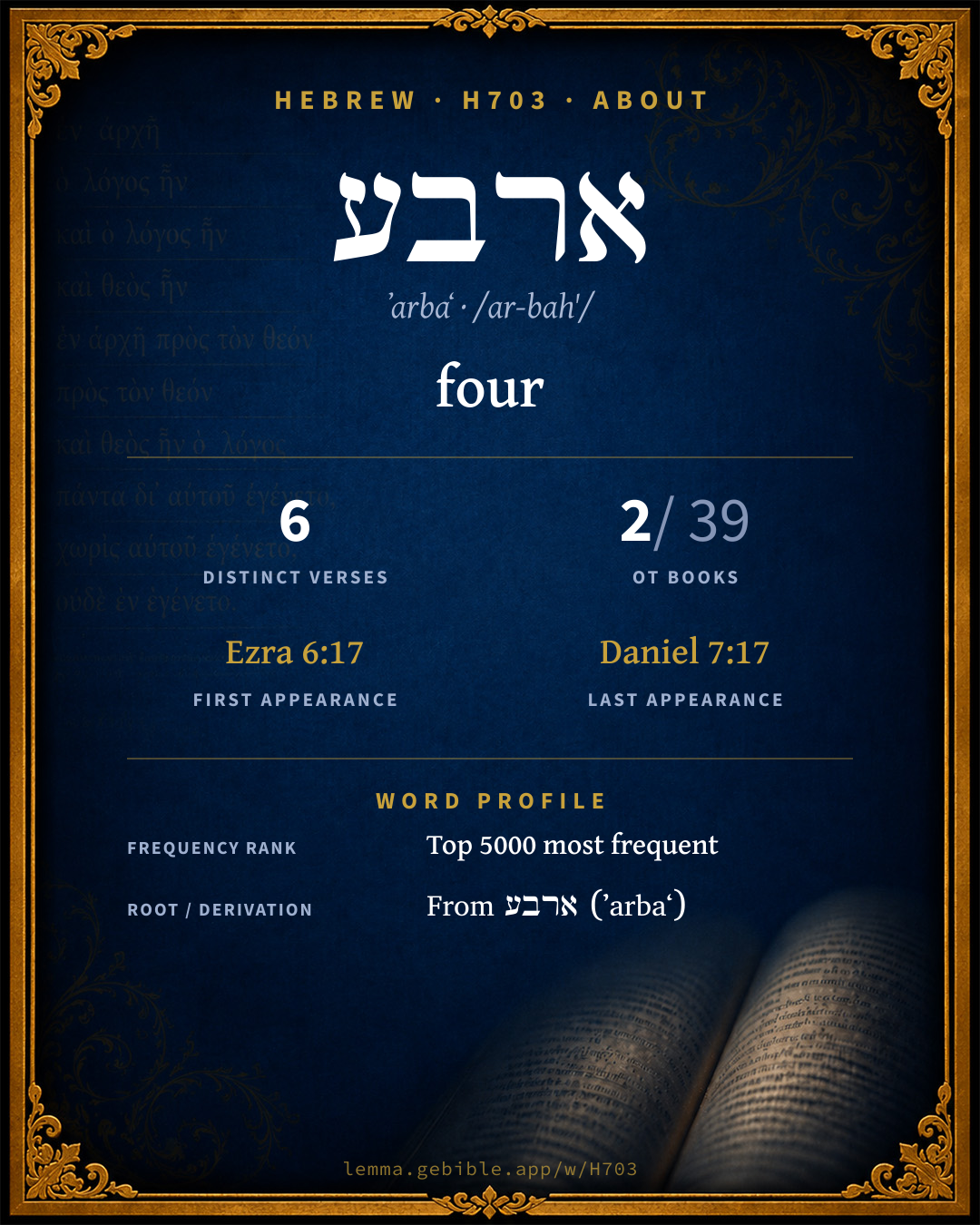
אַרְבַּע
four
Full lexicon entry — Brown-Driver-Briggs (BDB)
From Brown-Driver-Briggs (BDB)
Where this word appears
Grammar key — what these labels mean
Part of speech
- Adjective
- A word that describes or qualifies a noun.
State
- Absolute
- The independent form of a noun, not bound to a following word.
Gender
- Both
- Attested as both masculine and feminine.
Number
- Singular
- One.
Grammatical forms
- Adjective, Cardinal number, Both, Singular, Absolute 7 times (88%)
- Adjective, Adjective, Both, Singular, Absolute 1 time (13%)
Parsed forms decoded from the imported morphology (morphhb / Westminster Leningrad Codex — WLC text public domain, morphhb tagging CC BY 4.0), counted across 8 parsed occurrences — not distinct verses.
Every verse where H703 appears — 6 distinct verses across 2 books. Click any verse to open its interlinear word-by-word view. Verse text shown in the World English Bible for context — . Each verse’s Hebrew form is shown with its reference; the English is not keyword-highlighted, since the data carries no word-level English alignment. Use “Compare translations” on any verse to read it across multiple English versions. This concordance covers the Hebrew Bible; Septuagint (Greek Old Testament) occurrences are not indexed here.
Ezra 1 verse
Daniel 5 verses
- Daniel 3:25 אַרְבְּעָ֗ה adj Cardinal number bs He answered, Look, I see four men loose, walking in the midst of the fire, and they have no hurt; and the aspect of the fourth is like a son of the gods.
- Daniel 7:2 אַרְבַּע֙ adj Cardinal number bs Daniel spoke and said, I saw in my vision by night, and, behold, the four winds of the sky broke forth on the great sea.
- Daniel 7:3 וְ/אַרְבַּ֤ע conj + Adjective Cardinal number bs Four great animals came up from the sea, diverse one from another.
- Daniel 7:6 אַרְבַּ֛ע וְ/אַרְבְּעָ֤ה adj Cardinal number bs conj + Adjective Cardinal number bs After this I saw, and, behold, another, like a leopard, which had on its back four wings of a bird; the animal had also four heads; and dominion was given to it.
- Daniel 7:17 אַרְבַּ֑ע אַרְבְּעָ֥ה adj Cardinal number bs adj Adjective bs These great animals, which are four, are four kings, who shall arise out of the earth.
About this entry
At a glance — auto-summarized from this page’s data, not written by a person. Every figure links to its source below. This summary describes the numbers; it doesn’t interpret them.
ארבע (ʼarbaʻ) is a Hebrew word most often rendered “four.” Daniel dominates its distribution — 5 of 6 verses. The Hebrew Bible uses it across 6 verses — uncommon. It first appears in Ezra 6:17. Sharing its root, it stands alongside ארבע, ארבעים and ארבעתים. For the data behind this summary, explore the sense tree and the renderings breakdown below.
Gloss history
Strong's 1890 vs modern scholarship
About this word
Strong's H703 catalogs a Hebrew word from the Hebrew Old Testament.
These counts are not copied from any lexicon or concordance. They are computed here, from the morphology-tagged Hebrew Old Testament. What Lemma adds →
- 6
- distinct verses
- The word appears in 6 distinct verses.
- 2 / 39
- OT books
- The word appears in 2 of 39 Old Testament books.
- #2,625
- by frequency
- Top 5000 most frequent Hebrew words (rank 2,625 of 8,640 Hebrew words by occurrence).
View all 6 occurrences in the concordance →
By traditional corpus
Conventional, traditional groupings — biblical authorship is debated, so this is a traditional corpus grouping, not an authorship claim. Each share is this word’s portion of its verses in that division of the Hebrew canon. Each figure is a share of the word’s 6 distinct verses.
- Writings (Ketuvim) 6 verses · 100%
How translations render this word
Counts come from each version’s own published word-to-Strong’s tagging or interlinear alignment — an approximate guide to how each version renders this word, not a word-level alignment the data otherwise carries. Because each total is that version’s own tagged count, the per-version totals vary from one another and need not match the appearance or distinct-verse counts above. These counts may also differ from a printed concordance because Lemma counts each distinctly tagged rendering and does not collapse phrase taggings into a single head-word total. This is a fixed set of word-tagged versions (KJV, ASV, BSB, ULT) and does not change with the reading translation you choose elsewhere. Each version’s license is shown beside its name below (and on Sources).
BDB lists this Strong’s number as 3 distinct words (homographs). Each count above pools all of them and is not split by sense — see the Senses section below. A low-frequency rendering may belong to a different one of those words, not the primary meaning.
- King James Version†: Four 5×, Are four 2×
- American Standard Version†: Four 4×, Are four 2×
- Berean Standard Bible†: Four 7×
- unfoldingWord Literal Text†: Four 5×
King James Version Public Domain
Renders H703 across 8† tagged occurrences — most commonly:
Plus 1 rendering that appears only once — usually multi-word phrases or single function words the recovered tagging swept in, not distinct renderings.
American Standard Version Public Domain
Renders H703 across 8† tagged occurrences — most commonly:
Plus 2 renderings that appear only once — usually multi-word phrases or single function words the recovered tagging swept in, not distinct renderings.
Berean Standard Bible Public Domain
Renders H703 across 8† tagged occurrences — most commonly:
Plus 1 rendering that appears only once — usually multi-word phrases or single function words the recovered tagging swept in, not distinct renderings.
unfoldingWord Literal Text CC BY-SA 4.0
Renders H703 across 8† tagged occurrences — most commonly:
Plus 3 renderings that appear only once — usually multi-word phrases or single function words the recovered tagging swept in, not distinct renderings. Not rendered by a distinct English word in 1 further occurrence.
9 senses and sub-senses in the full BDB
What do BDB’s symbols mean?
BDB uses these scholarly abbreviations:
| Symbol | Meaning |
|---|---|
| 𝔊 | the Septuagint (the ancient Greek translation, LXX) |
| 𝔙 | the Vulgate (the Latin translation) |
| 𝔖 | the Syriac version (the Peshitta) |
| 𝔗 | the Targum (the Aramaic translation) |
| ψ | the Psalms |
| √ | root (the underlying root or stem) |
| ‖ | parallel passage (a synonymous or contrasted parallel) |
| † | the dagger: every passage where the word occurs is cited |
The 9 senses and sub-senses the full Brown-Driver-Briggs lexicon distinguishes for this word, in lexicon order (not ranked by frequency), with BDB’s own verbatim wording and sub-sense lettering. Shown in Hebrew script with BDB’s own scholarly abbreviations. The condensed entry is in the Lexicon Entry tab. See also the Forms in the corpus table below.
ארבע I f. four (NH = BH
- 1. without other num.:
- a. אַרְבַּע (1) before n.fpl. Je 15:3; Ex 25:12 (P) + 101 times, incl. א׳ אַמּוֹת Dt 3:11 + 5 times (but also †א׳ בַּאַמָּה four (in) cubit(s) Ex 26:2, 8; 36:9 1 K 7:27(×2), 38), and א׳ מֵאוֹת = 400 Gn 11:13 + 55 times (2) א׳ bef. du. רַנְלָ֑יִם Lv 11:23, רַגְלָיו Ex 25:26. †(3) bef. collective, א׳ צֹאן Ex 21:37 (E); א׳ רִבּוֹא = 40,000 Ezr 2:64 = Ne 7:66. †(4) rare and late, after n.fpl. עָרִים א׳ Jos 19:7 (P); after n. fs. cstr. בִּשְׁנַת א׳ לְ 1 K 22:41; Zc 7:1; 2 Ch 3:2.—קִרְיַת א׳, v. this, and ii. אַרְבַּע infr. †(5) n. om. Ez 43:15b Pr 30:15, 18 (Kt, v. supr.), v 21 Dn 8:8, 22; עַל־אַרְבַּ֑ע (sc. רגלים) = on all fours Lv 11:20, 21, 27, 42. e.g. Jeremiah 15:3
- b. אַרְבַּעַה (1) bef. n. mpl. Gn 2:10 (J), 14:9 Ex 25:34 + 21 times, + יָמִים (וְ)א׳ חֳדשִׁים Ju 19:2; 1 S 27:7; also א׳ א׳ פָנִים distrib. Ez 10:21. †(2) late, after n. mpl. 1 Ch 23:10. (3) n. om., Am 1:3, 6, 9 + 15 times, + (as pred. of n. mpl.) †Ex 27:16(×2); 38:19(×2); also בְּא׳, (sc. יוֹם) †Zc 7:1 = ordinal, on the fourth (day). e.g. Genesis 2:10
- c. אַרְבַּ֫עַת (1) bef. n. mpl. Ju 11:40 1 K 7:32 + 11 times (not Ez 7:2, v. supr.), + א׳ אֲלָפִים = 4000, 1 S 4:2 + 14 times †(2) bef. coll. הַבָּקָר Nu 7:7. †(3) n. om. 2 S 21:22. †(4) c. sf., after n. pl., = the four of them, Ez 1:8, 10(×3) + 6 times Ez, Dn 1:17 these boys, the four of them. e.g. Judges 11:40
- d. adv. אַרְבַּעְתָּ֑יִם 2 S 12:6 = four-fold Ges§ 97 h Köii. 1, 227, but read שִׁבְעָתָ֑יִם 𝔊 Th We Klo Dr Kmp Bu HPS. e.g. 2 Samuel 12:6
- 2. with other num.:
- a. (I) אַרְבַּע עֶשְׂרֵה = 14, (α) before n. fs., א׳ ע׳ שָׁנָה Gn 31:41, + (as ordinal, = 14th) 14:5; 2 K 18:13 = Is 36:1, Ez 40:1. (β) after n. fpl. עָרִים א׳ ע׳ Jos 15:36 + 8 times, נָשִׁים א׳ ע׳ 2 Ch 13:21. (2) אַרְבָּעָה עָשָׂר = 14, (α) before n. ms. Nu 17:14 (14 × 1000), Jb 42:12; especially. (as ord.) א׳ ע׳ יוֹם 14th day Ex 12:6, 18 + 7 times (β) bef. n. mpl. Nu 29:15. (γ) after n. mpl. Nu 29:13, 17 + 6 times (δ) after n. ms. Est 9:15, 19, 21, all = 14th. (ε) א׳ ע׳ pred. of נֶפֶשׁ Gn 46:22. (ζ) א׳ ע׳ = 14th (sc. day) Lv 23:15; 2 Ch 30:15 + 6 times e.g. Genesis 31:41
- b. 20 + (וְ) 4 + n. s. 1 K 15:33; 1 Ch 23:4 + 13 times 1 Ch 27; + n. pl. †Nu 7:88; n. om. 2 S 21:20, pred. ‖ 1 Ch 20:6; Ne 7:23; 4 + 20 + n. s. Nu 25:9; = 24th, יוֹם ע׳ וְא׳ Hg 1:15; 2:18; Zc 1:7; Ne 9:1; Dn 10:4, יוֹם om. Hg 2:10, 20, and (א׳ וְע׳) 1 Ch 24:18; 25:31†. e.g. 1 Kings 15:33
- c. other tens + 4, 1 Ch 7:7; 5:18 (+ n. s.), Ezr 2:15 + 7 times; 4 + tens + שָׁנָה Gn 11:16, + אֶלֶף 1000 Nu 1:27, 29; 2:4, 6; 26:25, 43.—Vid. Köii. 1, § 106. e.g. 1 Chronicles 7:7
ארבע II m. (called הָאָדָם הַגָּדוֹל בָּעֲנָקִים Jos 14
Senses from the full Brown-Driver-Briggs lexicon (Brown, Driver, Briggs; Oxford 1906 — public domain), digitized via Sefaria, supplemented by the OpenScriptures HebrewLexicon (CC BY 4.0). Full attribution on Sources.
Word origin
II. n.m. et f. four (NH = BH; MI8 ארבען = 40; Ph. ארבע, Pun. ארבעת, four; so Assyrian arbaʾu (rarely irbaʾ), irbitti; Arabic أَرْبَعٌ, أَرْبَعَةٌ; Sab. ארבעת CISiv, no. 232. 2 HomChrest. 47; Ethiopic አርባዕ, አርባዕቱ Aramaic אַרְבַּע, אַרְבְּעָה, ܐܰܪܒܰܥ, ܐܰܪܒܥܳܐ; Nab. ארבע, Palm. ארבע, ארבעא, Lzb367);—m.148 (c. n.f.) אַרְבַּע (abs. vel cstr.) Ex 21:37 +; also אַרְבַּ֑ע Lv 11:20 +; note (Baer Gi) Jos 21:18 + 6 times Jos 21 (van d. H. אַרְבָּ֑ע); in Pr 30:18 read f. with Qr; f. (c. n.m.) abs. אַרְבָּעָה Gn 2:10 + 125 times + Pr 30:18 (v. supr.); cstr. אַרְבַּעַת 1 S 4:2 + 29 times, incl. Ez 7:2 (but read m. Kt); sf. אַרְבַּעְתָּם Ez 1:8 + 5 times Ez, אַרְבַּעְתָּן 1:10, 10 (but read prob. -תָּם, Krae), v 16, 18; du. אַרְּבַּעְתָּ֑יִם 2 S 12:6, v. 1 d; pl. אַרְבָּעִים = 40, v. infr.;—four (in Hex 108 times, chiefly P, 98 times; Ez 52 times, Ch 47 times):—
III. n.pr.m. (called הָאָדָם הַגָּדוֹל בָּעֲנָקִים Jos 14:15, אֲבִי הָעֲנָק 15:13 cf. 21:11), inferred (erron.) from n.pr.loc. קִרְיַת א׳ (q.v.).
— Brown-Driver-Briggs (Oxford 1906, public domain), digitized via Sefaria, supplemented by the OpenScriptures HebrewLexicon (CC BY 4.0). See Sources.
Derived from ארבע (ʼarbaʻ) (H702) — four.
Jastrow Dictionary
A second Hebrew/Aramaic lexicon for comparison, covering Aramaic and post-biblical (Talmudic, Targumic, Midrashic) usage that the biblical-Hebrew BDB does not. Matched by lemma rather than by Strong’s number, so a lemma may carry more than one Jastrow headword (shown separately below), and the entries cover usage well beyond the Bible.
אַרְבַּע
- four, v. אַרְבָּעָא I a. אַרְבְּעָה.
רְבַע
- 1. to lie, couch. Targ. Num. XXII, 27 (h. text רבץ). Targ. Y. Gen. XLIX, 25; a. fr.—Part. רְבִיעַ; f. רְבִיעָא; pl. רְבִיעִין; רְבִיעָן. Ib. IV, 7. Targ. Deut. XXII, 6 (O. ed. Vien. רְבֵעָא). Targ. Ps. CIV, 22; a. fr.—Y. Ber. VIII, 12ᵇ top לא מיסתך דאת ר׳ וכ׳ is it not not enough that thou art lying (on the dining couch), and he stands and attends thee? Ib. גזירנא דהוא ר׳ וכ׳ (not גזירה) I decree that he lie down, and thou stand &c. Gen. R. s. 7 רביע ואנא וכ׳ lie down (to be lashed), and I will tell thee; Tanḥ. Ḥuck. 6; Pesik. R. s. 14. Koh. R. to I, 8 קם ור׳ ליה על רגלוי he arose and threw himself down at his feet. Shebu. 22ᵇ, a. fr. אריא הוא דר׳ וכ׳, v. אַרְיָא; a. fr.
- 2. to commit buggery. Ab. Zar. 24ᵃ דילמא רַבְעוּהָ לאימא דאימא perhaps they (gentiles) had connection with the grandmother (of the animal, while she was pregnant); a. e.
- 1. to cause to lie down, lay down. Targ. Y. Gen. XXIV, 11 (h. text ויברך). Targ. Y. Deut. XXV, 2 ויַרְבְּעִינֵיה (not ויִרְ׳).—Part. pass. מַרְבַּע. Targ. Y. I Gen. XLIX, 14.—Num. R. s. 19 אַרְבְּעוּנֵיה דילקי lay him down, that he may receive lashes; Tanḥ. l. c. ארבעתיה (corr. acc.); ib. ארבעונהי (corr. acc.). Pesik. R. l. c. אַרְבְּעִינֵיה lay thou him down. Y. Bicc. I, 64ᵃ אַרְבְּעֵיה על וכ׳ he ordered him to be laid on the benches (for punishment). B. Kam. 114ᵃ אַרְבְּעֵית לי אריא וכ׳ thou didst put a lion at my borders, i.e. you forced a violent neighbor upon me; a. e.—Y. Yeb. IV, 6ᵃ bot. ואנא בעי מַרְבַּעְתָּהּ וכ׳ and I want to assist at her lying down (for delivery), before she cools off, v. צְנַן.
- 2. to copulate animals, esp. to hybridize. Targ. Y. Gen. XXXVI, 24. Targ. Y. Lev. XIX, 19.
- 1. to divide into four parts. Targ. Y. Deut. XXXII, 4.
- 2. to make quadrangular. Part. pass. מְרַבַּע (מְרֻבַּע Hebraism); f. מְרַבְּעָא; pl. מְּרַבְּעִין; מְרַבְּעָן, מְרַבְּעָתָא quadrate. Targ. Ex. XXVII, 1. Targ. Ez. XLV, 2. Targ. I Kings VII, 5. Targ. Y. I Num. XXXIII, 7 (not מֵרַבְ׳); Targ. Y. I Ex. XIV, 2 (ed. Vien. מרביעתא, corr. acc.); a. e.—Y. Sot. V, 20ᵇ bot. מאן דמְרַבַּע ארבע וכ׳ he that wants to form four rows of four casks each requires sixteen casks. Erub. 57ᵃ אימור … כמאן דמְרַבְּעָא רַבּוּעֵי ודאי מי מְרַבַּעְנָא we said, we consider it in our calculations as if it were squared; do we, however, really make it a square (by filling the space with buildings)?; a. e.
A Dictionary of the Targumim, the Talmud Babli and Yerushalmi, and the Midrashic Literature (Marcus Jastrow; London, Luzac, 1903) — Public Domain. Digitized via Sefaria. Digitized via Sefaria. Full attribution on Sources.
Forms in the corpus
The 8 distinct written forms H703 takes in the Hebrew Bible, most frequent first — each parse links to that state’s occurrences in the concordance. Hebrew forms include their vowel points and cantillation, so a single lemma takes many written forms.
| Form | Parsing | Example | Uses |
|---|---|---|---|
| אַרְבְּעָ֗ה | Adjective, Cardinal number, Both, Singular, Absolute | Daniel 3:25 | 1 |
| אַרְבְּעָ֥ה | Adjective, Adjective, Both, Singular, Absolute | Daniel 7:17 | 1 |
| אַרְבַּ֑ע | Adjective, Cardinal number, Both, Singular, Absolute | Daniel 7:17 | 1 |
| אַרְבַּ֛ע | Adjective, Cardinal number, Both, Singular, Absolute | Daniel 7:6 | 1 |
| אַרְבַּ֣ע | Adjective, Cardinal number, Both, Singular, Absolute | Ezra 6:17 | 1 |
| אַרְבַּע֙ | Adjective, Cardinal number, Both, Singular, Absolute | Daniel 7:2 | 1 |
| וְ/אַרְבְּעָ֤ה | Adjective, Cardinal number, Both, Singular, Absolute | Daniel 7:6 | 1 |
| וְ/אַרְבַּ֤ע | Adjective, Cardinal number, Both, Singular, Absolute | Daniel 7:3 | 1 |
Same root — word family
Other BDB entries built from the same root as H703, grouped by Strong’s listed origin. These share a root / origin per the lexicon — not necessarily a shared meaning. Each links to that word’s own entry.
Derives from
Shares the same root
Proper names from this root
People and places named from this root — a name, not an additional meaning of the word.
Compare all same-root words → Showing 4 of 5 — not the complete family. 1 of the same-root words is a proper name (a person or place). They share a root, not necessarily a meaning.
Septuagint verse parallels
This word appears in 6 verses that also exist in the Greek Old Testament (Septuagint), out of the 6 Hebrew verses it occurs in. You can read those verses in Greek by switching the Old Testament edition to the Septuagint.
Read these verses in the Septuagint
This is a verse-level parallel only — the same verses exist in both the Hebrew and Greek Old Testaments. No word-level Hebrew↔Greek correspondence is claimed: the data carries no such alignment, so no Greek word is shown as this Hebrew word’s translation. Coverage is not total — the Septuagint omits the deuterocanon and renumbers the Psalms, so some Hebrew verses have no direct Greek parallel.