
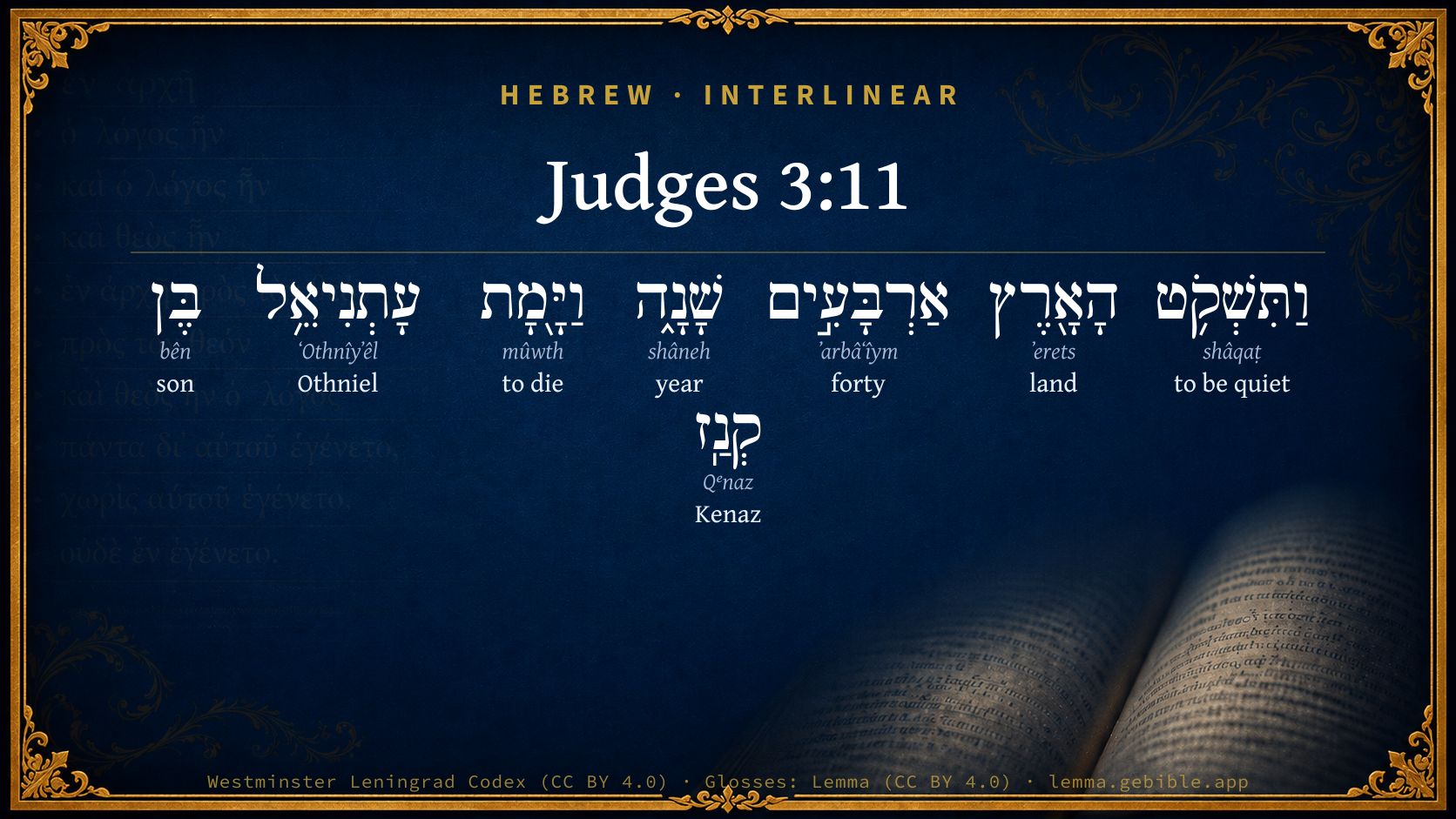
Judges 3:11

Hebrew (Westminster Leningrad Codex) Judges 3:11 appears in the Hebrew Old Testament. The text above is from the Westminster Leningrad Codex. Each word links to its Strong’s number, a concise gloss, and parsing drawn from the Open Scriptures Hebrew Bible morphology. Click any word for its full Brown-Driver-Briggs (BDB) entry.
Download image
Cite this verse

Judges 3:11 (World English Bible). Public Domain. Lemma interlinear Bible study tool, https://lemma.gebible.app/v/judges/3/11.

Show BibTeX & RIS
BibTeX
RIS
English Translation
The land had rest forty years. Othniel the son of Kenaz died.
World English Bible · Public Domain
Download a study sheet

One document with this verse’s original text, its word-by-word gloss line, the meaning frame, cross-references with their text, attributed commentary, and full source and license credits — printable, and it pastes into notes with its structure intact.

This verse Autodidact and up

Study sheet (.html) Plain text (.txt)

A passage Seminary Student

Up to 50 verses in one chapter. A passage sheet keeps up to 6 commentary sources and 12 cross-references per verse, in the order this page ranks them, and says so on the sheet whenever that leaves anything out. Ask for a single verse and you get the Autodidact verse sheet above.

Everything on this page stays free to read, with no account — the sheet is a download of what is already on screen, not access to it.

Want to remove ads? Support Godless Engineer
Compare translations 3

The same verse in 3 English versions, stacked beneath the original-language interlinear above. Click any original word for its lexicon entry.

Each is an independent rendering of the whole verse — the interlinear is not word-aligned to these translations.

Highlighted words mark where these versions differ — a whole-verse word diff, not a word-by-word alignment.

  • World English Bible Public Domain
    The land had rest forty years. Othniel the son of Kenaz died.
  • King James Version Public Domain
    And the land had rest forty years. And Othniel the son of Kenaz died.
  • unfoldingWord Literal Text CC BY-SA 4.0
    And the land rested 40 years. Then Othniel, the son of Kenaz, died.

unfoldingWord Literal Text — © unfoldingWord, licensed CC BY-SA 4.0. Word-aligned USFM3 via Door43 (git.door43.org/unfoldingWord/en_ult).

Versions to compare (up to 4)

3 of 4 selected

Show all 18 translations

Every available English version of this verse, each an independent rendering of the whole verse.

  • World English Bible Public Domain
    The land had rest forty years. Othniel the son of Kenaz died.
  • Berean Standard Bible Public Domain
    So the land had rest for forty years, until Othniel son of Kenaz died.
  • Majority Standard Bible Public Domain
    So the land had rest for forty years, until Othniel son of Kenaz died.
  • King James Version Public Domain
    And the land had rest forty years. And Othniel the son of Kenaz died.
  • American Standard Version (1901) Public Domain
    And the land had rest forty years. And Othniel the son of Kenaz died.
  • Revised Version (1885) Public Domain
    And the land had rest forty years. And Othniel the son of Kenaz died.
  • Geneva Bible (1599) Public Domain
    So the lande had rest fourtie yeeres, and Othniel the sonne of Kenaz dyed.
  • Douay-Rheims (1899) Public Domain
    And the land rested forty years, and Othoniel the son of Cenez died.
  • Young's Literal Translation Public Domain
    and the land resteth forty years. And Othniel son of Kenaz dieth,
  • Literal Standard Version CC BY-SA 4.0
    and the land rests forty years. And Othniel son of Kenaz dies,
  • Unlocked Literal Bible CC BY-SA 4.0
    The land had peace for forty years. Then Othniel son of Kenaz died.
  • unfoldingWord Literal Text CC BY-SA 4.0
    And the land rested 40 years. Then Othniel, the son of Kenaz, died.
  • Darby Bible Public Domain
    So the land had rest forty years. Then Oth'ni-el the son of Kenaz died.
  • World Messianic Bible Public Domain
    The land had rest forty years, then Othniel the son of Kenaz died.
  • Webster's Bible Public Domain
    And the land had rest forty years: and Othniel the son of Kenaz died.
  • Free Bible Version CC BY-SA 4.0
    As a result, the country was a peace for forty years until Othniel, son of Kenaz, died.
  • Bible in Basic English Public Domain
    Then for forty years the land had peace, till the death of Othniel, the son of Kenaz.
  • JPS Tanakh (1917) Public Domain
    And the land had rest forty years. And Othniel the son of Kenaz died.

Literal Standard Version (2020), Covenant Press — licensed CC BY-SA 4.0. Text via the HelloAO Bible API (eBible.org). Unlocked Literal Bible (unfoldingWord) — licensed CC BY-SA 4.0. Text via the HelloAO Bible API (eBible.org). unfoldingWord Literal Text — © unfoldingWord, licensed CC BY-SA 4.0. Word-aligned USFM3 via Door43 (git.door43.org/unfoldingWord/en_ult). Free Bible Version, Dr. Jonathan Gallagher — licensed CC BY-SA 4.0. Text via the HelloAO Bible API (eBible.org).

Word by word

More ways to search: Search by grammar → Find every occurrence → Compare this word →

Practice this passage: Drill this verse → Learn its vocabulary →

About this verse

These counts appear in no published source. They are computed here, from the morphology-tagged text and Lemma’s own curated glosses. What Lemma adds →

8
words
8
distinct lemmas
Historical
section

Notable vocabulary

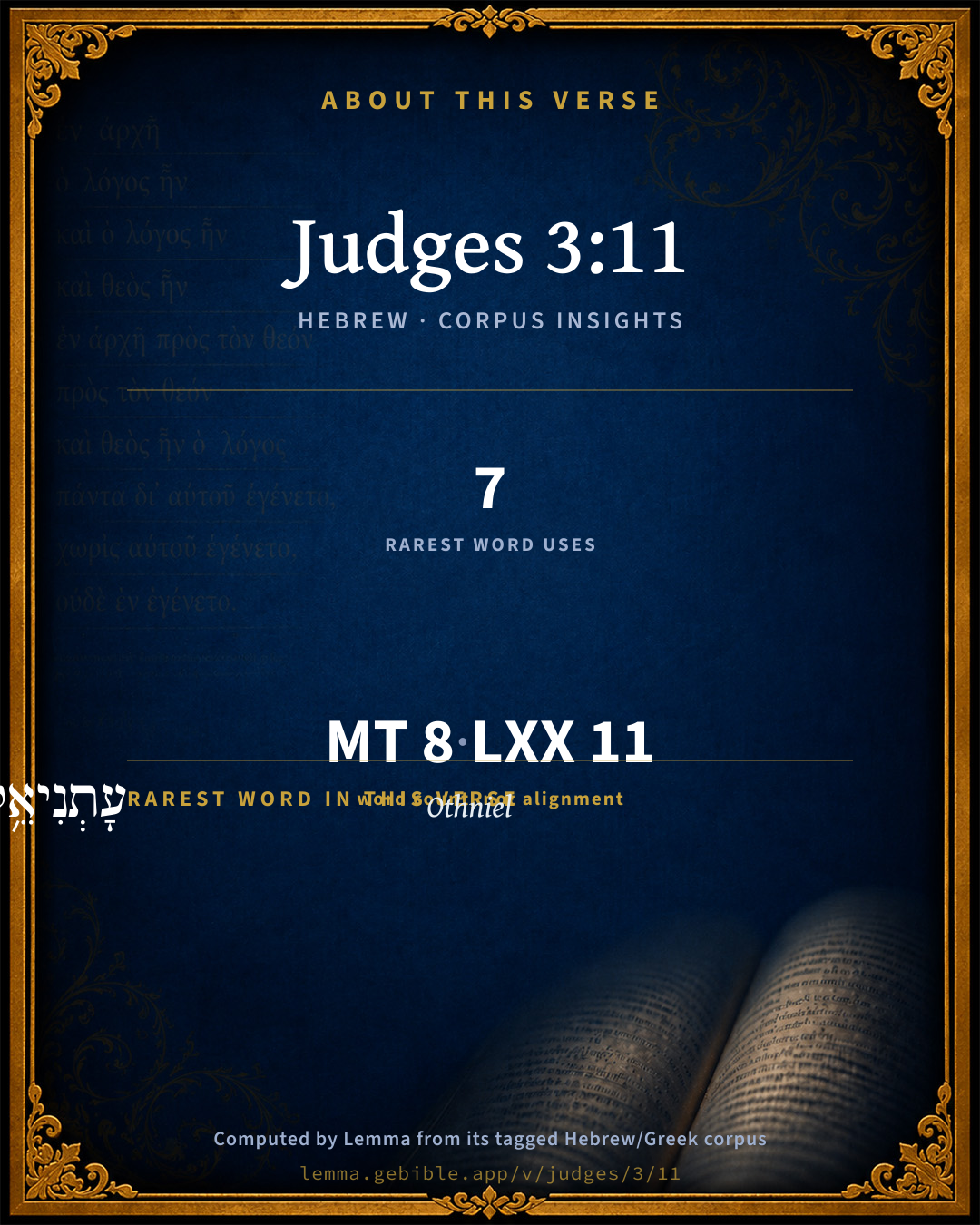
The rarest word here is עָתְנִיאֵ֥ל Othniel H6274 — appearing just 7 times in the whole Hebrew Bible.

Shared distinctive vocabulary

עָתְנִיאֵ֥ל Othniel H6274 occurs in 6 verses of the Hebrew Bible. Also found in:

Grammatical profile

  • 2 verbs
  • 5 nouns
  • 1 adjective

Verb forms

  • וַתִּשְׁקֹ֥ט Qal · Sequential Imperfect
  • וַיָּ֖מָת Qal · Sequential Imperfect

Hebrew & Septuagint length

In English translation the verse runs 12 words from the Hebrew and 14 from the Septuagint (LXX English) — closely comparable.

A rough comparison of the two English renderings, which tokenize alike — not a word-level alignment.

Word counts can differ between the Hebrew and the Greek without any difference in meaning — e.g. the Hebrew direct-object marker אֵת has no separate Greek word, and Greek often adds the article ὁ.

In the original languages it is 8 Hebrew tokens and 11 Greek tokens — but the two are counted differently (Hebrew bundles its prefixes and suffixes into one token; the Greek is in lemma form), so that isn’t a like-for-like length.

Cross-references

8

Topical passages linked to Judges 3:11 in the Treasury of Scripture Knowledge — connected by theme and wording, ordered by reader-vote popularity; previews shown in the World English Bible.

  • Joshua 11:23 So Joshua took the whole land, according to all that Yahweh spoke to Moses; and Joshua gave it for an inheritance to Israel according to their divisions by their tribes. The land had rest from war.
  • Judges 3:30 So Moab was subdued that day under the hand of Israel. The land had rest eighty years.
  • Judges 5:31 So let all your enemies perish, Yahweh: But let those who love him be as the sun when he goes forth in his might. The land had rest forty years.
  • Judges 8:28 So Midian was subdued before the children of Israel, and they lifted up their heads no more. The land had rest forty years in the days of Gideon.
  • Esther 9:22 as the days in which the Jews had rest from their enemies, and the month which was turned to them from sorrow to gladness, and from mourning into a good day; that they should make them days of feasting and gladness, and of sending portions one to another, and gifts to the needy.
  • Joshua 15:17 Othniel the son of Kenaz, the brother of Caleb, took it: and he gave him Achsah his daughter as wife.
  • Judges 3:9 When the children of Israel cried to Yahweh, Yahweh raised up a savior to the children of Israel, who saved them, even Othniel the son of Kenaz, Caleb's younger brother.
  • 1 Chronicles 4:13 The sons of Kenaz: Othniel, and Seraiah. The sons of Othniel: Hathath.

Cross-references courtesy of OpenBible.info (CC BY 4.0).

Hebrew and Greek witnesses Masoretic Hebrew ↔ Greek Septuagint

The same verse in the two great witnesses to the Old Testament, shown verse-for-verse.

These are two independent witnesses, not word-aligned to each other, and the Septuagint is shown in lemma (dictionary) form.

Hebrew Judges 3:11 Masoretic · Westminster Leningrad Codex

וַתִּשְׁקֹ֥ט הָאָ֖רֶץ אַרְבָּעִ֣ים שָׁנָ֑ה וַיָּ֖מָת עָתְנִיאֵ֥ל בֶּן קְנַֽז

The land had rest forty years. Othniel the son of Kenaz died.

World English Bible · Public Domain

Greek LXX Judges 3:11 Septuagint · lemma form

καί ἡσυχάζω ὁ γῆ τεσσαράκοντα ἔτος καί ἀποθνήσκω γοθονιηλ υἱός κενεζ

And the land was quiet forty years; and Gothoniel the son of Kenez died.

LXX2012 (modern English Septuagint) · Public Domain

Hebrew: Westminster Leningrad Codex (CC BY 4.0). Greek: Septuagint (public domain); English from LXX2012 (modern English Septuagint) (Public Domain). How the Septuagint differs from the Hebrew →

Targum (Aramaic paraphrase)

1

The Targum is the ancient Jewish Aramaic paraphrase of the Hebrew Scriptures — an interpretive translation, not the Hebrew text itself. Onkelos (literal) and Pseudo-Jonathan (expansive) render the Torah, and Jonathan the Prophets. Coverage is partial: where no permissively-licensed English translation exists for a verse, only the Aramaic is shown. This is verse-level text, not a word-by-word alignment to the Hebrew.

  1. Targum Jonathan Prophets (Joshua–Malachi)
    וּשְׁדוֹכַת אַרְעָא דְיִשְׂרָאֵל אַרְבְּעִין שְׁנִין וּמִית עָתְנִיאֵל בַּר קְנַז:

    (no public-domain English translation for this verse)

    Targum Jonathan — Aramaic: “Mikraot Gedolot” (public domain). English: “Sefaria Community Translation” (CC0 1.0 (public-domain dedication)); “London "Chaldee Paraphrase," 1871” (public domain). Text via Sefaria.

Commentary

Notes on Judges 3:11 from classic Christian and Jewish commentators (each source and its license shown beneath its notes). The classic Christian expositions comment on the surrounding passage and are grouped to its opening verse, so a note may address several verses; the Jewish commentaries on the Tanakh (Rashi and others) are per-verse, so they appear only where the commentator wrote on this verse.

Lemma curates 59 commentaries, every one of them public domain or Creative Commons licensed, each selected and text-cleaned for this edition rather than reprinted as found. About our sources →

Trapp's Complete Commentary

John Trapp

Jdg 3:11 And the land had rest forty years. And Othniel the son of Kenaz died.

Ver. 11. And the land had rest forty years,] sc., From the death of Joshua to the death of Othniel, and the eight years of servitude under the Syrians being taken in, as it may be gathered from 1Ki 6:1.

John Trapp, A Commentary or Exposition upon All the Books of the Old and New Testament (1647–1656) — public domain. Text from a community e-Sword module.

Geneva Bible (1599)

Geneva Bible translators

That is, 32 under Joshua, and eight under Othniel.

Geneva Bible (1599) marginal notes — public domain. Text via Bolls.life.

Jamieson, Fausset & Brown

Robert Jamieson, A. R. Fausset & David Brown

Othniel . . . died--How powerful the influence of one good man is, in church or state, is best found in his loss [BISHOP HALL].

Jamieson, Fausset & Brown — Commentary Critical and Explanatory on the Whole Bible (1871) — public domain (CC PDM 1.0). Text via the HelloAO Bible API.

Ellicott's Commentary for English Readers

(11) The land had rest forty years.—Rabbi Tanchum interprets this to mean, “till forty years after the death of Joshua.” For the very difficult chronology of this period, see the Introduction. Many questions have been raised, such as—Do the forty years include or exclude the period of servitude? Is forty meant to be an exact or a general number? Are the various periods of rest and servitude continuous and successive, or do they refer to different parts of the Holy Land, and do they synchronise? Perhaps no final answer to these questions is as yet possible, and no less than fifty schemes of the chronology of the period of the judges have been attempted, which fact alone proves how insufficient are the data on which to decide.

Died.—Probably during the forty years, unless we suppose that he attained a most unusual age. After this event the tribe of Judah sinks into the background till the days of David.

A Bible Commentary for English Readers, edited by Charles John Ellicott (1878–1897) — public domain. Text from a community e-Sword module.

The Cambridge Bible for Schools and Colleges

gen. ed. J. J. S. Perowne

11. And the land had rest forty years] A formula of the editor, to whom the chronological scheme of the Book is due; cf. Jdg_3:30, Jdg_5:31, Jdg_8:28; and Jos_11:23; Jos_14:15.

The Cambridge Bible for Schools and Colleges (gen. ed. J. J. S. Perowne; Cambridge University Press, 1878–1918) — public domain. Text from a community e-Sword module.

John Gill's Exposition

And the land had rest forty years,.... As it should seem from the time of this deliverance; though, according to Ben Gersom and Abarbinel, the eight years' servitude are to be included in them; and Bishop Usher (r) reckons these forty years from the rest first settled in the land by Joshua; but the former sense seems best:

and Othniel the son of Kenaz died: not at the end of the forty years; it is not likely he should live so long, but when he died is not certain; Eusebius (s) says he judged Israel fifty years.

(r) Anual. Vet. Test. p. 42. (s) Evangel. Praepar. l. 1O. c. 14. p. 502.

John Gill's Exposition of the Whole Bible (1746–1763) — public domain (CC PDM 1.0). Text via the HelloAO Bible API.

Albert Barnes' Notes on the Bible

The land - means here, as in Jdg 1:2, not the whole land of Canaan, but the part concerned, probably the land of the tribe of Judah. Forty years, here and elsewhere, is (like fourscore years, Jdg 3:30) a round number, perhaps equivalent to a generation.

Albert Barnes' Notes on the Bible (1834–1885) — public domain. Text from a community e-Sword/MySword module.

Haydock's Catholic Bible Commentary

Died, "forty years after Josue, according to the chronology of Usher, which we follow," (Calmet) or rather Usher translates the land began to rest "in the fortieth year" from the peace of Josue. He places the death to that leader in the year of the world 2570, and the end of Chusan’s dominion 2599; so that, if we deduct 40 years from this last date, we shall come to the year 2559, the sixth of Josue’s administration, when he began to divide the conquered lands. He supposes that the peace of Othoniel lasted about 62 years, when Eglon disturbed it for eighteen years. "Aod delivered Israel. After him Samgar appeared, and the land rested till the 80th year from the peace of Othoniel." Houbigant censures this indiscriminate use of cardinal and of ordinal numbers, and the blending times of servitude with those of peace; (Haydock) and "surely this method of reckoning is very harsh, and contrary to the usual acceptation of words." (Calmet) --- Yet it is adopted by many. (Worthington) --- IT may suit to form a system, but can have no solid foundation. (Haydock) --- The epoch from which Usher dates is no where so distinctly specified, as that we should suppose that the author of the Book of Judges had it in view. Moreover, by this method, we are left to guess how long each of the judges reigned, or how long the peace which they had procured, subsisted. Usher admits that they years of servitude are specified; and, why not also the years of peace, since they are expressed exactly in the same manner? If the ordinal numbers 40th, 80th, &c., were intended, b would be prefixed, as [in] Deuteronomy i. 3.; and this grammatical observation along, suffices to overturn the calculation of Usher. (Houbigant, Proleg.) --- Salien dates from the death of Josue in 2600, and allows that 40 years elapsed from that period till the decease of Othoniel; including the years which some attribute to the ancients, and to the anarchy; (chap. xvii., &c., to the end,) and also the eight years of servitude; so that instead of a rest of 40 years, we shall find that all was in confusion the greatest part of the time. The idolatry of Israel, which shortly brought on the servitude under Eglon, commenced immediately after the conclusion of these 40 years, when Salien begins to enumerate the years of Aod’s government. Thus he does from one judge to another. This system does not indeed make the text bend to uphold it, but it supposes that the sacred writer includes anarchy and servitude under the name of rest. In these matters much is to be supplied by conjecture, and hence the chronological difficulties which infidels propose, to invalidate the authority of the Scripture, can have but little weight, till the learned shall have discovered the exact disposition of former times. The first judge of Israel was of the tribe of Juda. The second was chosen from the almost ruined tribe of Benjamin, as the learned commonly place the dreadful catastrophe which befel that tribe during the anarchy which ensued, and the death of Josue and of the ancients. Aod had no share in the crime. (Haydock)

George Leo Haydock (1774–1849), Haydock's Catholic Family Bible and Commentary, 1859 edition — public domain. Excludes Psalms (Douay-Rheims chapter numbering differs from Protestant) and Deuterocanonical books (Catholic canon only).

Matthew Poole's English Annotations

The land had rest; either, first, It rested about forty years, or the greatest part of forty years; it being most frequent in Scripture to use numbers in such a latitude. Thus the Israelites are said to bear their iniquities forty years in the wilderness, Num 14:34, when there wanted near two years of that number; and to dwell in Egypt four hundred and thirty years, when there wanted many years of that number. Thus Joseph’s kindred, sent for and called by him into Egypt, are numbered seventy-five souls, Act 7:14, although they were but seventy, as is affirmed, Gen 46:27; Exo 1:5. So here

the land is said to

rest forty years, although they were in servitude eight of those years, Jdg 3:8. And in like manner the land is said to have rest eighty years, though eighteen of them they served the king of Moab, Jdg 3:14. And so in some other instances. Nor is it strange and unusual, either in Scripture or in other authors, for things to be denominated from the greater part, as here it was; especially when they did enjoy some degrees of rest and peace, even in their times of slavery, which here they did. Or, secondly, It rested, i.e. began to rest, or recovered its interrupted rest, in the fortieth year, either after Joshua’s death, or after the first and famous rest procured for them by Joshua, as is noted, Heb 4:9, when he destroyed and subdued the Canaanites, and gave them quiet possession of the land; and the land had rest from war, as is said, Jos 11:23; 14:15. So there is this difference between the years of servitude and oppression, and those of rest, that in the former he tells us how long it lasted; in the latter, when it began; by which, compared with the other years, it was easy also to know how long the rest lasted. To strengthen this interpretation, two things must be noted.

1. That resting is here put for beginning to rest, as to beget is put for beginning to beget, Gen 5:32; 11:26; and to reign, for to begin to reign, 2Sa 2:10; and to build, 1Ki 6:15,36, for to begin to build, 2Ch 3:1.

2. That forty years is put for the fortieth year; the cardinal number for the ordinal, which is common both in the Holy Scripture, as Gen 1:5; 2:11; Exo 12:2; Hag 1:1; Mar 16:2 and in other authors.

Matthew Poole's English Annotations on the Holy Bible (1683–1685) — public domain. Text from a community e-Sword/MySword module.

Whedon's Commentary on the Bible

Daniel D. Whedon

11. Forty years — This long period of peace and independence was necessary to the development of the nation.

Othniel… died — How remarkable the fact that a nation may be held back for nearly a half century from rebellion against God by the influence of a faithful ruler. It is not necessary to suppose that Othniel lived during all the forty years of rest. His influence may have held the people in check long after he was dead, and ever after those years of rest were associated with his name. Few individuals or nations, however, can endure undisturbed prosperity without damage to their moral character.

Daniel D. Whedon (gen. ed.), Commentary on the Old and New Testaments (1874–1909) — public domain. Text from a community e-Sword module.

The Pulpit Commentary

And Othniel, etc. The arrangement of this verse suggests that Othniel lived through the whole forty years of rest, but this is highly improbable. The first part of the verse only belongs to the preceding section, which it closes quite naturally. The result of Othniel"s victories was a rest of forty years (cf. ver. 30; Jud_1:5:31; 8:28, etc.). The latter half of the verse And Othniel the son of Kenaz died begins a new section, and is introductory to the first apostasy, which followed after his death.

"And the land had rest the true peace.

I IT IS A REWARD OF CONSECRATED EFFORT AND SELFDENIAL.

II A PREPARATION FOR HIGHER CONCEPTIONS AND REALISATIONS OF RIGHTEOUSNESS. III A SABBATH OF CONSECRATED TIME AND SERVICE TO THE HIGHEST. M.

The Pulpit Commentary (1880–1919), ed. H.D.M. Spence-Jones & Joseph S. Exell — public domain. Text from a community e-Sword module.

John Wesley's Explanatory Notes

Forty years - It rested about forty years, or the greatest part of forty years: it being most frequent in scripture to use numbers in such a latitude. Nor is it unusual either in scripture, or in other authors, for things to be denominated from the greater part; especially, when they enjoyed some degrees of rest and peace even in their times of slavery.

John Wesley, Explanatory Notes Upon the Whole Bible (1754–1765) — public domain. Text via the GEBible commentary corpus.

Lesson kit

Teaching starters — assembled from the data on this page, not authored interpretation. Every prompt links to the verse data it draws on. Edit before teaching.

Judges, in the Historical, opens this verse with 8 words (8 distinct Hebrew lemmas). Its most distinctive word is ʻOthnîyʼêl (“Othniel”). A historical commentator’s framing appears above. Read the whole chapter for the surrounding context.

Discussion questions

  1. What does “Othniel” (ʻOthnîyʼêl) contribute to the verse as a whole?
  2. How does Joshua 15:17, which shares the word «Othniel», read alongside this verse?
  3. These translations render this verse differently. What is at stake in choosing one wording over another?
  4. «וַתִּשְׁקֹ֥ט» is a Qal Sequential Imperfect verb. How does that grammatical form shape the action described?
  5. Compare how Trapp's Complete Commentary and Geneva Bible (1599) read this verse. Where do they agree or differ?

Things to notice

Reading settings

Reading text

Shown beneath each verse's original-language words.

Old Testament
Old Testament edition

Read the OT as the Masoretic Hebrew (MT) or the Greek Septuagint (LXX).

English shown for the Greek Septuagint (in the Hebrew ↔ Greek comparison).

Comparing translations? Open the Compare panel on any verse page to stack up to four side by side.