
Isaiah 58:5

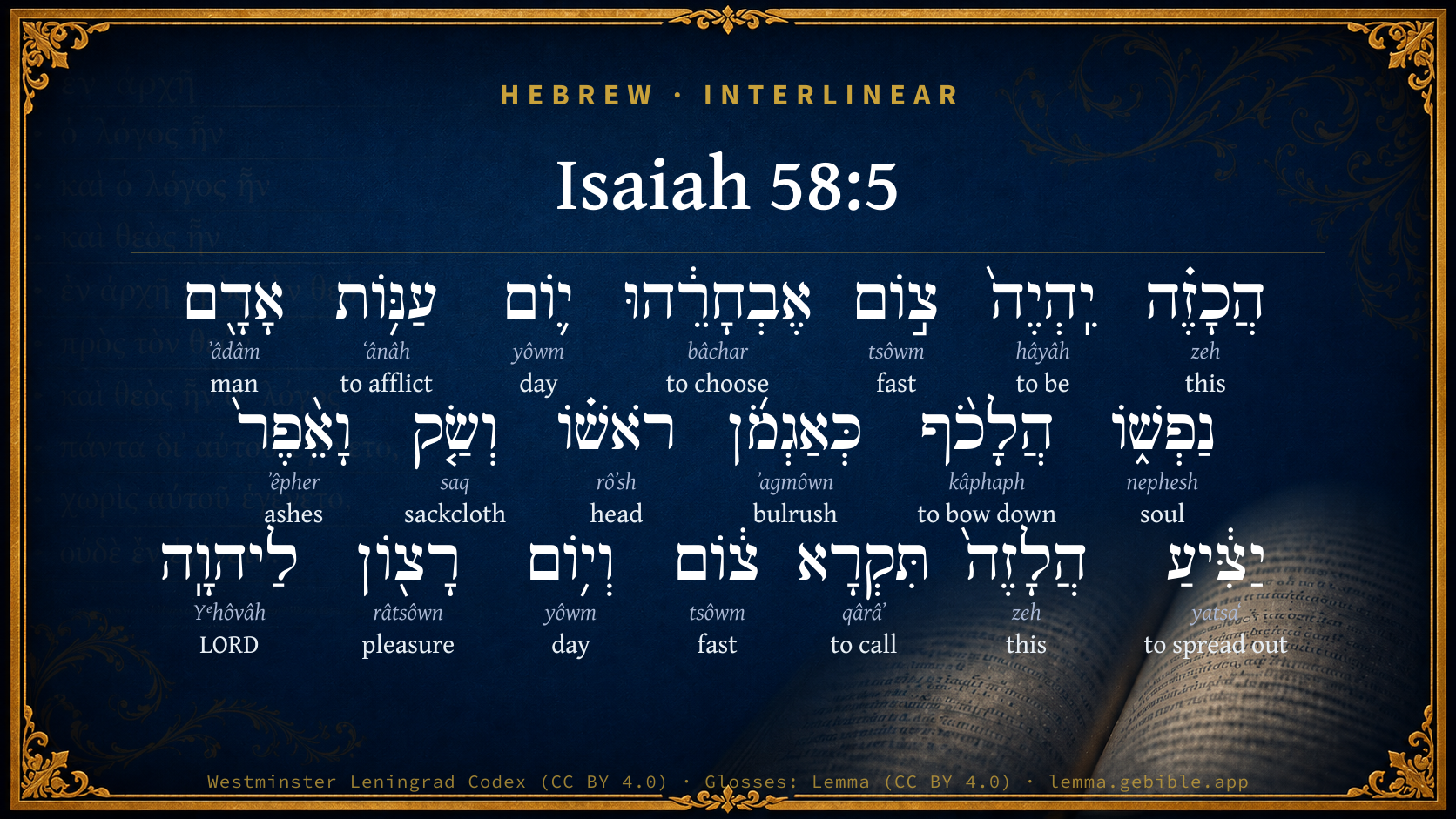
Hebrew (Westminster Leningrad Codex) Isaiah 58:5 appears in the Hebrew Old Testament. The text above is from the Westminster Leningrad Codex. Each word links to its Strong’s number, a concise gloss, and parsing drawn from the Open Scriptures Hebrew Bible morphology. Click any word for its full Brown-Driver-Briggs (BDB) entry.
Download image
Cite this verse

Isaiah 58:5 (World English Bible). Public Domain. Lemma interlinear Bible study tool, https://lemma.gebible.app/v/isaiah/58/5.

Show BibTeX & RIS
BibTeX
RIS
English Translation
Is such the fast that I have chosen? the day for a man to afflict his soul? Is it to bow down his head as a rush, and to spread sackcloth and ashes under him? will you call this a fast, and an acceptable day to Yahweh?
World English Bible · Public Domain
Download a study sheet

One document with this verse’s original text, its word-by-word gloss line, the meaning frame, cross-references with their text, attributed commentary, and full source and license credits — printable, and it pastes into notes with its structure intact.

This verse Autodidact and up

Study sheet (.html) Plain text (.txt)

A passage Seminary Student

Up to 50 verses in one chapter. A passage sheet keeps up to 6 commentary sources and 12 cross-references per verse, in the order this page ranks them, and says so on the sheet whenever that leaves anything out. Ask for a single verse and you get the Autodidact verse sheet above.

Everything on this page stays free to read, with no account — the sheet is a download of what is already on screen, not access to it.

Want to remove ads? Support Godless Engineer
Compare translations 3

The same verse in 3 English versions, stacked beneath the original-language interlinear above. Click any original word for its lexicon entry.

Each is an independent rendering of the whole verse — the interlinear is not word-aligned to these translations.

Highlighted words mark where these versions differ — a whole-verse word diff, not a word-by-word alignment.

  • World English Bible Public Domain
    Is such the fast that I have chosen? the day for a man to afflict his soul? Is it to bow down his head as a rush, and to spread sackcloth and ashes under him? will you call this a fast, and an acceptable day to Yahweh?
  • King James Version Public Domain
    Is it such a fast that I have chosen? a day for a man to afflict his soul? is it to bow down his head as a bulrush, and to spread sackcloth and ashes under him? wilt thou call this a fast, and an acceptable day to the LORD?
  • unfoldingWord Literal Text CC BY-SA 4.0
    Is the fast, I choose it, like this, a day of a man humbling his soul, to bow his head like a reed, and to spread sackcloth and ashes? Do you call this a fast and a day of acceptance to Yahweh?

unfoldingWord Literal Text — © unfoldingWord, licensed CC BY-SA 4.0. Word-aligned USFM3 via Door43 (git.door43.org/unfoldingWord/en_ult).

Versions to compare (up to 4)

3 of 4 selected

Show all 18 translations

Every available English version of this verse, each an independent rendering of the whole verse.

  • World English Bible Public Domain
    Is such the fast that I have chosen? the day for a man to afflict his soul? Is it to bow down his head as a rush, and to spread sackcloth and ashes under him? will you call this a fast, and an acceptable day to Yahweh?
  • Berean Standard Bible Public Domain
    Is this the fast I have chosen: a day for a man to deny himself, to bow his head like a reed, and to spread out sackcloth and ashes? Will you call this a fast and a day acceptable to the LORD?
  • Majority Standard Bible Public Domain
    Is this the fast I have chosen: a day for a man to deny himself, to bow his head like a reed, and to spread out sackcloth and ashes? Will you call this a fast and a day acceptable to the LORD?
  • King James Version Public Domain
    Is it such a fast that I have chosen? a day for a man to afflict his soul? is it to bow down his head as a bulrush, and to spread sackcloth and ashes under him? wilt thou call this a fast, and an acceptable day to the LORD?
  • American Standard Version (1901) Public Domain
    Is such the fast that I have chosen? the day for a man to afflict his soul? Is it to bow down his head as a rush, and to spread sackcloth and ashes under him? wilt thou call this a fast, and an acceptable day to Jehovah?
  • Revised Version (1885) Public Domain
    Is such the fast that I have chosen? the day for a man to afflict his soul? Is it to bow down his head as a rush, and to spread sackcloth and ashes under him? wilt thou call this a fast, and an acceptable day to the LORD?
  • Geneva Bible (1599) Public Domain
    Is it such a fast that I haue chosen, that a man should afflict his soule for a day, and to bowe downe his head, as a bull rush, and to lie downe in sackecloth and ashes? wilt thou call this a fasting, or an acceptable day to the Lord?
  • Douay-Rheims (1899) Public Domain
    Is this such a fast as I have chosen: for a man to afflict his soul for a day? is this it, to wind his head about like a circle, and to spread sackcloth and ashes? wilt thou call this a fast, and a day acceptable to the Lord?
  • Young's Literal Translation Public Domain
    Like this is the fast that I choose? The day of a man's afflicting his soul? To bow as a reed his head, And sackcloth and ashes spread out? This dost thou call a fast, And a desirable day -- to Jehovah?
  • Literal Standard Version CC BY-SA 4.0
    Is this like the fast that I choose? The day of a man’s afflicting his soul? To bow his head as a reed, || And spread out sackcloth and ashes? Do you call this a fast, || And a desirable day—to YHWH?
  • Unlocked Literal Bible CC BY-SA 4.0
    Is this really the kind of fast that I would want: A day for anybody to humble himself, for him to bow down his head like a reed, and to spread sackcloth and ashes under himself? Do you really call this a fast, a day that pleases Yahweh?
  • unfoldingWord Literal Text CC BY-SA 4.0
    Is the fast, I choose it, like this, a day of a man humbling his soul, to bow his head like a reed, and to spread sackcloth and ashes? Do you call this a fast and a day of acceptance to Yahweh?
  • Darby Bible Public Domain
    Is such the fast that I have chosen, a day for a man to afflict his soul, -- that he should bow down his head as a bulrush, and spread sackcloth and ashes [under him]? Wilt thou call this a fast, and a day acceptable to Jehovah?
  • World Messianic Bible Public Domain
    Is this the fast that I have chosen? A day for a man to humble his soul? Is it to bow down his head like a reed, and to spread sackcloth and ashes under himself? Will you call this a fast, and an acceptable day to the LORD?
  • Webster's Bible Public Domain
    Is it such a fast that I have chosen? a day for a man to afflict his soul? is it to bow down his head as a bulrush, and to spread sackcloth and ashes under him? wilt thou call this a fast, and an acceptable day to the LORD?
  • Free Bible Version CC BY-SA 4.0
    Is this the kind of fast I want when people act out their humility by bowing their heads down like a reed and by lying around in sackcloth and ashes? Is that what you call a fast, a day the Lord appreciates?
  • Bible in Basic English Public Domain
    Have I given orders for such a day as this? a day for keeping yourselves from pleasure? is it only a question of the bent head, of putting on haircloth, and being seated in the dust? is this what seems to you a holy day, well-pleasing to the Lord?
  • JPS Tanakh (1917) Public Domain
    Is such the fast that I have chosen? the day for a man to afflict his soul? Is it to bow down his head as a bulrush, and to spread sackcloth and ashes under him? Wilt thou call this a fast, and an acceptable day to the LORD?

Literal Standard Version (2020), Covenant Press — licensed CC BY-SA 4.0. Text via the HelloAO Bible API (eBible.org). Unlocked Literal Bible (unfoldingWord) — licensed CC BY-SA 4.0. Text via the HelloAO Bible API (eBible.org). unfoldingWord Literal Text — © unfoldingWord, licensed CC BY-SA 4.0. Word-aligned USFM3 via Door43 (git.door43.org/unfoldingWord/en_ult). Free Bible Version, Dr. Jonathan Gallagher — licensed CC BY-SA 4.0. Text via the HelloAO Bible API (eBible.org).

Word by word

More ways to search: Search by grammar → Find every occurrence → Compare this word →

Practice this passage: Drill this verse → Learn its vocabulary →

יַצִּ֔יעַ
yatsaʻ
H3331
“to spread out”
Verb, Hiphil, Imperfect, 3rd Person, Masculine, Singular
Part of Speech
Verb
Stem
Hiphil
Form
Imperfect
Person
3rd Person
Gender
Masculine
Number
Singular
Full BDB Definition

Origin: a primitive root

TWOT: 896

to spread out, make a bed - (Hiphil) to lay, spread out - (Hophal) to be laid, be spread out
  1. הֲכָזֶ֗ה zeh H2088 “like/as · this” Particle, Interrogative + Preposition + Pronoun, Demonstrative, Masculine, Singular
  2. יִֽהְיֶה֙ hâyâh H1961 “to be” Verb, Qal, Imperfect, 3rd Person, Masculine, Singular
  3. צ֣וֹם tsôwm H6685 “fast” Noun, Common, Masculine, Singular, Absolute
  4. אֶבְחָרֵ֔הוּ bâchar H977 “to choose · him” Verb, Qal, Imperfect, 1st Person, Common, Singular + Suffix, Personal, 3rd Person, Masculine, Singular
  5. י֛וֹם yôwm H3117 “day of” Noun, Common, Masculine, Singular, Construct
  6. עַנּ֥וֹת ʻânâh H6031 “to afflict” Verb, Piel, Infinitive Construct
  7. אָדָ֖ם ʼâdâm H120 “man” Noun, Common, Masculine, Singular, Absolute
  8. נַפְשׁ֑וֹ nephesh H5315 “soul · his” Noun, Common, Both, Singular, Construct + Suffix, Personal, 3rd Person, Masculine, Singular
  9. הֲלָכֹ֨ף kâphaph H3721 “to bow down” Particle, Interrogative + Preposition + Verb, Qal, Infinitive Construct
  10. כְּאַגְמֹ֜ן ʼagmôwn H100 “like/as · bulrush” Preposition + Noun, Common, Masculine, Singular, Absolute
  11. רֹאשׁ֗וֹ rôʼsh H7218 “head · his” Noun, Common, Masculine, Singular, Construct + Suffix, Personal, 3rd Person, Masculine, Singular
  12. וְשַׂ֤ק saq H8242 “and · sackcloth” Conjunction + Noun, Common, Masculine, Singular, Absolute
  13. וָאֵ֨פֶר֙ ʼêpher H665 “and · ashes” Conjunction + Noun, Common, Masculine, Singular, Absolute
  14. הֲלָזֶה֙ zeh H2088 “to/for · this” Particle, Interrogative + Preposition + Pronoun, Demonstrative, Masculine, Singular
  15. תִּקְרָא qârâʼ H7121 “to call” Verb, Qal, Imperfect, 2nd Person, Masculine, Singular
  16. צ֔וֹם tsôwm H6685 “fast” Noun, Common, Masculine, Singular, Absolute
  17. וְי֥וֹם yôwm H3117 “and · day of” Conjunction + Noun, Common, Masculine, Singular, Construct
  18. רָצ֖וֹן râtsôwn H7522 “pleasure” Noun, Common, Masculine, Singular, Absolute
  19. לַיהוָֽה Yᵉhôvâh H3068 “to/for · LORD” Preposition + Noun, Proper

About this verse

These counts appear in no published source. They are computed here, from the morphology-tagged text and Lemma’s own curated glosses. What Lemma adds →

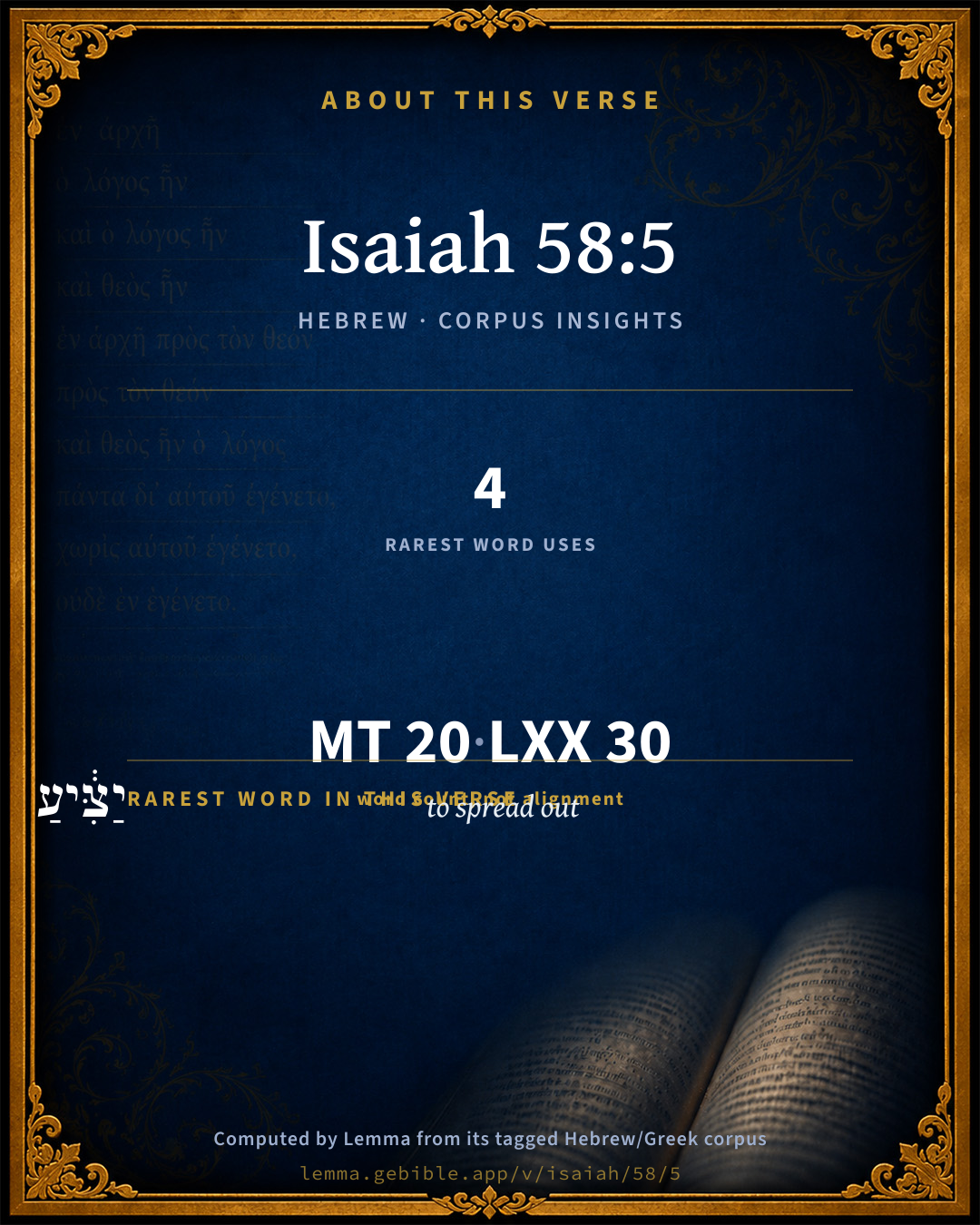
20
words
17
distinct lemmas
Prophets
section

Notable vocabulary

The rarest word here is יַצִּ֔יעַ to spread out H3331 — appearing just 4 times in the whole Hebrew Bible.

Shared distinctive vocabulary

יַצִּ֔יעַ to spread out H3331 occurs in 4 verses of the Hebrew Bible. Also found in:

Grammatical profile

  • 6 verbs
  • 12 nouns
  • 2 pronouns

Verb forms

  • יִֽהְיֶה֙ Qal · Imperfect
  • אֶבְחָרֵ֔הוּ Qal · Imperfect
  • עַנּ֥וֹת Piel · Infinitive Construct
  • הֲלָכֹ֨ף Qal · Infinitive Construct
  • יַצִּ֔יעַ Hiphil · Imperfect
  • תִּקְרָא Qal · Imperfect

Repetition

Words recur within this verse — often emphatic in Hebrew:

  • צ֣וֹם fast H6685 ×2
  • י֛וֹם day H3117 ×2
  • הֲכָזֶ֗ה this H2088 ×2

Hebrew & Septuagint length

In English translation the verse runs 47 words from the Hebrew and 43 from the Septuagint (LXX English) — closely comparable.

A rough comparison of the two English renderings, which tokenize alike — not a word-level alignment.

Word counts can differ between the Hebrew and the Greek without any difference in meaning — e.g. the Hebrew direct-object marker אֵת has no separate Greek word, and Greek often adds the article ὁ.

In the original languages it is 20 Hebrew tokens and 30 Greek tokens — but the two are counted differently (Hebrew bundles its prefixes and suffixes into one token; the Greek is in lemma form), so that isn’t a like-for-like length.

Cross-references

19

Topical passages linked to Isaiah 58:5 in the Treasury of Scripture Knowledge — connected by theme and wording, ordered by reader-vote popularity; previews shown in the World English Bible.

  • Daniel 9:3–19 I set my face to the Lord God, to seek by prayer and petitions, with fasting and sackcloth and ashes.
  • Zechariah 7:5 "Speak to all the people of the land, and to the priests, saying, 'When you fasted and mourned in the fifth and in the seventh month for these seventy years, did you at all fast to me, really to me?
  • Isaiah 49:8 Thus says Yahweh, In an acceptable time have I answered you, and in a day of salvation have I helped you; and I will preserve you, and give you for a covenant of the people, to raise up the land, to make them inherit the desolate heritage:
  • Esther 4:16 Go, gather together all the Jews who are present in Shushan, and fast you for me, and neither eat nor drink three days, night or day: I also and my maidens will fast in like manner; and so will I go in to the king, which is not according to the law: and if I perish, I perish.
  • Isaiah 61:2 to proclaim the year of Yahweh's favor, and the day of vengeance of our God; to comfort all who mourn;
  • Romans 12:2 Don't be conformed to this world, but be transformed by the renewing of your mind, so that you may prove what is the good, well-pleasing, and perfect will of God.
  • Leviticus 16:29 "It shall be a statute to you forever: in the seventh month, on the tenth day of the month, you shall afflict your souls, and shall do no manner of work, the native-born, or the stranger who lives as a foreigner among you:
  • 2 Chronicles 20:3 Jehoshaphat feared, and set himself to seek to Yahweh; and he proclaimed a fast throughout all Judah.
  • Psalms 69:13 But as for me, my prayer is to you, Yahweh, in an acceptable time. God, in the abundance of your loving kindness, answer me in the truth of your salvation.
  • Luke 4:19 And to proclaim the acceptable year of the Lord."
  • 1 Kings 21:27–29 It happened, when Ahab heard those words, that he tore his clothes, and put sackcloth on his flesh, and fasted, and lay in sackcloth, and went softly.
  • Ezra 10:6 Then Ezra rose up from before the house of God, and went into the chamber of Jehohanan the son of Eliashib: and [when] he came there, he ate no bread, nor drink water; for he mourned because of the trespass of them of the captivity.
  • Nehemiah 9:1–2 Now in the twenty-fourth day of this month the children of Israel were assembled with fasting, and with sackcloth, and earth on them.
  • Esther 4:3 In every province, wherever the king's commandment and his decree came, there was great mourning among the Jews, and fasting, and weeping, and wailing; and many lay in sackcloth and ashes.
  • Job 2:8 He took for himself a potsherd to scrape himself with, and he sat among the ashes.
  • Isaiah 58:3 Why have we fasted, [say they], and you don't see? [why] have we afflicted our soul, and you take no knowledge? Behold, in the day of your fast you find [your own] pleasure, and exact all your labors.
  • 1 Peter 2:5 You also, as living stones, are built up as a spiritual house, to be a holy priesthood, to offer up spiritual sacrifices, acceptable to God through Jesus Christ.
  • Jonah 3:5–8 The people of Nineveh believed God; and they proclaimed a fast, and put on sackcloth, from the greatest of them even to the least of them.
  • 2 Kings 6:30 It happened, when the king heard the words of the woman, that he tore his clothes (now he was passing by on the wall); and the people looked, and, behold, he had sackcloth within on his flesh.

Cross-references courtesy of OpenBible.info (CC BY 4.0).

Hebrew and Greek witnesses Masoretic Hebrew ↔ Greek Septuagint

The same verse in the two great witnesses to the Old Testament, shown verse-for-verse.

These are two independent witnesses, not word-aligned to each other, and the Septuagint is shown in lemma (dictionary) form.

Hebrew Isaiah 58:5 Masoretic · Westminster Leningrad Codex

הֲכָזֶ֗ה יִֽהְיֶה֙ צ֣וֹם אֶבְחָרֵ֔הוּ י֛וֹם עַנּ֥וֹת אָדָ֖ם נַפְשׁ֑וֹ הֲלָכֹ֨ף כְּאַגְמֹ֜ן רֹאשׁ֗וֹ וְשַׂ֤ק וָאֵ֨פֶר֙ יַצִּ֔יעַ הֲלָזֶה֙ תִּקְרָא צ֔וֹם וְי֥וֹם רָצ֖וֹן לַיהוָֽה

Is such the fast that I have chosen? the day for a man to afflict his soul? Is it to bow down his head as a rush, and to spread sackcloth and ashes under him? will you call this a fast, and an acceptable day to Yahweh?

World English Bible · Public Domain

Greek LXX Isaiah 58:5 Septuagint · lemma form

οὐ οὗτος ὁ νηστεία ἐκλέγω καί ἡμέρα ταπεινόω ἄνθρωπος ὁ ψυχή αὐτός οὐδέ ἄν κάμπτω ὡς κρίκος ὁ τράχηλος σύ καί σάκκος καί σποδός ὑποστρώννυμι οὐδέ οὕτως καλέω νηστεία δεκτός

I have not chosen this fast, nor such a day for a man to afflict his soul; neither though you should bend down your neck as a ring, and spread under you sackcloth and ashes, neither thus shall you⌃ call a fast acceptable.

LXX2012 (modern English Septuagint) · Public Domain

On this verse, Keil & Delitzsch discusses the Septuagint’s reading. Read the note in Commentary ↓

Hebrew: Westminster Leningrad Codex (CC BY 4.0). Greek: Septuagint (public domain); English from LXX2012 (modern English Septuagint) (Public Domain). How the Septuagint differs from the Hebrew →

Targum (Aramaic paraphrase)

1

The Targum is the ancient Jewish Aramaic paraphrase of the Hebrew Scriptures — an interpretive translation, not the Hebrew text itself. Onkelos (literal) and Pseudo-Jonathan (expansive) render the Torah, and Jonathan the Prophets. Coverage is partial: where no permissively-licensed English translation exists for a verse, only the Aramaic is shown. This is verse-level text, not a word-by-word alignment to the Hebrew.

  1. Targum Jonathan Prophets (Joshua–Malachi)
    הַהָדָא הוּא תַּעֲנִיתָא דְרָעִינָא בָהּ יוֹמָא דִמְסַגֵף אֱנָשָׁא נַפְשֵׁהּ כָּפֵיף רֵישֵׁה כְאַגְמוֹן כָּפֵיף וְעַל סַקָא וְקִיטְמָא בָּאֵית הַלְדָא אַתּוּן קְרַן תַּעֲנִית וְיוֹמָא דְרַעֲוָא בֵיהּ מִן קֳדָם יְיָ:

    Is this the fast which I delight in? a day to afflict oneself? Is it to have his head bent down as a bulrush, and passing the night in sackcloth and ashes? Will ye call this a fast before the presence of the Lord, and a day in which I delight?

    Targum Jonathan — Aramaic: “Mikraot Gedolot” (public domain). English: “Sefaria Community Translation” (CC0 1.0 (public-domain dedication)); “London "Chaldee Paraphrase," 1871” (public domain). Text via Sefaria.

Commentary

Notes on Isaiah 58:5 from classic Christian and Jewish commentators (each source and its license shown beneath its notes). The classic Christian expositions comment on the surrounding passage and are grouped to its opening verse, so a note may address several verses; the Jewish commentaries on the Tanakh (Rashi and others) are per-verse, so they appear only where the commentator wrote on this verse.

Lemma curates 59 commentaries, every one of them public domain or Creative Commons licensed, each selected and text-cleaned for this edition rather than reprinted as found. About our sources →

Trapp's Complete Commentary

John Trapp

Isa 58:5 Is it such a fast that I have chosen? a day for a man to afflict his soul? [is it] to bow down his head as a bulrush, and to spread sackcloth and ashes [under him]? wilt thou call this a fast, and an acceptable day to the LORD?

Ver. 5. Is it such a fast that I have chosen?] No; for God hates that mar-good formality; and displeasing service is double dishonour.

A day for a man to afflict his soul,] i.e., His body a whole day at least, from evening till evening, {Lev 23:32} or from morning till evening. {Jdg 20:26 2Sa 3:35} Yet so as that nature be chastised, not disabled for service; and that we take not the more liberty afterwards to pamper the flesh which we have pined, as those dames of Athens did in their Thesmophoria, a feast of Ceres, to the which they prepared themselves with fasting; but after that took their liquor more freely than was fit {a} And as the Turks do at this day in their solemn fasts; they will not so much as taste a cup of water, or wash their mouths with water all the day long, before the stars appear in the sky; but then they lay the reins in the neck and run riot. {b}

Is it to bow down the head as a bulrush?] While the heart is unbowed, and stands bolt upright. Hypocrites, like bulrushes, hang down their heads for a day, while some storm of trouble is upon them; but when a fair sunshine day is come to dry it up again, they lift up their heads as before. Fitly, saith a grave divine, is formality compared to a bulrush; the colour is fresh, the skin smooth; he is very exact that can find a knot in a bulrush; but if you peel it, what is under but a kind of spungeous, unsubstantial substance, of no use in the world worth the speaking of. Such are hypocrites; a fair outside, specious pretences of piety, &c., all the rest not worth a rush. Pictures, saith another, are pretty things to look on, and that is all they are good for. Christ looked on, and loved the young Pharisee, &c.

And to spread sackcloth and ashes under him?] The Jews did so usually in their solenm mournings. {Est 4:3 Jer 6:26} The heathens also did the like. {Jon 3:5 Mat 11:21}

Wilt thou call this a fast?] Is it not a mere mock fast, as was that of the Pharisees? and is that of the Papists, who pride themselves that day with opinion of merit, for their mere outward abstinence. Some Protestants also fast; but they had need to send, as God speaks, for mourning women, that by their cunning they may be taught to mourn, {Jer 9:17} and for reformation (the main business of a fast) they mind it not.

And an acceptable day to the Lord.] Heb., A day of goodwill or well liking, therefore called elsewhere a day of atonement or expiation, and hath most excellent promises made to it. {Joe 2:12; Joe 2:18} Only there must be withal a turning from wicked works; without which God seeth no work or worth in a fast, {Joh 3:10} nor can it be an acceptable day to the Lord.

{a} Rous’s Archaeol. Attica.

{b} Turkish History, 777; Voyage into the Levant.

John Trapp, A Commentary or Exposition upon All the Books of the Old and New Testament (1647–1656) — public domain. Text from a community e-Sword module.

The Biblical Illustrator

Joseph S. Exell

Isa_58:5-9

Is it such a fast that I have chosen?

--

The fast which God has chosen

I. GODS PURPOSE IN COMMANDING MEN TO FAST.

1. To lead us to prayer (Isa_58:4), prayer so real that our voices are heard on high, that God will hear and answer.

2. To aid us in realizing communion with Him (Isa_58:9); that His voice be heard by us as truly as ours by Him; our voice to Him (Isa_58:8), His to us.

3. To aid in repressing self in all its forms. In Joh_3:30, we have thegeneral principle, also in Php_2:8.

II. THE NATURE OR CHARACTER OF TRUE ABSTINENCE.

1. To loose our bands (Luk_13:16), whom Satan hath bound Luk_11:21-22; Mat_5:29-30).

2. To undo our burdens (Psa_55:22; Mat_11:28-30).

3. To break every yoke, every habit that enslaves (Rom_14:21; 1Co_6:12-18). I will not be brought under the power of any.

4. To bring the flesh into subjection to the spirit (Gal_5:17).

III. THE EFFECT OF TRUE ABSTINENCE.

1. Then thy light shall break forth like morning (Php_2:15-16; Mat_5:16).

2. Thy righteousness shall go before thee as a leader to higher grace and 2Co_3:18).

3. Thy prayer shall be heard (verse 9).

4. There shall be light from on high, and His guidance for ever (verse 10; Psa_32:8; Exo_33:14).

Conclusion: To keep this season properly, we must be ourselves free as now creatures in Him. We must act habitually in the spirit of freedom Gal_5:1). We must do what in us lies to make others free Num_10:29). (H. Linton, M. A.)

Philanthropic piety

In these verses you have the religious instinct working, not through selfishness, but through love, not in formal religious devotions, but in earnest philanthropic services.

I. ITS RITUAL IS PHILANTHROPIC SERVICE. Pure religion and undefiled is this, to visit the widow and fatherless, etc.

II. ITS INFLUENCE IS GLORIOUSLY BENEFICENT. What is it? Light. Then shall thy light break forth as the morning. Prosperity will come on them as the genial dawning of a long and blessed day. Health. Thine health shall spring forth speedily. All weakness and disease will depart, and healthful vigour will come into the soul. Righteousness. Thy righteousness shall go before thee. The eternal law of rectitude--not expediency, not caprice, not passion, not morbid sentiment, will guide the footsteps as a leader through the winding path of life. Glory. The glory of the Lord shall be thy rereward (margin, shall gather thee up, that ye shall bring up the rear).

III. ITS SPIRIT IS ACCEPTABLE TO GOD. Then shalt thou call and the Lord shall answer; thou shalt cry, and He shall say, Here I am. The idea is that if men would only be real in their religion, show their love to Him by labouring earnestly for the good of suffering humanity, then He would respond to their prayers, and grant them their request. (Homilist.)

The Biblical Illustrator, edited by Joseph S. Exell (c. 1880s–1900s) — public domain. Text from a community e-Sword module.

Tyndale Open Study Notes

Tyndale Open Resources

58:5 This is a satirical portrayal of the people’s fasting as mere external piety without repentance and righteous acts. Ritualistic and insincere fasting is nothing but pomp. • Wearing burlap and ashes are expressions of sorrow and mourning. • please the Lord? The people erroneously believed that the Lord would bless them, if only they performed the right rituals.

Tyndale Open Study Notes — © Tyndale Open Resources, licensed CC BY-SA 4.0. Text via the HelloAO Bible API.

Jamieson, Fausset & Brown

Robert Jamieson, A. R. Fausset & David Brown

for a man to afflict his soul--The pain felt by abstinence is not the end to be sought, as if it were meritorious; it is of value only in so far as it leads us to amend our ways (Isa 58:6-7).

bow . . . head . . . sackcloth--to affect the outward tokens, so as to "appear to men to fast" (Mat 6:17-18; Kg1 21:27; Est 4:3).

Jamieson, Fausset & Brown — Commentary Critical and Explanatory on the Whole Bible (1871) — public domain (CC PDM 1.0). Text via the HelloAO Bible API.

Ellicott's Commentary for English Readers

(5) A day for a man to afflict his soul.—The phrase comes from Lev_16:29, and describes the soul-sorrow which was the true ideal of fasting. In contrast with this we have the picture, reminding us of Mat_6:16, of the mechanical prostrations, which are as the waving of a bulrush in the breeze. The image suggests a new aspect of our Lord’s statement, that the Baptist was not as “a reed shaken by the wind” (Mat_11:7), scil., that his fasting was not outward and ceremonial, like that of the Pharisees.

A Bible Commentary for English Readers, edited by Charles John Ellicott (1878–1897) — public domain. Text from a community e-Sword module.

The Cambridge Bible for Schools and Colleges

gen. ed. J. J. S. Perowne

5. Should such be the fast that I choose? Can mere gestures and symbols of humiliation avail anything, along with such evidences of an unspiritual frame of mind?

to afflict his soul] Both here and in Isa_58:3 the phrase expresses what is of moral value in the act of fasting, the repression of sensual impulses through abstinence, &c. It is so used also in Psa_35:13 (“I humbled my soul through fasting”), and in the laws about fasting it becomes almost a technical expression (Lev_16:29; Lev_16:31; Lev_23:27; Lev_23:32; Num_29:7). From it comes the noun ta‘anîth (humiliation), the common term for fasting in late Hebrew (found Ezr_9:5). How little the true end of fasting was attained in the case of those here addressed has been shewn in Isa_58:4.

The Cambridge Bible for Schools and Colleges (gen. ed. J. J. S. Perowne; Cambridge University Press, 1878–1918) — public domain. Text from a community e-Sword module.

John Gill's Exposition

Is it such a fast that I have chosen?.... That is, can this be thought to be a fast approved of by me, and acceptable to me, before described, and is as follows:

a day for a man to afflict his soul? only to appoint a certain day, and keep that, by abstaining from bodily food, and so for a short time afflict himself; or only after this manner to afflict himself, and not humble himself for his sins, and abstain from them, and do the duties of justice and charity incumbent on him:

is it to bow down his head as a bulrush; when it is moved with the wind, or bruised, or withered; as if he was greatly depressed and humbled, and very penitent and sorrowful. The Syriac version renders it, "as a hook"; like a fish hook, which is very much bent; so Jarchi interprets the word:

and to spread sackcloth and ashes under him? which were ceremonies used in times of mourning and fasting; sometimes sackcloth was put on their loins, and ashes on their heads; and sometimes these were strewed under them, and they laid down upon their sackcloth, which, being coarse, was uneasy to them, and rolled themselves in ashes, as expressive of their meanness and vileness:

wilt thou call this a fast, and an acceptable day to the Lord? does this deserve the name of a fast? or can it be imagined that such a day so spent, can be agreeable to God? that such persons and services will be accepted of by him? or that hereby sin is atoned for, and God is well pleased, and will show his favour and good will, and have respect to such worshippers of him? no, surely.

John Gill's Exposition of the Whole Bible (1746–1763) — public domain (CC PDM 1.0). Text via the HelloAO Bible API.

Albert Barnes' Notes on the Bible

Is it such a fast that I have chosen? - Is this such a mode of fasting as I have appointed and as I approve?

A day for a man to afflict his soul? - Margin, ‘To afflict his soul for a day.’ The reading in the text is the more correct; and the idea is, that the pain and inconvenience experienced by the abstinence from food was not the end in view in fasting. This seems to have been the mistake which they made, that they supposed there was something meritorious in the very pain incurred by such abstinence. Is there not danger of this now? Do we not often feel that there is something meritorious in the very inconveniences which we suffer in our acts of self denial? The important idea in the passage before us is, that the pain and inconvenience which we may endure by the most rigid fasting are not meritorious in the sight of God. They are not that at which he aims by the appointment of fasting. He aims at justice, truth, benevolence, holiness Isa 58:6-7; and he esteems the act of fasting to be of value only as it will be the means of leading us to reflect on our faults, and to amend our lives.

Is it to bow down his head - A bulrush is the large reed that grows in marshy places. It is, says Johnson, without knots or joints. In the midst of water it grows luxuriantly, yet the stalk is not solid or compact like wood, and, being unsupported by joints, it easily bends over under its own weight. it thus becomes the emblem of a man bowed down with grief. Here it refers to the sanctimoniousness of a hypocrite when fasting - a man without real feeling who puts on an air of affected solemnity, and ‘appears to others to fast.’ Against that the Saviour warned his disciples, and directed them, when they fasted, to do it in their ordinary dress, and to maintain an aspect of cheerfulness Mat 6:17-18. The hypocrites in the time of Isaiah seemed to have supposed that the object was gained if they assumed this affected seriousness. How much danger is there of this now! How often do even Christians assume, on all the more solemn occasions of religious observance, a forced sanctimoniousness of manner; a demure and dejected air; nay, an appearance of melancholy - which is often understood by the worm to be misanthropy, and which easily slides into misanthropy! Against this we should guard. Nothing more injures the cause of religion than sanctimoniousness, gloom, reserve, coldness, and the conduct and deportment which, whether right or wrong, will be construed by those around us as misanthropy. Be it not forgotten that the seriousness which religion produces is always consistent with cheerfulness, and is always accompanied by benevolence; and the moment we feel that our religious acts consist in merely bowing down the head like a bulrush, that moment we may be sure we shall do injury to all with whom we come in contact.

And to spread sackcloth and ashes under him - On the meaning of the word ‘sackcloth,’ see the notes at Isa 3:24. It was commonly worn around the loins in times of fasting and of any public or private calamity. It was also customary to sit on sackcloth, or to spread it under one either to lie on, or to kneel on in times of prayer, as an expression of humiliation. Thus in Est 4:3, it is said. ‘and many lay on sackcloth and ashes:’ or, as it is in the margin, ‘sackcloth and ashes were laid under many;’ (compare 1Ki 21:27). A passage in Josephus strongly confirms this, in which he describes the deep concern of the Jews for the danger of Herod Agrippa, after having been stricken suddenly with a violent disorder in the theater of Caesarea. ‘Upon the news of his danger, immediately the multitude, with their wives and children, “sitting upon sackcloth according to their country rites,” prayed for the king; all places were filled with wailing and lamentation; while the king, who lay in an upper room, beholding the people below thus falling prostrate on the ground, could not himself refrain from tears’ (Antiq. xix. 8. 2). We wear crape - but for a somewhat different object. With us it is a mere sign of grief; but the wearing of sackcloth or sitting on it was not a mere sign of grief, but was regarded as tending to produce humiliation and mortification. Ashes also were a symbol of grief and sorrow. The wearing of sackcloth was usually accompanied with ashes Dan 9:3; Est 4:1, Est 4:3. Penitents, or those in affliction, either sat down on the ground in dust and ashes Job 2:8; Job 42:6; Jon 3:6; or they put ashes on their head 2Sa 13:19; Lam 3:16; or they mingled ashes with their food Psa 102:9. The Greeks and the Romans had also the same custom of strewing themselves with ashes in mourning. Thus Homer (Iliad, xviii. 22), speaking of Achilles bewailing the death of Patroclus, says:

Cast on the ground, with furious hands he spread

The scorching ashes o’er his graceful head,

His purple garments, and his golden hairs;

Those he deforms, and these he tears.

Laertes (Odys. xxiv. 315), shows his grief in the same manner:

Deep from his soul he sighed, and sorrowing spread

A cloud of ashes on his hoary head.

So Virgil (AEn. x. 844), speaking of the father of Lausus, who was brought to him wounded, says:

Canitiem immundo deformat pulvere.

Wilt thou call this a fast? - Wilt thou suppose that these observances can be such as God will approve and bless? The truth here taught is, that no mere outward expressions of penitence can be acceptable to God.

Albert Barnes' Notes on the Bible (1834–1885) — public domain. Text from a community e-Sword/MySword module.

Haydock's Catholic Bible Commentary

Circle. They affected extreme debility, Matthew vi. 16. (Calmet) --- Ashes. These external marks of penance are not condemned, but the want of corresponding sentiments. (Haydock) --- Protestants would hence infer that fasting from flesh is not requisite, or a religious worship. But St. Jerome shews the contrary, provided it be joined with the observance of other commandments, as the saints and Christ himself have shewn us. (Worthington)

George Leo Haydock (1774–1849), Haydock's Catholic Family Bible and Commentary, 1859 edition — public domain. Excludes Psalms (Douay-Rheims chapter numbering differs from Protestant) and Deuterocanonical books (Catholic canon only).

Matthew Poole's English Annotations

That I have chosen; approve of, accept, or delight in, by a metonymy, because we delight in what we freely choose.

A day for a man to afflict his soul; or, to afflict his soul for a day. It is an hypallage, and so it may be understood either for a man to take a certain time to afflict his soul in, and that either from even to even, Lev 23:32, or from morning to evening, Jdg 20:26; 2Sa 3:35; or else to afflict his soul for a little time. To afflict, or keep himself low, or chastise the body for want of food, viz. outwardly, without any inward sorrow, or compunction for sin, working a true humiliation in the sight of God.

His soul, put here synecdochically for the body or person, as is usual in Scripture, Gen 46:18,22,25; Le 5:2,4; 7:20,21,27; 22:11.

To bow down his head as a bulrush: here the prophet sets down those external gestures and postures in particular which they did join with their hypocritical fasts, as he had mentioned it before in general.

To bow down; bowing is the posture of mourners, Psa 35:14; and here it is either, as if through weakness of body their heads did hang down; or counterfeitly, to represent the posture of true penitents, moving sometimes their heads this way, and that way, as the word signifieth, not unlike the balance of a clock, as the bulrush moved by the wind boweth itself down, waving to and fro, in a kind of circular or semicircular motion; the contrary motion of lifting up the head being an indication of pride, Isa 3:16. It is the guise of hypocrites to put on affected countenances, Mt 6 16.

To spread sackcloth and ashes under him. The Jews, to express their sorrow, made use of sackcloth and ashes two ways.

1. Sometimes by putting on sackcloth upon their bodies, as 1Ki 21:27; Psa 69:11, and casting ashes upon their heads, 2Sa 13:19. And,

2. Sometimes by spreading sackcloth under them, and lying down upon ashes, Est 4:3; Job 2:8. The intent of

sackcloth was to afflict the body by its unpleasing harshness, and of

ashes to represent their own vileness, as being but dust and ashes; their putting of them on might note their uneasiness under sin, and laying on them their self-abhorrency, shaming themselves for it.

Quest. Are such rites now convenient on a day of humiliation to help us in our afflicting of ourselves?

Answ. Gospel services neither require them nor need them, respecting more the inward afflicting of the soul with godly sorrow and deep contrition; yet may they carry this instruction along with them, that our ornaments, our best and gaudy apparel, ought to be laid aside, as not suiting either the ground and cause, or the end and design, of days of humiliation.

Wilt thou call this a fast? i.e. canst thou upon a rational account as a mere man call it so? canst thou think, suppose, or believe it to be so? it being such a one as has nothing in it but the lifeless skeleton and dumb signs of a fast, nothing of deep humiliation appearing in it, or real reformation proceeding from it. Not that the prophet blames them for these external rites in this outward way of afflicting themselves; for, this he commands, Lev 23:27,31-32, and appoints certain rites to be used, Lev 16:19,21. And these particular rites were frequent in their solemn humiliations, 1Ki 21:27; Est 4:3; Dan 9:3; used also by the heathen, Jon 3:5,6. See Mat 11:21. But that which he condemns is their hypocrisy in separating true humiliation from them, for bodily exercise profiteth little, 1Ti 4:8.

An acceptable day to the Lord; a day that God will approve of, as before. Heb. a day of acceptance, or that will turn to a good account on your behalf.

Matthew Poole's English Annotations on the Holy Bible (1683–1685) — public domain. Text from a community e-Sword/MySword module.

Whedon's Commentary on the Bible

Daniel D. Whedon

5-7. Is it such a fast — That is, the one chosen fast which I have appointed through my servant Moses? Only the fast connected with the day of atonement had been thus duly appointed. With this annual great day of atonement were prescribed many and various ceremonial duties, all having symbolic importance, not needful to be here defined. At various times in the history of Israel other fasts were established, especially from the time of the exile onward. With classes of Jews who affected much religiousness, fasting became merely an outward asceticism, and this is what is here condemned. The moral intent of a fast is expressed by the deepest humiliation, penitence, a whole self-surrender to God, heart-felt love for others, and a round of sincerely compassionate acts such as the wants of our fellow men call for. For the lack of these the prophet characterizes the fasting of his times, and of times foreseen far into the future, as dumb show and hypocrisy. The kind of pretended humiliation he condemns does not tend to radical reformation of life. This demands that they should loose the bands of wickedness, and undo heavy burdens: or, in other words, should cease to be unjust to debtors and others. Break every yoke, etc. — That is, the manumission of slaves, (Leviticus 25,) and the cessation of every sort of oppressiveness, etc. See Jer_34:8-22. The kind of character required before God embraces, moreover, forgiveness of enemies, unfeigned sympathy with sufferers, and pure, general beneficence.

Daniel D. Whedon (gen. ed.), Commentary on the Old and New Testaments (1874–1909) — public domain. Text from a community e-Sword module.

The Pulpit Commentary

Is it such a fast that I have chosen, etc.? Do you suppose that such can be the fast commanded by me in the Law a fast which is expressly called "a day for a man to afflict his soul"? Is afflicting one"s soul simply bowing down one"s head as a bulrush, and making one"s couch on sackcloth and ashes? Surely it is much more than this. (On the employment of "sackcloth and ashes" in fasting, see Est_4:3 Dan 9:3Jo Dan_3:6)

The Pulpit Commentary (1880–1919), ed. H.D.M. Spence-Jones & Joseph S. Exell — public domain. Text from a community e-Sword module.

John Wesley's Explanatory Notes

Chosen - Approve of, accept, or delight in, by a metonymy, because we delight in what we freely chuse. For a day - This may be understood, either for a man to take a certain time to afflict his soul in, and that either from even to even, Lev. xxiii, 32, or from morning to evening, or for a little time. Wilt thou call - Canst thou suppose it to be so? A fast - It being such an one as has nothing in it, but the dumb signs of a fast, nothing of deep humiliation appearing in it, or, real reformation proceeding from it. Acceptable day - A day that God will approve of.

John Wesley, Explanatory Notes Upon the Whole Bible (1754–1765) — public domain. Text via the GEBible commentary corpus.

Keil & Delitzsch

C. F. Keil & F. Delitzsch

Whilst the people on the fast-day are carrying on their worldly, selfish, everyday business, the fasting is perverted from a means of divine worship and absorption in the spiritual character of the day to the most thoroughly selfish purposes: it is supposed to be of some worth and to merit some reward. This work-holy delusion, behind which self-righteousness and unrighteousness were concealed, is met thus by Jehovah through His prophet: "Can such things as these pass for a fast that I have pleasure in, as a day for a man to afflict his soul? To bow down his head like a bulrush, and spread sackcloth and ashes under him - dost thou call this a fast and an acceptable day for Jehovah? Is not this a fast that I have pleasure in: To loose coils of wickedness, to untie the bands of the yoke, and for sending away the oppressed as free, and that ye break every kind of yoke? Is it not this, to break thy bread to the hungry, and to take the poor and houseless to thy home; when thou seest a naked man that thou clothest him, and dost not deny thyself before thine own flesh?" The true worship, which consists in works of merciful love to one's brethren, and its great promises are here placed in contrast with the false worship just described. הכזה points backwards: is such a fast as this a fast after Jehovah's mind, a day on which it can be said in truth that a man afflicts his soul (Lev 16:29)? The ה of הלכף is resumed in הלזה; the second ל is the object to תּקרא expressed as a dative. The first ל answers to our preposition "to" with the infinitive, which stands here at the beginning like a casus absol. (to hang down; for which the inf. abs. הכפוף might also be used), and as in most other cases passes over into the finite (et quod saccum et cinerem substernit, viz., sibi: Ges. 132, Anm. 2). To hang down the head and sit in sackcloth and ashes - this does not in itself deserve the name of fasting and of a day of gracious reception (Isa 56:7; Isa 61:2) on the part of Jehovah (ליהוה for a subjective genitive).

Isa 58:6 and Isa 58:7 affirm that the fasting which is pleasant to Jehovah consists in something very different from this, namely, in releasing the oppressed, and in kindness to the helpless; not in abstinence form eating as such, but in sympathetic acts of that self-denying love, which gives up bread or any other possession for the sake of doing good to the needy.

(Note: The ancient church connected fasting with almsgiving by law. Dressel, Patr. Ap. p. 493.)

There is a bitter irony in these words, just as when the ancients said, "not eating is a natural fast, but abstaining form sin is a spiritual fast." During the siege of Jerusalem by the Chaldeans a general emancipation of the slaves of Israelitish descent (who were to be set free, according to the law, every three years) was resolved upon and carried out; but as soon as the Chaldeans were gone, the masters fetched their liberated slaves back into servitude again (Jer 34:8-22). And as Isa 58:6 shows, they carried the same selfish and despotic disposition with them into captivity. The זה which points forwards is expanded into infin. absolutes, which are carried on quite regularly in the finite tense. Mōtâh, which is repeated palindromically, signifies in both cases a yoke, lit., vectis, the cross wood which formed the most important part of the yoke, and which was fastened to the animal's head, and so connected with the plough by means of a cord or strap (Sir. 30:13; 33:27).

(Note: I have already observed at Isa 47:6, in vindication of what was stated at Isa 10:27, that the yoke was not in the form of a collar. I brought the subject under the notice of Prof. Schegg, who wrote to me immediately after his return from his journey to Palestine to the following effect: "I saw many oxen ploughing in Egypt, Palestine, Syria, and the neighbourhood of Ephesus; and in every case the yoke was a cross piece of wood laid upon the neck of the animal, and fastened to the pole of the plough by a cord which passed under the neck of the animal.")

It is to this that אגדּות, knots, refers. We cannot connect it with mutteh, a state of perverted right (Eze 9:9), as Hitzig does. רצוּצים are persons unjustly and forcibly oppressed even with cruelty; רצץ is a stronger synonym to עשׂק (e.g., Amo 4:1). In Isa 58:7 we have the same spirit of general humanity as in Job 31:13-23; Eze 18:7-8 (compare what James describes in Jam 1:27 as "pure religion and undefiled"). לחם (פרשׂ) פרץ is the usual phrase for κλᾶν (κλάζειν) ἄρτον. מרוּדים is the adjective to עניּים, and apparently therefore must be derived from מרד: miserable men who have shown themselves refractory towards despotic rulers. But the participle mârūd cannot be found elsewhere; and the recommendation to receive political fugitives has a modern look. The parallels in Lam 1:7 and Lam 3:19 are conclusive evidence, that the word is intended as a derivative of רוּד, to wander about, and it is so rendered in the lxx, Targ., and Jerome (vagos). But מרוד, pl. מרוּדים, is no adjective; and there is nothing to recommend the opinion, that by "wanderers" we are to understand Israelitish men. Ewald supposes that מרוּדים may be taken as a part. hoph. for מוּרדים, hunted away, like הממותים in Kg2 11:2 (Keri המּמתים); but it cannot be shown that the language allowed of this shifting of a vowel-sound. We prefer to assume that מרוּדים (persecuted) is regarded as part. pass., even if only per metaplasmum, from מרד, a secondary form of רוּד (cf., מכס, מלץ, מצח, makuna). Isa 58:7 is still the virtual subject to אבחרהוּ צום. The apodosis to the hypothetical כּי commences with a perf. consec., which then passes into the pausal future תתעלּם. In hsilgnE:egaugnaL\&מבשׂרך (from thine own flesh) it is presupposed that all men form one united whole as being of the same flesh and blood, and that they form one family, owing to one another mutual love.

Keil & Delitzsch — Biblical Commentary on the Old Testament (1861–1891) — public domain (CC PDM 1.0). Text via the HelloAO Bible API. (Old Testament only.)

J. A. Alexander on Isaiah

Joseph Addison Alexander

“Shall it be like this, the fast that I will choose, the day of man’s humbling himself? Is it to hang his head like a bulrush and make sackcloth and ashes his bed? Wilt thou call this a fast, and a day of acceptance (an acceptable day) to Jehovah?” The general meaning of this verse is clear, although its structure and particular expressions are marked with a strong idiomatic peculiarity which makes exact translation very difficult. The interrogative form, as in many other cases, implies strong negation mingled with surprise. Nothing is gained but something lost by dropping the future forms of the first clause. The second member of the first clause is not part of the contemptuous description of a mere external fast, but belongs to the definition of a true one, as a time for men to practice self-humiliation. He does not ask whether the fast which he chooses is a day for a man to afflict himself, implying that it is not, which would be destructive of the very essence of a fast; but he asks whether the fast which he has chosen as a time for men to humble and afflict themselves is such as this, (i.e., a mere external self-abasement). The effect of fasting as an outward means and token of sincere humiliation, may be learned from the case of Ahab (1Ki 21:27-29), and the Ninevites. (Jon 3:5-9). The use of sackcloth and ashes in connection with fasting is recorded in Est 9:3.

Joseph Addison Alexander, The Prophecies of Isaiah (1846–1847; New York: Scribner, 1870–1878) — public domain. Text from a community e-Sword module.

Rashi

Rabbi Shlomo Yitzchaki (Rashi)

Is it to bend Heb. הֲלָכֹף. This ‘hey’ is the interrogative. That is to say, “Perhaps I require bending the head like a fishhook (כְּאַגְמֹן)?” אַגְמֹן is a sort of bent needle with which they catch fish, and they call it ajjm in O.F.

Will you call this a fast Heb. הֲלָזֶה. An interrogative form. Therefore, the ‘hey’ is punctuated with a ‘hataf-pattah.’

Rashi on the Tanakh — English translations: “The Judaica Press complete Tanach with Rashi, translated by A. J. Rosenberg” (CC BY 4.0); “Pentateuch with Rashi's commentary by M. Rosenbaum and A.M. Silbermann, 1929-1934” (public domain); “The Metsudah Tanach series, Lakewood, N.J” (CC BY 4.0); and “The Book of Joshua, Metsudah Publications, 1997” (CC BY 4.0). Text via Sefaria.

Ibn Ezra

Rabbi Abraham ibn Ezra

A day for a man to afflict his soul. Repetition of the same idea (a fast) in other words.

לכוף To bow down. It is a verb ע״ע similar in form to לקב to curse (Num. 23:11).

אנמן Bulrush. A tender plant, that bends its top; it is well known.

יַצִּיעַ To spread. The Dagesh in צ compensates for the omission of the radical; י comp. אצרך I form thee (Jer. 1:5); the full form is יַיְצִיעַ, and its meaning is to place as a couch; comp. יצע was spread (Est. 4:3)

Ibn Ezra on the Tanakh — English translations: “Sefaria Community Translation” (CC0 1.0 (public-domain dedication)); “Yalkut, Sifsei Chachomim Chumash, Metsudah Publications, 2009” (CC BY 4.0); and “Commentary of Ibn Ezra on Isaiah - trans. by M. Friedlander, 1873” (public domain). Text via Sefaria.

Lesson kit

Teaching starters — assembled from the data on this page, not authored interpretation. Every prompt links to the verse data it draws on. Edit before teaching.

Isaiah, in the Prophets, opens this verse with 20 words (17 distinct Hebrew lemmas). Its most distinctive word is yatsaʻ (“to spread out”). A historical commentator’s framing appears above. Read the whole chapter for the surrounding context.

Discussion questions

  1. How does “to spread out” (yatsaʻ) shape what this verse is saying?
  2. How does Esther 4:3, which shares the word «to spread out», read alongside this verse?
  3. What does the repetition of “fast” (2× in this one verse) do in this verse?
  4. The translations on this page render this verse differently — a whole-verse word diff, not a word-by-word alignment. What might account for the different wordings?
  5. «יִֽהְיֶה֙» is a Qal Imperfect verb. How does that grammatical form shape the action described?
  6. Compare how Trapp's Complete Commentary and The Biblical Illustrator read this verse. Where do they agree or differ?

Things to notice

Reading settings

Reading text

Shown beneath each verse's original-language words.

Old Testament
Old Testament edition

Read the OT as the Masoretic Hebrew (MT) or the Greek Septuagint (LXX).

English shown for the Greek Septuagint (in the Hebrew ↔ Greek comparison).

Comparing translations? Open the Compare panel on any verse page to stack up to four side by side.