

Psalms 119:67

Hebrew (Westminster Leningrad Codex) Psalms 119:67 appears in the Hebrew Old Testament. The text above is from the Westminster Leningrad Codex. Each word links to its Strong’s number, a concise gloss, and parsing drawn from the Open Scriptures Hebrew Bible morphology. Click any word for its full Brown-Driver-Briggs (BDB) entry.
Download image
Cite this verse

Psalms 119:67 (World English Bible). Public Domain. Lemma interlinear Bible study tool, https://lemma.gebible.app/v/psalms/119/67.

Show BibTeX & RIS
BibTeX
RIS
English Translation
Before I was afflicted, I went astray; But now I observe your word.
World English Bible · Public Domain
Download a study sheet

One document with this verse’s original text, its word-by-word gloss line, the meaning frame, cross-references with their text, attributed commentary, and full source and license credits — printable, and it pastes into notes with its structure intact.

This verse Autodidact and up

Study sheet (.html) Plain text (.txt)

A passage Seminary Student

Up to 50 verses in one chapter. A passage sheet keeps up to 6 commentary sources and 12 cross-references per verse, in the order this page ranks them, and says so on the sheet whenever that leaves anything out. Ask for a single verse and you get the Autodidact verse sheet above.

Everything on this page stays free to read, with no account — the sheet is a download of what is already on screen, not access to it.

Want to remove ads? Support Godless Engineer
Compare translations 3

The same verse in 3 English versions, stacked beneath the original-language interlinear above. Click any original word for its lexicon entry.

Each is an independent rendering of the whole verse — the interlinear is not word-aligned to these translations.

Highlighted words mark where these versions differ — a whole-verse word diff, not a word-by-word alignment.

  • World English Bible Public Domain
    Before I was afflicted, I went astray; But now I observe your word.
  • King James Version Public Domain
    Before I was afflicted I went astray: but now have I kept thy word.
  • unfoldingWord Literal Text CC BY-SA 4.0
    Before I was afflicted, I was going astray, but now I observe your word.

unfoldingWord Literal Text — © unfoldingWord, licensed CC BY-SA 4.0. Word-aligned USFM3 via Door43 (git.door43.org/unfoldingWord/en_ult).

Versions to compare (up to 4)

3 of 4 selected

Show all 17 translations

Every available English version of this verse, each an independent rendering of the whole verse.

  • World English Bible Public Domain
    Before I was afflicted, I went astray; But now I observe your word.
  • Berean Standard Bible Public Domain
    Before I was afflicted, I went astray; but now I keep Your word.
  • Majority Standard Bible Public Domain
    Before I was afflicted, I went astray; but now I keep Your word.
  • King James Version Public Domain
    Before I was afflicted I went astray: but now have I kept thy word.
  • American Standard Version (1901) Public Domain
    Before I was afflicted I went astray; But now I observe thy word.
  • Revised Version (1885) Public Domain
    Before I was afflicted I went astray; but now I observe thy word.
  • Geneva Bible (1599) Public Domain
    Before I was afflicted, I went astray: but nowe I keepe thy woorde.
  • Young's Literal Translation Public Domain
    Before I am afflicted, I -- I am erring, And now Thy saying I have kept.
  • Literal Standard Version CC BY-SA 4.0
    Before I am afflicted, I am erring, || And now I have kept Your saying.
  • Unlocked Literal Bible CC BY-SA 4.0
    Before I was afflicted I went astray, but now I observe your word.
  • unfoldingWord Literal Text CC BY-SA 4.0
    Before I was afflicted, I was going astray, but now I observe your word.
  • Darby Bible Public Domain
    Before I was afflicted I went astray, but now I keep thy ùword.
  • World Messianic Bible Public Domain
    Before I was afflicted, I went astray; but now I observe your word.
  • Webster's Bible Public Domain
    Before I was afflicted I went astray: but now have I kept thy word.
  • Free Bible Version CC BY-SA 4.0
    Previously I was suffering, wandering away from you, but now I do what you say.
  • Bible in Basic English Public Domain
    Before I was in trouble I went out of the way; but now I keep your word.
  • JPS Tanakh (1917) Public Domain
    Before I was afflicted, I did err; but now I observe Thy word.

Literal Standard Version (2020), Covenant Press — licensed CC BY-SA 4.0. Text via the HelloAO Bible API (eBible.org). Unlocked Literal Bible (unfoldingWord) — licensed CC BY-SA 4.0. Text via the HelloAO Bible API (eBible.org). unfoldingWord Literal Text — © unfoldingWord, licensed CC BY-SA 4.0. Word-aligned USFM3 via Door43 (git.door43.org/unfoldingWord/en_ult). Free Bible Version, Dr. Jonathan Gallagher — licensed CC BY-SA 4.0. Text via the HelloAO Bible API (eBible.org).

Word by word

More ways to search: Search by grammar → Find every occurrence → Compare this word →

Practice this passage: Drill this verse → Learn its vocabulary →

About this verse

These counts appear in no published source. They are computed here, from the morphology-tagged text and Lemma’s own curated glosses. What Lemma adds →

7
words
7
distinct lemmas
Wisdom
section

Notable vocabulary

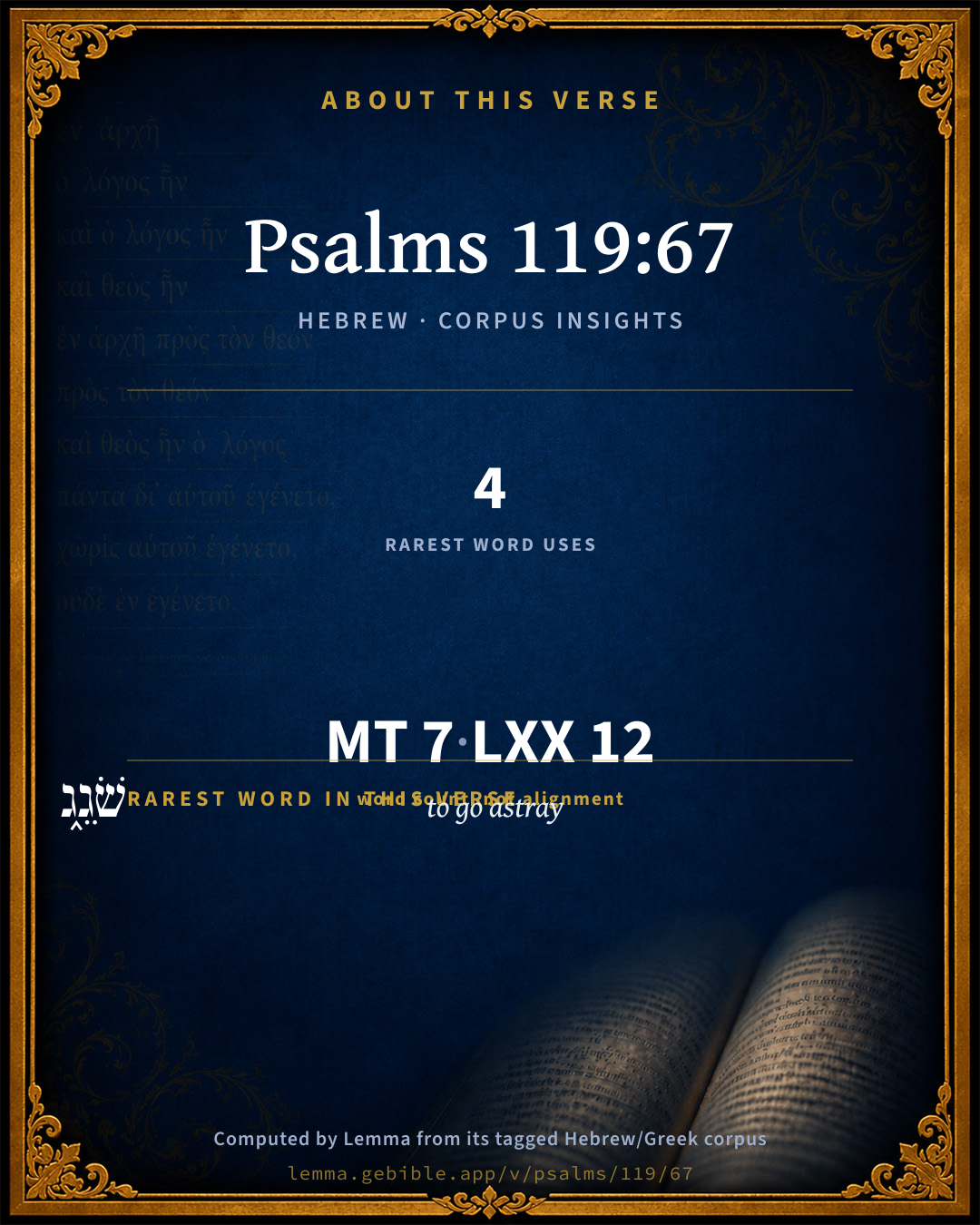
The rarest word here is שֹׁגֵ֑ג to go astray H7683 — appearing just 4 times in the whole Hebrew Bible.

Shared distinctive vocabulary

שֹׁגֵ֑ג to go astray H7683 occurs in 4 verses of the Hebrew Bible. Also found in:

Grammatical profile

  • 3 verbs
  • 1 noun
  • 1 pronoun
  • 2 adverbs

Verb forms

  • אֶ֭עֱנֶה Qal · Imperfect
  • שֹׁגֵ֑ג Qal · Participle Active
  • שָׁמָֽרְתִּי Qal · Perfect

Hebrew & Septuagint length

In English translation the verse runs 13 words from the Hebrew and 12 from the Septuagint (LXX English) — closely comparable.

A rough comparison of the two English renderings, which tokenize alike — not a word-level alignment.

Word counts can differ between the Hebrew and the Greek without any difference in meaning — e.g. the Hebrew direct-object marker אֵת has no separate Greek word, and Greek often adds the article ὁ.

In the original languages it is 7 Hebrew tokens and 12 Greek tokens — but the two are counted differently (Hebrew bundles its prefixes and suffixes into one token; the Greek is in lemma form), so that isn’t a like-for-like length.

Cross-references

15

Topical passages linked to Psalms 119:67 in the Treasury of Scripture Knowledge — connected by theme and wording, ordered by reader-vote popularity; previews shown in the World English Bible.

  • Jeremiah 31:18–19 I have surely heard Ephraim bemoaning himself [thus], You have chastised me, and I was chastised, as a calf unaccustomed [to the yoke]: turn you me, and I shall be turned; for you are Yahweh my God.
  • Psalms 119:71 It is good for me that I have been afflicted, That I may learn your statutes.
  • Hosea 5:15–6:1 I will go and return to my place, until they acknowledge their offense, And seek my face. In their affliction they will seek me earnestly."
  • Psalms 119:75 Yahweh, I know that your judgments are righteous, That in faithfulness you have afflicted me.
  • Psalms 119:176 I have gone astray like a lost sheep. Seek your servant, for I don't forget your commandments.
  • Hebrews 12:5–11 and you have forgotten the exhortation which reasons with you as with children, "My son, don't take lightly the chastening of the Lord, Nor faint when you are reproved by him;
  • Hosea 2:6–7 Therefore, behold, I will hedge up your way with thorns, And I will build a wall against her, That she can't find her way.
  • Revelation 3:10 Because you kept my command to endure, I also will keep you from the hour of testing, which is to come on the whole world, to test those who dwell on the earth.
  • Jeremiah 22:21 I spoke to you in your prosperity; but you said, I will not hear. This has been your manner from your youth, that you didn't obey my voice.
  • Deuteronomy 32:15 But Jeshurun grew fat, and kicked: You have grown fat, you are grown thick, you are become sleek; Then he forsook God who made him, Lightly esteemed the Rock of his salvation.
  • 2 Samuel 11:2–27 It happened at evening, that David arose from off his bed, and walked on the roof of the king's house: and from the roof he saw a woman bathing; and the woman was very beautiful to look on.
  • 2 Chronicles 33:9–13 Manasseh seduced Judah and the inhabitants of Jerusalem, so that they did evil more than did the nations whom Yahweh destroyed before the children of Israel.
  • Proverbs 1:32 For the backsliding of the simple will kill them. The careless ease of fools will destroy them.
  • 2 Samuel 10:19 When all the kings who were servants to Hadarezer saw that they were put to the worse before Israel, they made peace with Israel, and served them. So the Syrians feared to help the children of Ammon any more.
  • Psalms 73:5–28 They are free from burdens of men, Neither are they plagued like other men.

Cross-references courtesy of OpenBible.info (CC BY 4.0).

Hebrew and Greek witnesses Masoretic Hebrew ↔ Greek Septuagint

The same verse in the two great witnesses to the Old Testament, shown verse-for-verse.

You’re reading Greek Psalm 118 (Hebrew Psalm 119). The Septuagint counts the superscription, so verse numbers can differ from the Hebrew — chapter-level alignment, not verse-by-verse. Numbering follows Rahlfs.

These are two independent witnesses, not word-aligned to each other, and the Septuagint is shown in lemma (dictionary) form.

Hebrew Psalms 119:67 Masoretic · Westminster Leningrad Codex

טֶ֣רֶם אֶ֭עֱנֶה אֲנִ֣י שֹׁגֵ֑ג וְ֝עַתָּ֗ה אִמְרָתְךָ֥ שָׁמָֽרְתִּי

Before I was afflicted, I went astray; But now I observe your word.

World English Bible · Public Domain

Greek LXX Greek Psalm 118:67 Septuagint · lemma form

πρό ὁ ἐγώ ταπεινόω ἐγώ πλημμελέω διά οὗτος ὁ λόγιον σύ φυλάσσω

Before I was afflicted, I transgressed; therefore have I kept your word.

LXX2012 (modern English Septuagint) · Public Domain

On this verse, John Gill's Exposition discusses the Septuagint’s reading. Read the note in Commentary ↓

Hebrew: Westminster Leningrad Codex (CC BY 4.0). Greek: Septuagint (public domain); English from LXX2012 (modern English Septuagint) (Public Domain). How the Septuagint differs from the Hebrew →

Commentary

Notes on Psalms 119:67 from classic Christian and Jewish commentators (each source and its license shown beneath its notes). The classic Christian expositions comment on the surrounding passage and are grouped to its opening verse, so a note may address several verses; the Jewish commentaries on the Tanakh (Rashi and others) are per-verse, so they appear only where the commentator wrote on this verse.

Lemma curates 59 commentaries, every one of them public domain or Creative Commons licensed, each selected and text-cleaned for this edition rather than reprinted as found. About our sources →

Trapp's Complete Commentary

John Trapp

Psa 119:67 Before I was afflicted I went astray: but now have I kept thy word.

Ver. 67. Before I was afflicted I went astray] Especially through high mindedness and earthly mindedness, which are purged out by affliction, and grace increased; as fish thrive better in cold and salt waters, as the walnut tree is most fruitful when most beaten. Master Ascham was a good schoolmaster to Queen Elizabeth, but affliction was a better, &c. See my Treatise on Rev 3:19.

But now I have kept thy word] Now that I have been lashed to it, and have paid for my learning; Vexatio dat intellectum, Smart maketh wit. As the scourging and beating of the garment with a stick beateth out the moths and dust, so do afflictions corruptions from the heart. Quae nocent, docent. Corrections of instructions are the way of life, Pro 6:23

John Trapp, A Commentary or Exposition upon All the Books of the Old and New Testament (1647–1656) — public domain. Text from a community e-Sword module.

The Biblical Illustrator

Joseph S. Exell

Psa_119:67

Before I was afflicted I went astray: but now have I kept Thy Word.

The fruits of sanctified affliction

1. Your afflictions, if sanctified, will lead you to searchings of heart. Many sins, long forgotten, are now recalled to remembrance. Then, retiring, into the secret recesses of the spirit, where latent evils are concealed, you view yourselves in a true light, and form the right estimate of your characters.

2. Will dispose you to justify God even under the most trying dispensations. When you reflect on all that God hath done for you, and on your own sinfulness and ingratitude, you will perceive abundant cause to condemn yourselves, and to justify God.

3. Will greatly enhance your estimate of Christ and His salvation. In all His offices, characters, and relations He is most precious to you.

4. Will lead you to a more perfect understanding of the Scriptures.

5. Will work in you patience and submission to the Divine will. Tribulation worketh patience.

6. Will enhance a spirit of sympathy with others similarly situated.

7. Will enable you to form a correct estimate of the things of the world.

8. Will induce in you a more unreserved consecration to the service of Christ.

9. Will excite in you more ardent desires for that glorious condition of existence where sorrow will be unknown. (T. Swan.)

The Biblical Illustrator, edited by Joseph S. Exell (c. 1880s–1900s) — public domain. Text from a community e-Sword module.

Joseph Benson's Commentary

Psa 119:67-68. Before I was afflicted I went astray — As men too generally do in their prosperity. Thou art good — Gracious and bountiful in thy nature; and dost good — To all men, both good and bad, (Mat 5:45,) and in all things, yea, even when thou afflictest. Teach me thy statutes — Which is the good I chiefly desire.

Joseph Benson's Commentary on the Old and New Testaments (1811–1818) — public domain. Text from a community e-Sword module.

J. A. Alexander on Psalms

Joseph Addison Alexander

67. (Psa 119:67) Before I suffered I (was) going astray, and now thy saying I observe. Going astray, wandering, erring, i. e. habitually, ever straying. And now (on the contrary), where our idiom would require a but. The saying of God is what he says, including both commands and promises, which indeed are represented in the Old Testament, and especially in this psalm, as inseparable. Observe, attend to, keep in view, according to the nature of the object, trusting the promise, obeying the command. The last verb strictly means I have observed, implying that the salutary fruit of the affliction was already realised and still continued. The sentiment of this verse has been echoed, and its very words repeated, by the godly sufferers of every age, a strong proof that it was meant to be so used. At the same time it furnishes an exquisite description of the effect produced upon the Jews, as a body, by the Babylonish exile, and especially the end which it for ever put to their continual lapses into idolatry, by which their early history was characterised, and with respect to which the whole race might well have said, Before I suffered I was (ever) straying.

Joseph Addison Alexander, The Psalms Translated and Explained (1850) — public domain. Text from a community e-Sword module.

Geneva Bible (1599)

Geneva Bible translators

So Jeremiah saith, that before the Lord touched him, he was like a calf untamed: so that the use of God’s rod is to call us home to God.

Geneva Bible (1599) marginal notes — public domain. Text via Bolls.life.

Matthew Henry's Commentary

David here tells us what he had experienced, 1. Of the temptations of a prosperous condition: "Before I was afflicted, while I lived in peace and plenty, and knew no sorrow, I went astray from God and my duty." Sin is going astray; and we are most apt to wander from God when we are easy and think ourselves at home in the world. Prosperity is the unhappy occasion of much iniquity; it makes people conceited of themselves, indulgent of the flesh, forgetful of God, in love with the world, and deaf to the reproofs of the word. See Psa 30:6. It is good for us, when we are afflicted, to remember how and wherein we went astray before we were afflicted, that we may answer the end of the affliction. 2. Of the benefit of an afflicted state: "Now have I kept thy word, and so have been recovered from my wanderings." God often makes use of afflictions as a means to reduce those to himself who have wandered from him. Sanctified afflictions humble us for sin and show us the vanity of the world; they soften the heart, and open the ear to discipline. The prodigal's distress brought him to himself first and then to his father.

Matthew Henry's Commentary on the Whole Bible (1708–1710) — public domain (CC PDM 1.0). Text via the HelloAO Bible API.

Adam Clarke's Commentary

Verse 67. Before I was afflicted I went astray] Many have been humbled under affliction, and taught to know themselves and humble themselves before God, that probably without this could never have been saved; after this, they have been serious and faithful. Affliction sanctified is a great blessing; unsanctified, it is an additional curse.

Adam Clarke's Commentary on the Bible (1810–1826) — public domain. Text from a community e-Sword/MySword module.

John Calvin's Commentaries

67. Before I was brought low I went astray As the verb ענה anah, sometimes signifies to speak, or to testify, some adopt this rendering, Before I meditated upon thy statutes I went astray; but this seems too forced. Others go still farther from the meaning, in supposing it to be, that when the prophet went astray, he had nothing to say in answer to God. I will not stop to refute these conceits, there being no ambiguity in the words. David in his own person describes either that wantonness or rebellion, common to all mankind, which is displayed in this, that we never yield obedience to God until we are compelled by his chastisements. It is indeed a monstrous thing obstinately to refuse to submit ourselves to Him; and yet experience demonstrates, that so long as he deals gently with us, we are always breaking forth into insolence. Since even a prophet of God required to have his rebellion corrected by forcible means, this kind of discipline is assuredly most needful for us. The first step in obedience being the mortifying of the flesh, to which all men are naturally disinclined, it is not surprising if God bring us to a sense of our duty by manifold afflictions. Yea, rather as the flesh is from time to time obstreperous, even when it seems to be tamed, it is no wonder to find him repeatedly subjecting us anew to the rod. This is done in different ways. He humbles some by poverty, some by shame, some by diseases, some by domestic distresses, some by hard and painful labors; and thus, according to the diversity of vices to which we are prone, he applies to each its appropriate remedy. It is now obvious how profitable a truth this confession contains. The prophet speaks of himself even as Jeremiah, (Jeremiah 31:18,) in like manner, says of himself, that he was “as a bullock unaccustomed to the yoke;” but still he sets before us an image of the rebellion which is natural to us all. We are very ungrateful, indeed, if this fruit which we reap from chastisements do not assuage or mitigate their bitterness. So long as we are rebellious against God, we are, in a state of the deepest wretchedness: now, the only means by which He bends and tames us to obedience, is his instructing us by his chastisements. The prophet, at the same time, teaches us by his own example, that since God gives evidence of his willingness that we should become his disciples, by the pains he takes to subdue our hardness, we should at least endeavor to become gentle, and, laying aside all stubbornness, willingly bear the yoke which he imposes upon us.

The next verse needs no explanation, being nearly of the same import as the last verse of the former eight. He beseeches God to exercise his goodness towards him, not by causing him to increase in riches and honors, or to abound in pleasures, but by enabling him to make progress in the knowledge of the law. It is usual for almost all mankind to implore the exercise of God’s goodness towards them, and to desire that he would deal bountifully with them, in the way of gratifying the diversity of the desires into which they are severally hurried by the inclinations of the flesh; but David protests that he would be completely satisfied, provided he experienced God to be liberal towards him in this one particular, which almost all men pass over with disdain.

John Calvin's Commentaries (1540-1563) — public domain. Text from the Calvin Translation Society English edition (1840s-50s) via the Christian Classics Ethereal Library (ccel.org). Calvin's coverage is partial (roughly two-thirds of the Bible); uncommented books and verses are honest gaps, never fabricated. The 19th-century editor's footnotes and remarks are omitted so the notes are faithfully Calvin's own voice.

Ellicott's Commentary for English Readers

(67) That there is allusion here to the Babylonian exile, and its moral and religious effect on the nation, there can be little doubt.

A Bible Commentary for English Readers, edited by Charles John Ellicott (1878–1897) — public domain. Text from a community e-Sword module.

The Cambridge Bible for Schools and Colleges

gen. ed. J. J. S. Perowne

67. I went astray] I did err; the word used in Lev_5:18; Num_15:28. The verse is equally applicable to Israel as a nation, taught by the discipline of exile, or to the Psalmist as an individual. Cp. Psa_119:71; Psa_119:75; Psa_118:18; Job_5:17.

The Cambridge Bible for Schools and Colleges (gen. ed. J. J. S. Perowne; Cambridge University Press, 1878–1918) — public domain. Text from a community e-Sword module.

John Gill's Exposition

Their heart is as fat as grease,.... Or tallow, a lump of it, fat or grease congealed. That is, the heart of the above proud persons, who abounded in riches, were glutted with the things of this world; had more than heart could wish, and so became proud and haughty: or their hearts were gross, sottish, senseless, and stupid, as persons fat at heart are; or as creatures over fat, which have little or no feeling: so these had no knowledge of the law of God, no sense of their duty, no remorse of conscience for sin; their hearts were hardened, and they past feeling, and given up to a reprobate mind; see Isa 6:9; The Targum is,

"the imagination of their heart is become gross as fat:''

the Septuagint is, "curdled like milk"; that is, hardened, as Suidas (s) interprets it;

but I delight in thy law; after the inward man; as the apostle did, Rom 7:22; as fulfilled in Christ; as in his hands, as King and Lawgiver; as written upon his own heart; and so yielding a ready and cheerful obedience to it; he delighted in reading the law, in meditating on it, and in observing it.

(s) In voce

John Gill's Exposition of the Whole Bible (1746–1763) — public domain (CC PDM 1.0). Text via the HelloAO Bible API.

Albert Barnes' Notes on the Bible

Before I was afflicted - The Septuagint and the Latin Vulgate, “Before I was humbled.” The Hebrew word has the general sense of being afflicted, and may refer to any kind of trial.

I went astray - The Hebrew word means to wander; to err; to do wrong; to transgress. Num 15:28; Job 12:16. It here means that he forgot his duty; that he fell into sin; that he departed from what was right; that he embraced erroneous views; that he lived in the neglect of his soul, the neglect of duty, and the neglect of God. Prosperity had not led him to fulfill duty; to seek salvation; to trust in God. This was, in his case, as it is in thousands of others, the experience of his life. Hence, affliction often becomes so necessary to check us when we are going astray, and so useful in recalling us to the ways of duty and of truth.

But now have I kept thy word - Since I was afflicted. The effect has been to recall me from my wanderings, and to turn me to paths of duty and holiness. This is an effect often - very often - experienced; this is language which can be used by many a child of God. Of those who are the children of God it may be said that they are “always” benefited “sooner” or “later” by afflictions. It may not be at the time of the affliction (compare Heb 12:11), but the “ultimate” effect is in all cases to benefit them. Some error is corrected; some evil habit changed; some mode of life not consistent with religion is forsaken; pride is humbled; the heart is quickened in duty; habits of prayer are resumed or formed; the affections are fixed on a better world; the soul is made more gentle, calm, humble, spiritual, pure. Afflictions are among the most precious means of grace. They are entirely under the direction of God. They may be endlessly varied, and adapted to the case of every individual.

God knows every heart, and the best way to reach any heart. By sickness; by disappointment; by loss of property; by bereavement; by blighted hopes; by the ingratitude of others; by the unkindness of professed friends, and the malice of enemies; by domestic troubles; by the misconduct of children - perhaps the most severe of all human ills, and the hardest to bear; in ten thousand ways God can reach the heart, and break and crush it, and make it ready for the entrance of truth - as the farmer breaks and pulverizes the soil by the plow and the harrow, so that it shall be prepared to receive the seed. Compare the notes at Isa 28:24-29. Among those things for which good men have most occasion for thankfulness are afflictions; and when we lie down on the bed of death, and look over life and the divine dealings with us through life, as the glories of heaven are about to open upon us, we shall feel that among the chiefest mercies of God are those dealings of his holy hand, trying at the time, which kept us from going astray, or which recalled us when we had wandered from him - and “that in our life, now closing, there has not been one trial too much.”

Albert Barnes' Notes on the Bible (1834–1885) — public domain. Text from a community e-Sword/MySword module.

Matthew Poole's English Annotations

I went astray, as men generally do in their prosperity. See Deu 32:15; Psa 73:4-6, &c.; Pro 1:32; Jer 22:21.

Matthew Poole's English Annotations on the Holy Bible (1683–1685) — public domain. Text from a community e-Sword/MySword module.

The Treasury of David

Charles H. Spurgeon

Ver. 67. Before I was afflicted I went astray. Partly, perhaps, through the absence of trial. Often our trials act as a thorn hedge to keep us in the good pasture, but our prosperity is a gap through which we go astray. If any of us remember a time in which we had no trouble, we also probably recollect that then grace was low and temptation was strong. It may be that some believer cries, "O that it were with me as in those summer days before I was afflicted." Such a sigh is most unwise, and arises from a carnal love of ease: the spiritual man who prizes growth in grace will bless God that those dangerous days are over, and that if the weather be more stormy it is also more healthy. It is well when the mind is open and candid, as in this instance: perhaps David would never have known and confessed his own straying if he had not smarted under the rod. Let us join in his humble acknowledgments, for doubtless we have imitated him in his straying. Why is it that a little ease works in us so much disease? Can we never rest without rusting? Never be filled without waxing fat? Never rise as to one world without going down as to another! What weak creatures we are to be unable to bear a little pleasure! What base hearts are those which turn the abundance of God's goodness into an occasion for sin.

But now have I kept thy word. Grace is in that heart which profits by its chastening. It is of no use to plough barren soil. When there is no spiritual life affliction works no spiritual benefit; but where the heart is sound trouble awakens conscience, wandering is confessed, the soul becomes again obedient to the command, and continues to be so. Whipping will not turn a rebel into a child; but to the true child a touch of the rod is a sure corrective. In the Psalmist's case the medicine of affliction worked a change "but"; an immediate change "now"; a lasting change "have I" an inward change "have I kept"; a change towards God "thy word." Before his trouble he wandered, but after it he kept within the hedge of the word, and found good pasture for his soul the trial tethered him to his proper place; it kept him, and then he kept God's word. Sweet are the uses of adversity, and this is one of them, it puts a bridle upon transgression and furnishes a spur for holiness.

Ver. 67. Before I was afflicted I went astray, etc. Not that he wilfully, wickedly, maliciously, and through contempt, departed from his God; this lie denies (Ps 18:21); but through the weakness of the flesh, the prevalence of corruption, and the force of temptation, and very much through a careless, heedless, and negligent frame of spirit, he got out of the right way, and wandered from it before he was well aware. The word is used of erring through ignorance (Le 5:18). This was in his time of prosperity, when, though he might not, like Jeshurun, wax fat and kick, and forsake and lightly esteem the Rock of his salvation; or fall into temptations and hurtful lusts, and err from the faith, and be pierced with many sorrows; yet he might become inattentive to the duties of religion, and be negligent of them, which is a common case. John Gill.

Ver. 67. Before I was afflicted. The Septuagint and Latin Vulgate, "Before I was humbled." The Hebrew word has the general sense of being afflicted, and may refer to any kind of trial. Albert Barnes.

Ver. 67. Before I was afflicted. Prosperity is a more refined and severe test of character titan adversity, as one hour of summer sunshine produces greater corruption than the longest winter day. Eliza Cook.

Ver. 67. I was afflicted. God in wisdom deals with us as some great person would do with a disobedient son, that forsakes his house, and riots among his tenants. His father gives orders that they should treat him ill, affront, and chase him from them, and all, that he might bring him back. The same doth God: man is his wild and debauched son; he flies from the commands of his father, and cannot endure to live under his strict and severe government. He resorts to the pleasures of the world, and revels and riots among the creatures. But God resolves to recover him, and therefore commands every creature to handle him roughly. "Burn him, fire; toss him, tempests, and shipwreck his estate; forsake him, friends; designs, fail him; children, be rebellious to him, as he is to me; let his supports and dependencies sink under him, his riches melt away, leave him poor, and despised, and destitute." These are all God's servants, and must obey his will. And to what end is all this, but that, seeing himself forsaken of all, he may at length, like the beggared prodigal, return to his father? Ezekiel Hopkins, 1633-1690.

Ver. 67. I was afflicted. As men clip the feathers of fowls, when they begin to fly too high or too far; even so doth God diminish our riches, etc., that we should not pass our bounds, and glory too much of such gifts. Otho Wermullerus.

Ver. 67. But now have I kept thy word.

Affliction brings Man Home.

"Man like a silly sheep doth often stray,

Not knowing of his way,

Blind deserts and the wilderness of sin

He daily travels in;

There's nothing will reduce him sooner than

Afflictions to his pen.

He wanders in the sunshine, but in rain

And stormy weather hastens home again."

"Thou, the great Shepherd of my soul, O keep

Me, my unworthy sheep

From gadding: or if fair means will not do it,

Let foul, then, bring me to it.

Rather then I should perish in my error,

Lord bring me back with terror;

Better I be chastised with thy rod

And Shepherd's staff, than stray from thee, my God."

"Though for the present stripes do grieve me sore,

At last they profit more,

And make me to observe thy word, which I

Neglected formerly;

Let me come home rather by weeping cross

Than still be at a loss.

For health I would rather take a bitter pill,

Than eating sweet meats to be always ill." Thomas Washbourne, 1606-1687.

Ver. 67. From the countless throng before the throne of God and the Lamb, we may yet hear the words of the Psalmist, "Before I was afflicted I went astray: but now have I kept thy word." There is many an one who will say, "Behold, happy is the man whom God correcteth" (Joh 5:17). One would tell you that his worldly undoing was the making of his heavenly prospects; and another that the loss of all things was the gain of All in All. There are multitudes whom God has afflicted with natural blindness that they might gain spiritual sight; and those who under bodily infirmities and diseases of divers sorts have pined and wasted away this earthly life, gladly laying hold on glory, honour, and immortality instead. William Garrett Lewis, in "Westbourne Grove Sermons", 1872.

Ver. 67. By affliction God separates the sin which he hates from the soul which he loves. John Mason.

Ver. 67.

1. The dangers of prosperity.

2. The benefits of adversity. G.R.

Ver. 67. The restraining power of affliction

Ver. 67,71,75. Affliction thrice viewed and thrice blessed. I

1. Before affliction: straying.

2. In affliction: learning.

3. After affliction: knowing. C.A.D.

Psalms 119:68*

Charles H. Spurgeon's The Treasury of David (1869–1885) — public domain. Psalms only. Text from a community e-Sword/MySword module.

The Pulpit Commentary

Before I was afflicted I went astray. "Sweet are the uses of adversity." The psalmist feels end confesses that the afflictions, which he has suffered (see comment on ver. 65), have been good for him. They have made him less apt to "go astray" than he was (comp. ver. 71). But now have I kept thy Word (comp. vers. 51, 56, 87, etc.).

The moral service of affliction.

We are constantly dealing with the mission of affliction to the spiritual life. It may come with some freshness to follow the thought of the psalmist here, and see that the experience of affliction tells directly on the practical life of duty and relationship. It masters that growing self-willedness which leads the good man to try and take life into his own hands; and brings to him the humility and self-distrust which incline to keep well within the limits of God"s Word. "If any of us remember a time in which we had no trouble, we also probably recollect that then grace was low, and temptation was strong." As an illustration in a larger sphere, Bishop Wordsworth"s suggestion may be taken, "This was eminently true of the Hebrew nation. Before the Captivity, they had been torn by schisms Israel against Judah, and Judah against Israel, and corrupted by idolatry; but they were purified from these evils by their afflictions.

I AFFLICTIONS PROVIDE TIMES OF MEDITATION. They are to the moral life what sabbaths are to the bodily life. They stop the rush; they affirm that there is something more important than self-interest; they compel quietness; they give opportunity for reviewing. When we can do nothing, we have a chance of thinking. Let life go on without changes or trials, and the sell must assume exaggerated importance. How can a man keep nobly dependent on God, who finds everything prosper under the hand of his energy? Affliction comes, makes him stop and think, and look back and up.

II AFFLICTIONS TONE TIMES OF MEDITATION. Distinguish between the tone of meditations in our holiday-times, and in our times of affliction. In the one case we have bodily health; in the other, bodily weakness. It is an element of importance that suffering and pain should give tone to meditation; but it is needful to bear in mind that affliction may make meditation exaggerated, one-sided, or unworthy. The meditation of such times needs Divine guiding and sanctifying.

III AFFLICTIONS PASS INTO NEW OPPORTUNITY. When a man comes back to life from a sick-bed, it is as if he began life afresh; with this difference he had to grow into experience, now he has the opportunity to use experience. Habits are broken. He can make a new way, ordered and shaped by the new resolves based on the meditations of his affliction. R.T.

The Pulpit Commentary (1880–1919), ed. H.D.M. Spence-Jones & Joseph S. Exell — public domain. Text from a community e-Sword module.

unfoldingWord translationNotes

Door43 World Missions Community

Before I was afflicted

This can be stated in active form. AT: "Before you afflicted me" or "Before you punished me" (See: Active or Passive)

I went astray

Disobeying God is spoken of as if the person walked on the wrong path. AT: "I disobeyed you" (See: Metaphor)

I observe your word

Here "word" represents commandments. AT: "I obey your commandments" (See: Metonymy)

translationWords

afflicted

astray

statute

unfoldingWord translationNotes — © Distant Shores Media and the Door43 World Missions Community, licensed CC BY-SA 4.0. Source: git.door43.org/Door43/en_tn.

Rashi

Rabbi Shlomo Yitzchaki (Rashi)

Before I recited to You about Your commandments, before I uttered them in the study halls, I erred in them and sinned. But now that I have recited them, I kept your Torah, for study teaches me to turn away from sin: therefore, I beg of You, “Teach me the best of reason and knowledge.”

I recited Heb. אענה, an expression of studying and reciting in the study hall, like (verse 172): “My tongue will utter (תען) Your word.” Similarly (Mal. 2:12): “From the man who commits it, the Lord shall cut off one of acuity or erudition (ועונה) from the tents of Jacob.” An ingenious one among the sages, and one who can answer among the students.

Rashi on the Tanakh — English translations: “The Judaica Press complete Tanach with Rashi, translated by A. J. Rosenberg” (CC BY 4.0); “Pentateuch with Rashi's commentary by M. Rosenbaum and A.M. Silbermann, 1929-1934” (public domain); “The Metsudah Tanach series, Lakewood, N.J” (CC BY 4.0); and “The Book of Joshua, Metsudah Publications, 1997” (CC BY 4.0). Text via Sefaria.

Lesson kit

Teaching starters — assembled from the data on this page, not authored interpretation. Every prompt links to the verse data it draws on. Edit before teaching.

Psalms, in the Wisdom, opens this verse with 7 words (7 distinct Hebrew lemmas). Its most distinctive word is shâgag (“to go astray”). A historical commentator’s framing appears above. Read the whole chapter for the surrounding context.

Discussion questions

  1. The word shâgag carries the sense “to go astray.” How does it shape the verse?
  2. Leviticus 5:18 shares the word «to go astray» with this verse. How do the two illuminate each other?
  3. These translations render this verse differently. What is at stake in choosing one wording over another?
  4. The verb «אֶ֭עֱנֶה» is Qal Imperfect. How does its form color the action?
  5. Reading how Trapp's Complete Commentary and The Biblical Illustrator read this verse, where do the two commentators agree and where do they part?

Things to notice

Reading settings

Reading text

Shown beneath each verse's original-language words.

Old Testament
Old Testament edition

Read the OT as the Masoretic Hebrew (MT) or the Greek Septuagint (LXX).

English shown for the Greek Septuagint (in the Hebrew ↔ Greek comparison).

Comparing translations? Open the Compare panel on any verse page to stack up to four side by side.