
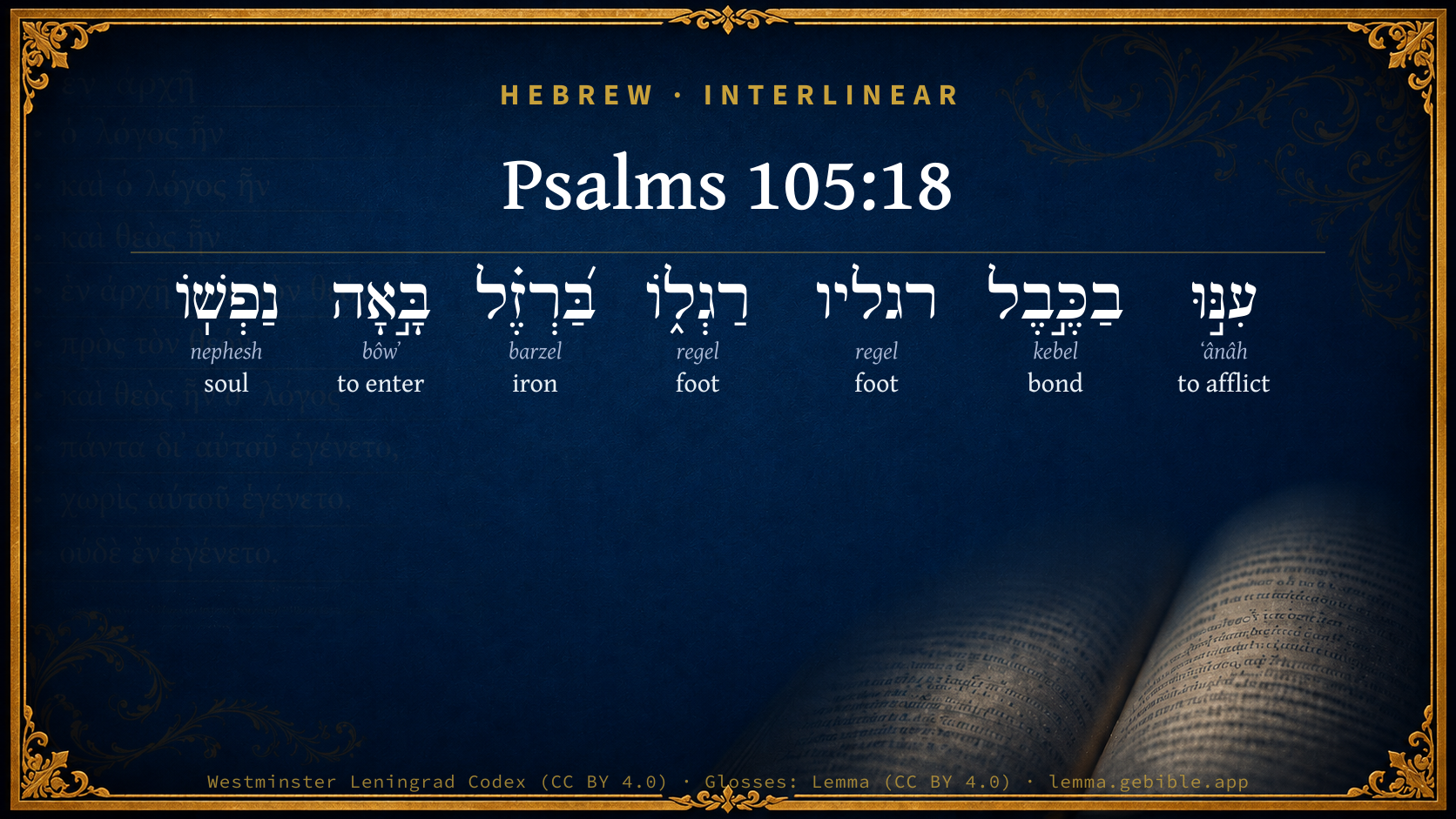
Psalms 105:18

Hebrew (Westminster Leningrad Codex) Psalms 105:18 appears in the Hebrew Old Testament. The text above is from the Westminster Leningrad Codex. Each word links to its Strong’s number, a concise gloss, and parsing drawn from the Open Scriptures Hebrew Bible morphology. Click any word for its full Brown-Driver-Briggs (BDB) entry.
Download image
Cite this verse

Psalms 105:18 (World English Bible). Public Domain. Lemma interlinear Bible study tool, https://lemma.gebible.app/v/psalms/105/18.

Show BibTeX & RIS
BibTeX
RIS
English Translation
They bruised his feet with shackles. His neck was locked in irons,
World English Bible · Public Domain
Highlights
  • 1 first appearance in the Hebrew Bible
Full analysis ↓
Download a study sheet

One document with this verse’s original text, its word-by-word gloss line, the meaning frame, cross-references with their text, attributed commentary, and full source and license credits — printable, and it pastes into notes with its structure intact.

This verse Autodidact and up

Study sheet (.html) Plain text (.txt)

A passage Seminary Student

Up to 50 verses in one chapter. A passage sheet keeps up to 6 commentary sources and 12 cross-references per verse, in the order this page ranks them, and says so on the sheet whenever that leaves anything out. Ask for a single verse and you get the Autodidact verse sheet above.

Everything on this page stays free to read, with no account — the sheet is a download of what is already on screen, not access to it.

Want to remove ads? Support Godless Engineer
Compare translations 3

The same verse in 3 English versions, stacked beneath the original-language interlinear above. Click any original word for its lexicon entry.

Each is an independent rendering of the whole verse — the interlinear is not word-aligned to these translations.

Highlighted words mark where these versions differ — a whole-verse word diff, not a word-by-word alignment.

  • World English Bible Public Domain
    They bruised his feet with shackles. His neck was locked in irons,
  • King James Version Public Domain
    Whose feet they hurt with fetters: he was laid in iron:
  • unfoldingWord Literal Text CC BY-SA 4.0
    They oppressed his feet in a shackle; his neck went into the iron,

unfoldingWord Literal Text — © unfoldingWord, licensed CC BY-SA 4.0. Word-aligned USFM3 via Door43 (git.door43.org/unfoldingWord/en_ult).

Versions to compare (up to 4)

3 of 4 selected

Show all 18 translations

Every available English version of this verse, each an independent rendering of the whole verse.

  • World English Bible Public Domain
    They bruised his feet with shackles. His neck was locked in irons,
  • Berean Standard Bible Public Domain
    They bruised his feet with shackles and placed his neck in irons,
  • Majority Standard Bible Public Domain
    They bruised his feet with shackles and placed his neck in irons,
  • King James Version Public Domain
    Whose feet they hurt with fetters: he was laid in iron:
  • American Standard Version (1901) Public Domain
    His feet they hurt with fetters: He was laid in `chains of' iron,
  • Revised Version (1885) Public Domain
    His feet they hurt with fetters; he was laid in chains of iron:
  • Geneva Bible (1599) Public Domain
    They helde his feete in the stockes, and he was laide in yrons,
  • Douay-Rheims (1899) Public Domain
    They humbled his feet in fetters: the iron pierced his soul,
  • Young's Literal Translation Public Domain
    They have afflicted with fetters his feet, Iron hath entered his soul,
  • Literal Standard Version CC BY-SA 4.0
    They have afflicted his feet with chains, || Iron has entered his soul,
  • Unlocked Literal Bible CC BY-SA 4.0
    His feet were bound by shackles; on his neck was put an iron collar,
  • unfoldingWord Literal Text CC BY-SA 4.0
    They oppressed his feet in a shackle; his neck went into the iron,
  • Darby Bible Public Domain
    They afflicted his feet with fetters; his soul came into irons;
  • World Messianic Bible Public Domain
    They bruised his feet with shackles. His neck was locked in irons,
  • Webster's Bible Public Domain
    Whose feet they hurt with fetters: he was laid in iron:
  • Free Bible Version CC BY-SA 4.0
    They hurt his feet by placing them in shackles, and they put an iron collar around his neck,
  • Bible in Basic English Public Domain
    His feet were fixed in chains; his neck was put in iron bands;
  • JPS Tanakh (1917) Public Domain
    His feet they hurt with fetters, his person was laid in iron;

Literal Standard Version (2020), Covenant Press — licensed CC BY-SA 4.0. Text via the HelloAO Bible API (eBible.org). Unlocked Literal Bible (unfoldingWord) — licensed CC BY-SA 4.0. Text via the HelloAO Bible API (eBible.org). unfoldingWord Literal Text — © unfoldingWord, licensed CC BY-SA 4.0. Word-aligned USFM3 via Door43 (git.door43.org/unfoldingWord/en_ult). Free Bible Version, Dr. Jonathan Gallagher — licensed CC BY-SA 4.0. Text via the HelloAO Bible API (eBible.org).

Word by word

More ways to search: Search by grammar → Find every occurrence → Compare this word →

Practice this passage: Drill this verse → Learn its vocabulary →

About this verse

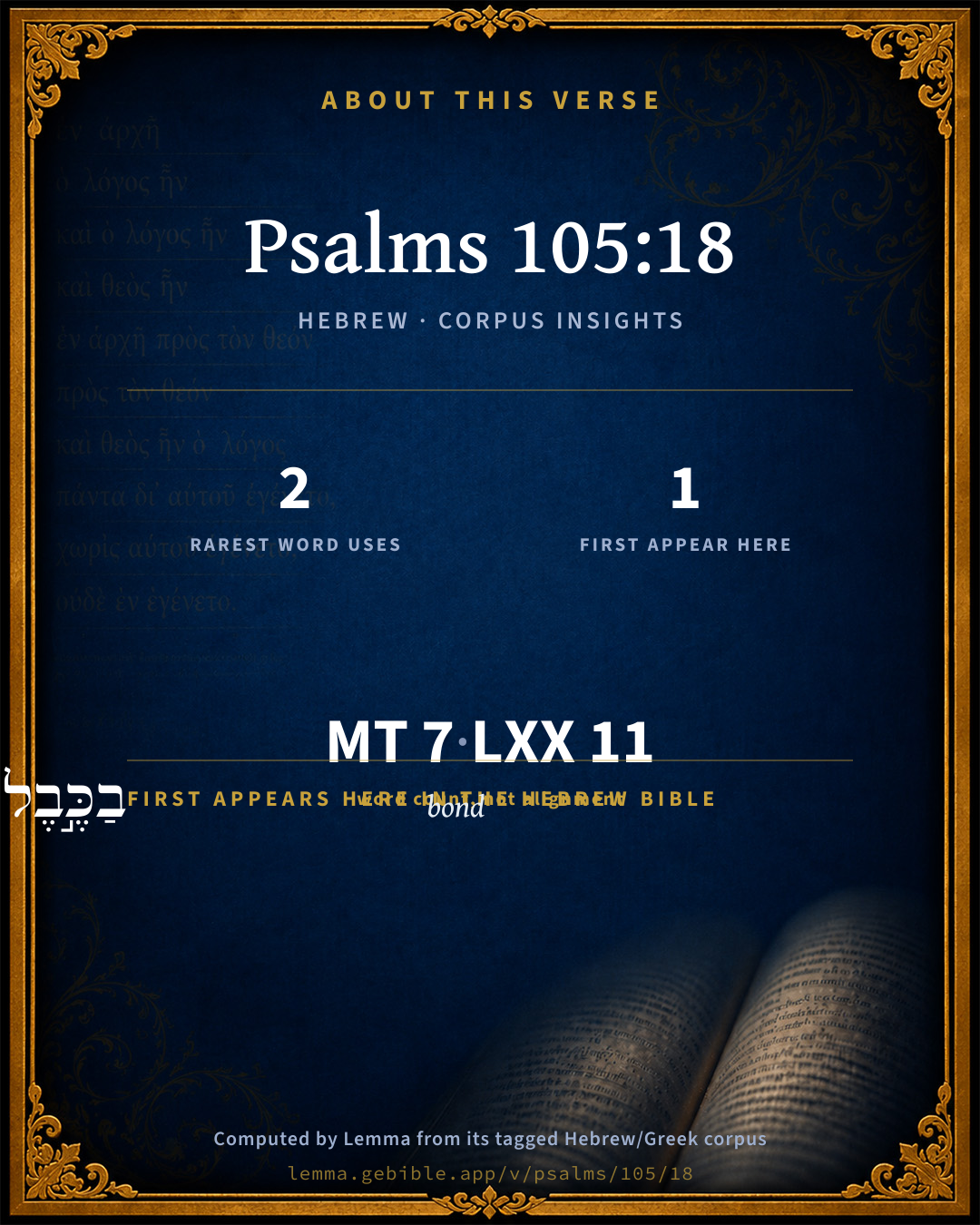
These counts appear in no published source. They are computed here, from the morphology-tagged text and Lemma’s own curated glosses. What Lemma adds →

7
words
6
distinct lemmas
Wisdom
section

Notable vocabulary

The rarest word here is בַכֶּ֣בֶל bond H3525 — appearing just 2 times in the whole Hebrew Bible.

First appearance in Scripture

This word makes its first canonical appearance in the Hebrew Bible here:

  • בַכֶּ֣בֶל bond H3525

Shared distinctive vocabulary

בַכֶּ֣בֶל bond H3525 occurs in 2 verses of the Hebrew Bible. Also found in:

Grammatical profile

  • 2 verbs
  • 5 nouns

Verb forms

  • עִנּ֣וּ Piel · Perfect
  • בָּ֣אָה Qal · Perfect

Repetition

A word recurs within this verse — often emphatic in Hebrew:

  • רגליו foot H7272 ×2

Hebrew & Septuagint length

In English translation the verse runs 12 words from the Hebrew and 11 from the Septuagint (LXX English) — closely comparable.

A rough comparison of the two English renderings, which tokenize alike — not a word-level alignment.

Word counts can differ between the Hebrew and the Greek without any difference in meaning — e.g. the Hebrew direct-object marker אֵת has no separate Greek word, and Greek often adds the article ὁ.

In the original languages it is 7 Hebrew tokens and 11 Greek tokens — but the two are counted differently (Hebrew bundles its prefixes and suffixes into one token; the Greek is in lemma form), so that isn’t a like-for-like length.

Cross-references

4

Topical passages linked to Psalms 105:18 in the Treasury of Scripture Knowledge — connected by theme and wording, ordered by reader-vote popularity; previews shown in the World English Bible.

  • Genesis 39:20 Joseph's master took him, and put him into the prison, the place where the king's prisoners were bound, and he was there in custody.
  • Genesis 40:15 For indeed, I was stolen away out of the land of the Hebrews, and here also have I done nothing that they should put me into the dungeon."
  • Acts 16:24 who, having received such a charge, threw them into the inner prison, and secured their feet in the stocks.
  • Psalms 107:10 Some sat in darkness and in the shadow of death, Being bound in affliction and iron,

Cross-references courtesy of OpenBible.info (CC BY 4.0).

Hebrew and Greek witnesses Masoretic Hebrew ↔ Greek Septuagint

The same verse in the two great witnesses to the Old Testament, shown verse-for-verse.

You’re reading Greek Psalm 104 (Hebrew Psalm 105). The Septuagint counts the superscription, so verse numbers can differ from the Hebrew — chapter-level alignment, not verse-by-verse. Numbering follows Rahlfs.

These are two independent witnesses, not word-aligned to each other, and the Septuagint is shown in lemma (dictionary) form.

Hebrew Psalms 105:18 Masoretic · Westminster Leningrad Codex

עִנּ֣וּ בַכֶּ֣בֶל רגליו רַגְל֑וֹ בַּ֝רְזֶ֗ל בָּ֣אָה נַפְשֽׁוֹ

They bruised his feet with shackles. His neck was locked in irons,

World English Bible · Public Domain

Greek LXX Greek Psalm 104:18 Septuagint · lemma form

ταπεινόω ἐν πέδη ὁ πούς αὐτός σίδηρος διαἔρχομαι ὁ ψυχή αὐτός

They hurt his feet with fetters; his soul passed into iron,

LXX2012 (modern English Septuagint) · Public Domain

On this verse, Ellicott's Commentary for English Readers discusses the Septuagint’s reading. Read the note in Commentary ↓

Hebrew: Westminster Leningrad Codex (CC BY 4.0). Greek: Septuagint (public domain); English from LXX2012 (modern English Septuagint) (Public Domain). How the Septuagint differs from the Hebrew →

Commentary

Notes on Psalms 105:18 from classic Christian and Jewish commentators (each source and its license shown beneath its notes). The classic Christian expositions comment on the surrounding passage and are grouped to its opening verse, so a note may address several verses; the Jewish commentaries on the Tanakh (Rashi and others) are per-verse, so they appear only where the commentator wrote on this verse.

Lemma curates 59 commentaries, every one of them public domain or Creative Commons licensed, each selected and text-cleaned for this edition rather than reprinted as found. About our sources →

Trapp's Complete Commentary

John Trapp

Psa 105:18 Whose feet they hurt with fetters: he was laid in iron:

Ver. 18. Whose feet they hurt with fetters] God hereby fitting him for that great service; as he did afterwards Moses, by forty years’ banishment in Midian, and David, by Saul’s persecution, till his soul was even as a weaned child, Psa 131:2.

He was laid in iron] Heb. His soul came into iron; or, the iron entered into his soul; but sin entered not into his conscience. See a like phrase Luk 2:35.

John Trapp, A Commentary or Exposition upon All the Books of the Old and New Testament (1647–1656) — public domain. Text from a community e-Sword module.

J. A. Alexander on Psalms

Joseph Addison Alexander

18. (Psa 105:18) They hurt, with the fetter, his feet; into iron came his soul. That Joseph was actually chained or fettered is included in the true sense of the word bound, applied to him in the history. See Gen 40:3, and compare Gen 39:20; Gen 39:22. They, the Egyptians, or his gaolers; or the verb may be indefinitely construed, as if it had been said, his feet were hurt. The verb means elsewhere to humble or mortify, but is here used in its strict sense of afflicting, causing to suffer. The Prayer Book version of the last clause, the iron entered into his soul, is ungrammatical, the word for iron being masculine, while that for soul is, like the verb, feminine. The general sense is given in the text of the English Bible, and the exact form in the margin. The mention of the soul, as in many other cases, is of course not meant to be exclusive of the body, but to suggest the idea or intimate and heartfelt suffering. See above, on Psa 3:2; Psa 11:1, etc.

Joseph Addison Alexander, The Psalms Translated and Explained (1850) — public domain. Text from a community e-Sword module.

John Calvin's Commentaries

18 They afflicted his feet in the fetters It is not without cause that the Psalmist prosecutes the winding course of Jacob’s early history, which might so confuse the minds of men as to prevent them from directing their attention to the counsel of God. What seemed less likely than to believe that God, by so directly opposite and circuitous a path, meant to accomplish what he had purposed? But his providence, by surmounting so many obstacles, is brought out more conspicuously, than if he had despatched the whole matter by a short and easy road. Had Joseph, as soon as he arrived in Egypt, been presented to the king, and made its governor, the way to what followed would have been easy. But when he was carried away to prison, and lay there separated from the society of men, living as one half-dead; and when his becoming known to the king was a long time subsequent to this, and beyond all expectation, such a sudden change renders the miracle much more evident. This circuitous course then, which the prophet recounts, serves not a little to illustrate the subject in hand. Joseph was many times dead before he was sold. Hence it follows, that God as often showed his care of his Church by delivering him who might be termed her father. When after, having been brought into Egypt, Joseph was conveyed from hand to hand till he descended into another grave, is it not the more clearly manifest from this that God, while he seems to be asleep in heaven, is all the while keeping the strictest watch over his servants, and that he is carrying forward his purpose more effectually by these various windings, than if he had gone straight forward, yea, than if he had run with rapid pace? For this reason the prophet affirms that his feet were afflicted in the fetters; a fact which, although not stated in the narrative of Moses, he speaks of as well known. And no doubt, many things were delivered by tradition to the Jews of which no mention is made in the Scriptures. It is also probable enough, that, instead of being put at first under mild restraint, as was afterwards the case, he was rigorously confined. Whether we read, his soul entered into the iron, or the iron entered into his soul, the meaning, which, in either case, is exactly the same, amounts to this, that the holy man was so galled with fetters, that it seemed as if his life had been given over to the sword. Whence it follows, that the safety of his life was as hopeless as the restoration of life to a dead body.

John Calvin's Commentaries (1540-1563) — public domain. Text from the Calvin Translation Society English edition (1840s-50s) via the Christian Classics Ethereal Library (ccel.org). Calvin's coverage is partial (roughly two-thirds of the Bible); uncommented books and verses are honest gaps, never fabricated. The 19th-century editor's footnotes and remarks are omitted so the notes are faithfully Calvin's own voice.

Ellicott's Commentary for English Readers

(18) He was laid in iron.—The Prayer Book Version, “the iron entered into his soul,” has established itself so firmly among expressive proverbial sayings, that the mind almost resents the Authorised Version. The grammar of the clause does not decide its sense with certainty; for its syntax is rather in favour of the Prayer Book Version, though the feminine form of the verb makes in favour of the marginal rendering. Symmachus has, “his soul came into iron;” the LXX., “his soul passed through iron.” The Vulg., however, has the other Version, “the iron passed through his soul”—first found in the Targum. The parallelism is in favour of the Authorised Version.

A Bible Commentary for English Readers, edited by Charles John Ellicott (1878–1897) — public domain. Text from a community e-Sword module.

The Cambridge Bible for Schools and Colleges

gen. ed. J. J. S. Perowne

18. Whose feet] R.V. His feet. This verse is merely a poetical description of imprisonment. The narrative in Gen. does not hint that Joseph was severely treated.

he was laid in iron] I.e. as R.V., he was laid in (chains of) iron. But the Heb. literally means, (into) iron entered his soul; and his soul is not a mere equivalent for he, but denotes (though we have no word by which it could be rendered here) Joseph’s whole sensitive personality. He keenly felt the degradation and suffering of his unjust imprisonment. Thus the sense is substantially the same as that of the picturesque rendering of the P.B.V. which has passed into a proverbial phrase, “the iron entered into his soul[58].” This rendering, which is that of the Targ. and Vulg.[59], is defended by Delitzsch and others, but is questionable for grammatical reasons.

[58] Coverdale’s original rendering (1535) was, the yron pearsed his herte. The alteration in the Great Bible (1539) was no doubt suggested by Münster’s ferreum (vinculum) intravit usque ad animam eius.

[59] According to the present text, which has ferrum pertransiit animam eius. But as all the mss. of the LXX have σίδηρον διῆλθεν ἡ ψυχὴ αὐτοῦ, it seems probable that animam is a corruption for anima.

The Cambridge Bible for Schools and Colleges (gen. ed. J. J. S. Perowne; Cambridge University Press, 1878–1918) — public domain. Text from a community e-Sword module.

John Gill's Exposition

Whose feet they hurt with fetters,.... For it seems Joseph was not only cast into prison, upon the calumny of his mistress; but had fetters put upon him, and his feet were made fast with them; and these were so close and heavy, as to pinch and gall and hurt him; which, though not mentioned in his history, was undoubtedly true; see Gen 39:20.

He was laid in iron: or "the iron" (or, as the Targum, "the iron chain") "went into his Soul" (f); his body; it ate into him, and gave him great pain: or rather, as it is in the king's Bible, "his soul went into the iron chain"; there being, as Aben Ezra observes, an ellipsis of the particle and which is supplied by Symmachus, and so in the Targum; that is, his body was enclosed in iron bands, so Buxtorf (g). In all this he was a type of Christ, whose soul was made exceeding sorrowful unto death: he was seized by the Jews, led bound to the high priest, fastened to the cursed tree, pierced with nails, and more so with the sins of his people he bore; and was laid in the prison of the grave; from whence and from judgment he was brought, Isa 53:8.

(f) So Pagninus, Montanus, Vatablus. (g) Lexic. "in voce"

John Gill's Exposition of the Whole Bible (1746–1763) — public domain (CC PDM 1.0). Text via the HelloAO Bible API.

Albert Barnes' Notes on the Bible

Whose feet they hurt with fetters - In Gen 40:3; it is said of Joseph that he was “bound” in prison. It is not improbable that his “feet” were bound, as this is the usual way of confining prisoners.

He was laid in iron - In the prison. The margin is, “his soul came into iron.” The version in the Prayer-Book of the Episcopal Church is, the iron entered into his soul. This is a more striking and beautiful rendering, though it may be doubted whether the Hebrew will permit it. DeWette renders it, “In iron lay his body.”

Albert Barnes' Notes on the Bible (1834–1885) — public domain. Text from a community e-Sword/MySword module.

Matthew Poole's English Annotations

Heb. his soul came into iron; which seems to be added emphatically to aggravate his imprisonment, and to show how grievous it was to his very soul, which must needs sympathize with his body, and moreover was greatly vexed to consider both the great injury which was done to him, and yet the foul and public scandal which lay upon him.

Matthew Poole's English Annotations on the Holy Bible (1683–1685) — public domain. Text from a community e-Sword/MySword module.

The Treasury of David

Charles H. Spurgeon

Ver. 18. Whose feet they hurt with fetters. From this we learn a little more of Joseph's sufferings than we find in the book of Genesis: inspiration had not ceased, and David was as accurate an historian as Moses, for the same Spirit guided his pen.

He was laid in iron, or "into iron came his soul." The prayer book version, "the iron entered into his soul, "is ungrammatical, but probably expresses much the same truth. His fetters hurt his mind as well as his body, and well did Jacob say, "The archers shot at him, and sorely grieved him." Under the cruelly false accusation, which he could not disprove, his mind was, as it were, belted and bolted around with iron, and had not the Lord been with him he might have sunk under his sufferings. In all this, and a thousand things besides, he was an admirable type of him who in the highest sense is "the Shepherd, the stone of Israel." The iron fetters were preparing him to wear chains of gold, and making his feet ready to stand on high places. It is even so with all the Lord's afflicted ones, they too shall one day step from their prisons to their thrones.

Ver. 18. His soul came into iron (margin). The whole person is denoted by the soul, because the soul of the captive suffers still more than the body. Imprisonment is one of the most severe trials to the soul. Even to spiritual heroes, such as a Savonarola and St. Cyran, the waters often go over the soul. E.W. Hengstenberg.

Ver. 18. His soul came into iron. Till we have felt it, we cannot conceive that sickness of heart, which at times will steal upon the patient sufferer; that sense of loneliness, that faintness of soul, which comes from hopes deferred and wishes unshared, from the selfishness of brethren and the heartlessness of the world. We ask ourselves, If the Lord were with me, should I suffer thus, not only the scorn of the learned and the contempt of the great, but even the indifference and neglect of those whom I have served, who yet forget me? So Joseph might have asked; and so till now may the elect ask, as they stand alone without man's encouragement or sympathy, not turned aside by falsehood or scorn, with their face set as a flint, yet deeply feeling what it costs them. Andrew dukes, in" The Types of Genesis, "1858.

Psalms 105:19*

Charles H. Spurgeon's The Treasury of David (1869–1885) — public domain. Psalms only. Text from a community e-Sword/MySword module.

Whedon's Commentary on the Bible

Daniel D. Whedon

18. Hurt with fetters—The Egyptian laws were very severe against the crime of which Joseph was wickedly charged. “An attempt at adultery was to be punished with one thousand blows.”—Delitzsch. Joseph’s punishment was much lighter. Potiphar probably doubted the story of his wife. Still, Joseph was put with the “king’s prisoners” in a “dungeon,” or pit, “bound,” as guilty of a state crime, (Gen_39:20,) until he obtained favour of the “keeper of the prison,” and his condition was alleviated.

He was laid in iron—Hebrew, his soul came into iron.

Daniel D. Whedon (gen. ed.), Commentary on the Old and New Testaments (1874–1909) — public domain. Text from a community e-Sword module.

The Pulpit Commentary

Whose feet they hurt with fetters: he was laid in iron; rather, his soul entered into iron. In Genesis nothing more is said than that Joseph "was bound" in the prison. (Gen_40:3) But the psalmist knows what imprisonment was in those early times.

The Pulpit Commentary (1880–1919), ed. H.D.M. Spence-Jones & Joseph S. Exell — public domain. Text from a community e-Sword module.

unfoldingWord translationNotes

Door43 World Missions Community

shackles

metal restraints used to fasten a prisoner's wrists or ankles together

His feet were bound by shackles; on his neck was put an iron collar

These statements can be restated as active. AT: "The Egyptians bound his feet in shackles; they put an iron collar around his neck. (See: Active or Passive and Assumed Knowledge and Implicit Information)

The word of Yahweh tested him

"The message of Yahweh tested him"

translationWords

bind

true

word of God

unfoldingWord translationNotes — © Distant Shores Media and the Door43 World Missions Community, licensed CC BY-SA 4.0. Source: git.door43.org/Door43/en_tn.

Rashi

Rabbi Shlomo Yitzchaki (Rashi)

his soul was placed in irons Said Rav Huna the son of Idi: She [Potiphar’s wife] made him a “shirtua” under his beard, so that if he bent his face over, the “shirtua” would wound him. שרתוע means a forked, suspended spear.

Rashi on the Tanakh — English translations: “The Judaica Press complete Tanach with Rashi, translated by A. J. Rosenberg” (CC BY 4.0); “Pentateuch with Rashi's commentary by M. Rosenbaum and A.M. Silbermann, 1929-1934” (public domain); “The Metsudah Tanach series, Lakewood, N.J” (CC BY 4.0); and “The Book of Joshua, Metsudah Publications, 1997” (CC BY 4.0). Text via Sefaria.

Lesson kit

Teaching starters — assembled from the data on this page, not authored interpretation. Every prompt links to the verse data it draws on. Edit before teaching.

Psalms, in the Wisdom, opens this verse with 7 words (6 distinct Hebrew lemmas). Its most distinctive word is kebel (“bond”). A historical commentator’s framing appears above. Read the whole chapter for the surrounding context.

Discussion questions

  1. How does “bond” (kebel) shape what this verse is saying?
  2. This is the first place “bond” appears in Scripture (first appears here). What does its debut here establish?
  3. How does Psalms 149:8, which shares the word «bond», read alongside this verse?
  4. What does the repetition of “foot” (2× in this one verse) do in this verse?
  5. These translations render this verse differently; the difference is in the English rendering, not the original. What questions does that raise?
  6. «עִנּ֣וּ» is a Piel Perfect verb. How does that grammatical form shape the action described?
  7. Compare how Trapp's Complete Commentary and J. A. Alexander on Psalms read this verse. Where do they agree or differ?

Things to notice

Reading settings

Reading text

Shown beneath each verse's original-language words.

Old Testament
Old Testament edition

Read the OT as the Masoretic Hebrew (MT) or the Greek Septuagint (LXX).

English shown for the Greek Septuagint (in the Hebrew ↔ Greek comparison).

Comparing translations? Open the Compare panel on any verse page to stack up to four side by side.