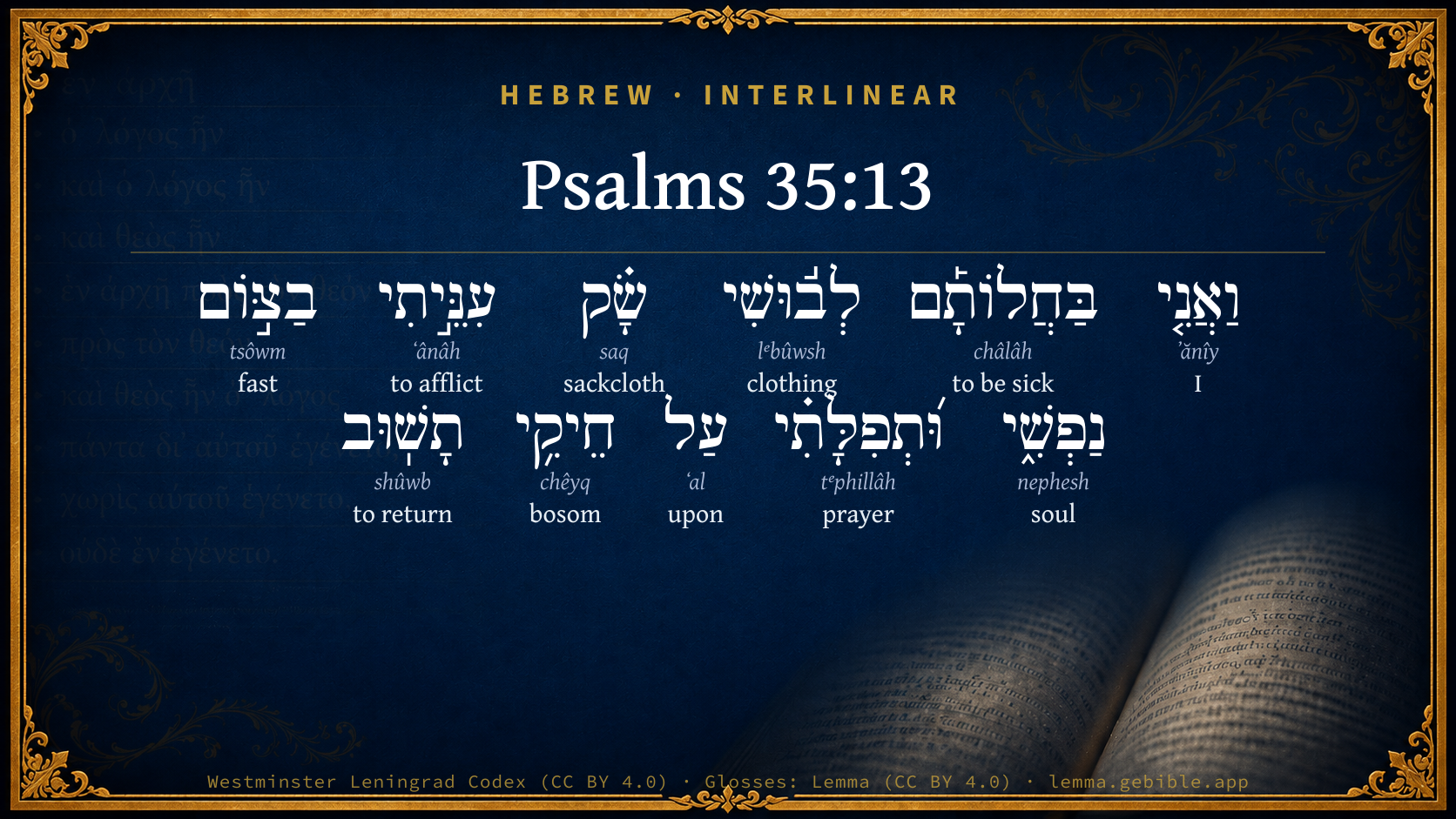
Psalms 35:13

Hebrew (Westminster Leningrad Codex) Psalms 35:13 appears in the Hebrew Old Testament. The text above is from the Westminster Leningrad Codex. Each word links to its Strong’s number, a concise gloss, and parsing drawn from the Open Scriptures Hebrew Bible morphology. Click any word for its full Brown-Driver-Briggs (BDB) entry.
Download image
Cite this verse

Psalms 35:13 (World English Bible). Public Domain. Lemma interlinear Bible study tool, https://lemma.gebible.app/v/psalms/35/13.

Show BibTeX & RIS
BibTeX
RIS
English Translation
But as for me, when they were sick, my clothing was sackcloth. I afflicted my soul with fasting. My prayer returned into my own bosom.
World English Bible · Public Domain
Download a study sheet

One document with this verse’s original text, its word-by-word gloss line, the meaning frame, cross-references with their text, attributed commentary, and full source and license credits — printable, and it pastes into notes with its structure intact.

This verse Autodidact and up

Study sheet (.html) Plain text (.txt)

A passage Seminary Student

Up to 50 verses in one chapter. A passage sheet keeps up to 6 commentary sources and 12 cross-references per verse, in the order this page ranks them, and says so on the sheet whenever that leaves anything out. Ask for a single verse and you get the Autodidact verse sheet above.

Everything on this page stays free to read, with no account — the sheet is a download of what is already on screen, not access to it.

Want to remove ads? Support Godless Engineer
Compare translations 3

The same verse in 3 English versions, stacked beneath the original-language interlinear above. Click any original word for its lexicon entry.

Each is an independent rendering of the whole verse — the interlinear is not word-aligned to these translations.

Highlighted words mark where these versions differ — a whole-verse word diff, not a word-by-word alignment.

  • World English Bible Public Domain
    But as for me, when they were sick, my clothing was sackcloth. I afflicted my soul with fasting. My prayer returned into my own bosom.
  • King James Version Public Domain
    But as for me, when they were sick, my clothing was sackcloth: I humbled my soul with fasting; and my prayer returned into mine own bosom.
  • unfoldingWord Literal Text CC BY-SA 4.0
    But I, when they were sick, my clothing sackcloth; I afflicted my soul with fasting, and my prayer returned upon my bosom.

unfoldingWord Literal Text — © unfoldingWord, licensed CC BY-SA 4.0. Word-aligned USFM3 via Door43 (git.door43.org/unfoldingWord/en_ult).

Versions to compare (up to 4)

3 of 4 selected

Show all 18 translations

Every available English version of this verse, each an independent rendering of the whole verse.

  • World English Bible Public Domain
    But as for me, when they were sick, my clothing was sackcloth. I afflicted my soul with fasting. My prayer returned into my own bosom.
  • Berean Standard Bible Public Domain
    Yet when they were ill, I put on sackcloth; I humbled myself with fasting, but my prayers returned unanswered.
  • Majority Standard Bible Public Domain
    Yet when they were ill, I put on sackcloth; I humbled myself with fasting, but my prayers returned unanswered.
  • King James Version Public Domain
    But as for me, when they were sick, my clothing was sackcloth: I humbled my soul with fasting; and my prayer returned into mine own bosom.
  • American Standard Version (1901) Public Domain
    But as for me, when they were sick, my clothing was sackcloth: I afflicted my soul with fasting; And my prayer returned into mine own bosom.
  • Revised Version (1885) Public Domain
    But as for me, when they were sick, my clothing was sackcloth: I afflicted my soul with fasting; and my prayer returned into mine own bosom.
  • Geneva Bible (1599) Public Domain
    Yet I, when they were sicke, I was clothed with a sacke: I humbled my soule with fasting: and my praier was turned vpon my bosome.
  • Douay-Rheims (1899) Public Domain
    But as for me, when they were troublesome to me, I was clothed with haircloth. I humbled my soul with fasting; and my prayer shall be turned into my bosom.
  • Young's Literal Translation Public Domain
    And I -- in their sickness my clothing `is' sackcloth, I have humbled with fastings my soul, And my prayer unto my bosom returneth.
  • Literal Standard Version CC BY-SA 4.0
    And I—in their sickness my clothing [is] sackcloth, || I have humbled my soul with fastings, || And my prayer returns to my bosom.
  • Unlocked Literal Bible CC BY-SA 4.0
    But, when they were sick, I wore sackcloth; I fasted for them with my head bowed on my chest.
  • unfoldingWord Literal Text CC BY-SA 4.0
    But I, when they were sick, my clothing sackcloth; I afflicted my soul with fasting, and my prayer returned upon my bosom.
  • Darby Bible Public Domain
    But as for me, when they were sick, my clothing was sackcloth; I chastened my soul with fasting, and my prayer returned into mine own bosom:
  • World Messianic Bible Public Domain
    But as for me, when they were sick, my clothing was sackcloth. I afflicted my soul with fasting. My prayer returned into my own bosom.
  • Webster's Bible Public Domain
    But as for me, when they were sick, my clothing was sackcloth: I humbled my soul with fasting; and my prayer returned into my own bosom.
  • Free Bible Version CC BY-SA 4.0
    But when they were sick, I put on clothes of sackcloth in sympathy. I denied myself through fasting. May my prayer for them return to bless me too.
  • Bible in Basic English Public Domain
    But as for me, when they were ill I put on the clothing of sorrow: I went without food and was sad, and my prayer came back again to my heart.
  • JPS Tanakh (1917) Public Domain
    But as for me, when they were sick, my clothing was sackcloth, I afflicted my soul with fasting; and my prayer, may it return into mine own bosom.

Literal Standard Version (2020), Covenant Press — licensed CC BY-SA 4.0. Text via the HelloAO Bible API (eBible.org). Unlocked Literal Bible (unfoldingWord) — licensed CC BY-SA 4.0. Text via the HelloAO Bible API (eBible.org). unfoldingWord Literal Text — © unfoldingWord, licensed CC BY-SA 4.0. Word-aligned USFM3 via Door43 (git.door43.org/unfoldingWord/en_ult). Free Bible Version, Dr. Jonathan Gallagher — licensed CC BY-SA 4.0. Text via the HelloAO Bible API (eBible.org).

Word by word

More ways to search: Search by grammar → Find every occurrence → Compare this word →

Practice this passage: Drill this verse → Learn its vocabulary →

בַצּ֣וֹם
tsôwm
H6685
“in/at the · fast”
Preposition, Determined + Noun, Common, Masculine, Singular, Absolute
Part of Speech
Preposition + Noun
Type
Common
Gender
Masculine
Number
Singular
State
Absolute
Full BDB Definition

Origin: from H6684

TWOT: 1890a

fast, fasting
  1. וַאֲנִ֤י ʼănîy H589 “and · I” Conjunction + Pronoun, Personal, 1st Person, Common, Singular
  2. בַּחֲלוֹתָ֡ם châlâh H2470 “in/at · to be sick · them” Preposition + Verb, Qal, Infinitive Construct + Suffix, Personal, 3rd Person, Masculine, Plural
  3. לְב֬וּשִׁי lᵉbûwsh H3830 “clothing · my” Noun, Common, Masculine, Singular, Construct + Suffix, Personal, 1st Person, Common, Singular
  4. שָׂ֗ק saq H8242 “sackcloth” Noun, Common, Masculine, Singular, Absolute
  5. עִנֵּ֣יתִי ʻânâh H6031 “to afflict” Verb, Piel, Perfect, 1st Person, Common, Singular
  6. נַפְשִׁ֑י nephesh H5315 “soul · my” Noun, Common, Both, Singular, Construct + Suffix, Personal, 1st Person, Common, Singular
  7. וּ֝תְפִלָּתִ֗י tᵉphillâh H8605 “and · prayer · my” Conjunction + Noun, Common, Feminine, Singular, Construct + Suffix, Personal, 1st Person, Common, Singular
  8. עַל ʻal H5921 “upon” Preposition
  9. חֵיקִ֥י chêyq H2436 “bosom · my” Noun, Common, Masculine, Singular, Construct + Suffix, Personal, 1st Person, Common, Singular
  10. תָשֽׁוּב shûwb H7725 “to return” Verb, Qal, Imperfect, 3rd Person, Feminine, Singular

About this verse

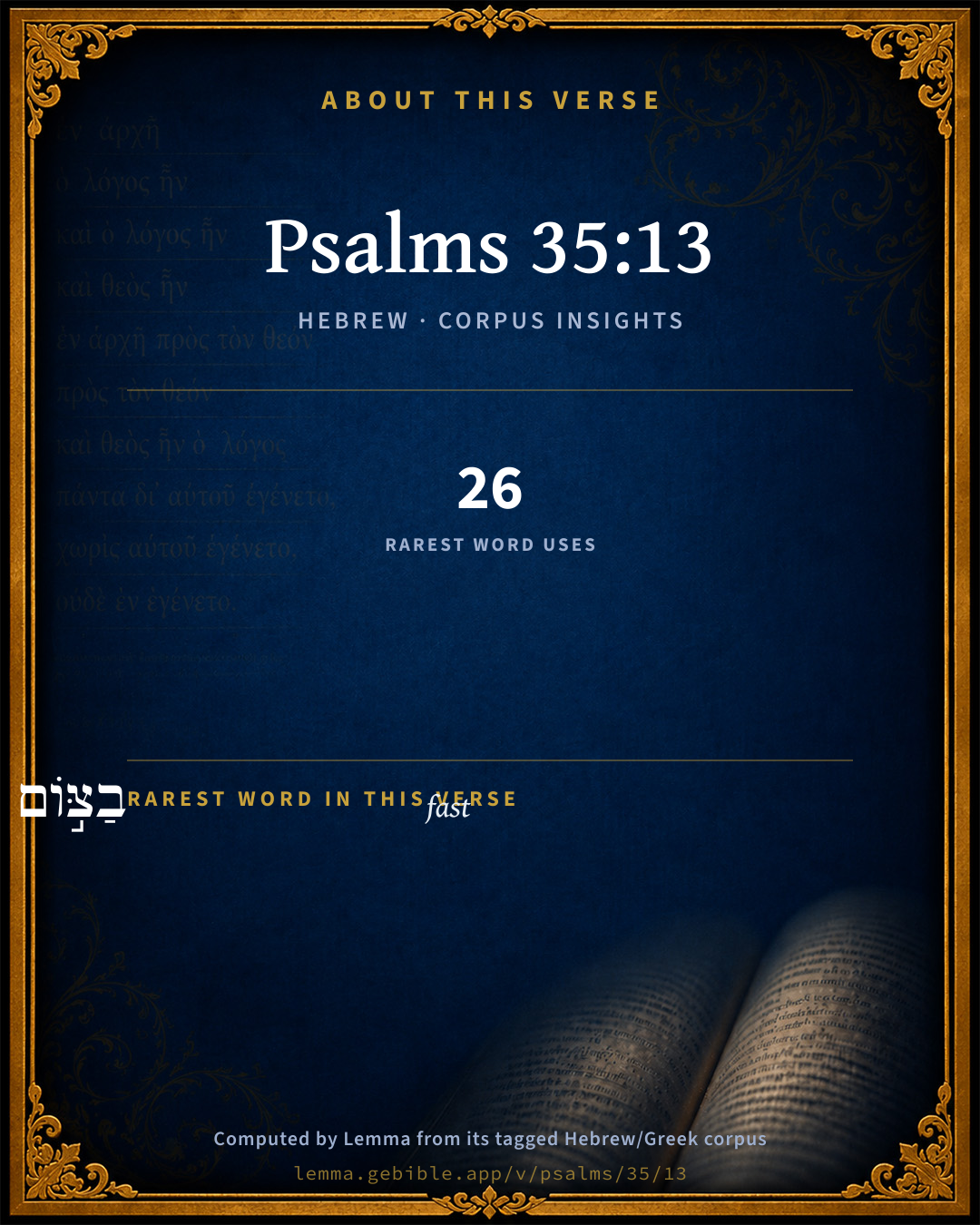
These counts appear in no published source. They are computed here, from the morphology-tagged text and Lemma’s own curated glosses. What Lemma adds →

11
words
11
distinct lemmas
Wisdom
section

Shared distinctive vocabulary

בַצּ֣וֹם fast H6685 occurs in 22 verses of the Hebrew Bible. Also found in:

Grammatical profile

  • 3 verbs
  • 6 nouns
  • 1 pronoun
  • 1 preposition

Verb forms

  • בַּחֲלוֹתָ֡ם Qal · Infinitive Construct
  • עִנֵּ֣יתִי Piel · Perfect
  • תָשֽׁוּב Qal · Imperfect

Hebrew & Septuagint length

In English translation the verse runs 25 words from the Hebrew and 24 from the Septuagint (LXX English) — closely comparable.

A rough comparison of the two English renderings, which tokenize alike — not a word-level alignment.

Word counts can differ between the Hebrew and the Greek without any difference in meaning — e.g. the Hebrew direct-object marker אֵת has no separate Greek word, and Greek often adds the article ὁ.

Cross-references

12

Topical passages linked to Psalms 35:13 in the Treasury of Scripture Knowledge — connected by theme and wording, ordered by reader-vote popularity; previews shown in the World English Bible.

  • Psalms 69:10–11 When I wept and I fasted, That was to my reproach.
  • Job 30:25 Didn't I weep for him who was in trouble? Wasn't my soul grieved for the needy?
  • Matthew 5:44 But I tell you, love your enemies, bless those who curse you, do good to those who hate you, and pray for those who mistreat you and persecute you,
  • Leviticus 16:31 It is a Sabbath of solemn rest to you, and you shall afflict your souls; it is a statute forever.
  • Isaiah 58:5 Is such the fast that I have chosen? the day for a man to afflict his soul? Is it to bow down his head as a rush, and to spread sackcloth and ashes under him? will you call this a fast, and an acceptable day to Yahweh?
  • Matthew 10:13 If the household is worthy, let your peace come on it, but if it isn't worthy, let your peace return to you.
  • Luke 10:6 If a son of peace is there, your peace will rest on him; but if not, it will return to you.
  • Romans 12:14–15 Bless those who persecute you; bless, and don't curse.
  • Leviticus 16:29 "It shall be a statute to you forever: in the seventh month, on the tenth day of the month, you shall afflict your souls, and shall do no manner of work, the native-born, or the stranger who lives as a foreigner among you:
  • 1 Kings 21:27–29 It happened, when Ahab heard those words, that he tore his clothes, and put sackcloth on his flesh, and fasted, and lay in sackcloth, and went softly.
  • Isaiah 58:3 Why have we fasted, [say they], and you don't see? [why] have we afflicted our soul, and you take no knowledge? Behold, in the day of your fast you find [your own] pleasure, and exact all your labors.
  • Matthew 9:14–15 Then John's disciples came to him, saying, "Why do we and the Pharisees fast often, but your disciples don't fast?"

Cross-references courtesy of OpenBible.info (CC BY 4.0).

Hebrew and Greek witnesses Masoretic Hebrew ↔ Greek Septuagint

The same verse in the two great witnesses to the Old Testament, shown verse-for-verse.

You’re reading Greek Psalm 34 (Hebrew Psalm 35). The Septuagint counts the superscription, so verse numbers can differ from the Hebrew — chapter-level alignment, not verse-by-verse. Numbering follows Rahlfs.

These are two independent witnesses, not word-aligned to each other, and the Septuagint is shown in lemma (dictionary) form.

Hebrew Psalms 35:13 Masoretic · Westminster Leningrad Codex

וַאֲנִ֤י בַּחֲלוֹתָ֡ם לְב֬וּשִׁי שָׂ֗ק עִנֵּ֣יתִי בַצּ֣וֹם נַפְשִׁ֑י וּ֝תְפִלָּתִ֗י עַל חֵיקִ֥י תָשֽׁוּב

But as for me, when they were sick, my clothing was sackcloth. I afflicted my soul with fasting. My prayer returned into my own bosom.

World English Bible · Public Domain

Greek LXX Greek Psalm 34:13 Septuagint · lemma form

ἐγώ δέ ἐν ὁ αὐτός παρα ἐνὀχλέω ἐγώ ἐνδύω σάκκος καί ταπεινόω ἐν νηστεία ὁ ψυχή ἐγώ καί ὁ προσευχή ἐγώ εἰς κόλπος ἐγώ ἀποστρέφω

But I, when they troubled me, put on sackcloth, and humbled my soul with fasting: and my prayer shall return to my own bosom.

LXX2012 (modern English Septuagint) · Public Domain

Hebrew: Westminster Leningrad Codex (CC BY 4.0). Greek: Septuagint (public domain); English from LXX2012 (modern English Septuagint) (Public Domain). How the Septuagint differs from the Hebrew →

Commentary

Notes on Psalms 35:13 from classic Christian and Jewish commentators (each source and its license shown beneath its notes). The classic Christian expositions comment on the surrounding passage and are grouped to its opening verse, so a note may address several verses; the Jewish commentaries on the Tanakh (Rashi and others) are per-verse, so they appear only where the commentator wrote on this verse.

Lemma curates 59 commentaries, every one of them public domain or Creative Commons licensed, each selected and text-cleaned for this edition rather than reprinted as found. About our sources →

Trapp's Complete Commentary

John Trapp

Psa 35:13 But as for me, when they were sick, my clothing [was] sackcloth: I humbled my soul with fasting; and my prayer returned into mine own bosom.

Ver. 13. But as for me, when they were sick] i.e. Any way afflicted, when they ailed anything.

My clothing was sachcloth] I put myself in mourners’ habit; Incedebam atratus, to testify my good affection toward them.

I humbled my soul with fasting] In die designate, in a solemn day set apart for the purpose; as the ð with a patach showeth (Kimehi). Ieiunium est humilitas mentis, miserationis expensa, charitatis illecebra, allevamentum infirmitatis, alimentum salutis, saith Ambrose, Fasting is the affliction of the soul, the cost of compassion, &c.

And my prayer returned into mine own bosom] i.e. Though they had no benefit by it, yet myself had; for no faithful prayer is ineffectual; like Jonathan’s bow, it never returned empty, 2Sa 1:22. I received the fruit of my prayers for them upon my bosom.

John Trapp, A Commentary or Exposition upon All the Books of the Old and New Testament (1647–1656) — public domain. Text from a community e-Sword module.

The Biblical Illustrator

Joseph S. Exell

Psa_35:13

I humbled my soul with fasting.

The duty of fasting

So said David. All Gods faithful children, under every dispensation, have observed the same rule. So must each one now say, who hopes for the highest degree of blessedness hereafter. Can none, then, be saved without fasting? I have heard people sometimes ask. This question might be answered by another: Can any be saved without praying? The same authority has commanded the observance of both. But fasting is an unpleasant duty; and those who wish to escape from it, while they readily grant that it was practised by the Jews, deny that it is binding upon Christians. Did not our Lord fast forty days and forty nights, thus setting us an example of subduing the flesh to the Spirit, that in this way His godly monitions may be more perfectly obeyed? Do not the apostles tell us that they were in fastings often? Do they not enjoin it upon Christians to give themselves to fasting and prayer? This may all be true, answers an objector, but why not leave it to each one to discharge this duty when he feels disposed, and why celebrate the fast of Lent, which sprung Up, perhaps, during the dark ages of the world? In reply to the first question, I would merely say that if we wait until we feel in a humour to fast, we shall never fast at all. Hence the wisdom of the Church in appointing stated seasons (or it, when we are bound to attend to it, or prove ourselves unworthy and disobedient children. Our Saviour said to His disciples (Mat_9:15). And from the earliest ages of the Church directions concerning this observance are found. But while it is expected of all to keep the fasts of the Church, all cannot observe them alike. The sick, or such as are just recovering their health, may not be able, perhaps, to abstain from food; and they who are obliged to toil hard for their daily bread, require more to sustain their strength than those whose lives are less active. But all should deny themselves in some way. (John H. Norton.)

My prayer returned into mine own bosom.--

The benefits of prayer

The ancient garments were loose and flowing, and fell in a hollow fold upon the bosom; into which fold were often put articles of use, or value, for the convenience of carriage; and especially when presents were made, they were frequently deposited there. By his prayer returning into his own bosom, therefore, David meant, that though it failed to bring the desired benefit to those for whom it was delivered, it should turn to his own recompense and advantage. Such is the case, more or less, with all the acts of kindness rendered to our neighbour; they conduce not only to his benefit but our own. Ye who take delight in the well-being of others, and make it a business in your life to minister thereto, know well the value of this grace to your own hearts; it is a perpetual source of consolation and satisfaction. And even if you fail in pleasing those whom you seek to please, or in benefiting those whom you seek to benefit; still the good to yourself is not lost; there is joy in the endeavour, independent of the result. The pious act to which the text alludes was the fruit of love, of the most disinterested and holy affection. David was surrounded with bitter and violent enemies, who daily sought his life; and the manner in which he expresses himself respecting them reminds us strongly of Davids Lord. He lifted up his heart in supplication to the mercy-seat; he did all that in him lay. But his prayer was not granted, as neither was the prayer of Jesus for the reckless Jew. From this remarkable instance before us, I am led to speak of the value of intercessory prayer, of prayer for our brethren, and for all our fellow-creatures. God has ordained it (1Ti_2:1). We know not what may be dependent upon our prayers. What good they may bring to them for whom we pray. And assuredly they bring much good to us.

I. The prayer for superiors of every kind begets in us that spirit of obedience, which God has commanded, and which God will bless.

II. Children pray for parents. Who can tell the benefits which they themselves derive from this duty? On the other hand, the parent prays for the child. The child is wayward and wanton: the parent prays for correction and amendment; but they do not always come. But the supplication is not without its fruit, in blessed peace of mind from knowing that he has done his best: that his child was not ruined by his neglect to pray for him. And so--

III. for all relatives. The principle of mutual love is kept alive thereby.

IV. But perhaps the most observable instance of all is that wherewith the text is connected, the supplication for enemies. This is a peculiar exercise of faith: this requires a greater struggle in the inner man, to obtain the mastery over our own self-love; and to make us desire with godly sincerity the good of those who have injured us, and to entreat the Lord for it, as for our own favour and blessing. This is indeed a victory of the Spirit of grace; and the Lord honours it with a signal reward, and makes it productive of vast benefit to our souls. Such was the Lords own example. Let us also herein follow our Lord. (J. Slade, M. A.)

The remunerative power of charity

The psalmist is speaking of the ungrateful returns which he received from his enemies for many acts of kindness. When they were in trouble and sickness, he did not fail to intercede with God on their behalf: he prayed for them, and put on sackcloth, and fasted; whereas, he goes on to say, in mine adversity they rejoiced, etc. Were, then, his prayers all thrown away? Not so; he was persuaded that they would return into his own bosom; that the prayers, that is, which should be fruitless in regard to those for whom they were presented, should certainly produce good to him by whom they had been offered. Now, we do not think that sufficient attention is paid to the various modes in which what is done for others, returns, as it were, to the doer, gust as though God regarded it as a loan, and would not permit it to remain long in his hands--for we hardly know the philanthropic deed in regard of which we may not prove the high probability, if not the certainty, that he who performs it gains an abundant requital, even if you suppose him not moved by the purest motive, or not bringing into account the recompenses of eternity. The interests of the several classes in a community, nay, of the various members of the vast human family, are so bound up one with the other, that it is scarcely possible for an individual benefit to fail to be a general; and if the good which is wrought in an isolated quarter cannot remain there, but must propagate itself over wide districts, we may easily believe that God, who orders and appoints all things so that they work His own ends, causes much of this reflected good to fall on the party with whom it originated; and thus he who fasted and humbled himself in sackcloth finds that his prayer hath returned into his own bosom. If I support infirmaries for children, I take the best means of preventing our being hereafter burdened with sickly and dependent families; disease is corrected, and the injuries are repaired in childhood which entail on us, if neglected, a crowd of miserable objects; and what I give to the pining infant I more than receive back from the vigorous man. If I support hospitals for the reception of those who must otherwise perish unregarded, what do I but take measures to continue to his family the industrious father, on whom it hangs for subsistence, and whose death would make it a pensioner on benevolence? Then surely what I give will, in all probability, return into mine own bosom, if it prove instrumental in preserving a useful member to the community, and prevent fresh demands upon charity. Neither does this take into account what ought not to be omitted--that there is a direct tendency in hospitals and infirmaries to the nourishing in the poor kindly feelings towards the rich; and he can know little of the mutual dependence of the several ranks in society, who does not know that money employed on the procuring this result is money at interest, and not money sunk. But let us now consider more particularly the ease in which the motive to benevolence is such as God approves--man acting from a principle of love to the Saviour, who has declared that He counts as done to Himself what is done for His sake to the least of His brethren. We believe that even in the present life the remunerating power will have a greater sphere of exercise in this case than in any other. It is to be observed, that though a Christian will be ready, with St. Paul, to do good unto all men, he will study with the same apostle to do good, especially to those that are of the household of faith; and if his charities bring him mostly into association with those who are serving the same Lord, and if, though he neglect not the temporal, he is chiefly instrumental in supplying the spiritual wants of the destitute, it is very evident that there will be that returned to him in the prayers and blessings of those whom he succours, which there would not be if the objects of his benevolence were all at enmity with God. But if we may contend that what we have called the remunerating power of charity is already in operation, who can doubt that hereafter, when we reach the time and scene, which are specially appointed for the Divine retributions, it will be proved to the letter that our gifts and our deeds have returned into our own bosoms. When we read that even a cup of cold water given in the name of a disciple shell not lose its reward, we are taught that God takes account of the minutest acts of Christian benevolence, and designs them a recompense, so that as not even the least can escape His observation, not even the least shall be without retribution. He annexes rewards to our actions to show His graciousness, and to animate to obedience; and, with this as the base, He may justly be expected to leave no service unrequited, and yet at the same time to requite in proportion to the action. But with all the reasons there may be for expecting the most exact retributions, who can doubt that the righteous will hereafter be amazed and overcome, as the strict connection is shown them between what they did and what they enjoy? (H. Melvill, B. D.)

The Biblical Illustrator, edited by Joseph S. Exell (c. 1880s–1900s) — public domain. Text from a community e-Sword module.

Joseph Benson's Commentary

Psa 35:13. When they were sick — Or in any other great misery; my clothing was sackcloth — Which was the habit of mourners. I humbled — Hebrew, I afflicted, my soul with fasting — And with compassion and fervent prayers for them; and, or but, my prayer returned into mine own bosom — My fastings and prayers did them no good, neither abated their malice, nor prevailed with God for them, so far as I desired; but returned to me without success, like a gift sent to an uncivil person, who disdainfully rejects it, and returns it to the giver. But this clause may be rendered, And my prayer in my bosom returned; that is, I daily and frequently repeated my prayers for them, and that not only in public, when I joined with others, but also in secret, between God and my own soul; and that with a sincere and hearty affection. For what is done secretly, and affectionately, is said to be done in the bosom. Others render it, My prayer rested, or, settled in my bosom — That is, “I never was without a prayer for them in my breast.” So Mudge.

Joseph Benson's Commentary on the Old and New Testaments (1811–1818) — public domain. Text from a community e-Sword module.

J. A. Alexander on Psalms

Joseph Addison Alexander

13. (Psa 35:13) And I—in their sickness my clothing (was) sackcloth; I humbled with fasting my soul—and my prayer into my bosom shall return. The general idea is that he displayed the deepest sympathy with their distresses. This idea is expressed by figures borrowed from the oriental mourning usages. Sackcloth, fasting, and prayer are here particularly mentioned. To humble the soul (or one's self), or as some explain it, to mortify the appetite, is the phrase by which fasting is described in the Law of Moses (Lev 16:31; Lev 23:27; Lev 23:32, Num 29:7), and which is here combined with the later word —The last clause is obscure, and is by some understood to signify the constancy of supplication, coming back and going out again without cessation. Others explain it as a mere description of the attitude of prayer with the head bowed upon the bosom, as if he had said, I was continually pouring prayer into my bosom. But neither of these explanations is so probable as the traditional one of the Jews, according to which he desires that the prayer which he offered for them might redound to his own advantage. Or the clause may be still more simply construed as a prediction "My prayer shall not be lost, it shall return in blessings to the heart which prompted it."

Joseph Addison Alexander, The Psalms Translated and Explained (1850) — public domain. Text from a community e-Sword module.

Geneva Bible (1599)

Geneva Bible translators

I prayed for them with inward affection, as I would have done for myself: or, I declared mine affection with bowing down mine head.

Geneva Bible (1599) marginal notes — public domain. Text via Bolls.life.

Jamieson, Fausset & Brown

Robert Jamieson, A. R. Fausset & David Brown

prayer . . . bosom--may denote either the posture--the head bowed--(compare Kg1 18:42) --or, that the prayer was in secret. Some think there is a reference to the result--the prayer would benefit him if not them.

Jamieson, Fausset & Brown — Commentary Critical and Explanatory on the Whole Bible (1871) — public domain (CC PDM 1.0). Text via the HelloAO Bible API.

Adam Clarke's Commentary

Verse 13. When they were sick] This might refer to the case of Absalom, who was much beloved of his father, and for whose life and prosperity he no doubt often prayed, wept, and fasted.

My prayer returned into mine own bosom.] Though from the wayward and profligate life they led, they did not profit by my prayers, yet God did not permit me to pray in vain. They were like alms given to the miserable for God's sake, who takes care to return to the merciful man tenfold into his bosom. The bosom is not only the place where the Asiatics carry their purses, but also where they carry any thing that is given to them.

Adam Clarke's Commentary on the Bible (1810–1826) — public domain. Text from a community e-Sword/MySword module.

Ellicott's Commentary for English Readers

(13) And my prayer returned into mine own bosom.—This has been most variously explained. The context evidently implies something done for the benefit of the whilome friends for whom, in their sickness, the poet had worn sackcloth, and had fasted and adopted all the other signs of mourning. We must therefore set aside (1) the idea of fruitless prayer, in spite of the analogy of Mat_10:13, Luk_10:6. (2) The notion that the answer to the prayer came back to the psalmist himself, instead of to those for whom it was offered, must also be set aside. And (3) we must reject the notion of secret, i.e., silent prayer, in spite of Pro_17:23; Pro_21:14, since all the “outward and visible” signs of mourning are indicated, and the very object was to show sympathy and interest.

There remains (1) the literal, and my prayer turned upon my bosom, referring to the posture described in Psa_35:14. (Comp. 1Ki_18:42, where, however, there is no express mention of prayer.) The words were, as it were, muttered into his bosom. This is the view of Ewald and Delitzsch, but seems prosaic. (2)The far more probable meaning, my prayer came back again and again to my bosom, i.e., was repeated over and over again; just as we say, “the thought recurred to my mind.” (Comp. the common phrase for thoughts coming upon the heart, Jer_3:16; Jer_7:31, etc.) The Hebrew verb has this frequentative sense in one of its conjugations.

A Bible Commentary for English Readers, edited by Charles John Ellicott (1878–1897) — public domain. Text from a community e-Sword module.

The Cambridge Bible for Schools and Colleges

gen. ed. J. J. S. Perowne

13. The ‘good’ he had done to them. His sympathy when they were in trouble was no mere formality. He prayed for their recovery, humbling himself before God with mourning and fasting (Psa_69:10-11; 2Sa_12:16; Joe_2:12), that their sin might be forgiven and their sickness removed.

humbled] R.V., afflicted. It is the technical term for fasting in the Law. See Lev_16:29; Lev_16:31; Lev_23:27; Lev_23:32; Num_29:7; Isa_58:3; Isa_58:5.

and my prayer returned into mine own bosom] An obscure phrase; not to be explained of the attitude of earnest prayer with head bent down on the bosom so that the prayer which came from his heart seemed to return thither again (1Ki_18:42 does not justify this explanation): nor again, that his prayer returned to him without effecting its object (Mat_10:13), for there would be no point in his prayer being unanswered: but rather, my prayer shall return into mine own bosom. They have recompensed him evil for good; but his prayer will not be unrewarded. As the causeless curse returns with interest into the bosom whence it issues (Psa_79:12), so the prayer at least brings back a blessing to its offerer (Jer_18:20).

The Cambridge Bible for Schools and Colleges (gen. ed. J. J. S. Perowne; Cambridge University Press, 1878–1918) — public domain. Text from a community e-Sword module.

John Gill's Exposition

But as for me, when they were sick,.... Or under any disorder or distress of body or mind, when any misfortune or infirmity attended them; meaning Saul and his courtiers, before David was persecuted by them;

my clothing was sackcloth; that is, he was grieved, and mourned for them, it being usual to put on sackcloth in time of mourning; see Gen 37:34;

I humbled my soul with fasting; on the account of them, giving up himself to prayer for them, as follows:

and my prayer returned into mine own bosom; that is, he prayed privately and heartily for them, as for himself; he was constant in it, his heart was in it, and he took delight in it, and he was heard and answered; unless the sense should be, that his prayer was slighted by them, and so returned back to himself, as a present despised is returned; but however it was not without its effect, the good for which he prayed for them was returned by the Lord unto him.

John Gill's Exposition of the Whole Bible (1746–1763) — public domain (CC PDM 1.0). Text via the HelloAO Bible API.

Albert Barnes' Notes on the Bible

But as for me - The psalmist now contrasts their conduct with his own. He refers to the recollections of his past life, and to the acts of kindness which he had shown to them in thees of trouble, as more deeply marking the evils of their own conduct now.

When they were sick - Compare the notes at Job 30:25. It would seem from this that the persons referred to, who now treated him with so much ingratitude, were those with whom he had been formerly intimately associated, or whom he had regarded as his personal friends, since it cannot be supposed that this deep sympathy would have been shown for those who were altogether strangers to him.

My clothing was sackcloth - Compare the notes at Psa 30:11. The meaning is, that he showed the deepest sympathy in their distress by putting on the emblems of humiliation or mourning. It was also with reference to prayer in their behalf; and to fasting, that he put on these marks of grief. The idea is, that he did all that was understood to be connected with the deepest humiliation before God, and that would fit the mind for earnest prayer in their behalf. He felt that their restoration to health - that the preservation of their lives - depended on God, and he most earnestly and fervently pleaded in their behalf.

I humbled my soul with fasting - Margin, “afflicted;” so the Hebrew properly means. The word “soul” here is equivalent to “self;” I afflicted myself. He subjected himself to the pains of hunger, that he might be better prepared to offer fervent and acceptable prayer. Among the Hebrews fasting and prayer were much more closely connected than they are with Christians. See Dan 9:3; Mat 17:21; Luk 2:37.

And my prayer returned into mine own bosom - DeWette explains this as meaning, “I prayed with my head sunk on my bosom;” that is, with the head bowed down, so that the prayer which went out of Iris lips seemed to return again to his own bosom - that earnest prayer which one offers when the head is bowed with sorrow. A posture somewhat similar to this is referred to in the case of Elijah, 1Ki 18:42 : “And he cast himself down upon the earth, and put his face between his knees.” The posture of prayer with the head reclining toward the bosom is common among the Muslims, “Reland” de Religione Mohammetica, p. 87. Jarchi explains this as meaning that he sought the same for those who were now his enemies which he would for himself, or that he desired that that should come into his own bosom which he sought for them. Prof. Alexander supposes that this means, according to a traditional interpretation of the Jews, that he desired that the prayer which he offered might redound to his own advantage: “My prayer shall not be lost, it shall return in blessings to the heart which prompted it.” There can be no reason to doubt that this is true “in fact;” and that prayer offered for others “does” bring back blessings to those who offer it. But to suppose that this was the “motive” in the case is to suppose that the psalmist was wholly selfish, and would take away the very point of his observation about his prayer - that it was dictated by the sincerest love for them and true sympathy for their sufferings. The most simple interpretation, therefore, is that which supposes that the prayer was offered under such a burden of grief on account of their sufferings, that his head sank on his bosom; or, in other words, that the prayer which was offered was such as is presented when the heart is most burdened and most sad.

Albert Barnes' Notes on the Bible (1834–1885) — public domain. Text from a community e-Sword/MySword module.

Matthew Poole's English Annotations

Sick; or in any other great misery.

Sackcloth; which was the habit of mourners, Gen 37:34; Mat 11:21; Rev 11:3.

I humbled my soul, Heb. I afflicted my soul, (of which phrase see Lev 16:29,31; 23:27,32, &c.,) partly with fasting, and partly with compassion and fervent prayers for them. And my prayer returned into mine own bosom: according to this translation the sense may be this, and, or but, or although my fastings and prayers did them no good, neither abated their malice, nor prevailed with God for them, so far as I desired, but returned to me without success, like a gift sent to an uncivil person, who disdainfully rejects it, and returns it to the giver. But,

1. This is not true, that his prayers returned empty to him, and did them no good, for they prevailed with God for their recovery, as appears by the following verses.

2. This doth not seem to suit well with the context; for both in the foregoing and following words he is only describing what he did for them, and not what the effects of it were, which he describes in the succeeding verses. Others therefore render the words otherwise; either,

1. Thus, and my prayer in my bosom returned, i.e. I did daily and frequently repeat my prayers for them, and that not only in public, when I joined with others in a fast-day appointed for them, which might be done in policy or for ostentation; but also in secret, between God and my own soul, and that with a sincere and hearty affection: for what is done secretly and affectionately, is said to be done in the bosom, Num 11:12; Psa 89:50; Pro 21:14, although indeed there is in those places another proposition; which may possibly alter the case. Or,

2. (which seems the truest sense) And as for my prayer, (to wit, which I joined with my fasting on their behalf,) let it return (nothing being more frequent than for future verbs to be put imperatively)

into my own bosom; i.e. if any shall think or say that my fasting for them was but counterfeit or politic, and that I did not pray for them, but rather against them, as I do in this Psalm, and that under all this show I secretly wished their death or destruction; my earnest desire is, that the all-seeing and heart-searching God would grant unto me, when I come into their circumstances, the same things which I begged for them, whether good or evil. And this sense agrees with the common use of this phrase in Scripture, where whatsoever is repaid to any man is said to be rendered into his bosom, as Psa 79:2; Isa 65:6,7; Jer 32:18; Luk 6:38, as elsewhere it is said to return upon his head.

Matthew Poole's English Annotations on the Holy Bible (1683–1685) — public domain. Text from a community e-Sword/MySword module.

The Treasury of David

Charles H. Spurgeon

Ver. 13. But as for me, when they were sick, my clothing was sackcloth. David had been a man of sympathy; he had mourned when Saul was in ill health, putting on the weeds of sorrow for him as though he were a near and dear friend. His heart went into mourning for his sick master. Humbled my soul with fasting. He prayed for his enemy, and made the sick man's case his own, pleading and confessing as if his own personal sin had brought on the evil. This showed a noble spirit in David, and greatly aggravated the baseness of those who now so cruelly persecuted him. And my prayer returned into mine own bosom. Prayer is never lost: if it bless not those for whom intercession is made, it shall bless the intercessors. Clouds do not always descend in showers upon the same spot from which the vapours ascended, but they come down somewhere; and even so do supplications in some place or other yield their showers of mercy. If our dove find no rest for the sole of her foot among our enemies, it shall fly into our bosoms and bring an olive branch of peace in its mouth. How sharp is the contrast all through this Psalm between the righteous and his enemies! We must be earnest to keep the line of demarcation broad and clear.

Ver. 13. My prayer returned into, or was directed to, my bosom. Of the many interpretations that are given of this passage, that appears to me the most probable which derives it from the posture of the worshipper; who standing with his head inclined downward toward his bosom, turned away his attention from all external objects, and uttered his mournful and earnest requests, as if they were directed to his own bosom. Such a posture of devotion is in use both among Jews and Mohammedans. Koeler in Repertor. Lit. Orient.; and Reland de Relig. Mohammedica, quoted by Walford in loc.

Ver. 13. (last clause). We may read it thus: Let my prayer return into my bosom; that is, I wished no worse to them than to myself: let me receive of God such good as I prayed for them. See Ps 79:12. Henry Ainsworth.

Ver. 13. Christian sympathy even for the froward.

Ver. 13. (last clause). Personal benefit of intercessory prayer.

Ver. 13-14. Compassion to the sick. C. Simeon.

Psalms 35:14*

Ver. 13-14. Compassion to the sick. C. Simeon.

Psalms 35:15*

Charles H. Spurgeon's The Treasury of David (1869–1885) — public domain. Psalms only. Text from a community e-Sword/MySword module.

Whedon's Commentary on the Bible

Daniel D. Whedon

13. When they were sick—It is plain David refers to an actual experience. He had put on sackcloth, fasted and prayed, when those had been “sick” who now rejoiced at his fall.

My prayer returned into mine own bosom—As my enemies were not in a moral state to be benefitted by my prayers, the blessings I had invoked upon them returned to me. Compare Mat_10:13; Luk_10:6

Daniel D. Whedon (gen. ed.), Commentary on the Old and New Testaments (1874–1909) — public domain. Text from a community e-Sword module.

The Pulpit Commentary

But as for me, when they were sick, my clothing was sackcloth. It is suggested that David had acted thus, especially in the case of Saul, when he was first afflicted with his terrible malady; (1Sa_16:14-23 1Sa_18:10) but he appears to speak of his habitual practice, whenever any of his friends were sick. (On the putting on of sackcloth as a sign of grief, see Gen_37:34 2Sa_3:31 2Sa_21:10 1Ki_21:27 2Ki_6:30 2Ki_19:1 Est 4:1Jo Est 16:15 Psa_69:11 Psa_69:11, etc.) I humbled my soul with fasting. Another customary indication of grief. (see Psa_69:10 Psa_109:24 Jud_1:20:26 1Sa_31:13 2Sa_1:12 2Sa_22:16 1Ki_21:27 Neh_1:4, etc.) And my prayer returned into mine own bosom. (comp. Mat_10:13) Prayers for others, if prevented by their unworthiness from benefiting them, are yet not altogether void and vain. They bring a blessing to the man that offers them.

The Pulpit Commentary (1880–1919), ed. H.D.M. Spence-Jones & Joseph S. Exell — public domain. Text from a community e-Sword module.

John Wesley's Explanatory Notes

Returned - Although my fastings and prayers did them no good.

John Wesley, Explanatory Notes Upon the Whole Bible (1754–1765) — public domain. Text via the GEBible commentary corpus.

unfoldingWord translationNotes

Door43 World Missions Community

when they were sick

The word "they" refers to the "unrighteous witnesses" (Psalms 35:11).

I wore sackcloth

"I showed that I was sad"

with my head bowed on my chest

This was a symbol of prayer. "with my head bent down in prayer" (See: Symbolic Action)

in grief as for my brother

The writer was as sad as if his own brother had died. AT: "grieving as if my own brother was ill" (See: Simile)

I bent down in mourning as for my mother

The writer mourned as if his own mother had died. AT: "I mourned as if my own mother had died" (See: Simile)

I bent down

This was a symbol of pain and suffering. (See: Symbolic Action)

translationWords

sackcloth

fast

bow

mourn

unfoldingWord translationNotes — © Distant Shores Media and the Door43 World Missions Community, licensed CC BY-SA 4.0. Source: git.door43.org/Door43/en_tn.

Rashi

Rabbi Shlomo Yitzchaki (Rashi)

and may my prayer return upon my bosom That is to say: If they say that I afflicted myself only for their detriment, that their illness should become more serious, may my prayer that I prayed for them return to me.

Rashi on the Tanakh — English translations: “The Judaica Press complete Tanach with Rashi, translated by A. J. Rosenberg” (CC BY 4.0); “Pentateuch with Rashi's commentary by M. Rosenbaum and A.M. Silbermann, 1929-1934” (public domain); “The Metsudah Tanach series, Lakewood, N.J” (CC BY 4.0); and “The Book of Joshua, Metsudah Publications, 1997” (CC BY 4.0). Text via Sefaria.

Lesson kit

Teaching starters — assembled from the data on this page, not authored interpretation. Every prompt links to the verse data it draws on. Edit before teaching.

Psalms, in the Wisdom, opens this verse with 11 words (11 distinct Hebrew lemmas). Its most distinctive word is tsôwm (“fast”). A historical commentator’s framing appears above. Read the whole chapter for the surrounding context.

Discussion questions

  1. How does “fast” (tsôwm) shape what this verse is saying?
  2. 2 Samuel 12:16 shares the word «fast» with this verse. How do the two illuminate each other?
  3. These translations render this verse differently. What is at stake in choosing one wording over another?
  4. The verb «בַּחֲלוֹתָ֡ם» is Qal Infinitive Construct. How does its form color the action?
  5. Reading how Trapp's Complete Commentary and The Biblical Illustrator read this verse, where do the two commentators agree and where do they part?

Things to notice

Reading settings

Reading text

Shown beneath each verse's original-language words.

Old Testament
Old Testament edition

Read the OT as the Masoretic Hebrew (MT) or the Greek Septuagint (LXX).

English shown for the Greek Septuagint (in the Hebrew ↔ Greek comparison).

Comparing translations? Open the Compare panel on any verse page to stack up to four side by side.