
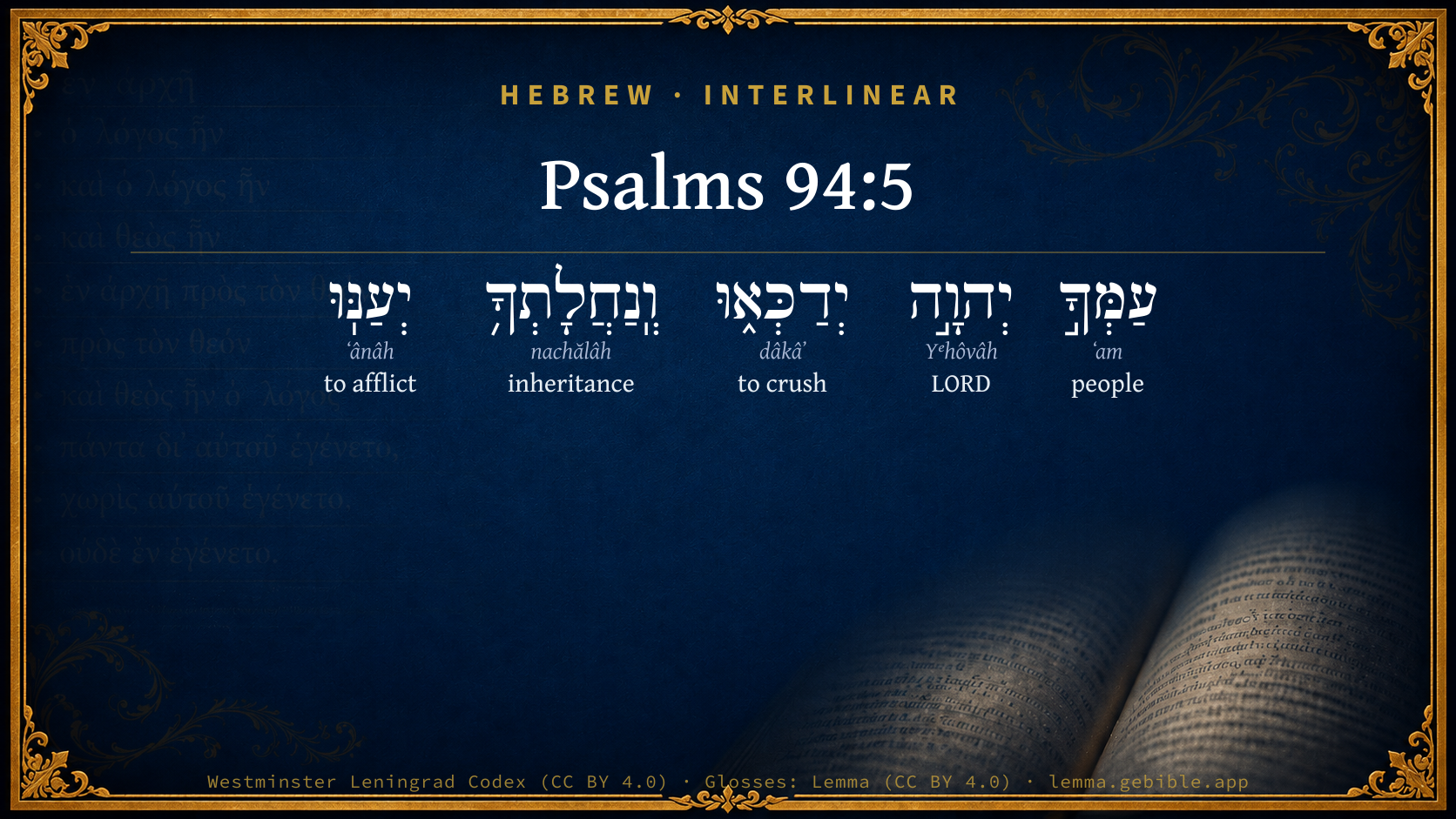
Psalms 94:5

Hebrew (Westminster Leningrad Codex) Psalms 94:5 appears in the Hebrew Old Testament. The text above is from the Westminster Leningrad Codex. Each word links to its Strong’s number, a concise gloss, and parsing drawn from the Open Scriptures Hebrew Bible morphology. Click any word for its full Brown-Driver-Briggs (BDB) entry.
Download image
Cite this verse

Psalms 94:5 (World English Bible). Public Domain. Lemma interlinear Bible study tool, https://lemma.gebible.app/v/psalms/94/5.

Show BibTeX & RIS
BibTeX
RIS
English Translation
They break your people in pieces, Yahweh, And afflict your heritage.
World English Bible · Public Domain
Download a study sheet

One document with this verse’s original text, its word-by-word gloss line, the meaning frame, cross-references with their text, attributed commentary, and full source and license credits — printable, and it pastes into notes with its structure intact.

This verse Autodidact and up

Study sheet (.html) Plain text (.txt)

A passage Seminary Student

Up to 50 verses in one chapter. A passage sheet keeps up to 6 commentary sources and 12 cross-references per verse, in the order this page ranks them, and says so on the sheet whenever that leaves anything out. Ask for a single verse and you get the Autodidact verse sheet above.

Everything on this page stays free to read, with no account — the sheet is a download of what is already on screen, not access to it.

Want to remove ads? Support Godless Engineer
Compare translations 3

The same verse in 3 English versions, stacked beneath the original-language interlinear above. Click any original word for its lexicon entry.

Each is an independent rendering of the whole verse — the interlinear is not word-aligned to these translations.

Highlighted words mark where these versions differ — a whole-verse word diff, not a word-by-word alignment.

  • World English Bible Public Domain
    They break your people in pieces, Yahweh, And afflict your heritage.
  • King James Version Public Domain
    They break in pieces thy people, O LORD, and afflict thine heritage.
  • unfoldingWord Literal Text CC BY-SA 4.0
    They crush your people, Yahweh; they afflict your inheritance.

unfoldingWord Literal Text — © unfoldingWord, licensed CC BY-SA 4.0. Word-aligned USFM3 via Door43 (git.door43.org/unfoldingWord/en_ult).

Versions to compare (up to 4)

3 of 4 selected

Show all 18 translations

Every available English version of this verse, each an independent rendering of the whole verse.

  • World English Bible Public Domain
    They break your people in pieces, Yahweh, And afflict your heritage.
  • Berean Standard Bible Public Domain
    They crush Your people, O LORD; they oppress Your heritage.
  • Majority Standard Bible Public Domain
    They crush Your people, O LORD; they oppress Your heritage.
  • King James Version Public Domain
    They break in pieces thy people, O LORD, and afflict thine heritage.
  • American Standard Version (1901) Public Domain
    They break in pieces thy people, O Jehovah, And afflict thy heritage.
  • Revised Version (1885) Public Domain
    They break in pieces thy people, O LORD, and afflict thine heritage.
  • Geneva Bible (1599) Public Domain
    They smite downe thy people, O Lord, and trouble thine heritage.
  • Douay-Rheims (1899) Public Domain
    Thy people, O Lord, they have brought low: and they have afflicted thy inheritance.
  • Young's Literal Translation Public Domain
    Thy people, O Jehovah, they bruise, And Thine inheritance they afflict.
  • Literal Standard Version CC BY-SA 4.0
    Your people, O YHWH, they bruise, || And they afflict Your inheritance.
  • Unlocked Literal Bible CC BY-SA 4.0
    They crush your people, Yahweh; they afflict the nation that belongs to you.
  • unfoldingWord Literal Text CC BY-SA 4.0
    They crush your people, Yahweh; they afflict your inheritance.
  • Darby Bible Public Domain
    They crush thy people, O Jehovah, and afflict thine inheritance;
  • World Messianic Bible Public Domain
    They break your people in pieces, LORD, and afflict your heritage.
  • Webster's Bible Public Domain
    They break in pieces thy people, O LORD, and afflict thy heritage.
  • Free Bible Version CC BY-SA 4.0
    Lord, they crush your people; they oppress those you call your own.
  • Bible in Basic English Public Domain
    Your people are crushed by them, O Lord, your heritage is troubled,
  • JPS Tanakh (1917) Public Domain
    They crush Thy people, O LORD, and afflict Thy heritage.

Literal Standard Version (2020), Covenant Press — licensed CC BY-SA 4.0. Text via the HelloAO Bible API (eBible.org). Unlocked Literal Bible (unfoldingWord) — licensed CC BY-SA 4.0. Text via the HelloAO Bible API (eBible.org). unfoldingWord Literal Text — © unfoldingWord, licensed CC BY-SA 4.0. Word-aligned USFM3 via Door43 (git.door43.org/unfoldingWord/en_ult). Free Bible Version, Dr. Jonathan Gallagher — licensed CC BY-SA 4.0. Text via the HelloAO Bible API (eBible.org).

Word by word

More ways to search: Search by grammar → Find every occurrence → Compare this word →

Practice this passage: Drill this verse → Learn its vocabulary →

About this verse

These counts appear in no published source. They are computed here, from the morphology-tagged text and Lemma’s own curated glosses. What Lemma adds →

5
words
5
distinct lemmas
Wisdom
section

Notable vocabulary

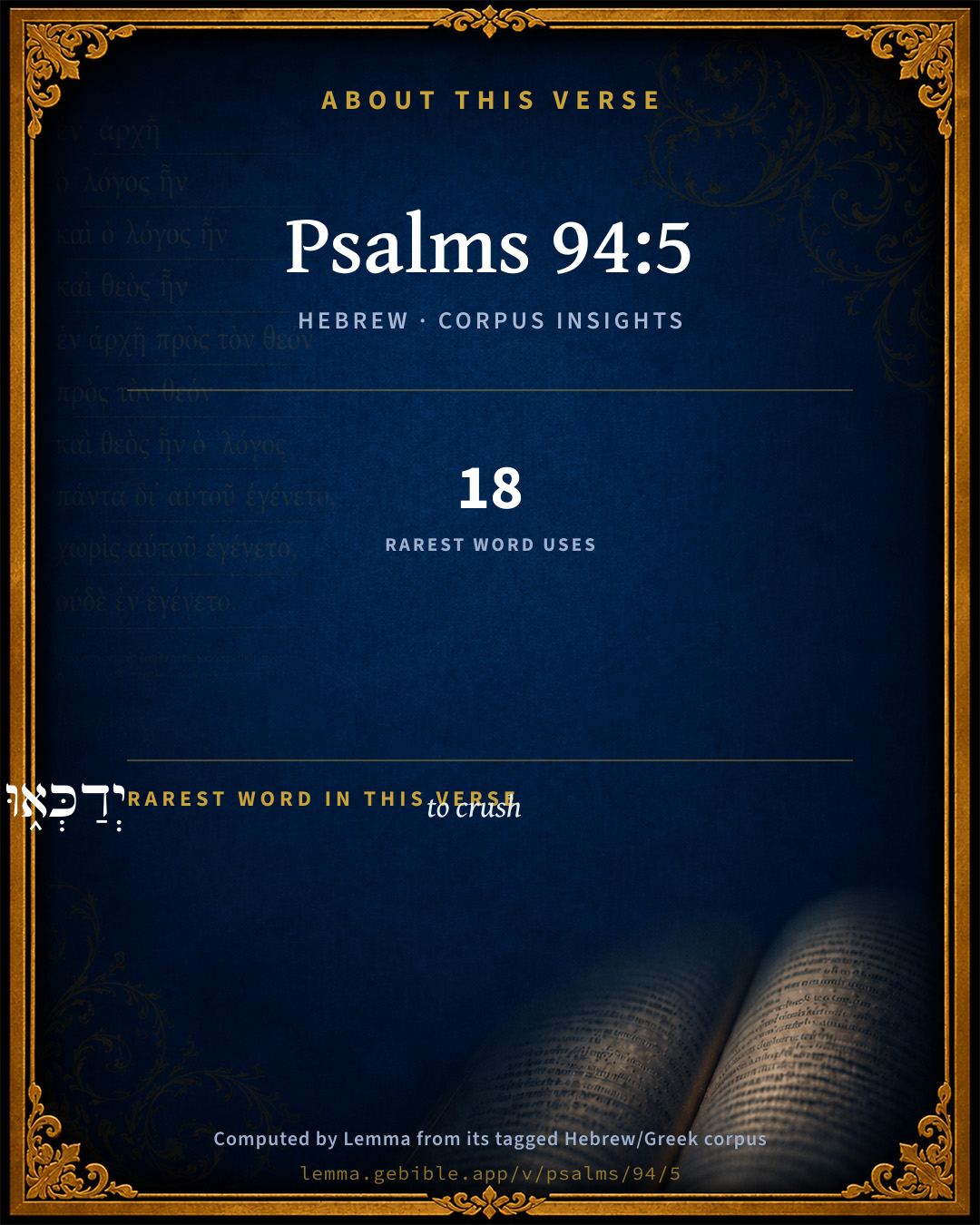
The rarest word here is יְדַכְּא֑וּ to crush H1792 — appearing just 18 times in the whole Hebrew Bible.

Shared distinctive vocabulary

יְדַכְּא֑וּ to crush H1792 occurs in 18 verses of the Hebrew Bible. Also found in:

Grammatical profile

  • 2 verbs
  • 3 nouns

Verb forms

  • יְדַכְּא֑וּ Piel · Imperfect
  • יְעַנּֽוּ Piel · Imperfect

Hebrew & Septuagint length

In English translation the verse runs 11 words from the Hebrew and 11 from the Septuagint (LXX English) — the same length.

A rough comparison of the two English renderings, which tokenize alike — not a word-level alignment.

Word counts can differ between the Hebrew and the Greek without any difference in meaning — e.g. the Hebrew direct-object marker אֵת has no separate Greek word, and Greek often adds the article ὁ.

Cross-references

18

Topical passages linked to Psalms 94:5 in the Treasury of Scripture Knowledge — connected by theme and wording, ordered by reader-vote popularity; previews shown in the World English Bible.

  • Isaiah 3:15 What do you mean that you crush my people, And grind the face of the poor?" says the Lord, Yahweh of Hosts.
  • Psalms 79:2–3 They have given the dead bodies of your servants to be food for the birds of the sky, The flesh of your saints to the animals of the earth.
  • Exodus 2:23–24 It happened in the course of those many days, that the king of Egypt died, and the children of Israel sighed because of the bondage, and they cried, and their cry came up to God because of the bondage.
  • Psalms 7:2 Lest they tear apart my soul like a lion, Ripping it in pieces, while there is none to deliver.
  • Psalms 14:4 Have all the workers of iniquity no knowledge, Who eat up my people as they eat bread, And don't call on Yahweh?
  • Psalms 44:22 Yes, for your sake we are killed all day long. We are regarded as sheep for the slaughter.
  • Psalms 74:8 They said in their heart, "We will crush them completely." They have burned up all the places in the land where God was worshiped.
  • Psalms 74:19–20 Don't deliver the soul of your dove to wild beasts. Don't forget the life of your poor forever.
  • Psalms 79:7 For they have devoured Jacob, And destroyed his homeland.
  • Psalms 129:2–3 Many times they have afflicted me from my youth up, Yet they have not prevailed against me.
  • Isaiah 52:5 Now therefore, what do I here, says Yahweh, seeing that my people is taken away for nothing? those who rule over them do howl, says Yahweh, and my name continually all the day is blasphemed.
  • Jeremiah 22:17 But your eyes and your heart are not but for your covetousness, and for shedding innocent blood, and for oppression, and for violence, to do it.
  • Jeremiah 50:11 Because you are glad, because you rejoice, O you who plunder my heritage, because you are wanton as a heifer that treads out [the grain], and neigh as strong horses;
  • Jeremiah 51:20–23 You are my battle-axe and weapons of war: and with you will I break in pieces the nations; and with you will I destroy kingdoms;
  • Jeremiah 51:34 Nebuchadrezzar the king of Babylon has devoured me, he has crushed me, he has made me an empty vessel, he has, like a monster, swallowed me up, he has filled his maw with my delicacies; he has cast me out.
  • Micah 3:2–3 You who hate the good, And love the evil; Who tear off their skin, And their flesh from off their bones;
  • Revelation 11:3 I will give power to my two witnesses, and they will prophesy one thousand two hundred sixty days, clothed in sackcloth."
  • Revelation 17:6 I saw the woman drunken with the blood of the saints, and with the blood of the martyrs of Jesus. When I saw her, I wondered with great amazement.

Cross-references courtesy of OpenBible.info (CC BY 4.0).

Hebrew and Greek witnesses Masoretic Hebrew ↔ Greek Septuagint

The same verse in the two great witnesses to the Old Testament, shown verse-for-verse.

You’re reading Greek Psalm 93 (Hebrew Psalm 94). The Septuagint counts the superscription, so verse numbers can differ from the Hebrew — chapter-level alignment, not verse-by-verse. Numbering follows Rahlfs.

These are two independent witnesses, not word-aligned to each other, and the Septuagint is shown in lemma (dictionary) form.

Hebrew Psalms 94:5 Masoretic · Westminster Leningrad Codex

עַמְּךָ֣ יְהוָ֣ה יְדַכְּא֑וּ וְֽנַחֲלָתְךָ֥ יְעַנּֽוּ

They break your people in pieces, Yahweh, And afflict your heritage.

World English Bible · Public Domain

Greek LXX Greek Psalm 93:5 Septuagint · lemma form

ὁ λαός σύ κύριος ταπεινόω καί ὁ κληρονομία σύ κακόω

They have afflicted your people, O Lord, and hurt your heritage.

LXX2012 (modern English Septuagint) · Public Domain

Hebrew: Westminster Leningrad Codex (CC BY 4.0). Greek: Septuagint (public domain); English from LXX2012 (modern English Septuagint) (Public Domain). How the Septuagint differs from the Hebrew →

Commentary

Notes on Psalms 94:5 from classic Christian and Jewish commentators (each source and its license shown beneath its notes). The classic Christian expositions comment on the surrounding passage and are grouped to its opening verse, so a note may address several verses; the Jewish commentaries on the Tanakh (Rashi and others) are per-verse, so they appear only where the commentator wrote on this verse.

Lemma curates 59 commentaries, every one of them public domain or Creative Commons licensed, each selected and text-cleaned for this edition rather than reprinted as found. About our sources →

Trapp's Complete Commentary

John Trapp

Psa 94:5 They break in pieces thy people, O LORD, and afflict thine heritage.

Ver. 5. They break in pieces thy people] They make potsherds of them. And this is the best use they make of thy patience; break it off, therefore.

John Trapp, A Commentary or Exposition upon All the Books of the Old and New Testament (1647–1656) — public domain. Text from a community e-Sword module.

The Treasury of David

Charles H. Spurgeon

Ver. 5. They break in pieces thy people, O LORD, grinding them with oppression, crushing them with contempt. Yet the men they break in pieces are God's own people, and they are persecuted because they are so; this is a strong plea for the divine interposition.

And afflict thine heritage, causing them sorrowful humiliation and deep depression of heart. The term, "thine heritage, "marks out the election of the saints, God's peculiar interest and delight in them, his covenant relation, of long standing, to them and their fathers; this also is a storehouse of arguments with their faithful God. Will he not defend his own? Will a man lose his inheritance, or permit it to be contemptuously despoiled? Those who are ground down, and trampled on, are not strangers, but the choice and chosen ones of the Lord; how long will he leave them to be a prey to cruel foes

Ver. 5. They break in pieces thy people. They tread down; they grind; they crush. The Hebrew word is often used as meaning to crush under foot; to trample on; and hence it means to oppress. La 3:34, Isa 3:15. Albert Barnes.

Ver. 5-10.

1. High handed oppression by the wicked (Ps 94:5-6).

2. Hard hearted indifference to Divine supervision (Ps 94:7).

3. Clear headed demonstration of the Divine cognisance and vengeance (Ps 94:8-10). C.A.D.

Psalms 94:6*

Charles H. Spurgeon's The Treasury of David (1869–1885) — public domain. Psalms only. Text from a community e-Sword/MySword module.

Joseph Benson's Commentary

Psa 94:5-7. They afflict thy heritage — Those righteous persons whom thou hast chosen for thy portion or inheritance. They slay the widow, &c. — Whom common humanity obliged them to spare, pity, and relieve. Yet they say, The Lord shall not see — Their meeting with impunity and prosperity in their impious and barbarous practices makes them ready to doubt, or to deny, the providence of God in the government of his church and of the world. Neither doth the God of Jacob regard it — Though there are such evident demonstrations of the divine interpositions in favour of Jacob, and of his watchful care over them as his people, yet, for all that, they fancy he does not regard, nor will call them to any account for their doings.

Joseph Benson's Commentary on the Old and New Testaments (1811–1818) — public domain. Text from a community e-Sword module.

J. A. Alexander on Psalms

Joseph Addison Alexander

5. (Psa 94:5) Thy people, Jehovah, they grind (or crush), and thy inheritance theyhumble (or afflict). The first verb means to bruise, break in pieces, or reduce to powder. The people and heritage of God are synonymous expressions, the people being so called because they belonged to him, and were possessed by him, from generation to generation. The terms of this verse seem to point out foreign persecutors or oppressors as the subject of complaint.

Joseph Addison Alexander, The Psalms Translated and Explained (1850) — public domain. Text from a community e-Sword module.

Geneva Bible (1599)

Geneva Bible translators

Seeing the Church was then so sore oppressed, it ought not to seem strange to us, if we see it so now, and therefore we must call to God, to take our cause in hand.

Geneva Bible (1599) marginal notes — public domain. Text via Bolls.life.

Adam Clarke's Commentary

Verse 5. They break in pieces thy people] This was true of the Babylonians. Nehuchadnezzar slew many; carried the rest into captivity; ruined Jerusalem; overturned the temple; sacked, pillaged, and destroyed all the country.

Adam Clarke's Commentary on the Bible (1810–1826) — public domain. Text from a community e-Sword/MySword module.

John Calvin's Commentaries

5 They break in pieces thy people, O Jehovah! Having spoken of their discourse or language as vain-glorious and shameless, he proceeds to speak of their deeds, in cruelly persecuting the Church. It is hard that even the subjects of heathen princes should be subjected to unjust persecution, but a more intolerable thing still, that those who are God’s own people, his peculiar inheritance, should be trampled under the foot of tyranny. The prayer before us is one which, as I have already remarked, is given with the intention that we should prefer it ourselves, when we or others may be persecuted by wicked men, and especially intestine enemies. Our safety is dear to the Lord, not only as we are men, the workmanship of his hand, but as we are his peculiar heritage; and this should lead us, when wronged at any time, to betake ourselves to God with the more confidence. It is farther added — that they spare not the widow, and the orphan, and murder the stranger God, while he has commanded us in general to cultivate equity and justice in our common intercourse, has commended the orphan, widow, and stranger, to our peculiar care, as being more exposed to injury, and therefore more entitled to humanity and compassion. To treat such objects with cruelty argues a singular degree of impiety, and contempt of divine authority, and is not only an outrage of common justice, but the infraction of a privilege of special protection which God has condescended to cast around them. They who are chargeable with such conduct, particularly provoke the divine anger. As to little children especially, their helplessness and tender age will even protect them from being attacked by dogs and wild beasts. And what shall we think of the monstrous inhumanity of men, who would make them the objects of their assault? We have here a specimen of the dreadful state of matters which must then have prevailed in the Church of God. The law was there, and the ordinances of divine appointment, yet we see to what an awful extent every species of wickedness abounded. Let us beware lest we fall into a similar state of corruption, and should it so happen under our own observation that men persecute the stranger, seize the widow, and rob the fatherless, let us, in imitation of the Psalmist, who would have us alleviate their misfortunes, pray God to undertake their defense.

John Calvin's Commentaries (1540-1563) — public domain. Text from the Calvin Translation Society English edition (1840s-50s) via the Christian Classics Ethereal Library (ccel.org). Calvin's coverage is partial (roughly two-thirds of the Bible); uncommented books and verses are honest gaps, never fabricated. The 19th-century editor's footnotes and remarks are omitted so the notes are faithfully Calvin's own voice.

Ellicott's Commentary for English Readers

(5) Break in pieces.—Or, crush. (See Isa_3:15, where the word is in parallelism with “grind the faces of the poor.”)

A Bible Commentary for English Readers, edited by Charles John Ellicott (1878–1897) — public domain. Text from a community e-Sword module.

The Cambridge Bible for Schools and Colleges

gen. ed. J. J. S. Perowne

5. They break in pieces] Or, crush (as Isa_3:15; Pro_22:22), by violence and extortion. Thy people … thine inheritance, as in Psa_28:9. Cp. Deu_4:20.

The Cambridge Bible for Schools and Colleges (gen. ed. J. J. S. Perowne; Cambridge University Press, 1878–1918) — public domain. Text from a community e-Sword module.

John Gill's Exposition

They break in pieces thy people, O Lord,.... Not the Israelites, as Kimchi; but the church of Christ, by their anathemas, cruel edicts, and persecutions; by confiscating their goods, imprisoning their persons, putting them to cruel deaths; and by such means think to "wear out" the saints of the most High, the Lord's covenant and peculiar people; which is mentioned as an aggravation of their sin, and as an argument with the Lord to arise on their behalf:

and afflict thine heritage; the church, styled God's heritage, Pe1 5:3, whom the Lord has chosen for his inheritance; and are dear to him, as his portion, his jewels, and even as the apple of his eye; and yet these are afflicted all manner of ways by their persecuting enemies, as Israel was of old in Egypt.

John Gill's Exposition of the Whole Bible (1746–1763) — public domain (CC PDM 1.0). Text via the HelloAO Bible API.

Albert Barnes' Notes on the Bible

They break in pieces thy people - They tread down; they grind; they crush. The Hebrew word is often used as meaning to crush under foot; to trample on; and hence, it means to oppress. Lam 3:34; Isa 3:15.

And afflict - To wit, by oppression and wrong. If this refers to foreigners, it means that they did this by invasion and by the ravages of war.

Thine heritage - Thy people, regarded as an inheritance or possession. See Psa 28:9, note; Psa 33:12, note; Psa 68:9, note; Psa 74:2, note; Isa 19:25, note; Isa 47:6, note; 1Pe 5:3, note.

Albert Barnes' Notes on the Bible (1834–1885) — public domain. Text from a community e-Sword/MySword module.

Matthew Poole's English Annotations

Those righteous persons whom thou hast chosen for thy portion or inheritance.

Matthew Poole's English Annotations on the Holy Bible (1683–1685) — public domain. Text from a community e-Sword/MySword module.

Whedon's Commentary on the Bible

Daniel D. Whedon

5. Break in pieces—Crush.

Afflict—Literally, Cast down to the ground, bring low. The phrase answers to “break in pieces,” crush, in the preceding member.

Daniel D. Whedon (gen. ed.), Commentary on the Old and New Testaments (1874–1909) — public domain. Text from a community e-Sword module.

The Pulpit Commentary

They break in pieces thy people, O Lord; or, "crush," "oppress". (comp. Isa_3:15 Pro_22:22, where the verb is evidently used, not of foreign foes, but of domestic oppressors) And afflict thine heritage; or, "thine inheritance those whom thou hast taken to be thy "peculiar people", (Deu_14:2) thine own exclusive possession.

The Pulpit Commentary (1880–1919), ed. H.D.M. Spence-Jones & Joseph S. Exell — public domain. Text from a community e-Sword module.

unfoldingWord translationNotes

Door43 World Missions Community

afflict the nation

Here the metonym "nation" refers to the people of the nation. AT: "afflict the people of the nation" (See: Metonymy)

They crush

The psalmist speaks of powerful people treating powerless people badly as if it were crushing them or breaking them in pieces. See how "break in pieces" is translated in Psalms 72:4. AT: "They completely destroy" or "They greatly harm" (See: Metaphor)

the widow

"women whose husbands have died"

the fatherless

"children without fathers"

the God of Jacob does not take notice of it

"the God of Israel does not see what we do"

translationWords

people of God

afflicted

nation

Jacob

unfoldingWord translationNotes — © Distant Shores Media and the Door43 World Missions Community, licensed CC BY-SA 4.0. Source: git.door43.org/Door43/en_tn.

Lesson kit

Teaching starters — assembled from the data on this page, not authored interpretation. Every prompt links to the verse data it draws on. Edit before teaching.

Psalms, in the Wisdom, opens this verse with 5 words (5 distinct Hebrew lemmas). Its most distinctive word is dâkâʼ (“to crush”). A historical commentator’s framing appears above. Read the whole chapter for the surrounding context.

Discussion questions

  1. The word dâkâʼ carries the sense “to crush.” How does it shape the verse?
  2. Job 4:19 shares the word «to crush» with this verse. How do the two illuminate each other?
  3. These translations render this verse differently; the difference is in the English rendering, not the original. What questions does that raise?
  4. The verb «יְדַכְּא֑וּ» is Piel Imperfect. How does its form color the action?
  5. Reading how Trapp's Complete Commentary and The Treasury of David read this verse, where do the two commentators agree and where do they part?

Things to notice

Reading settings

Reading text

Shown beneath each verse's original-language words.

Old Testament
Old Testament edition

Read the OT as the Masoretic Hebrew (MT) or the Greek Septuagint (LXX).

English shown for the Greek Septuagint (in the Hebrew ↔ Greek comparison).

Comparing translations? Open the Compare panel on any verse page to stack up to four side by side.