
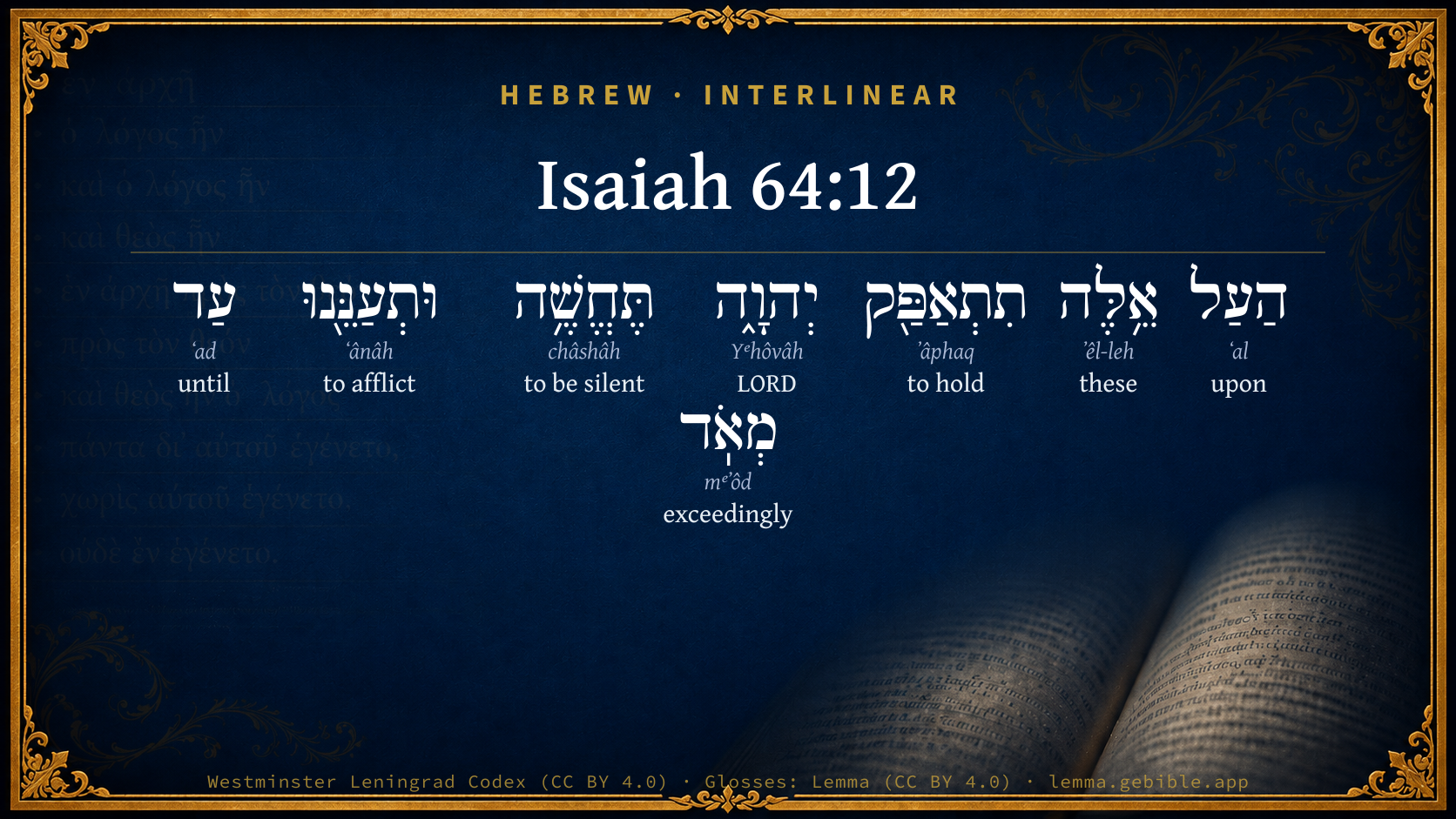
Isaiah 64:12

Hebrew (Westminster Leningrad Codex) Isaiah 64:12 appears in the Hebrew Old Testament. The text above is from the Westminster Leningrad Codex. Each word links to its Strong’s number, a concise gloss, and parsing drawn from the Open Scriptures Hebrew Bible morphology. Click any word for its full Brown-Driver-Briggs (BDB) entry.
Download image
Cite this verse

Isaiah 64:12 (World English Bible). Public Domain. Lemma interlinear Bible study tool, https://lemma.gebible.app/v/isaiah/64/12.

Show BibTeX & RIS
BibTeX
RIS
English Translation
Will you refrain yourself for these things, Yahweh? will you hold your peace, and afflict us very sore?
World English Bible · Public Domain
Download a study sheet

One document with this verse’s original text, its word-by-word gloss line, the meaning frame, cross-references with their text, attributed commentary, and full source and license credits — printable, and it pastes into notes with its structure intact.

This verse Autodidact and up

Study sheet (.html) Plain text (.txt)

A passage Seminary Student

Up to 50 verses in one chapter. A passage sheet keeps up to 6 commentary sources and 12 cross-references per verse, in the order this page ranks them, and says so on the sheet whenever that leaves anything out. Ask for a single verse and you get the Autodidact verse sheet above.

Everything on this page stays free to read, with no account — the sheet is a download of what is already on screen, not access to it.

Want to remove ads? Support Godless Engineer
Compare translations 3

The same verse in 3 English versions, stacked beneath the original-language interlinear above. Click any original word for its lexicon entry.

Each is an independent rendering of the whole verse — the interlinear is not word-aligned to these translations.

Highlighted words mark where these versions differ — a whole-verse word diff, not a word-by-word alignment.

  • World English Bible Public Domain
    Will you refrain yourself for these things, Yahweh? will you hold your peace, and afflict us very sore?
  • King James Version Public Domain
    Wilt thou refrain thyself for these things, O LORD? wilt thou hold thy peace, and afflict us very sore?
  • unfoldingWord Literal Text CC BY-SA 4.0
    At these, will you restrain yourself, Yahweh? Will you be silent and humble us to abundance?”

unfoldingWord Literal Text — © unfoldingWord, licensed CC BY-SA 4.0. Word-aligned USFM3 via Door43 (git.door43.org/unfoldingWord/en_ult).

Versions to compare (up to 4)

3 of 4 selected

Show all 17 translations

Every available English version of this verse, each an independent rendering of the whole verse.

  • World English Bible Public Domain
    Will you refrain yourself for these things, Yahweh? will you hold your peace, and afflict us very sore?
  • Berean Standard Bible Public Domain
    After all this, O LORD, will You restrain Yourself? Will You keep silent and afflict us beyond measure?
  • Majority Standard Bible Public Domain
    After all this, O LORD, will You restrain Yourself? Will You keep silent and afflict us beyond measure?
  • King James Version Public Domain
    Wilt thou refrain thyself for these things, O LORD? wilt thou hold thy peace, and afflict us very sore?
  • American Standard Version (1901) Public Domain
    Wilt thou refrain thyself for these things, O Jehovah? wilt thou hold thy peace, and afflict us very sore?
  • Revised Version (1885) Public Domain
    Wilt thou refrain thyself for these things, O LORD? wilt thou hold thy peace, and afflict us very sore?
  • Geneva Bible (1599) Public Domain
    Wilt thou holde thy selfe still at these things, O Lord? wilt thou holde thy peace and afflict vs aboue measure?
  • Douay-Rheims (1899) Public Domain
    Wilt thou refrain thyself, O Lord, upon these things, wilt thou hold thy peace, and afflict us vehemently?
  • Young's Literal Translation Public Domain
    For these dost Thou refrain Thyself, Jehovah? Thou art silent, and dost afflict us very sore!'
  • Literal Standard Version CC BY-SA 4.0
    Do You refrain Yourself for these, YHWH? You are silent, and afflict us very severely!
  • Unlocked Literal Bible CC BY-SA 4.0
    How can you still hold back, Yahweh? How can you remain silent and continue to humiliate us?”
  • unfoldingWord Literal Text CC BY-SA 4.0
    At these, will you restrain yourself, Yahweh? Will you be silent and humble us to abundance?”
  • Darby Bible Public Domain
    Wilt thou restrain thyself in presence of these things, Jehovah? Wilt thou hold thy peace, and afflict us very sore?
  • World Messianic Bible Public Domain
    Will you hold yourself back for these things, LORD? Will you keep silent and punish us very severely?
  • Free Bible Version CC BY-SA 4.0
    In view of all this, are you still going to refuse to help us? Are you going to stay quiet and punish us so severely?
  • Bible in Basic English Public Domain
    []
  • JPS Tanakh (1917) Public Domain
    (64-11) Wilt Thou refrain Thyself for these things, O LORD? Wilt Thou hold Thy peace, and afflict us very sore?

Literal Standard Version (2020), Covenant Press — licensed CC BY-SA 4.0. Text via the HelloAO Bible API (eBible.org). Unlocked Literal Bible (unfoldingWord) — licensed CC BY-SA 4.0. Text via the HelloAO Bible API (eBible.org). unfoldingWord Literal Text — © unfoldingWord, licensed CC BY-SA 4.0. Word-aligned USFM3 via Door43 (git.door43.org/unfoldingWord/en_ult). Free Bible Version, Dr. Jonathan Gallagher — licensed CC BY-SA 4.0. Text via the HelloAO Bible API (eBible.org).

Word by word

More ways to search: Search by grammar → Find every occurrence → Compare this word →

Practice this passage: Drill this verse → Learn its vocabulary →

About this verse

These counts appear in no published source. They are computed here, from the morphology-tagged text and Lemma’s own curated glosses. What Lemma adds →

8
words
8
distinct lemmas
Prophets
section

Notable vocabulary

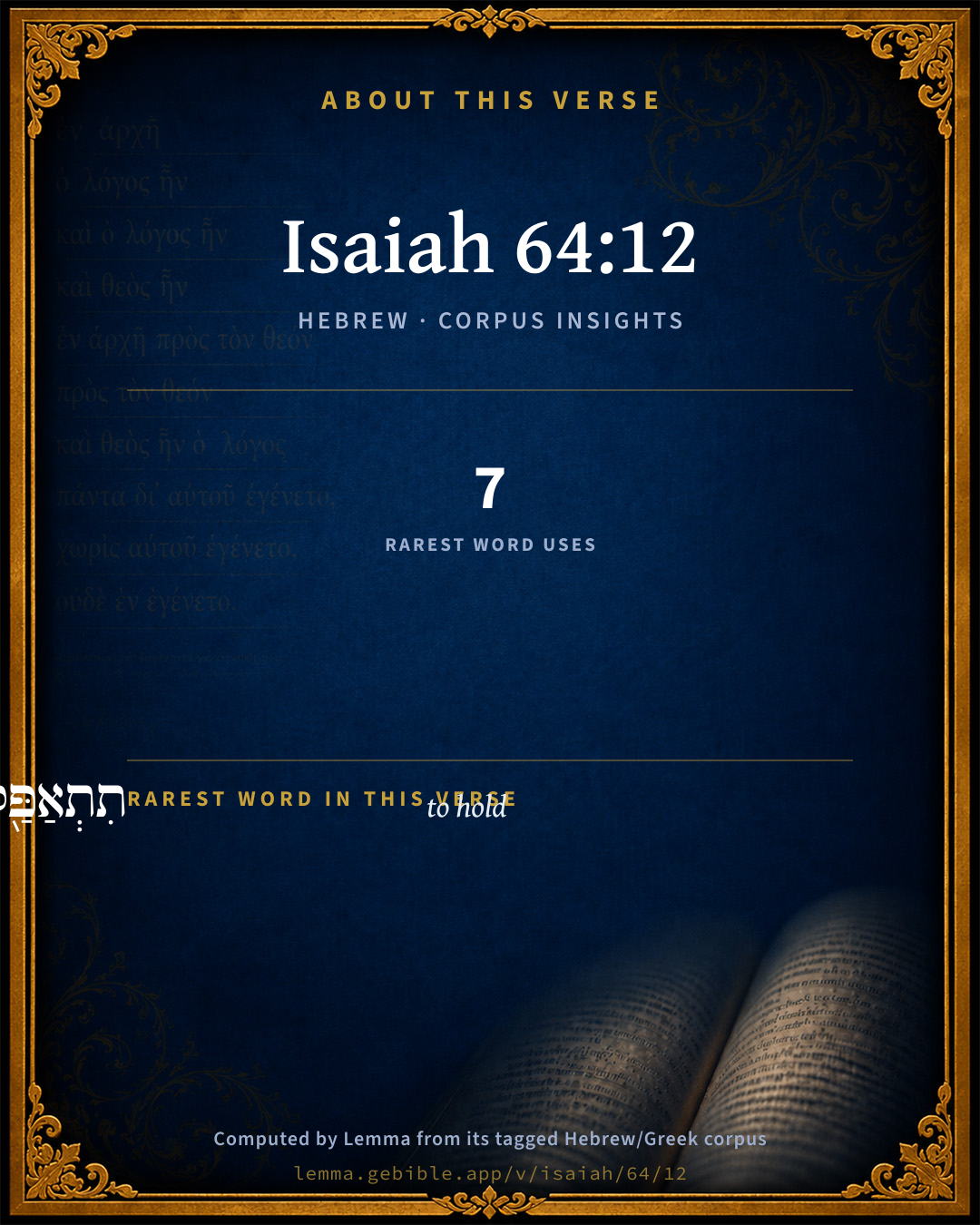
The rarest word here is תִתְאַפַּ֖ק to hold H662 — appearing just 7 times in the whole Hebrew Bible.

Shared distinctive vocabulary

תִתְאַפַּ֖ק to hold H662 occurs in 7 verses of the Hebrew Bible. Also found in:

Grammatical profile

  • 3 verbs
  • 1 noun
  • 1 pronoun
  • 2 prepositions
  • 1 adverb

Verb forms

  • תִתְאַפַּ֖ק Hithpael · Imperfect
  • תֶּחֱשֶׁ֥ה Qal · Imperfect
  • וּתְעַנֵּ֖נוּ Piel · Imperfect

Hebrew & Septuagint length

In English translation the verse runs 18 words from the Hebrew and 20 from the Septuagint (LXX English) — closely comparable.

A rough comparison of the two English renderings, which tokenize alike — not a word-level alignment.

Word counts can differ between the Hebrew and the Greek without any difference in meaning — e.g. the Hebrew direct-object marker אֵת has no separate Greek word, and Greek often adds the article ὁ.

Cross-references

10

Topical passages linked to Isaiah 64:12 in the Treasury of Scripture Knowledge — connected by theme and wording, ordered by reader-vote popularity; previews shown in the World English Bible.

  • Isaiah 42:14 I have long time held my peace; I have been still, and refrained myself: [now] will I cry out like a travailing woman; I will gasp and pant together.
  • Psalms 74:10–11 How long, God, shall the adversary reproach? Shall the enemy blaspheme your name forever?
  • Psalms 74:18–19 Remember this, that the enemy has mocked you, Yahweh. Foolish people have blasphemed your name.
  • Psalms 83:1 God, don't keep silent. Don't keep silent, And don't be still, God.
  • Zechariah 1:12 Then the angel of Yahweh replied, "O Yahweh of Hosts, how long will you not have mercy on Jerusalem and on the cities of Judah, against which you have had indignation these seventy years?"
  • Psalms 10:1 Why do you stand far off, Yahweh? Why do you hide yourself in times of trouble?
  • Psalms 79:5 How long, Yahweh? Will you be angry forever? Will your jealousy burn like fire?
  • Psalms 80:3–4 Turn us again, God. Cause your face to shine, And we will be saved.
  • Psalms 89:46–51 How long, Yahweh? Will you hide yourself forever? Will your wrath burn like fire?
  • Revelation 6:10 They cried with a loud voice, saying, "How long, Master, the holy and true, until you judge and avenge our blood on those who dwell on the earth?"

Cross-references courtesy of OpenBible.info (CC BY 4.0).

Hebrew and Greek witnesses Masoretic Hebrew ↔ Greek Septuagint

The same verse in the two great witnesses to the Old Testament, shown verse-for-verse.

These are two independent witnesses, not word-aligned to each other, and the Septuagint is shown in lemma (dictionary) form.

Hebrew Isaiah 64:12 Masoretic · Westminster Leningrad Codex

הַעַל אֵ֥לֶּה תִתְאַפַּ֖ק יְהוָ֑ה תֶּחֱשֶׁ֥ה וּתְעַנֵּ֖נוּ עַד מְאֹֽד

Will you refrain yourself for these things, Yahweh? will you hold your peace, and afflict us very sore?

World English Bible · Public Domain

Greek LXX Isaiah 64:12 Septuagint · lemma form
And for all these things you, O Lord, has withholden, yourself, and been silent, and have brought us very low.

LXX2012 (modern English Septuagint) · Public Domain

Hebrew: Westminster Leningrad Codex (CC BY 4.0). Greek: Septuagint (public domain); English from LXX2012 (modern English Septuagint) (Public Domain). How the Septuagint differs from the Hebrew →

Commentary

Notes on Isaiah 64:12 from classic Christian and Jewish commentators (each source and its license shown beneath its notes). The classic Christian expositions comment on the surrounding passage and are grouped to its opening verse, so a note may address several verses; the Jewish commentaries on the Tanakh (Rashi and others) are per-verse, so they appear only where the commentator wrote on this verse.

Lemma curates 59 commentaries, every one of them public domain or Creative Commons licensed, each selected and text-cleaned for this edition rather than reprinted as found. About our sources →

Trapp's Complete Commentary

John Trapp

Isa 64:12 Wilt thou refrain thyself for these [things], O LORD? wilt thou hold thy peace, and afflict us very sore?

Ver. 12. Wilt thou refrain thyself for these things?] Or, Canst thou contain thyself at these things? No, he cannot; witness his answer hereunto. {Isa 65:1} The obstinate Jews do in vain still recite these words in their synagogues, as Jerome here noteth.

Wilt thou hold thy peace?] And by thy silence seem to consent to the enemy’s outrages and our calamities? Habet acrimoniam, saith Hyperius. There is some sharpness in these short questions; and yet because they were full of faith and fervency, they were highly accepted in heaven.

And afflict us very sore?] Heb., Usque valde? Unto very much, or unto extremity.

John Trapp, A Commentary or Exposition upon All the Books of the Old and New Testament (1647–1656) — public domain. Text from a community e-Sword module.

The Biblical Illustrator

Joseph S. Exell

Isa_64:12

Wilt Thou refrain Thyself for these things, O Lord?

--

Self-restraint and silence, as applied to God

Self-restraint and silence, as applied to God are common figures for inaction and apparent indifference to the interests, and especially the sufferings, of His people. (J. A. Alexander.)

Jehovahs mercy

Jehovahs mercy cannot violently restrain itself longer; it must burst forth, like Josephs tears in the recognition scene (Gen_45:1). (F. Delitzsch, D. D.)

The Biblical Illustrator, edited by Joseph S. Exell (c. 1880s–1900s) — public domain. Text from a community e-Sword module.

Geneva Bible (1599)

Geneva Bible translators

That is, at the contempt of thine own glory? though our sins have deserved this, yet thou wilt not suffer thy glory thus to be diminished.

Geneva Bible (1599) marginal notes — public domain. Text via Bolls.life.

Jamieson, Fausset & Brown

Robert Jamieson, A. R. Fausset & David Brown

for these things--Wilt Thou, notwithstanding these calamities of Thy people, still refuse Thy aid (Isa 42:14)?

In Isa 64:9, their plea was, "we are all Thy people." In answer, God declares that others (Gentiles) would be taken into covenant with Him, while His ancient people would be rejected. The Jews were slow to believe this; hence Paul says (Rom 10:20) that Isaiah was "very bold" in advancing so unpopular a sentiment; he implies what Paul states (Rom 2:28; Rom 9:6-7; Rom. 11:1-31), that "they are not all (in opposition to the Jews' plea, Isa 64:9) Israel which are of Israel." God's reason for so severely dealing with Israel is not changeableness in Him, but sin in them (Isa 65:2-7). Yet the whole nation shall not be destroyed, but only the wicked; a remnant shall be saved (Isa 65:8-16). There shall be, finally, universal blessedness to Israel, such as they had prayed for (Isa 65:17-25).

Next: Isaiah Chapter 65

Jamieson, Fausset & Brown — Commentary Critical and Explanatory on the Whole Bible (1871) — public domain (CC PDM 1.0). Text via the HelloAO Bible API.

Ellicott's Commentary for English Readers

(12) Wilt thou refrain . . .?—The final appeal to the fatherly compassion of Jehovah reminds us of the scene when Joseph could not “refrain” (Gen_45:1), and natural tenderness would find a vent. Could the God of Israel look on the scene of desolation, and not be moved to pity?

A Bible Commentary for English Readers, edited by Charles John Ellicott (1878–1897) — public domain. Text from a community e-Sword module.

The Cambridge Bible for Schools and Colleges

gen. ed. J. J. S. Perowne

12. refrain thyself] See ch. Isa_63:15.

The Cambridge Bible for Schools and Colleges (gen. ed. J. J. S. Perowne; Cambridge University Press, 1878–1918) — public domain. Text from a community e-Sword module.

John Gill's Exposition

Wilt thou refrain thyself for these things, O Lord?.... From delivering us out of our troubles and miseries, and taking vengeance on our enemies, and showing thy zeal for thine own glory; or, as Kimchi paraphrases it,

"how canst thou contain thyself for these things, and not have mercy?''

how canst thou bear to see Judea, and all its cities, a wilderness; Jerusalem, and the temple of it, in ruins?

wilt thou hold thy peace? or, "be silent"; and not plead thine own cause, and the cause of thy people?

and afflict us very sore? exceedingly, even to extremity; or for ever, as the Targum, thinking it long, as well as heavy. Jerom observes, that the Jews say these words in their synagogues every day; which show that they look upon this prophecy to respect their present case.

Next: Isaiah Chapter 65

John Gill's Exposition of the Whole Bible (1746–1763) — public domain (CC PDM 1.0). Text via the HelloAO Bible API.

Albert Barnes' Notes on the Bible

Wilt thou refrain thyself - Wilt thou refuse to come to our aid? Wilt thou decline to visit us, and save us from our calamities?

Wilt thou hold thy peace - Wilt thou not speak for our rescue, and command us to be delivered? Thus closes this chapter of great tenderness and beauty. It is a model of affectionate and earnest entreaty for the divine interposition in the day of calamity. With such tender and affectionate earnestness may we learn to plead with God! Thus may all his people learn to approach him as a Father: thus feel that they have the inestimable privilege, in times of trial, of making known their needs to the High and Holy One. Thus, when calamity presses on us; when as individuals or as families we are afflicted; or when our country or the church is suffering under long trials, may we go to God and humbly confess our sins, and urge his promises, and take hold of his strength, and plead with him to interpose. Thus pleading, be will hear us; thus presenting our cause, he will interpose to save.

Albert Barnes' Notes on the Bible (1834–1885) — public domain. Text from a community e-Sword/MySword module.

Matthew Poole's English Annotations

Wilt thou refrain thyself for these things, viz. that are done by the Babylonians? do none of these things move thee to take vengeance on them?

Wilt thou hold thy peace; wilt thou be as one that regards not? Wilt thou be still, and suffer them?

And afflict us very sore: see Isa 64:9; for these our sins, or for these our sufferings; shall we feel the smart of it, that have done no such things, but have been sufferers under the Babylonians? to which God answers in the next chapter.

Matthew Poole's English Annotations on the Holy Bible (1683–1685) — public domain. Text from a community e-Sword/MySword module.

Whedon's Commentary on the Bible

Daniel D. Whedon

12. Wilt thou refrain thyself — That is, refuse to render aid in such extremity. It seems like a tender, deprecating, but not hopeless, remonstrance. It does not express despair. There is a faint, lingering confidence that God will yet be pitiful, and the next chapter gives the key as to how the pity and the help are to come.

Daniel D. Whedon (gen. ed.), Commentary on the Old and New Testaments (1874–1909) — public domain. Text from a community e-Sword module.

The Pulpit Commentary

Wilt thou refrain thyself for these things? rather, at these things seeing that these things are so. Will they not provoke thee to interfere?

The Pulpit Commentary (1880–1919), ed. H.D.M. Spence-Jones & Joseph S. Exell — public domain. Text from a community e-Sword module.

John Wesley's Explanatory Notes

Wilt thou - Do none of these things move thee to take vengeance? Thy peace - Wilt thou be as one that regards not?

John Wesley, Explanatory Notes Upon the Whole Bible (1754–1765) — public domain. Text via the GEBible commentary corpus.

J. A. Alexander on Isaiah

Joseph Addison Alexander

“Wilt thou for these (things) restrain Thyself, oh Jehovah, wilt Thou keep silence and afflict us to extremity? This is simply another application of the argument by way of an importunate appeal to the divine compassions. Self-restraint and silence, as applied to God, are common figures for inaction and apparent indifference to the interests and especially the sufferings of His people. (See above, on Isa 42:14 and Isa 63:15). The question is not whether God will remain silent in spite of what His people suffered, but whether the loss of their external advantages will induce Him to forsake them. The question as in many other cases implies a negation of the strongest kind. The destruction of the old theocracy was God’s own act and was designed to bring the church under a new and far more glorious dispensation. How the loss of a national organization and preeminence was to be made good is fully stated in the following chapter.

Joseph Addison Alexander, The Prophecies of Isaiah (1846–1847; New York: Scribner, 1870–1878) — public domain. Text from a community e-Sword module.

Lesson kit

Teaching starters — assembled from the data on this page, not authored interpretation. Every prompt links to the verse data it draws on. Edit before teaching.

Isaiah, in the Prophets, opens this verse with 8 words (8 distinct Hebrew lemmas). Its most distinctive word is ʼâphaq (“to hold”). A historical commentator’s framing appears above. Read the whole chapter for the surrounding context.

Discussion questions

  1. What does “to hold” (ʼâphaq) contribute to the verse as a whole?
  2. Genesis 43:31 shares the word «to hold» with this verse. How do the two illuminate each other?
  3. These translations render this verse differently; the difference is in the English rendering, not the original. What questions does that raise?
  4. The verb «תִתְאַפַּ֖ק» is Hithpael Imperfect. How does its form color the action?
  5. Reading how Trapp's Complete Commentary and The Biblical Illustrator read this verse, where do the two commentators agree and where do they part?

Things to notice

Reading settings

Reading text

Shown beneath each verse's original-language words.

Old Testament
Old Testament edition

Read the OT as the Masoretic Hebrew (MT) or the Greek Septuagint (LXX).

English shown for the Greek Septuagint (in the Hebrew ↔ Greek comparison).

Comparing translations? Open the Compare panel on any verse page to stack up to four side by side.