
Job 30:11

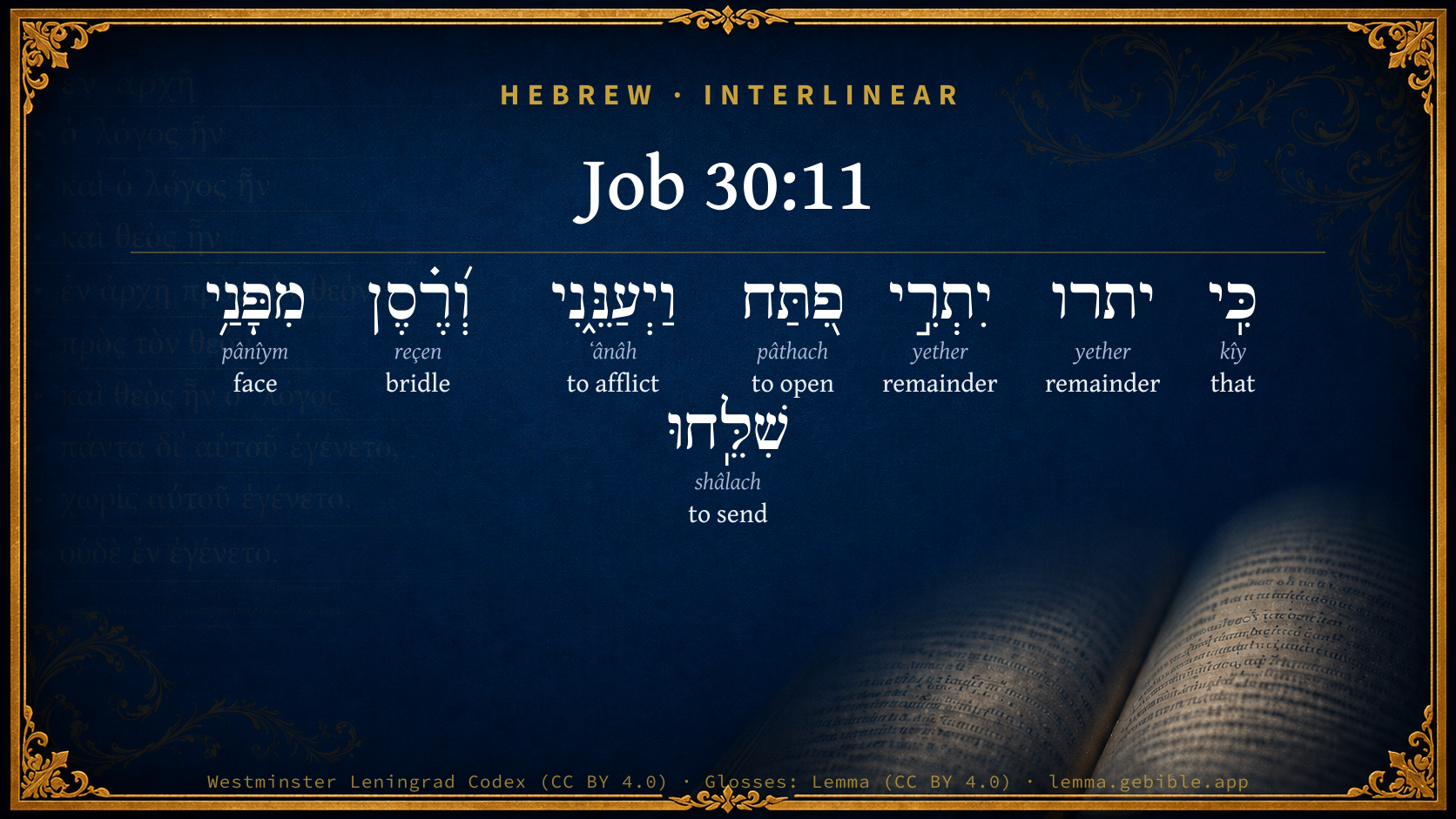
Hebrew (Westminster Leningrad Codex) Job 30:11 appears in the Hebrew Old Testament. The text above is from the Westminster Leningrad Codex. Each word links to its Strong’s number, a concise gloss, and parsing drawn from the Open Scriptures Hebrew Bible morphology. Click any word for its full Brown-Driver-Briggs (BDB) entry.
Download image
Cite this verse

Job 30:11 (World English Bible). Public Domain. Lemma interlinear Bible study tool, https://lemma.gebible.app/v/job/30/11.

Show BibTeX & RIS
BibTeX
RIS
English Translation
For he has untied his cord, and afflicted me; And they have thrown off restraint before me.
World English Bible · Public Domain
Highlights
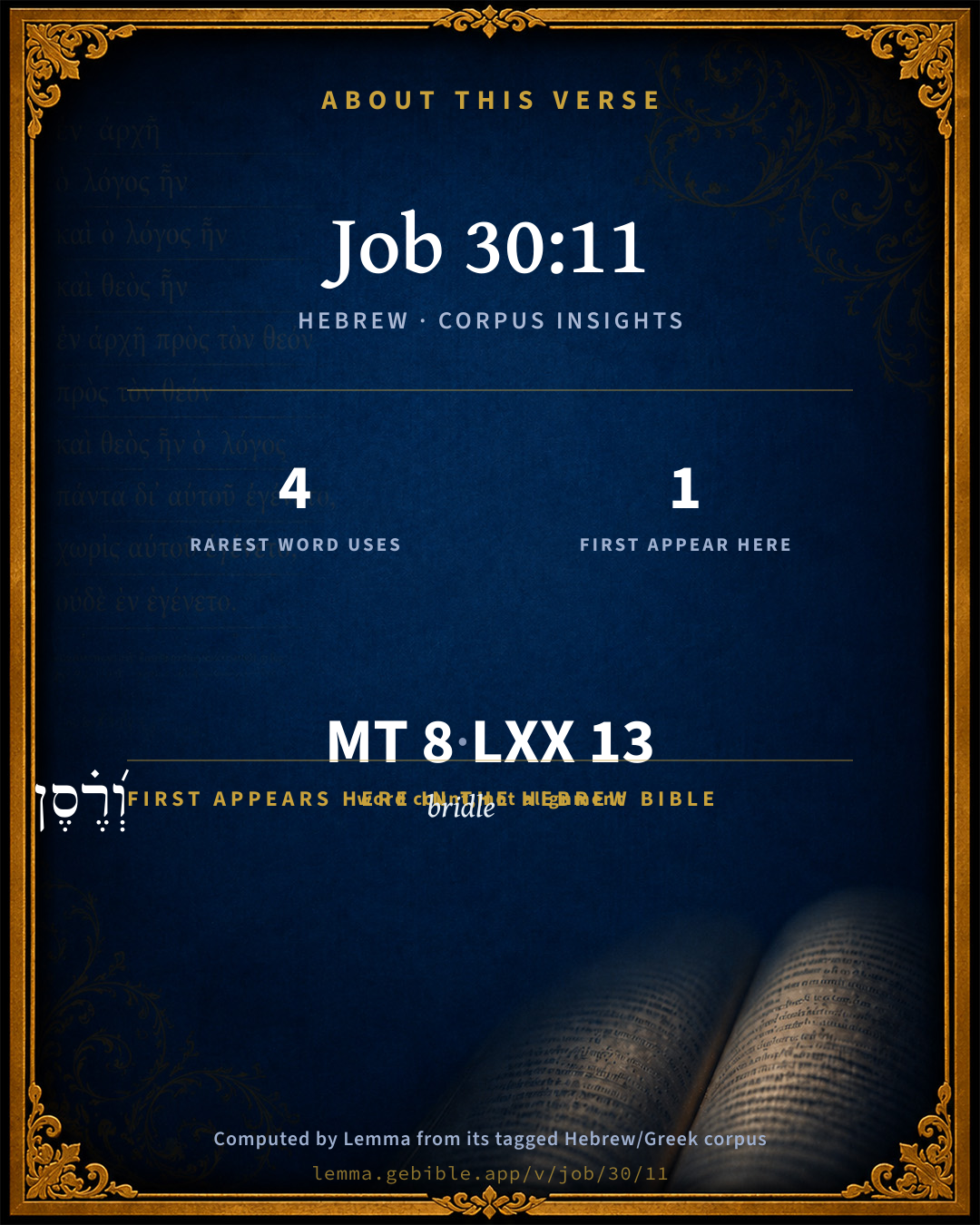
  • 1 first appearance in the Hebrew Bible
Full analysis ↓
Download a study sheet

One document with this verse’s original text, its word-by-word gloss line, the meaning frame, cross-references with their text, attributed commentary, and full source and license credits — printable, and it pastes into notes with its structure intact.

This verse Autodidact and up

Study sheet (.html) Plain text (.txt)

A passage Seminary Student

Up to 50 verses in one chapter. A passage sheet keeps up to 6 commentary sources and 12 cross-references per verse, in the order this page ranks them, and says so on the sheet whenever that leaves anything out. Ask for a single verse and you get the Autodidact verse sheet above.

Everything on this page stays free to read, with no account — the sheet is a download of what is already on screen, not access to it.

Want to remove ads? Support Godless Engineer
Compare translations 3

The same verse in 3 English versions, stacked beneath the original-language interlinear above. Click any original word for its lexicon entry.

Each is an independent rendering of the whole verse — the interlinear is not word-aligned to these translations.

Highlighted words mark where these versions differ — a whole-verse word diff, not a word-by-word alignment.

  • World English Bible Public Domain
    For he has untied his cord, and afflicted me; And they have thrown off restraint before me.
  • King James Version Public Domain
    Because he hath loosed my cord, and afflicted me, they have also let loose the bridle before me.
  • unfoldingWord Literal Text CC BY-SA 4.0
    For he has loosed my cord and humbled me, so they cast away restraint from my face.

unfoldingWord Literal Text — © unfoldingWord, licensed CC BY-SA 4.0. Word-aligned USFM3 via Door43 (git.door43.org/unfoldingWord/en_ult).

Versions to compare (up to 4)

3 of 4 selected

Show all 18 translations

Every available English version of this verse, each an independent rendering of the whole verse.

  • World English Bible Public Domain
    For he has untied his cord, and afflicted me; And they have thrown off restraint before me.
  • Berean Standard Bible Public Domain
    Because God has unstrung my bow and afflicted me, they have cast off restraint in my presence.
  • Majority Standard Bible Public Domain
    Because God has unstrung my bow and afflicted me, they have cast off restraint in my presence.
  • King James Version Public Domain
    Because he hath loosed my cord, and afflicted me, they have also let loose the bridle before me.
  • American Standard Version (1901) Public Domain
    For he hath loosed his cord, and afflicted me; And they have cast off the bridle before me.
  • Revised Version (1885) Public Domain
    For he hath loosed his cord, and afflicted me, and they have cast off the bridle before me.
  • Geneva Bible (1599) Public Domain
    Because that God hath loosed my corde and humbled mee, they haue loosed the bridle before me.
  • Douay-Rheims (1899) Public Domain
    For he hath opened his quiver, and hath afflicted me, and hath put a bridle into my mouth.
  • Young's Literal Translation Public Domain
    Because His cord He loosed and afflicteth me, And the bridle from before me, They have cast away.
  • Literal Standard Version CC BY-SA 4.0
    Because He loosed His cord and afflicts me, || And the bridle from before me, || They have cast away.
  • Unlocked Literal Bible CC BY-SA 4.0
    For God has unstrung the string to my bow and afflicted me, and those who taunt me cast off restraint before my face.
  • unfoldingWord Literal Text CC BY-SA 4.0
    For he has loosed my cord and humbled me, so they cast away restraint from my face.
  • Darby Bible Public Domain
    For he hath loosed my cord and afflicted me; so they cast off the bridle before me.
  • World Messianic Bible Public Domain
    For he has untied his cord, and afflicted me; and they have thrown off restraint before me.
  • Webster's Bible Public Domain
    Because he hath loosed my cord, and afflicted me, they have also let loose the bridle before me.
  • Free Bible Version CC BY-SA 4.0
    God has made my bowstring loose and humbled me.
  • Bible in Basic English Public Domain
    For he has made loose the cord of my bow, and put me to shame; he has sent down my flag to the earth before me.
  • JPS Tanakh (1917) Public Domain
    For He hath loosed my cord, and afflicted me, and they have cast off the bridle before me.

Literal Standard Version (2020), Covenant Press — licensed CC BY-SA 4.0. Text via the HelloAO Bible API (eBible.org). Unlocked Literal Bible (unfoldingWord) — licensed CC BY-SA 4.0. Text via the HelloAO Bible API (eBible.org). unfoldingWord Literal Text — © unfoldingWord, licensed CC BY-SA 4.0. Word-aligned USFM3 via Door43 (git.door43.org/unfoldingWord/en_ult). Free Bible Version, Dr. Jonathan Gallagher — licensed CC BY-SA 4.0. Text via the HelloAO Bible API (eBible.org).

Word by word

More ways to search: Search by grammar → Find every occurrence → Compare this word →

Practice this passage: Drill this verse → Learn its vocabulary →

וְ֝רֶ֗סֶן
reçen
H7448
“and · bridle”
Conjunction + Noun, Common, Masculine, Singular, Absolute
Part of Speech
Conjunction + Noun
Type
Common
Gender
Masculine
Number
Singular
State
Absolute
Full BDB Definition

Origin: from an unused root meaning to curb

TWOT: 2180a

something that restrains, halter, jaw - halter - of restraint thrown off (figuratively) - jaw (of crocodile)
  1. כִּֽי kîy H3588 “that” Conjunction
  2. יתרו yether H3499 “remainder · his” Noun, Common, Masculine, Singular, Construct + Suffix, Personal, 3rd Person, Masculine, Singular
  3. יִתְרִ֣י yether H3499 “remainder · my” Noun, Common, Masculine, Singular, Construct + Suffix, Personal, 1st Person, Common, Singular
  4. פִ֭תַּח pâthach H6605 “to open” Verb, Piel, Perfect, 3rd Person, Masculine, Singular
  5. וַיְעַנֵּ֑נִי ʻânâh H6031 “and · to afflict · me” Conjunction + Verb, Piel, Sequential Imperfect, 3rd Person, Masculine, Singular + Suffix, Personal, 1st Person, Common, Singular
  6. מִפָּנַ֥י pânîym H6440 “from · face(s) · my” Preposition + Noun, Common, Both, Plural, Construct + Suffix, Personal, 1st Person, Common, Singular
  7. שִׁלֵּֽחוּ shâlach H7971 “to send” Verb, Piel, Perfect, 3rd Person, Common, Plural

About this verse

These counts appear in no published source. They are computed here, from the morphology-tagged text and Lemma’s own curated glosses. What Lemma adds →

8
words
7
distinct lemmas
Wisdom
section

Notable vocabulary

The rarest word here is וְ֝רֶ֗סֶן bridle H7448 — appearing just 4 times in the whole Hebrew Bible.

First appearance in Scripture

This word makes its first canonical appearance in the Hebrew Bible here:

  • וְ֝רֶ֗סֶן bridle H7448

Shared distinctive vocabulary

וְ֝רֶ֗סֶן bridle H7448 occurs in 4 verses of the Hebrew Bible. Also found in:

Grammatical profile

  • 3 verbs
  • 4 nouns
  • 1 conjunction

Verb forms

  • פִ֭תַּח Piel · Perfect
  • וַיְעַנֵּ֑נִי Piel · Sequential Imperfect
  • שִׁלֵּֽחוּ Piel · Perfect

Repetition

A word recurs within this verse — often emphatic in Hebrew:

  • יתרו remainder H3499 ×2

Hebrew & Septuagint length

In English translation the verse runs 17 words from the Hebrew and 19 from the Septuagint (LXX English) — closely comparable.

A rough comparison of the two English renderings, which tokenize alike — not a word-level alignment.

Word counts can differ between the Hebrew and the Greek without any difference in meaning — e.g. the Hebrew direct-object marker אֵת has no separate Greek word, and Greek often adds the article ὁ.

In the original languages it is 8 Hebrew tokens and 13 Greek tokens — but the two are counted differently (Hebrew bundles its prefixes and suffixes into one token; the Greek is in lemma form), so that isn’t a like-for-like length.

Cross-references

9

Topical passages linked to Job 30:11 in the Treasury of Scripture Knowledge — connected by theme and wording, ordered by reader-vote popularity; previews shown in the World English Bible.

  • Job 12:21 He pours contempt on princes, And loosens the belt of the strong.
  • Ruth 1:21 I went out full, and Yahweh has brought me home again empty; why do you call me Naomi, seeing Yahweh has testified against me, and the Almighty has afflicted me?"
  • Job 12:18 He loosens the bond of kings, He binds their loins with a belt.
  • 2 Samuel 16:5–8 When king David came to Bahurim, behold, a man of the family of the house of Saul came out, whose name was Shimei, the son of Gera. He came out, and cursed still as he came.
  • Psalms 32:9 Don't be like the horse, or like the mule, which have no understanding, Who are controlled by bit and bridle, or else they will not come near to you.
  • Psalms 35:21 Yes, they opened their mouth wide against me. They said, "Aha! Aha! Our eye has seen it!"
  • Matthew 26:67–68 Then they spit in his face and beat him with their fists, and some slapped him,
  • Matthew 27:39–44 Those who passed by blasphemed him, wagging their heads,
  • James 1:26 If anyone among you thinks himself to be religious while he doesn't bridle his tongue, but deceives his heart, this man's religion is worthless.

Cross-references courtesy of OpenBible.info (CC BY 4.0).

Hebrew and Greek witnesses Masoretic Hebrew ↔ Greek Septuagint

The same verse in the two great witnesses to the Old Testament, shown verse-for-verse.

These are two independent witnesses, not word-aligned to each other, and the Septuagint is shown in lemma (dictionary) form.

Hebrew Job 30:11 Masoretic · Westminster Leningrad Codex

כִּֽי יתרו יִתְרִ֣י פִ֭תַּח וַיְעַנֵּ֑נִי וְ֝רֶ֗סֶן מִפָּנַ֥י שִׁלֵּֽחוּ

For he has untied his cord, and afflicted me; And they have thrown off restraint before me.

World English Bible · Public Domain

Greek LXX Job 30:11 Septuagint · lemma form

ἀναοἴγω γάρ φαρέτρα αὐτός κακόω ἐγώ καί χαλινός ὁ πρόσωπον ἐγώ ἐκ ἀποστέλλω

For he has opened his quiver and afflicted me: they also have cast off the restraint of my presence.

LXX2012 (modern English Septuagint) · Public Domain

On this verse, Adam Clarke's Commentary discusses the Septuagint’s reading. Read the note in Commentary ↓

Hebrew: Westminster Leningrad Codex (CC BY 4.0). Greek: Septuagint (public domain); English from LXX2012 (modern English Septuagint) (Public Domain). How the Septuagint differs from the Hebrew →

Commentary

Notes on Job 30:11 from classic Christian and Jewish commentators (each source and its license shown beneath its notes). The classic Christian expositions comment on the surrounding passage and are grouped to its opening verse, so a note may address several verses; the Jewish commentaries on the Tanakh (Rashi and others) are per-verse, so they appear only where the commentator wrote on this verse.

Lemma curates 59 commentaries, every one of them public domain or Creative Commons licensed, each selected and text-cleaned for this edition rather than reprinted as found. About our sources →

The Cambridge Bible for Schools and Colleges

gen. ed. J. J. S. Perowne

11. Job_30:11 is very variously understood; it may mean,

For they have loosed their rein and humbled me,

They have cast off the bridle before me.

So taken, the two clauses have much the same meaning, each being a figurative manner of saying that the low rabble have cast off all restraint, and subject the sufferer to painful humiliations. The verb in the first clause is sing., but may distribute to each the conduct of the whole. Others, however, make the subject to be God, rendering: Because he has loosed his rein and humbled me, they also have cast off the bridle before me (A. V.). There is nothing, however, to indicate such an antithesis between two different subjects in the two clauses. Another reading gives my rein or cord (A. V.), but no help comes from adopting this.

11–14. Further description of the outrageous insults of these base outcasts.

The Cambridge Bible for Schools and Colleges (gen. ed. J. J. S. Perowne; Cambridge University Press, 1878–1918) — public domain. Text from a community e-Sword module.

Trapp's Complete Commentary

John Trapp

Job 30:11 Because he hath loosed my cord, and afflicted me, they have also let loose the bridle before me.

Ver. 11. Because he hath loosed my cord] i.e. God hath taken away mine authority, whereby I heretofore kept them in order, and made them more obsequious, so that now, like headstrong horses, having gotten the bit between their teeth, they run whithersoever they list, and rise up against their rider. It is God who casteth contempt upon princes, Psa 107:40 Job 12:21, as he did upon Solomon in his old age, upon his son Rehoboam, upon Ephraim, Hos 13:1, {See Trapp on "Hos 13:1"} upon our Edward II, and Henry VI. Some render it, He hath loosed my bow string, in reference to Job 29:20, so that I cannot now shoot at those that slight me. Job was disarmed and disabled to do as he desired, as Philip, king of France, was in the battle between him and Edward III, king of England, at the instant whereof there fell such a piercing shower of rain as dissolved the strings of his archers, and made their bows usefuless (Dan. Hist. f. 237).

And afflicted me] When a tree is felled each man pulleth off a branch, saith the Greek proverb. When a dog is worried, every cur will fall on him, and have a fling at him; when a deer is wounded, the whole herd will set against him, and thrust him out of their company: so, when God hath afflicted Job, every base beggarly fellow sat heavy upon his skirts. This was an addition to his affliction.

Theft have also let loose the bridle upon me] Those insolents, having pulled their heads out of the halter, lay the reins in the neck, and run riot; yea, they run at tilt against me, as it were, beyond all reason and measure, without fear, shame, or manners, Effraenate in me invecti sunt (Jan.). For, upon me, some read, before me; q.d. Now they dare do anything, even in my presence, who formerly stood in awe of me.

John Trapp, A Commentary or Exposition upon All the Books of the Old and New Testament (1647–1656) — public domain. Text from a community e-Sword module.

Joseph Benson's Commentary

Job 30:11. Because he — That is, God; hath loosed my cord — Hath slackened the string of my bow, and so rendered it and my arrows useless; that is, he hath deprived me of my strength and defence: so understood, this expression is opposed to that used Job 29:20, My bow is renewed, &c. But the phrase may mean, He hath taken away from me that power and authority wherewith, as with a cord, I bound them to their good behaviour, and kept them within proper bounds. A similar expression is used in this sense Job 12:18. As, however, the word יתר, jether, here rendered cord, also means excellence, and is so translated Gen 49:3; Job 4:21, and in other places, the sense here may be, He hath loosed, broken, or destroyed my excellence: or, as Schultens translates it, He hath stripped me of my glory. And afflicted me — When they perceived that God, who had been my faithful friend and constant defender, had forsaken me and was become mine enemy, they presently took this advantage of showing their malice against me. They have also let loose the bridle — They have cast off all former restraints of law, humanity, or modesty, and have given themselves full liberty to speak or act what they pleased against me: and this before me — For they now dare to do those things before mine eyes which they would formerly have trembled lest they should come to my ears.

Joseph Benson's Commentary on the Old and New Testaments (1811–1818) — public domain. Text from a community e-Sword module.

Geneva Bible (1599)

Geneva Bible translators

He said that the young men when they saw him, hid themselves, as Job 29:8, and now in his misery they were impudent and licentious.

God hath taken from me the force, credit, and authority wherewith I kept them in subjection.

Geneva Bible (1599) marginal notes — public domain. Text via Bolls.life.

Jamieson, Fausset & Brown

Robert Jamieson, A. R. Fausset & David Brown

He--that is, "God"; antithetical to "they"; English Version here follows the marginal reading (Keri).

my cord--image from a bow unstrung; opposed to Job 29:20. The text (Chetib), "His cord" or "reins" is better; "yea, each lets loose his reins" [UMBREIT].

Jamieson, Fausset & Brown — Commentary Critical and Explanatory on the Whole Bible (1871) — public domain (CC PDM 1.0). Text via the HelloAO Bible API.

Adam Clarke's Commentary

Verse 11. Because he hath loosed my cord] Instead of יתרי yithri, my cord, which is the keri or marginal reading, יתרו yithro, his cord, is the reading of the text in many copies; and this reading directs us to a metaphor taken from an archer, who, observing his butt, sets his arrow on the string, draws it to a proper degree of tension, levels, and then loosing his hold, the arrow flies at the mark. He hath let loose his arrow against me; it has hit me; and I am wounded. The Vulgate understood it in this way: Pharetram enim suam aperuit. So also the Septuagint: Ανοιξας γαρ φαρετραν αυτου; "He hath opened his quiver."

They have also let loose the bridle] When they perceived that God had afflicted me, they then threw off all restraints; like headstrong horses, swallowed the bit, got the reins on their own neck, and ran off at full speed.

Adam Clarke's Commentary on the Bible (1810–1826) — public domain. Text from a community e-Sword/MySword module.

Ellicott's Commentary for English Readers

(11) Because he hath loosed my cord.—Better, his: i.e., “God hath loosed the cord of his bow and they have cast off all restraint before me.”

A Bible Commentary for English Readers, edited by Charles John Ellicott (1878–1897) — public domain. Text from a community e-Sword module.

John Gill's Exposition

Because he hath loosed my cord,.... Not his silver cord, for then he must have died immediately, Ecc 12:6; though it may be understood of the loosening of his nerves through the force of his disease, and the afflictions he endured from God and man, see Job 30:17; or rather of the shattered state and condition of his family and substance; which, while he enjoyed, he had respect and reverence from men; but now all being loosed, scattered, and destroyed, he was treated with derision and scorn; or, better still, of his power and authority as a civil magistrate, by which, as with a cord, he bound many to subjection and obedience to him, and which commanded reverence of him; but this being now loosed and removed from him, persons of the baser sort behaved in an insolent manner towards him; there is a "Keri", or a marginal reading of this clause, which we follow; but the "Cetib", or written text, is "his cord"; and so Mr. Broughton renders it, "he hath loosed his string"; which he explains of the string or rein of his government, that holdeth base men from striving with the mighty, and which comes to the same sense; for the power and authority Job had as a governor were of God, and which he had now loosened; the allusion may be to the string of a bow, which being loosed, it cannot cast out the arrow; and respect may be had to what Job had said, Job 29:20, "my bow was renewed in my hand"; it then abode in strength, and its strength was renewed; but now he had lost his power and strength, at least it was greatly weakened, that he could not defend himself, nor punish the wicked:

and afflicted me; that is, God, who is also understood in the preceding clause, though not expressed. Job's afflictions were many, and there were second causes of them, who were the movers, instruments, and means of them, as Satan, the Sabeans and Chaldeans, yet they were of God, as the appointer, orderer, and sender of them; and so Job understood them, and always as here ascribed them to him; wherefore there was a just cause for them, and an end to be answered by them, and it became Job patiently to bear them, and to wait the issue of them: now, on this account, the above persons were emboldened and encouraged to use Job in the ill manner they did:

they have also let loose the bridle before me; the restraints that were upon them when Job was in his prosperity, and had the reins of government in his hand; these they now cast off, and showed no manner of reverence of him, nor respect for him; and the bridle that was upon their mouths, which kept them from speaking evil of him while he was in power, now they slipped it from them, and gave themselves an unbounded liberty in deriding, reproaching, and reviling him; see Psa 39:1; and this they did before him, in his presence and to his face, who before were mute and silent.

John Gill's Exposition of the Whole Bible (1746–1763) — public domain (CC PDM 1.0). Text via the HelloAO Bible API.

Albert Barnes' Notes on the Bible

Because he hath loosed my cord - According to this translation, the reference here is to God, and the sense is, that the reason why he was thus derided and contemned by such a worthless race was, that God had unloosened his cord. That is, God had rendered him incapable of vindicating himself, or of inflicting punishment. The figure, according to this interpretation, is taken from a bow, and Job means to say that his bow was relaxed, his vigor was gone, and they now felt that they might insult him with impunity. But instead of the usual reading in the Hebrew text יתרי yithriy - “my nerve,” another reading יתרוּ yithriv - “his nerve,” is found in the qeri (margin). This reading has been adopted in the text by Jahn, and is regarded as genuine by Rosenmuller, Umbreit, and Noyes. According to this, the meaning is, that the worthless rabble that now treated him with so much contempt, had relaxed all restraint, and they who had hitherto been under some curb, now rushed upon him in the most unbridled manner. They had cast off all restraint arising from respect to his rank, standing, moral worth, and the dread of his power, and now treated him with every kind of indignity.

And afflicted me - By the disrespect and contempt which they have evinced.

They have also let loose the bridle before me - That is, they have cast off all restraint - repeating the idea in the first member of the verse.

Albert Barnes' Notes on the Bible (1834–1885) — public domain. Text from a community e-Sword/MySword module.

Haydock's Catholic Bible Commentary

For he. Protestants, "Because he hath loosed my cord, and afflicted me, they have also let loose the bridle before me," (Haydock) being no longer under any restraint. Sometimes it was customary to put bits into the mouth of a person who was led to execution, Isaias xxxvii. 29. (Calmet) --- The Hebrew plural, have put, insinuates the plurality of persons in God, (Worthington) though it may be as well referred to the enemies of Job.

George Leo Haydock (1774–1849), Haydock's Catholic Family Bible and Commentary, 1859 edition — public domain. Excludes Psalms (Douay-Rheims chapter numbering differs from Protestant) and Deuterocanonical books (Catholic canon only).

Matthew Poole's English Annotations

Because he, to wit, God, for it follows, he afflicted me, which was God’s work.

Hath loosed my cord; either,

1. He hath slackened the string (as this word sometimes signifies) of my bow, and so rendered my bow and arrows useless, either to offend others, or to defend myself, i.e. he hath deprived me of my strength or defence: so this is opposed to that expression, Job 29:20. Or,

2. He hath taken away from me that power and authority wherewith, as with a cord, I bound them to the good behaviour, and kept them within their bounds. The like expression is used in the same sense Job 15:18.

Afflicted me: when they perceived that God, who had been my faithful friend, and constant defender, had forsaken me, and was become mine enemy, they presently took this advantage of showing their malice against me.

They have also let loose the bridle; they cast off all former restraints of law, or humanity, or modesty, and gave themselves full liberty to speak or act what they pleased against me. Before me; they durst now do those things before mine eyes, which formerly they trembled lest they should come to my ears.

Matthew Poole's English Annotations on the Holy Bible (1683–1685) — public domain. Text from a community e-Sword/MySword module.

Whedon's Commentary on the Bible

Daniel D. Whedon

11. Loosed my cord — My girdle, (Furst;) bowstring, (Dillmann;) the well-known symbol of power, or, as in Job_4:21, the cord, (Delitzsch,) like that of a tent that keeps the soul in the body. In either view God had humbled him. He forbears to mention Deity by name. They also have cast off the bridle; that is, all restraint, perhaps all sense of shame. The antitheis is obvious.

Daniel D. Whedon (gen. ed.), Commentary on the Old and New Testaments (1874–1909) — public domain. Text from a community e-Sword module.

The Pulpit Commentary

Because he hath loosed my cord. "He," in this passage, can only be God; and thus Job turns here to some extent from his human persecutors to his great Afflicter, the Almighty. God has "loosened his cord" i.e. has relaxed his vital fibre, taken away his strength, reduced him to helplessness. Hence, and hence only, do the persecutors dare to crowd around him and insult him. And afflicted me. God has afflicted him with blow after blow with impoverishment, (Job_1:14-17) with bereavement, (Job_1:18, Job_1:19) with a sore malady. (Job_2:7) They have also let loose the bridle before me. This has given his persecutors the courage to east aside all restraint, and lead him with insult after insult (vers. 1, 9, 10).

The Pulpit Commentary (1880–1919), ed. H.D.M. Spence-Jones & Joseph S. Exell — public domain. Text from a community e-Sword module.

John Wesley's Explanatory Notes

He - God. Cord - Hath slackened the string of my bow, and so rendered my bow and arrows useless; he hath deprived me of my strength or defense. Let loose - They cast off all former restraints of humanity, or modesty, and do those things before mine eyes, which formerly they trembled lest they should come to my ears.

John Wesley, Explanatory Notes Upon the Whole Bible (1754–1765) — public domain. Text via the GEBible commentary corpus.

Rashi

Rabbi Shlomo Yitzchaki (Rashi)

For He untied my bowstring He untied the string of my bow (that I said above that my bow would become stronger); i.e., He weakened my strength—He Who has the power to do so.

and they have cast off the bridle My bridle, with which they were bridled to me—they cast it off before me because they no longer fear me.

Rashi on the Tanakh — English translations: “The Judaica Press complete Tanach with Rashi, translated by A. J. Rosenberg” (CC BY 4.0); “Pentateuch with Rashi's commentary by M. Rosenbaum and A.M. Silbermann, 1929-1934” (public domain); “The Metsudah Tanach series, Lakewood, N.J” (CC BY 4.0); and “The Book of Joshua, Metsudah Publications, 1997” (CC BY 4.0). Text via Sefaria.

Lesson kit

Teaching starters — assembled from the data on this page, not authored interpretation. Every prompt links to the verse data it draws on. Edit before teaching.

Job, in the Wisdom, opens this verse with 8 words (7 distinct Hebrew lemmas). Its most distinctive word is reçen (“bridle”). A historical commentator’s framing appears above. Read the whole chapter for the surrounding context.

Discussion questions

  1. What does “bridle” (reçen) contribute to the verse as a whole?
  2. The word “bridle” first appears here in Scripture. What is being introduced at this debut?
  3. Job 41:13 shares the word «bridle» with this verse. How do the two illuminate each other?
  4. “remainder” occurs 2× in this one verse. What is the effect of the repetition?
  5. These translations render this verse differently. What is at stake in choosing one wording over another?
  6. The verb «פִ֭תַּח» is Piel Perfect. How does its form color the action?
  7. Reading how The Cambridge Bible for Schools and Colleges and Trapp's Complete Commentary read this verse, where do the two commentators agree and where do they part?

Things to notice

Reading settings

Reading text

Shown beneath each verse's original-language words.

Old Testament
Old Testament edition

Read the OT as the Masoretic Hebrew (MT) or the Greek Septuagint (LXX).

English shown for the Greek Septuagint (in the Hebrew ↔ Greek comparison).

Comparing translations? Open the Compare panel on any verse page to stack up to four side by side.