
Lamentations 3:33

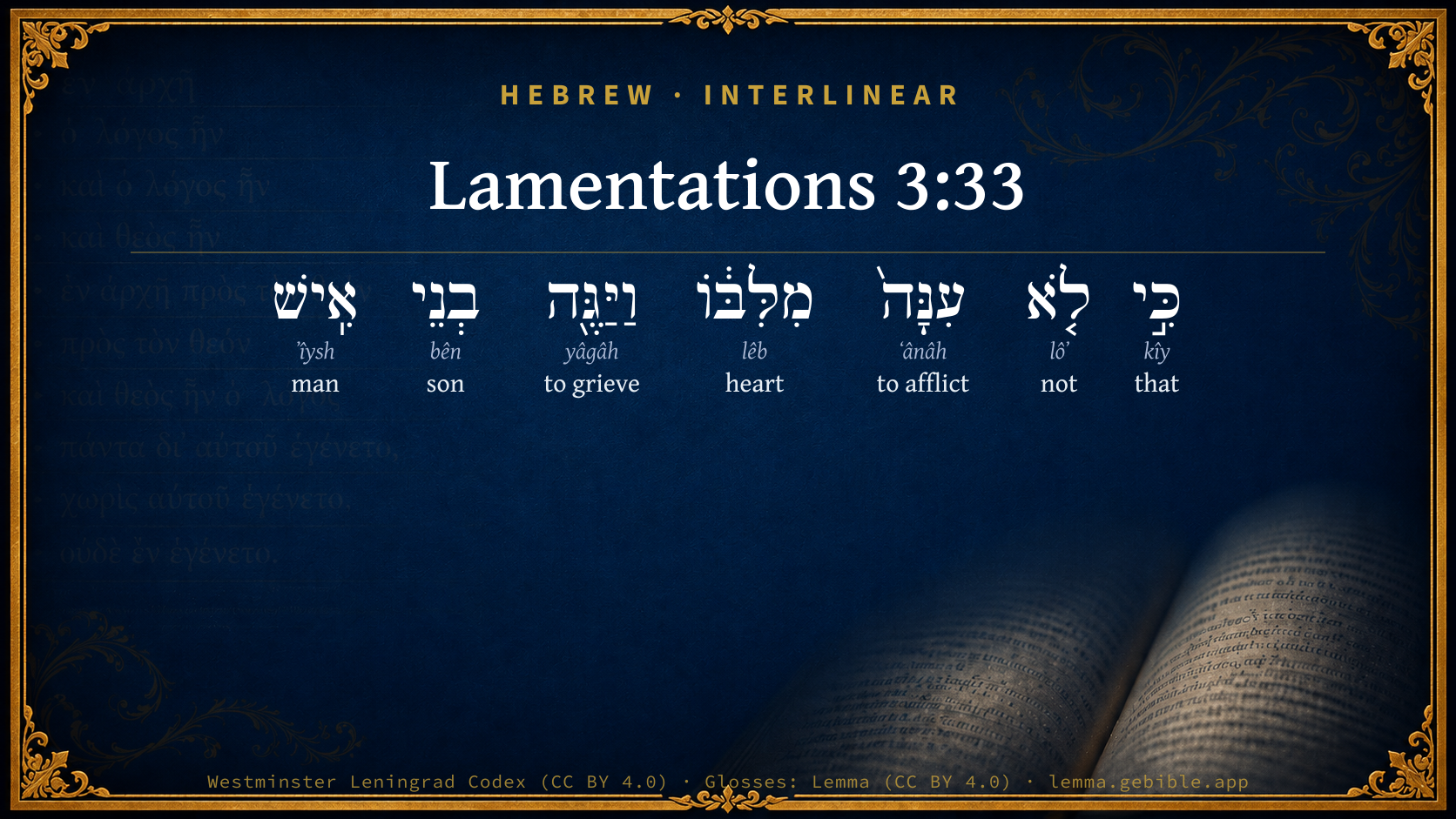
Hebrew (Westminster Leningrad Codex) Lamentations 3:33 appears in the Hebrew Old Testament. The text above is from the Westminster Leningrad Codex. Each word links to its Strong’s number, a concise gloss, and parsing drawn from the Open Scriptures Hebrew Bible morphology. Click any word for its full Brown-Driver-Briggs (BDB) entry.
Download image
Cite this verse

Lamentations 3:33 (World English Bible). Public Domain. Lemma interlinear Bible study tool, https://lemma.gebible.app/v/lamentations/3/33.

Show BibTeX & RIS
BibTeX
RIS
English Translation
For he does not afflict willingly, nor grieve the children of men.
World English Bible · Public Domain
Download a study sheet

One document with this verse’s original text, its word-by-word gloss line, the meaning frame, cross-references with their text, attributed commentary, and full source and license credits — printable, and it pastes into notes with its structure intact.

This verse Autodidact and up

Study sheet (.html) Plain text (.txt)

A passage Seminary Student

Up to 50 verses in one chapter. A passage sheet keeps up to 6 commentary sources and 12 cross-references per verse, in the order this page ranks them, and says so on the sheet whenever that leaves anything out. Ask for a single verse and you get the Autodidact verse sheet above.

Everything on this page stays free to read, with no account — the sheet is a download of what is already on screen, not access to it.

Want to remove ads? Support Godless Engineer
Compare translations 3

The same verse in 3 English versions, stacked beneath the original-language interlinear above. Click any original word for its lexicon entry.

Each is an independent rendering of the whole verse — the interlinear is not word-aligned to these translations.

Highlighted words mark where these versions differ — a whole-verse word diff, not a word-by-word alignment.

  • World English Bible Public Domain
    For he does not afflict willingly, nor grieve the children of men.
  • King James Version Public Domain
    For he doth not afflict willingly nor grieve the children of men.
  • unfoldingWord Literal Text CC BY-SA 4.0
    For he does not afflict from his heart, or grieve the sons of man. LAMEDH

unfoldingWord Literal Text — © unfoldingWord, licensed CC BY-SA 4.0. Word-aligned USFM3 via Door43 (git.door43.org/unfoldingWord/en_ult).

Versions to compare (up to 4)

3 of 4 selected

Show all 18 translations

Every available English version of this verse, each an independent rendering of the whole verse.

  • World English Bible Public Domain
    For he does not afflict willingly, nor grieve the children of men.
  • Berean Standard Bible Public Domain
    For He does not willingly afflict or grieve the sons of men.
  • Majority Standard Bible Public Domain
    For He does not willingly afflict or grieve the sons of men.
  • King James Version Public Domain
    For he doth not afflict willingly nor grieve the children of men.
  • American Standard Version (1901) Public Domain
    For he doth not afflict willingly, nor grieve the children of men.
  • Revised Version (1885) Public Domain
    For he doth not afflict willingly, nor grieve the children of men.
  • Geneva Bible (1599) Public Domain
    For he doeth not punish willingly, nor afflict the children of men,
  • Douay-Rheims (1899) Public Domain
    Caph. For he hath not willingly afflicted, nor cast off the children of men.
  • Young's Literal Translation Public Domain
    For He hath not afflicted with His heart, Nor doth He grieve the sons of men.
  • Literal Standard Version CC BY-SA 4.0
    For He has not afflicted with His heart, || Nor does He grieve the sons of men.
  • Unlocked Literal Bible CC BY-SA 4.0
    For he does not afflict from his heart or torment the children of mankind.
  • unfoldingWord Literal Text CC BY-SA 4.0
    For he does not afflict from his heart, or grieve the sons of man. LAMEDH
  • Darby Bible Public Domain
    for he doth not willingly afflict or grieve the children of men.
  • World Messianic Bible Public Domain
    For he does not afflict willingly, nor grieve the children of men.
  • Webster's Bible Public Domain
    For he doth not afflict willingly nor grieve the children of men.
  • Free Bible Version CC BY-SA 4.0
    For he doesn't willingly hurt people, or cause them grief.
  • Bible in Basic English Public Domain
    For he has no pleasure in troubling and causing grief to the children of men.
  • JPS Tanakh (1917) Public Domain
    For He doth not afflict willingly, nor grieve the children of men.

Literal Standard Version (2020), Covenant Press — licensed CC BY-SA 4.0. Text via the HelloAO Bible API (eBible.org). Unlocked Literal Bible (unfoldingWord) — licensed CC BY-SA 4.0. Text via the HelloAO Bible API (eBible.org). unfoldingWord Literal Text — © unfoldingWord, licensed CC BY-SA 4.0. Word-aligned USFM3 via Door43 (git.door43.org/unfoldingWord/en_ult). Free Bible Version, Dr. Jonathan Gallagher — licensed CC BY-SA 4.0. Text via the HelloAO Bible API (eBible.org).

Word by word

More ways to search: Search by grammar → Find every occurrence → Compare this word →

Practice this passage: Drill this verse → Learn its vocabulary →

About this verse

These counts appear in no published source. They are computed here, from the morphology-tagged text and Lemma’s own curated glosses. What Lemma adds →

7
words
7
distinct lemmas
Prophets
section

Notable vocabulary

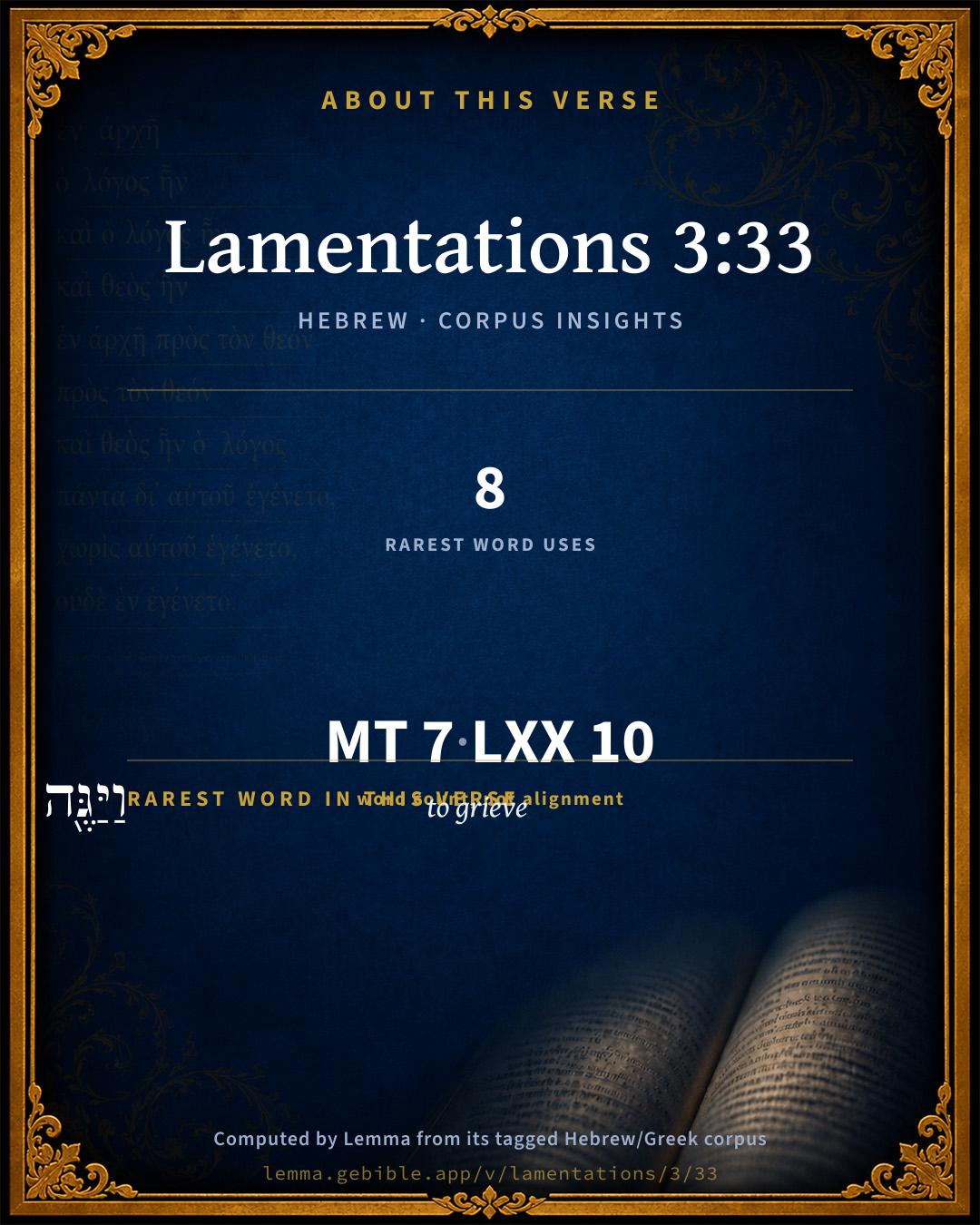
The rarest word here is וַיַּגֶּ֖ה to grieve H3013 — appearing just 8 times in the whole Hebrew Bible.

Shared distinctive vocabulary

וַיַּגֶּ֖ה to grieve H3013 occurs in 8 verses of the Hebrew Bible. Also found in:

Grammatical profile

  • 2 verbs
  • 3 nouns
  • 1 conjunction
  • 1 particle

Verb forms

  • עִנָּה֙ Piel · Perfect
  • וַיַּגֶּ֖ה Piel · Sequential Imperfect

Hebrew & Septuagint length

In English translation the verse runs 12 words from the Hebrew and 19 from the Septuagint (LXX English) — the Septuagint runs noticeably longer here. See the side-by-side →

A rough comparison of the two English renderings, which tokenize alike — not a word-level alignment.

Word counts can differ between the Hebrew and the Greek without any difference in meaning — e.g. the Hebrew direct-object marker אֵת has no separate Greek word, and Greek often adds the article ὁ.

In the original languages it is 7 Hebrew tokens and 10 Greek tokens — but the two are counted differently (Hebrew bundles its prefixes and suffixes into one token; the Greek is in lemma form), so that isn’t a like-for-like length.

Cross-references

4

Topical passages linked to Lamentations 3:33 in the Treasury of Scripture Knowledge — connected by theme and wording, ordered by reader-vote popularity; previews shown in the World English Bible.

  • Ezekiel 33:11 Tell them, As I live, says the Lord Yahweh, I have no pleasure in the death of the wicked; but that the wicked turn from his way and live: turn you, turn you from your evil ways; for why will you die, house of Israel?
  • Ezekiel 18:32 For I have no pleasure in the death of him who dies, says the Lord Yahweh: therefore turn yourselves, and live.
  • Hebrews 12:9–10 Furthermore, we had the fathers of our flesh to chasten us, and we paid them respect. Shall we not much rather be in subjection to the Father of spirits, and live?
  • Isaiah 28:21 For Yahweh will rise up as on Mount Perazim, he will be angry as in the valley of Gibeon; that he may do his work, his strange work, and bring to pass his act, his strange act.

Cross-references courtesy of OpenBible.info (CC BY 4.0).

Hebrew and Greek witnesses Masoretic Hebrew ↔ Greek Septuagint

The same verse in the two great witnesses to the Old Testament, shown verse-for-verse.

Here the Septuagint runs noticeably longer than the Hebrew — LXX2012 (modern English Septuagint) 19 words vs World English Bible 12. A rough length comparison of the two English translations, not a word-level alignment — read both below.

These are two independent witnesses, not word-aligned to each other, and the Septuagint is shown in lemma (dictionary) form.

Hebrew Lamentations 3:33 Masoretic · Westminster Leningrad Codex

כִּ֣י לֹ֤א עִנָּה֙ מִלִּבּ֔וֹ וַיַּגֶּ֖ה בְנֵי אִֽישׁ

For he does not afflict willingly, nor grieve the children of men.

World English Bible · Public Domain

Greek LXX Lamentations 3:33 Septuagint · lemma form

ὅτι οὐ ἀποκρίνω ἀπό καρδία αὐτός καί ταπεινόω υἱός ἀνήρ

He has not answered in anger from his heart, though he has brought low the children of a man.

LXX2012 (modern English Septuagint) · Public Domain

Hebrew: Westminster Leningrad Codex (CC BY 4.0). Greek: Septuagint (public domain); English from LXX2012 (modern English Septuagint) (Public Domain). How the Septuagint differs from the Hebrew →

Commentary

Notes on Lamentations 3:33 from classic Christian and Jewish commentators (each source and its license shown beneath its notes). The classic Christian expositions comment on the surrounding passage and are grouped to its opening verse, so a note may address several verses; the Jewish commentaries on the Tanakh (Rashi and others) are per-verse, so they appear only where the commentator wrote on this verse.

Lemma curates 59 commentaries, every one of them public domain or Creative Commons licensed, each selected and text-cleaned for this edition rather than reprinted as found. About our sources →

Trapp's Complete Commentary

John Trapp

Lam 3:33 For he doth not afflict willingly nor grieve the children of men.

Ver. 33. For he doth not afflict willingly.] Heb., From the heart. {a} Non nisi coactus, as that emperor said when he sealed a writ for execution of a condenmed person: I would not do it but upon necessity. It goeth as much against the heart with God as it can do against the hair with us:

“ Ille dolet quoties cogitur esse ferox. ”

{a} Non est Deo volupe, proprium, aut per se intentum. Poenas dat dum poenas exigit. - Sen. de Augusto. Iustis etiam suppliciis illacrymavit et ingemuit. - De Vespasiano Suetonius.

John Trapp, A Commentary or Exposition upon All the Books of the Old and New Testament (1647–1656) — public domain. Text from a community e-Sword module.

Geneva Bible (1599)

Geneva Bible translators

Hebrew, with his heart.

He taketh no pleasure in it, but doeth it of necessity for our amendment, when he suffereth the wicked to oppress the poor.

Geneva Bible (1599) marginal notes — public domain. Text via Bolls.life.

Jamieson, Fausset & Brown

Robert Jamieson, A. R. Fausset & David Brown

He does not afflict any willingly (literally, "from His heart," that is, as if He had any pleasure in it, Eze 33:11), much less the godly (Heb 12:10).

Jamieson, Fausset & Brown — Commentary Critical and Explanatory on the Whole Bible (1871) — public domain (CC PDM 1.0). Text via the HelloAO Bible API.

Adam Clarke's Commentary

Verse 33. For he doth not afflict willingly] It is no pleasure to God to afflict men. He takes no delight in our pain and misery: yet, like a tender and intelligent parent, he uses the rod; not to gratify himself, but to profit and save us.

Adam Clarke's Commentary on the Bible (1810–1826) — public domain. Text from a community e-Sword/MySword module.

John Calvin's Commentaries

This is another confirmation of the same truth, that God takes no delight in the evils or miseries of men. It is indeed a strong mode of speaking which the Prophet adopts, but very suitable. God, we know, puts on, as it were, our form or manner, for he cannot be comprehended in his inconceivable glory by human minds. Hence it is that he transfers to himself what properly can only apply to men. God surely never acts unwillingly nor feignedly: how then is that suitable which Jeremiah declares, — that God does not afflict from his heart? But God, as already said, does here assume the character of man; for though he afflicts us with sorrow as he pleases, yet true it is that he delights not in the miseries of men; for if a father desires to benefit his own children, and deals kindly with them, what ought we to think of our heavenly Father?

“Ye,” says Christ, “who are evil, know how to do good to your children,” (Matthew 7:11;)

what then are we to expect from the very fountain of goodness? As, then, parents are not willingly angry with their children, nor handle them roughly, there is no doubt but that God never punishes men except when he is constrained. There is, as I have said, an impropriety in the expression, but it is enough to know, that God derives no pleasure from the miseries of men, as profane men say, who utter such blasphemies as these, that we are like balls with which God plays, and that we are exposed to many evils, because God wishes to have as it were, a pleasant and delectable spectacle in looking on the innumerable afflict, ions, and at length on the death of men.

That such thoughts, then, might not tempt us to unbelief, the Prophet here puts a check on us, and declares that God does not afflict from his heart, that is, willingly, as though he delighted in the evils of men, as a judge, who, when he ascends his throne and condemns the guilty to death, does not do this from his heart, because he wishes all to be innocent, and thus to have a reason for acquitting them; but. yet he willingly condemns the guilty, because this is his duty. So also God, when he adopts severity towards men, he indeed does so willingly, because he is the judge of the world; but he does not do so from the heart, because he wishes all to be innocent — for far away from him is all fierceness and cruelty; and as he regards men with paternal love, so also he would have them to be saved, were they not as it were by force to drive him to rigor. And this feeling he also expresses in Isaiah,

“Ah! I will take consolation from mine adversaries.” (Isaiah 1:24.)

He calls them adversaries who so often provoked him by their obstinacy; yet he was led unwillingly to punish their sins, and hence he employed a particle expressive of grief, and exclaimed Ah! as a father who wishes his son to be innocent, and yet is compelled to be severe with him.

But however true this doctrine may be, taken generally, there is yet no doubt but that the Prophet here addresses only the faithful; and doubtless this privilege peculiarly belongs to God’s children, as it has been shown before. It follows, —

John Calvin's Commentaries (1540-1563) — public domain. Text from the Calvin Translation Society English edition (1840s-50s) via the Christian Classics Ethereal Library (ccel.org). Calvin's coverage is partial (roughly two-thirds of the Bible); uncommented books and verses are honest gaps, never fabricated. The 19th-century editor's footnotes and remarks are omitted so the notes are faithfully Calvin's own voice.

Ellicott's Commentary for English Readers

(33) Not . . . willingly.—Literally, not from the heart, as being the centre of volition as well as emotion

A Bible Commentary for English Readers, edited by Charles John Ellicott (1878–1897) — public domain. Text from a community e-Sword module.

The Cambridge Bible for Schools and Colleges

gen. ed. J. J. S. Perowne

33. willingly] lit. as mg. from his heart.

The Cambridge Bible for Schools and Colleges (gen. ed. J. J. S. Perowne; Cambridge University Press, 1878–1918) — public domain. Text from a community e-Sword module.

John Gill's Exposition

To subvert a man in his cause,.... A poor man, as the Targum, which aggravates it; as by courses and methods taken in an open court, so by secret underhand ways, to get the cause from him, and injure him in his property:

the Lord approveth not; or, "seeth not" (g); which some understand as spoken by wicked men, who do the above things, and flatter themselves that God sees not, and takes no notice of them, Eze 9:9; and others read it interrogatively, "doth not the Lord see?" (h) he does; he sees all the actions of men, nothing is hid from him; but he sees not with approbation; he do not look upon such things with delight and pleasure, but with abhorrence, Hab 1:13. The Targum is,

"is it possible that it should not be revealed before the Lord?''

(g) "non vidit, vel videt", Pagninus, Montanus, Calvin. (h) "Non videret?" Piscator.

John Gill's Exposition of the Whole Bible (1746–1763) — public domain (CC PDM 1.0). Text via the HelloAO Bible API.

Haydock's Catholic Bible Commentary

Men. He punishes with regret, Ezechiel xviii. 23. Our crimes force him to chastise, ver. 36. (Calmet) --- Yet he seeks our advantage. (Worthington)

George Leo Haydock (1774–1849), Haydock's Catholic Family Bible and Commentary, 1859 edition — public domain. Excludes Psalms (Douay-Rheims chapter numbering differs from Protestant) and Deuterocanonical books (Catholic canon only).

Matthew Poole's English Annotations

In the Hebrew it is, he doth not afflict from his heart, that is, with pleasure and delight; or (which seemeth the best sense to me) not from his own mere motion without a cause given him from the persons afflicted. Hence judgment is called God’s strange work. Showing mercy is his proper natural work, which floweth from himself without any cause in the creature. Judgment is his strange work, to which he never proceedeth but when provoked, and as it were forced from the creature, whence it followeth that he cannot delight in it.

Matthew Poole's English Annotations on the Holy Bible (1683–1685) — public domain. Text from a community e-Sword/MySword module.

The Pulpit Commentary

Willingly; literally, from his heart.

The Pulpit Commentary (1880–1919), ed. H.D.M. Spence-Jones & Joseph S. Exell — public domain. Text from a community e-Sword module.

John Wesley's Explanatory Notes

Willingly - Not from his own mere motion without a cause given him from the persons afflicted. Hence judgment is called God's strange work.

John Wesley, Explanatory Notes Upon the Whole Bible (1754–1765) — public domain. Text via the GEBible commentary corpus.

Rashi

Rabbi Shlomo Yitzchaki (Rashi)

For He does not willingly afflict or grieve the sons of man from His heart and from His will, but the iniquity causes [it].

Rashi on the Tanakh — English translations: “The Judaica Press complete Tanach with Rashi, translated by A. J. Rosenberg” (CC BY 4.0); “Pentateuch with Rashi's commentary by M. Rosenbaum and A.M. Silbermann, 1929-1934” (public domain); “The Metsudah Tanach series, Lakewood, N.J” (CC BY 4.0); and “The Book of Joshua, Metsudah Publications, 1997” (CC BY 4.0). Text via Sefaria.

Lesson kit

Teaching starters — assembled from the data on this page, not authored interpretation. Every prompt links to the verse data it draws on. Edit before teaching.

Lamentations, in the Prophets, opens this verse with 7 words (7 distinct Hebrew lemmas). Its most distinctive word is yâgâh (“to grieve”). The Greek Septuagint runs longer here. A historical commentator’s framing appears above. Read the whole chapter for the surrounding context.

Discussion questions

  1. What does “to grieve” (yâgâh) contribute to the verse as a whole?
  2. Job 19:2 shares the word «to grieve» with this verse. How do the two illuminate each other?
  3. Compared with the Hebrew, the Septuagint runs longer here. What questions does that raise?
  4. These translations render this verse differently. What is at stake in choosing one wording over another?
  5. The verb «עִנָּה֙» is Piel Perfect. How does its form color the action?
  6. Reading how Trapp's Complete Commentary and Geneva Bible (1599) read this verse, where do the two commentators agree and where do they part?

Things to notice

Reading settings

Reading text

Shown beneath each verse's original-language words.

Old Testament
Old Testament edition

Read the OT as the Masoretic Hebrew (MT) or the Greek Septuagint (LXX).

English shown for the Greek Septuagint (in the Hebrew ↔ Greek comparison).

Comparing translations? Open the Compare panel on any verse page to stack up to four side by side.