
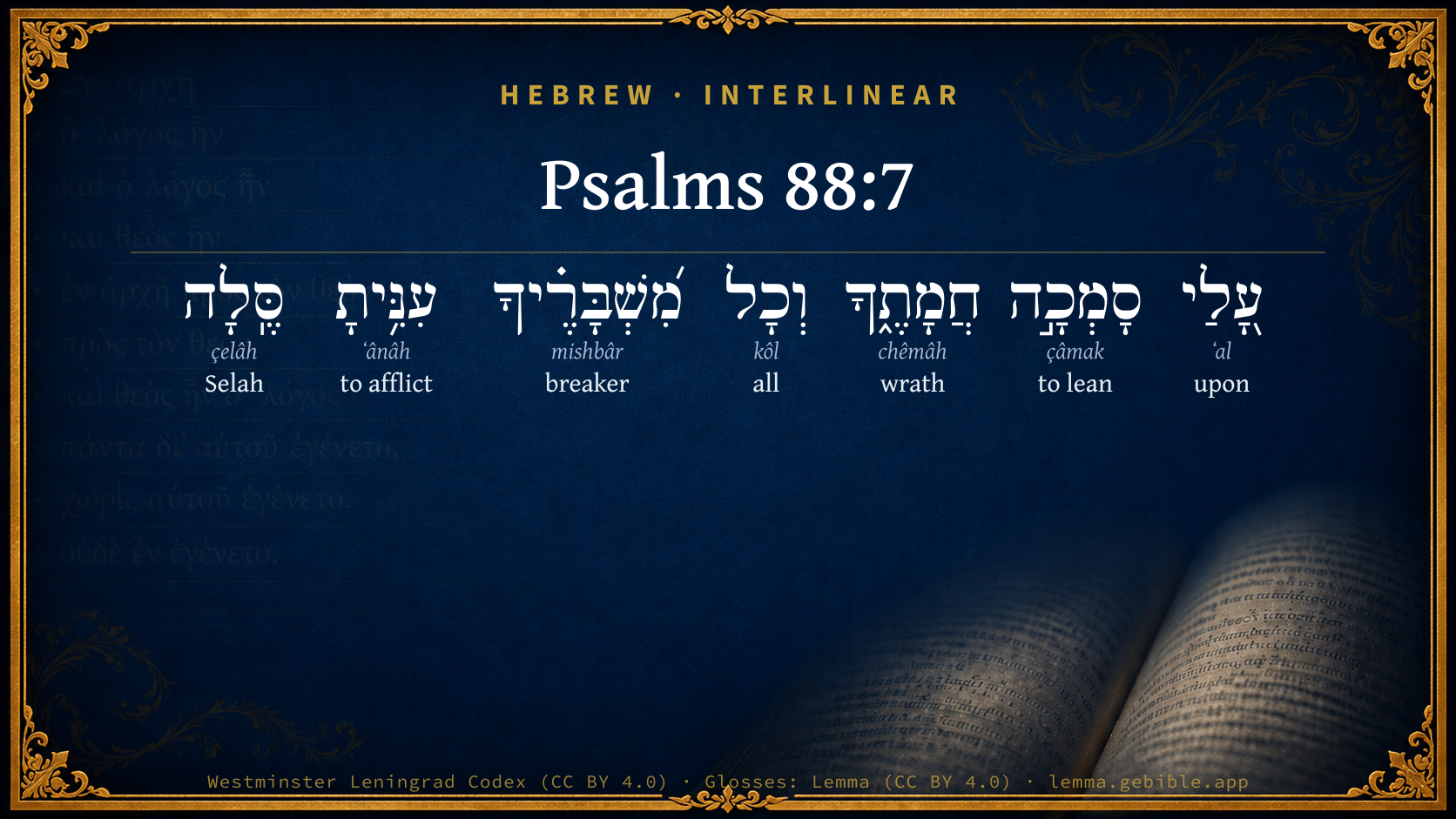
Psalms 88:7

Hebrew (Westminster Leningrad Codex) Psalms 88:7 appears in the Hebrew Old Testament. The text above is from the Westminster Leningrad Codex. Each word links to its Strong’s number, a concise gloss, and parsing drawn from the Open Scriptures Hebrew Bible morphology. Click any word for its full Brown-Driver-Briggs (BDB) entry.
Download image
Cite this verse

Psalms 88:7 (World English Bible). Public Domain. Lemma interlinear Bible study tool, https://lemma.gebible.app/v/psalms/88/7.

Show BibTeX & RIS
BibTeX
RIS
English Translation
Your wrath lies heavily on me. You have afflicted me with all your waves. Selah.
World English Bible · Public Domain
Download a study sheet

One document with this verse’s original text, its word-by-word gloss line, the meaning frame, cross-references with their text, attributed commentary, and full source and license credits — printable, and it pastes into notes with its structure intact.

This verse Autodidact and up

Study sheet (.html) Plain text (.txt)

A passage Seminary Student

Up to 50 verses in one chapter. A passage sheet keeps up to 6 commentary sources and 12 cross-references per verse, in the order this page ranks them, and says so on the sheet whenever that leaves anything out. Ask for a single verse and you get the Autodidact verse sheet above.

Everything on this page stays free to read, with no account — the sheet is a download of what is already on screen, not access to it.

Want to remove ads? Support Godless Engineer
Compare translations 3

The same verse in 3 English versions, stacked beneath the original-language interlinear above. Click any original word for its lexicon entry.

Each is an independent rendering of the whole verse — the interlinear is not word-aligned to these translations.

Highlighted words mark where these versions differ — a whole-verse word diff, not a word-by-word alignment.

  • World English Bible Public Domain
    Your wrath lies heavily on me. You have afflicted me with all your waves. Selah.
  • King James Version Public Domain
    Thy wrath lieth hard upon me, and thou hast afflicted me with all thy waves. Selah.
  • unfoldingWord Literal Text CC BY-SA 4.0
    Your wrath rests heavily on me, and you overwhelm all of your waves. Selah

unfoldingWord Literal Text — © unfoldingWord, licensed CC BY-SA 4.0. Word-aligned USFM3 via Door43 (git.door43.org/unfoldingWord/en_ult).

Versions to compare (up to 4)

3 of 4 selected

Show all 18 translations

Every available English version of this verse, each an independent rendering of the whole verse.

  • World English Bible Public Domain
    Your wrath lies heavily on me. You have afflicted me with all your waves. Selah.
  • Berean Standard Bible Public Domain
    Your wrath weighs heavily upon me; all Your waves have submerged me. Selah
  • Majority Standard Bible Public Domain
    Your wrath weighs heavily upon me; all Your waves have submerged me. Selah
  • King James Version Public Domain
    Thy wrath lieth hard upon me, and thou hast afflicted me with all thy waves. Selah.
  • American Standard Version (1901) Public Domain
    Thy wrath lieth hard upon me, And thou hast afflicted me with all thy waves. Selah
  • Revised Version (1885) Public Domain
    Thy wrath lieth hard upon me, and thou hast afflicted me with all thy waves. Selah
  • Geneva Bible (1599) Public Domain
    Thine indignation lyeth vpon me, and thou hast vexed me with all thy waues. Selah.
  • Douay-Rheims (1899) Public Domain
    They have laid me in the lower pit: in the dark places, and in the shadow of death.
  • Young's Literal Translation Public Domain
    Upon me hath Thy fury lain, And `with' all Thy breakers Thou hast afflicted. Selah.
  • Literal Standard Version CC BY-SA 4.0
    Your fury has lain on me, || And You have afflicted [with] all Your breakers. Selah.
  • Unlocked Literal Bible CC BY-SA 4.0
    Your wrath lies heavy on me, and all your waves crash over me. Selah
  • unfoldingWord Literal Text CC BY-SA 4.0
    Your wrath rests heavily on me, and you overwhelm all of your waves. Selah
  • Darby Bible Public Domain
    Thy fury lieth hard upon me, and thou hast afflicted [me] with all thy waves. Selah.
  • World Messianic Bible Public Domain
    Your wrath lies heavily on me. You have afflicted me with all your waves. Selah.
  • Webster's Bible Public Domain
    \\88:6\\Thou hast laid me in the lowest pit, in darkness, in the deeps.
  • Free Bible Version CC BY-SA 4.0
    Your hostility crushes me; you are drowning me under your crashing waves. Selah.
  • Bible in Basic English Public Domain
    The weight of your wrath is crushing me, all your waves have overcome me. (Selah.)
  • JPS Tanakh (1917) Public Domain
    (88-8) Thy wrath lieth hard upon me, and all Thy waves Thou pressest down. Selah

Literal Standard Version (2020), Covenant Press — licensed CC BY-SA 4.0. Text via the HelloAO Bible API (eBible.org). Unlocked Literal Bible (unfoldingWord) — licensed CC BY-SA 4.0. Text via the HelloAO Bible API (eBible.org). unfoldingWord Literal Text — © unfoldingWord, licensed CC BY-SA 4.0. Word-aligned USFM3 via Door43 (git.door43.org/unfoldingWord/en_ult). Free Bible Version, Dr. Jonathan Gallagher — licensed CC BY-SA 4.0. Text via the HelloAO Bible API (eBible.org).

Word by word

More ways to search: Search by grammar → Find every occurrence → Compare this word →

Practice this passage: Drill this verse → Learn its vocabulary →

About this verse

These counts appear in no published source. They are computed here, from the morphology-tagged text and Lemma’s own curated glosses. What Lemma adds →

7
words
7
distinct lemmas
Wisdom
section

Notable vocabulary

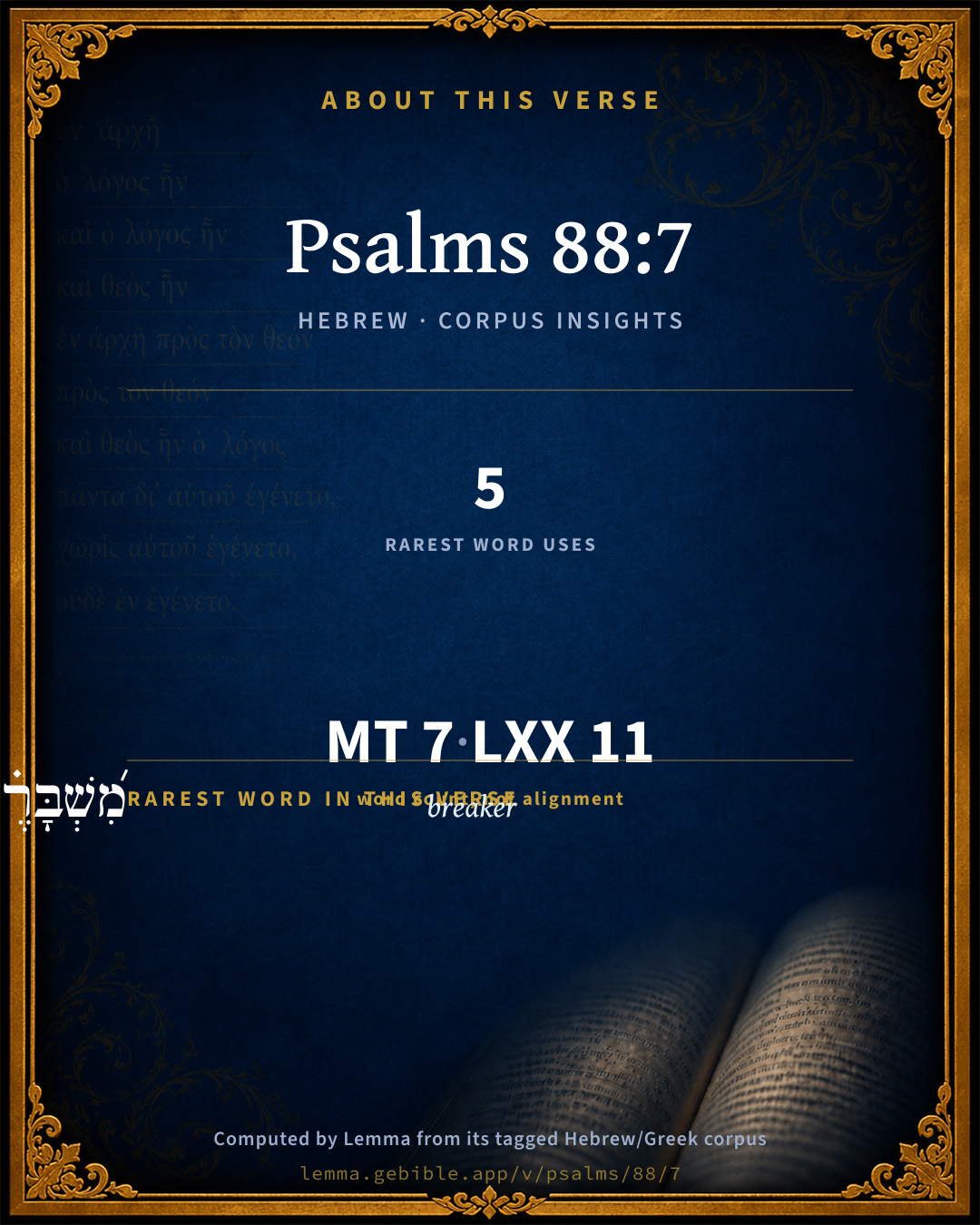
The rarest word here is מִ֝שְׁבָּרֶ֗יךָ breaker H4867 — appearing just 5 times in the whole Hebrew Bible.

Shared distinctive vocabulary

מִ֝שְׁבָּרֶ֗יךָ breaker H4867 occurs in 5 verses of the Hebrew Bible. Also found in:

Grammatical profile

  • 2 verbs
  • 3 nouns
  • 1 preposition
  • 1 particle

Verb forms

  • סָמְכָ֣ה Qal · Perfect
  • עִנִּ֥יתָ Piel · Perfect

Hebrew & Septuagint length

In English translation the verse runs 15 words from the Hebrew and 17 from the Septuagint (LXX English) — closely comparable.

A rough comparison of the two English renderings, which tokenize alike — not a word-level alignment.

Word counts can differ between the Hebrew and the Greek without any difference in meaning — e.g. the Hebrew direct-object marker אֵת has no separate Greek word, and Greek often adds the article ὁ.

In the original languages it is 7 Hebrew tokens and 11 Greek tokens — but the two are counted differently (Hebrew bundles its prefixes and suffixes into one token; the Greek is in lemma form), so that isn’t a like-for-like length.

Cross-references

12

Topical passages linked to Psalms 88:7 in the Treasury of Scripture Knowledge — connected by theme and wording, ordered by reader-vote popularity; previews shown in the World English Bible.

  • Psalms 42:7 Deep calls to deep at the noise of your waterfalls. All your waves and your billows have swept over me.
  • Job 6:4 For the arrows of the Almighty are within me, My spirit drinks up their poison. The terrors of God set themselves in array against me.
  • Romans 2:5–9 But according to your hardness and unrepentant heart you are treasuring up for yourself wrath in the day of wrath, revelation, and of the righteous judgment of God;
  • 1 Peter 2:24 who his own self bore our sins in his body on the tree, that we, having died to sins, might live to righteousness; by whose stripes you were healed.
  • Job 10:16 If my head is held high, you hunt me like a lion. Again you show yourself powerful to me.
  • Psalms 32:4 For day and night your hand was heavy on me. My strength was sapped in the heat of summer. Selah.
  • Psalms 38:1 Yahweh, don't rebuke me in your wrath, Neither chasten me in your hot displeasure.
  • Psalms 90:7 For we are consumed in your anger. We are troubled in your wrath.
  • Psalms 102:10 Because of your indignation and your wrath, For you have taken me up, and thrown me away.
  • Jonah 2:3 For you threw me into the depths, In the heart of the seas. The flood was all around me. All your waves and your billows passed over me.
  • John 3:36 One who believes in the Son has eternal life, but one who disobeys the Son won't see life, but the wrath of God remains on him."
  • Revelation 6:16–17 They told the mountains and the rocks, "Fall on us, and hide us from the face of him who sits on the throne, and from the wrath of the Lamb,

Cross-references courtesy of OpenBible.info (CC BY 4.0).

Hebrew and Greek witnesses Masoretic Hebrew ↔ Greek Septuagint

The same verse in the two great witnesses to the Old Testament, shown verse-for-verse.

You’re reading Greek Psalm 87 (Hebrew Psalm 88). The Septuagint counts the superscription, so verse numbers can differ from the Hebrew — chapter-level alignment, not verse-by-verse. Numbering follows Rahlfs.

These are two independent witnesses, not word-aligned to each other, and the Septuagint is shown in lemma (dictionary) form.

Hebrew Psalms 88:7 Masoretic · Westminster Leningrad Codex

עָ֭לַי סָמְכָ֣ה חֲמָתֶ֑ךָ וְכָל מִ֝שְׁבָּרֶ֗יךָ עִנִּ֥יתָ סֶּֽלָה

Your wrath lies heavily on me. You have afflicted me with all your waves. Selah.

World English Bible · Public Domain

Greek LXX Greek Psalm 87:7 Septuagint · lemma form

τίθημι ἐγώ ἐν λάκκος κατώτατος ἐν σκοτεινός καί ἐν σκιά θάνατος

Your wrath has pressed heavily upon me, and you have brought upon me all your billows. Pause.

LXX2012 (modern English Septuagint) · Public Domain

Hebrew: Westminster Leningrad Codex (CC BY 4.0). Greek: Septuagint (public domain); English from LXX2012 (modern English Septuagint) (Public Domain). How the Septuagint differs from the Hebrew →

Commentary

Notes on Psalms 88:7 from classic Christian and Jewish commentators (each source and its license shown beneath its notes). The classic Christian expositions comment on the surrounding passage and are grouped to its opening verse, so a note may address several verses; the Jewish commentaries on the Tanakh (Rashi and others) are per-verse, so they appear only where the commentator wrote on this verse.

Lemma curates 59 commentaries, every one of them public domain or Creative Commons licensed, each selected and text-cleaned for this edition rather than reprinted as found. About our sources →

Trapp's Complete Commentary

John Trapp

Psa 88:7 Thy wrath lieth hard upon me, and thou hast afflicted [me] with all thy waves. Selah.

Ver. 7. Thy wrath lieth hard upon me] So it did upon David, Psa 32:3, but especially upon the Son of David, the Lord Christ, of whose sufferings these were but types, or as chips of his cross.

And thou hast afflicted me with all thy waves] But all this while it is thy doing, and that carrieth comfort in it.

John Trapp, A Commentary or Exposition upon All the Books of the Old and New Testament (1647–1656) — public domain. Text from a community e-Sword module.

The Biblical Illustrator

Joseph S. Exell

Psa_88:7

Thy wrath lieth hard upon me, and Thou hast afflicted me with all Thy waves.

For the troubled

As men, the people of God share the common lot of men, and what is that but trouble? Yea, there are some sorrows which are peculiar to Christians, some extra griefs of which they partake because they are believers, though these are something more than balanced by those peculiar and bitter troubles which belong to the ungodly, and are engendered by their transgressions, from which the Christian is delivered.

I. Expound the text.

1. Tried saints are very prone to overrate their afflictions.

2. Saints do well to trace all their trials to their God.

3. Afflicted children of God do well to have a keen eye to the wrath that mingles with their troubles. God will visit His childrens transgressions. He will frequently let common sinners go on throughout life unrebuked; but not so His children. If you were going home to-day, and saw a number of boys throwing stones and breaking windows, you might not interfere with them-, but if you saw your own lad among them, I will be bound you would fetch him out, and make him repent of it. Perhaps the reason of your trouble may not be a sin committed, but a duty neglected. Search and look, and see wherein you have been guilty of omission. When you have so done let me give one word of caution. Do not expect when in the trouble to perceive any immediate benefit resulting from it. Remember that word, Nevertheless, afterward it yieldeth the peaceable fruit of righteousness. The gardener takes his knife and prunes the fruit trees to make them bring forth more fruit; his little child comes trudging at his heels and cries, Father, I do not see that the fruit comes on the trees after you have cut them. No, dear child, it is not likely you would, but come round in a few months when the season of fruit has come, and then shall you see the golden apples which thank the knife. Graces which are meant to endure require time for their production, and are not thrust forth and ripened in a night. Were they so soon ripe they might be as speedily rotten.

II. The benefits of trouble.

1. Severe trouble in a true believer has the effect of loosening the roots of his soul earthward and tightening the anchor-hold of his heart heavenward. How can he love the world which has become so drear to him? Why should he seek after grapes so bitter to his taste?

2. Affliction frequently opens truths to us, and opens us to the truth. Blessed is that man who receives the truth of God into his inmost self; he shall never lose it, but it shall be the life of his spirit.

3. Affliction, when sanctified by the Holy Spirit, brings much glory to God out of Christians, through their experience of the Lords faithfulness to them.

4. Affliction gives us through grace the inestimable privilege of conformity to the Lord Jesus. We pray to be like Christ, but how can we be if we are not men of sorrows at all, and never become the acquaintance of grief?

5. Our sufferings are of great service to us when God blesses them, for they help us to be useful to others. Luther was right, when he said affliction was the best book in the ministers library. How can the man of God sympathize with the afflicted ones, if he knows nothing at all about their troubles? (C. H. Spurgeon.)

The Biblical Illustrator, edited by Joseph S. Exell (c. 1880s–1900s) — public domain. Text from a community e-Sword module.

J. A. Alexander on Psalms

Joseph Addison Alexander

8. (Psa 88:7). Upon me weighs thy wrath, and (with) all thy waves thou dost oppress me. Selah. The word translated waves corresponds etymologically to breakers. See above, on Psa 42:7. With the first clause compare Psa 38:2. The verb to oppress or afflict is applied in historical prose to the oppression of Israel in Egypt, Gen 15:13, Exo 1:12. The infinitive of the same verb occurs in the title of the psalm before us. The Selah indicates the depth of his distress, and the necessity of a pause before resuming the description.

Joseph Addison Alexander, The Psalms Translated and Explained (1850) — public domain. Text from a community e-Sword module.

Geneva Bible (1599)

Geneva Bible translators

The storms of thy wrath have overwhelmed me.

Geneva Bible (1599) marginal notes — public domain. Text via Bolls.life.

Adam Clarke's Commentary

Verse 7. Thou hast afflicted me with all thy waves.] The figures in this verse seem to be taken from a tempest at sea. The storm is fierce, and the waves cover the ship.

Adam Clarke's Commentary on the Bible (1810–1826) — public domain. Text from a community e-Sword/MySword module.

John Calvin's Commentaries

Some translate the first clause of the 7th verse, Thy indignation hath approached upon me; and the Hebrew word סמך, samach, is sometimes to be taken in this sense. But from the scope of the passage, it must necessarily be understood here, as in many other places, in the sense of to surround, or to lie heavy upon; for when the subject spoken of is a man sunk into a threefold grave, it would be too feeble to speak of the wrath of God as merely approaching him. The translation which I have adopted is peculiarly suitable to the whole drift of the text. It views the prophet as declaring, that he sustained the whole burden of God’s wrath; seeing he was afflicted with His waves. Farther, as so dreadful a flood did not prevent him from lifting up his heart and prayers to God, we may learn from his example to cast the anchor of our faith and prayers direct into heaven in all the perils of shipwreck to which we may be exposed.

John Calvin's Commentaries (1540-1563) — public domain. Text from the Calvin Translation Society English edition (1840s-50s) via the Christian Classics Ethereal Library (ccel.org). Calvin's coverage is partial (roughly two-thirds of the Bible); uncommented books and verses are honest gaps, never fabricated. The 19th-century editor's footnotes and remarks are omitted so the notes are faithfully Calvin's own voice.

Ellicott's Commentary for English Readers

(7) And thou hast afflicted.—Literally, And thou hast pressed (me) down with all thy breakers, supplying the object, and taking the accusative in the text as the instrument, as in Psa_102:23, where the same verb is used (Authorised Version, “weakened”).

A Bible Commentary for English Readers, edited by Charles John Ellicott (1878–1897) — public domain. Text from a community e-Sword module.

The Cambridge Bible for Schools and Colleges

gen. ed. J. J. S. Perowne

7. Thy wrath &c.] Cp. Psa_32:4; Psa_38:2.

thou hast afflicted me with all thy waves] Cp. Psa_42:7 for the metaphor.

The Cambridge Bible for Schools and Colleges (gen. ed. J. J. S. Perowne; Cambridge University Press, 1878–1918) — public domain. Text from a community e-Sword module.

John Gill's Exposition

The wrath lieth hard upon me,.... So some good men apprehend, when they are under afflictive dispensations of Providence, and are left of God, and have not his immediate presence, and the discoveries of his love; though fury is not in him, nor does any wrath in reality fall upon them, only it seems so to them; see Psa 38:1, but the wrath of God did really lie with all the effects of it upon Christ, as the surety of his people, when he was made sin, and a curse for them; see Psa 89:38,

and thou hast afflicted me with all thy waves; the afflictions of God's people are compared to waves and billows of the sea, which are many, and come one upon the back of another, and threaten to overwhelm and sink; see Psa 42:7 and so the sufferings of Christ are signified by waters coming into him, and floods overflowing him; and hence they are called a baptism, Psa 69:1, and these were brought upon him by the Lord; he spared him not; he laid the whole chastisement, all the punishment due to the sins of his people, on him; he caused every wave to come upon him, and him to endure all sorrows and sufferings the law and justice of God could require.

Selah. See Gill on Psa 3:2.

John Gill's Exposition of the Whole Bible (1746–1763) — public domain (CC PDM 1.0). Text via the HelloAO Bible API.

Albert Barnes' Notes on the Bible

Thy wrath lieth hard upon me - Presses me down; burdens me. The meaning is, that that which was the proper and usual expression of wrath or displeasure - to wit, bodily and mental suffering - pressed hard on him. and crushed him to the earth. These bodily sufferings he interpreted, in the sad and gloomy state of mind in which he was, as evidences of the divine displeasure against himself.

And thou hast afflicted me - Thou hast oppressed me, or broken me down.

With all thy waves - literally, “thy breakers;” that is, with expressions of wrath like the waves of the sea, which foam and break on the shore. Nothing could be a more striking image of wrath. Those “breakers” seem to be so furious and angry, they rush along with so much impetuosity, they are so mighty, they dash with such fury on the shore, that it seems as if nothing could stand before them. Yet they find a barrier such as we should little expect. The low and humble beach made of shifting sand, where there seems to be no stability, is an effectual barrier against all their rage; as the humble piety of the child of God, apparently without strength to resist calamity, bears all the beatings of affliction, and maintains its place as the heavy waves of sorrow roll upon it. On the meaning of the word used here, and on the idea expressed, see the notes at Psa 42:7.

Albert Barnes' Notes on the Bible (1834–1885) — public domain. Text from a community e-Sword/MySword module.

Matthew Poole's English Annotations

Thy wrath; either, first, the sense of thy wrath; or rather, secondly, the effects of it; as the next clause explains this.

With all thy waves; with thy judgments, breaking in furiously upon me like the waves of the sea.

Matthew Poole's English Annotations on the Holy Bible (1683–1685) — public domain. Text from a community e-Sword/MySword module.

The Treasury of David

Charles H. Spurgeon

Ver. 7. Thy wrath lieth hard upon me. Dreadful plight this, the worst in which a man can be found. Wrath is heavy in itself; God's wrath is crushing beyond conception, and when that presses hard the soul is oppressed indeed. The wrath of God is the very hell of hell, and when it weighs upon the conscience a man feels a torment such as only that of damned spirits can exceed. Joy or peace, or even numbness of indifference, there can be none to one who is loaded with this most tremendous of burdens.

And thou hast afflicted me with all thy waves, or all thy breakers. He pictures God's wrath as breaking over him like those waves of the sea which swell, and rage, and dash with fury upon the shore. How could his frail barque hope to survive those cruel breakers, white like the hungry teeth of death. Seas of affliction seemed to rush in upon him with all the force of omnipotence; he felt himself to be oppressed and afflicted like Israel in Egypt, when they cried by reason of their afflictions. It appeared impossible for him to suffer more, he had exhausted the methods of adversity and endured all its waves. So have we imagined, and yet it is not really quite so bad. The worst case might be worse, there are alleviations to every woe; God has other and more terrible waves which, if he chose to let them forth, would sweep us into the infernal abyss, whence hope has long since been banished.

Selah. There was need to rest. Above the breakers the swimmer lifts his head and looks around him, breathing for a moment, until the next wave comes. Even lamentation must have its pauses. Nights are broken up into watches, and even so mourning has its intervals. Such sorrowful music is a great strain both on voices and instruments, and it is well to give the singers the relief of silence for a while.

Ver. 7. Thy wrath lieth hard upon me. Others read, sustains itself, or bears up itself upon me, which is as if a giant should with his whole weight stay himself upon a child. Thomas Goodwin.

Ver. 7. There are some that feel the wrath of God on their souls and consciences, and yet are not under wrath, but are true saints of God. Examples ye have in Paul, that chosen vessel of God to bear the name of Jesus among the Gentiles, he had fightings without and terrors within. Heman the Ezrahite said, `The waves of the Lord's indignation are gone over my head, so that they are like to drown me; I suffer terrors and doubtings from my very youth, so that I can never be quit of them.' And both these were the dear children of God. Now, if you feel nothing but wrath, and thou dost ask how thou shalt judge of thy state when thou art bearing such a wrath, that put all the sand of the sea in balance with it, it would overweigh it; and when thou hast such a fire in thy conscience, that, put iron and brass in that fire, it would melt them, for they were not able to abide it: how then shalt thou know, in this case, that thou art loved of God, and that he hath chosen thee to eternal life? I tell thee, if thou art the chosen child of God, and a vessel of mercy, under a sense of wrath, in this estate this will be thy disposition. First, Thou wilt hate and detest thy sin, which is the cause of thy misery, and hath brought thee to this pain. Secondly, Thou wilt have some dolour and sorrow for thy sin, and thou wilt lament because thou hast provoked God to anger against thee. Thirdly, Thou wilt have a desire to be reconciled to God; and thou wouldst gladly be at peace with him, that thy sins may be taken away out of his sight. Fourthly, There will be hunger and thirst for the blood of Christ to quench that wrath, and for his righteousness to cover thy soul. Fifthly, There will be a patient waiting upon the Lord's deliverance, and when thou canst not get to this persuasion, then there will be a hope above hope, and thou wilt say with Job, (Job 13:15), `Lord, I will trust in thee, though thou shouldest slay me.' John Welch.

Psalms 88:8*

Charles H. Spurgeon's The Treasury of David (1869–1885) — public domain. Psalms only. Text from a community e-Sword/MySword module.

Whedon's Commentary on the Bible

Daniel D. Whedon

7. Thou hast afflicted me with all thy waves—The figure of the deeps, Psa_88:6, is brought forward. He is in the boiling depths of the ocean, and a heavy tempest is raging over him. See Jon_2:3; Psa_42:7

Daniel D. Whedon (gen. ed.), Commentary on the Old and New Testaments (1874–1909) — public domain. Text from a community e-Sword module.

The Pulpit Commentary

Thy wrath lieth hard upon me. Here the cause of all the psalmist"s sufferings is touched; God was angry with him (comp. ver. 16). And thou hast afflicted me with all thy waves. (comp. Psa_42:7, "All thy waves and thy billows have gone over me

Affliction conceived as Divine wrath.

"Thy wrath lieth hard upon me." The word "wrath" has now such meanings and suggestions for us, that it cannot be wisely applied to God. The Prayer book Version reads, "Thine indignation lieth hard upon me, and thou hast vexed me with all thy storms." The word "indignation" better suggests official feeling in response to wrong doing. "Wrath" suggests personal feeling. It would be well, however, if we could keep "wrath" as the Special term to indicate the response of God to man"s sin. "He is angry with," wrathful towards, "the wicked every day." Perowne translates by a very unsuitable word, "Upon me thy fury lieth hard." In his moments of deepest depression the man of God ought not to associate fury with his God, because it indicates feeling that is beyond control, passion; and we may never think of God as having lost self-control. It must be borne in mind that we have in this psalm passionate utterances, not calm and sober judgments. These are not the quiet, settled opinions of the psalmist; they are only passing feelings, belonging to a time of strain. They are his "infirmity." Two things lead him to think and speak thus.

I THE SENSE OF SIN MAKES AFFLICTION SEEM LIKE DIVINE WRATH. When the son of the widow of Zarephath died, she rushed into the presence of Elijah, saying, "O thou man of God, art thou come unto me to call my sin to remembrance, and to slay my son?" Her feeling is that which comes to us all in times of affliction. We ask what we can have done to need this visitation of Divine wrath. The Jews were sure that either the man born blind or his parents must have sinned. The friends of Job could find no explanation of Job"s afflictions, save that he had come under the wrath of God for some special sin. The Book of Job is written to show that this may be the explanation of suffering, and it may not be. All through life, and often very painfully at the close of life, the sense of sin embitters trial and suffering. Our relief comes from feeling that all God"s "wrath," shown in the afflictions of his people, is disciplinary and corrective. (see Heb_12:5-11)

II THE SPECIAL FORMS AFFLICTION SOMETIMES TAKES COMPEL US TO THINK THEY ARE SIGNS OF DIVINE WRATH. It is not so much their intensity as it is their special character. Some kinds of affliction are specially distressing; they are unsightly, or offensive, or disgraceful. This is hinted at in the psalm. Even relatives shrank from the sufferer. Take the case of Job. This was the bitterest feature of his trouble. Illustrate from such disease as leprosy, or from offensive forms of skin disease. Surely some special "wrath" in God must appoint us such a lot. And yet the truth may be that this is but a burden of love. We are only being shown "how great things we may be able to suffer for his Name"s sake. R.T.

The Pulpit Commentary (1880–1919), ed. H.D.M. Spence-Jones & Joseph S. Exell — public domain. Text from a community e-Sword module.

John Wesley's Explanatory Notes

Waves - With they judgments, breaking in furiously upon me like the waves of the sea.

John Wesley, Explanatory Notes Upon the Whole Bible (1754–1765) — public domain. Text via the GEBible commentary corpus.

unfoldingWord translationNotes

Door43 World Missions Community

Your wrath lies heavy on me

This speaks about God being very angry with the writer as if God's wrath were a heavy object lying on top of the writer. AT: "I feel your great anger" or "I feel how very angry you are with me" (See: Metaphor)

all your waves crash over me

This speaks about God being very angry with the writer as if God's anger were large waves rising up from the sea then landing on the writer. (See: Metaphor)

Selah

This may be a musical term that tells people how to sing or play their instruments here. Some translations write the Hebrew word, and some translations do not include it. See how you translated this in Psalms 3:2. (See: Copy or Borrow Words)

translationWords

wrath

selah

unfoldingWord translationNotes — © Distant Shores Media and the Door43 World Missions Community, licensed CC BY-SA 4.0. Source: git.door43.org/Door43/en_tn.

Rashi

Rabbi Shlomo Yitzchaki (Rashi)

You have put me into the lowest pit That is the exile.

Rashi on the Tanakh — English translations: “The Judaica Press complete Tanach with Rashi, translated by A. J. Rosenberg” (CC BY 4.0); “Pentateuch with Rashi's commentary by M. Rosenbaum and A.M. Silbermann, 1929-1934” (public domain); “The Metsudah Tanach series, Lakewood, N.J” (CC BY 4.0); and “The Book of Joshua, Metsudah Publications, 1997” (CC BY 4.0). Text via Sefaria.

Lesson kit

Teaching starters — assembled from the data on this page, not authored interpretation. Every prompt links to the verse data it draws on. Edit before teaching.

Psalms, in the Wisdom, opens this verse with 7 words (7 distinct Hebrew lemmas). Its most distinctive word is mishbâr (“breaker”). A historical commentator’s framing appears above. Read the whole chapter for the surrounding context.

Discussion questions

  1. The word mishbâr carries the sense “breaker.” How does it shape the verse?
  2. How does 2 Samuel 22:5, which shares the word «breaker», read alongside this verse?
  3. These translations render this verse differently; the difference is in the English rendering, not the original. What questions does that raise?
  4. «סָמְכָ֣ה» is a Qal Perfect verb. How does that grammatical form shape the action described?
  5. Compare how Trapp's Complete Commentary and The Biblical Illustrator read this verse. Where do they agree or differ?

Things to notice

Reading settings

Reading text

Shown beneath each verse's original-language words.

Old Testament
Old Testament edition

Read the OT as the Masoretic Hebrew (MT) or the Greek Septuagint (LXX).

English shown for the Greek Septuagint (in the Hebrew ↔ Greek comparison).

Comparing translations? Open the Compare panel on any verse page to stack up to four side by side.