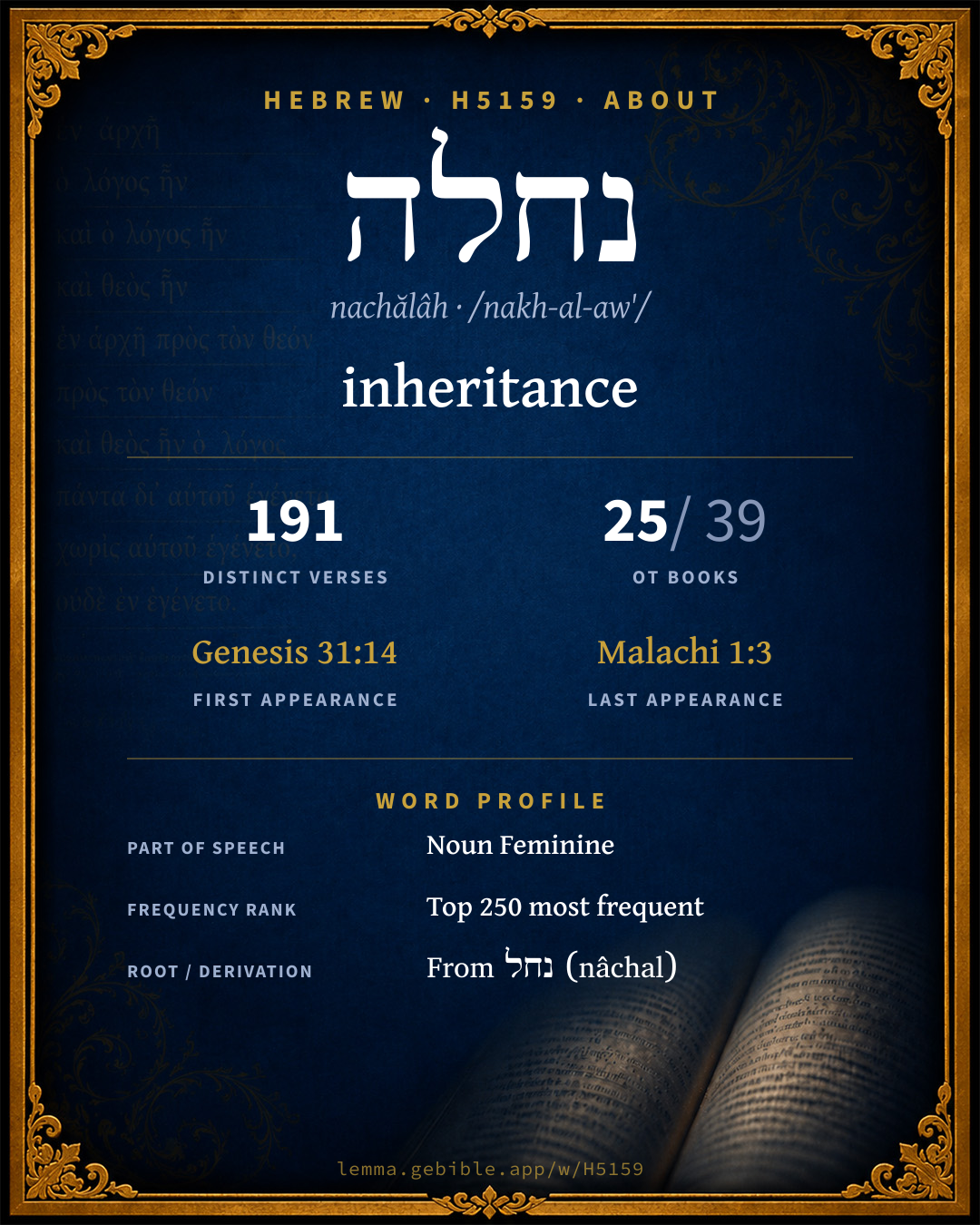
נַחֲלָה
inheritance
also: possession, property, heritage fuller range ↓
Full lexicon entry — Brown-Driver-Briggs (BDB)
From Brown-Driver-Briggs (BDB)
Where this word appears
See every Construct-state word in the Hebrew Bible →
Grammar key — what these labels mean
Part of speech
- Noun
- A naming word — a person, place, thing, or idea.
Noun type
- Common
- A common noun — a general class of person, place, or thing (“king,” “city,” “water”), not a specific name.
State
- Absolute
- The independent form of a noun, not bound to a following word.
- Construct
- A noun bound to a following noun in a possessive / “of” relationship (the construct chain).
Gender
- Feminine
- Grammatically feminine.
Number
- Singular
- One.
- Plural
- More than one (in Hebrew, generally three or more).
Every verse where H5159 appears in the Book of Joshua — 43 distinct verses. Click any verse to open its interlinear word-by-word view. Verse text shown in the World English Bible for context — . Each verse’s Hebrew form is shown with its reference; the English is not keyword-highlighted, since the data carries no word-level English alignment. Use “Compare translations” on any verse to read it across multiple English versions. This concordance covers the Hebrew Bible; Septuagint (Greek Old Testament) occurrences are not indexed here.
Joshua
- Joshua 11:23 לְ/נַחֲלָ֧ה prep + n c fs So Joshua took the whole land, according to all that Yahweh spoke to Moses; and Joshua gave it for an inheritance to Israel according to their divisions by their tribes. The land had rest from war.
- Joshua 13:6 בְּֽ/נַחֲלָ֔ה prep + n c fs all the inhabitants of the hill-country from Lebanon to Misrephoth Maim, even all the Sidonians; them will I drive out from before the children of Israel: only allot you it to Israel for an inheritance, as I have commanded you.
- Joshua 13:7 בְּ/נַחֲלָ֖ה prep + n c fs Now therefore divide this land for an inheritance to the nine tribes, and the half-tribe of Manasseh.
- Joshua 13:8 נַחֲלָתָ֑/ם n c fs cs + sfx pers 3mp With him the Reubenites and the Gadites received their inheritance, which Moses gave them, beyond the Jordan eastward, even as Moses the servant of Yahweh gave them:
- Joshua 13:14 נַחֲלָ֑ה נַחֲלָת֔/וֹ n c fs n c fs cs + sfx pers 3ms Only to the tribe of Levi he gave no inheritance; the offerings of Yahweh, the God of Israel, made by fire are his inheritance, as he spoke to him.
- Joshua 13:23 נַחֲלַ֤ת n c fs cs The border of the children of Reuben was the Jordan, and the border [of it]. This was the inheritance of the children of Reuben according to their families, the cities and the villages of it.
- Joshua 13:28 נַחֲלַ֥ת n c fs cs This is the inheritance of the children of Gad according to their families, the cities and the villages of it.
- Joshua 13:33 נַחֲלָ֑ה נַחֲלָתָ֔/ם n c fs n c fs cs + sfx pers 3mp But to the tribe of Levi Moses gave no inheritance: Yahweh, the God of Israel, is their inheritance, as he spoke to them.
- Joshua 14:2 נַחֲלָתָ֑/ם n c fs cs + sfx pers 3mp by the lot of their inheritance, as Yahweh commanded by Moses, for the nine tribes, and for the half-tribe.
- Joshua 14:3 נַחֲלַ֨ת נַחֲלָ֖ה n c fs cs n c fs For Moses had given the inheritance of the two tribes and the half-tribe beyond the Jordan: but to the Levites he gave no inheritance among them.
- Joshua 14:9 לְ/נַחֲלָ֛ה prep + n c fs Moses swore on that day, saying, Surely the land whereon your foot has trodden shall be an inheritance to you and to your children forever, because you have wholly followed Yahweh my God.
- Joshua 14:13 לְ/נַחֲלָֽה prep + n c fs Joshua blessed him; and he gave Hebron to Caleb the son of Jephunneh for an inheritance.
- Joshua 14:14 לְֽ/נַחֲלָ֔ה prep + n c fs Therefore Hebron became the inheritance of Caleb the son of Jephunneh the Kenizzite to this day; because that he wholly followed Yahweh, the God of Israel.
- Joshua 15:20 נַחֲלַ֛ת n c fs cs This is the inheritance of the tribe of the children of Judah according to their families.
- Joshua 16:5 נַחֲלָתָ/ם֙ n c fs cs + sfx pers 3mp The border of the children of Ephraim according to their families was [thus]: the border of their inheritance eastward was Ataroth Addar, to Beth Horon the upper;
- Joshua 16:8 נַחֲלַ֛ת n c fs cs From Tappuah the border went along westward to the brook of Kanah; and the goings out of it were at the sea. This is the inheritance of the tribe of the children of Ephraim according to their families;
- Joshua 16:9 נַחֲלַ֣ת n c fs cs together with the cities which were set apart for the children of Ephraim in the midst of the inheritance of the children of Manasseh, all the cities with their villages.
- Joshua 17:4 נַחֲלָ֖ה נַֽחֲלָ֔ה n c fs n c fs They came near before Eleazar the priest, and before Joshua the son of Nun, and before the princes, saying, Yahweh commanded Moses to give us an inheritance among our brothers: therefore according to the commandment of Yahweh he gave them an inheritance among the brothers of their father.
- Joshua 17:6 נַחֲלָ֖ה n c fs because the daughters of Manasseh had an inheritance among his sons. The land of Gilead belonged to the rest of the sons of Manasseh.
- Joshua 17:14 נַחֲלָ֗ה n c fs The children of Joseph spoke to Joshua, saying, Why have you given me but one lot and one part for an inheritance, seeing I am a great people, because hitherto Yahweh has blessed me?
- Joshua 18:2 נַֽחֲלָתָ֑/ם n c fs cs + sfx pers 3mp There remained among the children of Israel seven tribes, which had not yet divided their inheritance.
- Joshua 18:4 נַֽחֲלָתָ֖/ם n c fs cs + sfx pers 3mp Appoint for you three men of each tribe: and I will send them, and they shall arise, and walk through the land, and describe it according to their inheritance; and they shall come to me.
- Joshua 18:7 נַחֲלָת֑/וֹ נַחֲלָתָ֗/ם n c fs cs + sfx pers 3ms n c fs cs + sfx pers 3mp For the Levites have no portion among you; for the priesthood of Yahweh is their inheritance: and Gad and Reuben and the half-tribe of Manasseh have received their inheritance beyond the Jordan eastward, which Moses the servant of Yahweh gave them.
- Joshua 18:20 נַחֲלַת֩ n c fs cs The Jordan was the border of it on the east quarter. This was the inheritance of the children of Benjamin, by the borders of it round about, according to their families.
- Joshua 18:28 נַֽחֲלַ֥ת n c fs cs and Zelah, Eleph, and the Jebusite (the same is Jerusalem), Gibeath, [and] Kiriath; fourteen cities with their villages. This is the inheritance of the children of Benjamin according to their families.
- Joshua 19:1 נַֽחֲלָתָ֔/ם נַחֲלַ֥ת n c fs cs + sfx pers 3mp n c fs cs The second lot came out for Simeon, even for the tribe of the children of Simeon according to their families: and their inheritance was in the midst of the inheritance of the children of Judah.
- Joshua 19:2 בְּ/נַֽחֲלָתָ֑/ם prep + n c fs cs + sfx pers 3mp They had for their inheritance Beersheba, or Sheba, and Moladah,
- Joshua 19:8 נַחֲלַ֛ת n c fs cs and all the villages that were round about these cities to Baalath Beer, Ramah of the South. This is the inheritance of the tribe of the children of Simeon according to their families.
- Joshua 19:9 נַחֲלַ֖ת נַחֲלָתָֽ/ם n c fs cs n c fs cs + sfx pers 3mp Out of the part of the children of Judah was the inheritance of the children of Simeon; for the portion of the children of Judah was too much for them: therefore the children of Simeon had inheritance in the midst of their inheritance.
- Joshua 19:10 נַחֲלָתָ֖/ם n c fs cs + sfx pers 3mp The third lot came up for the children of Zebulun according to their families; and the border of their inheritance was to Sarid;
- Joshua 19:16 נַחֲלַ֥ת n c fs cs This is the inheritance of the children of Zebulun according to their families, these cities with their villages.
- Joshua 19:23 נַחֲלַ֛ת n c fs cs This is the inheritance of the tribe of the children of Issachar according to their families, the cities with their villages.
- Joshua 19:31 נַחֲלַ֛ת n c fs cs This is the inheritance of the tribe of the children of Asher according to their families, these cities with their villages.
- Joshua 19:39 נַחֲלַ֛ת n c fs cs This is the inheritance of the tribe of the children of Naphtali according to their families, the cities with their villages.
- Joshua 19:41 נַחֲלָתָ֑/ם n c fs cs + sfx pers 3mp The border of their inheritance was Zorah, and Eshtaol, and Irshemesh,
- Joshua 19:48 נַחֲלַ֛ת n c fs cs This is the inheritance of the tribe of the children of Dan according to their families, these cities with their villages.
- Joshua 19:49 נַחֲלָ֛ה n c fs So they made an end of distributing the land for inheritance by the borders of it; and the children of Israel gave an inheritance to Joshua the son of Nun in the midst of them:
- Joshua 19:51 הַ/נְּחָלֹ֡ת ptcl def.art + n c fp These are the inheritances, which Eleazar the priest, and Joshua the son of Nun, and the heads of the fathers' [houses] of the tribes of the children of Israel, distributed for inheritance by lot in Shiloh before Yahweh, at the door of the tent of meeting. So they made an end of dividing the land.
- Joshua 21:3 מִ/נַּחֲלָתָ֖/ם prep + n c fs cs + sfx pers 3mp The children of Israel gave to the Levites out of their inheritance, according to the commandment of Yahweh, these cities with their suburbs.
- Joshua 23:4 בְּ/נַחֲלָ֖ה prep + n c fs Behold, I have allotted to you these nations that remain, to be an inheritance for your tribes, from the Jordan, with all the nations that I have cut off, even to the great sea toward the going down of the sun.
- Joshua 24:28 לְ/נַחֲלָתֽ/וֹ prep + n c fs cs + sfx pers 3ms So Joshua sent the people away, every man to his inheritance.
- Joshua 24:30 נַחֲלָת֔/וֹ n c fs cs + sfx pers 3ms They buried him in the border of his inheritance in Timnathserah, which is in the hill-country of Ephraim, on the north of the mountain of Gaash.
- Joshua 24:32 לְ/נַחֲלָֽה prep + n c fs The bones of Joseph, which the children of Israel brought up out of Egypt, buried they in Shechem, in the parcel of ground which Jacob bought of the sons of Hamor the father of Shechem for a hundred pieces of money: and they became the inheritance of the children of Joseph.
About this entry
At a glance — auto-summarized from this page’s data, not written by a person. Every figure links to its source below. This summary describes the numbers; it doesn’t interpret them.
נחלה (nachălâh) is a Hebrew noun most often rendered “inheritance.” Beyond “inheritance” it also covers “possession”, “property”, and “heritage” — see its full sense range. With 191 verses in 25 books, it is a common word in the Hebrew Bible. First canonically at Genesis 31:14, it enters the text early. It clusters with נחל and נחל under a shared root. See the sense tree, 191-verse concordance, and the renderings breakdown below.
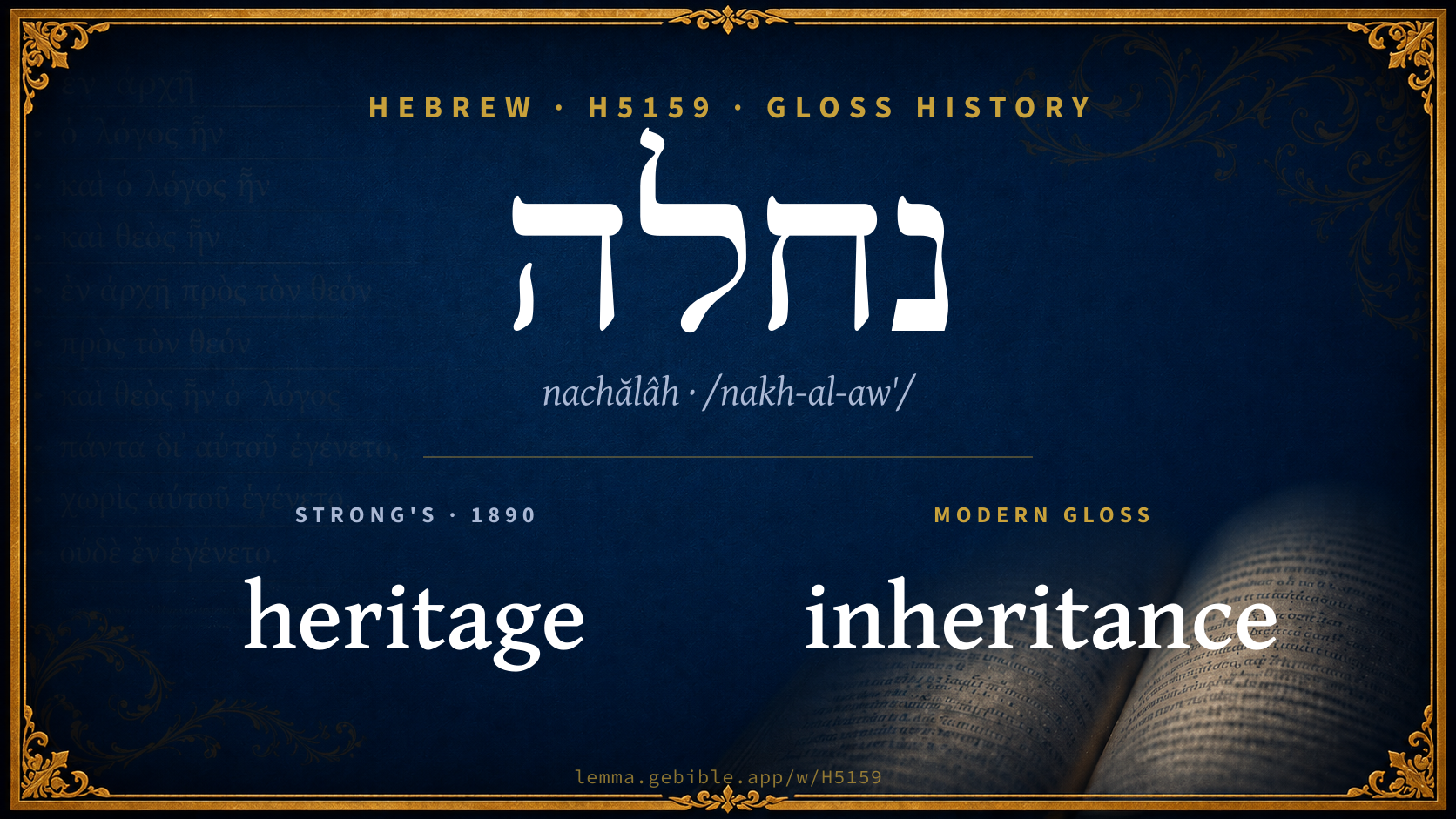
Gloss history
Strong's 1890 vs modern scholarship
About this word
Strong's H5159 catalogs a Hebrew word from the Hebrew Old Testament.
These counts are not copied from any lexicon or concordance. They are computed here, from the morphology-tagged Hebrew Old Testament. What Lemma adds →
- 191
- distinct verses
- The word appears in 191 distinct verses.
- 25 / 39
- OT books
- The word appears in 25 of 39 Old Testament books.
- #213
- by frequency
- Top 250 most frequent Hebrew words (rank 213 of 8,640 Hebrew words by occurrence).
View all 191 occurrences in the concordance →
Most concentrated in
- Joshua 43 verses 23%
- Numbers 31 verses 16%
- Deuteronomy 22 verses 12%
By section of the Old Testament
By traditional corpus
Conventional, traditional groupings — biblical authorship is debated, so this is a traditional corpus grouping, not an authorship claim. Each share is this word’s portion of its verses in that division of the Hebrew canon. Each figure is a share of the word’s 191 distinct verses.
- Prophets (Nevi'im) 97 verses · 51%
- Torah (Pentateuch) 56 verses · 29%
- Writings (Ketuvim) 38 verses · 20%
How translations render this word
Counts come from each version’s own published word-to-Strong’s tagging or interlinear alignment — an approximate guide to how each version renders this word, not a word-level alignment the data otherwise carries. Because each total is that version’s own tagged count, the per-version totals vary from one another and need not match the appearance or distinct-verse counts above. These counts may also differ from a printed concordance because Lemma counts each distinctly tagged rendering and does not collapse phrase taggings into a single head-word total. This is a fixed set of word-tagged versions (KJV, ASV, BSB, ULT) and does not change with the reading translation you choose elsewhere. Each version’s license is shown beside its name below (and on Sources).
- King James Version: Inheritance 125×, Heritage 23×, Is the inheritance 10×
- American Standard Version: Inheritance 118×, Heritage 19×, Is the inheritance 10×
- Berean Standard Bible: Inheritance 159×, Heritage 11×, Was the inheritance 10×
- unfoldingWord Literal Text: Inheritance 163×, Inheritance of 33×, And 5×
King James Version Public Domain
Renders H5159 across 222 tagged occurrences — most commonly:
Plus 41 renderings that appear only once — usually multi-word phrases or single function words the recovered tagging swept in, not distinct renderings.
American Standard Version Public Domain
Renders H5159 across 221 tagged occurrences — most commonly:
Plus 52 renderings that appear only once — usually multi-word phrases or single function words the recovered tagging swept in, not distinct renderings.
Berean Standard Bible Public Domain
Renders H5159 across 216 tagged occurrences — most commonly:
Plus 16 renderings that appear only once — usually multi-word phrases or single function words the recovered tagging swept in, not distinct renderings. Not rendered by a distinct English word in 6 further occurrences.
unfoldingWord Literal Text CC BY-SA 4.0
Renders H5159 across 232 tagged occurrences — most commonly:
Plus 17 renderings that appear only once — usually multi-word phrases or single function words the recovered tagging swept in, not distinct renderings.
10 senses and sub-senses in the full BDB
What do BDB’s symbols mean?
BDB uses these scholarly abbreviations:
| Symbol | Meaning |
|---|---|
| 𝔊 | the Septuagint (the ancient Greek translation, LXX) |
| 𝔙 | the Vulgate (the Latin translation) |
| 𝔖 | the Syriac version (the Peshitta) |
| 𝔗 | the Targum (the Aramaic translation) |
| ψ | the Psalms |
| √ | root (the underlying root or stem) |
| ‖ | parallel passage (a synonymous or contrasted parallel) |
| † | the dagger: every passage where the word occurs is cited |
The 10 senses and sub-senses the full Brown-Driver-Briggs lexicon distinguishes for this word, in lexicon order (not ranked by frequency), with BDB’s own verbatim wording and sub-sense lettering. Shown in Hebrew script with BDB’s own scholarly abbreviations. The condensed entry is in the Lexicon Entry tab. See also the Forms in the corpus table below.
- 1. property:
- a. in Canaan given by י׳ to Israel, †נחלת ישׂראל Ju 20:6; †נ׳ יעקב Is 58:14, especially †אֲשֶׁר נֹתֵן לְךָ נַחֲלָה Dt 4:21; 15:4; 19:10; 20:16; 21:23; 24:4; 25:19; 26:1 (all D); הנחלה אשׁר הנחלתי את עמי Je 12:14. e.g. Judges 20:6
- b. distrib. among tribes: נתן נ׳ לְ Nu 16:14; 36:2 Jos 14:3 (restore לְ), 17:4, 14; 19:49 (all P); נתן לנ׳ לְ Dt 29:7 Jos 11:23; 14:13 (all D2); נָֽחֲלוּ נחלה Jos 17:6 (J); תֵּחָלֵק בנ׳ Nu 26:53, 56 (P); נפל בנחלה Nu 34:2 (P), Ju 18:1 Ez 47:22; הפיל בנ׳ Jos 13:6; 23:4 (D2), Ez 45:1; 47:22, also v 29 (Co reads ב for מ). e.g. Numbers 16:14
- c. nations as possession of the people, ψ 111:6; of the king 2:8. e.g. Psalms 111:6
- d. Levites have no property in the land Nu 18:23, 24 Dt 10:9; 12:12; their possession is י׳ Nu 18:20 (P); י׳ הוּא נחלתו Dt 10:9; 18:2 Jos 13:14, 33 (all D); the tithes Nu 18:21, 24, 26 (P). e.g. Numbers 18:23
- e. †י׳ takes Isr. as his property, 1 S 10:1 1 K 8:53 2 K 21:14 Is 19:25 Mi 7:18 ψ 33:12; 68:10; 106:5; עם נחלה Dt 4:20 (D2); עַמְּךָ וְנַחֲלָֽתְךָ Dt 9:26, 29 (D), 1 K 8:51; ‖ עַם Is 47:6 Jo 2:17; 4:2 Mi 7:14 ψ 28:9; 78:62, 71; 94:5, 14; 106:40; נחלת י׳ 1 S 26:19 2 S 20:19; 21:3; נ׳ אלהים 2 S 14:16; יעקב חבל נ׳ Dt 32:9; שׁבט נ׳ Je 10:16 = 51:19, ψ 74:2; שׁבטי נ׳ Is 63:17; also, the holy mt. Ex 15:17 (song), temple Je 12:7 ψ 79:1, land Je 2:7; 12:8, 9; 16:18; 50:11. e.g. 1 Samuel 10:1
- 2. portion, share:
- a. assigned by God, Is 54:17 ψ 37:18; 127:3; elsewhere ‖ חֵלָק Jb 20:29; 27:13; 31:2. e.g. Isaiah 54:17
- b. by choice, ‖ חֵלֶק, לא נ׳ לנו בבן ישׁי 2 S 20:1 we have no share in the son of Jesse = 1 K 12:16 = 2 Ch 10:16. e.g. 2 Samuel 20:1
- 3. inheritance (45 times) חֵלָק וְנַחֲלָה בְּבֵית אָבִינוּ Gn 31:14 (E) portion or inheritance in the house of our father; העביר נ׳ לְ Nu 27:7, 8 (P) cause the inheritance to pass unto; נתן נ׳ לְ Nu 27:9, 10, 11 (P), Jb 42:15; †נחלת אבוה Nu 36:3, 8 1 K 21:3, 4 Pr 19:14; נ׳ לבניו תהיה Ez 46:16. e.g. Genesis 31:14
Senses from the full Brown-Driver-Briggs lexicon (Brown, Driver, Briggs; Oxford 1906 — public domain), digitized via Sefaria, supplemented by the OpenScriptures HebrewLexicon (CC BY 4.0). Full attribution on Sources.
Word origin
n.f. possession, property, inheritance (orig. gift; NH = BH);—נ׳ Nu 18:23 +; נַחֲלָת ψ 16:6 (Ges§ 80 g), read נַחֲלָתִי Ew SS We Köii 1, 425; cstr. נַחֲלַת Jos 13:23; sf. נַחֲלָתִי Ru 4:6; נַחֲלַתְכֶם ψ 105:11; pl. נְחָלוֹת Is 49:8, נְחָלֹת Jos 19:51;—
— Brown-Driver-Briggs (Oxford 1906, public domain), digitized via Sefaria, supplemented by the OpenScriptures HebrewLexicon (CC BY 4.0). See Sources.
Derived from נחל (nâchal) (H5157) — to inherit.
Jastrow Dictionary
A second Hebrew/Aramaic lexicon for comparison, covering Aramaic and post-biblical (Talmudic, Targumic, Midrashic) usage that the biblical-Hebrew BDB does not. Matched by lemma rather than by Strong’s number, so a lemma may carry more than one Jastrow headword (shown separately below), and the entries cover usage well beyond the Bible.
נַחֲלָה
- [turn, lot,] inheritance, right of succession. B. Bath. VIII, 4 אחד הבן ואחד הבת בנ׳ the same law of succession applies to sons and (eventually) to daughters (v. ib. 122ᵇ). Bekh. VIII, 1, v. בְּכוֹר. Midr. Till. to Ps. V, 1 (play on נחילות ib.) על הנ׳ שנחלתם וכ׳ for the possession which you took from me, and for the possession which I took from you; a. fr.—Trnsf. the central sanctuary at Shiloh or at Jerusalem. Tosef. Zeb. XIII, 20; Zeb. 119ᵃ, sq.; Meg. 10ᵃ, contrad. to מְנוּחָה.—Pl. נַחֲלוֹת. B. Bath. VIII, 2 סדר נ׳ וכ׳ the following is the order of succession (among relatives). Ib. 117ᵃ משונה נחלה זו מכל נ׳ שבעולם this division of inheritance (after the conquest of Canaan) is different from all other successions; a. fr.—Yalk. Ps. 629, v. נְחִילָה.
A Dictionary of the Targumim, the Talmud Babli and Yerushalmi, and the Midrashic Literature (Marcus Jastrow; London, Luzac, 1903) — Public Domain. Digitized via Sefaria. Digitized via Sefaria. Full attribution on Sources.
Forms in the corpus
The 117 distinct written forms H5159 takes in the Hebrew Bible, most frequent first — each parse links to that state’s occurrences in the concordance. Hebrew forms include their vowel points and cantillation, so a single lemma takes many written forms.
The 60 most common forms are shown; 57 rarer forms follow in the full concordance.
Same root — word family
Other BDB entries built from the same root as H5159, grouped by Strong’s listed origin. These share a root / origin per the lexicon — not necessarily a shared meaning. Each links to that word’s own entry.
Derives from
Shares the same root
Compare all same-root words → They share a root, not necessarily a meaning.
Septuagint verse parallels
This word appears in 182 verses that also exist in the Greek Old Testament (Septuagint), out of the 191 Hebrew verses it occurs in. You can read those verses in Greek by switching the Old Testament edition to the Septuagint.
Read these verses in the Septuagint
- Genesis 31:14
- Exodus 15:17
- Numbers 16:14
- Deuteronomy 4:20
- Joshua 11:23
- Judges 2:6
- Ruth 4:5
- 1 Samuel 10:1
- 2 Samuel 14:16
- 1 Kings 8:36
- 2 Kings 21:14
- 1 Chronicles 16:18
This is a verse-level parallel only — the same verses exist in both the Hebrew and Greek Old Testaments. No word-level Hebrew↔Greek correspondence is claimed: the data carries no such alignment, so no Greek word is shown as this Hebrew word’s translation. Coverage is not total — the Septuagint omits the deuterocanon and renumbers the Psalms, so some Hebrew verses have no direct Greek parallel.