Ezekiel 44:28

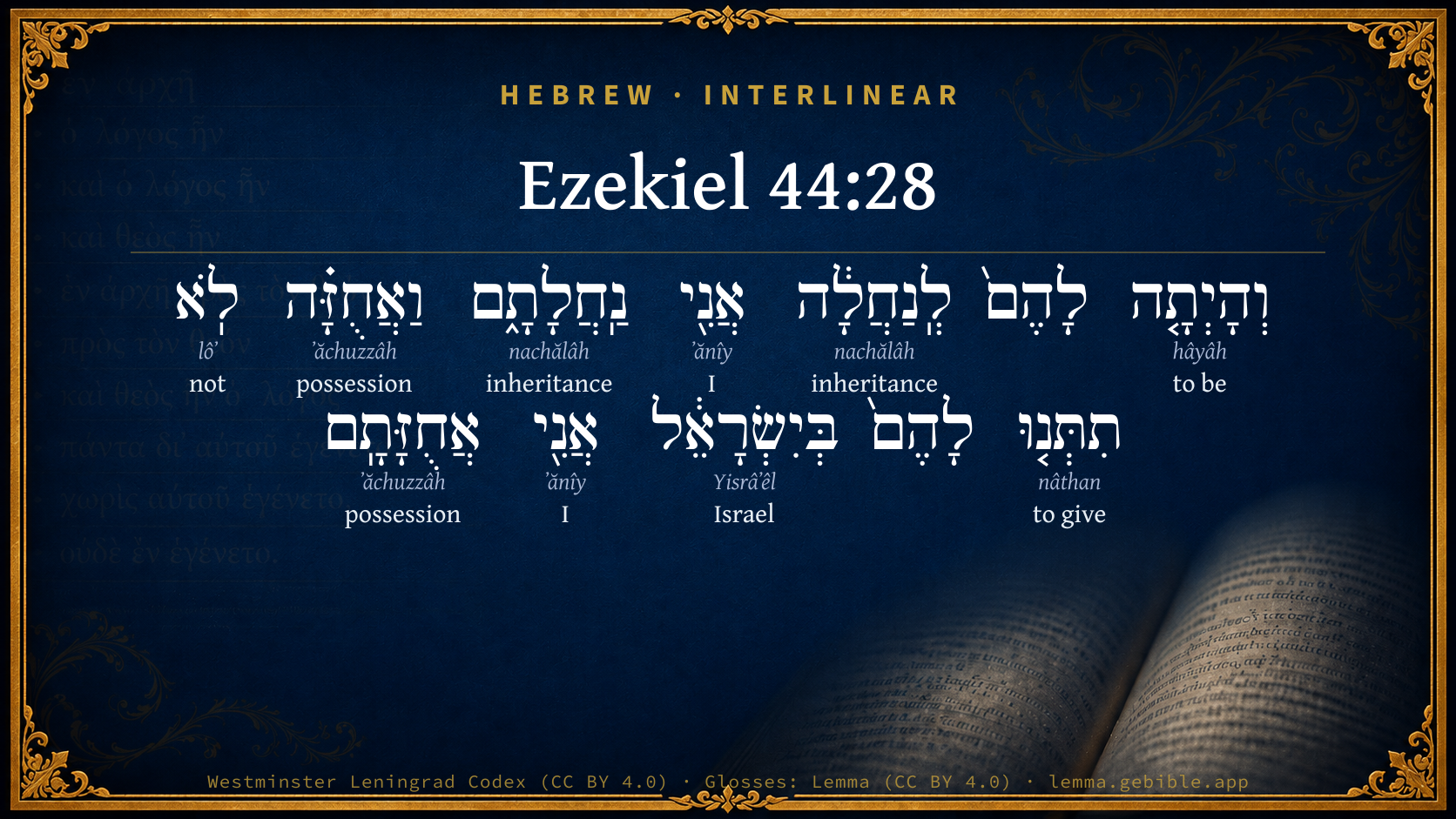
Hebrew (Westminster Leningrad Codex) Ezekiel 44:28 appears in the Hebrew Old Testament. The text above is from the Westminster Leningrad Codex. Each word links to its Strong’s number, a concise gloss, and parsing drawn from the Open Scriptures Hebrew Bible morphology. Click any word for its full Brown-Driver-Briggs (BDB) entry.
Download image
Cite this verse

Ezekiel 44:28 (World English Bible). Public Domain. Lemma interlinear Bible study tool, https://lemma.gebible.app/v/ezekiel/44/28.

Show BibTeX & RIS
BibTeX
RIS
English Translation
They shall have an inheritance: I am their inheritance; and you shall give them no possession in Israel; I am their possession.
World English Bible · Public Domain
Download a study sheet

One document with this verse’s original text, its word-by-word gloss line, the meaning frame, cross-references with their text, attributed commentary, and full source and license credits — printable, and it pastes into notes with its structure intact.

This verse Autodidact and up

Study sheet (.html) Plain text (.txt)

A passage Seminary Student

Up to 50 verses in one chapter. A passage sheet keeps up to 6 commentary sources and 12 cross-references per verse, in the order this page ranks them, and says so on the sheet whenever that leaves anything out. Ask for a single verse and you get the Autodidact verse sheet above.

Everything on this page stays free to read, with no account — the sheet is a download of what is already on screen, not access to it.

Want to remove ads? Support Godless Engineer
Compare translations 3

The same verse in 3 English versions, stacked beneath the original-language interlinear above. Click any original word for its lexicon entry.

Each is an independent rendering of the whole verse — the interlinear is not word-aligned to these translations.

Highlighted words mark where these versions differ — a whole-verse word diff, not a word-by-word alignment.

  • World English Bible Public Domain
    They shall have an inheritance: I am their inheritance; and you shall give them no possession in Israel; I am their possession.
  • King James Version Public Domain
    And it shall be unto them for an inheritance: I am their inheritance: and ye shall give them no possession in Israel: I am their possession.
  • unfoldingWord Literal Text CC BY-SA 4.0
    This will be their inheritance: I am their inheritance, and you must give them no property in Israel; I will be their property!

unfoldingWord Literal Text — © unfoldingWord, licensed CC BY-SA 4.0. Word-aligned USFM3 via Door43 (git.door43.org/unfoldingWord/en_ult).

Versions to compare (up to 4)

3 of 4 selected

Show all 18 translations

Every available English version of this verse, each an independent rendering of the whole verse.

  • World English Bible Public Domain
    They shall have an inheritance: I am their inheritance; and you shall give them no possession in Israel; I am their possession.
  • Berean Standard Bible Public Domain
    In regard to their inheritance, I am their inheritance. You are to give them no possession in Israel, for I am their possession.
  • Majority Standard Bible Public Domain
    In regard to their inheritance, I am their inheritance. You are to give them no possession in Israel, for I am their possession.
  • King James Version Public Domain
    And it shall be unto them for an inheritance: I am their inheritance: and ye shall give them no possession in Israel: I am their possession.
  • American Standard Version (1901) Public Domain
    And they shall have an inheritance: I am their inheritance; and ye shall give them no possession in Israel; I am their possession.
  • Revised Version (1885) Public Domain
    And they shall have an inheritance; I am their inheritance: and ye shall give them no possession in Israel; I am their possession.
  • Geneva Bible (1599) Public Domain
    And the Priesthood shall bee their inheritance, yea, I am their inheritance: therefore shall ye giue them no possessio in Israel, for I am their possession.
  • Douay-Rheims (1899) Public Domain
    And they shall have no inheritance, I am their inheritance: neither shall you give them any possession in Israel, for I am their possession.
  • Young's Literal Translation Public Domain
    And it hath been to them for an inheritance; I `am' their inheritance: and a possession ye do not give to them in Israel; I `am' their possession.
  • Literal Standard Version CC BY-SA 4.0
    And it has been for an inheritance to them; I [am] their inheritance, and you do not give a possession to them in Israel; I [am] their possession.
  • Unlocked Literal Bible CC BY-SA 4.0
    This will be their inheritance: I am their inheritance, and you must give them no property in Israel; I will be their property!
  • unfoldingWord Literal Text CC BY-SA 4.0
    This will be their inheritance: I am their inheritance, and you must give them no property in Israel; I will be their property!
  • Darby Bible Public Domain
    And it shall be unto them for an inheritance; I am their inheritance: and ye shall give them no possession in Israel; I am their possession.
  • World Messianic Bible Public Domain
    “‘They shall have an inheritance: I am their inheritance; and you shall give them no possession in Israel. I am their possession.
  • Webster's Bible Public Domain
    And it shall be to them for an inheritance: I am their inheritance: and ye shall give them no possession in Israel: I am their possession.
  • Free Bible Version CC BY-SA 4.0
    Regarding their share of the land, I will take care of them. You are not to give them any property in Israel, because I will provide for them.
  • Bible in Basic English Public Domain
    And they are to have no heritage; I am their heritage: you are to give them no property in Israel; I am their property.
  • JPS Tanakh (1917) Public Domain
    And it shall be unto them for an inheritance: I am their inheritance; and ye shall give them no possession in Israel: I am their possession.

Literal Standard Version (2020), Covenant Press — licensed CC BY-SA 4.0. Text via the HelloAO Bible API (eBible.org). Unlocked Literal Bible (unfoldingWord) — licensed CC BY-SA 4.0. Text via the HelloAO Bible API (eBible.org). unfoldingWord Literal Text — © unfoldingWord, licensed CC BY-SA 4.0. Word-aligned USFM3 via Door43 (git.door43.org/unfoldingWord/en_ult). Free Bible Version, Dr. Jonathan Gallagher — licensed CC BY-SA 4.0. Text via the HelloAO Bible API (eBible.org).

Word by word

More ways to search: Search by grammar → Find every occurrence → Compare this word →

Practice this passage: Drill this verse → Learn its vocabulary →

וַאֲחֻזָּ֗ה
ʼăchuzzâh
H272
“and · possession”
Conjunction + Noun, Common, Feminine, Singular, Absolute
Part of Speech
Conjunction + Noun
Type
Common
Gender
Feminine
Number
Singular
State
Absolute
Full BDB Definition

Origin: from passive participle from H270

TWOT: 64a

possession, property - land - possession by inheritance
  1. וְהָיְתָ֤ה hâyâh H1961 “and · to be” Conjunction + Verb, Qal, Sequential Perfect, 3rd Person, Feminine, Singular
  2. לְֽנַחֲלָ֔ה nachălâh H5159 “to/for · inheritance” Preposition + Noun, Common, Feminine, Singular, Absolute
  3. אֲנִ֖י ʼănîy H589 “I” Pronoun, Personal, 1st Person, Common, Singular
  4. נַֽחֲלָתָ֑ם nachălâh H5159 “inheritance · their” Noun, Common, Feminine, Singular, Construct + Suffix, Personal, 3rd Person, Masculine, Plural
  5. לֹֽא lôʼ H3808 “not” Particle, Negative
  6. תִתְּנ֤וּ nâthan H5414 “to give” Verb, Qal, Imperfect, 2nd Person, Masculine, Plural
  7. בְּיִשְׂרָאֵ֔ל Yisrâʼêl H3478 “in/at · Israel” Preposition + Noun, Proper
  8. אֲנִ֖י ʼănîy H589 “I” Pronoun, Personal, 1st Person, Common, Singular
  9. אֲחֻזָּתָֽם ʼăchuzzâh H272 “possession · their” Noun, Common, Feminine, Singular, Construct + Suffix, Personal, 3rd Person, Masculine, Plural

About this verse

These counts appear in no published source. They are computed here, from the morphology-tagged text and Lemma’s own curated glosses. What Lemma adds →

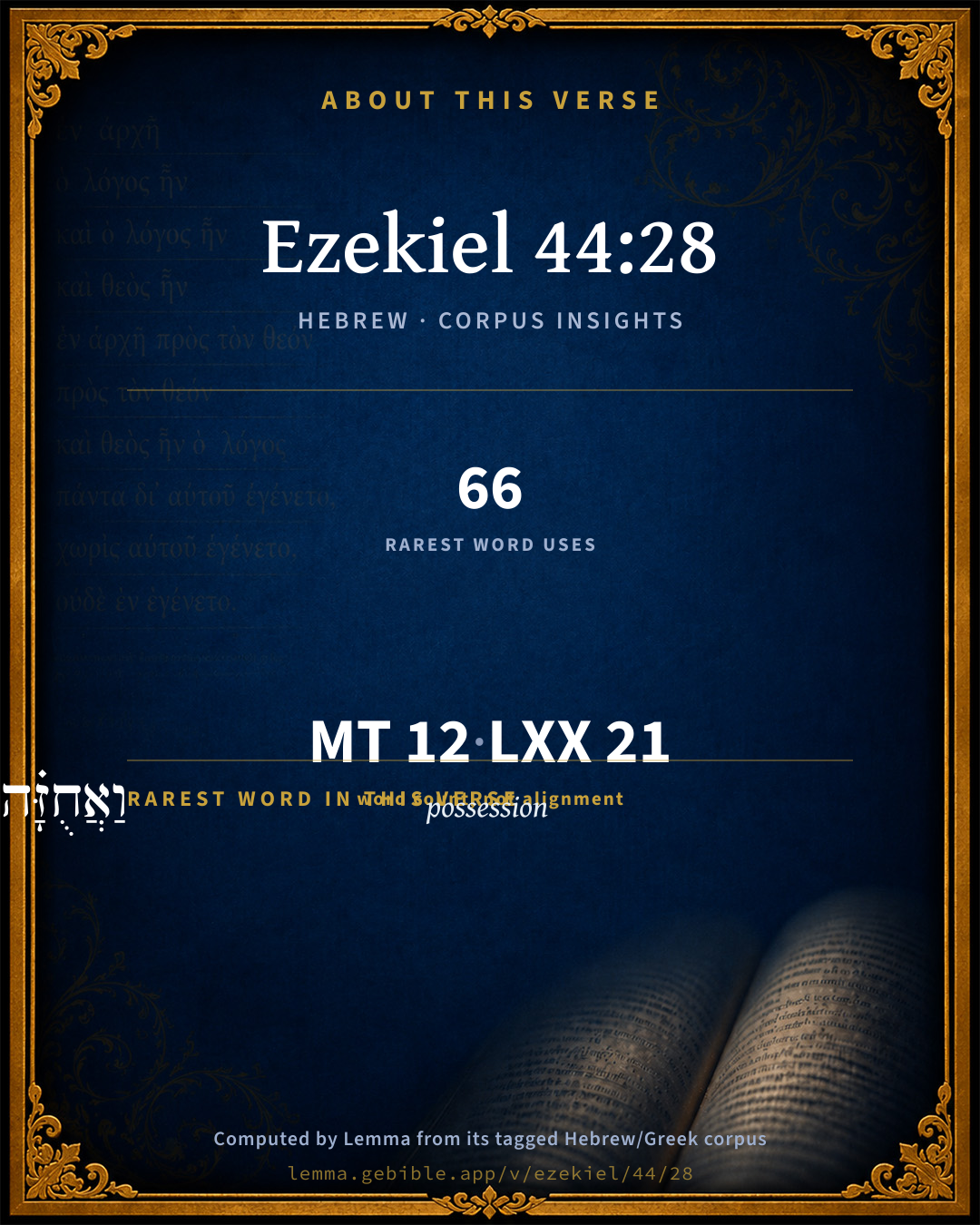
12
words
7
distinct lemmas
Prophets
section

Grammatical profile

  • 2 verbs
  • 5 nouns
  • 2 pronouns
  • 2 prepositions
  • 1 particle

Verb forms

  • וְהָיְתָ֤ה Qal · Sequential Perfect
  • תִתְּנ֤וּ Qal · Imperfect

Repetition

Words recur within this verse — often emphatic in Hebrew:

  • לְֽנַחֲלָ֔ה inheritance H5159 ×2
  • וַאֲחֻזָּ֗ה possession H272 ×2
  • אֲנִ֖י I H589 ×2

Hebrew & Septuagint length

In English translation the verse runs 22 words from the Hebrew and 30 from the Septuagint (LXX English) — closely comparable.

A rough comparison of the two English renderings, which tokenize alike — not a word-level alignment.

Word counts can differ between the Hebrew and the Greek without any difference in meaning — e.g. the Hebrew direct-object marker אֵת has no separate Greek word, and Greek often adds the article ὁ.

In the original languages it is 12 Hebrew tokens and 21 Greek tokens — but the two are counted differently (Hebrew bundles its prefixes and suffixes into one token; the Greek is in lemma form), so that isn’t a like-for-like length.

Cross-references

8

Topical passages linked to Ezekiel 44:28 in the Treasury of Scripture Knowledge — connected by theme and wording, ordered by reader-vote popularity; previews shown in the World English Bible.

  • Numbers 18:20 Yahweh said to Aaron, You shall have no inheritance in their land, neither shall you have any portion among them: I am your portion and your inheritance among the children of Israel.
  • Joshua 13:33 But to the tribe of Levi Moses gave no inheritance: Yahweh, the God of Israel, is their inheritance, as he spoke to them.
  • Deuteronomy 18:1–2 The priests the Levites, [even] all the tribe of Levi, shall have no portion nor inheritance with Israel: they shall eat the offerings of Yahweh made by fire, and his inheritance.
  • Deuteronomy 10:9 Therefore Levi has no portion nor inheritance with his brothers; Yahweh is his inheritance, according as Yahweh your God spoke to him.)
  • Ezekiel 45:4 It is a holy portion of the land; it shall be for the priests, the ministers of the sanctuary, who come near to minister to Yahweh; and it shall be a place for their houses, and a holy place for the sanctuary.
  • Joshua 13:14 Only to the tribe of Levi he gave no inheritance; the offerings of Yahweh, the God of Israel, made by fire are his inheritance, as he spoke to him.
  • Ezekiel 48:9–11 The offering that you shall offer to Yahweh shall be twenty-five thousand [reeds] in length, and ten thousand in breadth.
  • 1 Peter 5:2–4 Shepherd the flock of God which is among you, exercising the oversight, not under compulsion, but voluntarily, not for dishonest gain, but willingly;

Cross-references courtesy of OpenBible.info (CC BY 4.0).

Hebrew and Greek witnesses Masoretic Hebrew ↔ Greek Septuagint

The same verse in the two great witnesses to the Old Testament, shown verse-for-verse.

These are two independent witnesses, not word-aligned to each other, and the Septuagint is shown in lemma (dictionary) form.

Hebrew Ezekiel 44:28 Masoretic · Westminster Leningrad Codex

וְהָיְתָ֤ה לָהֶם֙ לְֽנַחֲלָ֔ה אֲנִ֖י נַֽחֲלָתָ֑ם וַאֲחֻזָּ֗ה לֹֽא תִתְּנ֤וּ לָהֶם֙ בְּיִשְׂרָאֵ֔ל אֲנִ֖י אֲחֻזָּתָֽם

They shall have an inheritance: I am their inheritance; and you shall give them no possession in Israel; I am their possession.

World English Bible · Public Domain

Greek LXX Ezekiel 44:28 Septuagint · lemma form

καί εἰμί αὐτός εἰς κληρονομία ἐγώ κληρονομία αὐτός καί κατάσχεσις αὐτός οὐ δίδωμι ἐν ὁ υἱός ἰσραήλ ὅτι ἐγώ κατάσχεσις αὐτός

And it shall be to them for an inheritance: I am their inheritance: and no possession shall be given them among the children of Israel; for I am their possession.

LXX2012 (modern English Septuagint) · Public Domain

On this verse, Haydock's Catholic Bible Commentary discusses the Septuagint’s reading. Read the note in Commentary ↓

Hebrew: Westminster Leningrad Codex (CC BY 4.0). Greek: Septuagint (public domain); English from LXX2012 (modern English Septuagint) (Public Domain). How the Septuagint differs from the Hebrew →

Targum (Aramaic paraphrase)

1

The Targum is the ancient Jewish Aramaic paraphrase of the Hebrew Scriptures — an interpretive translation, not the Hebrew text itself. Onkelos (literal) and Pseudo-Jonathan (expansive) render the Torah, and Jonathan the Prophets. Coverage is partial: where no permissively-licensed English translation exists for a verse, only the Aramaic is shown. This is verse-level text, not a word-by-word alignment to the Hebrew.

  1. Targum Jonathan Prophets (Joshua–Malachi)
    וּתְהֵי לְהוֹן לְאַחֲסָנָא חוּלַק מוֹתַר קוּרְבָּנִי חוּלַקְהוֹן וְאַחְסָנָא לָא תִתְּנוּן לְהוֹן בְּיִשְׂרָאֵל מַתְּנַן דִיהֲבֵית לְהוֹן אִינוּן אַחֲסַנְתְּהוֹן:

    (no public-domain English translation for this verse)

    Targum Jonathan — Aramaic: “Mikraot Gedolot” (public domain). English: “Sefaria Community Translation” (CC0 1.0 (public-domain dedication)); “London "Chaldee Paraphrase," 1871” (public domain). Text via Sefaria.

Commentary

Notes on Ezekiel 44:28 from classic Christian and Jewish commentators (each source and its license shown beneath its notes). The classic Christian expositions comment on the surrounding passage and are grouped to its opening verse, so a note may address several verses; the Jewish commentaries on the Tanakh (Rashi and others) are per-verse, so they appear only where the commentator wrote on this verse.

Lemma curates 59 commentaries, every one of them public domain or Creative Commons licensed, each selected and text-cleaned for this edition rather than reprinted as found. About our sources →

Ellicott's Commentary for English Readers

(28) I am their inheritance.—This is a simple repetition of the frequent declarations in the law (Num_18:20; Deu_10:9; Deu_18:2); the priests were to be supported by the tithes given to God, and by their portion of the offerings made to Him. These are here summarily mentioned in Eze_44:28-29, and may be found more particularly described, as regards the priests’ share of the meat, sin, and trespass offerings, in Lev_2:3; Lev_6:25; Lev_6:29; Lev_7:6-7; the devoted field, Lev_27:21; the first-fruits, Exo_23:19; Exo_34:26; Num_18:13; Deu_18:4; and for the special heave offerings, Num_15:19-21; Num_18:19. As it was not inconsistent with these provisions that the priests should also have assigned to them cities for residence, with their suburbs for pasturage, so these gifts are not now excluded by the fact that the priests should possess the “oblation” of land (Eze_45:1-5), although their portion is thereby greatly increased.

A Bible Commentary for English Readers, edited by Charles John Ellicott (1878–1897) — public domain. Text from a community e-Sword module.

Trapp's Complete Commentary

John Trapp

Eze 44:28 And it shall be unto them for an inheritance: I [am] their inheritance: and ye shall give them no possession in Israel: I [am] their possession.

Ver. 28. And it shall be, &c.] This that followeth shall be their inheritance, {Eze 44:29-31} and whatsoever they want more shall be made up in me.

John Trapp, A Commentary or Exposition upon All the Books of the Old and New Testament (1647–1656) — public domain. Text from a community e-Sword module.

The Biblical Illustrator

Joseph S. Exell

Eze_44:28

I am their inheritance.

God an inheritance

We possess God as the flower the sunlight; as a babe the mother. All His resources are placed at our disposal. The seed cast into the ground immediately begins to take from earth and air the nutriment of its life, and we have the same power of deriving from the infinite fulness of God all that shall make us pure and strong and gentle. Ours are the unsearchable riches of Christ; we are made full through the fulness which God the Father has been pleased to make dwell in Him. All the resources which have been placed at His disposal in His ascension and eternal reign are gifts which He holds for men. Alas for us that we fail to possess our possessions! (F. B. Meyer, B. A.)

God the portion of the people

Christ is all in all to His people. He is all their strength, wisdom, and righteousness. They are but the clouds irradiated by the sun, and bathed in its brightness. He is the light which flames in their grey mist and turns it to a glory. They are but the belt and cranks and wheels; He is the power. They are but the channel, muddy and dry; He is the flashing life which fills it and makes it a joy. They are the body; He is the Soul dwelling in every part to save it from corruption and give movement and warmth.

Thou art the organ, whose full breath is thunder;

I am the keys, beneath Thy fingers pressed.

(A. Maclaren, D. D.).

The Biblical Illustrator, edited by Joseph S. Exell (c. 1880s–1900s) — public domain. Text from a community e-Sword module.

Joseph Benson's Commentary

Eze 44:28-30. It shall be unto them for an inheritance, &c. — Their ministry in my sanctuary, and the perquisites thereto belonging, shall be to them instead of lands and inheritances, of which they shall not have any share, as the other tribes have, (see the margins) excepting the portion allotted to them in the beginning of the following chapter. They shall eat the meat-offering, &c. — They shall have their share of them, after the part dedicated to God has been consumed upon the altar. And every dedicated thing shall be theirs — Whatsoever men dedicate to God, the use of it shall accrue to the priests; if it be a living creature, it shall be killed, and the priests shall have the benefit of it; if a piece of land, it shall belong to the priests: see the margin. And the first of all the first-fruits, &c. — The word בכורים, translated first-fruits, signifies the first ripe, or best of the fruits, while they were growing in the field: see the margin. The latter word, תרומה, rendered oblation, denotes an offering out of the product of the ground after it was made fit for use; as out of the corn, after it was threshed and laid in heaps in the floor or granary; and so of oil and wine, after they were pressed and fitted to be used. Ye shall also give unto the priests the first of your dough — The first dough that you bake of the new corn every year, in the same proportion as in other first-fruits. That he may cause a blessing to rest on thy house — That the priest, whose office it is to bless the people in God’s name, may pray for and bless thee and thy family. Observe, reader, it is all in all to the comfort of any house to have the blessing of God upon it, and that blessing to rest in it; to dwell where we dwell, and to extend to those that shall come after us. And the way to have the blessing of God upon our estates is, to honour God with them, and to give him and his ministers, him and his poor, their share out of them. God blesses, he surely blesses, the habitation of those who are thus just, or righteous, Pro 3:33; and ministers, by instructing and praying for the families that are kind to them, should do their part toward causing God’s blessing to rest there.

Joseph Benson's Commentary on the Old and New Testaments (1811–1818) — public domain. Text from a community e-Sword module.

Tyndale Open Study Notes

Tyndale Open Resources

44:28-30 Because the priests belonged to the Lord and were provided for through a share of the sacrificial offerings of the Temple, they would not have any property or possession of land. The Lord was their inheritance, and their temporal needs were to be supplied by the firstfruits of the people’s harvests and the various offerings made at the Temple.

Tyndale Open Study Notes — © Tyndale Open Resources, licensed CC BY-SA 4.0. Text via the HelloAO Bible API.

Jamieson, Fausset & Brown

Robert Jamieson, A. R. Fausset & David Brown

I am their inheritance-- (Num 18:20; Deu 10:9; Deu 18:1; Jos 13:14, Jos 13:32).

Jamieson, Fausset & Brown — Commentary Critical and Explanatory on the Whole Bible (1871) — public domain (CC PDM 1.0). Text via the HelloAO Bible API.

Adam Clarke's Commentary

Verse 28. I am their inheritance] Those who affect to form their ecclesiastical matters on the model of the Jewish Church have with one consent left this out of the question. They will not live on the free-will offerings of the people; but must have vast revenues, and these secured to them by law. That every minister of God should be supported by the altar I grant; but I think, instead of that method of paying the parochial clergy which I see is so much objected to, and breeds so much dissension between the pastors and their flocks, it would be better, on these accounts, to assign them a portion of land adequate to their supply, or let the state maintain them as it does its other officers. In Israel God was their inheritance and their possession; but they had the breast and shoulder of all sin-offerings and trespass-offerings, and all dedicated things were theirs; and they had a portion of all the dough that was prepared for bread. These were considered as the Lord's property, and these he gave to them; and this is always implied in the Lord's being their inheritance and their possession. They had a plentiful support.

Hitherto tithes have been thought the best mode of paying the clergy, and providing for the poor of each parish; but these matters have undergone such alterations since the time of their institution, that some emendation of the system is at present absolutely necessary.

There should be a public acknowledgment of God in every nation, and this should be provided for by the state in a way the least burdensome to the people, that all may rejoice in the benefit. Happy the nations that have a Bible so correct, and a Liturgy so pure, as those in the British empire! In such cases, a religion established by the state is an unutterable blessing to the nation; only keep it to the Bible, and to the Liturgy, and all, under God, will be well; but when the sermon is against these, all is bad.

Adam Clarke's Commentary on the Bible (1810–1826) — public domain. Text from a community e-Sword/MySword module.

The Cambridge Bible for Schools and Colleges

gen. ed. J. J. S. Perowne

28. it shall be … inheritance] This cannot refer to the sin-offering (Eze_44:27), which was burnt entire outside the sanctuary. To translate: This shall be their inheritance (viz.) I am their inheritance, making the words “I am” &c. subject is too artificial. The balance of sentence seems to require, they shall have no inheritance, I am &c., corresponding to the second half of the verse. So Vulg., cf. Num_18:20; Deu_10:9; Deu_18:1-2; Jos_13:14 &c.

28–31. The maintenance of the priest. He shall have no inheritance among the people: the Lord is his inheritance. He shall eat the meat-offering, the sin- and trespass-offering; everything put to the ban shall be his, and the best of all the first-fruits and of all the dues.

The Cambridge Bible for Schools and Colleges (gen. ed. J. J. S. Perowne; Cambridge University Press, 1878–1918) — public domain. Text from a community e-Sword module.

John Gill's Exposition

And it shall be unto them for an inheritance,.... Either the sin offering, or the priesthood, and the perquisites belonging to it: or,

they shall have an inheritance (r); but what shall it be? God himself:

I am their inheritance; the Lord is the portion and inheritance of his people, who are made priests unto him, whether in a private or public capacity; they are heirs of God, he is their portion in the land of the living, and forever: God in all his perfections is theirs; and though incommunicable, they have the use and advantage of them, so far as they are capable and stand in need of them; as his eternity, immutability, omniscience, omnipotence, omnipresence, grace, mercy, goodness, truth, and faithfulness: he is theirs in all his persons; God the Father is their covenant God and Father; the Son of God is their Head and Husband, their Saviour and Redeemer, Mediator and Peacemaker, their Prophet, Priest, and King; his blood, righteousness, sacrifice, and faithfulness, theirs, and even all that he is and has: the Spirit of God is their convincer and enlightener, their quickener and sanctifier; their Comforter, and the Spirit of adoption to them, the seal and earnest of their future glory; and God under every character is theirs, as the God of nature and providence, and as the God of all grace; and this is an inheritance rich and large, a soul satisfying portion, an inconceivable and an inexhaustible one.

And ye shall give them no possession in Israel; so the priests and Levites had none under the law, but were provided for in another way, Num 18:20, the Lord's people and priests, under the Gospel dispensation, for the most part are the poor of this world, who have no share in the possessions of it; their good things are not here, but in the world to come, and in God himself: "I am their possession"; the Lord is enjoyed by them now; his love is shed abroad in their hearts; they have fellowship with the Father, and with his Son Jesus Christ, and communion with the Holy Ghost; and which is infinitely better than all the possessions of this world; and besides, provision is made for their outward maintenance, as follows:

(r) "habebunt etiam hereditarium aliquid", Tigurine version.

John Gill's Exposition of the Whole Bible (1746–1763) — public domain (CC PDM 1.0). Text via the HelloAO Bible API.

Haydock's Catholic Bible Commentary

No. This is omitted in Hebrew, Septuagint, &c. God was their portion. (Calmet) --- They had no land but what lay near their cities. (Haydock)

George Leo Haydock (1774–1849), Haydock's Catholic Family Bible and Commentary, 1859 edition — public domain. Excludes Psalms (Douay-Rheims chapter numbering differs from Protestant) and Deuterocanonical books (Catholic canon only).

Matthew Poole's English Annotations

Sin-offering being mentioned immediately before, gives the occasion of repeating the provision made for the priests, for under this one all other offerings are couched; and if the Lord do so expressly require a defiled priest to bring his sin-offering, in which the ministering priests had their share, he would expect the same of all Israel, which would amount to a great sum.

For an inheritance, instead of lands and cities.

I am their inheritance; God is the inheritance of all his people, but especially of his priests; and so what is given to God, by him is assigned to his officers.

Ye shall give them no possession, as the rest of the tribes had.

I am their possession; the peculiar blessing of God on them, and their share in his offerings, was a very rich possession.

Matthew Poole's English Annotations on the Holy Bible (1683–1685) — public domain. Text from a community e-Sword/MySword module.

Whedon's Commentary on the Bible

Daniel D. Whedon

28. By a slight change read, with Toy, “They shall have no inheritance: I am their Inheritance.” This is a great utterance. (See Num_18:20; Deu_10:9; Deu_18:2; Jos_13:33.)

Daniel D. Whedon (gen. ed.), Commentary on the Old and New Testaments (1874–1909) — public domain. Text from a community e-Sword module.

The Pulpit Commentary

Vers. 28-31 state the emoluments which should Be enjoyed by the priests.

The Authorized Version conveys the impression that the first portion of the priests" sustenance should be derived from the sin offering, which is not mentioned till the following verse. And it shall be unto them for an inheritance ought rather to be rendered, and there shall be to them (what shall be) for an inheritance; or more simply, and they shall have an inheritance (Revised Version), which, it is next declared, as in the Law (Num_18:20; Deu_10:9 Deu_18:1, Deu_18:2) should be Jehovah, and not any territorial possession or tribal tract such as should be assigned to the other tribes. (see Eze 48) Smend thinks Ezekiel was scarcely accurate in describing the priests as landless in the sense intended by the Deuteronomist and the priest-code, since in Eze_45:4 they are, after all, furnished with a plot of ground on which to build their houses and erect their sanctuary; whilst Wellhansen ("Gesehichte Israels," p. 165) holds the priest-code to have somewhat romanced in adopting the same language about the Aaronides and Levites, since, if they really did obtain forty-eight cities, "what were these if not a lot and a land tract, and that too a comparatively great and important one?" Neither view stands in need of refutation.

Taking God as an Inheritance.

The priests were to have no share in the partition of the land. They were to be supported by means of the sacrificial offerings of the people; and in so living they were said to take God for their Inheritance. Viewing their position from the lowest point of view, we have the thought that they were dependent on what was dedicated to God, as their livelihood was derived from God"s share of the produce of the land; a higher consideration would lead them to see that it was through God"s relation to his people that they received their maintenance; and the highest view to which they could attain would be to regard God himself as their real Inheritance, and the sacrificial offerings merely as necessary means of living. Let us see how God may be regarded as an Inheritance and a Possession.

I GOD MAY BE RECEIVED. An inheritance is not some distant territory that one simply knows of or beholds at a distance. We may believe in God, and even look towards him from afar, and yet not think of having any inheritance in him. But it is possible to have more close relations with him.

1. The inheritance is received as a birthright. The priests had a hereditary claim on their portion. All men are by nature children of God. By new birth we recover our original birthright. The Christian is an heir of God.

2. The inheritance is received through death. One dies, and another receives his inheritance. That was seen in Old Testament times in the succession of the priests. To us it is remarkable, as witnessed in the great fact that Christ died to give us our heavenly inheritance.

II GOD MAY BE OWNED. When we receive God as an Inheritance, we take him as our Possession. There is thus a certain ownership in God established. But in the most complete way he owns us. How, then, can we also own God? There is a spiritual appropriation by which we personally accept God as our God, and hold to him in faith. It is much to be able to say from the heart, "O God, thou art my God!" All religion centers in that experience. The priests were to enjoy special Divine privileges in the Jewish system; all Christians are now to own God as their peculiar Possession.

III GOD MAY BE ENJOYED. The inheritance is made use of and valued for what it gives, and on its own account.

1. When God is our Inheritance, Divine blessings are our portion. A rich inheritance contains many treasures acres of fertile soil, well-timbered land, farms and orchards, perhaps mines and houses. He who takes God for his Portion has all the wealth of God to supply his need. It is true he may still receive but little of this world"s goods; that is because God sees that it is best for him to be tried with poverty. But he will have a true sufficiency. If he trusts in God, and does what is right, he has the promise that he shall be fed. (Psa_37:3) Ultimately he will have great possessions. "All things are yours". (1Co_3:22)

2. God is himself the greatest Blessing for his people. The inheritance itself is more valuable than all that it is the means of procuring for us. To own God is to be rich indeed. When the Lord is our Portion we have a wealth of treasures for our souls. His presence, his love, his truth, his life, he himself dwelling within, make those who own him rich in the highest good.

The Lord the Inheritance of his people.

There was a special sense in which the Lord was the Inheritance of the Levites and priests among the sons of Israel. A provision was made for them to compensate them for the lack of a territory such as was apportioned to the other tribes. Jehovah himself undertook the care of those who ministered in his sanctuary; he was their Inheritance. This declaration is suggestive of a wider truth, viz. that God is the Portion and Inheritance of all his people.

I THE LORD PROVIDES FOR ALL THE NEED, BOTH TEMPORAL AND SPIRITUAL, OF THOSE WHO TRUST IN HIM.

II THE LORD IS THE JOY AND COMFORT OF THE HEARTS OF ALL WHO LOVE HIM.

III THE LORD IS THE EVERLASTING PORTION OF ALL WHO SEEK AND SERVE HIM HERE.

APPLICATION. Such a declaration as this should assist those who profess themselves to be God"s people to overcome the natural tendency to be anxious and careful concerning their temporal state and prospects. It should encourage them to set their affection upon things above upon the true riches. "Where your treasure is, there will your heart be also. T.

The Pulpit Commentary (1880–1919), ed. H.D.M. Spence-Jones & Joseph S. Exell — public domain. Text from a community e-Sword module.

John Wesley's Explanatory Notes

It - The sin-offering: but under this one, all other offerings are couched. For an inheritance - Instead of lands and cities.

John Wesley, Explanatory Notes Upon the Whole Bible (1754–1765) — public domain. Text via the GEBible commentary corpus.

unfoldingWord translationNotes

Door43 World Missions Community

General Information:

Yahweh continues giving Ezekiel his message to the house of Israel about the descendants of Zadok who serve as priests.

you

The word "you" refers to the people of Israel and so is plural. (See: Pronouns)

property

land that a person owns and uses to provide for the needs of his family

in Israel

"in the land of Israel"

translationWords

inherit

grain offering

sin offering

guilt offering

unfoldingWord translationNotes — © Distant Shores Media and the Door43 World Missions Community, licensed CC BY-SA 4.0. Source: git.door43.org/Door43/en_tn.

Rashi

Rabbi Shlomo Yitzchaki (Rashi)

It shall be to them the priesthood, for an inheritance.

Rashi on the Tanakh — English translations: “The Judaica Press complete Tanach with Rashi, translated by A. J. Rosenberg” (CC BY 4.0); “Pentateuch with Rashi's commentary by M. Rosenbaum and A.M. Silbermann, 1929-1934” (public domain); “The Metsudah Tanach series, Lakewood, N.J” (CC BY 4.0); and “The Book of Joshua, Metsudah Publications, 1997” (CC BY 4.0). Text via Sefaria.

Lesson kit

Teaching starters — assembled from the data on this page, not authored interpretation. Every prompt links to the verse data it draws on. Edit before teaching.

Ezekiel, in the Prophets, opens this verse with 12 words (7 distinct Hebrew lemmas). Its most distinctive word is ʼăchuzzâh (“possession”). A historical commentator’s framing appears above. Read the whole chapter for the surrounding context.

Discussion questions

  1. What does “possession” (ʼăchuzzâh) contribute to the verse as a whole?
  2. How does Numbers 18:20, which shares this passage’s theme, read alongside this verse?
  3. What does the repetition of “inheritance” (2× in this one verse) do in this verse?
  4. These translations render this verse differently; the difference is in the English rendering, not the original. What questions does that raise?
  5. «וְהָיְתָ֤ה» is a Qal Sequential Perfect verb. How does that grammatical form shape the action described?
  6. Compare how Ellicott's Commentary for English Readers and Trapp's Complete Commentary read this verse. Where do they agree or differ?

Things to notice

Reading settings

Reading text

Shown beneath each verse's original-language words.

Old Testament
Old Testament edition

Read the OT as the Masoretic Hebrew (MT) or the Greek Septuagint (LXX).

English shown for the Greek Septuagint (in the Hebrew ↔ Greek comparison).

Comparing translations? Open the Compare panel on any verse page to stack up to four side by side.