
Jeremiah 12:15

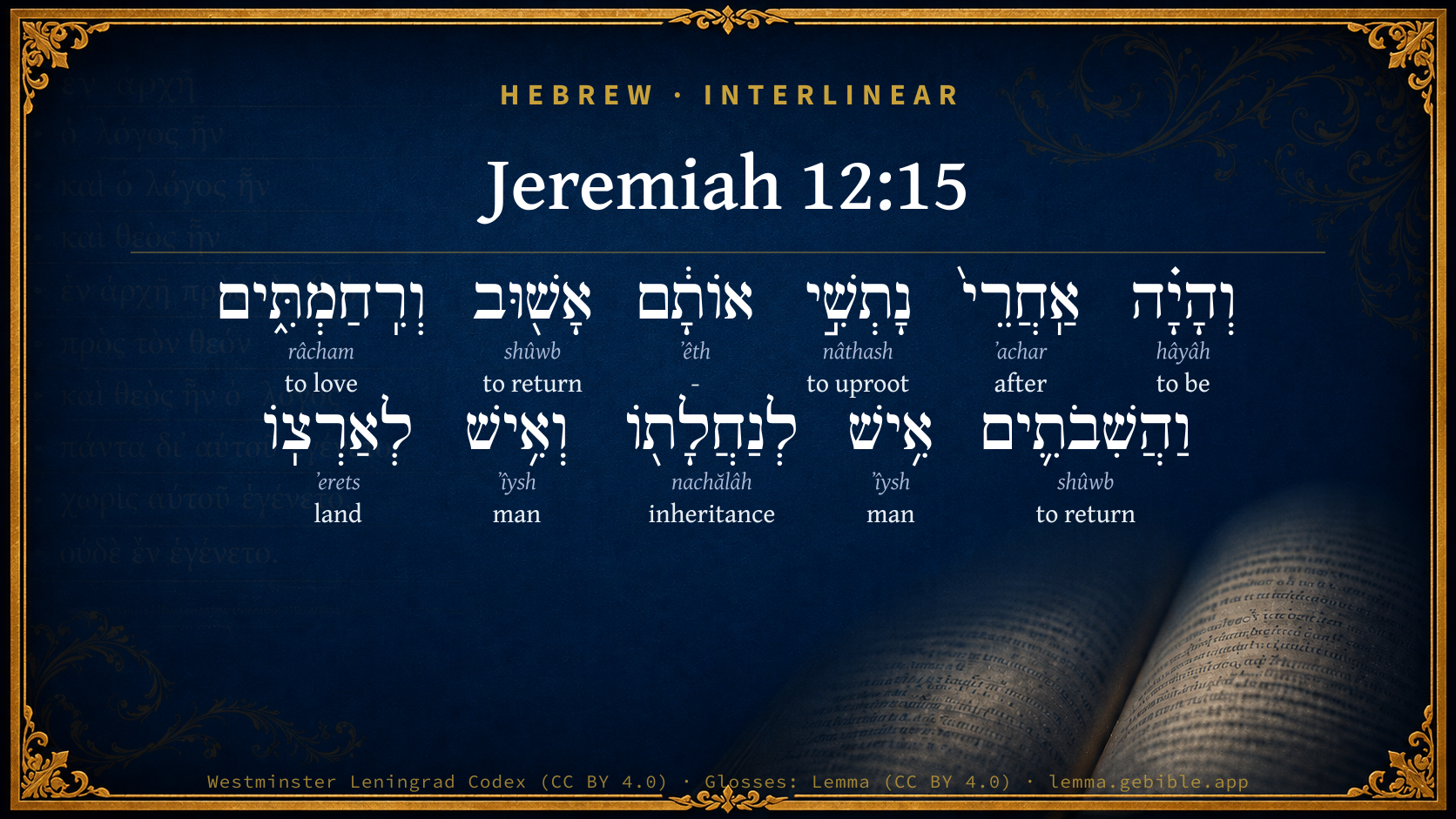
Hebrew (Westminster Leningrad Codex) Jeremiah 12:15 appears in the Hebrew Old Testament. The text above is from the Westminster Leningrad Codex. Each word links to its Strong’s number, a concise gloss, and parsing drawn from the Open Scriptures Hebrew Bible morphology. Click any word for its full Brown-Driver-Briggs (BDB) entry.
Download image
Cite this verse

Jeremiah 12:15 (World English Bible). Public Domain. Lemma interlinear Bible study tool, https://lemma.gebible.app/v/jeremiah/12/15.

Show BibTeX & RIS
BibTeX
RIS
English Translation
It shall happen, after that I have plucked them up, I will return and have compassion on them; and I will bring them again, every man to his heritage, and every man to his land.
World English Bible · Public Domain
Download a study sheet

One document with this verse’s original text, its word-by-word gloss line, the meaning frame, cross-references with their text, attributed commentary, and full source and license credits — printable, and it pastes into notes with its structure intact.

This verse Autodidact and up

Study sheet (.html) Plain text (.txt)

A passage Seminary Student

Up to 50 verses in one chapter. A passage sheet keeps up to 6 commentary sources and 12 cross-references per verse, in the order this page ranks them, and says so on the sheet whenever that leaves anything out. Ask for a single verse and you get the Autodidact verse sheet above.

Everything on this page stays free to read, with no account — the sheet is a download of what is already on screen, not access to it.

Want to remove ads? Support Godless Engineer
Compare translations 3

The same verse in 3 English versions, stacked beneath the original-language interlinear above. Click any original word for its lexicon entry.

Each is an independent rendering of the whole verse — the interlinear is not word-aligned to these translations.

Highlighted words mark where these versions differ — a whole-verse word diff, not a word-by-word alignment.

  • World English Bible Public Domain
    It shall happen, after that I have plucked them up, I will return and have compassion on them; and I will bring them again, every man to his heritage, and every man to his land.
  • King James Version Public Domain
    And it shall come to pass, after that I have plucked them out I will return, and have compassion on them, and will bring them again, every man to his heritage, and every man to his land.
  • unfoldingWord Literal Text CC BY-SA 4.0
    And it will happen after I pluck them up, I will turn and have compassion on them and bring them back, a man to his inheritance and a man to his land.

unfoldingWord Literal Text — © unfoldingWord, licensed CC BY-SA 4.0. Word-aligned USFM3 via Door43 (git.door43.org/unfoldingWord/en_ult).

Versions to compare (up to 4)

3 of 4 selected

Show all 18 translations

Every available English version of this verse, each an independent rendering of the whole verse.

  • World English Bible Public Domain
    It shall happen, after that I have plucked them up, I will return and have compassion on them; and I will bring them again, every man to his heritage, and every man to his land.
  • Berean Standard Bible Public Domain
    But after I have uprooted them, I will once again have compassion on them and return each one to his inheritance and to his land.
  • Majority Standard Bible Public Domain
    But after I have uprooted them, I will once again have compassion on them and return each one to his inheritance and to his land.
  • King James Version Public Domain
    And it shall come to pass, after that I have plucked them out I will return, and have compassion on them, and will bring them again, every man to his heritage, and every man to his land.
  • American Standard Version (1901) Public Domain
    And it shall come to pass, after that I have plucked them up, I will return and have compassion on them; and I will bring them again, every man to his heritage, and every man to his land.
  • Revised Version (1885) Public Domain
    And it shall come to pass, after that I have plucked them up, I will return and have compassion on them; and I will bring them again, every man to his heritage, and every man to his land.
  • Geneva Bible (1599) Public Domain
    And after that I haue plucked them out, I will returne, and haue compassion on them, and will bring againe euery man to his heritage, and euery man to his land.
  • Douay-Rheims (1899) Public Domain
    And when I shall have plucked them out, I will return, and have mercy on them: and I will bring them back, every man to his inheritance, and every man to his land.
  • Young's Literal Translation Public Domain
    And it hath been, after My plucking them out, I turn back, and have pitied them, And I have brought them back, Each to his inheritance, and each to his land.
  • Literal Standard Version CC BY-SA 4.0
    And it has been, after My plucking them out, || I turn back, and have pitied them, || And I have brought them back, || Each to his inheritance, and each to his land.
  • Unlocked Literal Bible CC BY-SA 4.0
    Then after I uproot those nations, it will happen that I will have compassion on them and bring them back; I will return them—each man to his inheritance and his land.
  • unfoldingWord Literal Text CC BY-SA 4.0
    And it will happen after I pluck them up, I will turn and have compassion on them and bring them back, a man to his inheritance and a man to his land.
  • Darby Bible Public Domain
    And it shall come to pass, after I have plucked them up, I will return, and have compassion on them, and will bring them back, each one to his inheritance, and each one to his land.
  • World Messianic Bible Public Domain
    It will happen that after I have plucked them up, I will return and have compassion on them. I will bring them again, every man to his heritage, and every man to his land.
  • Webster's Bible Public Domain
    And it shall come to pass, after I have plucked them out I will return, and have compassion on them, and will bring them again, every man to his heritage, and every man to his land.
  • Free Bible Version CC BY-SA 4.0
    However, once I have uprooted them, I will have mercy on them again, and bring each one back to their property and their land.
  • Bible in Basic English Public Domain
    And it will come about that, after they have been uprooted, I will again have pity on them; and I will take them back, every man to his heritage and every man to his land.
  • JPS Tanakh (1917) Public Domain
    And it shall come to pass, after that I have plucked them up, I will again have compassion on them; and I will bring them back, every man to his heritage, and every man to his land.

Literal Standard Version (2020), Covenant Press — licensed CC BY-SA 4.0. Text via the HelloAO Bible API (eBible.org). Unlocked Literal Bible (unfoldingWord) — licensed CC BY-SA 4.0. Text via the HelloAO Bible API (eBible.org). unfoldingWord Literal Text — © unfoldingWord, licensed CC BY-SA 4.0. Word-aligned USFM3 via Door43 (git.door43.org/unfoldingWord/en_ult). Free Bible Version, Dr. Jonathan Gallagher — licensed CC BY-SA 4.0. Text via the HelloAO Bible API (eBible.org).

Word by word

More ways to search: Search by grammar → Find every occurrence → Compare this word →

Practice this passage: Drill this verse → Learn its vocabulary →

נָתְשִׁ֣י
nâthash
H5428
“to uproot · me”
Verb, Qal, Infinitive Construct + Suffix, Personal, 1st Person, Common, Singular
Part of Speech
Verb
Stem
Qal
Form
Infinitive Construct
Full BDB Definition

Origin: a primitive root

TWOT: 1451

to pull up, expel, root out, pluck up - (Qal) to pull or pluck up - (Niphal) to be plucked up - (Hophal) to be plucked up
  1. וְהָיָ֗ה hâyâh H1961 “and · to be” Conjunction + Verb, Qal, Sequential Perfect, 3rd Person, Masculine, Singular
  2. אַֽחֲרֵי֙ ʼachar H310 “after” Preposition
  3. אוֹתָ֔ם ʼêth H853 “- · them” Particle, Direct Object + Suffix, Personal, 3rd Person, Masculine, Plural
  4. אָשׁ֖וּב shûwb H7725 “to return” Verb, Qal, Imperfect, 1st Person, Common, Singular
  5. וְרִֽחַמְתִּ֑ים râcham H7355 “and · to love · them” Conjunction + Verb, Piel, Sequential Perfect, 1st Person, Common, Singular + Suffix, Personal, 3rd Person, Masculine, Plural
  6. וַהֲשִׁבֹתִ֛ים shûwb H7725 “and · to return · them” Conjunction + Verb, Hiphil, Sequential Perfect, 1st Person, Common, Singular + Suffix, Personal, 3rd Person, Masculine, Plural
  7. אִ֥ישׁ ʼîysh H376 “man” Noun, Common, Masculine, Singular, Absolute
  8. לְנַחֲלָת֖וֹ nachălâh H5159 “to/for · inheritance · his” Preposition + Noun, Common, Feminine, Singular, Construct + Suffix, Personal, 3rd Person, Masculine, Singular
  9. וְאִ֥ישׁ ʼîysh H376 “and · man” Conjunction + Noun, Common, Masculine, Singular, Absolute
  10. לְאַרְצֽוֹ ʼerets H776 “to/for · land · his” Preposition + Noun, Common, Both, Singular, Construct + Suffix, Personal, 3rd Person, Masculine, Singular

About this verse

These counts appear in no published source. They are computed here, from the morphology-tagged text and Lemma’s own curated glosses. What Lemma adds →

11
words
9
distinct lemmas
Prophets
section

Notable vocabulary

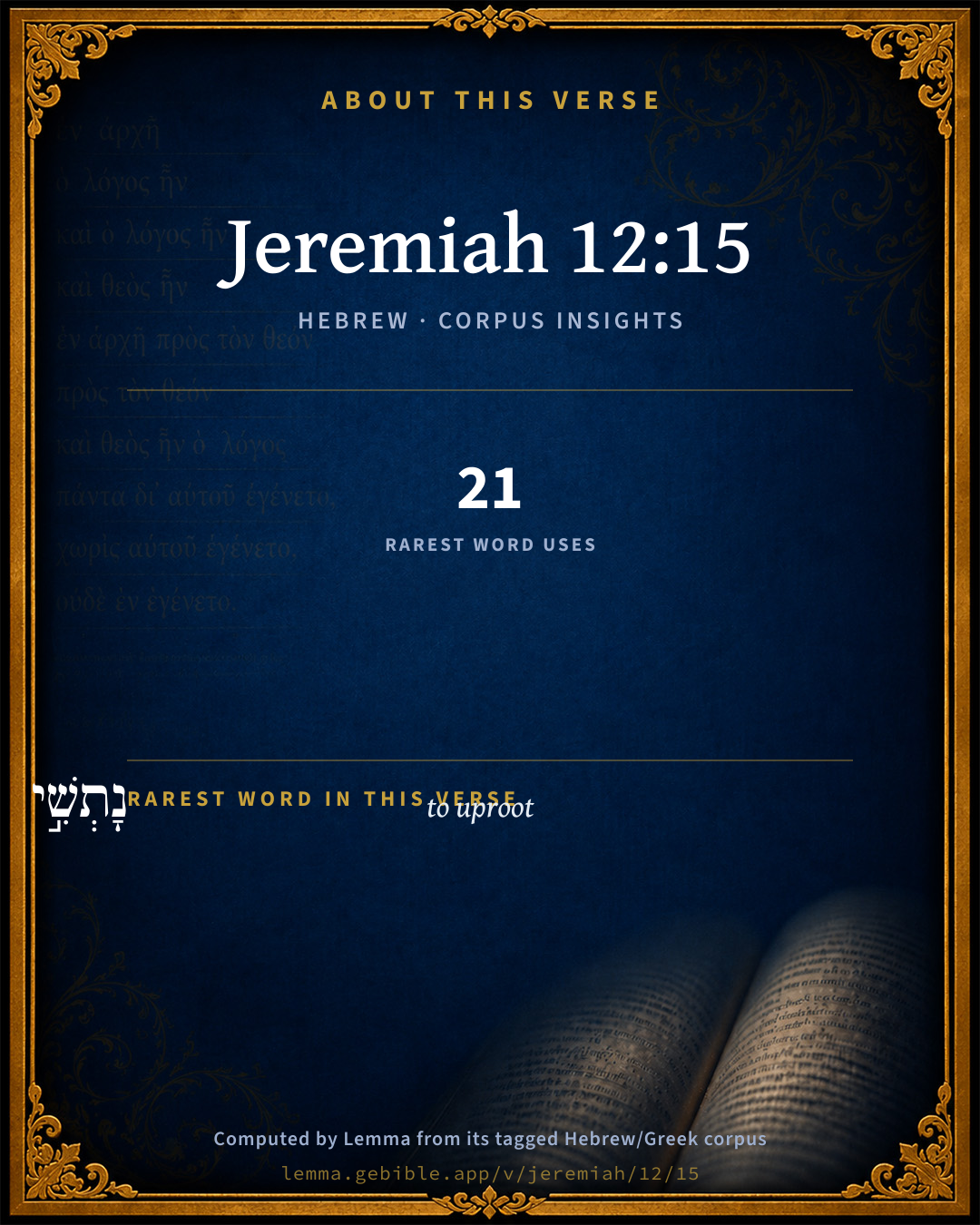
The rarest word here is נָתְשִׁ֣י to uproot H5428 — appearing just 21 times in the whole Hebrew Bible.

Shared distinctive vocabulary

נָתְשִׁ֣י to uproot H5428 occurs in 19 verses of the Hebrew Bible. Also found in:

Grammatical profile

  • 5 verbs
  • 4 nouns
  • 1 preposition
  • 1 particle

Verb forms

  • וְהָיָ֗ה Qal · Sequential Perfect
  • נָתְשִׁ֣י Qal · Infinitive Construct
  • אָשׁ֖וּב Qal · Imperfect
  • וְרִֽחַמְתִּ֑ים Piel · Sequential Perfect
  • וַהֲשִׁבֹתִ֛ים Hiphil · Sequential Perfect

Repetition

Words recur within this verse — often emphatic in Hebrew:

  • אָשׁ֖וּב to return H7725 ×2
  • אִ֥ישׁ man H376 ×2

Cross-references

8

Topical passages linked to Jeremiah 12:15 in the Treasury of Scripture Knowledge — connected by theme and wording, ordered by reader-vote popularity; previews shown in the World English Bible.

  • Jeremiah 49:6 But afterward I will bring back the captivity of the children of Ammon, says Yahweh.
  • Jeremiah 48:47 Yet will I bring back the captivity of Moab in the latter days, says Yahweh. Thus far is the judgment of Moab.
  • Jeremiah 49:39 But it shall happen in the latter days, that I will bring back the captivity of Elam, says Yahweh.
  • Deuteronomy 30:3 that then Yahweh your God will turn your captivity, and have compassion on you, and will return and gather you from all the peoples, where Yahweh your God has scattered you.
  • Amos 9:14 I will bring back the captivity of my people Israel, And they will rebuild the ruined cities, and inhabit them; and they will plant vineyards, and drink wine from them. They shall also make gardens, And eat the fruit of them.
  • Numbers 32:18 We will not return to our houses, until the children of Israel have inherited every man his inheritance.
  • Deuteronomy 3:20 until Yahweh give rest to your brothers, as to you, and they also possess the land which Yahweh your God gives them beyond the Jordan: then shall you return every man to his possession, which I have given you.
  • Isaiah 23:17–18 It shall happen after the end of seventy years, that Yahweh will visit Tyre, and she shall return to her hire, and shall play the prostitute with all the kingdoms of the world on the surface of the earth.

Cross-references courtesy of OpenBible.info (CC BY 4.0).

Hebrew and Greek witnesses Masoretic Hebrew ↔ Greek Septuagint

The same verse in the two great witnesses to the Old Testament, shown verse-for-verse.

These are two independent witnesses, not word-aligned to each other, and the Septuagint is shown in lemma (dictionary) form.

Hebrew Jeremiah 12:15 Masoretic · Westminster Leningrad Codex

וְהָיָ֗ה אַֽחֲרֵי֙ נָתְשִׁ֣י אוֹתָ֔ם אָשׁ֖וּב וְרִֽחַמְתִּ֑ים וַהֲשִׁבֹתִ֛ים אִ֥ישׁ לְנַחֲלָת֖וֹ וְאִ֥ישׁ לְאַרְצֽוֹ

It shall happen, after that I have plucked them up, I will return and have compassion on them; and I will bring them again, every man to his heritage, and every man to his land.

World English Bible · Public Domain

Greek LXX Structure differs

In the Septuagint, Jeremiah is about an eighth shorter than the Hebrew and arranges its material differently — the Oracles Against the Nations (Hebrew chapters 46–51) appear in the middle of the Greek book, after 25:13. Because the chapter and verse boundaries do not line up, a verse-for-verse comparison with the Hebrew is not shown.

A verse-for-verse comparison isn’t shown here because the chapters and verses don’t line up. Switch to the LXX edition with the MT / LXX toggle above to read the Greek directly.

Hebrew: Westminster Leningrad Codex (CC BY 4.0). Greek: Septuagint (public domain); English from a public-domain English Septuagint. How the Septuagint differs from the Hebrew →

Targum (Aramaic paraphrase)

1

The Targum is the ancient Jewish Aramaic paraphrase of the Hebrew Scriptures — an interpretive translation, not the Hebrew text itself. Onkelos (literal) and Pseudo-Jonathan (expansive) render the Torah, and Jonathan the Prophets. Coverage is partial: where no permissively-licensed English translation exists for a verse, only the Aramaic is shown. This is verse-level text, not a word-by-word alignment to the Hebrew.

  1. Targum Jonathan Prophets (Joshua–Malachi)
    וַהֲוָה בָּתַר דֶאֱטַלְטַל יַתְהוֹן אֲתוּב בְּמֵימְרִי וָאֱרְחֵים עֲלֵיהוֹן וַאֲתֵבִינוּן גְבַר לְאַחְסַנְתֵּיהּ וּגְבַר לְאַרְעֵיהּ:

    (no public-domain English translation for this verse)

    Targum Jonathan — Aramaic: “Mikraot Gedolot” (public domain). English: “Sefaria Community Translation” (CC0 1.0 (public-domain dedication)); “London "Chaldee Paraphrase," 1871” (public domain). Text via Sefaria.

Commentary

Notes on Jeremiah 12:15 from classic Christian and Jewish commentators (each source and its license shown beneath its notes). The classic Christian expositions comment on the surrounding passage and are grouped to its opening verse, so a note may address several verses; the Jewish commentaries on the Tanakh (Rashi and others) are per-verse, so they appear only where the commentator wrote on this verse.

Lemma curates 59 commentaries, every one of them public domain or Creative Commons licensed, each selected and text-cleaned for this edition rather than reprinted as found. About our sources →

Trapp's Complete Commentary

John Trapp

Jer 12:15 And it shall come to pass, after that I have plucked them out I will return, and have compassion on them, and will bring them again, every man to his heritage, and every man to his land.

Ver. 15. After that I have plucked them out,] sc., In both senses. {Jer 12:14}

I will return.] In the "midst of judgment, I will remember mercy."

And bring again every man to his heritage.] To the Church; for in every nation he that feareth God and worketh righteousness shall be accepted with him, and have a child’s part, even the reward of inheritance.

John Trapp, A Commentary or Exposition upon All the Books of the Old and New Testament (1647–1656) — public domain. Text from a community e-Sword module.

Tyndale Open Study Notes

Tyndale Open Resources

12:15 I will . . . have compassion on all of them: Even other nations, as wicked as they were, could be restored after experiencing disaster.

Tyndale Open Study Notes — © Tyndale Open Resources, licensed CC BY-SA 4.0. Text via the HelloAO Bible API.

Geneva Bible (1599)

Geneva Bible translators

After that I have punished the Gentiles, I will have mercy upon them.

Geneva Bible (1599) marginal notes — public domain. Text via Bolls.life.

Jamieson, Fausset & Brown

Robert Jamieson, A. R. Fausset & David Brown

A promise, applying to Judah, as well as to the nations specified (Amo 9:14). As to Moab, compare Jer 48:47; as to Ammon, Jer 49:6.

Jamieson, Fausset & Brown — Commentary Critical and Explanatory on the Whole Bible (1871) — public domain (CC PDM 1.0). Text via the HelloAO Bible API.

Adam Clarke's Commentary

Verse 15. I will return, and have compassion on them] This is a promise of restoration from the captivity, and an intimation also that some of their enemies would turn to the true God with them; learn the ways of his people; that is, would abjure idols, and take Jehovah for their God; and be built in the midst of his people, that is, Jew and Gentile forming one Church of the Most High.

Adam Clarke's Commentary on the Bible (1810–1826) — public domain. Text from a community e-Sword/MySword module.

John Calvin's Commentaries

God does not only promise mercy here to the Jews, but also to heathen nations, of whom he would be the Judge, to punish them for the sake of his people. And that this passage is to be extended to aliens is evident from the context; for the Prophet immediately adds, “And it shall be, that when they shall learn the ways of my people, to swear in my name, Live does Jehovah, as they have taught my people to swear by Baal, then shall they be built in the midst of my people.” We hence see that God would not only shew mercy to the remnant of his elect people, but also to their enemies.

If it be objected, — that thus God’s favor, manifested towards the children of Abraham, was obscured, the answer is, — that this availed much to confirm the hope of the faithful; for they had not only to look for their own salvation, but also for that of their enemies, whom God would gather together with them. Thus God rendered double his favor to the Israelites. The Prophet also in this place confirms in a striking manner the confidence of the faithful; for he says that God would be merciful even to their enemies for their sake, as they would be saved in common with themselves. We now then understand the object of the Prophet, when he declares, that God, after having drawn out the Gentiles from their own countries, would again be merciful to them, so as to restore every one of them to their own inheritance and to their own place.

John Calvin's Commentaries (1540-1563) — public domain. Text from the Calvin Translation Society English edition (1840s-50s) via the Christian Classics Ethereal Library (ccel.org). Calvin's coverage is partial (roughly two-thirds of the Bible); uncommented books and verses are honest gaps, never fabricated. The 19th-century editor's footnotes and remarks are omitted so the notes are faithfully Calvin's own voice.

Ellicott's Commentary for English Readers

(15) I will return, and have compassion on them.—The words refer, as Jer_12:16 shows, not to Judah only, but to the “evil neighbours.” For them also there is hope, and that hope is bound up with the return of Judah. Strong as was the prophet’s desire for retribution, it is overpowered by the new love shed abroad in his soul, and he sees that it does not exclude, even in their case, the pity and the yearning that look beyond it for an ultimate restoration.

A Bible Commentary for English Readers, edited by Charles John Ellicott (1878–1897) — public domain. Text from a community e-Sword module.

John Gill's Exposition

And it shall come to pass, after that I have plucked them out,.... Not the Jews only, but more especially their neighbouring nations; after they have been plucked up and carried captive, and been in captivity some time:

I will return, and have compassion on them; or, "have compassion on them again" (i); by returning their captivity, as is promised, Jer 48:47,

and I will bring them again, every man to his heritage, and every man to his land; this seems to respect the conversion of the Gentiles in the latter day, when the fulness of them shall be brought in; as the latter part of the preceding verse may more especially regard the conversion of the Jews at the same time, when they shall be gathered out of all nations where they are, and return to their own land.

(i) "rursus misereat me illorum", Junius & Tremellius; "rursus miserabor ipsorum", Piscator; "denuo miserabor ipsorum", Cocceius.

John Gill's Exposition of the Whole Bible (1746–1763) — public domain (CC PDM 1.0). Text via the HelloAO Bible API.

Haydock's Catholic Bible Commentary

Land; the Jews, as well as their neighbours, chap. xlix. 6. (Menochius) (Isaias xxiii. 15., and Ezechiel xvi. 55.)

George Leo Haydock (1774–1849), Haydock's Catholic Family Bible and Commentary, 1859 edition — public domain. Excludes Psalms (Douay-Rheims chapter numbering differs from Protestant) and Deuterocanonical books (Catholic canon only).

Matthew Poole's English Annotations

This seemeth not to be a prophecy only of the Jews’ return into their land after the fulfilling of the years of their captivity, but also of the bringing back of these nations after that they should be plucked up, and seems to relate to the calling of the Gentiles; but this prophecy must be limited by what followeth in the next verse, and not understood of all the inhabitants of those nations.

Matthew Poole's English Annotations on the Holy Bible (1683–1685) — public domain. Text from a community e-Sword/MySword module.

Whedon's Commentary on the Bible

Daniel D. Whedon

15. After that I have plucked — Sharing in Israel’s calamity, they shall also share in Israel’s mercy. I will return, etc. — I will again have compassion, a very common Hebraism.

Daniel D. Whedon (gen. ed.), Commentary on the Old and New Testaments (1874–1909) — public domain. Text from a community e-Sword module.

The Pulpit Commentary

I will return, and have compassion. The rendering is too Hebraistic; the sense is simply, I will again have compassion. The prophets offer no partial or "nationalistic" view; of the mercy of God. (comp. on Jer_48:47)

The Pulpit Commentary (1880–1919), ed. H.D.M. Spence-Jones & Joseph S. Exell — public domain. Text from a community e-Sword module.

Rashi

Rabbi Shlomo Yitzchaki (Rashi)

I will return and have pity on them They all suffered close to the destruction of the Temple, and concerning each one it is stated in this Book, “I will return the exile of...”

Rashi on the Tanakh — English translations: “The Judaica Press complete Tanach with Rashi, translated by A. J. Rosenberg” (CC BY 4.0); “Pentateuch with Rashi's commentary by M. Rosenbaum and A.M. Silbermann, 1929-1934” (public domain); “The Metsudah Tanach series, Lakewood, N.J” (CC BY 4.0); and “The Book of Joshua, Metsudah Publications, 1997” (CC BY 4.0). Text via Sefaria.

Lesson kit

Teaching starters — assembled from the data on this page, not authored interpretation. Every prompt links to the verse data it draws on. Edit before teaching.

Jeremiah, in the Prophets, opens this verse with 11 words (9 distinct Hebrew lemmas). Its most distinctive word is nâthash (“to uproot”). A historical commentator’s framing appears above. Read the whole chapter for the surrounding context.

Discussion questions

  1. The word nâthash carries the sense “to uproot.” How does it shape the verse?
  2. Deuteronomy 29:28 shares the word «to uproot» with this verse. How do the two illuminate each other?
  3. “to return” occurs 2× in this one verse. What is the effect of the repetition?
  4. These translations render this verse differently. What is at stake in choosing one wording over another?
  5. The verb «וְהָיָ֗ה» is Qal Sequential Perfect. How does its form color the action?
  6. Reading how Trapp's Complete Commentary and Tyndale Open Study Notes read this verse, where do the two commentators agree and where do they part?

Things to notice

  • These translations choose different wording for 15 words in this verse.
  • “to return” occurs 2× in this single verse.
  • 9 distinct Hebrew lemmas span 11 words in this verse.

Reading settings

Reading text

Shown beneath each verse's original-language words.

Old Testament
Old Testament edition

Read the OT as the Masoretic Hebrew (MT) or the Greek Septuagint (LXX).

English shown for the Greek Septuagint (in the Hebrew ↔ Greek comparison).

Comparing translations? Open the Compare panel on any verse page to stack up to four side by side.