Joshua 21:3

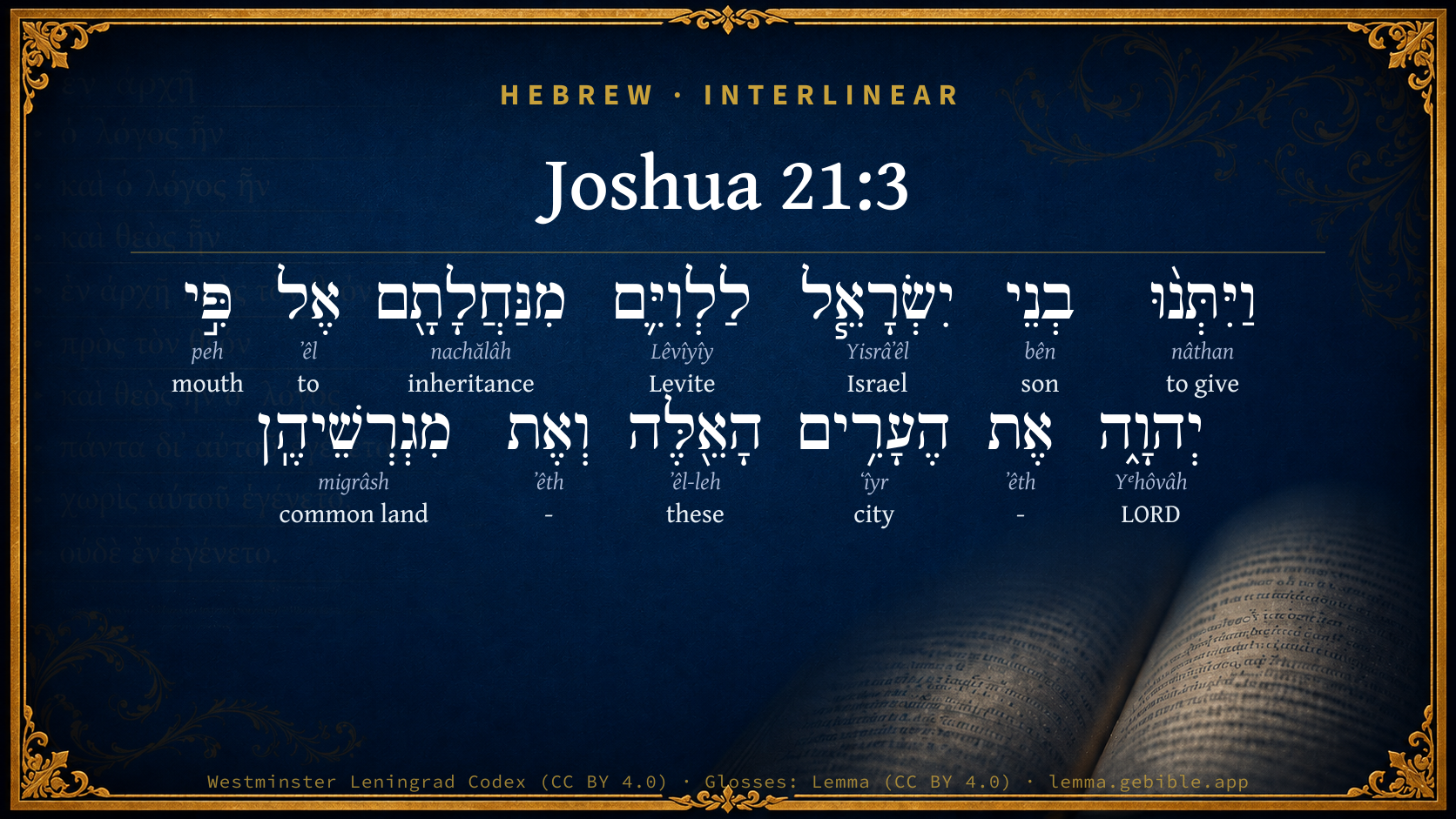
Hebrew (Westminster Leningrad Codex) Joshua 21:3 appears in the Hebrew Old Testament. The text above is from the Westminster Leningrad Codex. Each word links to its Strong’s number, a concise gloss, and parsing drawn from the Open Scriptures Hebrew Bible morphology. Click any word for its full Brown-Driver-Briggs (BDB) entry.
Download image
Cite this verse

Joshua 21:3 (World English Bible). Public Domain. Lemma interlinear Bible study tool, https://lemma.gebible.app/v/joshua/21/3.

Show BibTeX & RIS
BibTeX
RIS
English Translation
The children of Israel gave to the Levites out of their inheritance, according to the commandment of Yahweh, these cities with their suburbs.
World English Bible · Public Domain
Download a study sheet

One document with this verse’s original text, its word-by-word gloss line, the meaning frame, cross-references with their text, attributed commentary, and full source and license credits — printable, and it pastes into notes with its structure intact.

This verse Autodidact and up

Study sheet (.html) Plain text (.txt)

A passage Seminary Student

Up to 50 verses in one chapter. A passage sheet keeps up to 6 commentary sources and 12 cross-references per verse, in the order this page ranks them, and says so on the sheet whenever that leaves anything out. Ask for a single verse and you get the Autodidact verse sheet above.

Everything on this page stays free to read, with no account — the sheet is a download of what is already on screen, not access to it.

Want to remove ads? Support Godless Engineer
Compare translations 3

The same verse in 3 English versions, stacked beneath the original-language interlinear above. Click any original word for its lexicon entry.

Each is an independent rendering of the whole verse — the interlinear is not word-aligned to these translations.

Highlighted words mark where these versions differ — a whole-verse word diff, not a word-by-word alignment.

  • World English Bible Public Domain
    The children of Israel gave to the Levites out of their inheritance, according to the commandment of Yahweh, these cities with their suburbs.
  • King James Version Public Domain
    And the children of Israel gave unto the Levites out of their inheritance, at the commandment of the LORD, these cities and their suburbs.
  • unfoldingWord Literal Text CC BY-SA 4.0
    And the sons of Israel gave to the Levites from their inheritance these cities and their pasturelands, upon the mouth of Yahweh.

unfoldingWord Literal Text — © unfoldingWord, licensed CC BY-SA 4.0. Word-aligned USFM3 via Door43 (git.door43.org/unfoldingWord/en_ult).

Versions to compare (up to 4)

3 of 4 selected

Show all 18 translations

Every available English version of this verse, each an independent rendering of the whole verse.

  • World English Bible Public Domain
    The children of Israel gave to the Levites out of their inheritance, according to the commandment of Yahweh, these cities with their suburbs.
  • Berean Standard Bible Public Domain
    So by the command of the LORD, the Israelites gave the Levites these cities and their pasturelands out of their own inheritance:
  • Majority Standard Bible Public Domain
    So by the command of the LORD, the Israelites gave the Levites these cities and their pasturelands out of their own inheritance:
  • King James Version Public Domain
    And the children of Israel gave unto the Levites out of their inheritance, at the commandment of the LORD, these cities and their suburbs.
  • American Standard Version (1901) Public Domain
    And the children of Israel gave unto the Levites out of their inheritance, according to the commandment of Jehovah, these cities with their suburbs.
  • Revised Version (1885) Public Domain
    And the children of Israel gave unto the Levites out of their inheritance, according to the commandment of the LORD, these cities with their suburbs.
  • Geneva Bible (1599) Public Domain
    So the children of Israel gaue vnto the Leuites, out of their inheritance at the commandement of the Lord these cities with their suburbes.
  • Douay-Rheims (1899) Public Domain
    And the children of Israel gave out of their possessions according to the commandment of the Lord, cities and their suburbs.
  • Young's Literal Translation Public Domain
    And the sons of Israel give to the Levites, out of their inheritance, at the command of Jehovah, these cities and their suburbs:
  • Literal Standard Version CC BY-SA 4.0
    And the sons of Israel give to the Levites, out of their inheritance, at the command of YHWH, these cities and their outskirts:
  • Unlocked Literal Bible CC BY-SA 4.0
    So by the command of Yahweh, the people of Israel gave out of their inheritance the following cities, including their pasturelands, to the Levites.
  • unfoldingWord Literal Text CC BY-SA 4.0
    And the sons of Israel gave to the Levites from their inheritance these cities and their pasturelands, upon the mouth of Yahweh.
  • Darby Bible Public Domain
    And the children of Israel gave to the Levites out of their inheritance, according to the word of Jehovah, these cities and their suburbs.
  • World Messianic Bible Public Domain
    The children of Israel gave to the Levites out of their inheritance, according to the commandment of the LORD, these cities with their pasture lands.
  • Webster's Bible Public Domain
    And the children of Israel gave to the Levites out of their inheritance, at the commandment of the LORD, these cities and their suburbs.
  • Free Bible Version CC BY-SA 4.0
    So, following the Lord's instructions, the Israelites gave towns and pastures to the Levites from their own allocations.
  • Bible in Basic English Public Domain
    And the children of Israel out of their heritage gave to the Levites these towns with their grass-lands, by the order of the Lord.
  • JPS Tanakh (1917) Public Domain
    And the children of Israel gave unto the Levites out of their inheritance, according to the commandment of the LORD, these cities with the open land about them.

Literal Standard Version (2020), Covenant Press — licensed CC BY-SA 4.0. Text via the HelloAO Bible API (eBible.org). Unlocked Literal Bible (unfoldingWord) — licensed CC BY-SA 4.0. Text via the HelloAO Bible API (eBible.org). unfoldingWord Literal Text — © unfoldingWord, licensed CC BY-SA 4.0. Word-aligned USFM3 via Door43 (git.door43.org/unfoldingWord/en_ult). Free Bible Version, Dr. Jonathan Gallagher — licensed CC BY-SA 4.0. Text via the HelloAO Bible API (eBible.org).

Word by word

More ways to search: Search by grammar → Find every occurrence → Compare this word →

Practice this passage: Drill this verse → Learn its vocabulary →

מִגְרְשֵׁיהֶֽן
migrâsh
H4054
“common lands · their”
Noun, Common, Masculine, Plural, Construct + Suffix, Personal, 3rd Person, Feminine, Plural
Part of Speech
Noun
Type
Common
Gender
Masculine
Number
Plural
State
Construct
Full BDB Definition

Origin: from H1644

TWOT: 388c

common, common land, open land, suburb
  1. וַיִּתְּנ֨וּ nâthan H5414 “and · to give” Conjunction + Verb, Qal, Sequential Imperfect, 3rd Person, Masculine, Plural
  2. בְנֵי bên H1121 “sons of” Noun, Common, Masculine, Plural, Construct
  3. יִשְׂרָאֵ֧ל Yisrâʼêl H3478 “Israel” Noun, Proper
  4. לַלְוִיִּ֛ם Lêvîyîy H3881 “to/for the · Levites” Preposition, Determined + Noun, Gentilic, Masculine, Plural, Absolute
  5. מִנַּחֲלָתָ֖ם nachălâh H5159 “from · inheritance · their” Preposition + Noun, Common, Feminine, Singular, Construct + Suffix, Personal, 3rd Person, Masculine, Plural
  6. אֶל ʼêl H413 “to” Preposition
  7. פִּ֣י peh H6310 “mouth of” Noun, Common, Masculine, Singular, Construct
  8. יְהוָ֑ה Yᵉhôvâh H3068 “LORD” Noun, Proper
  9. אֶת ʼêth H853 “-” Particle, Direct Object
  10. הֶעָרִ֥ים ʻîyr H5892 “the · cities” Particle, Definite Article + Noun, Common, Feminine, Plural, Absolute
  11. הָאֵ֖לֶּה ʼêl-leh H428 “the · these” Particle, Definite Article + Pronoun, Demonstrative, Common, Plural
  12. וְאֶת ʼêth H853 “and · -” Conjunction + Particle, Direct Object

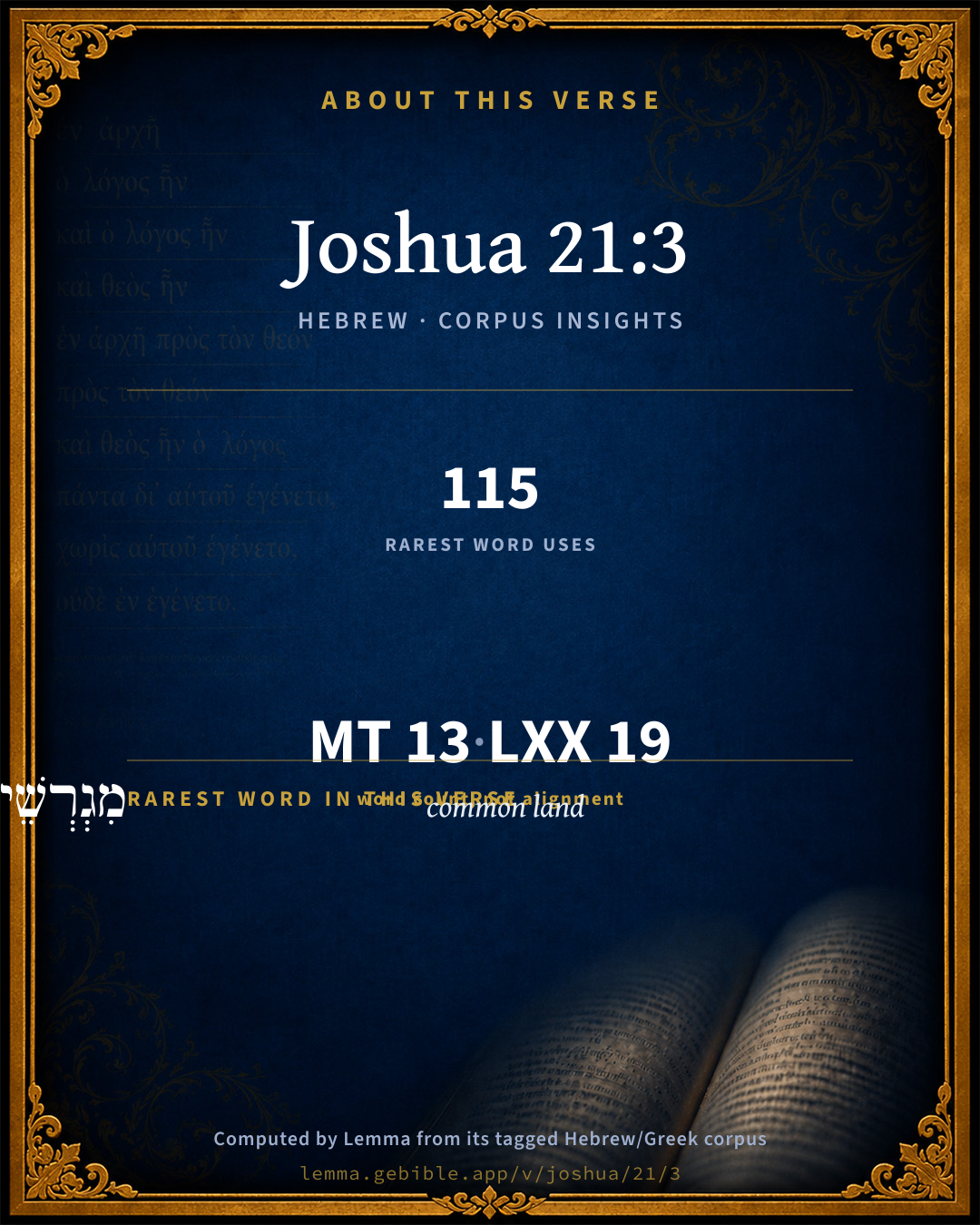
About this verse

These counts appear in no published source. They are computed here, from the morphology-tagged text and Lemma’s own curated glosses. What Lemma adds →

13
words
12
distinct lemmas
Historical
section

Grammatical profile

  • 1 verb
  • 8 nouns
  • 1 pronoun
  • 1 preposition
  • 2 particles

Verb forms

  • וַיִּתְּנ֨וּ Qal · Sequential Imperfect

Hebrew & Septuagint length

In English translation the verse runs 23 words from the Hebrew and 24 from the Septuagint (LXX English) — closely comparable.

A rough comparison of the two English renderings, which tokenize alike — not a word-level alignment.

Word counts can differ between the Hebrew and the Greek without any difference in meaning — e.g. the Hebrew direct-object marker אֵת has no separate Greek word, and Greek often adds the article ὁ.

In the original languages it is 13 Hebrew tokens and 19 Greek tokens — but the two are counted differently (Hebrew bundles its prefixes and suffixes into one token; the Greek is in lemma form), so that isn’t a like-for-like length.

Cross-references

3

Topical passages linked to Joshua 21:3 in the Treasury of Scripture Knowledge — connected by theme and wording, ordered by reader-vote popularity; previews shown in the World English Bible.

  • Genesis 49:7 Cursed be their anger, for it was fierce; And their wrath, for it was cruel. I will divide them in Jacob, Scatter them in Israel.
  • Deuteronomy 33:8–10 Of Levi he said, Your Thummim and your Urim are with your godly one, Whom you did prove at Massah, With whom you did strive at the waters of Meribah;
  • 1 Chronicles 6:54–81 Now these are their dwelling-places according to their encampments in their borders: to the sons of Aaron, of the families of the Kohathites (for theirs was the [first] lot),

Cross-references courtesy of OpenBible.info (CC BY 4.0).

Hebrew and Greek witnesses Masoretic Hebrew ↔ Greek Septuagint

The same verse in the two great witnesses to the Old Testament, shown verse-for-verse.

These are two independent witnesses, not word-aligned to each other, and the Septuagint is shown in lemma (dictionary) form.

Hebrew Joshua 21:3 Masoretic · Westminster Leningrad Codex

וַיִּתְּנ֨וּ בְנֵי יִשְׂרָאֵ֧ל לַלְוִיִּ֛ם מִנַּחֲלָתָ֖ם אֶל פִּ֣י יְהוָ֑ה אֶת הֶעָרִ֥ים הָאֵ֖לֶּה וְאֶת מִגְרְשֵׁיהֶֽן

The children of Israel gave to the Levites out of their inheritance, according to the commandment of Yahweh, these cities with their suburbs.

World English Bible · Public Domain

Greek LXX Joshua 21:3 Septuagint · lemma form

καί δίδωμι ὁ υἱός ἰσραήλ ὁ λευίτης ἐν ὁ κατακληρονομέω διά πρόσταγμα κύριος ὁ πόλις καί ὁ περισπόριον αὐτός

So the children of Israel gave to the Levites in their inheritance by the command of the Lord the cities and the country round.

LXX2012 (modern English Septuagint) · Public Domain

Hebrew: Westminster Leningrad Codex (CC BY 4.0). Greek: Septuagint (public domain); English from LXX2012 (modern English Septuagint) (Public Domain). How the Septuagint differs from the Hebrew →

Targum (Aramaic paraphrase)

1

The Targum is the ancient Jewish Aramaic paraphrase of the Hebrew Scriptures — an interpretive translation, not the Hebrew text itself. Onkelos (literal) and Pseudo-Jonathan (expansive) render the Torah, and Jonathan the Prophets. Coverage is partial: where no permissively-licensed English translation exists for a verse, only the Aramaic is shown. This is verse-level text, not a word-by-word alignment to the Hebrew.

  1. Targum Jonathan Prophets (Joshua–Malachi)
    וִיהָבוּ בְּנֵי יִשְׂרָאֵל לְלֵוָאֵי מֵאַחֲסַנְתְּהוֹן עַל מֵימְרָא דַייָ יַת קִרְוַיָא הָאִלֵין וְיַת רְוָחֵיהֶן:

    (no public-domain English translation for this verse)

    Targum Jonathan — Aramaic: “Mikraot Gedolot” (public domain). English: “Sefaria Community Translation” (CC0 1.0 (public-domain dedication)); “London "Chaldee Paraphrase," 1871” (public domain). Text via Sefaria.

Commentary

Notes on Joshua 21:3 from classic Christian and Jewish commentators (each source and its license shown beneath its notes). The classic Christian expositions comment on the surrounding passage and are grouped to its opening verse, so a note may address several verses; the Jewish commentaries on the Tanakh (Rashi and others) are per-verse, so they appear only where the commentator wrote on this verse.

Lemma curates 59 commentaries, every one of them public domain or Creative Commons licensed, each selected and text-cleaned for this edition rather than reprinted as found. About our sources →

Trapp's Complete Commentary

John Trapp

Jos 21:3 And the children of Israel gave unto the Levites out of their inheritance, at the commandment of the LORD, these cities and their suburbs.

Ver. 3. These cities and their suburbs.] In their cities others dwelt with them: for how could they subsist without those of other professions? See Ezr 2:70. And as for the suburbs, they were for pasture, pleasure, and other country commodities, not for tillage; for the Levites were not to have any such employment. {Num 18:20-24}

John Trapp, A Commentary or Exposition upon All the Books of the Old and New Testament (1647–1656) — public domain. Text from a community e-Sword module.

Joseph Benson's Commentary

Jos 21:3. The children of Israel gave — Probably they gave the Levites promiscuously such cities as God commanded, and the lot appropriated them to their several houses or families. Out of their inheritance — That is, out of their several possessions, that the burden might be equally divided; and that the Levites, being dispersed among the several tribes, according to Jacob’s prediction, (Gen 49:7,) might more easily and effectually teach the Israelites God’s law and judgments, which they were engaged to do, Deu 33:10; and that the people might upon all occasions resort to them, and inquire the meaning of the law at their mouths. And suburbs — Not only the use, but the absolute dominion of them, as is manifest both from Jos 21:11-12, where a distinction is made between the city and suburbs of Hebron, and the fields and villages thereof; (the former being given to the Levites, the latter to Caleb;) and from the return of these cities in the jubilee unto the Levites as to their proper owners, Lev 25:33-34.

Joseph Benson's Commentary on the Old and New Testaments (1811–1818) — public domain. Text from a community e-Sword module.

Adam Clarke's Commentary

Verse 3. And the children of Israel gave unto the Levites] They cheerfully obeyed the Divine command, and cities for habitations were appointed to them out of the different tribes by lot, that it might as fully appear that God designed them their habitations, as he designed the others their inheritances.

Adam Clarke's Commentary on the Bible (1810–1826) — public domain. Text from a community e-Sword/MySword module.

The Cambridge Bible for Schools and Colleges

gen. ed. J. J. S. Perowne

3. And the children of Israel gave] The successor of Moses did not fail to carry out faithfully the Divine Command, and preparations were made for assigning to them certain cities for their possession.

out of their inheritance] “Distinctness and diffusion” were the great points to be attained in their case, and therefore out of the inheritance of their brethren provision was made for them in such a way that, as during the wanderings they had guarded the Tabernacle of Jehovah, so now they should be “scattered” as widely as possible in Israel, to bear witness that the people still owed allegiance to Him.

The Cambridge Bible for Schools and Colleges (gen. ed. J. J. S. Perowne; Cambridge University Press, 1878–1918) — public domain. Text from a community e-Sword module.

John Gill's Exposition

And the children of Israel gave unto the Levites out of their inheritance,.... Knowing full well there was such a command, made no objection to their motion, but freely gave them cities out of the portion of inheritance allotted to them; this they did

at the commandment of the Lord, and in obedience to it, even gave these cities and suburbs; after mentioned: this was done by the tribes themselves; as there were a certain number fixed by the commandment of God, they agreed among themselves how many and what cities should be given out of each tribe; and then lots were cast for them by Joshua, what and which cities should be appropriated to their several divisions, as the Kohathites that sprang from Aaron, and the rest of them that did not, and the Gershonites and Merarites, as follows.

John Gill's Exposition of the Whole Bible (1746–1763) — public domain (CC PDM 1.0). Text via the HelloAO Bible API.

Haydock's Catholic Bible Commentary

Gave, by lot, ver. 4, &c. (Menochius) --- Whether any changes were afterwards made, to grant more or less, in proportion to the numbers of the four families, (as seems to have been done with regard to the other tribes) or the cities were specified in four parcels, and the priests received the first lot, the text does not explain. (Calmet) --- It is also uncertain what right the Levites had to these 48 cities. Some say that they had only the use of them, while others maintain that the cities were their property entirely, so that no other could live there without their consent. They could sell the houses, which returned to them in the year of the jubilee, if not redeemed before; but the suburbs were a common property of all the Levites, and could not be sold by any, Leviticus xxv. The cities, therefore, belonged to God, and he abandoned the property to his ministers. Other people might live among them, as they were not debarred from choosing their habitation in places which were not originally allotted to them. Thus we find that Gabaa was chiefly people by the tribe of Benjamin, when the outrage was offered to the Levite’s wife, and no blame attached to the latter, Judges xix. Saul and his family were of the same town, though it belonged to the Levites, and David kept his court at Hebron, a sacerdotal city, for the first seven years of his reign. (Calmet) --- Here also Caleb had probably resided, chap. xiv. 14. The priests and Levites were not indeed at this time sufficiently numerous to people all these cities; and Calmet supposes that they only received as many houses as they might occupy, being supplied with more by the magistrates as their numbers increased. But might not they let the houses, which they did not want to occupy, and receive the profits, so as to take possession of them when they had occasion? Were these 48 cities, which were the only part of the land to which the Levites had any claim, too many or too rich to compensate the labours of this most deserving tribe? It seems, therefore, unnecessary to call in the aid or interference of the magistrate, except any person were so bold as to refuse to give up what the law had so positively assigned to the Levites. Their rights were as well defined as those of any of the other tribes. (Haydock) --- The land beyond the suburbs, was cultivated by the proprietors, who might either live in the town or country. Many of the priests and Levites chose to reside near the tabernacle, as Moses had encouraged them to do, Deuteronomy xviii. 6. Thus Nobe became a sacerdotal city; (1 Kings xxi. 1,) and after the temple was built, Jerusalem and its environs were the places of abode for most of the priests. (Calmet)

George Leo Haydock (1774–1849), Haydock's Catholic Family Bible and Commentary, 1859 edition — public domain. Excludes Psalms (Douay-Rheims chapter numbering differs from Protestant) and Deuterocanonical books (Catholic canon only).

Matthew Poole's English Annotations

It seems most probable that they gave to the Levites promiscuously such cities as God commanded, and that the lot appropriated them to their several houses or families.

Out of their inheritance, i.e. out of their several possessions; partly that the burden and loss might be equally divided and principally, that the Levites being dispersed among the several tribes, according to Jacob’s prediction, Gen 49:7, might more easily, and frequently, and effectually teach the Israelites God’s law and judgments, which they were engaged to do, Deu 33:10; and that the people might upon all occasions resort to them, and require the meaning of the law at their mouths, Mal 2:7.

These cities and their suburbs; not only the use, but the absolute dominion of them, as is manifest both from Jos 21:11,12, where a distinction is made between

the city and suburbs of Hebron, and the fields and villages thereof, and the former are given to the Levites, the latter to Caleb; and from the return of these cities in the jubilee unto the Levites, as to their proper owners, Lev 25:33,34.

Matthew Poole's English Annotations on the Holy Bible (1683–1685) — public domain. Text from a community e-Sword/MySword module.

The Pulpit Commentary

Out of their inheritance. Out of that of Israel (see note on ver. 1). These cities. The number was forty-eight, i.e. , four times twelve. Bahr ("Symbolik des Alten Testaments," 1:221) remarks on the symbolical meaning of this number. He compares it, first, to the twelve tribes marching in four detachments, the ark of God and its guard in the centre (see Numbers 2). Four, he says, is the number of the world, and three the sign of God, and twelve of the combination of the two. Thus we are reminded of the heavenly city which "lieth four-square," which has "twelve foundations of precious stones," "twelve gates of pearls, and at the gates twelve angels," and the names of "the twelve tribes of Israel" written thereupon, and wherein was "the tree of life," with its "twelve manner of fruits," which were "yielded every month". (Rev_21:12, Rev_21:14, Rev_21:16, Rev_21:19, 21 22:2)

HOMILIES BY W.F. ADENEY Ver. 3. The cities of the Levites.

The Levites were scattered among the other tribes of Israel, and yet not individually but in clusters, in cities of their own. This arrangement must have had some object:

I THE LEVITES WERE SET APART FOR THE SERVICE OF GOD. They were freed from the claims and cares which fell on the other Israelites. They were maintained by the offerings of the people. Those who minister in spiritual things have temporal wants which the people who are benefited by their services should care for. They are not the less men because they are servants of God, and their home comforts should be secured that they may be free for spiritual work.

II THE LEVITES WERE ABLE TO MINISTER TO THE PEOPLE BY LIVING AMONGST THEM. When it was not their turn to be serving at the temple, the Levites appear to have been engaged in educational work and religious ministrations among the people of their neighbourhood. Church services are useless unless the private lives of men are improved. We must carry the gospel to those who will not come to hear it in the regular place of worship. It is the duty of Christians not to live apart from the world for their own sanctification, but to live in the world for the world"s redemption to be the leaven leavening the whole mass, the light of the world shining into the dark places. Thus the world will be Christianised

(1) by the gospel reaching those who are out of the way of ordinary religious influences;

(2) by example;

(3) by direct personal persuasion.

III THE LEVITES WERE ABLE TO CULTIVATE THEIR HUMAN SYMPATHIES BY LIVING AMONG THE PEOPLE. The religion of complete separation from the world is unnatural. It destroys some of the finest qualities of human life. Godliness cannot exist without humanity. The man of God is most truly human. Sympathy for human affairs, active pity for the distress of the world, and brotherly kindness are essential to the Christian life. Therefore the best school for the saint is not the hermit"s cell, but the marketplace. Complete separation from the world for religious ends developes

(1) morbid subjectivity,

(2) spiritual selfishness,

(3) pride,

(4) idleness.

IV THE LEVITES WERE ABLE TO CULTIVATE THEIR SPIRITUALITY BY MUTUAL INTERCOURSE. They lived in cities together; though in the midst of the tribes of Israel. Christians should unite in Church fellowship. Solitary mission work is difficult and painful. Christian society secures

(1) mutual sympathy,

(2) wholesome emulation.

The Church should be a home for the Christian. It is bad to be always in worldly society. W.F.A.

HOMILIES BY E. DE PRESSENSE Ver. 3. The portion of the tribe of Levi.

There might seem at first something strange in the withholding from the tribe of Levi its share among the cities of Canaan, divided by lot among the other tribes. There were, however, as we shall see, substantial reasons why the tribe of Levi should not be treated like the other tribes in the apportionment of the land of Canaan. IT HAD ITS OWN PECULIAR WORK TO WHICH IT WAS TO BE ENTIRELY CONSECRATED. Set apart for the service of the altar, it was not to be distracted by other interests. The sacrifices of the Lord were its inheritance. On the other hand, as it must have means of subsistence, every tribe was to set apart from its own lot that which was needful for the sacrifices and service of God. These temporal conditions of the tribe of Levi in the land of Canaan give us a very fair idea of the priesthood of the old covenant, and we shall be able to derive from their consideration several principles applicable to the priesthood of the new covenant.

(1) The fact that the tribe of Levi was to have no portion of its own, shows that it is not the will of God that His service should be mixed up with temporal and material interests.

(2) It is made incumbent on the whole nation to provide for the maintenance of the Levites. This is a sacred duty which cannot be neglected without prejudice to the service of God. In fulfilling this duty, the people associate themselves with the priesthood. The Levites, whom they maintain, are their representatives. The eleven tribes have their delegate in the twelfth. This truth was impressed on the minds of the children of Israel by the offering by which they had to redeem the first born of their male children. Thus even under the old covenant, the great idea of the universal priesthood was implicitly recognised. Now all Israel is a nation of priests, for, as says St. Peter, in Christ "we are made kings and priests unto God". (1Pe_2:9) Still the Church has its ministers; but these are not a clerical class apart; they are but the representatives of the people; or rather, they do but devote themselves specially to that which is at the same time the duty of every Christian. In fulfilling this ministry, they are called, as was the tribe of Levi, to renounce all earthly ambition, and not to attempt in any way to make holy things the handle for securing their own material advantage. Freely they have received, freely they are to give; or they will come under the condemnation of Simon Magus. It is for the Church to maintain these her servants by voluntary gifts. This duty was urged by the apostles. Let him who is taught communicate unto him that teacheth in all good things". (Gal_6:6)

(3) The Church has become altogether a race of priests. As a Church she has no right to secular dominion. When the papacy pretended that temporal power was a condition of safety for the Catholic Church, it ignored the laws concerning the priesthood, both under the old covenant and the new. Whenever a Church seeks to reign after the manner of temporal sovereigns, she becomes guilty of the same rebellion, and forgets the great words of her Divine Founder: "My kingdom is not of this world". E. (Joh_18:36) DE P.

The Pulpit Commentary (1880–1919), ed. H.D.M. Spence-Jones & Joseph S. Exell — public domain. Text from a community e-Sword module.

John Wesley's Explanatory Notes

The children of Israel gave - Probably they gave the Levites promiscuously such cities as God commanded, and the lot appropriated them to their several houses or families. Out of their inheritance - That is, out of their several possessions; that the burden might be equally divided; and, that the Levites being dispersed among the several tribes, according to Jacob's prediction, Gen. xlix, 7, might more easily, and effectually teach the Israelites God's law and judgments, which they were engaged to do, Deut. xxxiii, 10, and that the people might upon all occasions resort to them, and inquire the meaning of the law at their mouths. And suburbs - Not only the use, but the absolute dominion of them, as is manifest both from ver. 11, 12, where a distinction is made between the city and suburbs of Hebron, and the fields and villages thereof; (the former given to the Levites, the latter to Caleb;) and from the return of these cities in the Jubilee, unto the Levites as to their proper owners, Lev. xxv, 33, 34.

John Wesley, Explanatory Notes Upon the Whole Bible (1754–1765) — public domain. Text via the GEBible commentary corpus.

unfoldingWord translationNotes

Door43 World Missions Community

following cities

This refers to the cities to be listed in the next verses.

translationWords

command

Yahweh

Israel

inherit

Levi

unfoldingWord translationNotes — © Distant Shores Media and the Door43 World Missions Community, licensed CC BY-SA 4.0. Source: git.door43.org/Door43/en_tn.

Lesson kit

Teaching starters — assembled from the data on this page, not authored interpretation. Every prompt links to the verse data it draws on. Edit before teaching.

Joshua, in the Historical, opens this verse with 13 words (12 distinct Hebrew lemmas). Its most distinctive word is migrâsh (“common land”). A historical commentator’s framing appears above. Read the whole chapter for the surrounding context.

Discussion questions

  1. The word migrâsh carries the sense “common land.” How does it shape the verse?
  2. Genesis 49:7 shares this passage’s theme. How do the two illuminate each other?
  3. These translations render this verse differently; the difference is in the English rendering, not the original. What questions does that raise?
  4. The verb «וַיִּתְּנ֨וּ» is Qal Sequential Imperfect. How does its form color the action?
  5. Reading how Trapp's Complete Commentary and Joseph Benson's Commentary read this verse, where do the two commentators agree and where do they part?

Things to notice

Reading settings

Reading text

Shown beneath each verse's original-language words.

Old Testament
Old Testament edition

Read the OT as the Masoretic Hebrew (MT) or the Greek Septuagint (LXX).

English shown for the Greek Septuagint (in the Hebrew ↔ Greek comparison).

Comparing translations? Open the Compare panel on any verse page to stack up to four side by side.