
Ezekiel 46:16

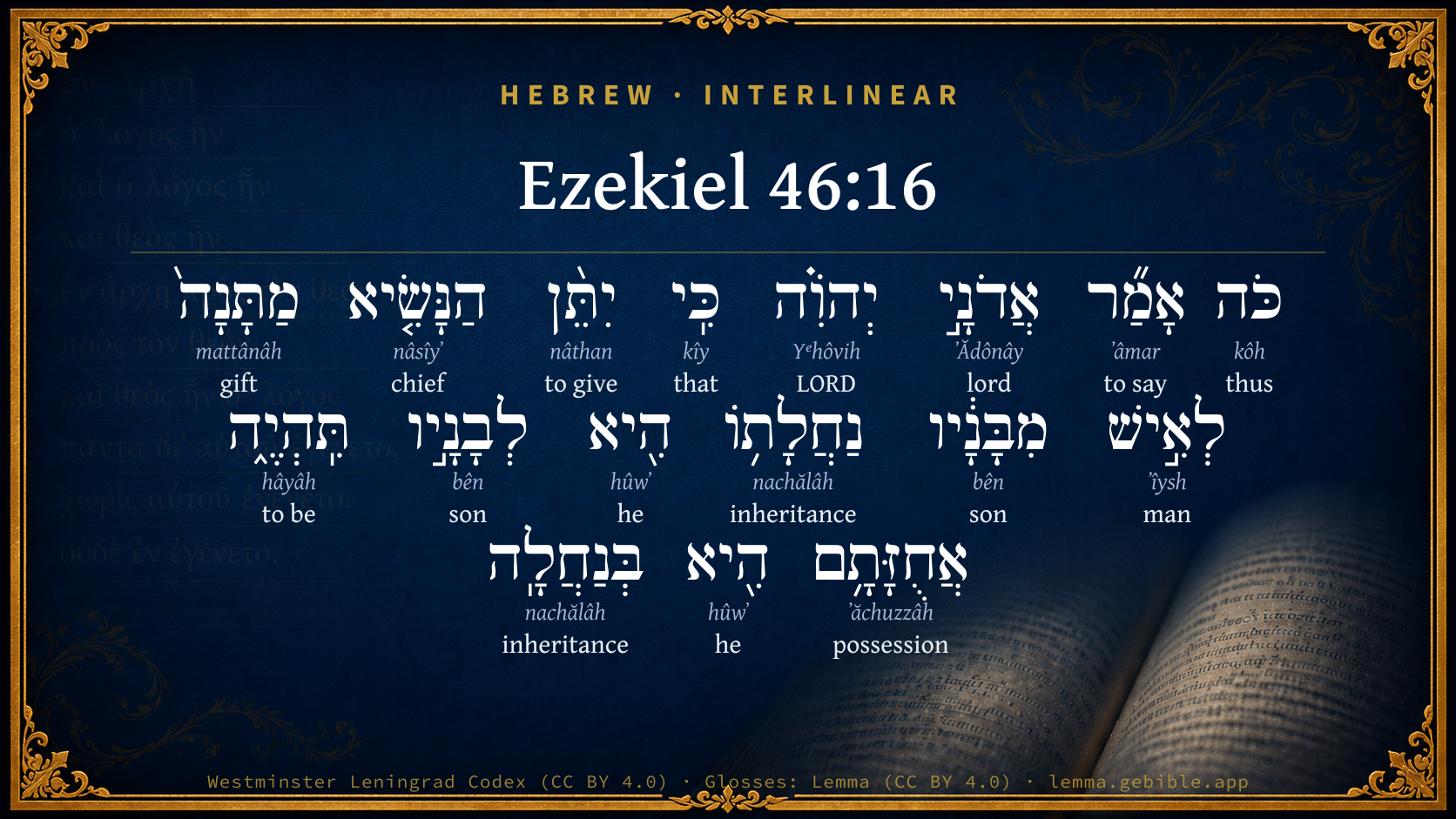
Hebrew (Westminster Leningrad Codex) Ezekiel 46:16 appears in the Hebrew Old Testament. The text above is from the Westminster Leningrad Codex. Each word links to its Strong’s number, a concise gloss, and parsing drawn from the Open Scriptures Hebrew Bible morphology. Click any word for its full Brown-Driver-Briggs (BDB) entry.
Download image
Cite this verse

Ezekiel 46:16 (World English Bible). Public Domain. Lemma interlinear Bible study tool, https://lemma.gebible.app/v/ezekiel/46/16.

Show BibTeX & RIS
BibTeX
RIS
English Translation
Thus says the Lord Yahweh: If the prince give a gift to any of his sons, it is his inheritance, it shall belong to his sons; it is their possession by inheritance.
World English Bible · Public Domain
Download a study sheet

One document with this verse’s original text, its word-by-word gloss line, the meaning frame, cross-references with their text, attributed commentary, and full source and license credits — printable, and it pastes into notes with its structure intact.

This verse Autodidact and up

Study sheet (.html) Plain text (.txt)

A passage Seminary Student

Up to 50 verses in one chapter. A passage sheet keeps up to 6 commentary sources and 12 cross-references per verse, in the order this page ranks them, and says so on the sheet whenever that leaves anything out. Ask for a single verse and you get the Autodidact verse sheet above.

Everything on this page stays free to read, with no account — the sheet is a download of what is already on screen, not access to it.

Want to remove ads? Support Godless Engineer
Compare translations 3

The same verse in 3 English versions, stacked beneath the original-language interlinear above. Click any original word for its lexicon entry.

Each is an independent rendering of the whole verse — the interlinear is not word-aligned to these translations.

Highlighted words mark where these versions differ — a whole-verse word diff, not a word-by-word alignment.

  • World English Bible Public Domain
    Thus says the Lord Yahweh: If the prince give a gift to any of his sons, it is his inheritance, it shall belong to his sons; it is their possession by inheritance.
  • King James Version Public Domain
    Thus saith the Lord GOD; If the prince give a gift unto any of his sons, the inheritance thereof shall be his sons'; it shall be their possession by inheritance.
  • unfoldingWord Literal Text CC BY-SA 4.0
    The Lord Yahweh says this: If the prince gives a gift to any of his sons, it is his inheritance. It will be the property of his sons, it is an inheritance.

unfoldingWord Literal Text — © unfoldingWord, licensed CC BY-SA 4.0. Word-aligned USFM3 via Door43 (git.door43.org/unfoldingWord/en_ult).

Versions to compare (up to 4)

3 of 4 selected

Show all 18 translations

Every available English version of this verse, each an independent rendering of the whole verse.

  • World English Bible Public Domain
    Thus says the Lord Yahweh: If the prince give a gift to any of his sons, it is his inheritance, it shall belong to his sons; it is their possession by inheritance.
  • Berean Standard Bible Public Domain
    This is what the Lord GOD says: ‘If the prince gives a gift to any of his sons as an inheritance, it will belong to his descendants. It will become their property by inheritance.
  • Majority Standard Bible Public Domain
    This is what the Lord GOD says: ‘If the prince gives a gift to any of his sons as an inheritance, it will belong to his descendants. It will become their property by inheritance.
  • King James Version Public Domain
    Thus saith the Lord GOD; If the prince give a gift unto any of his sons, the inheritance thereof shall be his sons'; it shall be their possession by inheritance.
  • American Standard Version (1901) Public Domain
    Thus saith the Lord Jehovah: If the prince give a gift unto any of his sons, it is his inheritance, it shall belong to his sons; it is their possession by inheritance.
  • Revised Version (1885) Public Domain
    Thus saith the Lord GOD: If the prince give a gift unto any of his sons, it is his inheritance, it shall belong to his sons; it is their possession by inheritance.
  • Geneva Bible (1599) Public Domain
    Thus saith the Lord God, If the prince giue a gift of his inheritance vnto any of his sonnes, it shalbe his sonnes, and it shall bee their possession by inheritance.
  • Douay-Rheims (1899) Public Domain
    Thus saith the Lord God: If the prince give a gift to any of his sons: the inheritance of it shall go to his children, they shall possess it by inheritance.
  • Young's Literal Translation Public Domain
    `Thus said the Lord Jehovah: When the prince giveth a gift to any of his sons, his inheritance it `is', to his sons it `is'; their possession it `is' by inheritance.
  • Literal Standard Version CC BY-SA 4.0
    Thus said Lord YHWH: “When the prince gives a gift to any of his sons, it [is] his inheritance, it [is] for his sons; it [is] their possession by inheritance.
  • Unlocked Literal Bible CC BY-SA 4.0
    The Lord Yahweh says this: If the prince gives a gift to any of his sons, it is his inheritance. It will be the property of his sons, it is an inheritance.
  • unfoldingWord Literal Text CC BY-SA 4.0
    The Lord Yahweh says this: If the prince gives a gift to any of his sons, it is his inheritance. It will be the property of his sons, it is an inheritance.
  • Darby Bible Public Domain
    Thus saith the Lord Jehovah: If the prince give a gift unto any of his sons, it shall be that one's inheritance, for his sons: it shall be their possession by inheritance.
  • World Messianic Bible Public Domain
    “‘The Lord GOD says: “If the prince gives a gift to any of his sons, it is his inheritance. It shall belong to his sons. It is their possession by inheritance.
  • Webster's Bible Public Domain
    Thus saith the Lord GOD; If the prince shall give a gift to any of his sons, the inheritance of it shall be to his sons; it shall be their possession by inheritance.
  • Free Bible Version CC BY-SA 4.0
    This is what the Lord God says: If the prince gives a gift of property to any of his sons to own, it will belong to his descendants. They will be able to inherit the property.
  • Bible in Basic English Public Domain
    This is what the Lord has said: If the ruler gives a property to any of his sons, it is his heritage and will be the property of his sons; it is theirs for their heritage.
  • JPS Tanakh (1917) Public Domain
    Thus saith the Lord GOD: If the prince give a gift unto any of his sons, it is his inheritance, it shall belong to his sons; it is their possession by inheritance.

Literal Standard Version (2020), Covenant Press — licensed CC BY-SA 4.0. Text via the HelloAO Bible API (eBible.org). Unlocked Literal Bible (unfoldingWord) — licensed CC BY-SA 4.0. Text via the HelloAO Bible API (eBible.org). unfoldingWord Literal Text — © unfoldingWord, licensed CC BY-SA 4.0. Word-aligned USFM3 via Door43 (git.door43.org/unfoldingWord/en_ult). Free Bible Version, Dr. Jonathan Gallagher — licensed CC BY-SA 4.0. Text via the HelloAO Bible API (eBible.org).

Word by word

More ways to search: Search by grammar → Find every occurrence → Compare this word →

Practice this passage: Drill this verse → Learn its vocabulary →

מַתָּנָה֙
mattânâh
H4979
“gift”
Noun, Common, Feminine, Singular, Absolute
Part of Speech
Noun
Type
Common
Gender
Feminine
Number
Singular
State
Absolute
Full BDB Definition

Origin: from H4976

TWOT: 1443c

gift
  1. כֹּה kôh H3541 “thus” Adverb
  2. אָמַ֞ר ʼâmar H559 “to say” Verb, Qal, Perfect, 3rd Person, Masculine, Singular
  3. אֲדֹנָ֣י ʼĂdônây H136 “Lord · my” Noun, Common, Masculine, Plural, Construct + Suffix, Personal, 1st Person, Common, Singular
  4. יְהֹוִ֗ה Yᵉhôvih H3069 “LORD” Noun, Proper
  5. כִּֽי kîy H3588 “that” Conjunction
  6. יִתֵּ֨ן nâthan H5414 “to give” Verb, Qal, Imperfect, 3rd Person, Masculine, Singular
  7. הַנָּשִׂ֤יא nâsîyʼ H5387 “the · chief” Particle, Definite Article + Noun, Common, Masculine, Singular, Absolute
  8. לְאִ֣ישׁ ʼîysh H376 “to/for · man” Preposition + Noun, Common, Masculine, Singular, Absolute
  9. מִבָּנָ֔יו bên H1121 “from · sons · his” Preposition + Noun, Common, Masculine, Plural, Construct + Suffix, Personal, 3rd Person, Masculine, Singular
  10. נַחֲלָת֥וֹ nachălâh H5159 “inheritance · his” Noun, Common, Feminine, Singular, Construct + Suffix, Personal, 3rd Person, Masculine, Singular
  11. הִ֖יא hûwʼ H1931 “he” Pronoun, Personal, 3rd Person, Feminine, Singular
  12. לְבָנָ֣יו bên H1121 “to/for · sons · his” Preposition + Noun, Common, Masculine, Plural, Construct + Suffix, Personal, 3rd Person, Masculine, Singular
  13. תִּֽהְיֶ֑ה hâyâh H1961 “to be” Verb, Qal, Imperfect, 3rd Person, Feminine, Singular
  14. אֲחֻזָּתָ֥ם ʼăchuzzâh H272 “possession · their” Noun, Common, Feminine, Singular, Construct + Suffix, Personal, 3rd Person, Masculine, Plural
  15. הִ֖יא hûwʼ H1931 “he” Pronoun, Personal, 3rd Person, Feminine, Singular
  16. בְּנַחֲלָֽה nachălâh H5159 “in/at · inheritance” Preposition + Noun, Common, Feminine, Singular, Absolute

About this verse

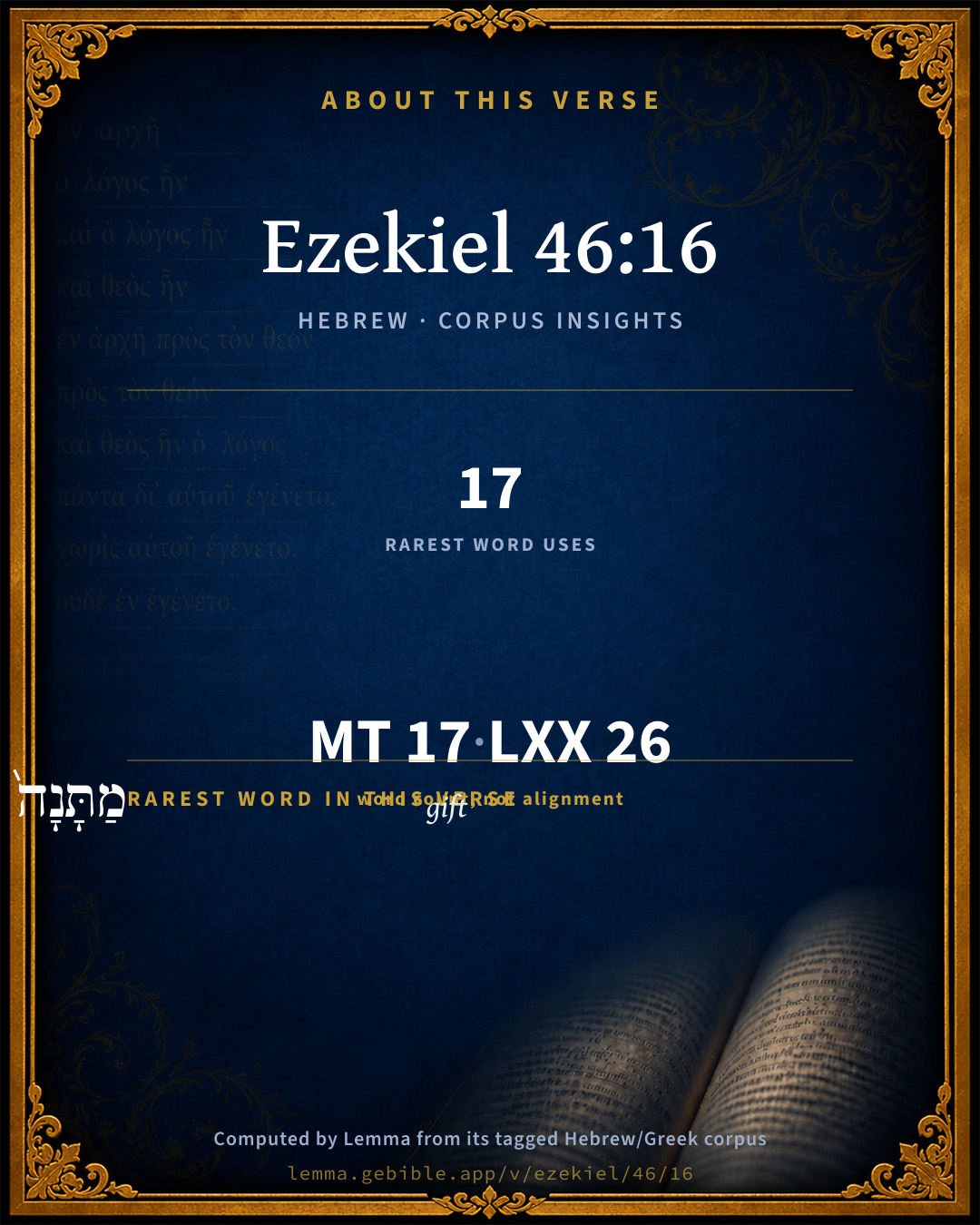
These counts appear in no published source. They are computed here, from the morphology-tagged text and Lemma’s own curated glosses. What Lemma adds →

17
words
14
distinct lemmas
Prophets
section

Notable vocabulary

The rarest word here is מַתָּנָה֙ gift H4979 — appearing just 17 times in the whole Hebrew Bible.

Shared distinctive vocabulary

מַתָּנָה֙ gift H4979 occurs in 17 verses of the Hebrew Bible. Also found in:

Grammatical profile

  • 3 verbs
  • 10 nouns
  • 2 pronouns
  • 1 conjunction
  • 1 adverb

Verb forms

  • אָמַ֞ר Qal · Perfect
  • יִתֵּ֨ן Qal · Imperfect
  • תִּֽהְיֶ֑ה Qal · Imperfect

Repetition

Words recur within this verse — often emphatic in Hebrew:

  • מִבָּנָ֔יו son H1121 ×2
  • נַחֲלָת֥וֹ inheritance H5159 ×2
  • הִ֖יא he H1931 ×2

Hebrew & Septuagint length

In English translation the verse runs 32 words from the Hebrew and 32 from the Septuagint (LXX English) — the same length.

A rough comparison of the two English renderings, which tokenize alike — not a word-level alignment.

Word counts can differ between the Hebrew and the Greek without any difference in meaning — e.g. the Hebrew direct-object marker אֵת has no separate Greek word, and Greek often adds the article ὁ.

In the original languages it is 17 Hebrew tokens and 26 Greek tokens — but the two are counted differently (Hebrew bundles its prefixes and suffixes into one token; the Greek is in lemma form), so that isn’t a like-for-like length.

Cross-references

9

Topical passages linked to Ezekiel 46:16 in the Treasury of Scripture Knowledge — connected by theme and wording, ordered by reader-vote popularity; previews shown in the World English Bible.

  • 2 Chronicles 21:3 Their father gave them great gifts, of silver, and of gold, and of precious things, with fortified cities in Judah: but the kingdom gave he to Jehoram, because he was the firstborn.
  • Galatians 4:7 So you are no longer a bondservant, but a son; and if a son, then an heir of God through Christ.
  • Genesis 25:5–6 Abraham gave all that he had to Isaac,
  • Psalms 37:18 Yahweh knows the days of the perfect. Their inheritance shall be forever.
  • Matthew 25:34 Then the King will tell those on his right hand, 'Come, blessed of my Father, inherit the Kingdom prepared for you from the foundation of the world;
  • Luke 10:42 but one thing is needed. Mary has chosen the good part, which will not be taken away from her."
  • John 8:35–36 A bondservant doesn't live in the house forever. A son remains forever.
  • Romans 8:15–17 For you didn't receive the spirit of bondage again to fear, but you received the Spirit of adoption, by whom we cry, "Abba! Father!"
  • Romans 8:29–32 For whom he foreknew, he also predestined to be conformed to the image of his Son, that he might be the firstborn among many brothers.

Cross-references courtesy of OpenBible.info (CC BY 4.0).

Hebrew and Greek witnesses Masoretic Hebrew ↔ Greek Septuagint

The same verse in the two great witnesses to the Old Testament, shown verse-for-verse.

These are two independent witnesses, not word-aligned to each other, and the Septuagint is shown in lemma (dictionary) form.

Hebrew Ezekiel 46:16 Masoretic · Westminster Leningrad Codex

כֹּה אָמַ֞ר אֲדֹנָ֣י יְהֹוִ֗ה כִּֽי יִתֵּ֨ן הַנָּשִׂ֤יא מַתָּנָה֙ לְאִ֣ישׁ מִבָּנָ֔יו נַחֲלָת֥וֹ הִ֖יא לְבָנָ֣יו תִּֽהְיֶ֑ה אֲחֻזָּתָ֥ם הִ֖יא בְּנַחֲלָֽה

Thus says the Lord Yahweh: If the prince give a gift to any of his sons, it is his inheritance, it shall belong to his sons; it is their possession by inheritance.

World English Bible · Public Domain

Greek LXX Ezekiel 46:16 Septuagint · lemma form

ὅδε λέγω κύριος θεός ἐάν δίδωμι ὁ ἀποἡγέομαι δόμα εἷς ἐκ ὁ υἱός αὐτός ἐκ ὁ κληρονομία αὐτός οὗτος ὁ υἱός αὐτός εἰμί κατάσχεσις ἐν κληρονομία

Thus says the Lord God; If the prince shall give a gift to one of his sons out of his inheritance, this shall be to his sons a possession as an inheritance.

LXX2012 (modern English Septuagint) · Public Domain

Hebrew: Westminster Leningrad Codex (CC BY 4.0). Greek: Septuagint (public domain); English from LXX2012 (modern English Septuagint) (Public Domain). How the Septuagint differs from the Hebrew →

Targum (Aramaic paraphrase)

1

The Targum is the ancient Jewish Aramaic paraphrase of the Hebrew Scriptures — an interpretive translation, not the Hebrew text itself. Onkelos (literal) and Pseudo-Jonathan (expansive) render the Torah, and Jonathan the Prophets. Coverage is partial: where no permissively-licensed English translation exists for a verse, only the Aramaic is shown. This is verse-level text, not a word-by-word alignment to the Hebrew.

  1. Targum Jonathan Prophets (Joshua–Malachi)
    כִּדְנַן אֲמַר יְיָ אֱלֹהִים אֲרֵי יִתֵּן רַבָּא מַתְּנָא לְחַד מִבְּנוֹהִי אַחֲסַנְתֵּיהּ הִיא לִבְנוֹהִי תְהֵי אֲחִידַתְהוֹן הִיא בְּאַחֲסָנָא:

    (no public-domain English translation for this verse)

    Targum Jonathan — Aramaic: “Mikraot Gedolot” (public domain). English: “Sefaria Community Translation” (CC0 1.0 (public-domain dedication)); “London "Chaldee Paraphrase," 1871” (public domain). Text via Sefaria.

Commentary

Notes on Ezekiel 46:16 from classic Christian and Jewish commentators (each source and its license shown beneath its notes). The classic Christian expositions comment on the surrounding passage and are grouped to its opening verse, so a note may address several verses; the Jewish commentaries on the Tanakh (Rashi and others) are per-verse, so they appear only where the commentator wrote on this verse.

Lemma curates 59 commentaries, every one of them public domain or Creative Commons licensed, each selected and text-cleaned for this edition rather than reprinted as found. About our sources →

Matthew Henry's Commentary

We have here a law for the limiting of the power of the prince in the disposing of the crown-lands. 1. If he have a son that is a favourite, or has merited well, he may, if he please, as a token of his favour and in recompence for his services, settle some parts of his lands upon him and his heirs for ever (Eze 46:16), provided it do not go out of the family. There may be a cause for parents, when their children have grown up, to be more kind to one than to another, as Jacob gave to Joseph one portion above his brethren, Gen 48:22. 2. Yet, if he have a servant that is a favourite, he may not in like manner settle lands upon him, Eze 46:17. The servant might have the rents, issues, and profits, for such a term, but the inheritance, the jus proprietarium - the right of proprietorship, shall remain in the prince and his heirs. It was fit that a difference should be put between a child and a servant, like that Joh 8:35. The servant abides not in the house for ever, as the son does. 3. What estates he gives his children must be of his own (Eze 46:18): He shall not take of the people's inheritance, under pretence of having many children to provide for; he shall not find ways to make them forfeit their estates, or to force them to sell them and so thrust his subjects out of their possession; but let him and his sons be content with their own. It is far from being a prince's honour to increase the wealth of his family and crown by encroaching upon the rights and properties of his subjects; nor will he himself be a gainer by it at last, for he will be but a poor prince when the people are scattered every man from his possession, when they quit their native country, being forced out of it by oppression, choosing rather to live among strangers that are free people, and where what they have they can call their own, be it ever so little. It is the interest of princes to rule in the hearts of their subjects, and then all they have is, in the best manner, at their service. It is better for themselves to gain their affections by protecting their rights than to gain their estates by invading them.

Matthew Henry's Commentary on the Whole Bible (1708–1710) — public domain (CC PDM 1.0). Text via the HelloAO Bible API.

The Cambridge Bible for Schools and Colleges

gen. ed. J. J. S. Perowne

16–18. Case of the prince alienating any part of his landed property to his sons or servants

If given to his sons the gift shall remain with them as their inheritance (Eze_46:16); if given to any of his servants it shall revert to the prince at the year of liberty (Eze_46:17).

The Cambridge Bible for Schools and Colleges (gen. ed. J. J. S. Perowne; Cambridge University Press, 1878–1918) — public domain. Text from a community e-Sword module.

Trapp's Complete Commentary

John Trapp

Eze 46:16 Thus saith the Lord GOD; If the prince give a gift unto any of his sons, the inheritance thereof shall be his sons’; it [shall be] their possession by inheritance.

Ver. 16. If the prince give a gift unto any of his sons.] As Jehoshaphat did cities to every one of his sons; though they long enjoyed them not, through the barbarous cruelty of their elder brother Jehoram. Christ, the Church’s king, giveth all his children gifts of great price; such as the world can neither give nor take from them, "spiritual blessings in heavenly" things and "places"; {Eph 1:3} yea, he bestoweth himself upon them, and is therefore called "The gift," {Joh 4:10} and "The benefit." {1Ti 6:2}

John Trapp, A Commentary or Exposition upon All the Books of the Old and New Testament (1647–1656) — public domain. Text from a community e-Sword module.

Joseph Benson's Commentary

Eze 46:16-18. If the prince give a gift, &c. — By these verses we learn, that even gifts, or legacies of lands, could only be granted till the year of jubilee, except to a person’s own heirs; for at that period all such gifts or grants devolved again to the original possessors, or their heirs. It shall be his to the year of liberty — That is, of jubilee, called the year of liberty, because it freed men’s persons from the service of their masters, and their estates from any engagements by which the right of them was transferred from their proper owners. After it shall return to the prince — Or to his heirs, if he be dead. But his inheritance shall be his sons’ for them — Or, his inheritance shall belong to his sons; it shall be theirs so as not to be alienated. The prince shall not take of the people’s inheritance — As Ahab did, 1Ki 21:16. That my people be not scattered — Lest, being turned out of their own, they be forced to wander up and down the country for a livelihood.

Joseph Benson's Commentary on the Old and New Testaments (1811–1818) — public domain. Text from a community e-Sword module.

Tyndale Open Study Notes

Tyndale Open Resources

46:16-18 Because the land assigned to the prince was the Lord’s gift to him and to his family, he could not give it permanently to one of his servants. Each Year of Jubilee, the fiftieth year when all land in Israel reverted to its original family owners, this land would revert to the crown. This provision was intended to remove the temptation for the king to acquire more and more land with which to reward his faithful servants, resulting in less land for the ordinary people. The land belonged to the Lord, and he divided it among his people. No one, not even the king, was permitted to tamper with the people’s inheritance.

Tyndale Open Study Notes — © Tyndale Open Resources, licensed CC BY-SA 4.0. Text via the HelloAO Bible API.

Jamieson, Fausset & Brown

Robert Jamieson, A. R. Fausset & David Brown

The prince's possession is to be inalienable, and any portion given to a servant is to revert to his sons at the year of jubilee, that he may have no temptation to spoil his people of their inheritance, as formerly (compare Ahab and Naboth, 1Ki. 21:1-29). The mention of the year of jubilee implies that there is something literal meant, besides the spiritual sense. The jubilee year was restored after the captivity [JOSEPHUS, Antiquities, 14.10,6; 1 Maccabees 6:49]. Perhaps it will be restored under Messiah's coming reign. Compare Isa 61:2-3, where "the acceptable year of the Lord" is closely connected with the comforting of the mourners in Zion, and "the day of vengeance" on Zion's foes. The mention of the prince's sons is another argument against Messiah being meant by "the prince."

Jamieson, Fausset & Brown — Commentary Critical and Explanatory on the Whole Bible (1871) — public domain (CC PDM 1.0). Text via the HelloAO Bible API.

Ellicott's Commentary for English Readers

(16) If the prince give a gift.—Eze_46:15-18 contain provisions in regard to the prince’s alienation of his domain. According to Eze_45:7-8, he was to have a portion of land on each side of the “oblation,” which should be sufficiently ample to prevent any attempts on his part at violence and exaction. For the same purpose, it was necessary that this territory should remain inalienably in his family. He might therefore convey any portion of it to his sons in fee simple, for they would naturally inherit it; but a conveyance to any one else came under the Mosaic law (Leviticus 25), and reverted to him or his heirs in the year of Jubile, here called “the year of liberty.”

A Bible Commentary for English Readers, edited by Charles John Ellicott (1878–1897) — public domain. Text from a community e-Sword module.

John Gill's Exposition

But if he give a gift of his inheritance to one of his servants,.... Who are not his sons, but his hired servants, and who serve him in a mercenary way; such are unregenerate ministers of the word, who preach Christ in pretence, and not in reality, for by ends, to serve themselves, and not him, or to advance his glory; and all carnal professors, who have only an outside of religion, a form of godliness without the power of it: to these Christ gives gifts, the gifts of nature, wealth, and riches, to some, to whom he gives not grace; these are his left hand blessings, which are given to the men of the world, who have their portion in this life: to others external means, the word and ordinances, but not internal special grace; yea, to some, gifts for the ministry, so as to be able to prophesy or preach in his name, which are meant by the talents, and pounds in the parable; some of which were given to slothful and unprofitable servants; see Mat 7:20.

Then it shall be his to the year of liberty; the servant's to whom it is given, as long as the prince pleases; who when they make no use, or an ill use of them, takes them away in lifetime, and gives them to those that have more, and employ them to better purpose, Zac 11:17, or however at death, which is a time of liberty from civil bondage, the servant is free from his master; and when good men are freed from the oppression of others, and from sin, Satan, and the world, and are delivered into the glorious liberty of the children of God; this is a year of liberty indeed to them; and then all external gifts to others, as riches, are held no longer; the word and ordinances no more enjoyed; prophesying, speaking with tongues, and all mere natural knowledge, cease, and vanish away, Co1 13:8, the allusion is to the year of jubilee, when liberty was proclaimed throughout the land, and every man returned to his possession, and to his family, Lev 25:10, and so the Targum, Jarchi, and Kimchi, interpret it of the year of jubilee; a type of the heavenly glory, and of the joy of the Lord, which Christ's faithful servants enter into; and when there will be a manifest difference between them and slothful servants, and the gifts of the one and of the other, and of their use of them, as well as between sons and servants:

after it shall return to the prince; signifying that such gifts are not durable; they are revertible to the donor of them; who will call these servants to an account for them at death or judgment, if not in time of life:

but his inheritance shall be his sons' for them; the prince's inheritance shall be theirs; for being sons they are heirs, heirs of God, and joint heirs with Christ: or that which is given them for an inheritance shall always continue; it shall never be taken from them or returned; but it shall be their own, for themselves, and enjoy it for ever; which is a confirmation of what is said in the preceding verse.

John Gill's Exposition of the Whole Bible (1746–1763) — public domain (CC PDM 1.0). Text via the HelloAO Bible API.

Albert Barnes' Notes on the Bible

The prince was robe provided with possessions of his own, in order to prevent exactions from his subjects; further enactments are added to prevent the alienation of the prince’s land. Any gifts made to his servants must revert to the prince in the “year of liberty,” or jubilee (see the marginal reference note).

Albert Barnes' Notes on the Bible (1834–1885) — public domain. Text from a community e-Sword/MySword module.

Matthew Poole's English Annotations

A gift, of houses or lands.

The inheritance thereof, the right to those houses or lands, shall descend to children’s children; the fee simple shall be to the posterity of that son to whom it was first given. They shall enjoy it, possess it, as heirs possess an inheritance.

Matthew Poole's English Annotations on the Holy Bible (1683–1685) — public domain. Text from a community e-Sword/MySword module.

Whedon's Commentary on the Bible

Daniel D. Whedon

16-18. These regulations protecting the sons of the prince prove that Ezekiel thought of him as a civil officer. The old interpreters who tried to make every phrase concerning the prince point to a coming heavenly Messiah were wrong. That every ceremonial act of the prince, king, and priests, in the Hebrew, as in every other ancient ritual, was intended to teach some religious lesson cannot be doubted; but what these lessons were must be determined by the symbolic language of the age and not by pressing our Christian conceptions into the Old Testament law (note Eze_43:10-11). The property of the prince (Eze_45:7-8) if given to a servant must revert back to the prince at the “year of release” (probably the fiftieth, the year of jubilee, Lev_25:10; Lev_27:24; though it is possibly the seventh, the year of release from debts, Jer_34:14; Deu_15:12). But the gifts of the prince to his sons should be theirs forever: “as for his inheritance, it shall be for his sons” (R.V., Eze_46:17). The prince must not, however, take any of the people’s lands in order to increase the inheritance of the royal princes (Eze_46:18; compare 1 Kings 21). The rights of each Hebrew citizen to a portion of the land were sacredly guarded by the old law (Lev_25:23; Numbers 26, 27).

Daniel D. Whedon (gen. ed.), Commentary on the Old and New Testaments (1874–1909) — public domain. Text from a community e-Sword module.

The Pulpit Commentary

Instructions for the prince as to how he should deal with his property are summarized in three regulations, introduced by the solemn formula of "Thus saith the Lord". (comp. ver. 1; Eze_45:9)

The first regulation. The prince might dispose of a portion of his royal property. (see Eze_45:7, Eze_45:8) by presenting part of it as a gift to any of his sons. In this case what was gifted should belong to his son or sons in perpetuity, should be his or theirs as his or their possession by inheritance; it should never again revert to the prince.

Vers. 16, 17The son and the servant.

The Jewish Law made careful provision to prevent the alienation of land from the families to which it originally belonged. The son might inherit permanently; but the servant could only receive a gift of land for a time, which would cease at the year of jubilee. Here was a marked distinction between the privileges of sonship and those of service. Now St. Paul draws attention to this distinction from another point of view, when contrasting, the gospel with the Law. There is a religion of worship, and one of service.

I THE LIFE OF WORSHIP HAS A PERMANENT INHERITANCE. This is the case with the spiritual experience of Christianity.

1. The Christian is a son.

(1) He is begotten by God.

(2) He is adopted by God.

(3) He owns Christ for his Brother.

(4) He is admitted into God"s presence as a child at home.

(5) He has the liberty of a son and his privileges.

secret of the Lord is with them that fear him." God makes his counsels known to true Christians.

2. The sons inheritance is permanent.

(1) For life, the grace of God given to the true Christian child will not desert him in after-years if he still looks for it and follows its guidance. God does not treat his people as the favorites of a day, whom a prince pampers while the whim is on him, and then capriciously flings aside; his favor is enduring like his eternal love.

(2) After death. The Christian inheritance is but tasted on earth; the better part of it awaits us beyond the grave. It is like the inheritance of Israel, a small part of which was on the coast of the Jordan, while that river had to be crossed before the main portion could be reached. "Godliness is profitable unto all things, having promise of the life that now is, and of that which is to come". (1Ti_4:8) We do not resign our Christian inheritance when we lie down to die; on the contrary, then we prepare to enter into the Promised Land in all its length and breadth.

II THE LIFE OF SERVITUDE HAS BUT TEMPORARY PRIVILEGES.

1. The promises of the Mosaic religion were for this world, as Bishop Warburton proved with redundancy of argument, in his famous book on the " Divine Legation of Moses" Therefore the Jew stood below the Christian in regard to his prospects of future good. But there are far lower lives of servitude than that of the pious Jew.

2. Christ spoke of the slavery of sin. (Joh_8:34) Now, this degraded servitude has its rewards. Sin gives gifts to its slaves. But they are not enduring possessions.

3. The bondage of worldliness holds many men. This thraldom promises great rewards. Riches and pleasures come in its train. The chains are forged of gold, and at first the weight of them is not felt. But the rewards of sin and worldliness are of brief duration. Their fruits may be sweet at first, but the after-taste of them is unendurably bitter. Even if no disappointment is met on earth, the worldly inheritance must be resigned at death. The slave of sin and the world can carry none of his treasures with him to the unseen future.

Vers. 16-18Earthly sovereignty not absolute.

Great temptations surround kings, inducing them to tyranny. Their own will is enveloped within military force. Obsequious flatterers pander to royal power. For self-interest, soldiers usually take sides with the prince. Hence a first lesson for princes to learn is that right is superior to might. The voice of justice is the voice of God.

I THE PRINCE IS A SUBJECT OF A HIGHER MONARCH. No earthly king holds absolute sway over his subjects. In truth, the mightiest monarch is only a vassal-king. He rules in the place of God. He has to listen to the summons, "Thus saith the Lord." He is appointed to administer the laws of God. He is amenable to a superior authority, and must render an account of his rule at the judgment-bar of heaven. To no king has God transferred the right of absolute rule. The term of a tyrant"s rule is entirely at the disposal of God. At any moment the King of kings can terminate a prince"s rule, and require a report of his doings. At the very height of a boastful tyranny he has often suffered a humiliating fall. A prince is simply a superior servant.

II THE PRINCE IS UNDER OBLIGATION TO HIS SONS. As he is not absolute master of his subjects, neither is he absolute master of his possessions. Even a king has no freehold in his property. It is held under lease. He has only a life-enjoyment in it. Death dissolves all earthly covenants. If he has sons, they are his heirs. By the indisputable law of God they have a right in reversion. As the prince had full enjoyment of his estates during his mortal life, so his sons shall have undiminished enjoyment of the estates during their life. By no principle of law or justice can a prince claim to extract from the ancestral estates more than a life-enjoyment, nor encumber his estates for successors. He must learn to identify himself with his children, to treat them as part and parcel of himself. Checks on selfishness God everywhere imposes. In the household of God sonship carries with it complete heirship.

III THE PRINCE IS UNDER OBLIGATION TO HIS SUBJECTS. Obligations among men are mutual. Kingship has duties as well as rights. If subjects are under obligation to serve and support their "prince, so too princes are under obligation to protect the lives and property of their subjects. Rightly understood, the prosperity of the people is identical with the prosperity of the king. The throne cannot be strong if the people are impoverished. The king and his people are united by a common bond of interest. The invasion of his subjects" rights is suicide to his authority suicide to kingship. "No man liveth unto himself." A selfish and avaricious policy is moral madness. No other principle is so favorable to prosperity and joy as wise benevolence.

IV THE PRINCE IS UNDER OBLIGATION TO HIS SERVANTS. No man is more dependent upon the service of others, no man so dependent, as a prince. His time and strength are as limited as any other man"s, yet the demands of duty are enormous. For his personal needs he requires servants; for his family wants he requires servants; and for every department of public government he requires servants. In proportion to the value of the services, remuneration must be made. If the prince be accounted mean or parsimonious, he will lose dignity, reputation, and influence. Yet his generous impulses must never be allowed to violate principles of justice. He must never trench on others" possessions to discharge a personal debt. Yet, alas! this has often beer, done! Kings stand among the greatest criminals. Secret service to the king has been paid in stolen coin. Yet restitution must some day be made, for God is always on the side of righteousness. And to every prince he says, "Be just before you are generous. D.

The Pulpit Commentary (1880–1919), ed. H.D.M. Spence-Jones & Joseph S. Exell — public domain. Text from a community e-Sword module.

Kretzmann's Popular Commentary

Paul E. Kretzmann

The Sacrificial Kitchens

v. 16. Thus saith the Lord God, in making provisions for the future, lest conditions arise which would result in acts of violence on the part of the ruler, If the prince give a gift unto any of his sons, the inheritance thereof shall be his sons’; it shall be their possession by inheritance, to remain permanently under their dominion.

v. 17. But if he give a gift of his inheritance, of the special land set aside for his use and enjoyment, to one of his servants, as a reward of service or loyalty, then it shall be his to the year of liberty, the so-called year of the jubilee, Lev 25:10; after, it shall return to the prince, revert to him as his property; but his inheritance shall be his sons’ for them, that is, only what the prince has presented to his Sons shall remain in their property at that time.

v. 18. Moreover, the prince shall not take of the people’s inheritance by oppression, a feature against which these ordinances guarded, to thrust them out of their possession, as when Ahab took Naboth’s vineyard; but he shall give his sons inheritance out of his own possession, Cf 1Sa 8:14; 1Sa 22:7, that My people be not scattered every man from his possession.

v. 19. After, that is, afterward, He brought me through the entry which was at the side of the gate, the entry mentioned Eze 42:9, into the holy chambers of the priests, those nearest to the inner north gate, which looked toward the north; and, behold, there was a place on the two sides westward, a section of the Temple area which had not yet been described.

v. 20. Then said He unto me, This is the place where the priests shall boil the trespass-offering and the sin-offering, where they shall bake the meat-offering, the food of the priests thus being prepared in immediate proximity to their chambers lest its sanctity be in any way polluted, that they bear them not out into the utter court to sanctify the people, to bring them into contact with this consecrated food and thus to defeat the object of the ordinance.

v. 21. Then He brought me forth into the utter court and caused me to pass by the four corners of the court; and, behold, in every corner of the court there was a court, a smaller tributary of the larger court.

v. 22. In the four corners of the court there were courts joined, closed, shut off from the rest of the court, of forty cubits long and thirty broad; these four corners were of one measure, of the same size.

v. 23. And there was a row of building round about in them, along their walls, round about them four, and it was made with boiling-places under the rows round about, roofed cooking apartments or kitchenettes, with a fireplace in each, next to the walls.

v. 24. Then said He unto me, These are the places of them that boil, where the ministers of the house, the ordinary Levites as servants of the Sanctuary, shall boil the sacrifice of the people, that part which belonged to the priests. By the sacrificial meals eaten by the people, then, was the communion and fellowship of all believers brought out symbolically.

Paul E. Kretzmann, Popular Commentary of the Bible (1921–1924) — public domain. Text from a community e-Sword module.

unfoldingWord translationNotes

Door43 World Missions Community

The Lord Yahweh says this

Yahweh speaks of himself by name to remind Ezekiel and the people that what he is saying is important. See how you translated this in Ezekiel 6:11. AT: "I, the Lord Yahweh, say this" (See: First, Second, or Third Person)

year of liberty

This is the year that a servant gains freedom. This is also called the "Year of Jubilee."

translationWords

Lord Yahweh

son

inherit

servant

free

unfoldingWord translationNotes — © Distant Shores Media and the Door43 World Missions Community, licensed CC BY-SA 4.0. Source: git.door43.org/Door43/en_tn.

Lesson kit

Teaching starters — assembled from the data on this page, not authored interpretation. Every prompt links to the verse data it draws on. Edit before teaching.

Ezekiel, in the Prophets, opens this verse with 17 words (14 distinct Hebrew lemmas). Its most distinctive word is mattânâh (“gift”). A historical commentator’s framing appears above. Read the whole chapter for the surrounding context.

Discussion questions

  1. How does “gift” (mattânâh) shape what this verse is saying?
  2. Genesis 25:6 shares the word «gift» with this verse. How do the two illuminate each other?
  3. “son” occurs 2× in this one verse. What is the effect of the repetition?
  4. The translations on this page render this verse differently — a whole-verse word diff, not a word-by-word alignment. What might account for the different wordings?
  5. The verb «אָמַ֞ר» is Qal Perfect. How does its form color the action?
  6. Reading how Matthew Henry's Commentary and The Cambridge Bible for Schools and Colleges read this verse, where do the two commentators agree and where do they part?

Things to notice

Reading settings

Reading text

Shown beneath each verse's original-language words.

Old Testament
Old Testament edition

Read the OT as the Masoretic Hebrew (MT) or the Greek Septuagint (LXX).

English shown for the Greek Septuagint (in the Hebrew ↔ Greek comparison).

Comparing translations? Open the Compare panel on any verse page to stack up to four side by side.