
Lamentations 5:2

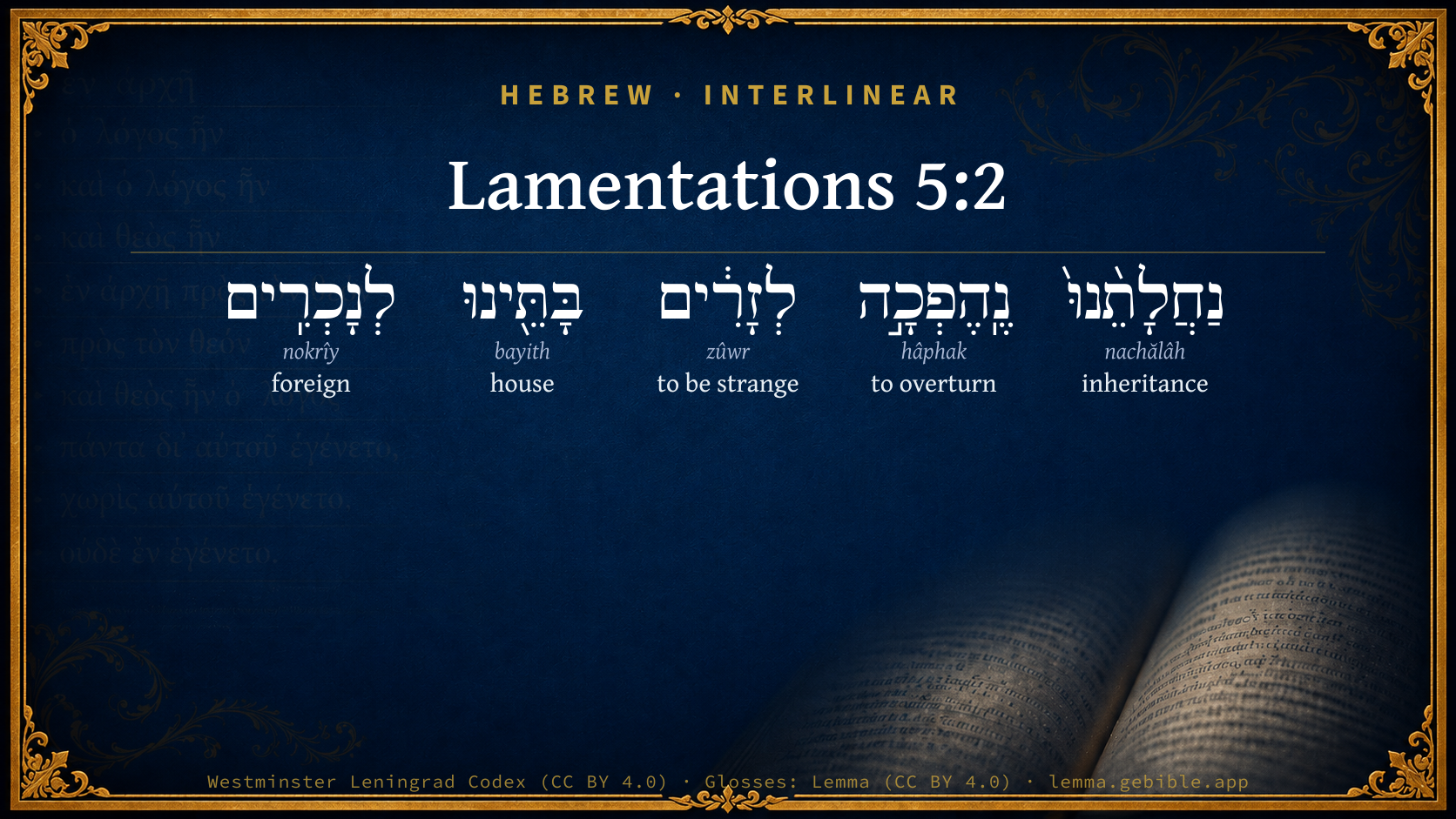
Hebrew (Westminster Leningrad Codex) Lamentations 5:2 appears in the Hebrew Old Testament. The text above is from the Westminster Leningrad Codex. Each word links to its Strong’s number, a concise gloss, and parsing drawn from the Open Scriptures Hebrew Bible morphology. Click any word for its full Brown-Driver-Briggs (BDB) entry.
Download image
Cite this verse

Lamentations 5:2 (World English Bible). Public Domain. Lemma interlinear Bible study tool, https://lemma.gebible.app/v/lamentations/5/2.

Show BibTeX & RIS
BibTeX
RIS
English Translation
Our inheritance is turned to strangers, Our houses to aliens.
World English Bible · Public Domain
Download a study sheet

One document with this verse’s original text, its word-by-word gloss line, the meaning frame, cross-references with their text, attributed commentary, and full source and license credits — printable, and it pastes into notes with its structure intact.

This verse Autodidact and up

Study sheet (.html) Plain text (.txt)

A passage Seminary Student

Up to 50 verses in one chapter. A passage sheet keeps up to 6 commentary sources and 12 cross-references per verse, in the order this page ranks them, and says so on the sheet whenever that leaves anything out. Ask for a single verse and you get the Autodidact verse sheet above.

Everything on this page stays free to read, with no account — the sheet is a download of what is already on screen, not access to it.

Want to remove ads? Support Godless Engineer
Compare translations 3

The same verse in 3 English versions, stacked beneath the original-language interlinear above. Click any original word for its lexicon entry.

Each is an independent rendering of the whole verse — the interlinear is not word-aligned to these translations.

Highlighted words mark where these versions differ — a whole-verse word diff, not a word-by-word alignment.

  • World English Bible Public Domain
    Our inheritance is turned to strangers, Our houses to aliens.
  • King James Version Public Domain
    Our inheritance is turned to strangers, our houses to aliens.
  • unfoldingWord Literal Text CC BY-SA 4.0
    Our inheritance has been turned over to strangers, our houses to foreigners.

unfoldingWord Literal Text — © unfoldingWord, licensed CC BY-SA 4.0. Word-aligned USFM3 via Door43 (git.door43.org/unfoldingWord/en_ult).

Versions to compare (up to 4)

3 of 4 selected

Show all 18 translations

Every available English version of this verse, each an independent rendering of the whole verse.

  • World English Bible Public Domain
    Our inheritance is turned to strangers, Our houses to aliens.
  • Berean Standard Bible Public Domain
    Our inheritance has been turned over to strangers, our houses to foreigners.
  • Majority Standard Bible Public Domain
    Our inheritance has been turned over to strangers, our houses to foreigners.
  • King James Version Public Domain
    Our inheritance is turned to strangers, our houses to aliens.
  • American Standard Version (1901) Public Domain
    Our inheritance is turned unto strangers, Our houses unto aliens.
  • Revised Version (1885) Public Domain
    Our inheritance is turned unto strangers, our houses unto aliens.
  • Geneva Bible (1599) Public Domain
    Our inheritance is turned to the strangers, our houses to the aliants.
  • Douay-Rheims (1899) Public Domain
    Our inheritance is turned to aliens: our houses to strangers.
  • Young's Literal Translation Public Domain
    Our inheritance hath been turned to strangers, Our houses to foreigners.
  • Literal Standard Version CC BY-SA 4.0
    Our inheritance has been turned to strangers, || Our houses to foreigners.
  • Unlocked Literal Bible CC BY-SA 4.0
    Our inheritance has been turned over to strangers; our houses to foreigners.
  • unfoldingWord Literal Text CC BY-SA 4.0
    Our inheritance has been turned over to strangers, our houses to foreigners.
  • Darby Bible Public Domain
    Our inheritance is turned to strangers, our houses to aliens.
  • World Messianic Bible Public Domain
    Our inheritance has been turned over to strangers, our houses to aliens.
  • Webster's Bible Public Domain
    Our inheritance is turned to strangers, our houses to aliens.
  • Free Bible Version CC BY-SA 4.0
    The land we used to own has been handed over to strangers, our houses have been given to foreigners.
  • Bible in Basic English Public Domain
    Our heritage is given up to men of strange lands, our houses to those who are not our countrymen.
  • JPS Tanakh (1917) Public Domain
    Our inheritance is turned unto strangers, our houses unto aliens.

Literal Standard Version (2020), Covenant Press — licensed CC BY-SA 4.0. Text via the HelloAO Bible API (eBible.org). Unlocked Literal Bible (unfoldingWord) — licensed CC BY-SA 4.0. Text via the HelloAO Bible API (eBible.org). unfoldingWord Literal Text — © unfoldingWord, licensed CC BY-SA 4.0. Word-aligned USFM3 via Door43 (git.door43.org/unfoldingWord/en_ult). Free Bible Version, Dr. Jonathan Gallagher — licensed CC BY-SA 4.0. Text via the HelloAO Bible API (eBible.org).

Word by word

More ways to search: Search by grammar → Find every occurrence → Compare this word →

Practice this passage: Drill this verse → Learn its vocabulary →

About this verse

These counts appear in no published source. They are computed here, from the morphology-tagged text and Lemma’s own curated glosses. What Lemma adds →

5
words
5
distinct lemmas
Prophets
section

Shared distinctive vocabulary

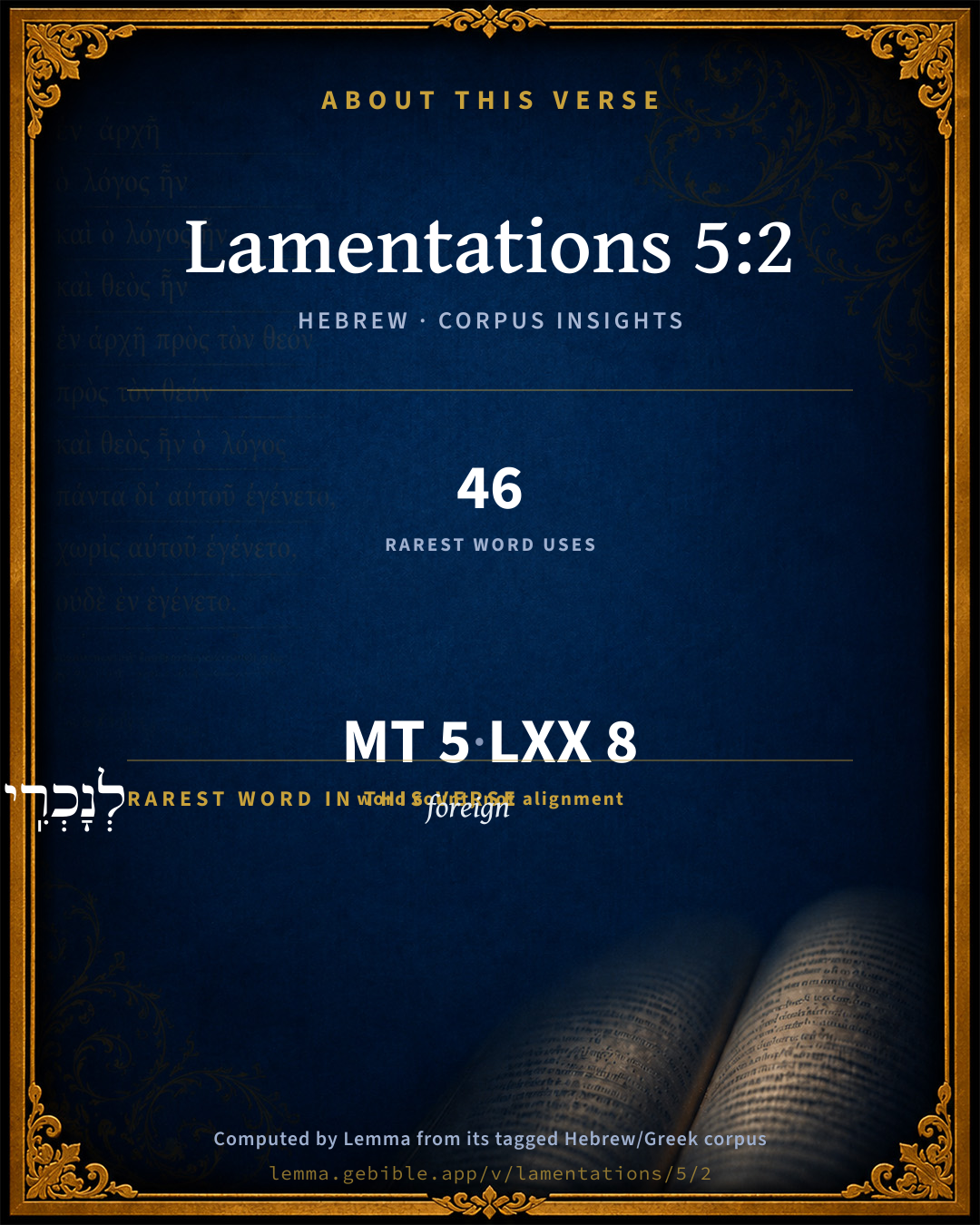
לְנָכְרִֽים foreign H5237 occurs in 45 verses of the Hebrew Bible. Also found in:

Grammatical profile

  • 1 verb
  • 2 nouns
  • 2 adjectives

Verb forms

  • נֶֽהֶפְכָ֣ה Niphal · Perfect

Hebrew & Septuagint length

In English translation the verse runs 10 words from the Hebrew and 12 from the Septuagint (LXX English) — closely comparable.

A rough comparison of the two English renderings, which tokenize alike — not a word-level alignment.

Word counts can differ between the Hebrew and the Greek without any difference in meaning — e.g. the Hebrew direct-object marker אֵת has no separate Greek word, and Greek often adds the article ὁ.

In the original languages it is 5 Hebrew tokens and 8 Greek tokens — but the two are counted differently (Hebrew bundles its prefixes and suffixes into one token; the Greek is in lemma form), so that isn’t a like-for-like length.

Cross-references

9

Topical passages linked to Lamentations 5:2 in the Treasury of Scripture Knowledge — connected by theme and wording, ordered by reader-vote popularity; previews shown in the World English Bible.

  • Isaiah 1:7 Your country is desolate. Your cities are burned with fire. Strangers devour your land in your presence, And it is desolate, As overthrown by strangers.
  • Zephaniah 1:13 Their wealth will become a spoil, and their houses a desolation. Yes, they will build houses, but won't inhabit them. They will plant vineyards, but won't drink their wine.
  • Deuteronomy 28:30–68 You shall betroth a wife, and another man shall lie with her: you shall build a house, and you shall not dwell therein: you shall plant a vineyard, and shall not use the fruit of it.
  • Psalms 79:1–2 God, the nations have come into your inheritance. They have defiled your holy temple. They have laid Jerusalem in heaps.
  • Isaiah 5:17 Then the lambs will graze as in their pasture, And strangers will eat the ruins of the rich.
  • Isaiah 63:18 Your holy people possessed [it] but a little while: our adversaries have trodden down your sanctuary.
  • Jeremiah 6:12 Their houses shall be turned to others, their fields and their wives together; for I will stretch out my hand on the inhabitants of the land, says Yahweh.
  • Ezekiel 7:21 I will give it into the hands of the strangers for a prey, and to the wicked of the earth for a spoil; and they shall profane it.
  • Ezekiel 7:24 Therefore I will bring the worst of the nations, and they shall possess their houses: I will also make the pride of the strong to cease; and their holy places shall be profaned.

Cross-references courtesy of OpenBible.info (CC BY 4.0).

Hebrew and Greek witnesses Masoretic Hebrew ↔ Greek Septuagint

The same verse in the two great witnesses to the Old Testament, shown verse-for-verse.

These are two independent witnesses, not word-aligned to each other, and the Septuagint is shown in lemma (dictionary) form.

Hebrew Lamentations 5:2 Masoretic · Westminster Leningrad Codex

נַחֲלָתֵ֨נוּ֙ נֶֽהֶפְכָ֣ה לְזָרִ֔ים בָּתֵּ֖ינוּ לְנָכְרִֽים

Our inheritance is turned to strangers, Our houses to aliens.

World English Bible · Public Domain

Greek LXX Lamentations 5:2 Septuagint · lemma form

κληρονομία ἐγώ μεταστρέφω ἀλλότριος ὁ οἶκος ἐγώ ξένος

Our inheritance has been turned away to aliens, our houses to strangers:

LXX2012 (modern English Septuagint) · Public Domain

Hebrew: Westminster Leningrad Codex (CC BY 4.0). Greek: Septuagint (public domain); English from LXX2012 (modern English Septuagint) (Public Domain). How the Septuagint differs from the Hebrew →

Commentary

Notes on Lamentations 5:2 from classic Christian and Jewish commentators (each source and its license shown beneath its notes). The classic Christian expositions comment on the surrounding passage and are grouped to its opening verse, so a note may address several verses; the Jewish commentaries on the Tanakh (Rashi and others) are per-verse, so they appear only where the commentator wrote on this verse.

Lemma curates 59 commentaries, every one of them public domain or Creative Commons licensed, each selected and text-cleaned for this edition rather than reprinted as found. About our sources →

Trapp's Complete Commentary

John Trapp

Lam 5:2 Our inheritance is turned to strangers, our houses to aliens.

Ver. 2. Our inheritance is turned to strangers.] So the Jews called all other nations, as the Greeks, barbarians. From hence to Lam 5:19 there are so many verses, so many different complaints. While we are in this "vale of misery and valley of tears," we are sure of many ailments, and still to have somewhat to cry for.

John Trapp, A Commentary or Exposition upon All the Books of the Old and New Testament (1647–1656) — public domain. Text from a community e-Sword module.

The Preacher's Complete Homiletical Commentary

Joseph S. Exell (gen. ed.)

EXEGETICAL NOTES.—

Lam_5:2 begins to describe the substance of the reproaches. Our inheritance, the land which was promised to Abraham, and of which his descendants had held possession for generations, is turned over unto strangers. Indeed, all their property had passed into other hands; our houses unto aliens. Even if any small houses were left standing, after the Chaldeans had destroyed every important building in Jerusalem, besides breaking down the city walls, they were at the disposal of those foreigners.

Lam_5:3. No recondite application of the terms of this verse—as that, “We are abandoned by Thee, our Father”—need be considered. The note of a Targum sufficiently defines them, “We are like the most desolate of beings.” We have become orphans, without a father. A devastating war, a merciless capture of Jerusalem, a banishment to a far country of thousands of the population, must have caused reports of many among the “bread-winners” being dead or missing; hence it could be said virtually, if not really, Our mothers [are] like widows, the words being true of other families as well as of those whose head had perished.

Lam_5:4. Not only are they orphaned and desolate, but they are cruelly mulcted. Our water for money we have drunken. The bitterness of the act was that water, perhaps from their own wells and cisterns, had to be paid for, and similarly to that, Our wood has come for a price. Held in such durance that they could not get the requisites for personal and domestic comfort, to which they had free access formerly, unless by bribing their custodians.

Lam_5:5. It is best to suppose that the phrase, On our necks we are pursued, means, our pursuers keep so close as to be, as it were, holding our necks; yet, tired out by such persecution, no rest is for us.

HOMILETICS

THE MISERIES OF THE DISINHERITED

(Lam_5:2-5)

I. To see their possessions enjoyed by foreigners. “Our inheritance is turned to strangers, our houses to aliens” (Lam_5:2). The land of Canaan was God’s gift to the Jews. It was promised to them long before they entered into possession. There was a time when it seemed they would not be permitted even to look upon their Beulah-land. But God kept His word, and, after long wandering and many disappointments, the tribes received their allotted inheritance. In beauty and fruitfulness they found the land all that it had been represented. For many happy years they sat under their own vine and fig-tree, none daring to make them afraid. It was a bitter disappointment to find themselves violently ejected, and their loved inheritance occupied by their enemies. The possessions of earth are liable to strange and sudden changes; but the heavenly inheritance is indefeasible, and can never be wrested from the faithful.

II. To be reduced to the condition of widows and orphans. “We are orphans and fatherless; our mothers are as widows” (Lam_5:3). Their misery was comparable to the sad and lonely desolation of fatherless orphans and wives just bereaved of their husbands. The guardian, guide, and support of family life is taken away, and they are left to battle with the cold, unpitying world, surrounded with heartless and cruel enemies. It is a painful experience for any family to be reduced by a single stroke from affluence to penury and friendlessness. If God did not help the widows and the fatherless, their condition would be unbearable. The competition of life is keen enough to the most favoured; but it is a terrible struggle to the lonely and friendless. The luxury of former years unfits many for the fierceness of life’s conflict, and thousands go down into untimely oblivion.

III. To be compelled to pay for the food and fuel produced on their own property. “We have drunken our water for money; our wood is sold unto us” (Lam_5:4). The bitterness of the complaint is intensified in not merely that they must pay for the necessaries of life, but that it is their own property which they have to purchase. The water in their own house cisterns is taxed; the wood in their own forests must be paid for—and they paid dearly for every fagot. “The captives were doubtless closely watched, and not allowed to stray from the place where they were detained in preparation for their removal to Babylon, and thus could obtain wood and water only by paying for them” (Speaker’s Commentary). How would they long now for the sticks their little children used to gather for the fires in which they idolatrously baked cakes for the queen of heaven! (Jer_7:18). It is in the hardships of life that we lament the wanton waste of more prosperous times.

IV. To be harassed by incessant toil. “Our necks are under persecution: we labour and have no rest” (Lam_5:5). We were pursued so actively that our enemies seemed ever so close upon us as to be leaning over our necks ready at once to seize us. We were tired out with being thus chased incessantly, and no opportunity was allowed us of refreshing our weary frames (Speaker’s Commentary). Labour is necessary for health, for sustenance, for happiness. There is nothing servile in honest and necessary work, whether by hand or brain. Abraham fed his own flocks. Moses kept sheep in the desert. Paul stitched canvas tents while labouring as a pioneer among the Gentiles. The fathers of the Roman Republic ploughed their own fields, sowed the seed, and reaped their harvests with their own hands. But there is neither nobility nor pleasure in forced labour, especially in labour unrelieved by necessary rest. Life becomes one long, weary, monotonous, and depressing grind. And this is often the fate of the disinherited.

LESSONS.—

1. It is a great hardship to see our rightful inheritance violently transferred to strangers.

2. The loss of worldly property is not always the greatest calamity.

3. The truly good have an inheritance that is incorruptible, undefiled, and that fadeth not away.

GERM NOTES ON THE VERSES

Lam_5:2-5. The sudden reverses of fortune.

1. From wealth to poverty (Lam_5:2).

2. From social happiness to loneliness (Lam_5:3).

3. From freedom to galling exactions (Lam_5:4).

4. From ease to excessive toil (Lam_5:5).

Lam_5:2. Property.

1. Knows nothing of absolute ownership.

2. Is constantly changing hands.

3. Its loss by robbery and pillage a great hardship.

4. Its fickle tenure contrasts with the imperishable character of spiritual possessions.

Lam_5:3. Bereavement.

1. One of the great curses of war.

2. The inevitable lot of humanity.

3. Brings pungent sorrow to somebody.

Lam_5:4-5. The loss of liberty. I. Is painfully realised by the imposition of unjust exactions. “We have drunken our water for money; our wood is sold unto us” (Lam_5:4). II. Is followed by oppression. “Our necks are under persecution” (Lam_5:5). III. Subjects to the slavery of incessant labour. “We labour and have no rest” (Lam_5:5).

ILLUSTRATIONS.—The sadness of national decline. “Since first the dominion of men was asserted over the ocean, three thrones, of mark beyond all others, have been set upon its sands—the thrones of Tyre, Venice, and England. Of the first of these great powers only the memory remains; of the second, the ruin; the third, which inherits their greatness, if it forget their example, may be led, through prouder eminence, to less pitied destruction. The exaltation, the sin, and the punishment of Tyre have been recorded for us in perhaps the most touching words ever uttered by the prophets of Israel against the cities of the stranger. Her successor, like her in perfection of beauty, though less in endurance of dominion, is still left for our beholding in the final period of her decline, a ghost upon the sands of the sea, so weak, so quiet, so bereft of all but her loveliness, that we might well doubt, as we watched her faint reflection in the mirage of the lagoon, which was the city and which the shadow.”—Ruskin.

Bereavement has its consolations. A little boy once went out in the early morn, and was greatly delighted with the little globes formed by the dew on the brambles. He hastened back, and led his father out to see these miniature worlds; but when the father and son arrived, the sun was up, and had drawn up in vapour the globes that had hung on the brambles, and so displeased the child. The child cried, and said, “The angry sun has taken them all up.” The father looked up and saw the beautiful rainbow on the bosom of the cloud, and said, “There, my child, the sun has taken up the bramble globes, and they help to form that beautiful bow on the cloud.” Ah! my friends, God has taken up some of our friends, and have we not murmured? But where are they? Ah! do they not form the beautiful bow round the throne of God?

Industry secures independence. He that hath a trade hath an estate, and he that hath a calling hath an office of profit and honour; but then the trade must be worked at and the calling followed. If we are industrious, we shall never starve, for at the working man’s house hunger looks in but dares not enter. Nor will the bailiff or the constable enter, for industry pays debts while despair increaseth them.—Franklin.

Compassion for the needy. King Oswald of Northumbria accompanied the monk Aidan in his long missionary journeys as interpreter. One day, as he feasted with the monk by his side, the thegn, a noble of his war-band, whom he had set to give alms to the poor at his gate, told him of a multitude that still waited fasting without. The king at once bade the untasted meat before him be carried to the poor, and his silver dish he divided piecemeal among them. Aidan seized the royal hand and blessed it. “May this hand,” he cried, “never grow old.”

Persecution defeats itself. The cruelty of Mary’s reign and the lurid fires of Smithfield had only worked in Londoners a fiercer conviction of the error and falsity of the Roman Catholic religion, and when Elizabeth came to the throne, the people thronged the streets and greeted her with acclamation, as though her coming were as the rising of the sun.

—Speaking of the persecutions and martyrdoms in the time of Queen Mary, Mr. Froude says, “Every martyr’s trial was a battle; every constant death was a defeat of the common enemy; and the instinctive consciousness that truth was asserting itself in suffering converted the natural emotion of horror into admiring pride.”

The Preacher's Complete Homiletical Commentary (gen. ed. Joseph S. Exell; Funk & Wagnalls, c. 1892) — public domain (pre-1929). A full-Bible homiletical/sermon-outline anthology covering 65 of 66 books (2 John is absent from the source module). Text from a community e-Sword module.

Jamieson, Fausset & Brown

Robert Jamieson, A. R. Fausset & David Brown

Our inheritance--"Thine inheritance" (Psa 79:1). The land given of old to us by Thy gift.

Jamieson, Fausset & Brown — Commentary Critical and Explanatory on the Whole Bible (1871) — public domain (CC PDM 1.0). Text via the HelloAO Bible API.

Adam Clarke's Commentary

Verse 2. Our inheritance is turned to strangers] The greater part of the Jews were either slain or carried away captive; and even those who were left under Gedaliah were not free, for they were vassals to the Chaldeans.

Adam Clarke's Commentary on the Bible (1810–1826) — public domain. Text from a community e-Sword/MySword module.

John Calvin's Commentaries

A catalogue of many calamities is now given by the Prophet, and as I have reminded you, for this end, that he may obtain God’s favor for himself and for the whole people. It was by no means a reasonable thing, that the inheritance of the elect people should be given to aliens; for we know that the land had been promised to Abraham four hundred years before his children possessed it; we know that this promise had been often repeated, “This land shall be to you for an inheritance.” For though God sustained all nations, yet he was pleased to take a peculiar care of his people. In short, no land has ever been given to men in so singular a way as the land of Canaan to the posterity of Abraham. As, then, this inheritance had been for so many ages possessed by the chosen people, Jeremiah does not without reason complain that it was turned over to aliens.

In the second clause he repeats the same thing; but he shews that the Jews had not only been robbed of their fields, but had been cast out of their houses, a more grievous and disgraceful thing. For it sometimes happens, that when one loses his farm, his fields, and vineyards, his house remains to him untouched; but the Prophet here amplifies the misery of his own nation, that they were not only deprived of their fields and possessions, but that they were also ejected from their own houses, and others had possession of them. For it is a sight deemed affecting even among heathens, when one unworthy of any honor succeeds in the place of another eminent in wealth and dignity. Well known are these words, —

O house of Aucus! How ruled by an unequal master!

As Tarquinius had succeeded and taken possession of the kingdom, the heathen poet upbraidingly said that the house of Ancus had passed over to those who were at first exiles and fugitives, but afterwards became proud and cruel tyrants. So also in this place Jeremiah says that aliens dwelt in the houses of the people. It follows, —

John Calvin's Commentaries (1540-1563) — public domain. Text from the Calvin Translation Society English edition (1840s-50s) via the Christian Classics Ethereal Library (ccel.org). Calvin's coverage is partial (roughly two-thirds of the Bible); uncommented books and verses are honest gaps, never fabricated. The 19th-century editor's footnotes and remarks are omitted so the notes are faithfully Calvin's own voice.

Ellicott's Commentary for English Readers

(2) Turned.—Used here as in the sense of transferred.

Houses.—In Jer. Iii. 13, the Chaldæans are said to have burnt the houses of Jerusalem, and those of the great men elsewhere; here, therefore, the “houses” spoken of are those of the farmers and peasants in the country.

A Bible Commentary for English Readers, edited by Charles John Ellicott (1878–1897) — public domain. Text from a community e-Sword module.

The Cambridge Bible for Schools and Colleges

gen. ed. J. J. S. Perowne

2. Our inheritance] our land, forfeited to the conquerors.

The Cambridge Bible for Schools and Colleges (gen. ed. J. J. S. Perowne; Cambridge University Press, 1878–1918) — public domain. Text from a community e-Sword module.

John Gill's Exposition

Our inheritance is turned to strangers,.... The land of Canaan in general, which was given to Abraham and his seed to be their inheritance; and their field, and vineyards in particular, which came to them by inheritance from their fathers, were now in the hands of the Chaldeans, strangers to God, and aliens from the commonwealth of Israel, as all Gentiles were, Eph 2:12;

our houses to aliens; which they had built or purchased, or their fathers had left them, were now inhabited by those of another country.

John Gill's Exposition of the Whole Bible (1746–1763) — public domain (CC PDM 1.0). Text via the HelloAO Bible API.

Albert Barnes' Notes on the Bible

Turned - “transferred.” The inheritance was the land of Canaan Lev 20:24.

Aliens - Or, “foreigners:” i. e. the Chaldaeans upon their conquest of the country.

Albert Barnes' Notes on the Bible (1834–1885) — public domain. Text from a community e-Sword/MySword module.

Haydock's Catholic Bible Commentary

Aliens. The Idumeans seized and kept possession of the southern parts.

George Leo Haydock (1774–1849), Haydock's Catholic Family Bible and Commentary, 1859 edition — public domain. Excludes Psalms (Douay-Rheims chapter numbering differs from Protestant) and Deuterocanonical books (Catholic canon only).

Matthew Poole's English Annotations

What our fathers inherited as given them by thee, and we as left to us by them, is come into the hands of the Chaldeans.

Matthew Poole's English Annotations on the Holy Bible (1683–1685) — public domain. Text from a community e-Sword/MySword module.

Whedon's Commentary on the Bible

Daniel D. Whedon

2. Our inheritance… to strangers — This has a woful meaning to the Jew. The land was to him the special gift of God, and his occupation of it a visible proof of the faithful covenant of Jehovah. For aliens, then, to gain possession of their inheritance and their houses was violently to annul this covenant, and so to take away their faith as well as their possessions.

Daniel D. Whedon (gen. ed.), Commentary on the Old and New Testaments (1874–1909) — public domain. Text from a community e-Sword module.

The Pulpit Commentary

Our inheritance. The land had been "given" to Abraham, (Gen_13:2-5 Gen_17:8) and was consequently inherited by Abraham"s posterity. Our houses. Not as it the Chaldeans had actually taken up their abode in some of the houses of Jerusalem. The expressions are forcible, but inexact. The land was seized; the houses were destroyed. (Jer_52:13)

The lost inheritance.

I THE EARTHLY INHERITANCE OF ISRAEL WAS TURNED TO STRANGERS. Canaan, the land promised to Abraham and his seed, was always regarded as more than a mere possession. It was considered to be received from God as an inheritance, and held by a Divine right. Yet even this sacred soil was taken away from the people. Strange races from the East settled down upon it, and the rightful owners were driven into captivity or compelled to pay for water from the wells their fathers had dug, and for fuel from their own woods (ver. 4). A second time the people have been driven from their inheritance, and Turkish mosques now desecrate the city of the Jews.

II THE SPIRITUAL INHERITANCE OF ISRAEL WAS TURNED TO STRANGERS. The Jews were more than possessors of one little favoured land. To them were entrusted the oracles of God. Prophets and priests gave them peculiar privileges in spiritual things. They were a people of God"s own possession. The blessings of the Jews were to culminate in the advent of the Messiah. The Messiah came. He came to his own inheritance, and his own people received him not; for Christ first offered himself to Jews. and Christ was first refused by Jews. In rejecting Christ the house of Israel rejected its true inheritance. Gentiles took up the privileges which Jews despised. We and other nations of Gentile Christendom are the strangers to whom their inheritance is turned over.

III THE CHRISTIAN INHERITANCE MAY BE TURNED TO STRANGERS. There have been Christian lands, such as North Africa and Asia Minor, which have lost their Christianity and have passed into the possession of the bitterest foes of the Crucified. Within the pale of Christendom the inheritance may be lost, If we permit unbelief to lay hold of people who once enjoyed full faith in Christ, this result will take place. When men who are unbelievers at heart get possession of Christian pulpits and undermine the very faith they are supposed to be preaching, is not this a terrible instance of the inheritance passing to strangers?

IV THE INHERITANCE IS TURNED TO STRANGERS BECAUSE THE CONDITIONS ON WHICH IT IS HELD ARE VIOLATED. This truth applies to all three cases just described to Israel"s earthly inheritance and her spiritual inheritance and to the Christian inheritance. The land was not given to strangers till after strange gods had been admitted into the land. It was always designed by God that the privileges of the gospel should be given to Gentiles as well as to Jews. ( e.g. Isa_60:3) But it was owing to their refusal of these privileges that the Jews lost their own share in them. The inheritance was to have been widened to admit new citizens; the old Citizens cast themselves out of it, and so gave place to the new. In like manner Christ never takes the candlestick from any portion of his Church till his people have faithlessly cast him oat of their hearts.

V THE LOST INHERITANCE IS TO BE RESTORED. Whether Israel will return to Palestine is only a question for the curious, and of no great practical interest. For so long as the people are restored to God and truly prosperous it cannot much matter on what spot of the globe they reside. In their palmy days many of them were in the habit of wandering far from their native land. But the true restoration, restoration to the spiritual inheritance in God, is promised to all who will return to him. (Isa_61:1-3)

HOMILIES BY D. YOUNG Ver. 2. The fate of inheritance and houses.

The Israelite reckoned a great deal on his inheritance, that which came to him as an Israelite; and in this he did quite right, seeing how he was bound to dwell on the promises made to Abraham. There was the national territory, sanctified and made a peculiarly valuable thing by the manner in which it first came into Israel"s hand. Then there were the tribal inheritances and the family inheritances. So that altogether inheritance was continually before the Israelite mind; inheritance became almost a part of self. Doubtless many tracts of land had run down in the same families for generations. And now the foreigner comes in to reap the riches of these lands and dwell in the houses built on them. What the Israelites failed to recollect was that the inheritance they esteemed so much was not the real inheritance in the eyes of God. The visible land, out of which comes the corn, the wine, the oil, is only the type of that deeper, that truly exhaustless spiritual land, where we are to sow plentifully, assured that a harvest cannot fail. There is the inheritance, corruptible, defiled, that doth fade away. There is the house made with hands, temporal, on the earth. And then, all unconscious of the pains we are preparing for ourselves, we let our heart"s best affections get round these things. The loss of the inheritance, the loss of the houses, was the way to gain, if only the loser could see it. Doubtless what we may fail to possess of temporal things some one else gets hold of; but his getting is not with a firm, abiding grasp. These lamenting Israelites would reckon that the less of inheritance and houses, which made them so miserable, would make the new possessors correspondingly happy; and such would be the case for a time, but only so long as the brightness of the first delusion lasted. God does not mean that we should ever say of any really good thing that our inheritance is turned to strangers, our houses to aliens. Of the really good things there is enough and to spare for all. Christ sends out his apostles to urge every one towards the inheritance of the saints in light; and in the house of him who is Father of Jesus and of all that believe in Jesus there are many mansions, many abiding places, a place for everyone wishing to dismiss the restless, craving spirit, and abide in such a place. Y.

The Pulpit Commentary (1880–1919), ed. H.D.M. Spence-Jones & Joseph S. Exell — public domain. Text from a community e-Sword module.

Lesson kit

Teaching starters — assembled from the data on this page, not authored interpretation. Every prompt links to the verse data it draws on. Edit before teaching.

Lamentations, in the Prophets, opens this verse with 5 words (5 distinct Hebrew lemmas). Its most distinctive word is nokrîy (“foreign”). A historical commentator’s framing appears above. Read the whole chapter for the surrounding context.

Discussion questions

  1. The word nokrîy carries the sense “foreign.” How does it shape the verse?
  2. Genesis 31:15 shares the word «foreign» with this verse. How do the two illuminate each other?
  3. These translations render this verse differently; the difference is in the English rendering, not the original. What questions does that raise?
  4. The verb «נֶֽהֶפְכָ֣ה» is Niphal Perfect. How does its form color the action?
  5. Reading how Trapp's Complete Commentary and The Preacher's Complete Homiletical Commentary read this verse, where do the two commentators agree and where do they part?

Things to notice

Reading settings

Reading text

Shown beneath each verse's original-language words.

Old Testament
Old Testament edition

Read the OT as the Masoretic Hebrew (MT) or the Greek Septuagint (LXX).

English shown for the Greek Septuagint (in the Hebrew ↔ Greek comparison).

Comparing translations? Open the Compare panel on any verse page to stack up to four side by side.