
1 Kings 21:3

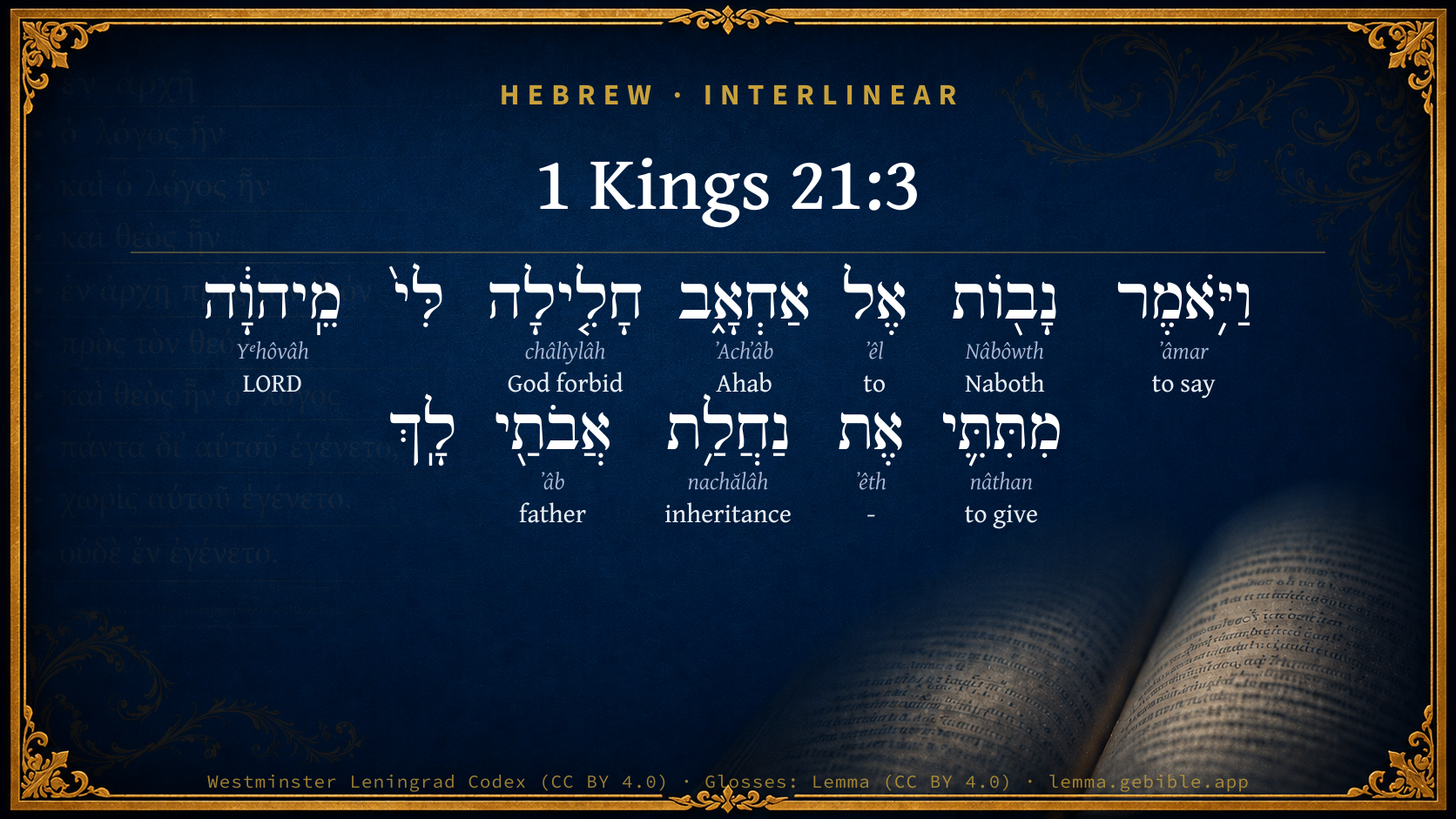
Hebrew (Westminster Leningrad Codex) 1 Kings 21:3 appears in the Hebrew Old Testament. The text above is from the Westminster Leningrad Codex. Each word links to its Strong’s number, a concise gloss, and parsing drawn from the Open Scriptures Hebrew Bible morphology. Click any word for its full Brown-Driver-Briggs (BDB) entry.
Download image
Cite this verse

1 Kings 21:3 (World English Bible). Public Domain. Lemma interlinear Bible study tool, https://lemma.gebible.app/v/1-kings/21/3.

Show BibTeX & RIS
BibTeX
RIS
English Translation
Naboth said to Ahab, Yahweh forbid it me, that I should give the inheritance of my fathers to you.
World English Bible · Public Domain
Download a study sheet

One document with this verse’s original text, its word-by-word gloss line, the meaning frame, cross-references with their text, attributed commentary, and full source and license credits — printable, and it pastes into notes with its structure intact.

This verse Autodidact and up

Study sheet (.html) Plain text (.txt)

A passage Seminary Student

Up to 50 verses in one chapter. A passage sheet keeps up to 6 commentary sources and 12 cross-references per verse, in the order this page ranks them, and says so on the sheet whenever that leaves anything out. Ask for a single verse and you get the Autodidact verse sheet above.

Everything on this page stays free to read, with no account — the sheet is a download of what is already on screen, not access to it.

Want to remove ads? Support Godless Engineer
Compare translations 3

The same verse in 3 English versions, stacked beneath the original-language interlinear above. Click any original word for its lexicon entry.

Each is an independent rendering of the whole verse — the interlinear is not word-aligned to these translations.

Highlighted words mark where these versions differ — a whole-verse word diff, not a word-by-word alignment.

  • World English Bible Public Domain
    Naboth said to Ahab, Yahweh forbid it me, that I should give the inheritance of my fathers to you.
  • King James Version Public Domain
    And Naboth said to Ahab, The LORD forbid it me, that I should give the inheritance of my fathers unto thee.
  • unfoldingWord Literal Text CC BY-SA 4.0
    And Naboth said to Ahab, “Profane to me from Yahweh, from my giving the inheritance of my fathers to you!”

unfoldingWord Literal Text — © unfoldingWord, licensed CC BY-SA 4.0. Word-aligned USFM3 via Door43 (git.door43.org/unfoldingWord/en_ult).

Versions to compare (up to 4)

3 of 4 selected

Show all 18 translations

Every available English version of this verse, each an independent rendering of the whole verse.

  • World English Bible Public Domain
    Naboth said to Ahab, Yahweh forbid it me, that I should give the inheritance of my fathers to you.
  • Berean Standard Bible Public Domain
    But Naboth replied, “The LORD forbid that I should give you the inheritance of my fathers.”
  • Majority Standard Bible Public Domain
    But Naboth replied, “The LORD forbid that I should give you the inheritance of my fathers.”
  • King James Version Public Domain
    And Naboth said to Ahab, The LORD forbid it me, that I should give the inheritance of my fathers unto thee.
  • American Standard Version (1901) Public Domain
    And Naboth said to Ahab, Jehovah forbid it me, that I should give the inheritance of my fathers unto thee.
  • Revised Version (1885) Public Domain
    And Naboth said to Ahab, The LORD forbid it me, that I should give the inheritance of my fathers unto thee.
  • Geneva Bible (1599) Public Domain
    And Naboth said to Ahab, The Lord keepe me from giuing the inheritance of my father vnto thee.
  • Douay-Rheims (1899) Public Domain
    Naboth answered him: The Lord be merciful to me, and not let me give thee the inheritance of my fathers.
  • Young's Literal Translation Public Domain
    And Naboth saith unto Ahab, `Far be it from me, by Jehovah, my giving the inheritance of my fathers to thee;'
  • Literal Standard Version CC BY-SA 4.0
    And Naboth says to Ahab, “Far be it from me, by YHWH, my giving the inheritance of my fathers to you”;
  • Unlocked Literal Bible CC BY-SA 4.0
    Naboth replied to Ahab, “May Yahweh forbid that I should give the inheritance of my ancestors to you.”
  • unfoldingWord Literal Text CC BY-SA 4.0
    And Naboth said to Ahab, “Profane to me from Yahweh, from my giving the inheritance of my fathers to you!”
  • Darby Bible Public Domain
    And Naboth said to Ahab, Jehovah forbid it me, that I should give the inheritance of my fathers to thee!
  • World Messianic Bible Public Domain
    Naboth said to Ahab, “May the LORD forbid me, that I should give the inheritance of my fathers to you!”
  • Webster's Bible Public Domain
    And Naboth said to Ahab, The LORD forbid it me, that I should give the inheritance of my fathers to thee.
  • Free Bible Version CC BY-SA 4.0
    But Naboth replied, “The Lord curse me if I should give you my forefathers' inheritance.”
  • Bible in Basic English Public Domain
    But Naboth said to Ahab, By the Lord, far be it from me to give you the heritage of my fathers.
  • JPS Tanakh (1917) Public Domain
    And Naboth said to Ahab: 'The LORD forbid it me, that I should give the inheritance of my fathers unto thee.'

Literal Standard Version (2020), Covenant Press — licensed CC BY-SA 4.0. Text via the HelloAO Bible API (eBible.org). Unlocked Literal Bible (unfoldingWord) — licensed CC BY-SA 4.0. Text via the HelloAO Bible API (eBible.org). unfoldingWord Literal Text — © unfoldingWord, licensed CC BY-SA 4.0. Word-aligned USFM3 via Door43 (git.door43.org/unfoldingWord/en_ult). Free Bible Version, Dr. Jonathan Gallagher — licensed CC BY-SA 4.0. Text via the HelloAO Bible API (eBible.org).

Word by word

More ways to search: Search by grammar → Find every occurrence → Compare this word →

Practice this passage: Drill this verse → Learn its vocabulary →

חָלִ֤ילָה
châlîylâh
H2486
“God forbid”
Particle, Interjection + Suffix, h
Part of Speech
Particle
Type
Interjection
Full BDB Definition

Origin: a directive from H2490

TWOT: 661c

far be it (from me), God forbid that, let it not be
  1. וַיֹּ֥אמֶר ʼâmar H559 “and · to say” Conjunction + Verb, Qal, Sequential Imperfect, 3rd Person, Masculine, Singular
  2. נָב֖וֹת Nâbôwth H5022 “Naboth” Noun, Proper
  3. אֶל ʼêl H413 “to” Preposition
  4. אַחְאָ֑ב ʼAchʼâb H256 “Ahab” Noun, Proper
  5. מֵֽיהוָ֔ה Yᵉhôvâh H3068 “from · LORD” Preposition + Noun, Proper
  6. מִתִּתִּ֛י nâthan H5414 “from · to give · me” Preposition + Verb, Qal, Infinitive Construct + Suffix, Personal, 1st Person, Common, Singular
  7. אֶת ʼêth H853 “-” Particle, Direct Object
  8. נַחֲלַ֥ת nachălâh H5159 “inheritance of” Noun, Common, Feminine, Singular, Construct
  9. אֲבֹתַ֖י ʼâb H1 “fathers · my” Noun, Common, Masculine, Plural, Construct + Suffix, Personal, 1st Person, Common, Singular

About this verse

These counts appear in no published source. They are computed here, from the morphology-tagged text and Lemma’s own curated glosses. What Lemma adds →

12
words
10
distinct lemmas
Historical
section

Notable vocabulary

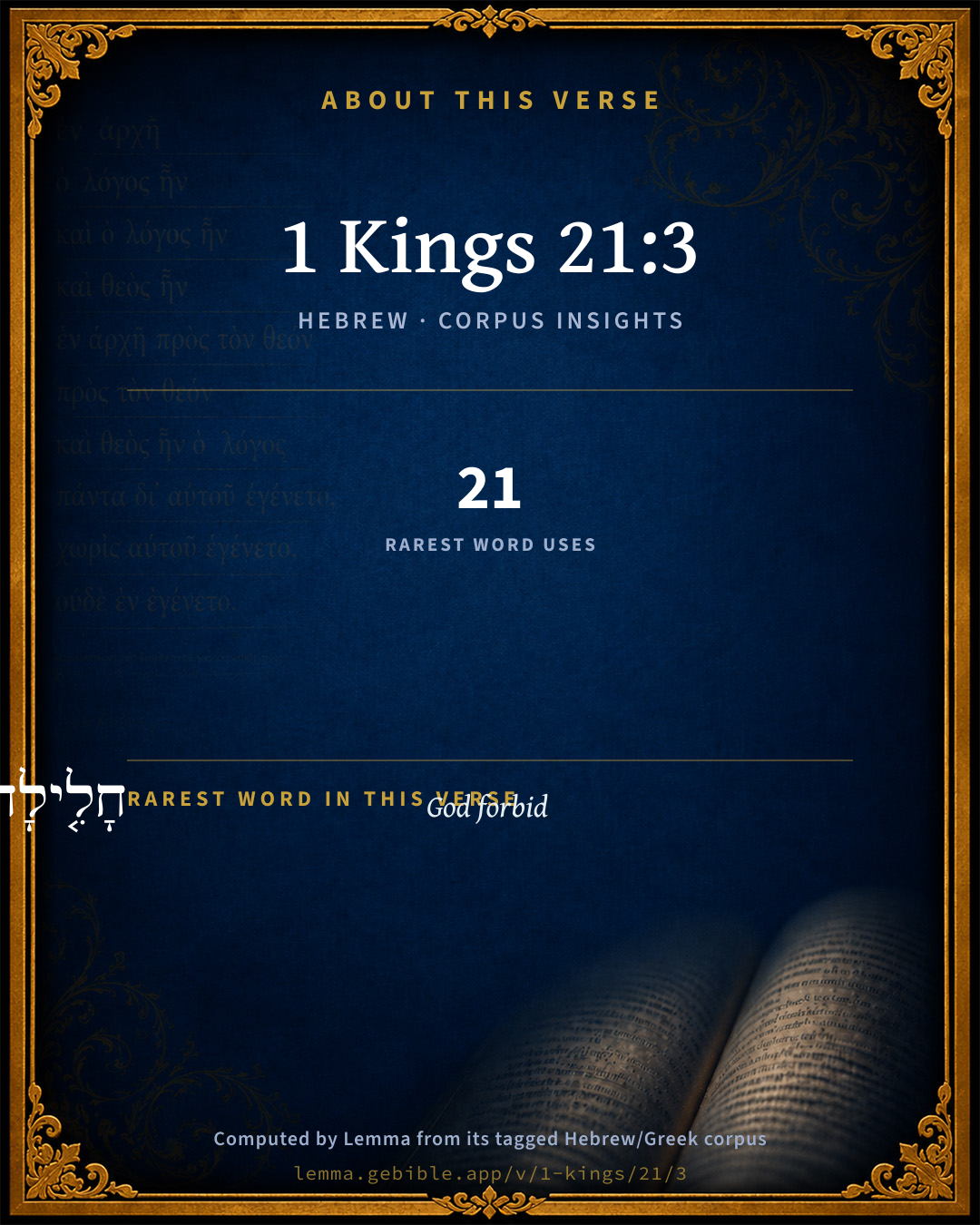
The rarest word here is חָלִ֤ילָה God forbid H2486 — appearing just 21 times in the whole Hebrew Bible.

Shared distinctive vocabulary

חָלִ֤ילָה God forbid H2486 occurs in 19 verses of the Hebrew Bible. Also found in:

Grammatical profile

  • 2 verbs
  • 5 nouns
  • 3 prepositions
  • 2 particles

Verb forms

  • וַיֹּ֥אמֶר Qal · Sequential Imperfect
  • מִתִּתִּ֛י Qal · Infinitive Construct

Hebrew & Septuagint length

In English translation the verse runs 19 words from the Hebrew and 15 from the Septuagint (LXX English) — closely comparable.

A rough comparison of the two English renderings, which tokenize alike — not a word-level alignment.

Word counts can differ between the Hebrew and the Greek without any difference in meaning — e.g. the Hebrew direct-object marker אֵת has no separate Greek word, and Greek often adds the article ὁ.

Cross-references

21

Topical passages linked to 1 Kings 21:3 in the Treasury of Scripture Knowledge — connected by theme and wording, ordered by reader-vote popularity; previews shown in the World English Bible.

  • Numbers 36:7 So shall no inheritance of the children of Israel remove from tribe to tribe; for the children of Israel shall cleave everyone to the inheritance of the tribe of his fathers.
  • Leviticus 25:23 "'The land shall not be sold in perpetuity, for the land is mine; for you are strangers and live as foreigners with me.
  • Ezekiel 46:18 Moreover the prince shall not take of the people's inheritance, to thrust them out of their possession; he shall give inheritance to his sons out of his own possession, that my people not be scattered every man from his possession.
  • Genesis 44:7 They said to him, "Why does my lord speak such words as these? Far be it from your servants that they should do such a thing!
  • Genesis 44:17 He said, "Far be it from me that I should do so. The man in whose hand the cup is found, he will be my bondservant; but as for you, go up in peace to your father."
  • Joshua 22:29 Far be it from us that we should rebel against Yahweh, and turn away this day from following Yahweh, to build an altar for burnt-offering, for meal-offering, or for sacrifice, besides the altar of Yahweh our God that is before his tent.
  • Joshua 24:16 The people answered, Far be it from us that we should forsake Yahweh, to serve other gods;
  • 1 Samuel 12:23 Moreover as for me, far be it from me that I should sin against Yahweh in ceasing to pray for you: but I will instruct you in the good and the right way.
  • 1 Samuel 24:6 He said to his men, Yahweh forbid that I should do this thing to my lord, Yahweh's anointed, to put forth my hand against him, seeing he is Yahweh's anointed.
  • 1 Chronicles 11:19 and said, My God forbid it me, that I should do this: shall I drink the blood of these men who have put their lives in jeopardy? for with [the jeopardy of] their lives they brought it. Therefore he would not drink it. These things did the three mighty men.
  • Job 27:5 Far be it from me that I should justify you. Until I die I will not put away my integrity from me.
  • Romans 3:4 May it never be! Yes, let God be found true, but every man a liar. As it is written, "That you might be justified in your words, And might prevail when you come into judgment."
  • Romans 3:6 May it never be! For then how will God judge the world?
  • Romans 3:31 Do we then nullify the law through faith? May it never be! No, we establish the law.
  • Romans 6:2 May it never be! We who died to sin, how could we live in it any longer?
  • Romans 6:15 What then? Shall we sin, because we are not under law, but under grace? May it never be!
  • Romans 7:7 What shall we say then? Is the law sin? May it never be! However, I wouldn't have known sin, except through the law. For I wouldn't have known coveting, unless the law had said, "You shall not covet."
  • Romans 7:13 Did then that which is good become death to me? May it never be! But sin, that it might be shown to be sin, by working death to me through that which is good; that through the commandment sin might become exceeding sinful.
  • 1 Corinthians 6:15 Don't you know that your bodies are members of Christ? Shall I then take the members of Christ, and make them members of a prostitute? May it never be!
  • Galatians 6:14 But far be it from me to boast, except in the cross of our Lord Jesus Christ, through which the world has been crucified to me, and I to the world.
  • 1 Samuel 26:9–11 David said to Abishai, Don't destroy him; for who can put forth his hand against Yahweh's anointed, and be guiltless?

Cross-references courtesy of OpenBible.info (CC BY 4.0).

Hebrew and Greek witnesses Masoretic Hebrew ↔ Greek Septuagint

The same verse in the two great witnesses to the Old Testament, shown verse-for-verse.

These are two independent witnesses, not word-aligned to each other, and the Septuagint is shown in lemma (dictionary) form.

Hebrew 1 Kings 21:3 Masoretic · Westminster Leningrad Codex

וַיֹּ֥אמֶר נָב֖וֹת אֶל אַחְאָ֑ב חָלִ֤ילָה לִּי֙ מֵֽיהוָ֔ה מִתִּתִּ֛י אֶת נַחֲלַ֥ת אֲבֹתַ֖י לָֽךְ

Naboth said to Ahab, Yahweh forbid it me, that I should give the inheritance of my fathers to you.

World English Bible · Public Domain

Greek LXX 1 Kings 21:3 Septuagint · lemma form

καί εἶπον πρός αὐτός ὅδε λέγω υἱός αδερ ὁ ἀργύριον σύ καί ὁ χρυσίον σύ ἐμός εἰμί καί ὁ γυνή σύ καί ὁ τέκνον σύ ἐμός εἰμί

Your silver and your gold are mine, and your wives and your children are mine.

LXX2012 (modern English Septuagint) · Public Domain

Hebrew: Westminster Leningrad Codex (CC BY 4.0). Greek: Septuagint (public domain); English from LXX2012 (modern English Septuagint) (Public Domain). How the Septuagint differs from the Hebrew →

Targum (Aramaic paraphrase)

1

The Targum is the ancient Jewish Aramaic paraphrase of the Hebrew Scriptures — an interpretive translation, not the Hebrew text itself. Onkelos (literal) and Pseudo-Jonathan (expansive) render the Torah, and Jonathan the Prophets. Coverage is partial: where no permissively-licensed English translation exists for a verse, only the Aramaic is shown. This is verse-level text, not a word-by-word alignment to the Hebrew.

  1. Targum Jonathan Prophets (Joshua–Malachi)
    וַאֲמַר נָבוֹת לְאַחְאָב חָס לִי מִן קֳדָם יְיָ מִלְמִתַּן יַת אַחֲסָנַת אֲבָהָתַי לָךְ:

    (no public-domain English translation for this verse)

    Targum Jonathan — Aramaic: “Mikraot Gedolot” (public domain). English: “Sefaria Community Translation” (CC0 1.0 (public-domain dedication)); “London "Chaldee Paraphrase," 1871” (public domain). Text via Sefaria.

Commentary

Notes on 1 Kings 21:3 from classic Christian and Jewish commentators (each source and its license shown beneath its notes). The classic Christian expositions comment on the surrounding passage and are grouped to its opening verse, so a note may address several verses; the Jewish commentaries on the Tanakh (Rashi and others) are per-verse, so they appear only where the commentator wrote on this verse.

Lemma curates 59 commentaries, every one of them public domain or Creative Commons licensed, each selected and text-cleaned for this edition rather than reprinted as found. About our sources →

Trapp's Complete Commentary

John Trapp

1Ki 21:3 And Naboth said to Ahab, The LORD forbid it me, that I should give the inheritance of my fathers unto thee.

Ver. 3. The Lord forbid it me.] The Lord had indeed forbidden it him. {Lev 25:23 Num 36:7 Eze 46:18} And hence his loathness; for he feared God in that corrupt time, and this made him a martyr; and for this his blood cried the louder against Ahab and Jezebel.

John Trapp, A Commentary or Exposition upon All the Books of the Old and New Testament (1647–1656) — public domain. Text from a community e-Sword module.

The Biblical Illustrator

Joseph S. Exell

1Ki_21:3

The Lord forbid that I should give the inheritance of my fathers unto thee.

The reply of Naboth, and its lessons

I. The reply of Naboth.

1. It first assures us that he is a conscientious man, and a worshipper of Jehovah. No; but from a conviction of his duty to God as the Supreme Lawgiver: and, therefore, rather than offend Him, or violate His will, he would incur the anger and vengeful power of Ahab.

2. Hence the moral heroism of the reply--similar to that which distinguished the answer of the apostles, in after history, when forbidden by the magistrates to preach in the name of Jesus. These brave men recognised the Divine authority; and, basing their publication upon its evidence, they were ready to undergo any persecution, any torture, any death, rather than disobey God. And it was according to this spirit that Naboth uttered the words to Ahab.

3. In this reply of Naboth, there is also the recognition of an old fundamental law, unrepealed, among the Hebrews, respecting landed property: and this recognition stands out in direct opposition to the loose practices of Ahab, the priests, and all the followers of Baal.

II. Its lessons.

1. The great value which every professing Christian ought to set upon his inheritance, as purchased for him, and handed down to him by Christ, and that no man ought to part with it through the force of temptation.

2. We learn furthermore from the reply of Naboth the great importance of decision of character, or as it is directed towards a right purpose.

3. Naboth openly avowed his belief in God and His laws before Ahab, and a nation given up to idolatry. And thus we are taught not to be ashamed of confessing our faith in Christ. (W. D. Horwood.)

The Biblical Illustrator, edited by Joseph S. Exell (c. 1880s–1900s) — public domain. Text from a community e-Sword module.

The Cambridge Bible for Schools and Colleges

gen. ed. J. J. S. Perowne

3. The Lord forbid it me] This verse is very interesting, because (1) it makes clear that Naboth was a worshipper of Jehovah and, in spite of the persecution of the prophets, did not shrink from making it known to the king by his language. Here was an example of one who had not bowed the knee nor given a kiss to Baal. And (2) the reason which he alleges for clinging to his inheritance shews that the teaching of the law of Moses (Num_36:7-8; Lev_25:27-28) concerning the sacredness of a paternal inheritance had taken firm hold of the minds of the people, so that Ahab did not think of venturing on harsh measures against one who put forward this religious plea as a bar to the royal desire.

The Cambridge Bible for Schools and Colleges (gen. ed. J. J. S. Perowne; Cambridge University Press, 1878–1918) — public domain. Text from a community e-Sword module.

John Gill's Exposition

And Naboth said to Ahab, the Lord forbid it me that I should give the inheritance of my fathers unto thee. The inheritances of families were not to be alienated to another family, or tribe, nor even to be sold, unless in extreme poverty, and then to return at the year of jubilee, Lev 25:23. Now Naboth was a man in good circumstances, and under no necessity of selling his vineyard; and, if he sold it, he might reasonably conclude, it becoming a part of the royal demesnes, would never revert to his family; and therefore, both out of regard to the law of God, and the good of his family, would not part with it at any rate: this shows that he was a conscientious man, and therefore is thought to be one of those that would not bow his knee to Baal, and against whom Ahab had a grudge, and sought an opportunity against him.

. Now Naboth was a man in good circumstances, and under no necessity of selling his vineyard; and, if he sold it, he might reasonably conclude, it becoming a part of the royal demesnes, would never revert to his family; and therefore, both out of regard to the law of God, and the good of his family, would not part with it at any rate: this shows that he was a conscientious man, and therefore is thought to be one of those that would not bow his knee to Baal, and against whom Ahab had a grudge, and sought an opportunity against him.

1 Kings 21:4

kg1 21:4

kg1 21:4

kg1 21:4And Ahab came into his house heavy and displeased,.... Just in the same humour he was after the prophet had delivered his message to him, Kg1 20:43, where the same words are used as here:

because of the word which Naboth the Jezreelite had spoken to him, for he had said, I will not give thee the inheritance of my fathers, neither by way of exchange nor of purchase: and such a denial he could not bear, since it looked like treating him with contempt, and taxing him with imprudence at least, if not with injustice, or both:

and he laid him down upon his bed; or couch, which might be not in his bedchamber, but in one of his halls, where his courtiers were:

and turned away his face; to the wall, not choosing to have conversation with any of his nobles:

and would eat no bread; the vexation took away his stomach, and he became melancholy, at least sullen.

John Gill's Exposition of the Whole Bible (1746–1763) — public domain (CC PDM 1.0). Text via the HelloAO Bible API.

Albert Barnes' Notes on the Bible

The Lord forbid it me - Or, “Yahweh forbid it me.” Naboth, as a worshipper of Yahweh, not of Baal, considers it would be wrong for him to comply with the king’s request, as contrary to the Law (margin). His was not a mere refusal arising out of a spirit of sturdy independence, or one based upon the sentiment which attaches men to ancestral estates.

Albert Barnes' Notes on the Bible (1834–1885) — public domain. Text from a community e-Sword/MySword module.

Haydock's Catholic Bible Commentary

Fathers. He would have deemed it a mark of disrespect and a crime, as he was not in a state of indigence; which alone could authorize him to sell his property, and then only till the year of jubilee; (Leviticus xxv. 23.) and as his field was to be turned into a royal garden, and the law was disregarded by the king, there was no prospect of his regaining it at that period. The law of Moses was till in force; and there were some, like Naboth, who were resolved to comply with it, (Calmet) even at the hazard of their lives. (Tirinus)

George Leo Haydock (1774–1849), Haydock's Catholic Family Bible and Commentary, 1859 edition — public domain. Excludes Psalms (Douay-Rheims chapter numbering differs from Protestant) and Deuterocanonical books (Catholic canon only).

Matthew Poole's English Annotations

For God hath expressly, and for divers weighty reasons, forbidden the alienation of lands from the tribes and families to which they were allotted, Lev 25:15,23,25; Num 36:7; Eze 46:18. And although these might have been alienated till the jubilee, yet he durst not sell it to the king for that time; because he supposed that if once it came into the king’s hand, especially to be made a garden of pleasure, and affixed to his palace, neither he nor his posterity could ever recover it again; and so he should both offend God, and wrong his posterity; which being, as it seems, a pious man, he durst not do.

Matthew Poole's English Annotations on the Holy Bible (1683–1685) — public domain. Text from a community e-Sword/MySword module.

Whedon's Commentary on the Bible

Daniel D. Whedon

3. The Lord forbid it me — Literally, Accursed to me from Jehovah from giving the inheritance of my fathers to thee. That is, I should be accursed or alienated from Jehovah by giving this inheritance away, or parting with it so as never to recover it again. So Naboth refused to sell his inheritance on religious grounds, for the law (Lev_25:23) said, “The land shall not be sold forever,” that is, so as to be cut off forever from the claim of the original possessor. For even if, through poverty, a man was obliged to sell a part of his possession, it would return to him again at the next jubilee.

Lev_25:25-28. But Ahab evidently wished to have Naboth make a final and irrecoverable disposal of his estate.

Daniel D. Whedon (gen. ed.), Commentary on the Old and New Testaments (1874–1909) — public domain. Text from a community e-Sword module.

The Pulpit Commentary

And Naboth said to Ahab, The Lord forbid it me Heb. Far be it to me from Jehovah. These words reveal to us, first, that Naboth was a worshipper of the Lord otherwise he would hardly have used the sacred name, and that to Ahab, with whom the servants of the true God had found but scant favour; and, secondly, that he looked upon the alienation of his patrimony as an act displeasing to the Lord, and as violating the law of Moses (Lev_25:3 sqq.; Num_36:7 sqq.) We have instances of the sale of land to the king in 2Sa_24:24 but that was by a Jebusite and in, 1Ki_16:24 that I should give the inheritance of my fathers unto thee. "The preservation of the hlj was for every covenant keeping Israelite a matter not merely of piety towards his family and his tribe but a religious duty" (Bahr). It is clear, however, that the restraints of the old Mosaic law began to be irksome in that latitudinarian age. Many of its provisions were already regarded as obsolete.

The Pulpit Commentary (1880–1919), ed. H.D.M. Spence-Jones & Joseph S. Exell — public domain. Text from a community e-Sword module.

John Wesley's Explanatory Notes

The Lord forbid - For God had expressly, and for divers weighty reasons forbidden the alienation of lands from the tribes and families to which they were allotted. And although these might have been alienated 'till the jubilee, yet he durst not sell it to the king for that time; because he supposed, if once it came into the king's hand, neither he, nor his posterity, could ever recover it; and so he should both offend God, and wrong his posterity.

John Wesley, Explanatory Notes Upon the Whole Bible (1754–1765) — public domain. Text via the GEBible commentary corpus.

unfoldingWord translationNotes

Door43 World Missions Community

May Yahweh forbid that I should give

This phrase is an oath that emphasizes that what follows will not happen. AT: "Because Yahweh forbids it, I will never give" (See: Assumed Knowledge and Implicit Information)

give the inheritance of my ancestors to you

The land that his ancestors received as a permanent possession is spoken of as if it were an inheritance. AT: "give to you the land that my ancestors received as an inheritance" (See: Metaphor)

translationWords

Yahweh

inherit

anger

turn

face

unfoldingWord translationNotes — © Distant Shores Media and the Door43 World Missions Community, licensed CC BY-SA 4.0. Source: git.door43.org/Door43/en_tn.

Lesson kit

Teaching starters — assembled from the data on this page, not authored interpretation. Every prompt links to the verse data it draws on. Edit before teaching.

1 Kings, in the Historical, opens this verse with 12 words (10 distinct Hebrew lemmas). Its most distinctive word is châlîylâh (“God forbid”). A historical commentator’s framing appears above. Read the whole chapter for the surrounding context.

Discussion questions

  1. How does “God forbid” (châlîylâh) shape what this verse is saying?
  2. How does Genesis 18:25, which shares the word «God forbid», read alongside this verse?
  3. The translations on this page render this verse differently — a whole-verse word diff, not a word-by-word alignment. What might account for the different wordings?
  4. «וַיֹּ֥אמֶר» is a Qal Sequential Imperfect verb. How does that grammatical form shape the action described?
  5. Compare how Trapp's Complete Commentary and The Biblical Illustrator read this verse. Where do they agree or differ?

Things to notice

Reading settings

Reading text

Shown beneath each verse's original-language words.

Old Testament
Old Testament edition

Read the OT as the Masoretic Hebrew (MT) or the Greek Septuagint (LXX).

English shown for the Greek Septuagint (in the Hebrew ↔ Greek comparison).

Comparing translations? Open the Compare panel on any verse page to stack up to four side by side.