Nehemiah 11:20

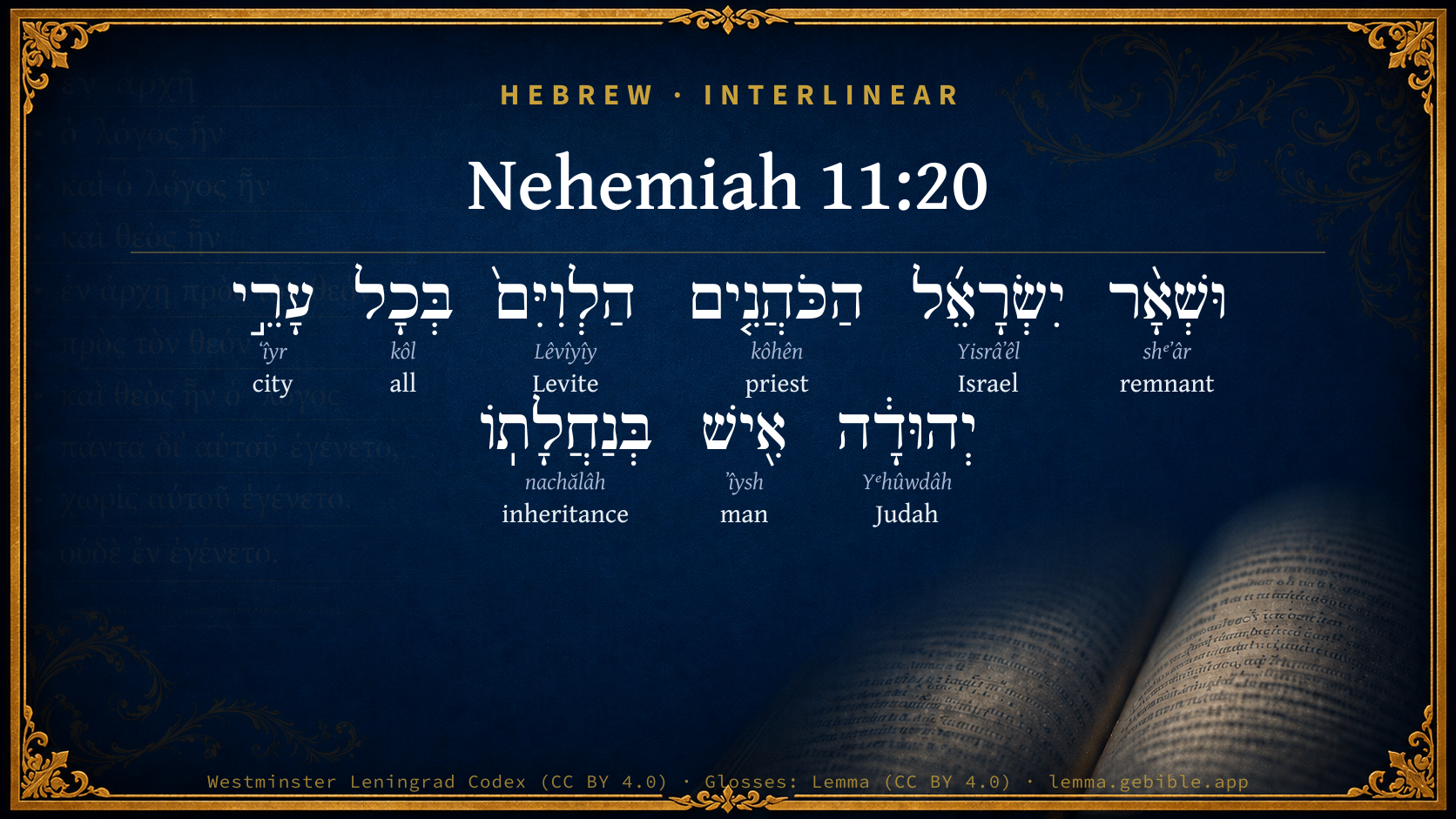
Hebrew (Westminster Leningrad Codex) Nehemiah 11:20 appears in the Hebrew Old Testament. The text above is from the Westminster Leningrad Codex. Each word links to its Strong’s number, a concise gloss, and parsing drawn from the Open Scriptures Hebrew Bible morphology. Click any word for its full Brown-Driver-Briggs (BDB) entry.
Download image
Cite this verse

Nehemiah 11:20 (World English Bible). Public Domain. Lemma interlinear Bible study tool, https://lemma.gebible.app/v/nehemiah/11/20.

Show BibTeX & RIS
BibTeX
RIS
English Translation
The residue of Israel, of the priests, the Levites, were in all the cities of Judah, everyone in his inheritance.
World English Bible · Public Domain
Download a study sheet

One document with this verse’s original text, its word-by-word gloss line, the meaning frame, cross-references with their text, attributed commentary, and full source and license credits — printable, and it pastes into notes with its structure intact.

This verse Autodidact and up

Study sheet (.html) Plain text (.txt)

A passage Seminary Student

Up to 50 verses in one chapter. A passage sheet keeps up to 6 commentary sources and 12 cross-references per verse, in the order this page ranks them, and says so on the sheet whenever that leaves anything out. Ask for a single verse and you get the Autodidact verse sheet above.

Everything on this page stays free to read, with no account — the sheet is a download of what is already on screen, not access to it.

Want to remove ads? Support Godless Engineer
Compare translations 3

The same verse in 3 English versions, stacked beneath the original-language interlinear above. Click any original word for its lexicon entry.

Each is an independent rendering of the whole verse — the interlinear is not word-aligned to these translations.

Highlighted words mark where these versions differ — a whole-verse word diff, not a word-by-word alignment.

  • World English Bible Public Domain
    The residue of Israel, of the priests, the Levites, were in all the cities of Judah, everyone in his inheritance.
  • King James Version Public Domain
    And the residue of Israel, of the priests, and the Levites, were in all the cities of Judah, every one in his inheritance.
  • unfoldingWord Literal Text CC BY-SA 4.0
    And the rest of Israel, the priests, the Levites, were in all the cities of Judah, a man in his inheritance.

unfoldingWord Literal Text — © unfoldingWord, licensed CC BY-SA 4.0. Word-aligned USFM3 via Door43 (git.door43.org/unfoldingWord/en_ult).

Versions to compare (up to 4)

3 of 4 selected

Show all 18 translations

Every available English version of this verse, each an independent rendering of the whole verse.

  • World English Bible Public Domain
    The residue of Israel, of the priests, the Levites, were in all the cities of Judah, everyone in his inheritance.
  • Berean Standard Bible Public Domain
    The rest of the Israelites, with the priests and Levites, were in all the villages of Judah, each on his own inheritance.
  • Majority Standard Bible Public Domain
    The rest of the Israelites, with the priests and Levites, were in all the villages of Judah, each on his own inheritance.
  • King James Version Public Domain
    And the residue of Israel, of the priests, and the Levites, were in all the cities of Judah, every one in his inheritance.
  • American Standard Version (1901) Public Domain
    And the residue of Israel, of the priests, the Levites, were in all the cities of Judah, every one in his inheritance.
  • Revised Version (1885) Public Domain
    And the residue of Israel, of the priests, the Levites, were in all the cities of Judah, every one in his inheritance.
  • Geneva Bible (1599) Public Domain
    And the residue of Israel, of the Priests, and of the Leuites dwelt in al the cities of Iudah, euery one in his inheritance.
  • Douay-Rheims (1899) Public Domain
    And the rest of Israel, the priests and the Levites were in all the cities of Juda, every man in his possession.
  • Young's Literal Translation Public Domain
    And the rest of Israel, of the priests, of the Levites, `are' in all cities of Judah, each in his inheritance;
  • Literal Standard Version CC BY-SA 4.0
    And the rest of Israel, of the priests, of the Levites, [are] in all cities of Judah, each in his inheritance;
  • Unlocked Literal Bible CC BY-SA 4.0
    The remainder of Israel and of the priests and the Levites were in all the towns of Judah. Everyone lived on his own inherited property.
  • unfoldingWord Literal Text CC BY-SA 4.0
    And the rest of Israel, the priests, the Levites, were in all the cities of Judah, a man in his inheritance.
  • Darby Bible Public Domain
    And the residue of Israel, the priests, [and] the Levites, were in all the cities of Judah, every one in his inheritance.
  • World Messianic Bible Public Domain
    The residue of Israel, of the priests, and the Levites were in all the cities of Judah, everyone in his inheritance.
  • Webster's Bible Public Domain
    And the residue of Israel, of the priests, and the Levites, were in all the cities of Judah every one in his inheritance.
  • Free Bible Version CC BY-SA 4.0
    The other Israelites, with rest of the priests and Levites, lived in their home towns in Judah, each on their own property.
  • Bible in Basic English Public Domain
    And the rest of Israel, of the priests, the Levites, were in all the towns of Judah, every one in his heritage.
  • JPS Tanakh (1917) Public Domain
    And the residue of Israel, of the priests, the Levites, were in all the cities of Judah, every one in his inheritance.

Literal Standard Version (2020), Covenant Press — licensed CC BY-SA 4.0. Text via the HelloAO Bible API (eBible.org). Unlocked Literal Bible (unfoldingWord) — licensed CC BY-SA 4.0. Text via the HelloAO Bible API (eBible.org). unfoldingWord Literal Text — © unfoldingWord, licensed CC BY-SA 4.0. Word-aligned USFM3 via Door43 (git.door43.org/unfoldingWord/en_ult). Free Bible Version, Dr. Jonathan Gallagher — licensed CC BY-SA 4.0. Text via the HelloAO Bible API (eBible.org).

Word by word

More ways to search: Search by grammar → Find every occurrence → Compare this word →

Practice this passage: Drill this verse → Learn its vocabulary →

וּשְׁאָ֨ר
shᵉʼâr
H7605
“and · remnant of”
Conjunction + Noun, Common, Masculine, Singular, Construct
Part of Speech
Conjunction + Noun
Type
Common
Gender
Masculine
Number
Singular
State
Construct
Full BDB Definition

Origin: from H7604

TWOT: 2307a

rest, residue, remnant, remainder
  1. יִשְׂרָאֵ֜ל Yisrâʼêl H3478 “Israel” Noun, Proper
  2. הַכֹּהֲנִ֤ים kôhên H3548 “the · priests” Particle, Definite Article + Noun, Common, Masculine, Plural, Absolute
  3. הַלְוִיִּם֙ Lêvîyîy H3881 “the · Levites” Particle, Definite Article + Noun, Gentilic, Masculine, Plural, Absolute
  4. בְּכָל kôl H3605 “in/at · all of” Preposition + Noun, Common, Masculine, Singular, Construct
  5. עָרֵ֣י ʻîyr H5892 “cities of” Noun, Common, Feminine, Plural, Construct
  6. יְהוּדָ֔ה Yᵉhûwdâh H3063 “Judah” Noun, Proper
  7. אִ֖ישׁ ʼîysh H376 “man” Noun, Common, Masculine, Singular, Absolute
  8. בְּנַחֲלָתֽוֹ nachălâh H5159 “in/at · inheritance · their” Preposition + Noun, Common, Feminine, Singular, Construct + Suffix, Personal, 3rd Person, Masculine, Plural

About this verse

These counts appear in no published source. They are computed here, from the morphology-tagged text and Lemma’s own curated glosses. What Lemma adds →

9
words
9
distinct lemmas
Historical
section

Shared distinctive vocabulary

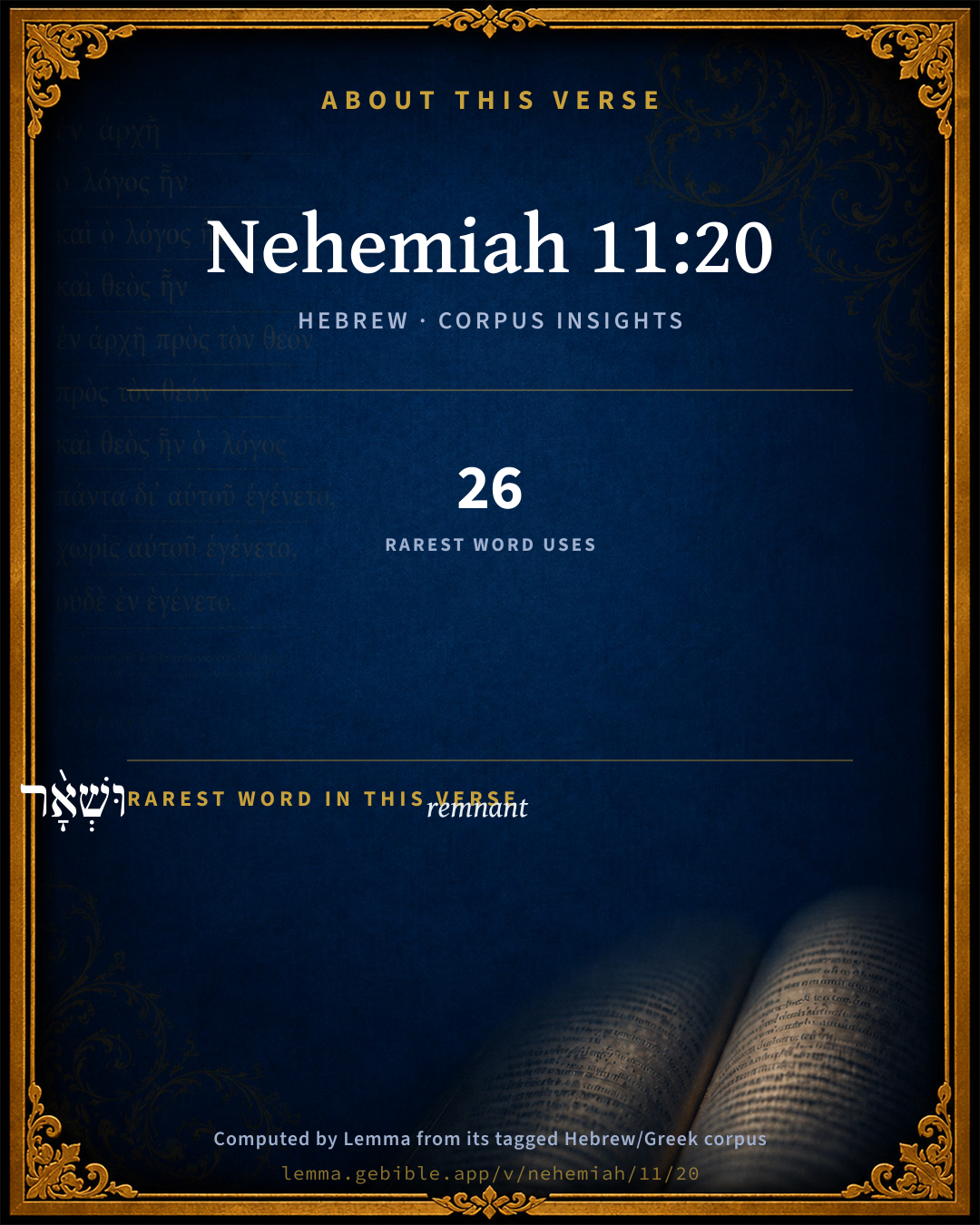
וּשְׁאָ֨ר remnant H7605 occurs in 25 verses of the Hebrew Bible. Also found in:

Grammatical profile

  • 9 nouns

Cross-references

1

Topical passages linked to Nehemiah 11:20 in the Treasury of Scripture Knowledge — connected by theme and wording, ordered by reader-vote popularity; previews shown in the World English Bible.

  • Nehemiah 11:3 Now these are the chiefs of the province who lived in Jerusalem: but in the cities of Judah lived everyone in his possession in their cities, [to wit], Israel, the priests, and the Levites, and the Nethinim, and the children of Solomon's servants.

Cross-references courtesy of OpenBible.info (CC BY 4.0).

Hebrew and Greek witnesses Masoretic Hebrew ↔ Greek Septuagint

The same verse in the two great witnesses to the Old Testament, shown verse-for-verse.

These are two independent witnesses, not word-aligned to each other, and the Septuagint is shown in lemma (dictionary) form.

Hebrew Nehemiah 11:20 Masoretic · Westminster Leningrad Codex

וּשְׁאָ֨ר יִשְׂרָאֵ֜ל הַכֹּהֲנִ֤ים הַלְוִיִּם֙ בְּכָל עָרֵ֣י יְהוּדָ֔ה אִ֖ישׁ בְּנַחֲלָתֽוֹ

The residue of Israel, of the priests, the Levites, were in all the cities of Judah, everyone in his inheritance.

World English Bible · Public Domain

Greek LXX Structure differs

The Septuagint has no separate book of Nehemiah. Its Greek text is the second half of Esdras B (2 Esdras), chapters 11–23; Ezra is the first half (1–10).

A verse-for-verse comparison isn’t shown here because the chapters and verses don’t line up. Switch to the LXX edition with the MT / LXX toggle above to read the Greek directly.

Hebrew: Westminster Leningrad Codex (CC BY 4.0). Greek: Septuagint (public domain); English from a public-domain English Septuagint. How the Septuagint differs from the Hebrew →

Commentary

Notes on Nehemiah 11:20 from classic Christian and Jewish commentators (each source and its license shown beneath its notes). The classic Christian expositions comment on the surrounding passage and are grouped to its opening verse, so a note may address several verses; the Jewish commentaries on the Tanakh (Rashi and others) are per-verse, so they appear only where the commentator wrote on this verse.

Lemma curates 59 commentaries, every one of them public domain or Creative Commons licensed, each selected and text-cleaned for this edition rather than reprinted as found. About our sources →

Matthew Henry's Commentary

Having given an account of the principal persons that dwelt in Jerusalem (a larger account of whom he had before, Ch1 9:2, etc.), Nehemiah, in these verses, gives us some account of the other cities, in which dwelt the residue of Israel, Neh 11:20. It was requisite that Jerusalem should be replenished, yet not so as to drain the country. The king himself is served of the field, which will do little service if there be not hands to manage it. Let there therefore be no strife, no envy, no contempt, no ill will, between the inhabitants of the cities and those of the villages; both are needful, both useful, and neither can be spared. 1. The Nethinims, the posterity of the Gibeonites, dwelt in Ophel, which was upon the wall of Jerusalem (Neh 3:26), because they were to do the servile work of the temple, which therefore they must be posted near to, that they might be ready to attend, Neh 11:21. 2. Though the Levites were dispersed through the cities of Judah, yet they had an overseer who resided in Jerusalem, superior of their order and their provincial, to whom they applied for direction, who took care of their affairs and took cognizance of their conduct, whether they did their duty, Neh 11:22. 3. Some of the singers were appointed to look after the necessary repairs of the temple, being ingenious men, and having leisure between their hours of service; they were over the business of the house of God, Neh 11:22. And, it seems, the king of Persia had such a kindness for their office that he allotted a particular maintenance for them, besides what belonged to them as Levites, Neh 11:23. 4. Here is one that was the king's commissioner at Jerusalem. He was of the posterity of Zerah (Neh 11:24); for of that family of Judah there were some new settled in Jerusalem, and not all of Pharez, as appears by that other catalogue, Ch1 9:6. He is said to be at the king's hand, or on the king's part, in all matters concerning the people, to determine controversies that arose between the king's officers and his subjects, to see that what was due to the king from the people was duly paid in and what was allowed by the king for the temple service was duly paid out, and happy it was for the Jews that one of themselves was in this post. 5. Here is an account of the villages, or country towns, which were inhabited by the residue of Israel - the towns in which the children of Judah dwelt (Neh 11:25-30), those that were inhabited by the children of Benjamin (Neh 11:31-35), and divisions for the Levites among both, Neh 11:36. We will now suppose them safe and easy, though few and poor, but by the blessing of God they were likely to increase in wealth and power, and they would have been more likely if there had not been that general profaneness among them, and lukewarmness in religion, with which they were charged in God's name by the prophet Malachi, who, it is supposed, prophesied about this time, and in whom prophecy ceased for some ages, till it revived in the great prophet and his forerunner.

Matthew Henry's Commentary on the Whole Bible (1708–1710) — public domain (CC PDM 1.0). Text via the HelloAO Bible API.

Trapp's Complete Commentary

John Trapp

Neh 11:20 And the residue of Israel, of the priests, [and] the Levites, [were] in all the cities of Judah, every one in his inheritance.

Ver. 20. Were in all the cities] Dispersed abroad to instruct the people, and to be as the salt of the earth, to keep it from putrifying.

John Trapp, A Commentary or Exposition upon All the Books of the Old and New Testament (1647–1656) — public domain. Text from a community e-Sword module.

Keil & Delitzsch

C. F. Keil & F. Delitzsch

Certain special remarks follow in Neh 11:20. - Neh 11:20 states that the rest of the Israelites, priests, and Levites dwelt in all the (other) cities of Judah, each in his inheritance. These cities are enumerated in Neh 11:25.

Neh 11:21

The Nethinim dwelt in Ophel, the southern slope of Mount Moriah; see rem. on Neh 3:26. Their chiefs were Zihah and Gispa. ציחה occurs Ezr 2:43, followed by חשׂוּפא, as head of a division of Levites; whence Bertheau tries, but unsuccessfully, to identify the latter name with גּשׁפּא. For it does not follow that, because a division of Nethinim was descended from Hasupha, that Gishpa, one of the chiefs of those Nethinim who dwelt on Ophel, must be the same individual as this Hasupha.

Neh 11:22-23

And the overseer (chief) of the Levites at Jerusalem was Uzzi, the son of Bani, of the sons of Asaph, the singers, in the business of the house of God. The מלאכה of the house of God was the duty of the Levites of the house of Shemaiah, Neh 11:15. Hence the remark in the present verse is supplementary to Neh 11:15. The chiefs or presidents of the two other divisions of Levites - of those to whom the outward business was entrusted, and of the singers - are named in Neh 11:16 and Neh 11:17; while, in the case of those entrusted with the business of the house of God, Neh 11:15, the chiefs are not named, probably because they were over the singers, the sons of Asaph, who in Neh 11:15 had not as yet been named. This is therefore done afterwards in Neh 11:22. מלאכת לנגד, coram opere, i.e., circa ea negotia, quae coram in templo exigenda erant (Burm. in Ramb.), does not belong to המּשׁררים, but to הלויּם פּקיד: Uzzi was overseer of the Levites in respect of their business in the house of God, i.e., of those Levites who had the charge of this business. The reason of this is thus given in Neh 11:23 : "for a command of the king was over them, and an ordinance was over the singers concerning the matter of every day." עליהם refers to the Levites. "A command of the king was over them" means: the king had commanded them. This command was concerning בּיומו יום דּבר, the matter of every day. The words stand at the end of the verse, because they refer to the two subjects המּלך and אמנה. אמנה is an arrangement depending upon mutual agreement, a treaty, an obligation entered into by agreement; comp. Neh 10:1. The meaning of the verse is: The every-day matter was laid upon the Levites by the command of the king, upon the singers by an agreement entered into. בּיומו יום דּבר, pensum quotidianum, is correctly explained by Schmid: de rebus necessariis in singulos dies. That we are not to understand thereby the contribution for every day, the rations of food (Ramb., Berth.), but the duty to be done on each day, is obvious from the context, in which not provisions, but the business of the Levites, is spoken of; and Uzzi the Asaphite was placed over the Levites in respect of their business in the house of God, and not in respect of food and drink. The business of the Levites in the house of God was determined by the command of the king; the business of the singers, on the contrary, especially that one of the singers should exercise a supervision over the services of the Levites in worship, was made the matter of an אמנה, an agreement entered into among themselves by the different divisions of Levites. The king is not David, who once regulated the services of the Levites (Ch1 23:4.), but the Persian king Artaxerxes, who is mentioned as המּלך in Neh 11:24; and המּלך מצות undoubtedly refers to the full power bestowed by Artaxerxes upon Ezra to order all that concerned the worship of God at Jerusalem; Ezr 7:12.

Neh 11:24

Finally, the official is named who had to transact with the king the affairs of the people, i.e., of the whole Jewish community in Judah and Jerusalem. Pethahiah, a Jew of the descendants of Zerah, was at the king's hand in all matters concerning the people. המּלך ליד can scarcely be understood of a royal commissioner at Jerusalem, but certainly designates an official transacting the affairs of the Jewish community at the hand of the king, at his court.

Keil & Delitzsch — Biblical Commentary on the Old Testament (1861–1891) — public domain (CC PDM 1.0). Text via the HelloAO Bible API. (Old Testament only.)

Geneva Bible (1599)

Geneva Bible translators

Of them, which dwelt not in Jerusalem.

Geneva Bible (1599) marginal notes — public domain. Text via Bolls.life.

Ellicott's Commentary for English Readers

(20-36) The heads in the country.

A Bible Commentary for English Readers, edited by Charles John Ellicott (1878–1897) — public domain. Text from a community e-Sword module.

The Cambridge Bible for Schools and Colleges

gen. ed. J. J. S. Perowne

20. This verse is clearly out of place, interrupting the register of ‘the porters’ and ‘the Nethinim.’ It would be more appropriate before Neh_11:25.

the residue of Israel] Cf. Neh_11:1, ‘the rest of the people,’ where the same word is used in the Hebrew.

‘Israel’ as in Neh_11:3 (cf. Ezr_2:70), denoting all the laity irrespective of their tribes.

of the priests, and the Levites] R.V. the priests, the Levites. The A.V., by inserting ‘and,’ and the R.V., by preserving the comma between the words, agree in not regarding this as an instance of the technical term ‘the priests the Levites’ which is found so often in Deuteronomy, and occurs elsewhere, e.g. 2Ch_5:5; 2Ch_23:18; 2Ch_30:27.

The words are coordinate although the copula is wanting. As in Neh_11:3, and in chap. Neh_10:28; Neh_10:34, Israel (or ‘the people’) with the priests and the Levites make up the whole sum of the nation.

The Cambridge Bible for Schools and Colleges (gen. ed. J. J. S. Perowne; Cambridge University Press, 1878–1918) — public domain. Text from a community e-Sword module.

John Gill's Exposition

And for the villages, with their fields,.... The cities and villages in the country, an account of the inhabitants of them next follows:

some of the children of Judah dwelt at Kirjatharba, and in the villages thereof; the same with Hebron, Jos 15:54

and at Dibon; the same with Dimonah, Jos 15:22

and at Jekabzeel, and in the villages thereof; the same with Kabzeel, one of the uttermost cities of the tribe of Judah southward, Jos 15:21, of which city was Benaiah, one of David's worthies, Sa2 23:20, from hence to the end of Neh 11:30 mention is made of various cities and towns, in the tribe of Judah, inhabited by the men of it, which are to be met with in Jos 15:1 excepting Jeshua and Mekonah, Neh 11:26, of which we nowhere else read.

John Gill's Exposition of the Whole Bible (1746–1763) — public domain (CC PDM 1.0). Text via the HelloAO Bible API.

Albert Barnes' Notes on the Bible

The returned community, though consisting mainly of members of the two tribes, represented the entire people of Israel. The ground, however, which they occupied, was not the whole land, but that which had constituted the kingdom of Judah.

Albert Barnes' Notes on the Bible (1834–1885) — public domain. Text from a community e-Sword/MySword module.

Kretzmann's Popular Commentary

Paul E. Kretzmann

Distribution of Other Jews

v. 20. And the residue of Israel, of the priests, and the Levites were in all the cities of Judah, every one in his inheritance, on the land occupied by his ancestors before the exile or in the city where they had lived.

v. 21. But the Nethinim dwelt in Ophel, on the southern slope of the Temple mount; and Ziha and Gispa were over the Nethinim.

v. 22. The overseer also of the Levites at Jerusalem was Ussi, the son of Bani, the son of Hashabiah, the son of Mattaniah, the son of Micha. of the sons of Asaph the singers were over the business of the house of God, that is, some of the eons of Asaph, the family of Temple slligers, were In charge of things which were needed for the interior of the Temple and its service. also the gifts for their maintenance.

v. 23. Nor it was the king’s commandment concerning them that a certain portion should be for singers, due for every day. Since these men were on duty every day in the liturgical part of the Temple services, they had to be supported entirely by the gifts of the people, and therefore the Persian monarch had so ordered.

v. 24. And Pethahiah, the son of Meshezabeel, of the children of Zerah, the son of Judah, this family usually known as the Zarhites, was at the king’s hand in all matters concerning the people, the Persian king’s special agent, probably in adjusting civil cases or in regulating financial matters.

v. 25. And for the villages, with their fields, some of the children of Judah dwelt at Kirjath-arba and in the villages thereof, that is, In Hebron, some twenty miles southwest of Jerusalem, and at Dibon and in the villages thereof, not far from Hebron, and at Jekabzeel and in the villages thereof,

v. 26. and at Jeshua, and at Moladah, and at Beth-phelet,

v. 27. and at Hazar-shual, and at Beersheba, on the extreme southern boundary, and in the villages thereof,

v. 28. and at Ziklag, toward the west, and at Mekonah and in the villages thereof,

v. 29. and at En-rimmon, and at Zareah, and at barmuth,

v. 30. Zanoah, Adullam, and in their villages, on the Philistine frontier, at Lachish, formerly a Philistine city, and the fields thereof, at Asekah, and in the villages thereof. Many of these towns, which were rebuilt at this time, are mentioned in Joshua 15. And they dwelt from Beersheba, almost on the Egyptian frontier, unto the Valley of Hinnom, southwest of Jerusalem, the entire distance being about fifty miles.

v. 31. The children also of Benjamin from Geba dwelt at Michmash, rather, from Geba to Michmash, and Aija, and Bethel, and in their villages, these towns being located in the ancient territory of the tribe, north and northwest of Jerusalem,

v. 32. and at Anathoth, Nob, Ananiah,

v. 33. Hazor, Ramah, Gittaim,

v. 34. Hadid, Zeboim, Neballat,

v. 35. Lod, and Ono, the Valley of Craftsmen, apparently in the vicinity of Lydda, on the edge of the Plain of Sharon.

v. 36. And of the Levites were divisions in Judah and in Benjamin, that is, those who were not residents of Jerusalem had definite cities assigned them in the territory of these former tribes, or some Levites were transferred from stations in Judah to cities of Benjamin. Thus the children of Israel, although under the jurisdiction of the Persian monarch, were able to serve their God according to the dictates of their own conscience. Religious liberty is a special blessing of God, and all Christians should appreciate it, enjoying it with hearts full of grateful praise and with willing hands. Note also that it was God’s purpose to keep Israel in its isolated position until Messiah would come, for salvation was of the Jews.

Paul E. Kretzmann, Popular Commentary of the Bible (1921–1924) — public domain. Text from a community e-Sword module.

Rashi

Rabbi Shlomo Yitzchaki (Rashi)

each one in his inheritance They were dwelling each one in his inheritance.

Rashi on the Tanakh — English translations: “The Judaica Press complete Tanach with Rashi, translated by A. J. Rosenberg” (CC BY 4.0); “Pentateuch with Rashi's commentary by M. Rosenbaum and A.M. Silbermann, 1929-1934” (public domain); “The Metsudah Tanach series, Lakewood, N.J” (CC BY 4.0); and “The Book of Joshua, Metsudah Publications, 1997” (CC BY 4.0). Text via Sefaria.

Lesson kit

Teaching starters — assembled from the data on this page, not authored interpretation. Every prompt links to the verse data it draws on. Edit before teaching.

Nehemiah, in the Historical, opens this verse with 9 words (9 distinct Hebrew lemmas). Its most distinctive word is shᵉʼâr (“remnant”). A historical commentator’s framing appears above. Read the whole chapter for the surrounding context.

Discussion questions

  1. How does “remnant” (shᵉʼâr) shape what this verse is saying?
  2. How does 1 Chronicles 11:8, which shares the word «remnant», read alongside this verse?
  3. These translations render this verse differently; the difference is in the English rendering, not the original. What questions does that raise?
  4. Compare how Matthew Henry's Commentary and Trapp's Complete Commentary read this verse. Where do they agree or differ?

Things to notice

Reading settings

Reading text

Shown beneath each verse's original-language words.

Old Testament
Old Testament edition

Read the OT as the Masoretic Hebrew (MT) or the Greek Septuagint (LXX).

English shown for the Greek Septuagint (in the Hebrew ↔ Greek comparison).

Comparing translations? Open the Compare panel on any verse page to stack up to four side by side.