
Ezekiel 46:18

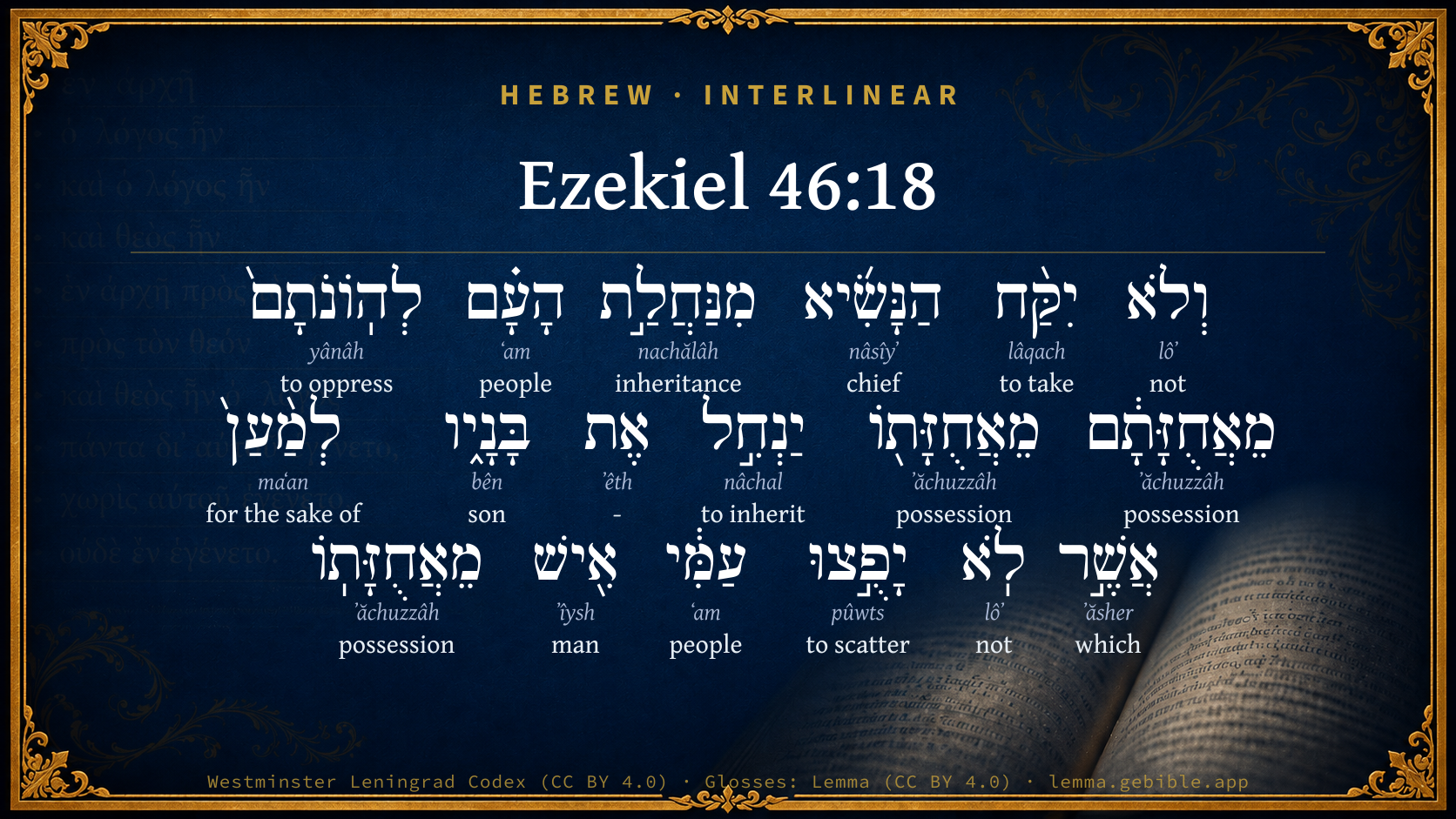
Hebrew (Westminster Leningrad Codex) Ezekiel 46:18 appears in the Hebrew Old Testament. The text above is from the Westminster Leningrad Codex. Each word links to its Strong’s number, a concise gloss, and parsing drawn from the Open Scriptures Hebrew Bible morphology. Click any word for its full Brown-Driver-Briggs (BDB) entry.
Download image
Cite this verse

Ezekiel 46:18 (World English Bible). Public Domain. Lemma interlinear Bible study tool, https://lemma.gebible.app/v/ezekiel/46/18.

Show BibTeX & RIS
BibTeX
RIS
English Translation
Moreover the prince shall not take of the people's inheritance, to thrust them out of their possession; he shall give inheritance to his sons out of his own possession, that my people not be scattered every man from his possession.
World English Bible · Public Domain
Download a study sheet

One document with this verse’s original text, its word-by-word gloss line, the meaning frame, cross-references with their text, attributed commentary, and full source and license credits — printable, and it pastes into notes with its structure intact.

This verse Autodidact and up

Study sheet (.html) Plain text (.txt)

A passage Seminary Student

Up to 50 verses in one chapter. A passage sheet keeps up to 6 commentary sources and 12 cross-references per verse, in the order this page ranks them, and says so on the sheet whenever that leaves anything out. Ask for a single verse and you get the Autodidact verse sheet above.

Everything on this page stays free to read, with no account — the sheet is a download of what is already on screen, not access to it.

Want to remove ads? Support Godless Engineer
Compare translations 3

The same verse in 3 English versions, stacked beneath the original-language interlinear above. Click any original word for its lexicon entry.

Each is an independent rendering of the whole verse — the interlinear is not word-aligned to these translations.

Highlighted words mark where these versions differ — a whole-verse word diff, not a word-by-word alignment.

  • World English Bible Public Domain
    Moreover the prince shall not take of the people's inheritance, to thrust them out of their possession; he shall give inheritance to his sons out of his own possession, that my people not be scattered every man from his possession.
  • King James Version Public Domain
    Moreover the prince shall not take of the people's inheritance by oppression, to thrust them out of their possession; but he shall give his sons inheritance out of his own possession: that my people be not scattered every man from his possession.
  • unfoldingWord Literal Text CC BY-SA 4.0
    The prince will not take the people’s inheritance away from their own property; he must provide for his sons from his own property so that my people will not be scattered, each man from his own property.’”

unfoldingWord Literal Text — © unfoldingWord, licensed CC BY-SA 4.0. Word-aligned USFM3 via Door43 (git.door43.org/unfoldingWord/en_ult).

Versions to compare (up to 4)

3 of 4 selected

Show all 18 translations

Every available English version of this verse, each an independent rendering of the whole verse.

  • World English Bible Public Domain
    Moreover the prince shall not take of the people's inheritance, to thrust them out of their possession; he shall give inheritance to his sons out of his own possession, that my people not be scattered every man from his possession.
  • Berean Standard Bible Public Domain
    The prince must not take any of the inheritance of the people by evicting them from their property. He is to provide an inheritance for his sons from his own property, so that none of My people will be displaced from his property.’”
  • Majority Standard Bible Public Domain
    The prince must not take any of the inheritance of the people by evicting them from their property. He is to provide an inheritance for his sons from his own property, so that none of My people will be displaced from his property.’”
  • King James Version Public Domain
    Moreover the prince shall not take of the people's inheritance by oppression, to thrust them out of their possession; but he shall give his sons inheritance out of his own possession: that my people be not scattered every man from his possession.
  • American Standard Version (1901) Public Domain
    Moreover the prince shall not take of the people's inheritance, to thrust them out of their possession; he shall give inheritance to his sons out of his own possession, that my people be not scattered every man from his possession.
  • Revised Version (1885) Public Domain
    Moreover the prince shall not take of the people’s inheritance, to thrust them out of their possession; he shall give inheritance to his sons out of his own possession: that my people be not scattered every man from his possession.
  • Geneva Bible (1599) Public Domain
    Moreouer the prince shall not take of the peoples inheritance, nor thrust them out of their possession: but he shall cause his sonnes to inherit of his owne possession, that my people be not scattered euery man from his possession.
  • Douay-Rheims (1899) Public Domain
    And the prince shall not take of the people's inheritance by violence, nor of their possession: but out of his own possession he shall give an inheritance to his sons: that my people be not dispersed every man from his possession.
  • Young's Literal Translation Public Domain
    And the prince doth not take of the inheritance of the people to oppress them, out of their possession, out of his own possession he doth cause his sons to inherit, so that My people are not scattered each from his possession.'
  • Literal Standard Version CC BY-SA 4.0
    And the prince does not take from the people’s inheritance to oppress them—from their possession; he causes his sons to inherit out of his own possession, so that My people are not each scattered from his possession.”
  • Unlocked Literal Bible CC BY-SA 4.0
    The prince will not take the people's inheritance away from their own property; he must provide for his sons from his own property so that my people will not be scattered, each man from his own property.'”
  • unfoldingWord Literal Text CC BY-SA 4.0
    The prince will not take the people’s inheritance away from their own property; he must provide for his sons from his own property so that my people will not be scattered, each man from his own property.’”
  • Darby Bible Public Domain
    And the prince shall not take of the people's inheritance, to thrust them by oppression out of their possession: he shall give his sons an inheritance out of his own possession: that my people be not scattered every one from his possession.
  • World Messianic Bible Public Domain
    Moreover the prince shall not take of the people’s inheritance, to thrust them out of their possession. He shall give inheritance to his sons out of his own possession, that my people not each be scattered from his possession.”’”
  • Webster's Bible Public Domain
    Moreover the prince shall not take of the people's inheritance by oppression, to thrust them out of their possession; but he shall give his sons' inheritance out of his own possession: that my people be not scattered every man from his possession.
  • Free Bible Version CC BY-SA 4.0
    The prince is not to take people's land, driving them off their property. He is to give land to his sons from his own property, so that none of my people shall be evicted from their property.”
  • Bible in Basic English Public Domain
    And the ruler is not to take the heritage of any of the people, driving them out of their property; he is to give a heritage to his sons out of the property which is his: so that my people may not be sent away from their property.
  • JPS Tanakh (1917) Public Domain
    Moreover the prince shall not take of the people's inheritance, to thrust them wrongfully out of their possession; he shall give inheritance to his sons out of his own possession; that My people be not scattered every man from his possession.'

Literal Standard Version (2020), Covenant Press — licensed CC BY-SA 4.0. Text via the HelloAO Bible API (eBible.org). Unlocked Literal Bible (unfoldingWord) — licensed CC BY-SA 4.0. Text via the HelloAO Bible API (eBible.org). unfoldingWord Literal Text — © unfoldingWord, licensed CC BY-SA 4.0. Word-aligned USFM3 via Door43 (git.door43.org/unfoldingWord/en_ult). Free Bible Version, Dr. Jonathan Gallagher — licensed CC BY-SA 4.0. Text via the HelloAO Bible API (eBible.org).

Word by word

More ways to search: Search by grammar → Find every occurrence → Compare this word →

Practice this passage: Drill this verse → Learn its vocabulary →

לְהֽוֹנֹתָם֙
yânâh
H3238
“to oppress · them”
Preposition + Verb, Hiphil, Infinitive Construct + Suffix, Personal, 3rd Person, Masculine, Plural
Part of Speech
Preposition + Verb
Stem
Hiphil
Form
Infinitive Construct
Full BDB Definition

Origin: a primitive root

TWOT: 873

to oppress, suppress, treat violently, maltreat, vex, do wrong - (Qal) to oppress, suppress - (Hiphil) to treat violently, maltreat
  1. וְלֹא lôʼ H3808 “and · not” Conjunction + Particle, Negative
  2. יִקַּ֨ח lâqach H3947 “to take” Verb, Qal, Imperfect, 3rd Person, Masculine, Singular
  3. הַנָּשִׂ֜יא nâsîyʼ H5387 “the · chief” Particle, Definite Article + Noun, Common, Masculine, Singular, Absolute
  4. מִנַּחֲלַ֣ת nachălâh H5159 “from · inheritance of” Preposition + Noun, Common, Feminine, Singular, Construct
  5. הָעָ֗ם ʻam H5971 “the · people” Particle, Definite Article + Noun, Common, Masculine, Singular, Absolute
  6. מֵאֲחֻזָּתָ֔ם ʼăchuzzâh H272 “from · possession · their” Preposition + Noun, Common, Feminine, Singular, Construct + Suffix, Personal, 3rd Person, Masculine, Plural
  7. מֵאֲחֻזָּת֖וֹ ʼăchuzzâh H272 “from · possession · his” Preposition + Noun, Common, Feminine, Singular, Construct + Suffix, Personal, 3rd Person, Masculine, Singular
  8. יַנְחִ֣ל nâchal H5157 “to inherit” Verb, Hiphil, Imperfect, 3rd Person, Masculine, Singular
  9. אֶת ʼêth H853 “-” Particle, Direct Object
  10. בָּנָ֑יו bên H1121 “sons · his” Noun, Common, Masculine, Plural, Construct + Suffix, Personal, 3rd Person, Masculine, Singular
  11. לְמַ֨עַן֙ maʻan H4616 “for the sake of” Preposition
  12. אֲשֶׁ֣ר ʼăsher H834 “which” Particle, Relative
  13. לֹֽא lôʼ H3808 “not” Particle, Negative
  14. יָפֻ֣צוּ pûwts H6327 “to scatter” Verb, Qal, Imperfect, 3rd Person, Masculine, Plural
  15. עַמִּ֔י ʻam H5971 “people · my” Noun, Common, Masculine, Singular, Construct + Suffix, Personal, 1st Person, Common, Singular
  16. אִ֖ישׁ ʼîysh H376 “man” Noun, Common, Masculine, Singular, Absolute
  17. מֵאֲחֻזָּתֽוֹ ʼăchuzzâh H272 “from · possession · his” Preposition + Noun, Common, Feminine, Singular, Construct + Suffix, Personal, 3rd Person, Masculine, Singular

About this verse

These counts appear in no published source. They are computed here, from the morphology-tagged text and Lemma’s own curated glosses. What Lemma adds →

18
words
14
distinct lemmas
Prophets
section

Notable vocabulary

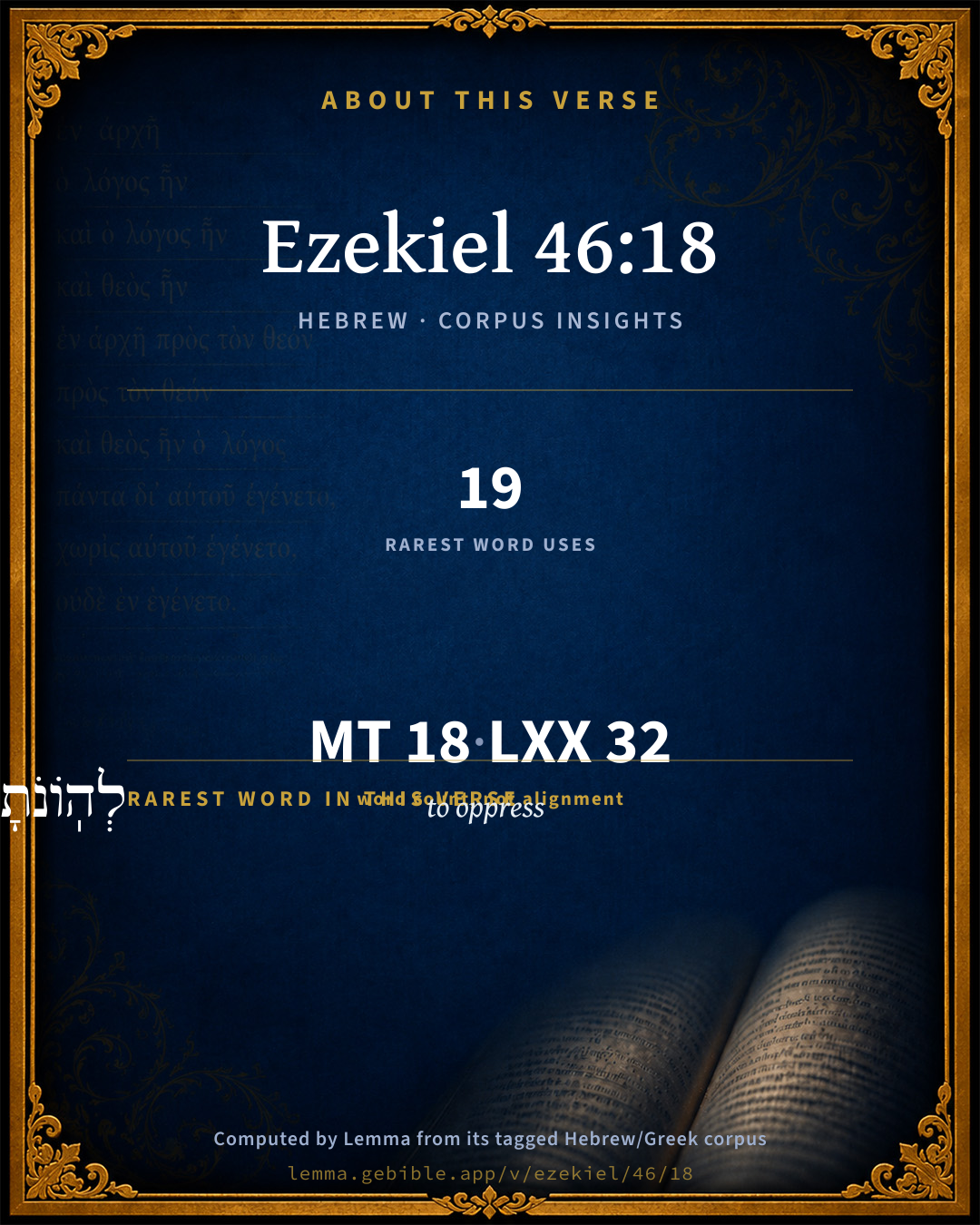
The rarest word here is לְהֽוֹנֹתָם֙ to oppress H3238 — appearing just 19 times in the whole Hebrew Bible.

Shared distinctive vocabulary

לְהֽוֹנֹתָם֙ to oppress H3238 occurs in 19 verses of the Hebrew Bible. Also found in:

Grammatical profile

  • 4 verbs
  • 9 nouns
  • 1 preposition
  • 4 particles

Verb forms

  • יִקַּ֨ח Qal · Imperfect
  • לְהֽוֹנֹתָם֙ Hiphil · Infinitive Construct
  • יַנְחִ֣ל Hiphil · Imperfect
  • יָפֻ֣צוּ Qal · Imperfect

Repetition

Words recur within this verse — often emphatic in Hebrew:

  • מֵאֲחֻזָּתָ֔ם possession H272 ×3
  • הָעָ֗ם people H5971 ×2
  • וְלֹא not H3808 ×2

Hebrew & Septuagint length

In English translation the verse runs 40 words from the Hebrew and 41 from the Septuagint (LXX English) — closely comparable.

A rough comparison of the two English renderings, which tokenize alike — not a word-level alignment.

Word counts can differ between the Hebrew and the Greek without any difference in meaning — e.g. the Hebrew direct-object marker אֵת has no separate Greek word, and Greek often adds the article ὁ.

In the original languages it is 18 Hebrew tokens and 32 Greek tokens — but the two are counted differently (Hebrew bundles its prefixes and suffixes into one token; the Greek is in lemma form), so that isn’t a like-for-like length.

Cross-references

16

Topical passages linked to Ezekiel 46:18 in the Treasury of Scripture Knowledge — connected by theme and wording, ordered by reader-vote popularity; previews shown in the World English Bible.

  • Ezekiel 45:8 In the land it shall be to him for a possession in Israel: and my princes shall no more oppress my people; but they shall give the land to the house of Israel according to their tribes.
  • 1 Kings 21:19 You shall speak to him, saying, Thus says Yahweh, Have you killed and also taken possession? You shall speak to him, saying, Thus says Yahweh, In the place where dogs licked the blood of Naboth shall dogs lick your blood, even yours.
  • Ezekiel 22:27 Her princes in the midst of it are like wolves ravening the prey, to shed blood, [and] to destroy souls, that they may get dishonest gain.
  • Psalms 72:2–4 He will judge your people with righteousness, And your poor with justice.
  • Psalms 78:72 So he was their shepherd according to the integrity of his heart, And guided them by the skillfulness of his hands.
  • Isaiah 11:3–4 His delight shall be in the fear of Yahweh; and he shall not judge after the sight of his eyes, neither decide after the hearing of his ears;
  • Isaiah 32:1–2 Behold, a king shall reign in righteousness, and princes shall rule in justice.
  • Jeremiah 23:5–6 Behold, the days come, says Yahweh, that I will raise to David a righteous Branch, and he shall reign as king and deal wisely, and shall execute justice and righteousness in the land.
  • Ezekiel 34:3–6 You eat the fat, and you clothe you with the wool, you kill the fatlings; but you don't feed the sheep.
  • Ezekiel 34:21 Because you thrust with side and with shoulder, and push all the diseased with your horns, until you have scattered them abroad;
  • Micah 1:1–2 The word of Yahweh that came to Micah the Morashtite in the days of Jotham, Ahaz, and Hezekiah, kings of Judah, which he saw concerning Samaria and Jerusalem.
  • Micah 2:1–2 Woe to those who devise iniquity And work evil on their beds! When the morning is light, they practice it, Because it is in the power of their hand.
  • John 10:28 I give eternal life to them. They will never perish, and no one will snatch them out of my hand.
  • Ephesians 4:8 Therefore he says, "When he ascended on high, he led captivity captive, and gave gifts to men."
  • Micah 3:1–3 I said, "Please listen, you heads of Jacob, And rulers of the house of Israel: Isn't it for you to know justice?
  • Psalms 68:18 You have ascended on high. You have led away captives. You have received gifts among men, Yes, among the rebellious also, that Yah God might dwell there.

Cross-references courtesy of OpenBible.info (CC BY 4.0).

Hebrew and Greek witnesses Masoretic Hebrew ↔ Greek Septuagint

The same verse in the two great witnesses to the Old Testament, shown verse-for-verse.

These are two independent witnesses, not word-aligned to each other, and the Septuagint is shown in lemma (dictionary) form.

Hebrew Ezekiel 46:18 Masoretic · Westminster Leningrad Codex

וְלֹא יִקַּ֨ח הַנָּשִׂ֜יא מִנַּחֲלַ֣ת הָעָ֗ם לְהֽוֹנֹתָם֙ מֵאֲחֻזָּתָ֔ם מֵאֲחֻזָּת֖וֹ יַנְחִ֣ל אֶת בָּנָ֑יו לְמַ֨עַן֙ אֲשֶׁ֣ר לֹֽא יָפֻ֣צוּ עַמִּ֔י אִ֖ישׁ מֵאֲחֻזָּתֽוֹ

Moreover the prince shall not take of the people's inheritance, to thrust them out of their possession; he shall give inheritance to his sons out of his own possession, that my people not be scattered every man from his possession.

World English Bible · Public Domain

Greek LXX Ezekiel 46:18 Septuagint · lemma form

καί οὐ μή λαμβάνω ὁ ἀποἡγέομαι ἐκ ὁ κληρονομία ὁ λαός καταδυναστεύω αὐτός ἐκ ὁ κατάσχεσις αὐτός κατακληρονομέω ὁ υἱός αὐτός ὅπως μή διασκορπίζω ὁ λαός ἐγώ ἕκαστος ἐκ ὁ κατάσχεσις αὐτός

And the prince shall by no means take of the inheritance of the people, to oppress them: he shall give an inheritance to his sons out of his own possession: that my people be not scattered, every one from his possession.

LXX2012 (modern English Septuagint) · Public Domain

Hebrew: Westminster Leningrad Codex (CC BY 4.0). Greek: Septuagint (public domain); English from LXX2012 (modern English Septuagint) (Public Domain). How the Septuagint differs from the Hebrew →

Targum (Aramaic paraphrase)

1

The Targum is the ancient Jewish Aramaic paraphrase of the Hebrew Scriptures — an interpretive translation, not the Hebrew text itself. Onkelos (literal) and Pseudo-Jonathan (expansive) render the Torah, and Jonathan the Prophets. Coverage is partial: where no permissively-licensed English translation exists for a verse, only the Aramaic is shown. This is verse-level text, not a word-by-word alignment to the Hebrew.

  1. Targum Jonathan Prophets (Joshua–Malachi)
    וְלָא יִסַב רַבָּא מֵאַחֲסָנַת עַמָא לְמֵינַסְהוֹן מֵאַחֲסַנְתְּהוֹן מֵאַחֲסַנְתֵּיהּ יַחְסִין לִבְנוֹהִי בְּדִיל דְלָא יִתְבַּדְרוּן עַמִי גְבַר מֵאַחֲסַנְתֵּיהּ:

    (no public-domain English translation for this verse)

    Targum Jonathan — Aramaic: “Mikraot Gedolot” (public domain). English: “Sefaria Community Translation” (CC0 1.0 (public-domain dedication)); “London "Chaldee Paraphrase," 1871” (public domain). Text via Sefaria.

Commentary

Notes on Ezekiel 46:18 from classic Christian and Jewish commentators (each source and its license shown beneath its notes). The classic Christian expositions comment on the surrounding passage and are grouped to its opening verse, so a note may address several verses; the Jewish commentaries on the Tanakh (Rashi and others) are per-verse, so they appear only where the commentator wrote on this verse.

Lemma curates 59 commentaries, every one of them public domain or Creative Commons licensed, each selected and text-cleaned for this edition rather than reprinted as found. About our sources →

Trapp's Complete Commentary

John Trapp

Eze 46:18 Moreover the prince shall not take of the people’s inheritance by oppression, to thrust them out of their possession; [but] he shall give his sons inheritance out of his own possession: that my people be not scattered every man from his possession.

Ver. 18. To thrust them out of their possession.] Ill accidents attend such princes, as affecting to be absolute in power, will be too resolute in will, or dissolute in life; oppressing their subjects to enrich their servants and parasites.

John Trapp, A Commentary or Exposition upon All the Books of the Old and New Testament (1647–1656) — public domain. Text from a community e-Sword module.

Geneva Bible (1599)

Geneva Bible translators

But be content with that portion that God hath assigned him, as Ezek. 45:8.

Geneva Bible (1599) marginal notes — public domain. Text via Bolls.life.

Ellicott's Commentary for English Readers

(18) Shall not take of the people’s inheritance.—Fresh warning is here given against oppression on the part of the prince, and he is reminded that the territory given inalienably to him and his heirs is to provide for his sons’ inheritance.

A Bible Commentary for English Readers, edited by Charles John Ellicott (1878–1897) — public domain. Text from a community e-Sword module.

John Gill's Exposition

After he brought me through the entry, which was at the side of the gate,.... The north gate of the inner court, where the prophet was last, Eze 44:4, through an entry, by the side of that, he was brought by the man his guide:

into the holy chambers of the priests; see Eze 42:13,

and, behold, there was a place in the two sides westward; or, "on their sides westward" (p); on the west side of the chambers; the Targum is at the west end of them: the use of this place follows,

(p) "in lateribus ejus vel eorum, in extremo", Starckius.

John Gill's Exposition of the Whole Bible (1746–1763) — public domain (CC PDM 1.0). Text via the HelloAO Bible API.

Matthew Poole's English Annotations

Shall not take; seize and escheat as forfeited, (like as Ahab dealt with Naboth, or David with Mephibosheth,) to give to others, or keep for himself.

By oppression; whether fraudulent or violent oppression, whether under colour of justice or against all rules of law.

To thrust them out, that he may put in his own creatures or children.

He shall give his sons, provide for his own, ont of that is his own.

That my people be not scattered; that they may keep together in their own land.

Matthew Poole's English Annotations on the Holy Bible (1683–1685) — public domain. Text from a community e-Sword/MySword module.

The Pulpit Commentary

The third regulation. The prince in all cases should endow his sons (or others) out of his own, and not out of his subjects" possessions, of which they have been violently robbed. A good rule for other princes besides this, and for owners of property in general

A warning to the great.

I THE GREAT ARE RESPONSIBLE TO GOD. The prince is the leader and supreme ruler of Israel. His rank and privilege lift him into the most exalted position. Yet he is responsible to God, and his duty is definitely marked out for him. Even the most "irresponsible" ruler of a despotic state cannot escape from responsibility in the sight of Heaven. Prince as well as peasant will have to give account of himself before the judgment-seat of God. Moreover, God directs and controls the movements of the most powerful earthly magnates. He who said to the sea, "Hitherto shalt thou come, but no further; and here shall thy proud waves be stayed," "put his hooks" in the proud ruler of Egypt. (Eze_29:4)

II THE GREAT ARE TEMPTED TO EXCEED THEIR RIGHTS. Men who enjoy the largest scope and who own the widest possessions must come to the confines of their territory. The biggest park has its fence. Now, a common temptation is to despise the best things within a man"s right, in envy for what lies beyond them. Thus, with all the wealth of the royal demesne, Ahab is sick with covetousness for Naboth"s vineyard. (1Ki_21:4) The possession of considerable power aggravates the temptation of the great to go beyond their rights. It is difficult for the despot to avoid degenerating into a tyrant.

III THE GREAT ARE WARNED AGAINST OPPRESSING THE PEOPLE. The danger of power passing over to tyranny is the besetting temptation of persons in influential positions. This danger alone raises a question as to the wisdom of entrusting overmuch power even to the best men. In the abstract, an irresistible paternal government might seem to be likely to secure the greatest good of a nation. But for this to be satisfactory we must not only endue the ruler with supreme wisdom, we must also eliminate from his character every atom of selfishness.

IV THE GREAT ARE NOT MORE FAVORED BY GOD THAN ARE OTHER PEOPLE. They have unique privileges, but these are bestowed in the form of a solemn trust. God is no respecter of persons. He cares for all his children. He is the people"s God, and the Friend of the poor. They who can find no earthly protector may look to Heaven for deliverance, for he who heard the cry of the Hebrews when they groaned under the oppression of the Egyptian bondage, and saved them from Pharaoh and his host, is still mighty to help the needy.

V GOD"S EQUAL GRACE FOR THE PEOPLE AS WELL AS THE GREAT SHOULD LEAD ALL TO TRUST HIM. If God only favored the so-called privileged classes, the multitude might well turn aside from religion in despair. But since God has ever been on the side of the oppressed, and has ever cared for the people, it is foolish to distrust him, and ungrateful to disregard his goodness. Whatever else the great may seize upon, they cannot take away the poor man"s religion. Here is a prize of permanent possession. It would be well if all knew and loved the God who cares for all.

Losing and keeping the inheritance.

The subject of this commandment is "the inalienable nature of the prince"s possession, and the sacred regard he must pay to the peoples its object was to legislate so that "no temptation might exist to spoil the people of their proper inheritances, as had been too often done in the days that were past." By the words of the text we are brought in contact with

I THE HEBREW IDEAL OF FAMILY INHERITANCE. The Mosaic legislation contemplated keeping the land in the occupancy of the same tribe and of the same family from generation to generation. It was not in the power of the occupier to sell it or to will it away from the family; and although it might be mortgaged, it reverted to the original possessor (or his family) at the year of jubilee. The ideal was that of all the families of the nation being interested and engaged in the happy, honorable, and fruitful employment of agriculture. In this case there would be no superabounding wealth on the one hand, and no degrading poverty on the other hand; while every Israelite would have the deepest interest in preserving the integrity of his country"s freedom, and would be contributing to its wealth. Such an ideal as this is hopelessly impossible in such a time as this, but in a primitive and pastoral age it was one calculated to secure the largest possible measure of individual happiness, domestic comfort, and national prosperity.

II ITS PARTIAL FAILURE AND ULTIMATE DISAPPEARANCE. Such a provision must have been attended with great difficulties in the way of realization. Dissipation on the one hand and avarice on the other would almost inevitably lead to loss and to appropriation. And there is no doubt they did. As time went by the land became lost to the families to whom it was originally apportioned. (Jos_19:51) And when the time camefor the great and sad deportation to other lands, the entire arrangement was broken up; finally the Jews were "scattered, every man from his possession;" and, dispersed among the Gentiles, they became the least pastoral or agricultural, and the most trading and financing, of any people on the earth. Where, then, does this prediction find

III A PLACE IN THE KINGDOM OF CHRIST? It will find it, in substance, in

1. Provision for the material well-being of the people of the land. As the result of Christian principle acting at both ends of the body politic, elevating the character and therefore the condition of those at the bottom, and leading those at the top to devote their resources and employ their (legislative and other) opportunities in the interest of the people, there will gradually ensue a wide distribution of comfort and prosperity. Abject poverty and superfluous possession will give place to universal competence, education, morality, piety in fact, national well-being. Many forces will have to contribute to this result, and it may be a long time coming, but it must be the issue of a true and practical Christianity. There are other "inheritances" beside that of land and wealth which need to be preserved, and which a Christian family or a Christian Church should devoutly determine to maintain. There must be:

2. The perpetuation of the fair heritage of an honorable name, a reputation for family goodness or wisdom that has come down many generations.

3. The preservation of the precious deposit of sacred truth. C.

The Pulpit Commentary (1880–1919), ed. H.D.M. Spence-Jones & Joseph S. Exell — public domain. Text from a community e-Sword module.

Lesson kit

Teaching starters — assembled from the data on this page, not authored interpretation. Every prompt links to the verse data it draws on. Edit before teaching.

Ezekiel, in the Prophets, opens this verse with 18 words (14 distinct Hebrew lemmas). Its most distinctive word is yânâh (“to oppress”). A historical commentator’s framing appears above. Read the whole chapter for the surrounding context.

Discussion questions

  1. What does “to oppress” (yânâh) contribute to the verse as a whole?
  2. Exodus 22:21 shares the word «to oppress» with this verse. How do the two illuminate each other?
  3. “possession” occurs 3× in this one verse. What is the effect of the repetition?
  4. These translations render this verse differently. What is at stake in choosing one wording over another?
  5. The verb «יִקַּ֨ח» is Qal Imperfect. How does its form color the action?
  6. Reading how Trapp's Complete Commentary and Geneva Bible (1599) read this verse, where do the two commentators agree and where do they part?

Things to notice

Reading settings

Reading text

Shown beneath each verse's original-language words.

Old Testament
Old Testament edition

Read the OT as the Masoretic Hebrew (MT) or the Greek Septuagint (LXX).

English shown for the Greek Septuagint (in the Hebrew ↔ Greek comparison).

Comparing translations? Open the Compare panel on any verse page to stack up to four side by side.