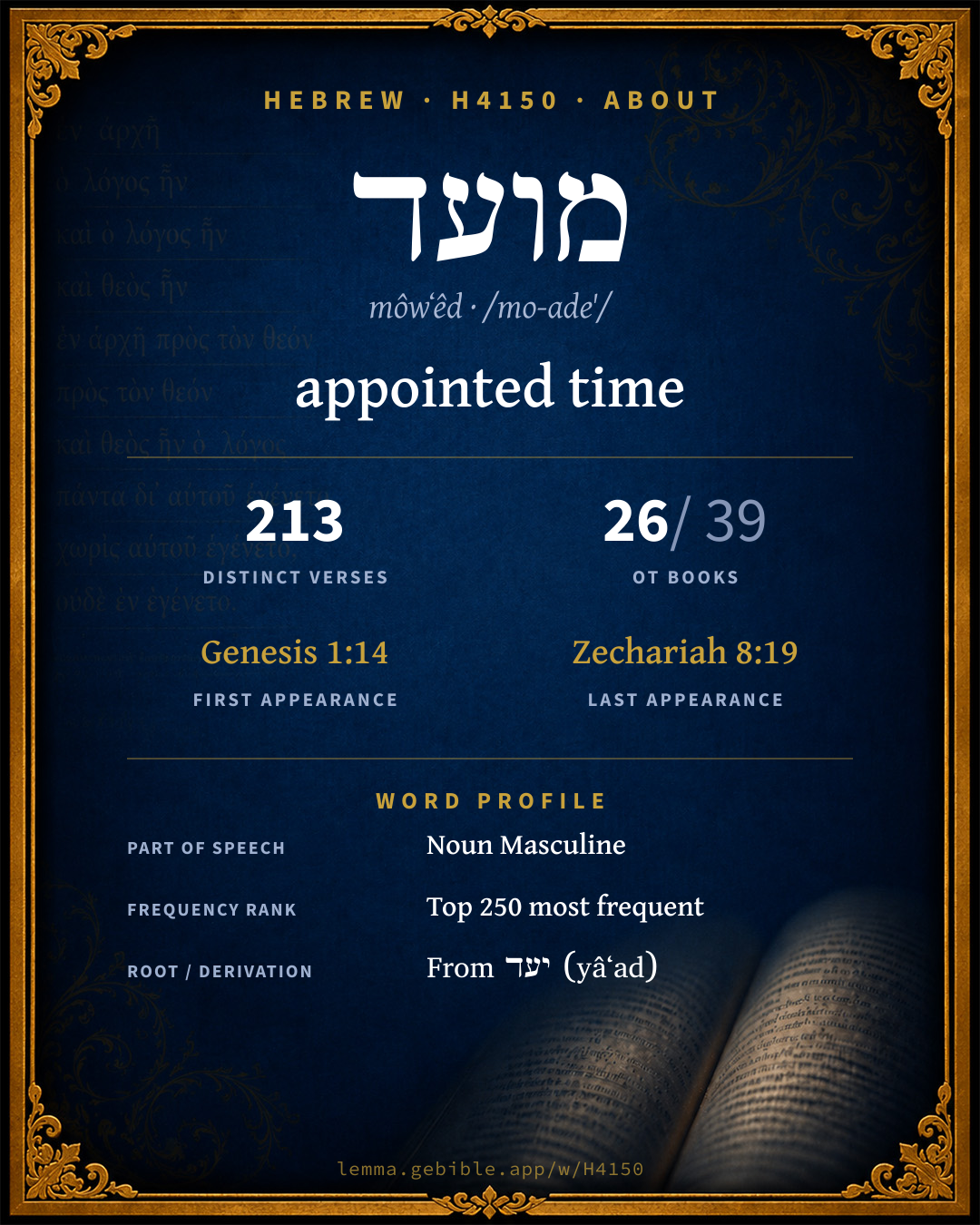
מוֹעֵד
appointed time
also: appointed place, meeting fuller range ↓
Full lexicon entry — Brown-Driver-Briggs (BDB)
From Brown-Driver-Briggs (BDB)
Where this word appears
See every Absolute-state word in the Hebrew Bible →
Grammar key — what these labels mean
Part of speech
- Noun
- A naming word — a person, place, thing, or idea.
Noun type
- Common
- A common noun — a general class of person, place, or thing (“king,” “city,” “water”), not a specific name.
State
- Absolute
- The independent form of a noun, not bound to a following word.
- Construct
- A noun bound to a following noun in a possessive / “of” relationship (the construct chain).
Gender
- Masculine
- Grammatically masculine.
Number
- Singular
- One.
- Plural
- More than one (in Hebrew, generally three or more).
Every verse where H4150 appears in the Book of Leviticus — 45 distinct verses. Click any verse to open its interlinear word-by-word view. Verse text shown in the World English Bible for context — . Each verse’s Hebrew form is shown with its reference; the English is not keyword-highlighted, since the data carries no word-level English alignment. Use “Compare translations” on any verse to read it across multiple English versions. This concordance covers the Hebrew Bible; Septuagint (Greek Old Testament) occurrences are not indexed here.
Leviticus
- Leviticus 1:1 מוֹעֵ֖ד n c ms Yahweh called to Moses, and spoke to him out of the Tent of Meeting, saying,
- Leviticus 1:3 מוֹעֵד֙ n c ms "'If his offering is a burnt offering from the herd, he shall offer a male without blemish. He shall offer it at the door of the Tent of Meeting, that he may be accepted before Yahweh.
- Leviticus 1:5 מוֹעֵֽד n c ms He shall kill the bull before Yahweh. Aaron's sons, the priests, shall present the blood and sprinkle the blood around on the altar that is at the door of the Tent of Meeting.
- Leviticus 3:2 מוֹעֵ֑ד n c ms He shall lay his hand on the head of his offering, and kill it at the door of the tent of meeting: and Aaron's sons the priests shall sprinkle the blood on the altar round about.
- Leviticus 3:8 מוֹעֵ֑ד n c ms and he shall lay his hand on the head of his offering, and kill it before the tent of meeting: and Aaron's sons shall sprinkle its blood on the altar round about.
- Leviticus 3:13 מוֹעֵ֑ד n c ms and he shall lay his hand on its head, and kill it before the tent of meeting; and the sons of Aaron shall sprinkle its blood on the altar round about.
- Leviticus 4:4 מוֹעֵ֖ד n c ms He shall bring the bull to the door of the Tent of Meeting before Yahweh; and he shall lay his hand on the head of the bull, and kill the bull before Yahweh.
- Leviticus 4:5 מוֹעֵֽד n c ms The anointed priest shall take some of the blood of the bull, and bring it to the Tent of Meeting.
- Leviticus 4:7 מוֹעֵ֑ד מוֹעֵֽד n c ms n c ms The priest shall put some of the blood on the horns of the altar of sweet incense before Yahweh, which is in the tent of meeting; and he shall pour out all the blood of the bull out at the base of the altar of burnt offering, which is at the door of the Tent of Meeting.
- Leviticus 4:14 מוֹעֵֽד n c ms when the sin in which they have sinned is known, then the assembly shall offer a young bull for a sin offering, and bring it before the Tent of Meeting.
- Leviticus 4:16 מוֹעֵֽד n c ms The anointed priest shall bring of the blood of the bull to the Tent of Meeting:
- Leviticus 4:18 מוֹעֵ֑ד מוֹעֵֽד n c ms n c ms He shall put some of the blood on the horns of the altar which is before Yahweh, that is in the Tent of Meeting; and the rest of the blood he shall pour out at the base of the altar of burnt offering, which is at the door of the Tent of Meeting.
- Leviticus 6:16 מוֹעֵ֖ד n c ms That which is left of it Aaron and his sons shall eat. It shall be eaten without yeast in a holy place. They shall eat it in the court of the Tent of Meeting
- Leviticus 6:26 מוֹעֵֽד n c ms The priest who offers it for sin shall eat it. It shall be eaten in a holy place, in the court of the Tent of Meeting.
- Leviticus 6:30 מוֹעֵ֛ד n c ms No sin offering, of which any of the blood is brought into the Tent of Meeting to make atonement in the Holy Place, shall be eaten: it shall be burned with fire.
- Leviticus 8:3 מוֹעֵֽד n c ms and assemble all the congregation at the door of the Tent of Meeting."
- Leviticus 8:4 מוֹעֵֽד n c ms Moses did as Yahweh commanded him; and the congregation was assembled at the door of the Tent of Meeting.
- Leviticus 8:31 מוֹעֵד֒ n c ms Moses said to Aaron and to his sons, "Boil the flesh at the door of the Tent of Meeting, and there eat it and the bread that is in the basket of consecration, as I commanded, saying, 'Aaron and his sons shall eat it.'
- Leviticus 8:33 מוֹעֵ֜ד n c ms You shall not go out from the door of the Tent of Meeting seven days, until the days of your consecration are fulfilled: for he shall consecrate you seven days.
- Leviticus 8:35 מוֹעֵ֜ד n c ms At the door of the Tent of Meeting you shall stay day and night seven days, and keep the charge of Yahweh, that you don't die: for so I am commanded."
- Leviticus 9:5 מוֹעֵ֑ד n c ms They brought what Moses commanded before the Tent of Meeting: and all the congregation drew near and stood before Yahweh.
- Leviticus 9:23 מוֹעֵ֔ד n c ms Moses and Aaron went into the Tent of Meeting, and came out, and blessed the people: and the glory of Yahweh appeared to all the people.
- Leviticus 10:7 מוֹעֵ֜ד n c ms You shall not go out from the door of the Tent of Meeting, lest you die; for the anointing oil of Yahweh is on you." They did according to the word of Moses.
- Leviticus 10:9 מוֹעֵ֖ד n c ms "Drink no wine nor strong drink, you, nor your sons with you, when you go into the Tent of Meeting, that you don't die: it shall be a statute forever throughout your generations:
- Leviticus 12:6 מוֹעֵ֖ד n c ms "'When the days of her purification are completed, for a son, or for a daughter, she shall bring to the priest at the door of the Tent of Meeting, a year old lamb for a burnt offering, and a young pigeon, or a turtledove, for a sin offering:
- Leviticus 14:11 מוֹעֵֽד n c ms The priest who cleanses him shall set the man who is to be cleansed, and those things, before Yahweh, at the door of the Tent of Meeting.
- Leviticus 14:23 מוֹעֵ֖ד n c ms "On the eighth day he shall bring them for his cleansing to the priest, to the door of the Tent of Meeting, before Yahweh.
- Leviticus 15:14 מוֹעֵ֔ד n c ms "'On the eighth day he shall take two turtledoves, or two young pigeons, and come before Yahweh to the door of the Tent of Meeting, and give them to the priest:
- Leviticus 15:29 מוֹעֵֽד n c ms On the eighth day she shall take two turtledoves, or two young pigeons, and bring them to the priest, to the door of the Tent of Meeting.
- Leviticus 16:7 מוֹעֵֽד n c ms He shall take the two goats, and set them before Yahweh at the door of the Tent of Meeting.
- Leviticus 16:16 מוֹעֵ֔ד n c ms and he shall make atonement for the Holy Place, because of the uncleanness of the children of Israel, and because of their transgressions, even all their sins; and so he shall do for the Tent of Meeting, that dwells with them in the midst of their uncleanness.
- Leviticus 16:17 מוֹעֵ֗ד n c ms There shall be no one in the Tent of Meeting when he enters to make atonement in the Holy Place, until he comes out, and has made atonement for himself and for his household, and for all the assembly of Israel.
- Leviticus 16:20 מוֹעֵ֖ד n c ms "When he has made an end of atoning for the Holy Place, the Tent of Meeting, and the altar, he shall present the live goat.
- Leviticus 16:23 מוֹעֵ֔ד n c ms "Aaron shall come into the Tent of Meeting, and shall take off the linen garments, which he put on when he went into the Holy Place, and shall leave them there.
- Leviticus 16:33 מוֹעֵ֛ד n c ms Then he shall make atonement for the Holy Sanctuary; and he shall make atonement for the Tent of Meeting and for the altar; and he shall make atonement for the priests and for all the people of the assembly.
- Leviticus 17:4 מוֹעֵד֮ n c ms and hasn't brought it to the door of the Tent of Meeting, to offer it as an offering to Yahweh before the tabernacle of Yahweh: blood shall be imputed to that man. He has shed blood; and that man shall be cut off from among his people.
- Leviticus 17:5 מוֹעֵ֖ד n c ms This is to the end that the children of Israel may bring their sacrifices, which they sacrifice in the open field, that they may bring them to Yahweh, to the door of the Tent of Meeting, to the priest, and sacrifice them for sacrifices of peace offerings to Yahweh.
- Leviticus 17:6 מוֹעֵ֑ד n c ms The priest shall sprinkle the blood on the altar of Yahweh at the door of the Tent of Meeting, and burn the fat for a sweet savor to Yahweh.
- Leviticus 17:9 מוֹעֵד֙ n c ms and doesn't bring it to the door of the Tent of Meeting, to sacrifice it to Yahweh; that man shall be cut off from his people.
- Leviticus 19:21 מוֹעֵ֑ד n c ms He shall bring his trespass offering to Yahweh, to the door of the Tent of Meeting, even a ram for a trespass offering.
- Leviticus 23:2 מוֹעֲדֵ֣י מוֹעֲדָֽ/י n c mp cs n c mp cs + sfx pers 1cs "Speak to the children of Israel, and tell them, 'The set feasts of Yahweh, which you shall proclaim to be holy convocations, even these are my set feasts.
- Leviticus 23:4 מוֹעֲדֵ֣י בְּ/מוֹעֲדָֽ/ם n c mp cs prep + n c ms cs + sfx pers 3mp "'These are the set feasts of Yahweh, even holy convocations, which you shall proclaim in their appointed season.
- Leviticus 23:37 מוֹעֲדֵ֣י n c mp cs "'These are the appointed feasts of Yahweh, which you shall proclaim to be holy convocations, to offer an offering made by fire to Yahweh, a burnt offering, and a meal offering, a sacrifice, and drink offerings, each on its own day;
- Leviticus 23:44 מֹעֲדֵ֖י n c mp cs Moses declared to the children of Israel the appointed feasts of Yahweh.
- Leviticus 24:3 מוֹעֵ֗ד n c ms Outside of the veil of the Testimony, in the Tent of Meeting, shall Aaron keep it in order from evening to morning before Yahweh continually: it shall be a statute forever throughout your generations.
About this entry
At a glance — auto-summarized from this page’s data, not written by a person. Every figure links to its source below. This summary describes the numbers; it doesn’t interpret them.
“appointed time” is the headline sense of the Hebrew noun מועד (môwʻêd). The King James Version usually renders it “congregation,” while modern versions prefer “meeting” (Berean Standard Bible) — see the renderings breakdown. With 213 verses in 26 books, it is a common word in the Hebrew Bible. It concentrates in Numbers, which alone accounts for 30% of its uses. Not a single-sense word: its full sense range also takes in “appointed place” and “meeting”. The sections below give every sense, occurrence, and version rendering.
Gloss history
Strong's 1890 vs modern scholarship
About this word
Strong's H4150 catalogs a Hebrew word from the Hebrew Old Testament.
These counts are not copied from any lexicon or concordance. They are computed here, from the morphology-tagged Hebrew Old Testament. What Lemma adds →
- 213
- distinct verses
- The word appears in 213 distinct verses.
- 26 / 39
- OT books
- The word appears in 26 of 39 Old Testament books.
- #212
- by frequency
- Top 250 most frequent Hebrew words (rank 212 of 8,640 Hebrew words by occurrence).
View all 213 occurrences in the concordance →
By section of the Old Testament
By traditional corpus
Conventional, traditional groupings — biblical authorship is debated, so this is a traditional corpus grouping, not an authorship claim. Each share is this word’s portion of its verses in that division of the Hebrew canon. Each figure is a share of the word’s 213 distinct verses.
- Torah (Pentateuch) 152 verses · 71%
- Prophets (Nevi'im) 31 verses · 15%
- Writings (Ketuvim) 30 verses · 14%
How translations render this word
Counts come from each version’s own published word-to-Strong’s tagging or interlinear alignment — an approximate guide to how each version renders this word, not a word-level alignment the data otherwise carries. Because each total is that version’s own tagged count, the per-version totals vary from one another and need not match the appearance or distinct-verse counts above. These counts may also differ from a printed concordance because Lemma counts each distinctly tagged rendering and does not collapse phrase taggings into a single head-word total. This is a fixed set of word-tagged versions (KJV, ASV, BSB, ULT) and does not change with the reading translation you choose elsewhere. Each version’s license is shown beside its name below (and on Sources).
- King James Version: Congregation 149×, Time appointed 6×, Solemn feasts 5×
- American Standard Version: Meeting 144×, Set feasts 8×, Appointed season 5×
- Berean Standard Bible: Meeting 146×, Appointed feasts 18×, Appointed time 13×
- unfoldingWord Literal Text: Meeting 147×, Appointed time 20×, Appointed times 10×
King James Version Public Domain
Renders H4150 across 223 tagged occurrences — most commonly:
Plus other, less common renderings. Plus 33 renderings that appear only once — usually multi-word phrases or single function words the recovered tagging swept in, not distinct renderings.
American Standard Version Public Domain
Renders H4150 across 225 tagged occurrences — most commonly:
Plus other, less common renderings. Plus 32 renderings that appear only once — usually multi-word phrases or single function words the recovered tagging swept in, not distinct renderings.
Berean Standard Bible Public Domain
Renders H4150 across 223 tagged occurrences — most commonly:
Plus 24 renderings that appear only once — usually multi-word phrases or single function words the recovered tagging swept in, not distinct renderings.
unfoldingWord Literal Text CC BY-SA 4.0
Renders H4150 across 228 tagged occurrences — most commonly:
Plus other, less common renderings. Plus 16 renderings that appear only once — usually multi-word phrases or single function words the recovered tagging swept in, not distinct renderings.
9 senses and sub-senses in the full BDB
What do BDB’s symbols mean?
BDB uses these scholarly abbreviations:
| Symbol | Meaning |
|---|---|
| 𝔊 | the Septuagint (the ancient Greek translation, LXX) |
| 𝔙 | the Vulgate (the Latin translation) |
| 𝔖 | the Syriac version (the Peshitta) |
| 𝔗 | the Targum (the Aramaic translation) |
| ψ | the Psalms |
| √ | root (the underlying root or stem) |
| ‖ | parallel passage (a synonymous or contrasted parallel) |
| † | the dagger: every passage where the word occurs is cited |
The 9 senses and sub-senses the full Brown-Driver-Briggs lexicon distinguishes for this word, in lexicon order (not ranked by frequency), with BDB’s own verbatim wording and sub-sense lettering. Shown in Hebrew script with BDB’s own scholarly abbreviations. The condensed entry is in the Lexicon Entry tab. See also the Forms in the corpus table below.
- 1. appointed time:
- a. in general with prefix לְ, at an or the appointed time Gn 18:14; Ex 13:10 (J), Ex 23:15; 34:18; Jos 8:14 (all JE), Gn 17:21; 21:2 (P), 1 S 9:24; 13:8 (after אשׁר insert either אָמַר 𝔊 𝔗 or שָׂם Dr), v 11 2 K 4:16, 17; Hb 2:3; Dn 8:19; 11:27, 29, 35; למ׳ דוד at the time appointed with David 1 S 20:35 (Thes SS place appointed); c. prefix בְּ Ho 2:11 Lv 23:4 Nu 9:2, 3, 7, 13; 28:2 (P); c. מִן 2 S 20:5; עַד עֵת מ׳ 24:15 unto the time appointed (but dub., v. Dr); c. vbs. בא מ׳ ψ 102:14; לקח מ׳ 75:3; שׂים מ׳ Ex 9:5 (J); העביר המ׳ Je 46:17; the stork ידעה מ׳ Je 8:7 knows her appointed time; מ׳ צאתך Dt 16:6 time of thy going forth (from Egypt). e.g. Genesis 18:14
- b. in particular (cf. Ex 13:10; 23:15; 34:18), sacred season, RV usually set feast or appointed season (wider than חַג, which was only a feast celebrated by a pilgrimage), מ׳ (ימי) יוֹם day(s) of appointed season (i.e. festivals) Ho 9:5; 12:10; La 2:7, 22; sg. indef. 1:4; of the feast of booths Dt 31:10; ‖ חג חדשׁ שׁבת Ho 2:13; ‖ שׁבת La 2:6; usually pl. מ׳ יהוה Lv 23:2, 4, 37, 44 (P), 2 Ch 2:3 Ezr 3:5; with sfs. referring to י׳ Lv 23:2 (P); בּמ׳ Nu 15:3; 29:39 (P), Ez 36:38; 46:9; קרית מ׳ city of our solemnities (sacred seasons) Is 33:20; למ׳ טובים Zc 8:19; ‖ שׁבתות Ez 44:24; ‖ חדשׁים Is 1:14; 1 Ch 23:31; 2 Ch 8:13; 31:3 Ne 10:34; ‖ חגים Ez 46:11; חגים חדשׁים Ez 45:17; ‖ ראשׁי חָדְשֵׁכֶם Nu 10:10 (P).—Notes. It is most probable that in Gn 1:14 (P), where מ׳ ‖ אֹתֹת, the reference is to the sacred seasons as fixed by the moon’s appearance; and so also עשׂה ירח למ׳ he made the moon for sacred seasons ψ 104:19, although many Lexx. & Comm. refer these to the seasons of the year.—למועד מועדים וחצי Dn 12:7 for a set time, times, and a half = 3 1/2 appointed times = half the prophetic week of years, cf. BrMP 453 f.—ויאכלו את המ׳ they ate throughout the sacred season (of Maṣṣoth) 2 Ch 30:22 AV RV, but Thes SS Be Ke Öt they ate the offerings of the sacred season; 𝔊 וַיְכַלּוּ. e.g. Exodus 13:10
- 2. appointed meeting: בֵּית מ׳ לְכָל־חַי Jb 30:23 house of meeting for every living (of She’ol); קְרִאֵי מ׳ Nu 16:2 (P) called to the assembly = קְרִאֵי הָעֵדָה; קרא עלי מ׳ La 1:15 called a festal meeting against me; בקרב מ׳ ψ 74:4 in the midst of thine assembly; הַר מוֹעֵד Is 14:13 mount of meeting or assembly (of the gods; the mountain of the gods in the extreme north, the oriental Olympus, Persian Alborg, Hindu Meru, Babylon. Arallû, cf. LenOrigines ii, ch. ix). e.g. Job 30:23
- 3. appointed place:
- a. the temple, ‖ שֻׂכּוֹ La 2:6, נוּגֵי ממ׳ afflicted (and driven) from the place of assembly Zp 3:18 (cf. BrMP 225). e.g. Lamentations 2:6
- b. synagogues, כָּל־מוֹעֲדֵי־אֵל בָּאָרֶץ all the appointed places of Ēl in the land ψ 74:8 = בֵּית וַעַד Sota 9:15. e.g. Psalms 74:8
- 4. appointed sign, signal, Ju 20:38. e.g. Judges 20:38
- 5. אֹהֶל מוֹעֵד tent of meeting (of God with his people: see יָעַד Niph. 1); the sacred tent of the Exodus (see אֹהֶל 3) Ex 33:7(×2) Nu 12:4; Dt 31:14(×2) (E), Nu 11:16 (J); often in P, as Ex 27:21; 29:4; Lv 1:1, 3; Jos 18:1; 19:51, etc. (131 times); elsewhere only 1 S 2:22b (om. 𝔊), 1 K 8:4 = 2 Ch 5:5, 1 Ch 6:17; 9:21; 23:32; 2 Ch 1:3, 6, 13. e.g. Exodus 33:7
Senses from the full Brown-Driver-Briggs lexicon (Brown, Driver, Briggs; Oxford 1906 — public domain), digitized via Sefaria, supplemented by the OpenScriptures HebrewLexicon (CC BY 4.0). Full attribution on Sources.
Word origin
n.m. ψ 102:14 appointed time, place, meeting; מ׳ Ex 9:5 + 183 times; מֹעֵד Dt 31:10; מוֹעֲדוֹ Nu 9:2 + 2 times; מֹעֲדוֹ La 2:6 + 3 times + 5 times sfs.; pl. מוֹעְדִים Dn 12:7 + 6 times; מֹעֲדִים Zc 8:19 1 Ch 23:31; מוֹעֲדוֹת 2 Ch 8:13; cstr. מוֹעֲדֵי Lv 23:2 + 6 times; מֹעֲדֵי Lv 23:44; sfs. מוֹעֲדַי Ez 44:24; מֹעֲדֵיכֶם Nu 15:3 + 6 times sfs;—
— Brown-Driver-Briggs (Oxford 1906, public domain), digitized via Sefaria, supplemented by the OpenScriptures HebrewLexicon (CC BY 4.0). See Sources.
Derived from יעד (yâʻad) (H3259) — to appoint.
Jastrow Dictionary
A second Hebrew/Aramaic lexicon for comparison, covering Aramaic and post-biblical (Talmudic, Targumic, Midrashic) usage that the biblical-Hebrew BDB does not. Matched by lemma rather than by Strong’s number, so a lemma may carry more than one Jastrow headword (shown separately below), and the entries cover usage well beyond the Bible.
מוּעָד
- (עוּד) forewarned, esp. (law) Muʿad (v. Ex. XXI, 29), an animal whose owner stands forewarned on account of three successive injuries; liable to full indemnity, contrad. to תָּם. B. Kam. I, 4 שור המ׳ an ox that has done damage three times. Ib. השן מ׳ לאכול וכ׳ the tooth of an animal is considered a muʿad with reference to eating such things as are fit to be eaten by it, i.e. damages for eating must be paid in full without previous forewarning. Ib. הרגל מ׳ לשבר וכ׳ the foot is a muʿad &c., i.e. what an animal treads upon on its way must be paid for in full without forewarning. Ib. הנחש מ׳ לעולם the serpent is always a muʿad (even when tamed). Ib. מ׳ משלם נזק שלם וכ׳ the muʿad pays full damage, collectible from the owner’s best property. Ib. II, 4 מ׳ כל שהעידו וכ׳ a muʿad is an animal against which three warnings on three days have been given; (another opin.) מ׳ שהעידו … פעמים against which three warnings have been given (even in one day). Ib. 5 אדם מ׳ לעולם damage done by a human being must under all circumstances be restored in full. Ib. 17ᵇ (הידוס) הרי זה מ׳ damage done by chickens must be restored in full; אינו מ׳ must not &c.; a. v. fr.—Trnsf. מ׳ לעבירה a muʿad for sin, i.e. likely to sin again. Num. R. s. 9 כיון שנשתלש בחטא נעשה מ׳ לע׳ having sinned three times, he has become a muʿad for sin.—Pl. מוּעָדִים, מוּעָדִין. B. Kam. I, 4; Tosef. ib. I, 4 חמשה מ׳ there are five kinds of muʿads. B. Kam. 16ᵃ; a. fr. e.g. Exodus 21:29
מוֹעֵד
- 1. appointed time, appointment. Pes. I, 3 (10ᵇ) בתוך המ׳ within the time appointed for the removal of leavened matter (up to the sixth hour of the day); אחר המ׳ after the time (until nightfall), Rashi; (oth. interpret., v. infra).—Pl. מוֹעֲדִים. Erub. 54ᵇ עשה מ׳ לתורה have fixed times for the study of the Law, v. מוֹדִיעַ.
- 2. festive season, festival, esp. = חוֹל הַמּ׳, the week-days intervening between the first and the last days of Passover and of Succoth. M. Kat. I, 1; a. fr.—Pes. l. c. בתוך המ׳ during the festive week of Passover; לאחר המ׳ after Passover, Tosaf.; (oth. interpret., v. supra).—Pl. מוֹעֲדִים, מוֹעֲדוֹת. Pes. X, 6 מ׳ ורגלים אחרים other seasons and festivals. Sabb. 145ᵇ מ׳ שבבל שמחים the festivals in Babylonia are joyously celebrated; a. fr.—מ׳ קטן Moʿed Katon, (half-festival) name of a treatise of the Mishnah, Tosefta, Talmud Babli and Y’rushalmi, of the Order of Moʿed.—סדר מ׳ the Order of Moʿed, name of the second order of the Mishnah, Tosefta and Talmud Babli and Y’rushalmi.
מוֹעֵד ²
- Targ. I Sam. I, 3; 4.—M. Kat. 18ᵇ חולא דמ׳ = חוֹל הַמּוֹעֵד, v. preced. Y. Ab. Zar. I, 39ᵇ bot. בריה דמ׳ the day or days after a (gentile) festival.—Pl. מוֹעֲדִין, מוֹעֲדַיָּא. Targ. Lev. XXIII, 2. Targ. Hos. II, 13; a. fr.
A Dictionary of the Targumim, the Talmud Babli and Yerushalmi, and the Midrashic Literature (Marcus Jastrow; London, Luzac, 1903) — Public Domain. Digitized via Sefaria. Digitized via Sefaria. Full attribution on Sources.
Forms in the corpus
The 68 distinct written forms H4150 takes in the Hebrew Bible, most frequent first — each parse links to that state’s occurrences in the concordance. Hebrew forms include their vowel points and cantillation, so a single lemma takes many written forms.
The 60 most common forms are shown; 8 rarer forms follow in the full concordance.
Same root — word family
Other BDB entries built from the same root as H4150, grouped by Strong’s listed origin. These share a root / origin per the lexicon — not necessarily a shared meaning. Each links to that word’s own entry.
Derives from
Shares the same root
Proper names from this root
People and places named from this root — a name, not an additional meaning of the word.
Compare all same-root words → Showing 4 of 7 — not the complete family. 3 of the same-root words are proper names (people or places). They share a root, not necessarily a meaning.
Septuagint verse parallels
This word appears in 202 verses that also exist in the Greek Old Testament (Septuagint), out of the 213 Hebrew verses it occurs in. You can read those verses in Greek by switching the Old Testament edition to the Septuagint.
Read these verses in the Septuagint
- Genesis 1:14
- Exodus 9:5
- Leviticus 1:1
- Numbers 1:1
- Deuteronomy 16:6
- Joshua 8:14
- Judges 20:38
- 1 Samuel 2:22
- 2 Samuel 20:5
- 1 Kings 8:4
- 2 Kings 4:16
- 1 Chronicles 6:32
This is a verse-level parallel only — the same verses exist in both the Hebrew and Greek Old Testaments. No word-level Hebrew↔Greek correspondence is claimed: the data carries no such alignment, so no Greek word is shown as this Hebrew word’s translation. Coverage is not total — the Septuagint omits the deuterocanon and renumbers the Psalms, so some Hebrew verses have no direct Greek parallel.