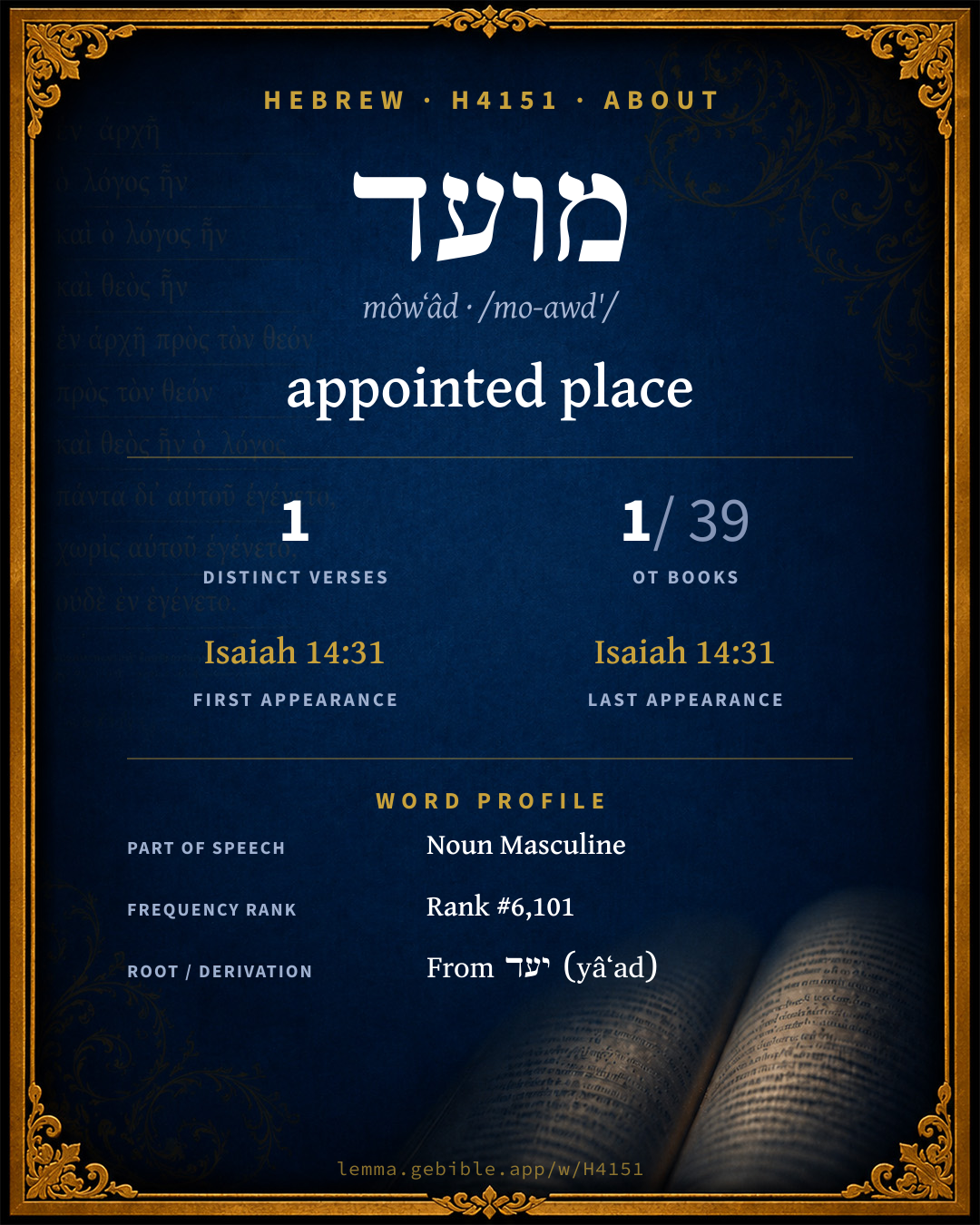
מוֹעָד
appointed place
Full lexicon entry — Brown-Driver-Briggs (BDB)
From Brown-Driver-Briggs (BDB)
Where this word appears
Grammar key — what these labels mean
Noun type
- Common
- A common noun — a general class of person, place, or thing (“king,” “city,” “water”), not a specific name.
State
- Construct
- A noun bound to a following noun in a possessive / “of” relationship (the construct chain).
Gender
- Masculine
- Grammatically masculine.
Number
- Plural
- More than one (in Hebrew, generally three or more).
Every verse where H4151 appears — 1 distinct verse across 1 book. Click any verse to open its interlinear word-by-word view. Verse text shown in the World English Bible for context — . Each verse’s Hebrew form is shown with its reference; the English is not keyword-highlighted, since the data carries no word-level English alignment. Use “Compare translations” on any verse to read it across multiple English versions. This concordance covers the Hebrew Bible; Septuagint (Greek Old Testament) occurrences are not indexed here.
Isaiah 1 verse
About this entry
At a glance — auto-summarized from this page’s data, not written by a person. Every figure links to its source below. This summary describes the numbers; it doesn’t interpret them.
מועד — transliterated môwʻâd — is a Hebrew noun carrying the sense “appointed place.” It is rare — just 1 verse in the entire Hebrew Bible. More than three-quarters of its appearances fall in Isaiah. A true hapax — its single appearance is Isaiah 14:31. Related forms include יעד, מועד and מועדה. See the sense tree, 1-verse concordance, and the renderings breakdown below.
Gloss history
Strong's 1890 vs modern scholarship
About this word
Strong's H4151 catalogs a Hebrew word from the Hebrew Old Testament.
These counts are not copied from any lexicon or concordance. They are computed here, from the morphology-tagged Hebrew Old Testament. What Lemma adds →
- 1
- distinct verses
- The word appears in 1 distinct verse.
- 1 / 39
- OT books
- The word appears in 1 of 39 Old Testament books.
- #6,101
- by frequency
- Rank #6,101 (rank 6,101 of 8,640 Hebrew words by occurrence).
View all 1 occurrence in the concordance →
Most concentrated in
- Isaiah 1 verse 100%
By section of the Old Testament
By traditional corpus
Conventional, traditional groupings — biblical authorship is debated, so this is a traditional corpus grouping, not an authorship claim. Each share is this word’s portion of its verses in that division of the Hebrew canon. Each figure is a share of the word’s 1 distinct verse.
- Prophets (Nevi'im) 1 verse · 100%
How translations render this word
Counts come from each version’s own published word-to-Strong’s tagging or interlinear alignment — an approximate guide to how each version renders this word, not a word-level alignment the data otherwise carries. Because each total is that version’s own tagged count, the per-version totals vary from one another and need not match the appearance or distinct-verse counts above. These counts may also differ from a printed concordance because Lemma counts each distinctly tagged rendering and does not collapse phrase taggings into a single head-word total. This is a fixed set of word-tagged versions (KJV, ASV, BSB, ULT) and does not change with the reading translation you choose elsewhere. Each version’s license is shown beside its name below (and on Sources).
- King James Version: Appointed times 1×
- American Standard Version: Ranks 1×
- Berean Standard Bible: Ranks 1×
- unfoldingWord Literal Text: Assembly 1×
King James Version Public Domain
Renders H4151 across 1 tagged occurrence — most commonly:
American Standard Version Public Domain
Renders H4151 across 1 tagged occurrence — most commonly:
Berean Standard Bible Public Domain
Renders H4151 across 1 tagged occurrence — most commonly:
unfoldingWord Literal Text CC BY-SA 4.0
Renders H4151 across 1 tagged occurrence — most commonly:
Senses in BDB
The 1 sense BDB distinguishes for this word, in lexicon order (not ranked by frequency or importance). The full entry — with sub-senses — is in the Lexicon Entry tab.
- appointed place (in army)
Word origin
Derived from יעד (yâʻad) (H3259) — to appoint.
Jastrow Dictionary
A second Hebrew/Aramaic lexicon for comparison, covering Aramaic and post-biblical (Talmudic, Targumic, Midrashic) usage that the biblical-Hebrew BDB does not. Matched by lemma rather than by Strong’s number, so a lemma may carry more than one Jastrow headword (shown separately below), and the entries cover usage well beyond the Bible.
מוּעָד
- (עוּד) forewarned, esp. (law) Muʿad (v. Ex. XXI, 29), an animal whose owner stands forewarned on account of three successive injuries; liable to full indemnity, contrad. to תָּם. B. Kam. I, 4 שור המ׳ an ox that has done damage three times. Ib. השן מ׳ לאכול וכ׳ the tooth of an animal is considered a muʿad with reference to eating such things as are fit to be eaten by it, i.e. damages for eating must be paid in full without previous forewarning. Ib. הרגל מ׳ לשבר וכ׳ the foot is a muʿad &c., i.e. what an animal treads upon on its way must be paid for in full without forewarning. Ib. הנחש מ׳ לעולם the serpent is always a muʿad (even when tamed). Ib. מ׳ משלם נזק שלם וכ׳ the muʿad pays full damage, collectible from the owner’s best property. Ib. II, 4 מ׳ כל שהעידו וכ׳ a muʿad is an animal against which three warnings on three days have been given; (another opin.) מ׳ שהעידו … פעמים against which three warnings have been given (even in one day). Ib. 5 אדם מ׳ לעולם damage done by a human being must under all circumstances be restored in full. Ib. 17ᵇ (הידוס) הרי זה מ׳ damage done by chickens must be restored in full; אינו מ׳ must not &c.; a. v. fr.—Trnsf. מ׳ לעבירה a muʿad for sin, i.e. likely to sin again. Num. R. s. 9 כיון שנשתלש בחטא נעשה מ׳ לע׳ having sinned three times, he has become a muʿad for sin.—Pl. מוּעָדִים, מוּעָדִין. B. Kam. I, 4; Tosef. ib. I, 4 חמשה מ׳ there are five kinds of muʿads. B. Kam. 16ᵃ; a. fr. e.g. Exodus 21:29
מוֹעֵד
- 1. appointed time, appointment. Pes. I, 3 (10ᵇ) בתוך המ׳ within the time appointed for the removal of leavened matter (up to the sixth hour of the day); אחר המ׳ after the time (until nightfall), Rashi; (oth. interpret., v. infra).—Pl. מוֹעֲדִים. Erub. 54ᵇ עשה מ׳ לתורה have fixed times for the study of the Law, v. מוֹדִיעַ.
- 2. festive season, festival, esp. = חוֹל הַמּ׳, the week-days intervening between the first and the last days of Passover and of Succoth. M. Kat. I, 1; a. fr.—Pes. l. c. בתוך המ׳ during the festive week of Passover; לאחר המ׳ after Passover, Tosaf.; (oth. interpret., v. supra).—Pl. מוֹעֲדִים, מוֹעֲדוֹת. Pes. X, 6 מ׳ ורגלים אחרים other seasons and festivals. Sabb. 145ᵇ מ׳ שבבל שמחים the festivals in Babylonia are joyously celebrated; a. fr.—מ׳ קטן Moʿed Katon, (half-festival) name of a treatise of the Mishnah, Tosefta, Talmud Babli and Y’rushalmi, of the Order of Moʿed.—סדר מ׳ the Order of Moʿed, name of the second order of the Mishnah, Tosefta and Talmud Babli and Y’rushalmi.
מוֹעֵד ²
- Targ. I Sam. I, 3; 4.—M. Kat. 18ᵇ חולא דמ׳ = חוֹל הַמּוֹעֵד, v. preced. Y. Ab. Zar. I, 39ᵇ bot. בריה דמ׳ the day or days after a (gentile) festival.—Pl. מוֹעֲדִין, מוֹעֲדַיָּא. Targ. Lev. XXIII, 2. Targ. Hos. II, 13; a. fr.
A Dictionary of the Targumim, the Talmud Babli and Yerushalmi, and the Midrashic Literature (Marcus Jastrow; London, Luzac, 1903) — Public Domain. Digitized via Sefaria. Digitized via Sefaria. Full attribution on Sources.
Same root — word family
Other BDB entries built from the same root as H4151, grouped by Strong’s listed origin. These share a root / origin per the lexicon — not necessarily a shared meaning. Each links to that word’s own entry.
Derives from
Shares the same root
Proper names from this root
People and places named from this root — a name, not an additional meaning of the word.
- יועד Yôwʻêd H3133 Joed
- יעדי Yeʻdîy H3260 Iddo
- נועדיה Nôwʻadyâh H5129 Noadiah
- מועדיה Môwʻadyâh H4153 Moadiah
Compare all same-root words → Showing 4 of 8 — not the complete family. 4 of the same-root words are proper names (people or places). They share a root, not necessarily a meaning.
Septuagint verse parallels
This word appears in 1 verse that also exists in the Greek Old Testament (Septuagint), out of the 1 Hebrew verse it occurs in. You can read those verses in Greek by switching the Old Testament edition to the Septuagint.
Read these verses in the Septuagint
This is a verse-level parallel only — the same verses exist in both the Hebrew and Greek Old Testaments. No word-level Hebrew↔Greek correspondence is claimed: the data carries no such alignment, so no Greek word is shown as this Hebrew word’s translation. Coverage is not total — the Septuagint omits the deuterocanon and renumbers the Psalms, so some Hebrew verses have no direct Greek parallel.